Friday, June 15, 2012

Play (2011) (in person: Ruben Östlund)


Ruben Östlund: Play (SE/DK/FR 2011). Sebastian Blyckert (Sebastian) and Anas Abdirahman (Anas).

Ruben Östlund at Alanamma. Midnight Sun Film Festival, Sodankylä, 2012.

SE/DK/FR 2011. PC: Plattform Produktion / Société Parisienne de Production / Film i Väst / Coproduction Office. P: Erik Hemmendorff. 
    D: Ruben Östlund. SC: Ruben Östlund, Erik Hemmendorff. DP: Marius Dybwad Brandrud – shot digitally with a Red One Camera – 1,85:1. S: Jan Alvermark, Jens de Place Bjørn. ED: Jakob Secher Schulsinger. 
    C: Kevin Vaz, Yannick Diakité, Nana Manu, Sebastian Blyckert, Anas Abdirahman, Abdiaziz Hilowle, Sebastian Hegmar, John Ortiz. 
    118 min. 
    35 mm print: Coproduction Office with English subtitles. 
    In person: Ruben Östlund.
    Viewed at Cinema Lapinsuu, Sodankylä (Midnight Sun Film Festival), Friday, 16 June 2012.

Svenska Filminstitutet, faktablad: "Ruben Östlund's third feature is a serious yet humorous study of human behaviour inspired by authentic cases in which groups of young boys robbed other children in central Göteborg. What was remarkable about the robberies was that they followed an elaborate role-play which tricked the victims without resort to violence or threats."

IMDb, Coproduction Office: "An astute observation based on real cases of bullying. In central Gothenburg, Sweden, a group of boys, aged 12-14, robbed other children on about 40 occasions between 2006 and 2008. The thieves used an elaborate scheme called the 'little brother number' or 'brother trick', involving advanced role-play and gang rhetoric rather than physical violence."

Anton Asikainen in the festival catalogue: "In 2020, Ruben Östlund’s Play will be considered as one of the most essential Nordic films of the previous decade. This is the only possible outcome, for probably no other film meters the pulse of Nordic societies with equal precision. A passenger train is dashing forward somewhere between Stockholm and the rest of Sweden."

"The neatly polished and quiet order of the train is disturbed by a cradle left in the middle of the aisle – something the train conductors don’t know how to deal with. At the same time in the nation’s capital a group of first generation immigrant children is carrying out an ingenious strategy of scaring and accusing unsure native Swedish kids so they would give up their cell phones. What ensues is a slowly developing psychological game that cuts straight into the nerve of Scandinavians who are spoiled by a false sense of security and not prepared for change. Östlund does this with style, perfecting the one-shot strategy we know from his hit short film Incident by a Bank. Razor-sharp photography underlines the precision with which the director processes his observations of the surroundings. At the end, the worlds of children and adults are not so significantly different, apart from the fact that the rules in child’s play may change in mid-game. Just like in any game, an incredible, ironical humour bubbles under the surface of Play." (Anton Asikainen)

AA: My first sampler of the work of Ruben Östlund, one of the most acclaimed contemporary Nordic directors. I watched most of it and was impressed by the absolute authenticity of the performances in the "little brother" plot. A group of immigrant children approaches a smaller group of younger native Swedish children to ask them what time it is. When they check it from a mobile phone, one of the immigrants says "it's exactly like the one that was stolen from my little brother". They want to examine it... and a long and winding chain of events is launched. Although the print was reportedly in 35 mm, it has been struck from a digital source with a surveillance camera look. Ruben Östlund reverts to the early cinema mode of long takes and long shots, in favour in contemporary art cinema.

Harriet Andersson morning discussion hosted by Liselott Forsman and Foster Hirsch


Harriet Andersson in the morning discussion at the Kitisenranta School, 15 June 2012. Photo: Taru Kalvi.

The School (Kitisenrannan koulu), Sodankylä, Midnight Sun Film Festival, Friday, 15 June 2012. The discussion was conducted in English.

Q: WHAT WAS THE FIRST FILM YOU SAW? A: I saw my first movie when I was four years old, at Sunday school. It was a Tarzan movie with Johnny Weissmuller. I liked the monkeys. At 14-15 I started really to go to the movies, but I didn't have much money. I don't remember much about them. I was bad at school. The school was not interesting for me except for gymnastics. But my parents said "if you are not working you are not going to eat". I met an opera singer when I was 15 and so I got into Calle Flygare's theatre school. My make-up teacher said: "you, you don't have a face". I was 16. It was a cruel thing to say.

Stockholm was a small town. Others were trying to get to the Dramaten theatre school. I was getting roles at the Oscars theatre owned by Anders Sandrew. And I started to get film roles in movies like Medan staden sover and Trots, directed by Gustaf Molander, and with actors like Inga Tidblad. Gustaf Molander wanted me to talk "stockholmska", in the Stockholm dialect, "that's what I want", to speak naturally.

FH: THAT WAS THE TREND: SPEAKING NATURALLY, THE WAY PEOPLE SPEAK. A: I was influenced by A Streetcar Named Desire, how Marlon Brando is calling "Stella".

Q: FEMALE MODELS? A: Gunn Wållgren, she was fantastic.

Q: INGMAR BERGMAN? A: In Gustaf Molander's movies I was getting good reviews and I was allowed to speak naturally. I heard that Ingmar had asked, "this new girl, how is she", if you "can get something out of her", like about a sack of potatoes.

Q: HOW WAS GUSTAF MOLANDER WITH ACTORS? A: He was sweet, fine, a little boring, a good director, never raised his voice. Ingmar Bergman I had actually met already in 1948 when he was making Fängelse. I went to his office where he was sitting with the beret on his head. I don't know whether he even looked at me. I had heard rumours that he hit actors, kicked them. The first time I saw him he didn't see me.

I was afraid because of all those rumours, but I liked some of his films. In Filmstaden we did a test with Lars Ekborg. He was also a little afraid. The cinematographer was Gunnar Fischer, a lovely man. We shot eight minutes in one take. We shot it twice.

FH: HOW CLOSE WERE YOU TO MONIKA? A: I was 20, she was 17. I was not so bad. I was a rebel, but I could behave when I wanted to. My father didn't want me to be an actor.

FH: YOU HAD WORKED AS AN ELEVATOR OPERATOR. A: Yes, and once Gunn Wållgren came in to the lift, she was very kind, and wanted to get into the third floor, but I just looked at her and the lift went nearly through the roof. That was the best thing that happened that year. Sometimes I just stood there one hour in vain. FH: LEARNING FAST OBSERVATION. A: Seeing right through you in the first minute.

Q: WHEN YOU READ THE SCRIPT OF MONIKA WHAT DID YOU THINK? A: It had first been a book, then a weekly magazine serial, very popular. I didn't need to wear so much makeup, and clothes: "go out and find something that Monika can have". Ingmar was not so much in his own element in the nature. The boat was on land. On the first day of shooting we did the mushroom scene, and Ingmar said "I can't use these two actors". But we were getting a little sun, we got tanned, and the boat got into the sea...

Q: YOU ALMOST LOST YOUR ROLES? A: Because of that scene with the food. Q: SHE'S A DOER. EXCERPT: SOMMAREN MED MONIKA: Monika eats meat like a wild woman.

A: I learned very early: don't stop acting when the camera is rolling. FH: THERE IS A WONDERFUL FREEDOM AND EASE... A: There were no rehearsals, not many takes, Ingmar was not like that. FH: YOU ARE FREER AT THE FIRST TAKE. A: At the first, at the second - after that it gets harder. I go by the instinct. When the camera starts, I start. In my attention there is a half for the technique, and a half for the acting. Bo Widerberg said that "she feels the [ground?] through her shoes". FH: DID INGMAR BERGMAN ALLOW IMPROVISATION? A: In a way.

A: In 1951 I got engaged with Per Oscarsson. Ingmar was married with a fantastic woman, Gun Grut, and they had a one year old son. We went out, as happens often in film, we came home when Per was not there, to pick up things. Ingmar had to tell Gun. She lived on the same street. Ingmar Bergman had a small room with a kitchen and a balcony, where I smoked. Gycklarnas afton was the story of our life at that time. "Can I come back?" "What? Never!" Q: IT WAS YOUR STORY ON SCREEN. A: The romantic side ended soon. We moved to Malmö, to the Malmö stadsteater. They were not very nice in the newspapers. There were headlines like "Now He'll Make Her His Hanna in The Merry Widow". I was 21, and it was the first time I played real theatre. I had started singing in revues, and now I got to play real fine theatre.

Q: WHAT IS YOUR DEAREST THEATRE ROLE? A: Hedvig in The Wild Duck. When I acted in Anne Frank's Diary there was a malicious article by Lars Schmidt before the premiere in the paper with the headline "From Revue to Anne Frank". I made a good Anne Frank, and after the premiere there was a big bunch of roses from Lars Schmidt to me with apologies.

Q: HOW WAS IT TO SWITCH FROM THE CAMERA TO THE STAGE. A: Ingmar was the one who gave me a contract. Mimi Pollak, a friend of Greta Garbo, was one of the few women directors. "Harriet lilla", she said. "This is not a film studio. I can't hear you". [Harriet gives a Mimi Pollak imitation].

FH: THE PROCESS IS DIFFERENT. A: It takes such a long time. In a film you shoot scene by scene, and then it's finished and stays forever. At the theatre you recite every evening the same words. I was not happy at Dramaten.

FH: IN THE USA AT FIRST SOMMAREN MED MONIKA WAS SHOWN FOR ADULTS ONLY, AND HARRIET ANDERSSON WAS MARKETED AS A NAUGHTY SEX STAR. AS A LITTLE KID I WAS AFRAID OF THAT WOMAN. A: That was the first round of distribution. I saw a poster. FH: BERGMAN IN THE USA WAS FIRST KNOWN AS A FRANK, SCANDALOUS, AND SEXY DIRECTOR. A: [Laughs].

Q: GYCKLARNAS AFTON. A: I had no part in the screenwriting. He hired a room at a hotel, and never showed me the script. He used small pieces of paper with yellow lines, and the script was made in his handwriting. FH: NEVER COLLABORATION? A: No. FH: The idea about the dark island... A: I said "I think it's shit". He got very angry. Q: COULD YOU CENSOR YOUR LINES? A: A little yes. Some words maybe. He was very understanding.

Q: ÅKE GRÖNBERG IS INGMAR BERGMAN'S ALTER EGO, THE BOSS OF THE CIRCUS. HASSE EKMAN PLAYS FRITZ. A: Hasse Ekman was a director, too, the son of Gösta Ekman, a beautiful man. The terms were not so good between Ingmar Bergman and Hasse Ekman, he made another kind of film, some very good films.

Q: HASSE EKMAN. A: I played a circus rider, "she can bite a nut, ride the biggest horse with just the pressure of her legs". I was really strong in those days. There was an arm wrestling scene with Hasse Ekman, and I kept winning. "Nej för fan", said Ingmar, but I didn't want to be weak. EXCERPT: GYCKLARNAS AFTON. A: It's difficult to explain, I was lucky to have this role, it was a joy. Even in horrible scenes there was a comfort.

FH: IN MONIKA YOU PLAYED A CONTEMPORARY ROLE, IN GYCKLARNAS AFTON, A PERIOD ROLE. YOUR BODY LANGUAGE IS DIFFERENT. A: I had a good costume designer, Mago, who designed for me such a corsette that I couldn't eat anything. I got to open it during lunch. I was starving. FH: YOUR PERFORMANCE IS MORE CONSCIOUS. A: The script was good. You have to learn to move in the costume, you can't move in the same way.

Q: THROUGH MAGO YOU MET MARLENE DIETRICH. A: She was a fantastic woman. We were at Jörn's house, and she said: "Why don't you let my good friend Balmain work for you. You come down and live in my apartment." She lived in a fantastic house. Jörn spoke a little French, and Balmain made me five pieces.

Q: KARIN - SÅSOM I EN SPEGEL. A: At that time I was married to a farmer, I drove a tractor and had a daughter down there. My husband was not interested in film or theatre. Ingmar called me and told that he'll send me a script. "Read it and call me". It was difficult, I must say, "too difficult for me". "Prata inte skit", he said. That was his first film at Fårö. Sven Nykvist was the cinematographer. We were down there for three weeks for exteriors. In the studio we built the wreck. That's where she raped her little brother. It was a happy time. The script girl's mother fixed the dinners.

FH: WHAT DID YOU DRAW ON FOR THE KNOWLEDGE ON THE WOMAN'S LOSING HER MIND. A: I visited a mental hospital, and the doctor called his nurse. "I'm not sick". Of course everybody says so. The doctor got the script, too. I didn't know so much about schizophrenia, hearing voices. The task was to show what happens inside the brain.

Q: INGMAR BERGMAN IN PERSONAL AND PROFESSIONAL TERMS? A: He was always a professional, always set work before anything else.

Q: SVEN NYKVIST. A: Gunnar Fischer and Sven Nykvist were both most sweet and kind men. Sven especially never said a bad word. He was very quiet. Ingmar, too, became nicer. I liked Sven very much. Sven did a lot for Ingmar. We teased him.

Q: VISKNINGAR OCH ROP, ERLAND JOSEPHSON. A: Liv Ullmann was so fantastic, so beautiful. Agnes is very sick. She is going to die and knows it. EXCERPT: VISKNINGAR OCH ROP. Erland Josephson as the doctor.

FH: YOU PLAYED THE EXTREME PARTS OF KARIN AND AGNES. WHY THOSE ROLES? A: I asked him. I don't remember. It's been such a long time. I was wondering about it. I was very happy. He knew I could do it. Erland Josephson died this spring, you know. Between the takes there was another life.

Q: MAI ZETTERLING. A: Älskande par was based on a novel by Agnes von Krusenstjerna. I read her novels at a young age. Mai called me and asked me to play in her movie. I hated her as a director, "Look here, do that". An actress herself, she behaved in this way. I said: "Please Mai, don't play when I'm playing". After two and a half years she called me again. She had also asked Gunnel and Bibi. She said: "I'm much nicer now" and started to cry. Flickorna was a funny thing to do, nervous - difficult.

If there is a difficulty with a director, go to the cinematographer, and be friendly with him. The only exception for me has been in a German film directed by Frank Wysbar, Barbara - wild wie das Meer. During the love scene the cinematographer shouted: "Halt! Das geht nicht. So kann man nicht küssen".

Q: JÖRN DONNER. A: In 1954 we met him in Helsinki during the Monika premiere. Ingmar didn't like Helsinki, and I was afraid because of the Russians. Jörn came, we talked, he gave a book he'd written. We stayed for two days. I didn't think much about Jörn. In the early years the Berlin Film Festival took place in the summer, and in 1962 it was hot and nice. Mago had been born in Berlin. Everywhere I saw Jörn. He didn't talk much. He was good-looking, and I was free. He lived in Djurgården in Stockholm. We were having dinner with Mago, and Jörn had given his phone number, so we called him and had coffee at his place. Our first movie together was En söndag i september. I was very much in love. He is the man I loved the most. He is my best friend also. Att älska we did with Zbigniew Cybulski. He was very funny. For that movie I got the award in Venice Film Festival for best actress. Again I lived together with a director.

Q: HOW WAS IT NOW TO LIVE AND WORK WITH A DIRECTOR? A: Not exactly the same. I was not always nice in the studio. He was new. I held my nose up a little. Q: YOU WERE TOGETHER FOR EIGHT YEARS, UNTIL HÄR BÖRJAR ÄVENTYRET. A: He was a little shy, too. Are Finnish men always shy? I learned Finnish words, good bad words, and words like "kulta, kulta".

Q: IN ANNA, THE CHARACTER YOU PLAYED WAS UNBALANCED AGAIN. A: I don't remember, I haven't seen it in a long time.

I felt at home in Helsinki and at Jörn's island. It was always very nice. I miss it sometimes.
Jörn also produced Fanny och Alexander, "too expensive", they said.

Q: IN PROFESSIONAL LIFE, FILM IS FIRST. HOW DID JÖRN AND INGMAR COMMUNICATE? A: I wasn't there. My part in Fanny och Alexander was a small part, a good part. They should be happy about Fanny och Alexander.

FH: YOU ALSO PLAYED FOR SIDNEY LUMET IN A DEADLY AFFAIR AND FOR JERRY LEWIS IN THE DAY THE CLOWN CRIED. A: In the Jerry Lewis film I had a small part as his wife. At that time he was not a nice man, a little sick, they said. His face was always to the camera. I didn't say anything.  Q: HE HAD A REPUTATION OF HAVING NO SENSE OF HUMOUR. A: That's true. I was never paid at all. The production company, Europa Films, doesn't exist. FH: JERRY LEWIS HAS LOCKED IT UP, HIS HOLOCAUST FILM. A: I remember the scene at the train station, the big lamps. It was evening, it was cold. It cost a lot of money.

FH: SIDNEY LUMET. A: He was so sweet. We did a lot of rehearsing, which is very rare. "Don't worry about the language, just act". James Mason and Simone Signoret were wonderful. Maximilian Schell was not so nice.

FH: WOULD YOU HAVE WANTED TO DO MORE INTERNATIONAL ROLES? A: No, because of the language. I had already had the experience of that German film with Frank Wysbar. I feel more comfortable at home.

Q: JAMES MASON, SIMONE SIGNORET. A: I had no scenes with Signoret, but she took care of me. James Mason asked me to dinner, "no blue jeans". His car came, he looked very satisfied, and he had this wonderful voice. "A lady never drinks whisky on the rocks".

FH: SO YOU DID NOT WANT TO BUILD AN INTERNATIONAL CAREER? A: No, I was too lazy for that.

Q: YOU ALSO WORKED WITH ERIK BLOMBERG. A: Bröllopsnatten was a Swedish-Finnish-Polish co-production based on a short story by Émile Zola, Överfallet / L'Attaque du moulin. I starred with Folke Sundqvist. It was a difficult time in Poland, and there was not much food. Erik had his wife, Mirjami Kuosmanen, with him. I had seen The White Reindeer, and was a little afraid of Mirjami. She was difficult. We worked for three and a half months. When we were leaving the whole village lay down on the floor: "don't forget us". Erik - Mirjami... the Finnish language can be exclusive.

Q: LARS VON TRIER. A: Dogville was a luxury holiday. I had a small part. Lauren Bacall was very funny. I like Lars. He loves to be a photographer. Q: YOU TICKLE ME. A: They should be scared of me. "What would Ingmar say". He was very much talking about Ingmar. Q: DID YOU SEE THE DEMONS? A: I didn't live with Lars; I didn't see them.

Q: INGMAR BERGMAN DID SMILES OF A SUMMER NIGHT AND ALL THESE WOMEN, YET THEY SAY HE HAD NO SENSE OF HUMOUR. A: He had his own sense of humour. In 1955 we separated, and Ingmar was doing a series of soap commercials for Tvålen Bris. He had found a new actress, Bibi Andersson, and he told me: "Get out of the studio!" Immediately I thought: "She's coming after me". Two years later, she was. Ingmar got thinner. He was sick of jealousy. He had his sense of humour in a way of his own. Q: EDGY? A: A little different.

Q: YOU STAYED GOOD FRIENDS. A: He called once a month on Saturday mornings: "Do I disturb you?", and we would talk one and a half hours. He talked, talked, talked. He was very lonely down there after Ingrid died.

FH: DID THAT ROCKY ISLAND EXPRESS SOMETHING OF HIS PERSONALITY? A: I don't know. He would take a long walk along the beach alone. He liked it.

Q: DID HE INSTRUCT YOU SEPARATELY? A: Sometimes. He was nice most of the time. He would put his arm around me or he grabbed my wrist when it was more serious. He never played in front of me, never said too much. Q: NOT OVER-ANALYZING. A: He may have been different with others. FH: HOW ABOUT THE ROLES WHERE YOU WEREN'T CAST? A: Gunnel in her roles was fantastic. In Persona, Bibi and Liv were so alike, so grateful and happy.

Q: WHICH FILM WOULD YOU TAKE TO THE DESERT ISLAND? A: I don't want to take one movie to a desert island, that would be hell. I don't know, no. [After repeated persuasion:] A Streetcar Named Desire.

The Movie Orgy (in the presence of Joe Dante)

US 1968. P: Jon Davison. ED: Joe Dante. A found footage compilation. 280 min. Source: Joe Dante. Format: DVCAM (from Betacam). Introduced by Joe Dante. Special thanks: Antti Suonio who proposed this to the festival. Viewed at Lapinsuu, Sodankylä (Midnight Sun Film Festival), 15 June 2012.

Joe Dante (résumé): This is the first thing I did, a collage of pop culture that was developed in 1968-1972, constangly changing and expanding into a duration of seven hours. It is a collage, get drunk, get stoned, grab a pizza and come back. It is not a conventional film, it's more a mash-up, perhaps to be compared with something you can now find in YouTube. It was made on 16 mm film and a splicer, there was no colour correction. It was just a bunch of stuff, suitably bizarre. American pop culture was juxtaposed with elements of anti-war, anti-establishment attitudes, and bad taste. Ten years ago in Hollywood we did a screening, surprisingly packed, Tarantino stayed for the whole. It has also played at the MoMA. It's an endurance test, but there are images there you will not be able to forget no matter how hard you try. There was only one 16 mm print that was ten years on the circuit. Finally it was scanned on Betacam, which means there will be three intermissions. But if you want to make a break elsewhere you won't miss anything.

AA rough notes: - Rated Z: unsuitable - fast edit - Great Gabbo - horse Midnight - Mighty Mouse - Attack of the 50 Ft. Woman - Colgate commercial - Groucho Marx in You Bet Your Life: bodybuilder from Muscle Shoals - sponsored by Dentynine - The Four Seasons: "Walk Like A Man" - Speed Crazy: "I'm a bundle of nerves, I never relax, I've been drifting since I was 16, never knew my folks. Rattlesnake is right: gotta be first." - W.C. Fields and a gun - The speed crazy shoots a garage attendant - Alfred Hitchcock presents - a nuclear bomb - Teenagers from Outer Space: a dog turns into a skeleton - atmosphere - gargons - "we'll continue our seach in another solar system" - The Naked City - nudie movies - there are eight million stories in the naked city - The Lone Ranger - The Wilhelm Tell overture by Rossini - "I was born in Texas, raised in Tennessee" - A Hart P. Danks biopic: "Silver Threads Among the Gold", 1876 - ex-wife a homeless, friendless scrubwoman - in 1903 the composer lives on a side street in Philadelphia, now a broken old man with a last bitter message - Warner Pathé News advertising Dial M for Murder, city paralyzed by atomic attack - Egypt's strongman protects the Suez Canal - Vietnam ousts Bao Dai, Diem elected the first President, a resounding victory for the free world - Ann-Margaret as a pro-Vietnam war figure: buy bonds - Nabisco cereals - The Adventures of Rin Tin Tin, the theme fanfare, Rin Tin Tin and Rusty - missile, Nabisco cereals, Defenders of America cards 1959 - Alphabet Cereals, Alpha-Bits - a screening for children, nudist girls, a jukebox scene, Greensleeves - I'm sick of that fleabag - Star of India, the most famous diamond - Skibana peanut sandwich, skippy peanut butter - Andy's Gang with Andy Devine - Superman

AA remarks: I watched ca 75 min from the beginning until it was three o'clock in the morning and I was not yet exhausted but knew I'd soon be. The Movie Orgy is a journey into a nation's pop cultural consciousness, a weird collage, and a vision of the Cold War and the Atomic Age, at once infantile and apocalyptic. The view has affinities with Susan Sontag's essay "The Imagination of Disaster".

Thursday, June 14, 2012

Les Girls (in the presence of Taina Elg)


George Cukor: Les Girls (US 1957). Gene Kelly (Barry Nichols), Taina Elg (Angele Ducros), Kay Kendall (Lady Wren) and Mitzi Gaynor (Joy Henderson).

Tytöt. US © 1957 Loew's & Sol C. Siegel Productions. PC: MGM. P: Sol C. Siegel. D: George Cukor. SC: John Patrick – based on a story by Vera Caspary. DP (CinemaScope, Metrocolor): Robert Surtees. AD: William A. Horning, Gene Allen. Cost: Orry-Kelly. M: Cole Porter – »Les Girls», »Flower Song», »You’re Just Too, Too», »Ça c’est l’amour», »Ladies In Waiting», »La Habanera», »Why Am I So Gone (About That Gal)?». ED: Ferris Webster. C: Gene Kelly (Barry Nichols), Mitzi Gaynor (Joy Henderson), Kay Kendall (Lady Wren), Taina Elg (Angele Ducros), Jacques Bergerac (Pierre Ducros). [On the Warner Home Video (2003) dvd Taina Elg hosts the bonus track "Cole Porter in Hollywood: Ça c'est l'amour".] 114 min. A 35 mm Svenska Filminstitutet / Filmarkivet print with Swedish subtitles by Wilhelm Sörensen. In the presence of Taina Elg interviewed by Foster Hirsch. Viewed at the tent, Sodankylä (Midnight Sun Film Festival), 13 June 2012.

Synopsis: Lady Wren publishes her tell-all memoirs about what happened behind the scenes of the Barry Nichols and Les Girls show. When the case is dealt with in court the movie turns into a musical version of Rashomon. Nobody is lying, yet everybody tells a completely different version of the events. MGM still produced this musical with total commitment and full resources, although the age of the classical Hollywood musical was over. This was George Cukor's first musical, a combination of verbal fireworks and visual splendour, as Jean-Pierre Coursodon has pointed out.

The screening started with a Finnish newsreel compilation on Taina Elg, including her visit to Finland for the Finnish premiere of Les Girls. Taina Elg: I'm very moved since in these newsreels I saw my father, my mother, many friends, and my son Raoul [Björkenheim] who was then 2 years old.

Foster Hirsch: Les Girls is a very important movie, one of the last original MGM musicals, not an adaptation. It was the last MGM movie for Gene Kelly and the last Cole Porter score, an important CinemaScope creation featuring 3 girls, 3 different versions, 3 panels, 3 windows. George Cukor was not known for musicals, but of this story he created a comedy with music, with 5 outstanding musical numbers, such as "Ça c’est l’amour". Taina Elg is a beloved figure in American musical theatre, its best possible ambassador.

Taina Elg: Behind the camera were great experts such as the cinematographer Robert Surtees. Leslie Caron was supposed to appear in Les Girls, but she had different ideas. I tested for the English part because Kay Kendall was married to Rex Harrison and didn't want to be away from him, but when she decided to come after all, suddenly I was the French girl. Cukor explained during the rehearsals that the material is very complicated. Do not trust anything you see.

FH: No, in this effervescent musical, don't trust anything, it's like Rashomon: "what is the truth?". Your body language in the role is French, you are very convincing as a French girl.

TE: It was always "Mr. Cukor", we never could call him George. "Ça c’est l’amour" we did in one take. We had to be careful not to fall into water. "Don't touch my toupé" was a warning from Gene Kelly.

FH: Taina Elg is a legend of U.S. musical theater, having appeared in Irma la Douce and The Sound of Music. She is singing in her own voice, and the choreography... TE: ... Jack Cole was the epitome of jazz dancing. The best. FH: It must have been difficult to dance jazz from a ballet background... TE: Not with Jack Cole.

AA: Revisited Les Girls, still one of the great MGM musicals. "Love is a soufflé, not a pudding". "Strictly business. No complications". A fine vintage Metrocolor print slightly turning red.

Q and A after the screening. TE: The production took four months. Cole was wonderful. It was the last MGM musical Gene did. Jack did most of the choreography. My language skills? I speak Finnish, Swedish, Italian, French, and English.

Q: GENE KELLY. TE: He was very dear. He dediced not to dance after that. This was his last performance. Cole brought the real jazz. I have not seen this movie before with a Finnish audience. We the performers were good friends. Mitzi Gaynor ate vegetables, she still looks great. We others ate cheese and drank wine.

FH: Mitzi Gaynor next made her most famous movie, South Pacific.
TE: She is very much like that. She was early on one who eats vegetables, she was the one who got that started. She got the role in South Pacific while making Les Girls.

Kay Kendall died early, and we were terribly shocked. She married the man she loved the most, but she was already ill. Cole Porter also died not long afterwards.     

FH: I have to compliment your performance, Miss Elg, how different you are in the three acts.

Remember My Name (in the presence of Alan Rudolph)

US © 1978 Columbia Pictures. PC: Lion's Gate Films. P: Robert Altman. D+SC: Alan Rudolph. DP: Tak Fujimoto - shot on 16 mm [according to Alan Rudolph, 13 June 2012] - blown up to 35 mm - 1,85:1. Cost: J. Allen Highfill. Makeup: Monty Westmore. Hair: Jerry Turnage. M: Alberta Hunter, produced by John Hammond. S: Sam Gemette. ED: William A. Sawyer, Tom Walls. C: Geraldine Chaplin (Emily), Anthony Perkins (Neil Curry), Moses Gunn (Pike), Berry Berenson (Barbara Curry), Jeff Goldblum (Mr. Nudd), Tim Thomerson (Jeff), Alfre Woodard (Rita), Dennis Franz (Franks). Loc: Culver City, Manhattan Beach, Marina del Rey, Topanga Canyon, Venice (California, US). 94 min. Print: David Blocker. Introduced by Alan Rudolph. Viewed at the School, Sodankylä (Midnight Sun Film Festival), 13 June 2012.

Résumé of Alan Rudolph's introduction: This is the only print of this movie. The movie was shot on 16 mm and blown up to 35 mm. The producer was Robert Altman who had promised the distributor to make two movies on the budget of one. I'm especially proud of the original music by Alberta Hunter, who was 84 years old and had recently made a comeback; she hadn't sung for 40 years. This print was made from the only surviving print via a dupe negative.

AA: There is a lot of talent combined in this story of a psychotic ex-wife (Geraldine Chaplin) who has been released from prison and starts to terrorize her ex-husband (Anthony Perkins) and his new wife (Berry Berenson). The emphasis is on psychology in this story of a woman stalker who is also capable of murder. The print is clean and the colour is fine.

Résumé of Alan Rudolph's answers to questions from the audience after the screening: Q (NEIL HARDWICK): ANTHONY PERKINS. I hadn't seen Remember My Name since it was released. - I never saw Psycho, but my wife had seen Anthony Perkins in Equus. There was a question of his accent, and whether he would know which end of the hammer to grab playing a construction worker. For his wife we found an actress who had never acted before but who had a natural way, based on Tony's suggestion: "How about my real wife?" Berry Berenson was Tony's wife and Marisa Berenson's sister. "Is she an actress?" "She wants to be." I thought she was terrific, and she started on the third day. There was also Jeff Goldblum's first speaking role and Alfre Woodard's first theatrical movie role. We were a very renegade outfit. We got drunk and watched dailies, everyone except Anthony Perkins. "I never go to dailies, Hitchcock, Welles, never". There were 30 people jammed in. I thought they were great. But Tony said: "I can't do this film. You have to recast. I can't act like that. They're too natural, I'm always acting, I have to quit". Then Robert Altman said: "We all quit". He was very proud.

Q: MUSIC, CHOOSE ME, REMEMBER MY NAME, DO YOU PREFER SONGS? In a low budget movie music is always the most expensive element. "Happy Birthday" would cost 20.000 USD now. I have always thought that songs are better than dialogue. The Alberta Hunter songs were produced by the legendary John Hammond and published by Columbia Records. So much better than what I'm trying to do with the dialogue, it's almost uncanny. The movie seems slow, seemingly nothing happens, the tension is beneath the surface. Geraldine Chaplin is overwhelming, I worked with her three times, and she helps make everyone else look better. She is unsympathetic on the surface, but you start to understand. Music helps. There was in the movie a loose simplistic metaphor for the women's movement. The picture had a very strange life. It was made quickly as a part of a deal with the Fox studios, with Quintet, perhaps, budgeted at a few hundred thousand, but the deal fell apart, yet Robert Altman said: "Let's just start shooting. Don't pay anybody". Columbia had just fired a president, and whoever took over noticed that we were shooting. "We'd like to have the movie". But when they saw it they said "We hate this", yet they didn't take their logo away. Mike Kaplan opened it in Los Angeles before Christmas, which is the worst time for an independent movie, in one little theater. We then released it ourselves and our advertising budget was enough for one advertisement on a double page in the Sunday issue of Los Angeles Times. The L.A. Weekly critic had seen the picture and declared it "the best film of the year". It set a record and played for months in that single theatre and nowhere else in the country. It played a city a year for five years. What we have now seen is the only print in existence. The lab went out of business and destroyed the negative. We bribed some people to make possible this only print of the movie.

Joe Dante morning discussion hosted by Peter von Bagh and Olaf Möller

The School (Kitisenrannan koulu), Sodankylä, Midnight Sun Film Festival, 14 June 2012.

Q: WHAT WAS THE FIRST MOVIE YOU SAW?
A: Snow White or Cinderella.
I was an avid reader of comics, and Carl Barks was among the most intelligent of their creators.
I was a Saturday matinee addict.
My dad was a golf professional. He taught golf in country clubs.
I begged him to take me to see Tarantula, but he ended up watching it alone, because I was so scared that I escaped to the lobby, and the staff had to notify my dad that "this kid can't take it".
We lived mostly in New Jersey and the environs. We didn't go that far. New Jersey people tend to stick around. But one summer we went to Florida, and from our place a window opened to a drive-in theatre, where they played White Christmas. I loved Danny Kaye, The Court Jester.

Q: LESSONS IN THE CINEMA, LESSONS AT SCHOOL?
In essays on literature I often failed because I had seen the movie which was different from the book, for example The Body Snatcher by R.L. Stevenson.
I changed school a lot, got bullied. The bullies were big. It was ok with mathematics. Because of polio I had to take one year off school.
College is not about learning but about how to get along.
Education is important, and it is not getting the attention it deserves.

There used to be ten cartoons before the feature. As a kid I saw the cartoons, not the feature, which had adults, and women. The higher up the female actors were on the cast list, the more likely it was that I skipped the feature. Except films like It Came from Outer Space in 3D.
I became a movie addict. At school I was the only kid who spent every weekend at the movies.

Q: 3D
I have been active in arranging screenings of all existing 3D prints from the 1950s. 95% of the 3D movies of the 1950s I have seen. The technology was not as good as today, the dual print projection system with its projector jiggles is not completely steady. Digital 3D is completely steady. Avatar, Hugo, it's superior as a process. Dial M for Murder is one of the best 3D movies ever. Although the technology now is superior I'm not sure that the use has been surpassed. In the 1950s the use of 3D was getting better. People learned from their mistakes. Creature from the Black Lagoon was very good in 3D with planes your eyes can adjust to.

Q: JACK ARNOLD
He was a journeyman contract director assigned to studio projects. He toed the line and found his niche in science fiction. He was efficient in staging and made his movies on time. There were others like him, but his films were better. He became more famous with tv comedy like Gilligan's Island. But The Incredible Shrinking Man was his best, very existentialist, made with very little money, inspiring for me. From what you have make the best movie you can is my credo.

Q OM: JACK ARNOLD'S POLITICAL VIEWS
Jack Arnold saw science fiction little differently during the cold war. His were benign creatures, more like ET already, pacifist, as in Space Children. It was difficult to stand up to your personal view in a studio film, to slip in the messages, to get personal material in the margins.

Q: AT WHAT POINT DID YOU DECIDE TO MAKE FILMS
I was to become a cartoonist, which was "not an art". Yet storyboards resemble comic books, and film frames cartoon strips. I started as an editor, but editing is solitary. When I started to direct I discovered that I really enjoyed it at the set, taking ideas, and all of a sudden I was a director.

I was an EC kid. Horror comics of the 1950s were deemed too scary: the ghouls, the zombies. MAD started as a comics magazine, and I became an ardent fan. There was a healthy disrespect for authority.

Q: ABOUT ROGER CORMAN THERE ARE MANY STORIES...
... all true. His figure is that of such a patrician, clean cut, educated. He was a boon for people of my generation. Most movies then were union movies. Corman produced movies for drive-ins, for grindhouses, with as little money as possible, and he found a roster of amazing talent, "the Corman school", who are now the pillars of the industry. His motto: "if you make a good movie you don't have to work for me anymore". Studios weren't blind, and they discovered Coppola, Bogdanovich, actors like Tommy Lee Jones. There was a whole lot of people in a little space.

Q: EDITING THE MOVIE ORGY
With Jon Davison we put together a 7 hour compilation of everything that was funny from 16 mm prints, chopped up.

I was working in Corman's trailer department. We were getting the dailies and making dupes of them for trailers. If the movie didn't work we changed the title, changed the trailer, and the same movie was shown again in grindhouses.

The Movie Orgy belongs to the 1960s, to the era of happenings.

We rented a Batman serial of 1943 with 15 chapters, 6 hours, silly, dumb, funny, cheating with the cliffhangers. We rented them, mixed up the reels and organized crazy events.

In The Movie Orgy we had 5-6 stories mixed up, with even some of the same actors showing up in different pictures. It was anti-military, this was the era of the Vietnam war. The Movie Orgy became very popular, and it was sponsored by Schlitz beer. It lasted quite a while, but then Schlitz started to propose things like introducing The Flintstones.

Q: EVEN RICHARD NIXON'S CHECKERS SPEECH WAS INCLUDED
Yes, and military commercials, announcements from draft boards

Q: ROGER CORMAN
I was a fan of his movies, and probably the only one from the Corman school who knew and admired his movies before I worked with him. We got along. I didn't drive. When I brought him my first trailer I dropped the reels into a manhole and was late for the screening in L.A. "If I were you I wouldn't be late for a screening": that was as angry as he gets. There was a women in prison movie, I made some changes, and the movie made money. "Who's the kid?" he asked.

The films could be ambitious for the budget, for movies done quickly. You had to learn the shortcuts, how to set up a dolly track, avoid reverse shots. The time between "action" and "cut" is what matters. The worst thing that could happen was a slow cameraman. We exposed a lot of film in a day.

Q: APPRENTICESHIP AS AN ASSISTANT DIRECTOR
There were no assistant directors in Corman's movies.

Excerpt: PIRANHA
The opening shot is the worst I have ever shot.
Q: HOW WAS IT? Cold and dark. But I enjoyed this. Q: THIS WAS TEN YEARS AFTER THE MOVIE ORGY. I made a lot of trailers in between. Q: CHILDHOOD, TOYS. All movies are political. My movies tend to be social. Of course, the screenwriter was John Sayles. Q: CHILDHOOD. I have not grown up. Directors can be children, and act like babies. It's important never to lose the childhood perspective, the sense of wonder. My credo: I never make a movie I wouldn't go to see. I was offered to direct The Flintstones (again The Flintstones), but I didn't want to do it. As for the producer, you need to cast the director.

Q: YOU TAKE THE CONCEPT OF GENRE SERIOUSLY
I like genre films. There is a lot of room for commentary. It is often more effective in a genre picture than in a picture with an overt message. It is better to slip it into the story. The march of the dead soldiers...

Q: ... FROM J'ACCUSE
Yes. They call it hommage, but it's stealing. It was not really conscious.

Q: DO YOU ADVISE FILM STUDENTS TO SEE A LOT OF MOVIES
No. With modern technology it is now easy to make movies. Honest, compelling movies about one's own lives.

Q: VIETNAM
During WWII a lot of movies were made with war propaganda. The Vietnam war was more controversial, nobody wanted to touch it with exceptions such as A Yank in Viet-Nam. Then, there was The Green Berets by John Wayne. Later it was discussed more critically in movies such as Go Tell the Spartans, but even previously indirectly in films such as Ulzana's Raid. But usually, audiences stayed away.

EXCERPT: THE HOWLING
Rob Bottin created the special make-up effects. Now it is all done with computers. The Howling was very well received and even noticed by Steven Spielberg who sent me the script of Gremlins. It started as an Amblin project with not too much money, but then it became a studio picture with a budget of 10 million dollars. I also got to direct a Twilight Zone episode.

Those were B pictures with an A budget. Now all A movies are B movies, serials, comics, cheap stuff, that is now mainstream. Forthcoming is another remake of The Lone Ranger, coasting on memories of memories.

Independent movies are often about family, about dysfunctional families. All very insular.

Q: YOUR FAVOURITE 1930S HORROR MOVIES
It changes daily. Bride of Frankenstein, Island of Lost Souls, The Black Cat. In the original Dracula the slow motion is creepy. The Browning version is heavily cut. In the Spanish version the actor is no Dracula. You get to see more of the sets in the Spanish version.

Q: HOLLYWOOD
I have been pretty much outside, not part of the inner circle, but I have done that a bit, too. Hollywood is not even a place anymore, movies are almost never shot there. The studio lots are mostly burned and bulldozed. The business is completely different. It has been quite a sea change.

I'd like to work more, but the whole business has changed. Now they raise money with your name. The productions are packaged and developed with no pay. Directors have to audition to movies. That is what you need to do if you want to make the movie.

Q: COMEDY
In the 1950s comedy you literally didn't know where it was going to go. Dean Martin & Jerry Lewis, Abbott & Costello, Bob Hope breaking the fourth wall, The Court Jester. Even Bob Hope had anarchy, addressing the camera, it was very stimulating. Hellzapoppin'. Frank Tashlin started as a cartoonist, directed Martin & Lewis and Jerry Lewis solo. The Martin & Lewis tv shows had even more anarchy than their movies. That was a variety act developed in nightclubs and brought then to live tv, doing shtick, ad libbing, running over schedule. Sometimes they actually had to cut the sketch. In the comedy there was the contrast of the straight-laced and tweaking everything.

Q: STRAIGHT-LACED / ANARCHIC IS A MAJOR DYNAMICS IN YOUR MOVIES
The 'Burbs is about suburbia, and David Lynch is working in that area. A lot is unconscious in movies.

Q: A MOVIE IS AN ATTEMPT TO PUT YOUR PSYCHE ON THE SCREEN
I turn down movies I don't believe in. You have to keep your personality.
To Be Or Not To Be is a black wartime comedy on a serious subject.

Q: YOU ARE A MOVIE COLLECTOR
In the 1960s there were a lot of 16 mm prints in circulation. I started with The Gamma People. The collection grew into 750 films, and I shared a vault. That was the pre-video era. Now it is a critical time to keep projectors, bulbs, and spare parts. We are doomed to stockpiling bulbs. A lot of films such as Ski Patrol only exist on 16 mm. Studios don't know where to find films. And there are the orphan films. Studios have been routinely destroying films.  They thought they were a thing of the moment.

Q: HOW DO YOU SELECT MOVIES TO YOUR COLLECTION
Some of them are my favourite movies which I can see 10, 15, 16 times. I screen them to different groups of friends. We band together, we trade. Movies in my collection include Holiday, Abbott and Costello Meet Frankenstein, Red River, Rio Bravo, She Wore a Yellow Ribbon, Mario Bava movies, and Italian Westerns.


My website Trailers from Hell! is a mini-film school about movies you didn't know exist.

With the digital revolution there is access to more than ever. The trick is nobody knows what they are. It's a double edged sword.

EXCERPT: GREMLINS (the meta-cinematic scene with the gremlins taking over the projection booth)
That was a very difficult scene. They said the audience would walk out, but it got the biggest laugh. "We just don't understand you".

Q (FROM NOW ON OM ALONE): MATINEE
It was about the William Castle thing. Q: MORE AUTOBIOGRAPHICAL. The room is filled with my stuff when I was a kid. It is pretty accurate, true to the day. Also the scene with the usherettes, the monster movies, the 1962 atmosphere, the Cuban missile crisis. The film-maker was someone like William Castle. The music is terrific.

Q: SCRIPT TO SCREEN
I used to have John Sayles on the set for the movies he wrote, and he wrote a couple of new scenes.
But nowadays, "if it ain't on the page, it's not on the stage".
Q: WERE YOU HAPPY? Matinee is not really my childhood. I had polio and had to stay in bed for a long time. I had just one brother, and when I took him to a monster movie he ran away in terror. He was too young to see The Curse of the Werewolf. Later he opened a restaurant. New Jersey people tend to stay. It's good for the Sopranos. There used to live a gangster down the road. When cars rode past we used to think, "who's in the trunk?". Lots of guys got subpoenaed.

Q: YOU HAVE NEVER DONE A CRIME FILM
I love The Asphalt Jungle, The Killing. Most of a director's projects don't get made. Multiply the movies on a director's filmography by three. Those didn't get made. Sometimes a production is cancelled within two weeks before the shooting date.
Q: MOST MISSED? The Termite Terrace about Chuck Jones and his circle. Never write a movie with cartoon characters, because then you are bound to the studio which owns them.
A great project would be about Roger Corman making The Trip, but he is too smart to allow that.

Q: LOONEY TUNES BACK IN ACTION
Chuck Jones was a friend of mine. That production was difficult, complicated and expensive. It took one and a half years to make, one year for editing. In post-production the producers were no longer happy with the jokes. In animation voices cue the movement, and dialogue is hard to replace. We did whatever we could, losing faith, changing many things, shooting new stuff. "We have to protect ourselves" they said. It was a headache. Going to the studio every morning to argue, that's not the way to do comedy. Movies get literally made by committee. "If they use my suggestion, I'll get a bonus". Q: IT HAS THE BEST USE OF THE TASMANIAN DEVIL. Endangered in Australia. Q: THERE IS A DEPTH OF FEELING. Courtesy of a good voice actor

Q: WHAT NEXT?
Who's got the money? It's all about the money. You need five films you are working on. I'm working on five films right now, deals for movies which may never get made.

EXCERPT: MATINEE

POSTSCRIPT: DESERT ISLAND MOVIE. AFTER THE MORNING DISCUSSION WE ASKED JOE DANTE SEPARATELY THE TRADITIONAL FINAL QUESTION ABOUT THE DESERT ISLAND MOVIE.
Once Upon a Time in the West

Friday, June 08, 2012

Film Concert Pohjalaisia (1925) Orion 2012 with Teppo Välimäki and Teijo Aho


Jalmari Lahdensuo: Pohjalaisia (FI 1925). The opening shot.

Pohjalaisia (1925). 100 min. 2K DCP restoration by KAVA (2012, restoration: Anna Lehto, Päivi Hurskainen, editing: Jarmo Nyman) at Cinema Orion, Helsinki (Pohjanmaa), 8 June 2012 (the first public performance of the restoration).

Live cinema event with two master accordionists, Teppo Välimäki and Teijo Aho. A part of the the festival of the province of Etelä-Pohjanmaa (Etelä-Pohjanmaa valtaa Senaatintorin: Pikkuusen häjymmät pirot, 7-9 June, 2012).

See my remarks about the movie on 30 May, 2012.

The Finnish cinema's annual Jussi awards and the Jussi statue have been inspired by the play Pohjalaisia (1914) and the two movies based on it (1925, 1936).

A shirt popular in Finland, called Jussi shirt, was first designed for this movie, based on traditional shirt design. The wine red shirt is called a Jussi shirt, and the blue alternative, an Antti shirt.

This was the only film work of Jalmari Lahdensuo (1880-1931), who was a highly regarded man of the theatre (theatre director and theatre manager), also a teacher of languages, a school director, a translator of plays and operas, a singer, a journalist, a critic. During the civil war he was engaged in tasks of the white army. Lahdensuo came from Pohjanmaa (Lapua), had led amateur theatre groups there, and directed the first public performance of Pohjalaisia, one of the most popular Finnish plays.

The author of the original play and the screenwriter Artturi Järviluoma (1879-1942, born in Alavus, Pohjanmaa) was already experienced in the cinema. He had written the screenplay for Nummisuutarit (1923), generally held as the best Finnish silent film. Based on Aleksis Kivi's beloved play, the adaptation was interestingly cinematic, more so than the sound film adaptation of the play.

From this background it is easy to understand that there is a feeling of a true Pohjanmaa spirit in the movie, not just in the circumstances and details of life, but in a more profound way. The hot blood of Jussi and Antti leads them to a conflict with law and order, but they are proud men ready to face the consequences of what they have done. What they cannot stand is injustice.

At its best the movie is in crowd scenes. The great communal dancing party ends with everybody dancing around the house to bring luck to it. The pietists' religious service at a private home is interrupted by the vallesmanni (sheriff) as an illegal meeting. When the häjyt (the badmen) come to provoke a fight at the dancing party, they come and leave the place dancing, in a special theatrical, demonstrative way, full of defiance.

Regarding the theatrical background of Jalmari Lahdensuo his only movie is more cinematic than might be expected. A model was clearly the Nummisuutarit film adaptation with its visions, quick montages, and special masks with a widescreen effect. The crowd scenes are full of life, and when there are more than two people in the shot, there is a feeling of real interaction. Lively scenes are the incident with the sacks of grain by the windmill, the drunken sequence, Antti's escape through the plains, Jussi's walk through the cornfield, and especially the two electrifying encounters of Jussi with the sheriff. In the first one, he breaks the sheriff's whip in half, and in the second, after having tasted the whip, he kills him with his knife. On a more tender and humoristic note, Jussi's marriage proposal scene with Liisa and her father is conveyed with looks only, without intertitles.

On the other hand, there is surprising clumsiness in camera movement such as panning. The editing is not always fluid. The Swedes mastered cinematic means already in the 1910s, but in Finland that happened ten years later with Valentin Vaala.

In the role of Jussi is Oiva Soini (1893-1971), an opera singer who played in three Suomi-Filmi productions in 1923-1925. Jussi was his final movie role. He has a strong physical presence in the same way as Bartolomeo Pagano as Maciste, or Stallone and Schwarzenegger in later days. By the windmill he carries simultaneously two sacks of grain and the miller. He jumps on a horse with a single jump like Douglas Fairbanks. (So does Köysti, the king of the badmen.) "Strong men are clumsy", reproaches Liisa, however.

From this fine reconstruction and restoration I saw in advance a dvd with a simulated toning which I liked and prefer to simulated tinting in the circumstances of modern media. But this version with simulated tinting looked good, too, better than I expected. The motif of the bright eyes of Liisa is central to the play and the movie. On ortochromatic stock eyes were always a challenge anyway, and it is especially important to do justice to the presentation of eyes in modern colour simulations of silent movies. I had never seen Pohjalaisia (1925) on screen before, and few have in 80 years. I had no complaints with the 2K DCP presentation.

Wednesday, June 06, 2012

Mozart i Salieri / Mozart and Salieri


Vladimir Gorikker: Моцарт и Сальери / Mozart i Salieri / Mozart and Salieri (SU 1962). Innokenti Smoktunovski (Mozart), Pjotr Glebov (Salieri).

Моцарт и Сальери / Mozart ja Salieri / Mozart och Salieri. SU 1962. PC: Rigas kinostudija. D+SC: Vladimir Gorikker – based on the one act opera (1898) by N.A. Rimsky-Korsakov – based on the one act tragedy (1830) by A.S. Pushkin. DP (bw): Vadim Mass. AD: U. Pauzers. Makeup: V. Kuznetsovoj. ED: J. Tselms, M. Tsharbyninoj. S: G. Korotejev. M: N.A. Rimski-Korsakov, excerpts: "Voi che sapete" played by the blind beggar, and Requiem by Mozart. M advisor: N. Avenarijs. Conductor: S. Samosud. C: Innokenti Smoktunovski (Mozart, singing voice: S. Lemeshev), Pjotr Glebov (Salieri, singing voice: A. Pirogov), A. Milbret (the blind violinist). Helsinki premiere 1.3.1974 Capitol, distr: Kosmos-Filmi, Finnish / Swedish subtitles Ulla-Liisa Heino / Jutta Leffkowitsch – VET 68458 – S – 1275 m / 47 min. A KAVA print viewed at Helsinki, Cinema Orion (50 Years Ago), 6 June 2012.

Revisited a top opera film adaptation with a superior performance by Innokenti Smoktunovsky as Mozart.

The film begins at the grave of Pushkin and proceeds from a wintry aerial establishing shot of 18th century Vienna to the house of Salieri. The other major location is the restaurant The Golden Lion.

As we all know, this interpretation is a veritable character assassination of Salieri who in reality was not at all like this.

In the Pushkin (and Shaffer) versions Salieri is the lethally envious colleague of the infinitely talented genius. Pushkin's Salieri realizes that he has killed music in his belief in the harmony of algebra.

Mozart as interpreted by Smoktunovsky is a Rococo figure, shallow and frivolous at first sight. Salieri reproaches him that "you are not worthy of yourself". "There is deity in you although you don't realize it yourself". "Like a cherub he has brought us songs from Paradise".

Mozart starts to play the piano in a light-hearted way, but suddenly there is something much more profound. "What depth, courage, concentration".

A black-clad man has ordered a Requiem, and that man haunts Mozart day and night.

"Genius and evil are incompatible", says Mozart, and that sentence haunts Salieri after he has poisoned Mozart. Even in death Mozart will be overwhelming.

Mozart belongs to the great roles of Smoktunovsky, along with Prince Myshkin, Hamlet, and Porfiri Petrovich (the police prosecutor in Crime and Punishment). Smoktunovsky's Mozart is startlingly childish and nice, yet with a sense of bottomless depth.

The print is good and it has been little used.

Lakeuksien lukko / [The King of the Plains]

Det hände i Österbotten. FI 1951. PC: Suomen Filmiteollisuus Ab. EX: T. J. Särkkä. D: Matti Kassila. SC: Toivo Särkkä (1947) and Matti Kassila (1950) based on the novel (1920) by Artturi Leinonen. DP: Pentti Unho. AD: Aarre Koivisto. Makeup: Leo Jokela, Olavi Suominen. Hairdos: Vivian Gustafsson, Siviä Friskberg. M: Tauno Pylkkänen. Songs: "Annikan laulu", trad., arr. Ahti Sonninen, also "Saksanpolkka", lyrics Artturi Leinonen. ED: Armas Vallasvuo. S: Taisto Lindegren. C: Aku Korhonen (talollinen / farmer Tuomas Juhonpoika Kantola), Eija Inkeri (Kantolan Annika), Matti Oravisto (Harri Adler), Sven Relander (Carl Erik Adler, Lohikosken patruuna / master of the Lohikoski manor), Heikki Savolainen (Tuomas), Kaarlo Halttunen (Samuli, työmies / worker), Anni Hämäläinen (Kantolan emäntä / mistress), Kalle Rouni (Lohikosken pehtoori / farm manager), Anton Soini (Simuna), Unto Salminen (sea captain Hanell), Ossi Korhonen (provost), Jalmari Rinne (vallesmanni / sheriff), Runar Schauman (maaherra / governor), Reino Kalliolahti (Kantolan Hemppa), Vilho Siivola (Jokiluoman isäntä / master), Veikko Linna (brewery master Hansson), Leo Jokela (Taavetti, farmhand), Pentti Irjala (Samppa), Harri Sinijärvi (Lohikosken puukhollari / bookkeeper). Loc: Seinäjoki (Törnävä manor), Pohja (the Fiskars factory district), Lapua (Tiistenjoki), Alajärvi (the boat sequence), Alajärvi, Kauhava, Lapua (the Kantola dam). Helsinki premiere: 26.1.1951 Tuulensuu – VET A-3475 – G – 80 min. A KAVA print without subtitles viewed at Cinema Orion, Helsinki (Pohjanmaa), 6 June 2012.

The story takes place at Pohjanmaa in 1859 when Finland was a grand duchy of the Russian Empire.

For Matti Kassila this is the weakest of his films, and nobody else has ever defended it, but there are things in it that I am fond of. I like the cinematography by Pentti Unho and the location shooting on real Pohjanmaa locations and elsewhere. I like the music by Tauno Pylkkänen including the songs in typical Pohjanmaa style. I like some of the performances such as the antagonists performed by Aku Korhonen and Sven Relander, and the Kantola mistress played by Anni Hämäläinen. Runar Schauman is a believable governor, and Jalmari Rinne a solid sheriff. There is much in the clothes, buildings, vehicles, weapons and furniture that feels authentic. The climactic fight scene of the rivals is realistic (actually Heikki Savolainen's leg was broken). The dialogue is not authentic. The area of Pohjanmaa depicted is bilingual, and at least the upper class would be speaking Swedish, and the spoken Finnish should be in strong Southern Pohjanmaa dialect, but in the movie the entire dialogue is mostly in standard modern Finnish. That is, however, accepted practice.

I like the ambition of the story towards true historical drama. It is based on reality, the story of the expansion of the Wasastjerna family, who were pioneers of modern agriculture. Their ruthless expansion was stopped by ill-fated investments in factories and finally the devastating crop failure of 1867. They are an essential part of Pohjanmaa history. Interesting themes of the industrial revolution, the brewery business, maritime transport, the devastation of the frost, the conflict between the rich masters of manors and the independent farmers, the tradition of the yöjalka (the official tradition of nighttime visits to the daughter of the house), etc. are present, but they could have been used much more efficiently.

The safety print is good, clean, intact, and without blemishes, and looks like it might have been struck from the nitrate negative.

Saturday, June 02, 2012

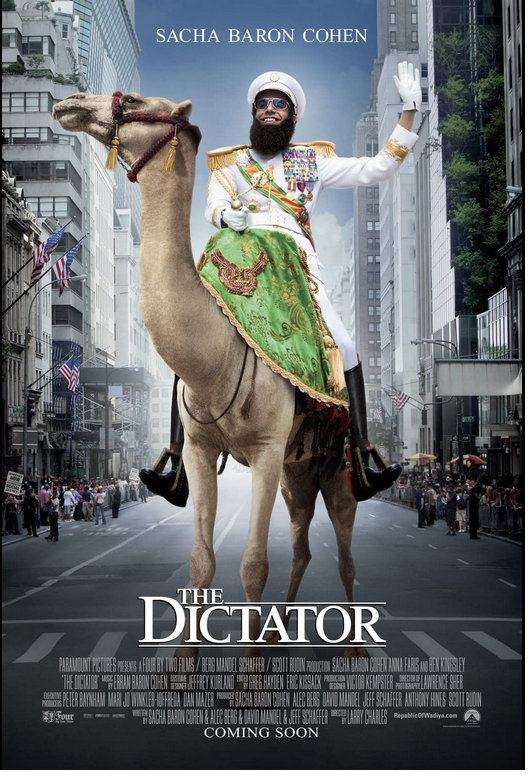
The Dictator (2012)


Larry Charles: The Dictator (US 2012) starring Sacha Baron Cohen as Admiral General Aladeen.

Diktaattori / The Dictator [Swedish title].
    US © 2012 Paramount Pictures. EX: Mari Jo Winkley-Ioffreda, Adam McKay, Peter Baynham, Dan Mazer. P: Sacha Baron Cohen, Alec Berg, David Mandel, Jeff Schaffer, Todd Schulman, Anthony Hines, Scott Rudin.
    D: Larry Charles. SC: Sacha Baron Cohen, Alec Berg, David Mandel, Jeff Schaffer. DP: Lawrence Sher. PD: Victor Kempster. AD: Greg Berry, etc. SFX and VFX: Factory VFX, Framestore, Hatch Productions (matte paintings), LOOK! Effects, Luma Pictures, Shade VFX. Cost: Jeffrey Kurland. Makeup dept. head: Judy Chin. M: Erran Baron Cohen. S: Andrew DeCristofaro. ED: Greg Hayden, Eric Kissack.
    C: Sacha Baron Cohen (Admiral General Aladeen / his double Efawadh), Ben Kingsley (Tamir, Aladeen's uncle), Jason Mantzoukas (Nadal, nuclear physicist), Anna Faris (Zoey), John C. Reilly (Clayton), Chris Elliott (Mr. Ogden), Fred Armisen (Death to Aladeen Restaurant waiter), Megan Fox (herself), Edward Norton (himself).
    83 min
    Released by Finnkino with Finnish / Swedish subtitles by Marko Hartama / Ulrika Lindfors-Davis. 2K DCP viewed at Tennispalatsi 2, Helsinki, 2 June 2012.

Technical specs from the IMDb: Camera: Arri Alexa, Panavision Primo Lenses - Negative format: Codex - Cinematographic process: ARRIRAW (source format), Digital Intermediate (2K) (master format) - Printed film format: 35 mm (anamorphic) (Kodak Vision 2383), D-Cinema - Aspect ratio: 2.35:1.

This is the first picture in which I noticed the Paramount Centenary logo.

The official synopsis: "The heroic story of a dictator who risks his life to ensure that democracy would never come to the country he so lovingly oppressed."

An offensive political satire.

Of the Sacha Baron Cohen movies I have seen Ali G Indahouse and Borat but missed Brüno.

The Dictator is a stronger and more solid movie than the first two Baron Cohen films. It has also a more traditional structure, but it does not matter, since the familiar "coming to America" plot is mostly but a hanger to Baron Cohen's crazy antics.

Obvious reference points are Charles Chaplin's The Great Dictator and Ernst Lubitsch's To Be Or Not To Be. In both the dictator is Hitler, in both the concept of the double is essential, and in both, the film-makers had the nerve to make a comedy about a contemporary genocidal tyrant. There are few direct connections in Baron Cohen's movie, but the changed beard motif has a distant connection to Lubitsch, and like in Chaplin's film there is a climactic speech given by a lookalike (in Baron Cohen's movie he is the original dictator replacing the double).

The Dictator has been filmed during the Arab spring, and, with a dedication to Kim Jong-il, its main targets are the tyrants of the modern world. Aladeen's project is to build his own nuclear weapon, and his main foes are the USA and Israel. As his entertainment Aladeen has a terrorist computer game selection, among which there is one devoted to the Munich massacre of Israeli athletes. In his guest house Aladeen hosts the real Osama bin Laden - the US has wiped out his double.

In New York, Aladeen's wily uncle Tamir (Ben Kingsley) replaces Aladeen with his double with orders to eliminate Aladeen, but Aladeen survives without clothes or money. In an anti-Aladeen demonstration he meets a new-age hippie called Zoey (Anna Faris) who has hair in her armpits, who conceals her feminine figure with unisex clothes and who takes him to her feminist, vegan grocery store whose employees are refugees from dictatorships. Aladeen also stumbles into a Death to Aladeen restaurant whose staff and clientele consists of countrymen whom Aladeen had ordered to be executed.

There are funny single jokes such as Aladeen's anger at the luxury hotel where he must pay USD 20 extra for the internet.

There are also more serious satirical aspects such as that the big powers of the world don't worry so much about Aladeen's tyrannical ways and are really only concerned about the control of his oil resources. Meanwhile, Tamir strikes deals with oil barons from the USA, Britain, Russia, and the leader of the group from China, Mr. Lao (Bobby Lee).

The high point of the movie is Aladeen's speech at the United Nations in defense of dictatorship, passionately urging the democratic countries to follow his way. "Imagine a country where one per cent of the people controlled most of the wealth and leaders wage war against the wrong country for trumped-up reasons." "Imagine a country whose prisons are filled with one racial group." One family would control the media, the top 1% could avoid paying taxes, people could be prevented from getting affordable healthcare and education, one could use the government to listen in on people, one would be allowed to use torture to elicit confessions, elections could be rigged, and the same parties could remain in power perpetually.

The wily Aladeen manages to return to power, and he weds Zoey whose chutzpah he has learned to admire, but only after the wedding ceremony Aladeen learns that Zoey really is Jewish. (In New York, to the dismay of Nadal, Aladeen has picked up some Jewish vocabulary because he likes it when people say what they mean).

I liked the soundtrack of this movie.

I had no complaints about the visual quality of the presentation.

Friday, June 01, 2012

Prometheus (2012) (3D)


Ridley Scott: Prometheus (US 2012).

Prometheus / Prometheus. 
    US © 2012 Twentieth Century Fox Film Corporation / Dune Entertainment III LLC in all territories except Brazil, Italy, Korea, Japan and Spain. PC also: Brandywine Productions / Scott Free Productions. P: David Giler, Walter Hill, Ridley Scott, Tony Scott. 
    D: Ridley Scott. SC: Jon Spaiths, Damon Lindelof. DP: Dariusz Wolski. PD: Arthur Max. AD: John King, etc. Set dec: Sonja Klaus. Cost: Janty Yates; cost dept.: big. Makeup, prosthetics, hair, creature design dept: big. Art dept: big. SFX team: big - Plowman Craven & Associates, FB-FX, Fuel International, Halon Entertainment, Lifecast, MPC (Moving Picture Company), ReelEye Company (SFX contact lenses), Special Eye Effects (contact lenses). VFX team: big - Lola Visual Effects, Luma Pictures, The Visual Effects Company (motion control), Weta Digital (roto). AN dept: big. M: Marc Streitenfeld. Frédéric Chopin. "The Alien Theme" by Jerry Goldsmith. S: Mark P. Stoeckinger. ED: Pietro Scalia. Casting: Nina Gold, Avy Kaufman. 
    C: Noomi Rapace (Elizabeth Shaw, an archaelogist), Michael Fassbender (David, an android), Charlize Theron (Meredith Vickers, supervisor of the exhibition), Idris Elba (Janek, captain of The Prometheus), Guy Pearce (Peter Weyland, multibillionaire, owner of The Prometheus), Logan Marshall-Green (Charlie Holloway, an archaeologist, Shaw's love interest), Sean Harris (Fifield, a geologist), Rafe Spall (Milburn, a botanist), Emun Elliott (Chance, ship pilot), Benedict Wong (Ravel, ship pilot), Kate Dickie (Ford, the ship medic). 
    Loc: Iceland (Dettifoss, Vatnajökull National Park; Hekla, Rangárvallasýsla); Highland, Scotland (Fort William, Glen Coe; Inverness; Rannoch Moor; The Storr, Isle of Skye); Ciudad de la Luz, Alicante, Comunidad Valenciana, Spain (water scenes). 
    Studio: Pinewood Studios. 
    124 min. 
    Released by FS Film with Finnish / Swedish subtitles by Topi Oksanen (from the manuscript) / Carina Laurila-Olin. 
    2K DCP viewed at Tennispalatsi 1, Helsinki, 1 June 2012 (day of Finnish premiere).

Technical specs from the IMDb: Camera: Red Epic, Zeiss Ultra Prime and Angenieux Optimo Lenses - Laboratory: Company 3 (digital intermediate), Fluent Image, London, UK. - Source format: Redcode RAW - Cinematographic process: Digital Intermediate (master format), Redcode RAW (5K) (dual-strip 3-D) (source format) - Printed film format: 35 mm (anamorphic) (Fuji Eterna-CP 3514DI), 70 mm (horizontal) (IMAX DMR blow-up) (dual-strip 3-D) (Kodak Vision 2383), D-Cinema (also 3-D version) - Aspect ratio: 2.35:1.

There had been no press screening in time for the NYT supplement of Helsingin Sanomat to publish a review of Prometheus, and I read Pertti Avola's review online today.

The official synopsis: "A team of explorers discover a clue to the origins of mankind on Earth, leading them on a journey to the darkest corners of the universe. There, they must fight a terrifying battle to save the future of the human race."

I have admired Ridley Scott since I saw The Duellists in 1979, and his movies Alien, Blade Runner, and Thelma & Louise have stood the test of time. Scott became famous because of his striking visuals as a top director of commercials, but at least in those movies his artistic vision was no longer surface gloss but something more profound. Scott belongs to the industrial designer type of directors, but at his best he is also a very good director of actors. Some of the most powerful and original action heroines in movies have emerged in his direction, and in Blade Runner the performances are consistently interesting even in small roles.

Prometheus originated as a prequel to Alien, but the result is another spinoff like the Aliens vs. Predators series. We see the birth of the alien, but it is only a subplot in Prometheus.

Prometheus is an effective horror film, and the most horrifying sequence is the one where Elizabeth Shaw (Noomi Rapace) gives birth to the monster.

The sense of wonder is not strong in this movie. At its most effective it is in the alien temple where David revives the alien hologram star map which has Earth as its destination. Our engineers had had second thoughts about us and they had planned to attack the Earth to destroy life with biological weapons. Instead, however, they themselves perished by their weapons.

David the android (Michael Fassbender) is an interesting character in the development of cinematic androids. He keeps educating himself by studying many languages, and he learns patterns and models from movies including Lawrence of Arabia ("The trick, William Potter, is not minding that it hurts."). David instantly understands what has been going on in the alien temple. At first viewing I did not get it why he injects Charlie Holloway with the poison from the alien's biological weapon. Elizabeth Shaw is not fertile, but she is impregnated by the alien substance in Holloway while they have intercourse.

The difference in the behaviour of David the android and the humans is so small that the point of David's nature is all but lost. Inadvertently, Prometheus is a movie about dehumanization. The female characters perform in Ninotchka mode (Ninotchka before falling in love and bursting into laughter), and they don't make love but get laid in a functional manner. Charlize Theron is almost unrecognizable in such a cold mode. Noomi Rapace is efficient in the same way as she was as the utterly traumatized Lisbeth Salander.

I have been puzzled by the Twilight series and The Hunger Games, the new kind of big popular dystopias where we visit worlds not worth living in with no positive perspectives or alternatives, no convincing counterforces to the horror. In Prometheus, the figure of Elizabeth Shaw is much less vibrant, much less a life-force than was Ripley at least in the original Alien movie. Or maybe the Shaw character is just so underdeveloped here that we cannot make much sense of her determination when she states that "I want to go to where they came from" together with the decapitated but still functioning David.  

Prometheus was shot in digital 3D with high lighting levels, and the darkness was added in post-production. Although the physical world consists largely of stone, metal, and glass, even in such reduced circumstances there is a sense of visual poverty which is surprising in such a big production. Ridley Scott was famous for his excellent visual quality before he turned digital (including the use of the digital intermediates in his movies and the less than perfect digital effects in Gladiator and Hannibal). The low definition of Prometheus is far from the visual brilliance of Alien and Blade Runner.

There was no problem with the 3D, and the image was bright enough.

An interesting positive reaction in Finnish by Jutta Sarhimaa in her blog (7 June, 2012): http://cinefiliaa.wordpress.com/2012/06/07/miksi-prometheus-on-nautinto-elokuvaksi-kesan-pelastus-ja-alien-fanin-unelmien-tayttymys/

Jim Emerson's Scanners blog  remarks (14 June, 2012) are worth reading: http://blogs.suntimes.com/scanners/2012/06/prometheus_alien_origins_the_s.html#more

Helene Schjerfbeck 150 (an exhibition)


Helene Schjerfbeck: Self-portrait. Black Background. 1915. Oil on canvas. 45,5 x 36. Herman and Elisabeth Hallonblad Collection, Ateneum Art Museum, Finnish National Gallery, Helsinki, inv. A-II-1065.

Helene Schjerfbeck: Fête juive (Sukkot) / Lehtimajajuhla, 1883. Oil on canvas, 118 x 172. Signe and Arie Gyllenberg Foundation, Helsinki. Models: Chava Slavatitsky / Eva Slavatitzkaja and fruit and tobacco seller Alter Fiedler (1840–1926). Painted in the studio Helene shared with Maria Wiik at Mariankatu 12, Helsinki. First exhibition: Salon de Paris 1883. Photo: my scan from the exhibition catalogue. PS: 7 Nov 2020 (source: HS Kuukausiliite 11/2020): In 1891, Chava was abducted by Hedwig von Haartman and Louise af Forselles to be converted to Christianity. Chava as Eva apparently ended up to Sweden and England, worked in the Salvation Army and was married in Denmark. The abductors were convicted, but the verdict was revoked in the court of appeals. The abductors were ordered to pay the family's legal costs.

Helene Schjerfbeck, exhibition 1.6.2012 – 14.10.2012. Curator: Leena Ahtola-Moorhouse. Ateneum Art Museum, Finnish National Gallery, Helsinki. Viewed on 1 June, 2012 (the day of the opening to the public).

Exhibition catalogue: Helene Schjerfbeck 150 Years. Chief editor: Leena Ahtola-Moorhouse. Helsinki: Ateneum Art Museum, Finnish National Gallery, 2012. – Three language editions: Finnish, Swedish, and English.

The official introduction: "This year marks the 150th anniversary of the birth of one of the most important and recognised artists in the entire Nordic region, Helene Schjerfbeck (1862–1946). To celebrate this anniversary, Ateneum Art Museum is presenting the largest ever exhibition of Schjerfbeck's art. Over three hundred works of art will be on display, covering all periods of Schjerfbeck's artistic output – from her historical paintings of the 1880s to her later examples of minimalistic modernism."  

"The new exhibition will present Schjerfbeck's well-known classics alongside previously unseen or seldom exhibited works of art from private collections. A central theme of the exhibition is Schjerfbeck's interaction with the masters of world art. For the first time, Schjerfbeck's paintings after El Greco will be displayed alongside two original works by the Spanish master."

"The curator of the Helene Schjerfbeck anniversary exhibition is Leena Ahtola-Moorhouse, Chief Curator at Ateneum Art Museum. A comprehensive catalogue raisonné of Schjerfbeck's art will be published in connection with the exhibition in which researchers shed new light on the artist and her work. The catalogue is edited by Leena Ahtola-Moorhouse and Anu Utriainen and will be available in Finnish, Swedish and English."

"The exhibition at Ateneum is part of the official programme marking the 150th anniversary of the birth of Helene Schjerfbeck. The anniversary will be celebrated throughout Finland with special exhibitions and events. The patroness of the anniversary year is President Tarja Halonen."

Schjerfbeck in Ateneum's collections

"Ateneum Art Museum has the world's largest and most comprehensive collection of Helene Schjerfbeck's art. The collection comprises a total of 212 paintings, drawings and sketchbooks. The first acquisition dates back more than 130 years to 1880, when the painting Wounded Warrior in the Snow was acquired by the Finnish Art Society. Ateneum's unique Schjerfbeck collection has also expanded over the years thanks to numerous valuable donations, the most significant being those of Nanny and Yrjö Kaunisto and of Ester and Jalo Sihtola."

"The Friends of Ateneum association has also added to the collection over the years. The most recent donation was made in autumn 2011, when the association presented Ateneum with five of Schjerfbeck's sketchbooks, a hundred sketches as well as photographs and other archive material."

"You can study Schjerfbeck works from the Ateneum collection by following an on-line trail A Journey with Helene Schjerfbeck that covers her long career and includes key works and quotations from her letters. Along the trail you will find drawings from a sketchbook collection donated by the Friends of the Ateneum. The commentary is by art historian Siina Hälikkä."

"The importance of Ateneum's Schjerfbeck collection has grown in recent years together with increased international interest in the artist's production. Already during her lifetime Schjerfbeck's art was displayed throughout Europe in numerous exhibitions of Finnish art. Art dealer Gösta Stenman began organising Schjerfbeck exhibitions in Finland in the 1910s. The extensive solo exhibition at Stenman's gallery in Stockholm in 1937 received a rapturous reception. After this, solo exhibitions were held also elsewhere in Sweden almost on a yearly basis."

"Her broader international breakthrough came in 2007, when a major retrospective exhibition of Schjerfbeck's art was held in Paris, Hamburg and the Hague. Attracting over 350,000 visitors, the exhibition aroused interest among researchers, artists and the general public alike."

"The most recent international exhibition of Schjerfbeck's art was in Ordrupgaard, Denmark, last autumn. The museum presented around sixty works, of which close to forty were from Ateneum's collection."

"Swedes will have another chance to admire Schjerfbeck's art after the exhibition at Ateneum, when a selection of paintings will travel to Prince Eugen's Museum in Stockholm and the Gothenburg Museum of Art."

AA: Helene Schjerfbeck's work belongs to the treasures of Finnish art. This exhibition with 300 artworks is the most extensive ever, and there are several works on display that have never been exhibited in public before.

The talent of the prodigy Helene Schjerbeck was instantly recognized, and already at the age of 17 she sold her historical painting A Wounded Soldier in the Snow to what is now the collection of the national gallery. She was immediately compared with the most prestigious artists of her age such as Albert Edelfelt. She never stopped painting, and the last works listed in the catalogue are from the year 1945 (she died in 1946). Schjerfbeck's public career lasted over 65 years. Schjerfbeck has always been highly regarded in Nordic countries, and during the last decade she has been receiving a much larger international recognition in Paris and elsewhere, and her works have commanded high prices in international auctions.

The Ateneum exhibition is a powerful experience. Some of Schjerfbeck's works are among the most familiar in Finnish culture, but they are always worth revisiting, and in such an exhibition they receive new contexts. Variations of favourite themes can be examined. Unknown works are hanged next to familiar ones. For the first time we can see side by side the original El Greco paintings and Schjerfbeck's hommages to them (she, herself, had never seen the originals, and studied them only in art books).

We follow the long journey from Helsinki to Paris, Bretagne, St. Ives, Italy, Hyvinkää, Tammisaari, and Saltsjöbaden in Sweden.

From the historical quality paintings of the 1870s Schjerfbeck moves towards early abstractions, and back to more realistic studies. She reacted to the trends of the 1920s, got involved in dialogues with selected past masters such as the Mannerist El Greco, and never stopped changing. She moved again towards abstraction, now more boldly.

Her series of self-portraits is among the most devastating in the history of art. Her final self-portraits, after the end of WWII, are images of death that can be compared with paintings of Lucian Freud and Alfred Hitchcock's Psycho. For me they seem to reflect the desolation of what happened in WWII.

I had not seen before the painting Fête juive (Sukkot) painted in Helsinki in 1883, and in this exhibition I also made a connection between it and the final death's heads Schjerfbeck made after WWII.

Mostly the works are oil paintings on canvas. I studied them at close range, and I was happy that the surface of most of the works was naked. Some works had a reflecting glass which makes it impossible to really know the painting. There were others, such as the first self-portrait, with a non-reflecting glass which is not so bad. Oil-painting is three-dimensional. Studying it at close range I can appreciate the depth of the brush strokes. In the middle period Schjerfbeck refuses depth, favours bleak colours, and there is a sense that the light and the fire have been extinguished. She flattens the surfaces intentionally. Towards the end she again accepts depth in her oil paintings.

The lighting of the exhibition is mostly fine, but some paintings have been sheltered from spotlights, and when there is reflecting glass, one cannot really see the work.

The paintings one can really only know by seeing them "live", but the huge catalogue is an excellent companion. It is expensive but worth buying. I read it in advance at the café to study the chronology, the titles, the subjects, and the locations, in order to focus on the paintings only in the actual exhibition, without having to read title cards. Ateneum's online services are an excellent way to go even deeper in the subject.

If I would make a film about Helene Schjerfbeck, I would do it in the fashion of Luciano Emmer and Alain Resnais (Van Gogh), never leaving the frames of the paintings, editing an inner journey with camera movements and dissolves. In the end there would be a montage of all her self-portraits, ending with the living dead skull.

This deeply moving exhibition alone is a good reason to visit Helsinki.

BEYOND THE JUMP BREAK: THE ART TRAIL:

Thursday, May 31, 2012

Samma no aji / An Autumn Afternoon


Yasujiro Ozu: 秋刀魚の味 / Sanma no aji / An Autumn Afternoon (JP 1962) starring Shima Iwashita (Michiko Hirayama), Chishu Ryu (Shuhei Hirayama), Keiji Sada (Koichi Hirayama) and Mariko Okada (Akiko Hirayama). Poster from IMDb.

秋刀魚の味 / Sanma no aji / Syksyinen iltapäivä / En hösteftermiddag.
    JP 1962. PC: Shochiku. P: Shizou Yamanochi.
    D: Yasujiro Ozu. SC: Kogo Noda, Yasujiro Ozu. DP: Yuharu Atsuta - Agfacolor. AD: Tatsuo Hamada. Cost: Yuuji Nagashima. M: Takanobu Saito. "Gunkan machi" ("The Battleship March", 1897): a patriotic song composed originally for primary schools. ED: Yoshiyasu Hamamura. S: Ichiro Ishii.
    C: Chishu Ryu (Shuhei Hirayama), Shima Iwashita (Michiko Hirayama), Keiji Sada (Koichi Hirayama), Mariko Okada (Akiko Hirayama, his wife), Nobuo Nakamura (Shuzo Kawai), Kuniko Miyake (Nobuko Kawai, his wife), Ryuji Kita (Susumu Horie), Michiyo Kan (Tamako Horie, his second wife), Eijiro Tohno (Seitaro Sakuma, "The Gourd"), Teruo Yoshida (Yutaka Miura), Noriko Maki (Fusako Taguchi), Shinichirô Mikami (Kazuo Hirayama), Michiyo Tamaki (Tamako), Haruko Sugimura (Tomoko), Daisuke Kato (Yoshitaro Sakamoto), Kyoko Kishida (Madam at Kaoru), Toyoko Takahashi (waitress at Wakamatsu). Shinobu Asaji (Youko Sasaki, Shuhei's secretary). Studio: Shochiku-Ofuna.
    In Finland tv: 27.7.1985 MTV2, 21.2.1999 YLE TV1, 6.11.2005 YLE Teema.
    112 min.
    A SFI Filmarkivet print (2005) with Swedish subtitles by Wakako Hongo and Per Sundfeldt. Electronic subtitles in Finnish by Eija Niskanen.
    Viewed at Cinema Orion, Helsinki (50 Years Ago), 31 May 2012.

The Japanese title of the movie refers to the taste of the fish called Pacific saury (also known as saira, or mackerel pike; the correct translitteration of the Japanese name seems to me nowadays sanma), in a season when it is at its tastiest. Although people eat all the time in this movie, and there is a scene where eel is eaten as a special delicacy, they never eat sanma.

Yokohama, the present.

Donald Richie's synopsis: "A company auditor, widowed and getting on in years, lives with his son and daughter and has as friends a few men his own age. From one of them he hears of the marriage of yet another friend's daughter. This sets him thinking about his own daughter. He decides that she should marry, and eventually arranges it with a young man recommended by his friends. The event goes off as planned. Again he meets with his friends. They all drink together once more, and he realizes that he is getting old, and that he is alone."

Revisited Yasujiro Ozu's final film in which there is no sign of him getting tired, although the director soon died of cancer on the evening of his 60th birthday. The subject is familiar, but there is a new vitality in the young characters. The portrait of the daughter Michiko (Shima Iwashita) is subtle. She is a modern woman with a sharp tongue, not submissive at all, yet facing the traditional fate of the youngest daughter. There are aspects of satire in the account of the modern young couple Koichi and Akiko with their fascination in consumer goods.

There is the familiar assured, laconic simplicity of Ozu's post-WWII style. Much of the narrative is realized via conversations over dinner and drink. After the people have left we see the empty space. There are recurrent short montages of chimneys, corridors, and streets signs.

Special emphases of this movie include: - Wartime nostalgia, and an ironic distance towards it: Shuhei Hirayama (Chishu Ryu) and his friends are war veterans. -  Alcoholism: the retired high-school teacher of the friends, Sakuma, now runs a noodle bar and drinks too much, supported by his long-suffering daughter who has never married. Sakuma becomes a warning example for Hirayama, because he also drinks a lot, and his daughter has not yet married, either. - Virility: a running joke is about Horie who has married a young woman about the age of his daughter and the virility medicine that he is supposed to need.

The marrying of Michiko becomes a major plot. There is such an ellipsis that we see the radiant Michiko in her lovely wedding dress but we never see the groom nor the wedding itself. When Hirayama visits his favourite bar, Torys Bar, after the wedding, dressed in his tailcoat, the bar hostess, who somehow reminds Hirayama of his wife, asks: "Are you coming from a funeral?"

There is a lounge music quality in Takanobu Saito's score. For a moment I was thinking about Marvin Hatley's Laurel and Hardy scores with their royal disregard for what is happening on screen.

The vanitatum vanitas theme in this movie is connected with consumer society.

"Finally you are alone" is the conclusion of the old teacher. In the final scene Hirayama gets to know what that means.

The print is brilliant, and it has been struck from a source with perfect colour. The visual quality is often fine, but at times I thought there was a slightly duped quality like in a good digital intermediate for a dvd master.