Friday, July 04, 2014

Les Croix de bois / Wooden Crosses (2014 Pathé 4K restoration)


Puuristit / Den stora fasan.
    FR 1931. D: Raymond Bernard. Based on the novel (1919) by Roland Dorgelès. SC: Raymond Bernard, André Lang. DP: Jules Krüger. ED: Lucienne Grumberg. AD: Jean Perrier.
    C: Raymond Aimos (Fouillard), Antonin Artaud (Vieublé), Charles Vanel (caporale Breval), Gabriel Gabrio (Sulphart), Paul Azaïs (Broucke), Pierre Blanchar (Gilbert Demachy).
    P: Pathé-Natan. [4K?] DCP. 115'. B&w. English subtitles. From: Pathé International Restaurato da Pathé e Fondation Jérôme Seydoux-Pathé. Il film è stato scansionato e restaurato in 4K presso il laboratorio L'Immagine Ritrovata / Restored by Pathé and Fondation Jérôme Seydoux-Pathé. The film was scanned and restored in 4K at L'Immagine Ritrovata laboratory.
    Fox Film Corporation bought the U.S. rights to Les Croix de bois but instead of releasing it used it for stock footage in The World Moves On (John Ford, 1933), Cavalcade (Frank Lloyd, 1933), The Road to Glory (Howard Hawks, 1936), and Seventh Heaven (Henry King, 1936).
    Also in France footage from Les Croix de bois was reused: in Les Nuits Moscovites (Alexis Granowsky, 1934), and L'Équipage (Anatole Litvak, 1935).
    English subtitles on the DCP by Lenny Borger.
    Introduce Sophie Seydoux (Fondation Jérôme Seydoux Pathé).
    Screened with e-subtitles in Italian by Sub-Ti at Cinema Arlecchino (Bologna, Il Cinema Ritrovato), 4 July 2014

Lenny Borger, 1983 (Il Cinema Ritrovato, 2014, catalogue and website): "Les Croix de bois is one of the most underrated films in French cinema from the Thirties which should nevertheless be included in the history of cinema among the most terrifying portrayals of the World War I. The structure and direction are surprisingly rigorous, almost documentary-like, in describing the relentless disintegration and the death of a squadron of French soldiers. Whilst Milestone and Pabst highlight their pacifism, Bernard avoids rhetoric, entrusting himself completely to the impact of Jules Krüger's cinematography. Its simplicity was criticised by some at the time but now shows its modernity, together with the rejection of pathos and military melodrama. The film was an immediate success, and yet international recognition was thwarted, first of all, by the Nazis (who banned it immediately) and then Hollywood, where it had a strange fate: it was bought by Fox as early as 1932, it would never be distributed but parts of it would be used for stock-shots by Darryl F. Zanuck's production. Yes, it really is Pierre Blanchar that you can see hurling grenades between two studio frames of Fredric March and Werner Baxter in The Road to Glory (1936) by Howard Hawks!" Lenny Borger, Les Croix de bois, "Cinématographe", no. 91, July 1983 [Lenny Borger's original article, thorough and profound, is still valid, to the point and worth checking out]. (Il Cinema Ritrovato, 2014, catalogue and website)

Presented by Gian Luca Farinelli, Sophia Seydoux introduced the film in English. She explained the significance of the novel by Roland Dorgelès, its meaning in the anti-war movement, the general feeling of "never again". She told about the commitment to authenticity, the research for actual locations and accessories. All actors and extras were veterans re-living an awful experience. Roland Dorgelès himself was the advisor on authenticity. In this early sound film a lot of things were invented to record the authentic combat sounds with three sound trucks, even building a huge generator at a distance of 2 km in order to avoid its distracting noise. (My notes of the introduction by Sophia Seydoux).

AA: I saw Raymond Bernard's masterpiece for the first time, and it was for me the highlight of this year's Il Cinema Ritrovato, so powerful that I could not take seriously the film I was planning to see next, Chandralekha. Les Croix de bois belongs to a handful of the best war films ever.

The most popular film of Finland is The Unknown Soldier (1955) which, like the novel on which it is based, became a major vehicle of coming to terms with the overwhelming devastation of war.

Les Croix de bois was such a film in France for the generation which had experienced the First World War. For decades veterans went to watch and cry in Les Croix de bois which was in continuous release after the premiere (except during the Occupation). It was recognized as authentic by those who had been through it themselves. It belongs to the great popular films of all time, films whose true audience figures can be impossible to estimate.

Les Croix de bois is not entertainment. It is bigger than a film. It is a memorial and a monument. A phenomenon, a site of remembering, an invitation to come to terms with a shock, the greatest in history so far.

Like Edvin Laine in our The Unknown Soldier, Raymond Bernard employed war veterans in his cast although they were now too old for the parts. There was the bigger truth there that they had lived through something that was beyond imagination. They conveyed the true approach, the atmosphere, the attitude, the reactions, the expressions, the gestures, the words, the sense of the ensemble. And that is why Les Croix de bois feels completely different than most war films.

The Finnish word for a dissolve or a superimposition is "ristikuva" (a cross shot, a crossing shot). I was struck here by the early superimposition from marching men to a cemetery full of wooden crosses. The image during the opening credits is that of eternal fire. Such shots belonged already to the established imagery of anti-war films, as are the superimpositions of ghost soldiers marching to heaven. Abel Gance had employed such images powerfully in J'accuse!

Mostly Les Croix de bois is about the brutal disillusion of a young recruit who enters a squadron of already hardened veterans. We witness jubilant parades, the general mobilization, the presentation of all aspects of military life, the equipment, the sleeping conditions, the esprit de corps, the marches in the darkness, the trenches, the stench, the patrols, the incessant ominous sound of the enemy about to mine our foxhole from below, war panic and hysteria, the canteen, the military drill, lice removal, war mail, and the war hospital with legless and armless invalids.

We are taken to the front, to the barrage of fire and explosions, the grim, cruel and brutal massacre going on there, the smoke and the darkness, the incessant thundering noise. The main combat takes place at a graveyard. The exhausted soldiers have to parade in front of a general. The fight goes on, and there is another parade - the steady parade of the wounded all day. Vacations are cancelled. There is a wailing voice of one of our own in no-man's-land. It is impossible to retrieve him.

Everybody dies, and finally Gilbert, too, is hit. He cries in vain for help, and in his hallucinations sees memories pass by as the flame of his life gets extinguished.

A film about the end of the myth of heroism in war. The battlefield has become a slaughterhouse.

The performances are strong. There is no music score, but diegetic music is important: military marches, "En revenant de Montmartre" [Dorgelès had led Bohemian life on the Montmartre before the war, and wrote later a beloved cycle of books about it], "Ave Maria", and the bitter theme song by the soldiers, "Les Croix de bois" written by Dorgelès for the movie ("Oui tu l'auras, ta croix, ta croix / Si c'est pas la croix de guerre / C'est que ça sera la croix de bois"). The realistic soundtrack is terrifying.

The cinematography by Jules Krüger is stark. Much of the film has been shot in the darkness.

The visual quality of the screening was puzzling. Is the condition of the source elements this bad? There was no full black, fine texture was missing, and at times the image looked like video. PS. I heard that there are issues about the digital projection at Arlecchino. The fault may have been with the projection.

PS. Roland Dorgelès was the one who coined the expression "drôle de guerre" in WWII.

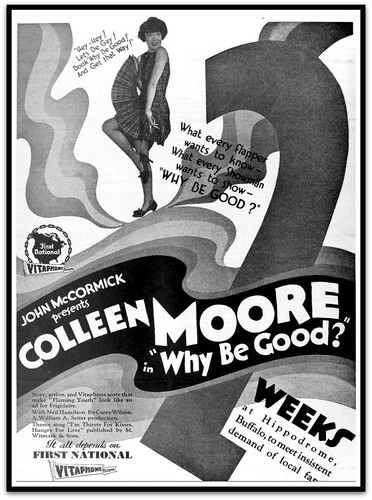
Why Be Good? (2014 Warner Bros. restoration)


Neil Hamilton, Edward Martindel, Colleen Moore
Jazzikuningatar. US 1929. D: William A. Seiter. Story+SC: Carey Wilson. DP: Sidney Hickox. ED: Terry Morse. C: Colleen Moore (Pert Kelly), Neil Hamilton (Peabody Jr.), Bodil Rosing (Ma Kelly), John Sainpolis (Pa Kelly), Edward Martindel (Peabody Sr.), Eddie Clayton (Tom), Louis Natheaux (Jimmy), Collette Merton (Julie), Dixie Gay (Susie), Jean Harlow. P: John McCormick per First National Pictures, Inc. DCP. 90'. B&w. From: Warner Bros. Restaurato da Warner Bros. presso il laboratorio L'Immagine Ritrovata / Restored by Warner Bros. at L'Immagine Ritrovata laboratory
    Based on the print at Cineteca Italiana di Milano.
    Introduced by Ned Price, in the presence of the restoration team.
    Screened with earphone commentary in Italian at Cinema Lumière - Sala Officinema/Mastroianni (Bologna, Il Cinema Ritrovato), 4 July 2014

Ned Price (Il Cinema Ritrovato, 2014, catalogue and website): "Why Be Good?, Colleen Moore's final silent, is a First National Film with no dialog, but contains a Vitaphone soundtrack with synchronized music and sound effects. The soundtrack is full of hot jazz and twenties dance music, and confirmed on it are such period jazz greats as Jimmy Dorsey, Phil Napoleon, Joe Venuti and Eddie Lang. The film portrays Colleen Moore as a wild flapper, dancing though beautiful art deco sets. Jean Harlow makes an early appearance as a prominent dress extra. Why be Good? was long believed to be a lost film, it was re-discovered though the perseverance of Film Historian, Joseph Yranski and Ron Hutchinson of the Vitaphone Project. The search began when Joseph interviewed actress Colleen Moore, who told him that a copy of the film survived in an Italian Film Archive. Ron Hutchinson was able to find a 16" Vitaphone disc containing the soundtrack and the task of locating the missing picture began. Gian Luca Farinelli of Cineteca di Bologna contacted Matteo Pavesi of Cineteca Italiana di Milano, who graciously allowed access to the 35mm nitrate dupe negative for the restoration at L'Immagine Ritrovata in conjunction with Warner Bros. The restoration will have a world premier at Il Cinema Ritrovato." Ned Price (Il Cinema Ritrovato, 2014, catalogue and website)

Jeff Codori (Il Cinema Ritrovato, 2014, catalogue and website): "Why Be Good? had many of the requisite elements: a bad girl who is actually good deep down; poor girl imported into a rich environment; mistaken identities; and the fairy-tale ending. Pert Kelly, a counter girl in a New York department store, has a reputation for promiscuity, but is secretly a virtuous woman. She meets Peabody, Jr., at a roadhouse one night, and they make a date to meet again the following evening. The next morning, Pert is late for work and is called on the carpet by the personnel manager, who turns out to be Peabody, Jr. His father, who owns the store, fires Pert, but Peabody, Jr. is (predictably) smitten with her. He invites her to one of his parent's fancy soirées. His father doubts Pert's virtue, so Junior decides to evaluate her by bringing her to a disreputable roadhouse where he has staged an elaborate test. She protests and, convinced, Junior marries her right away." Jeff Codori, Colleen Moore. A Biography of the Silent Film Star, McFarland & Company, Inc., Jefferson, NC 2012 (Il Cinema Ritrovato, 2014, catalogue and website)

In his introduction Ned Price explained the care that had been taken to put back together the sound and the image of this silent film which was released at the time with a music score on disc.

AA: Why Be Good? has hardly been seen in 80 years. A Colleen Moore vehicle directed by William A. Seiter, an ace in comedy and musical, a Hollywood veteran who knew the secret of doing star vehicles. There was a feeling of pleasant anticipation in the packed cinema, and Why Be Good? delivered.

It's a typical jazz age comedy with flappers and millionaires. The stern father instructs his son, about to take charge of the company as a boss of 200 men - and 1000 girls. "Some of the girls are hot stuff. Don't get mixed with any of them". On the last carefree night Peabody, Jr. is doing the round of the night spots such as Jazzland and The Boiler (with an oversized boiler emitting huge clouds of steam). There he inevitably meets Pert, a girl with a reputation...

This is where I had to leave for Les Croix de bois. But I had noticed Seiter's talent with humoristic ensemble shots, party scenes, and the zest and the panache expected of a Colleen Moore film.

The jazzy Vitaphone score, restored from vintage shellac disks, is perfect.

The image looks good in a digital, occasionally in a slightly duped kind of way.

I vampiri / The Vampires

Gianna Maria Canale as Giselle Du Grand
Lust of the Vampire. IT 1956. D: Riccardo Freda. Story: Piero Regnoli, Rijk Sijstrom. SC: Riccardo Freda, Piero Regnoli, Rijk Sijstrom. DP: Mario Bava. ED: Roberto Cinquini. AD+cost: Beni Montresor. M: Roman Vlad. C: Gianna Maria Canale (Giselle Du Grand e la duchessa Marguerite Du Grand), Carlo D'Angelo (l'ispettore Santel), Dario Michaelis (Pierre Valentin), Wandisa Guida (Laurette Robert), Antoine Belpêtré (dottor Julien De Grand), Riccardo Freda (un medico). P: Ermanno Donati, Luigi Carpentieri per Athena Cinematografica, Titanus. 35 mm. 85'. B&w. From: Fondazione Cineteca di Bologna
    Black and white in CinemaScope.
    Viewed with e-subtitles in English by Sub-Ti at Cinema Jolly, Bologna, Il Cinema Ritrovato, 4 July 2014

Gary Morris (Il Cinema Ritrovato, 2014, catalogue and website): "The first real Italian horror film, which even predates Hammer's horror series, takes place in an imaginary contemporary Paris created at Titanus's studios in Rome by the brilliant set designer Beni Montresor. In disagreement with the producers, Freda abandoned the production, which was finished by Mario Bava, the film's director of photography (who is apparently responsible for the 'thriller' interludes). I vampiri shows the key elements of both directors' approach to horror in a surprisingly effective way: Freda's obsession with the conflict between so-called normality made of conformism-progress-science and the irresistible attraction of transgression and sensuality; his vision of fleeting nature, beauty and physical integrity, and the desperate desire to maintain them; and, on the other, Bava's creation of fantastic worlds made of unrivaled visual intensity and details, chiaroscuro landscapes that emerge more from the director's magnificent control of the shot than from the psychology of the characters." Gary Morris, Universi in collisione: gli horror di Freda, in Riccardo Freda, edited by Stefano Della Casa and Emanuela Martini, Bergamo Film Meeting 1993(Il Cinema Ritrovato, 2014, catalogue and website)

Riccardo Freda in an interview by Stefano Della Casa (Il Cinema Ritrovato, 2014, catalogue and website): "I've always liked being the first to make a film. I vampiri came about in an odd way. We were at Donati and Carpentieri's studio thinking of a story to film, and I threw out the idea of making a horror film. They asked me if I had something ready. I said no but that I could in a day's time. And so I showed up with the story; I didn't have it written but recorded on tape. I even made sounds, like a door creaking; it was a lot of fun. They called Lombardo who immediately accepted it. Perhaps it was one of his more generous moments, helped by the fact that I didn't want any particular actor (except Canale), I was willing to do it in about ten days as long as the cameraman was Bava and the set designer Beni Montresor. I made one mistake: I made it under my Italian name, and Italians only accept fettuccine from their countrymen. Thereafter, I never made the same mistake, and everyone else copied me." Interview by Stefano Della Casa, in Riccardo Freda, edited by Stefano Della Casa and Emanuela Martini, Bergamo Film Meeting 1993 (Il Cinema Ritrovato, 2014, catalogue and website)

AA: Not a vampire film in the Dracula tradition, this is a horror story about the quest for eternal youth. Young women of a certain blood type become victims of the vampiristic thirst for new life elixir.

Except for Gianna Maria Canale the performances seem stale and tired. The art direction and the costumes of Ben Montresor are fine, though, and Roman Vlad creates a score in late 1920s mode.

Riccardo Freda has an innate talent for horror and the macabre, as is evident in the Venice lead chamber torture sequence in Il cavaliere misterioso. Whoever directed most of the latter part of the movie - Freda or Mario Bava: as soon as we enter the crypt and the secret passages in I vampiri there is an enhanced intensity. Full intensity is attained in the reception and the slow dance, bringing back memories of "the last ball in 1925". (The film is set in the present day of 1956).

I was thinking about L'Année dernière à Marienbad, Les Yeux sans visage, and Peeping Tom, all of which Freda and Bava anticipate here.

There is strange poetry in the sequences of the polyphon metal record [Olavi Schalin, Matti Piuhola], the fellow journalist intruding via grapevine, Gisella shooting the intruder who has discovered her macabre secret, the fountain of youth, the agony of the most recent young female victim, the revelation of the family motto "Conquisto l'inferno", and the instant ageing of the contessa. The visual effect of ageing is well conceived.

A fine print.

Thursday, July 03, 2014

Kaagaz ke phool / Paper Flowers


Guru Dutt: कागज़ के फूल / Kaagaz ke phool / Paper Flowers (IN 1959) with Guru Dutt (Suresh Sinha) and Waheeda Rehman (Shanti).

Guru Dutt: कागज़ के फूल / Kaagaz ke phool / Paper Flowers (IN 1959).

कागज़ के फूल / Fiori di carta. 
    IN 1959. P: Guru Dutt per Guru Dutt Films. 
    D: Guru Dutt. SC: Abrar Alvi. DP: V. K. Murthy - Black and white in CinemaScope. ED: Y. G. Chawhan. SC: M. R. Achrekar. M: S. D. Burman. Songs: Kaifi Azmi. 
    C: Guru Dutt (Suresh Sinha), Waheeda Rehman (Shanti), Baby Naaz (Pramila  Sinha), Johnny Walker (Rocky), Mahesh Kaul (Rai Bahadur Verma), Veena (Veena Varma/Veena Sinha), Minoo Mumtaz (veterinario), Niloufer, Sulochana Devi, Sheila Vaz. 
    Language: Hindi.
    144 min 
    35 mm print from National Archive of India.
    Screened with e-subtitles in Italian and English by Sub-Ti at Cinema Jolly, Bologna, Il Cinema Ritrovato, 3 July 2014
    Precede
INDIAN NEWS REVIEW NO 767 (IN 1963) 11'. V. inglese.

Arun Khopkar (Il Cinema Ritrovato, 2014, catalogue and website): "A dark, brooding masterpiece, Kaagaz ke Phool explores the make-believe world of the movies. Quasi-autobiographical in nature, it portrays the life and times of a filmmaker, depicting failure, oblivion and death as the inevitable outcomes of his journey. The theme proved to be somewhat prescient, since Kaagaz ke Phool was a commercial failure, and Guru Dutt never put his name to a film again, hurtling into a state of depression which led ultimately to his tragic suicide in 1964. The plot concerns Suresh Sinha, a famous film director whose marriage is on the rocks. When he grooms a young woman named Shanti to fame and stardom, the gossip about their love affair troubles Suresh's daughter. For her sake, Shanti withdraws from films. Suresh's fortunes begin to decline and he takes to drink, slowly losing his grip on himself."

The Realm of Shadows

"Guru Dutt, who died in 1964 at the age of thirty-nine, is today recognised as one of the masters of the world cinema, and as a creator of haunting images on the big screen."

"Many historians and critics see the film song, the sine qua non of the Indian cinema, as a deviation from a realistic idiom or as a concession to the box-office. But some of the greatest Indian directors have been able to lift the song to great lyrical heights and dramatic intensity. Guru Dutt was certainly a leading exponent of the form. Throughout his short but dazzling career, he moved with great ease from the spoken word of the dia- logue to the measured words of the lyric, merging them seamlessly with the help of skilful editing."

"Kaagaz Ke Phool provides several examples of his mastery. In the first ten minutes of the film,  intensely  powerful images move smoothly into a flashback. Preferring powerful montage to a straightforward narrative, Guru Dutt creates a daring sequence, stunning in its beauty and lyricism. The vast spaces of a film studio - with its lights, its dark corners, its high ceilings, catwalks, cranes and trolleys, all engulfed in complex patterns of light and shadow - are stretched to their expressive limits by the Cinemascope format of the film."

"Kaagaz Ke Phool was the first Indian film made in Cinemascope. Guru Dutt, however, was a seer of cinema who realized the potential of Cinemascope for his self-reflexive film about the film industry and the struggle of an artist to retain his own creativity. He used the format to express the loneliness of a man surrounded by vast spaces mute to his suffering. This was in 1959, a year before the masters of European cinema explored the artistic (as against the merely spectacular) potential of Cinemascope with films such as L'avventura (1960), La dolce vita (1960) and 8 ½ (1962)."

"Guru Dutt used lighting to pick up the glint in an eye and the flicker of a facial muscle, making them speak with rare eloquence and grace. He and his cameraman V. K. Murthy created brooding, introverted images with rich velvety blacks, casting a mood of foreboding and gloom. The world they take you into is oneiric, with its own laws of light and shade." Arun Khopkar (Il Cinema Ritrovato, 2014, catalogue and website)

AA: AA: A meta-film, a story of Indian film industry from the viewpoint of a rising star and a falling director, not unlike A Star Is Born, also seen here in Bologna in the William A. Wellman retrospective. Also as a study in alcoholism Guru Dutt's performance in Kaagaz ke phool can be compared with those of Fredric March and James Mason in their A Star Is Born interpretations.

Kaagaz ke phool covers many aspects of the film world: - facing huge crowds of fans - comical backstage scenes - the contempt faced by the film people among the reactionary elite: "I don't want my daughter to be tainted in the filthy atmosphere of films" - the novice Shanti making herself up for a big party and reproached by Suresh: "I never expected tinseltown to take you", "you have ruined your sweet innocence", "for the first time I see a swan trying to make herself look like a crow" - the joyous bus ride to a location - the premiere of Suresh's biggest hit, Devdas, starring Shanti - taking a joint portrait photograph after the screening - Shanti quits, and Suresh loses his touch - the next film is a catastrophe - "you aren't fit to direct anymore" - "after the millions I've made for you" - at night, Suresh sneaks into the studio to die in the director's chair.

It is also a song film, and like in Guru Dutt's Pyaasa, the songs are of the essence. Like in ancient storytelling cultures depicted by Robert Flaherty's Oidhche sheanchais seen earlier this afternoon and in our Finnish land of Kalevala, they are the life juice of the spirit, the vital way to convey experience. Music and moving images are inseparable. Main song passages include - the elegiac opening song bringing us to the memory lane, full of naive life force - another elegic song as Suresh is about to meet his daughter Pammi on the school yard, "spring is a guest here" - the film crew's trip to the countryside: the joyous bus ride, "the passing wind whispering in my ears" - Shanti's lament when Suresh is taking a distance from her: "time has wrought such beautiful agony" - Shanti's number song as a teacher of mathematics in a little village - Shanti's shock and despair witnessing Suresh as a decrepit ruin of his former self, an unrecognizable bum: "fly away, thirsty bee".

Suresh has found success as a film director, and we learn to know him as a man of dignity and integrity who does not take advantage of his protégée Shanti even though she would be willing.

Suresh's tragedy is the loss of his daughter. The upper class family of his wife has disowned him. The daughter herself does all she can to reintegrate the family. She also distances Shanti even further from Suresh. The final insult is the custody trial. It sets Suresh on his final downward path. Still on her wedding day ("even the viceroy of India has been invited") Pammi makes an effort to track down her father, even seeking out Shanti ("What have you come to take this time? I've lost everything.")

Like Pyaasa, this is a tragedy of the artist, the poet, burned by his art, losing his grip on reality.

Guru Dutt's mise-en-scène in this first Indian CinemaScope film is strong and assured.

It was a pleasure to see this print of originally good visual health, although it has been heavily used and has marks of rain, wear and scratches. There are enough good passages to deduce the original visual quality. There were many focus issues in the screening.

Zhenshchina zavtrashevo dnya / A Woman of Tomorrow (+ The Loan Shark King + The Shop Girl Detective)

Vera Yureneva / Вера Леонидовна Юренева
Screened with earphone commentary in Italian and English at Sala Mastroianni - Cinema Lumière, Bologna, Il Cinema Ritrovato, 3 July 2014
   Accompagnamento al piano di Donald Sosin

Mariann Lewinsky (Il Cinema Ritrovato, 2014, catalogue and website): "From this year's About a Hundred Years Ago. 1914 and Ritrovati e restaurati sections you can gather a nice sampler of actresses, and use it for all kinds of studies. This is a test run."

"Rise of the Film Star: Mary Cléo Tarlarini (Amor di regina) represents the pioneering generation - by 1914 she had appeared in some ninety films, a diva avant la lettre. Maria Jacobini (Il focolare domestico, Addio Giovinezza!) and Norma Talmadge (The Lady and Her Maid, The Loan Shark King), just emerging in 1914, were destined to become big stars, while in Sangue bleu Francesca Bertini is simply treated like a star, becoming one in the process, the lavish display of dresses doing much of the work. The most iconic film star of all time, Greta Garbo (The Temptress), was in real life a shy person who disliked acting; but her star persona, a divine beauty suffused with secret sufferings, casts an unfailing spell."

"Double Bill. For great stage actresses who also made great films, see Lyda Borelli (Fior di male), Nazimova (Eye for Eye), Tora Teje (Norrtullsligan), and Vera Yureneva (Žhenšhčhina zavtrašhnego dnya). Yureneva's masterful performance of 1914 fills us with a sense of gratitude to cinematography, which enables us to see it."

"Creators. The expressivity of actress Asta Nielsen (Vordertreppe-Hintertreppe) caused a sensation that changed cinema. She did not limit her talents to playing victims, but created a wide range of characters, including spunky low-class women. Her comedies inspired Rosa Porten (Die Landpomeranze, Der neueste Star vom Variété) and Wanda Treumann (Maison Fifi, Wanda's Trick, Das Teufelchen). On the other hand, acting was not the aim of Stacia Napierkowska (La Coupable, L'Étoile du génie, Effetti di luce). She created her film roles as pantomimes, and they should be understood and appreciated as such." Mariann Lewinsky (Il Cinema Ritrovato, 2014, catalogue and website)

1914. ATTRICI E DIVE

Coming from the Robert Flaherty screening I missed the first film in this programme and saw two shorts of fine Vitagraph quality, and a strong Russian drama.

THE LOAN SHARK KING
US 1914. D: Van Dyke Brooke. Story: Laura Colfax. C: Van Dyke Brooke (Hartman), Norma Talmadge (Helen Hartman), Antonio Moreno (Harry Graham). P: Vitagraph & Co. 35 mm. 335 m. 16' at 18 fps. B&w. From: BFI - National Archive
    AA: A drama. Defying her father's orders the daughter elopes with an artist. Five years later, there are two kids, and the artist is employed, but loan sharks pursue him wherever he works. The husband dies, and Helen is left with debt. Foreclosure is imminent, and the agents are already assessing the meagre possessions. Helen, left alone as a widowed mother, is facing a still more crushing system of usury. There is one man behind this - the loan shark king. The anagnorisis and the peripeteia: her own father is the loan shark king. Helen's father sees his two grandchildren. At the resolution Helen is utterly exhausted. - A fine natural performance by Norma Talmadge. - There is a Griffith affinity not only in the story (qf. A Corner in Wheat, The Usurer) but also in the mise-en-scène and the stark and uncluttered storytelling by Van Dyke Brooke. Ok print.

THE SHOP GIRL DETECTIVE
US 1914. P: Vitagraph & Co. 35 mm. 298 m. 14' at 18 fps. B&w.  From: BFI National Archive
    AA: A comedy. The would-be "shop girl detective" is using every free minute even at her job to read detective fiction. A millionaire from Upper Crust Avenue is forbidding his wife to visit tango tea events: "I will shut down on your spending money". The zealous girl detective misunderstands things and has police arrest the Upper Crust lady with a supposedly stolen garter. A funny one; it would be interesting to know who did this and who is the talented comedienne who plays the shop girl detective. Ok print.

ŽHENŠHČHINA ZAVTRAŠHNEGO DNYA
Женщина завтрашнего дня / Zhenshtshina zavtrashnego dnja / A Woman of Tomorrow. A modern drama in 3 acts / La Femme du demain / Femmes de demain / De Vrouw van Morgen. RU 1914. D: Piotr Chardynin. C: Vera Yureneva / Vera Jureneva, Ivan Mozžuchin / Ivan Mozzhukhin / Ivan Mosjoukine, Maria Morskaya. P: Khanzhonkov & Co. 35 mm. 795 m. 38' at 18 fps. Col. Dutch intertitles. From: EYE Filmmuseum (The Desmet Collection)
    SC: Aleksandr Voznesensky.
    AA: A drama with two great actors. Ivan Mozzhukhin we know, but the remarkable discovery here is the great Vera Yureneva (1876-1962) as the doctor who is also an activist for female rights - which was not just a role for Vera Yureneva. The film was written for her.
    Nora (Yureneva) is a famous doctor, and her lover is Robert (Mozzhukhin). There are a lot of patients in Nora's waiting room. There is an authentic quality in these scenes. Nora is very tired, but there is a nice dinner at her home, and Robert is coming. Yet there is an urgent call that interrupts the dinner. "I cannot deny help. And so many people can give me no money". Robert, alone, looks for distraction, visits a café, and smiles at the sweet waitress Nelly. He invites her to the theatre. She is very shy.
    Nora and Robert are still dating. There is a conference in Vienna which Nora helps organize. She gives a powerful speech for equal rights for women. Nora and Robert's relationship is still passionate.
    One year later, a grateful patient offers a considerable financial compensation for an efficient cure. "Now we can get married". They consult a picture book of all the places they can visit on their honeymoon.
    Nelly is ill. Robert visits her. She has a baby. The case is really serious. Nora is a specialist in such cases. There is great mourning.
    There is a Jan Olsson shot - a threeways split screen from a hotel from which Robert asks the concierge to call Nora. Nora is in the image on the left, the concierge and Robert are in the image to the right, and in the middle there is a city view - of Hanzhonkov studios.
    Nora arrives and decides to stay until the crisis is over. Nelly is delirious. "Please call her husband and ask him to come".
    There is an electrifying shot when Robert arrives and looks are exchanged.
    There is a further electrifying shot when Robert approaches and the shock starts to sink in.
    The performances have been rather subdued until now.
    The conclusion of the film is about Nora's infinite disappointment, also involving gesticulation of sorrow and agony. It is a moving pantomimic conclusion to the story.
    Chardynin's early cinema storytelling style is assured. Much is in long shots or full shots, often in long takes.
    A print from a toned and tinted source. The colours have mostly faded, except in intertitles, and the visual quality is then not brilliant. But there are enough fine passages for a mental reconstruction of how this movie has looked.

P.S. 8 Aug 2014. Lauri Piispa told me today that there are two versions of A Woman of Tomorrow. The version we saw in Bologna which survives in Amsterdam. And the other version that can be accessed at Gosfilmofond in Moscow. The Moscow print is not only longer - there is one reel more of tragedy, including the suicide of Robert (Ivan Mosjoukine) - but the entire film was reshot. Lauri also told that there is a sequel, Zhenshchina zavtrashevo dnya, 2:ya seriya, 1915, also directed by Chardynin. Their screenwriter Aleksandr Voznesensky was Yureneva's husband.

Oidhche sheanchais / Night of the Storyteller (2014 Harvard Film Archive preservation)

Michael Dirrane listening to the ancient yarn.
GB/IE 1935. D: Robert Flaherty. ED: John Goldman. P: Gaumont-British Picture Corporation Ltd. 35 mm. [20' announced]. B&w. Gaelic version with English subtitles. From: Harvard Film Archive
    Restored by Harvard Film Archive from a 35 mm nitrate print discovered at Harvard University in 2013
    Presented by Peter von Bagh. Introducono Sunniva O'Flynn e Haden Guest
    Actual duration: 12 min + restoration credits.
    C: Maggie Dirrane (the singer), Michael Dirrane, Seánainín Tom Ó Dioráin (the storyteller).
    Screened with e-subtitles in Italian by Sub-Ti at Cinema Arlecchino, Bologna, Il Cinema Ritrovato, 3 July 2014

Haden Guest, Sunniva O'Flynn (Il Cinema Ritrovato, 2014, catalogue and website): "The short Oidhche sheanchais affirms Flaherty's belief in cinema as a mythopoeic and folkloric art. Ireland's first government-sponsored film, Oidhche sheanchais was funded by a modest £ 200 budget assigned for the production of an Irish language talkie enshrining a vital element of the national heritage. Flaherty directed the film while in London recording the post-synch sound for Man of Aran, using that film's cast together with Seáinín Tom Ó Dioráin, a renowned Aran island storyteller. Unlike Man of Aran, Oidhche sheanchais was recorded entirely in Irish. Prior to the film's release the Irish Press distributed a dialogue transcript to ensure that "children will... not miss any of the beauty and subtlety of the story it tells"." Haden Guest, Sunniva O'Flynn (Il Cinema Ritrovato, 2014, catalogue and website)

Haden Guest in his introduction told us that this is the first public screening of the preservation, the answer print flown directly from the lab today from L.A.
    Oidhche sheanchais was the crystallization of the folkloric in Flaherty's work.
    For the first time in the cinema Irish language was spoken.
    It was Flaherty's first work in direct sound.
    In the film-to-film preservation the guideline was to respect the print - to keep the texture, the grain, and the truth of the photochemical image - within that patina, the true beauty of the photochemical image.

Sunniva O'Flynn reported that little had been heard about Oidhche sheanchais since it was distributed in Irish cinemas in 1935. From Man of Aran, Maggie Dirrane sings the sea shanty of loss of lives. Seánainín Tom Ó Dioráin, the storyteller, lost his life in a boating accident not long after the making of this film. (My notes of the introductions.)

AA: Four years ago when we did our Robert Flaherty retrospective I was aware of the title Oidhche sheanchais appearing in some filmographies, but none of the authoritative sources I consulted then could say anything about it, not even if the film had actually existed. Now we know.

Bought at the time for language teaching purposes by Harvard University, the film had survived there, and was identified in 2012.

It is a simple record with Maggie Dirrane singing, Seánainín Tom Ó Dioráin telling a story, and Michael Dirrane listening. The spelling of the name of the storyteller sounds like "Johnny Tom O'Dirrane"; he might be the grandfather? "It is a story that was old a thousand years ago".

It is the story of Martin Conroe and his children in Connemara. It was reported that fish shoaled in Blacksod Bay. Boats would come to fish there. That was the night when a storm grew. Martin Conroe's children collected nets. They used pitchforks to light the sod, put embers in front of the pitchfork to put glowing sod into the ballast. A great wave was approaching, and every boat was sinking, and the tail of the wave was so big. But pushing the pitchfork with the sod against the wave the wave flattened out. There were 78 widows with orphaned children.
    Then came a nobleman with a white horse to Martin Conroe. He asked his son to "accompany me for one hour". The son no longer knew where he was. There was a castle, a royal residence, they went from room to room, and there was a room with beautiful young women. One was in bed, and a pitchfork protruded from her belly. "Pull this out". She was the queen of the palace. And he pulled the pitchfork and the sod from her side. "I am the great wave that arose and killed so many people. It was I who raised the gale and the swell." The son found the horse again, and there were three years of prosperity. The Conroes bought Blacksod Bay, they could have bought the entire parish. There was a long life for the brothers. (I apologize for misunderstandings in the notes I scribbled during the screening).

Yet another expression of the Flaherty philosophy: catch the person when he is totally immersed in what he is doing.

A treat for a Finn, from the land of Kalevala, a fellow land of ancient storytellers and oral legends that have lasted millennia, also our most ancients legends being those of sailors and fishermen.

Flaherty documents here the oral storytelling circumstances: it is like song-lore, the yarn having a structure and rhythm like a song, the listeners repeating keywords like a chorus.

The faces are glowing. With his cinematographer, Flaherty is documenting the inner light of the storytellers.

The print conveys the true grit photochemical quality.

P.S. Harvard Film Archive website: "Robert Flaherty’s lost Irish Gaelic film found at Harvard. - Documentary pioneer Robert Flaherty directed the first film made in the Irish language, Oidhche Sheanchais (“A Night of Storytelling”) in 1935 during the production of his now classic film Man of Aran. - Cited in nearly every history of Irish cinema, this short (11 minute) film has been missing, believed lost, since a fire destroyed the only known copies in 1943. A nitrate print of the film, purchased by the Harvard College Library in 1935 at the request of Harvard’s Department of Celtic Languages and Literatures, was rediscovered by Houghton Library curators during a cataloging update in 2012." (Harvard Film Archive website, 3 July 2014)

Wild Boys of the Road

Kovan onnen poikia. US 1933. D: William A. Wellman. Story: Daniel Ahearn. SC: Earl Baldwin. DP: Arthur L. Todd. ED: Thomas Pratt. AD: Esdras Hartley. C: Frankie Darro (Eddie), Edwin Phillips (Tommy), Dorothy Coonan (Sally), Grant Mitchell (Mr. Smith), Rochelle Hudson (Grace), Sterling Holloway (Ollie), Ward Bond (Red), Minna Gombell (zia Carrie), Claire McDowell (Mrs. Smith), Ann Hovey (Lola), Charles Grapewin (Mr. Cadmust), Robert Barrat (giudice White). P: First National Pictures. 35 mm. 68'. From: Library of Congress per concessione di Park Circus
    Viewed with e-subtitles in Italian by Sub-Ti at Cinema Jolly, Bologna, Il Cinema Ritrovato, 3 July 2014

Gina Telaroli (Il Cinema Ritrovato, 2014, catalogue and website): "In November 2011, when news broke of Occupy Wall Street's forced and violent removal from Zuccotti Park at the hands of the NYPD and the hoses they held, images of Wellman's 1933 film of unemployable youth living in boxcars and shantytowns and repeatedly being violently ejected from them immediately sprang to mind. But instead of making a statement against capitalism and the 99 percent, Wellman's wild boys and girl (his future wife Dorothy Coonan) are just aiming to survive while looking for jobs and a way to help the struggling families they left behind. They're caught in the very real world of the Great Depression, a world Wellman went to great lengths to capture accurately, as Bertrand Tavernier documents: "Wellman's social-problem films are among the genre's most radical and violent. Hal Wallis had several shots deleted from Wild Boys of the Road because he deemed them unbearable for the general public; to Wellman they expressed the realities of the Depression". The movie also got saddled with a required and very-much-tacked-on happy ending. Even with its imposed outlook, Wild Boys of the Road stands out amongst films of the era, as it creates a striking juxtaposition between the harsh reality of the time period and the innocence and joy of youth. Tommy and Sally light up a screen that keeps threatening to go dark. This is perfectly encapsulated in the scene where Eddie sells his beloved car in order to get money for his unemployed father. After giving his father the twenty-two American dollars he desperately haggled for, he steps outside and is confronted with the now empty and abandoned garage. He pauses for a moment, walks away from the garage, and begins to whistle a few bars of We're in the Money, made popular earlier that year by Gold Diggers of 1933 (the film that coincidentally introduced Wellman to Coonan). The tune slowly tapers off as reality sets in, and he suddenly, and fiercely, turns around and runs to shut the garage door. It's a somber scene, despite the burst of Busby Berkeley dreams, and beautifully brings to mind some of Manny Farber's many words on Wellman: "Of all these poet-builders Wellman is the most interesting, particularly with Hopper-type scenery. It is a matter of drawing store fronts, heavy bedroom boudoirs, the heisting of a lonely service station, with light furious strokes. Also, in mixing jolting vulgarity [...] with a space composition dance in which the scene seems to be constructed before your eyes". Gina Telaroli (Il Cinema Ritrovato, 2014, catalogue and website)

AA: Wild Boys of the Road was the film in which I really paid attention to William Wellman as a director for the first time when that movie was telecast in Finland exactly 40 years ago; it was never theatrically released in our country. The theme certainly was topical and inflammatory in our land, too, when it was made during the Great Depression. In 1974 I was impressed by the strong social commitment in the film which fitted into the Warner Bros. studio line (as did Gold Diggers of 1933, four melodies of which we keep hearing during Wild Boys of the Road), but also to Wellman's personal views: his sympathy for the outcasts fighting for their right to live. On the other hand, Wellman was a dedicated anti-Bolshevik de primo giorno, contemplating joining Merian C. Cooper in the attack against Bolsheviks in 1918 (Merian C. Cooper then became perhaps the cinema's first Gulag survivor!), and I guess the politics matched ideally in John Wayne's Batjac company where Wellman made some of the best films of his last decade as a film director.

There is nothing extraordinary in the prologue showing the teenagers' normal life, dating, partying, and petting with girls. But the account of the social downfall of families of the middle-class kids is startling, and not so different from what is happening today in many parts of the world. The symbol of degradation is the need to sell the kids' rundown jalopy to the junkyard for 22 dollars. "Like saying goodbye to somebody". I was thinking about Ritwik Ghatak's Indian car film Ajantrik screened here two days ago.

The boys realize they are a burden to their impoverished families and decide to hit the road. Their railroad adventure is the truly remarkable part of this film. Like in Beggars of Life (and in Other Men's Women) Wellman is in his element on the railroad. Their first night at the uncovered freight car. Meeting a fellow traveller, the he who is a she. Dorothy Coonan, the future Mrs. Wellman, is excellent as the orphan Sally. The train guards and the railroad patrols are terrifying, most horrifyingly so the brakeman Ward Bond who rapes a lonely girl in an empty car. He is lynched by the wild boys. The scenes in rainstorms, the fights, and the escapes are hard hitting. The tragic turning-point is when Tommy loses his balance at a railway station escape, and his leg is run over by an approaching train. He has to be amputated, and he must start to use a prosthetic leg. In Cleveland there is "a boy's republic", "Sewer Pipe City", but the abandoned children are evicted from the land via waterhoses. In New York the kids find opportunities for jobs, but when Eddie steals a few dollars to buy clothes to qualify for an elevator attendant, they are arrested, facing prison. (Here I was thinking about the Indian film of yesterday, Bimal Roy's Do bigha zameen, where the desperate boy steals to help save the family's two acres of land). But the judge is understanding and promises to help them, instead. They all get a new start in life.

Luis Buñuel accompanied Wild Boys of the Road in Los olvidados to this point but added a tragic comment in his epilogue. Wild Boys of the Road is still one of the strongest and earliest entries in a remarkable lineage which includes A Passport to Life (Putyovka v zhizhn, by Nikolai Ekk, inspired by the books of Makarenko), Sciuscià, Valahol Europábán / Somewhere in Europe, Los olvidados, Salaam Bombay, Pixote, and many others.

In this period William Wellman was churning out quickies at Warner Bros. at the pace of five films annually or more. But Wild Boys of the Road does not look like a quickie or a cheapie. There is an epic feeling of national tragedy. It is a journey from coast to coast, from sunny California to New York. The boys state that "there are thousands like us", and the film makes us feel that visually, almost physically.

A brilliant print from the Library of Congress.

Wednesday, July 02, 2014

Do bigha zameen / Two Acres of Land


Bimal Roy: दो बीघा ज़मीन / Do bigha zameen / Two Acres of Land (IN 1953).

दो बीघा ज़मीन / Do bigha zamin / Due ettari di terra. 
   IN 1953. P: Bimal Roy per Bimal Roy Productions.
   D: Bimal Roy. Story: Salil Choudhury. SC: Hrishikesh Mukherjee. Dial.: Paul Mahendra. DP:  Kamal Bose. ED: Hrishikesh Mukherjee. AD: Gonesh Basak. M: Salil Choudhury. Songs: Shailendra. 
    C: Balraj Sahni (Shambu Maheto), Nirupa Roy (Parvati Maheto), Ratan Kumar (Kanhaiya Maheto), Murad (Thakur Harnam Singh), Nana Palsikar (Dhangu Maheto), Nasir Hussain (conducente di risciò).
    [DCP was announced]. 122'. B&w. Hindi version. From: National Archive of India
    Actual screening format: bluray with English subtitles.
    Introduced by Shivendra Singh Dungarpur.

Precede
INDIAN NEWS REVIEW N° 246 (IN 1953) 9' - including footage of Mount Everest conquerors, sherpas, and their equipment.

Viewed at Cinema Jolly (Bologna, Il Cinema Ritrovato), 2 July 2014

Saeed Mirza (Il Cinema Ritrovato, 2014, catalogue and website): "Originally a director in Bengali films, Bimal Roy brought the humanism and social concerns of his tradition to Hindi cinema. A screening of De Sica's Bicycle Thieves inspired him to create Do Bigha Zameen, the grittily dramatic tale of a poor farmer's struggle to save his land from the clutches of a rapacious landlord. Do Bigha Zameen won its director and its lead actor Balraj Sahni several awards, besides featuring in competition at the Cannes Film Festival in 1954, where it received a special mention."

The Ring of Truth

"It was less than a decade after India gained independence from British rule that Bimal Roy's film Do Bigha Zameen was released. Audiences around the country greeted it with stunned silence. There was no boisterous acclaim, none of the celebratory music that follows the news of a film becoming a box-office success. It was an acknowledgement that a new kind of cinema had emerged: a cinema in the popular mode, with the ring of truth."

"The film had bridged the gap between fiction and reality. Yes, it was overly melodramatic at times, and yes, the story line did have avoidable coincidences. But somewhere in all of this, there was an incredible honesty that could not be ignored. The film had touched the core of a nation's dilemma, as it attempted to free itself from its feudal past and move towards a modern, industrial future."

"The dilemma was about land. Eightyfive percent of the population lived in rural and semi-rural areas. Of  this, the vast majority were small, marginal farmers and landless labourers who worked on the fields of the big feudal landlords. In urban areas too, there was a large population of landless labourers who had escaped serfdom and migrated there in search of work."

"This was the central idea of Do Bigha Zameen. It is the story of a marginal farmer who is given a short time of three months to pay back a debt or forfeit his small piece of land. The film is about his battle to save the dignity and honour of his family. Bimal Roy slowly builds up the tension in the film, as the farmer and his young son move from their rural environs to the city of Kolkata in order to earn that crucial amount of money that can redeem their lives. The tension begins to mount as the farmer becomes a human carriage ferrying people across the city. As the deadline approaches, his son begins to work as a shoeshine boy and his pregnant wife also joins a village workforce."

"The film now revolves around the family fighting frenziedly against the odds to save their land. In the midst of all of this, Bimal Roy also reveals the underbelly of the city, where the poor congregate to live and work, and to make something of their lives. It is here that the viewer finds a camaraderie that celebrates the human spirit of compassion and understanding. But Bimal Roy reveals he has other concerns on his mind. He had two choices on how to end the film: Would he allow the characters to emerge triumphant from their ordeal, or would he rather predict the course the country would take in the future? He chose the latter. That is why his film has the ring of truth even today." Saeed Mirza (Il Cinema Ritrovato, 2014, catalogue and website)

In his introduction Shivendra Singh Dungarpur singled out two major inspirations for Bimal Roy. In 1951 Vsevolod Pudovkin visited India and encouraged film-makers to shoot on location. In 1952, in the Bombay Film Festival, Ladri di bicicletti was screened. Bimal Roy lived in Calcutta, a city which has not changed that much to this day.

AA: "The land is a farmer's mother", is a statement in Do bigha zameen, and the thrilling suspense story is about a farmer's family trying to save their two acres of land, everything they own.

The main current is realistic, but this film, too, is also a musical. There is a rain dance, there is a hymn to Mother Earth, there is a lament as the farmer is leaving for Calcutta, there are praises to the harvest. There are also urban song numbers. The most touching number is the lullaby of a kind mother to her baby. That mother helps the illiterate female protagonist to write a letter to her husband in the city.

Finally they all work hard to meet the three month deadline to pay back a debt to the callous landlord who wants to develop the land for industry. The father breaks his leg as a rickshaw driver. The son is lured to crime by a pickpocket. The pregnant mother, for the first time in the city, becomes a victim of hit and run, almost dies, but is rescued by a blood transfusion and expensive medicine, to which they now need all their savings.

They lose all except everything. They have themselves, and "the entire earth is our home now, the blue sky our roof".

It is a story of exploitation and degradation but also a story of friendship, solidarity, and an invincible life force.

Visual quality: bluray. There were two digital breaks with pixelation.

Brüder / [Brothers] and Zwei Welten / [Two Worlds]

ZWEI WELTEN
[Due mondi]. DE 1929. D: Werner Hochbaum. SC: Heinrich Braune. DP: Gustav Berger. P: Werner Hochbaum Filmproduktion GmbH. 35 mm. From: Bundesarchiv, Filmarchiv Austria

BRÜDER
[Fratello] / Brother. DE 1929. D: Werner Hochbaum. SC: Werner Hochbaum. DP: Gustav Berger. C: Gyula Balogh (il figlio), Erna Schumacher (la vecchia madre), Ilse Berger. P: Werner Hochbaum Filmproduktion GmbH. 35 mm. 1731 m. [64' announced]. B&w. From: Deutsche Kinemathek per concessione di Filmarchiv Austria
    The cast of Brüder consists of "Menschen aus dem Volke", "zum ersten Mal vor Kamera".
    Silent films screened without live music.
    Duration of Zwei Welten: 17 min, actual duration of Brüder: 75 min
    Screened with earphone commentary in Italian and English at Cinema Lumière - Sala Scorsese (Bologna, Il Cinema Ritrovato, 2 July 2014)

Joachim Schätz (Il Cinema Ritrovato, 2014, catalogue and website): "Brüder is Werner Hochbaum's feature debut, as well as the film that ushered in his rediscovery when it was saved from obscurity by East German film historians in 1973. Commissioned by the dockworkers' union and financed via the local Social Democratic party, it retells Hamburg's historic dockers' strike of 1896-97 as a family drama: one brother is a dockworker, the other a policeman. When push comes to shove, class solidarity trumps familial loyalty. Shots of harsh conditions in the workers' quarters, filmed on location, attest to the necessity of continued struggle. Starting with a mission statement ("to create a German proletarian film with simple means") and featuring mostly non-professional actors, Brüder is both modest and bold in its aspirations. Director-writer-producer Hochbaum eschews individualized storytelling in favor of patiently surveying a milieu and stringing together significant details. The prologue strolls through wintry Hamburg as if in a city symphony, then jumps from a policeman pushing a drunk to an Eisenstein-inspired montage of Germanic symbols of state authority. After measuring the police station against the worker protagonist's cramped apartment, Brüder settles into an observant social-realist mode shot through with striking symbolism. This mode is continued in the short subject Zwei Welten, a local campaign film for the Social Democratic party. Hochbaum fits some recycled material from Brüder into a montage of class contrast. While the jobless are marching, idle feet are playing golf and tennis. As the drained worker gets out of his coat, the industrialist is trying on a swastika armband for laughs. "All of you decide: dictatorship or democracy..." Joachim Schätz (Il Cinema Ritrovato, 2014, catalogue and website)

AA:  There is little to add to Joachim Schätz's excellent programme text.
    Both Brüder and Zwei Welten are built on contrast - two brothers, two worlds. The structure of Zwei Welten is classical-Griffithian (A Corner in Wheat). The roaming, observing camera records details of two worlds heartbreakingly distant from one another. Dictatorship or democracy? The film urges us to vote. The emphasis on the Nazi character is significant in a film made in 1929. Among the final images of the Social Democratic election propaganda film: harvesting, children of the Pestalozzi School, a shower of ballots.
    In Brüder, one brother is a docker and labour union activist, the other brother is a policeman in the Hafenwache (harbour patrol). They are introduced as antagonists, but when the docker is arrested, the policeman brother discreetly lets him escape. He is arrested again, and this time he lets it happen. He knows that the fight has started, they will now always fight for their rights. The spark has been ignited, and the fire will never be extinguished.
    Among the mottoes is Karl Marx's dictum about the history of mankind having been that of class struggles.
    The visual register is wide-ranging. There is lyrical footage of the harbour of Hamburg. There are beautiful documentary passages covering the waterfront. The fictional passages border on non-fiction, even naturalism.
    Even the inserts of telegrams, bulletins and declarations seem to have documentary value in the literal sense.
    Hochbaum displays a fine sense of rhythm in this silent film. There are passages of melancholy, fatigue, and silence. There are scenes of hard work, strike activity, and confrontations with the harbour police.
    In Hochbaum's films there is also a sense of natural movement: how his people move in their work, in their meetings, and in their free time. Their habitus - their physiognomy, their gestures, their expressions - are right; they are playing themselves.
    The account of the strike is sober and believable. Machine workers, coal men, sailors, and cleaners join the dockers. Brüder is a valuable chapter in the story of solidarity.

I love music in silent films, and good music can add 50% to the force of the movie. But it was like a breath of fresh air to enjoy these films in glorious silence, letting the innate rhythm of Hochbaum's montage and images have its free course.

The prints convey the true grit photochemical force of the films.

Tuesday, July 01, 2014

Ajantrik / Pathetic Fallacy


Ritwik Ghatak:অযান্ত্রিক / Ajantrik / Pathetic Fallacy (IN 1957).

অযান্ত্রিক. IN 1957. D+SC: Ritwik Ghatak. DP: Dinen Gupta. ED: Ramesh Joshi. AD: Robi Chattopadhyaya. M: Ali Akbar Khan. C: Kali Bannerjee (Bimal), Kajal Gupta (giovane donna), Shriman Deepak, Gyanesh Mukherjee (meccanico), Keshto Mukherjee, Gangapada Basu. P: Promode Lahiry per L.B. Films International. [DCP was announced]. 102'. B&w. Bengali version. From: National Archive of India
    Introduced by Shinvendra Singh Dungarpur.
    A dvd or bluray was screened.
    Precede:
INDIAN NEWS REVIEW N° 721 (India/1962) D.: 8'. V. inglese
    Viewed with e-subtitles in Italian and English at Cinema Jolly, Bologna (Il Cinema Ritrovato), 1 July 2014 - starting with views of a train crash - includes a meeting of Nehru and Mikoyan.

Kumar Shahani (Il Cinema Ritrovato, 2014, catalogue and website): "'One of the few truly original talents in the cinema this country has produced' was how Satyajit Ray described his contemporary, Ritwik Ghatak. Ajantrik, Ghatak's first released feature, proposes 'an emotional integration with the machine age' through the story of an ecentric taxi-driver named Bimal and a battered old Chevrolet called Jagaddal. The wheezing, honking, rattling car has a mind of its own, and Bimal too treats it as a human being. As he plies his trade in small-town Bihar and the regions of the Oraon tribe, the film explores the comical and philosophical aspects of the strange bond between man and machine."

Freedom from Fetishes

"A refugee of India's Partition, Ritwik Ghatak first thought of Ajantrik when the fledgling nation had been pulled apart into warring states repressing their own varied people, impoverishing themselves through repeated crises of identity. The original inhabitants of India live along its central forests and have been truly independent of any colonization. Ghatak had lived amongst the Oraons at the eastern end of these forests, where perhaps the plough was first perfected. The inhabitants of Central India have always had access to the finest iron ore in the world, from which other people have made weapons and machines that speed up organic tasks to lethal limits."

"But Ghatak knew that the Oraons - and even those who lived on the periphery of their cosmos, such as himself - could counterpoint the violent waves of civilization's upheavals through collective compassion, born of eros and its epistemes. Dance, movement and fluttering banners are forms that have grown from mere fetishes of individuals to alankaras, or figures of speech and music. They in turn can yield the abstractions to approximate signs. The notations, then, can create realizations of science and art, narrative beyond chronologies."

"That is how Ritwik Ghatak arrived at the bizarre structure - if it be so called - of Pathetic Fallacy. Imagine giving a film a title as historically abstract as that! Literally, the title Ajantrik extends the word jantrik (mechanical) to suggest its antithesis. We have seen the end of the era that hegemonized the mechanical over the organic and the self-transformative. In this film of episodes that leads to mutivalent interpretations, having no end or targeted object as it were, Ghatak wants to restore to us the signs that the Oraons and others like them (spread all over the earth) sought to find in their experience."

"It seems to me that the movement of dance frees the fetish from its otherworldly awe, making us both ecstatic and attentive. The fresh tribal air that wafts through the film gives us a promise of primeval freedom, from enclosing ourselves in any garb of stitched habit. The magical can never be levelled to a linear narrative with a beginning, middle and end. It is 'episodic', iterative, moves in curves and spirals that seem to open up and impel expression, contain and liberate from its grasp inner feeling, the secret of energy, desire, of ornament forever being stolen from the divine bride." Kumar Shahani (Il Cinema Ritrovato, 2014, catalogue and website)

AA: During the screening I was thinking about car films from Méliès till today - Le Raid Paris-Monte Carlo en deux heures - In jenen Tagen - Two-Lane Blacktop - The Love Bug - Ein Käfer gibt vollgas - Abbas Kiarostami and Ten - Flåklypa Grand Prix - Zhivyot takoi paren - A Jitney Elopement - Big Business - A Day's Pleasure - Lizzies of the Field - the Hal Roach comedies where a shower of water makes cars disintegrate, their parts disappearing into the sewer - Cosmopolis - Holy Motors - Taxi Driver - Limousine Love - Death Proof - Kustom Kar Kommandos - Katsastus - Christine - La Croisière jaune - Something New - Steve McQueen - Ryan Gosling - Michael Mann - John Frankenheimer - Trafic - Week-End - Bensaa suonissa - the Ilppo Pohjola motor trilogy - Crash - Breakdown (Hitchcock) - The Fast and the Furious - Mad Max... Satyajit Ray's Abhijaan (1962), inspired by Ajantrik...

... and kept realizing better and better that Ritwik Ghatak has created something unique here. The film is a love story between the mad rural taxi driver Bimal and his car (called Jagatdal or Jagaddal) which was ancient already when he purchased it 15 year ago. But he has lovingly maintained it, and his patience is endless despite the fact that the car keeps breaking down. The footboard is out of order. The car needs to be pushed every now and then. It has to be hand-cranked to start. It is a convertible through the torn cloth ceiling of which one can see the sky. There is a constant issue with the cooler whose epic steam clouds are a part of the film's main imagery. It looks not much different than the jalopies so popular during the Golden Age of comedy in the 1910s and the 1920s. - P.S. according to Wikipedia it's a 1920 Chevrolet.

The taxi driver's quixotic journey is a vehicle for some epic scenes of Indian society and reality. The hopeless roads, the rain and the mud, the floods. The hustle and the bustle of the city streets. The children at play. The abandoned young woman who needs to catch a train. The ceremonies of music and dance, modern and ancient. The forest people on the mountain who come to the rescue.

The car is actually quite ready for the cemetery, but Bimal repairs it thoroughly one last time, and to the amazement of all it looks splendid and is in working condition... for a while. After the last ride it is only fit for the metal junkyard. But a child is still playing with its horn.

A farcical celebration of the vigour and life-force of the people against all odds.

The image is full of dynamics and electricity from the start. The talent for mise-en-scène and blocking is innate for Ritwik Ghatak. The rhythm is relaxed and spontaneous.

The visual quality: a home digital format, with some pixelated breaks, based on a mostly healthy source, with occasional scratches and other signs of use.

Paavo Nurmi with Douglas Fairbanks and Mary Pickford in 1925


La IX Olimpiade di Amsterdam (2014 International Olympic Committee work-in-progress)

IT 1928. 120'. Did. italiane. Estratti delle diverse versioni del film. Introducono Adrian Wood (restoration producer for IOC) e Roberto Cicutto (Cinecittà Istituto Luce). Accompagnamento al piano di John Sweeney. Prod: Istituto LUCE. Original length 4980 m.
Nell'ambito di Film Restoration / FIAF Summer School
    Viewed with e-subtitles in English at Cinema Lumière - Sala Officinema/Mastroianni, Bologna (Il Cinema Ritrovato), 1 July 2014

Adrian Wood (Il Cinema Ritrovato, 2014, catalogue and website): "The film is currently being restored by the International Olympic Committee (IOC), in association with Istituto LUCE, as part of the IOC's ongoing preservation and restoration of all Official Record Films of the Games. This screening will comprise of un-restored scenes from both the original Italian version and the Dutch version (produced by UFA Berlin under the supervision of Wilhelm Prager) and material from the IOC's digital restoration. Further work on the restoration of the Dutch version is envisaged. This screening will also include a presentation on the film's production and its versioning (for Germany, Netherlands and the Soviet Union) as well as the IOC's restoration programme." Adrian Wood

"A special column on the Istituto Nazionale LUCE in the magazine "Cine Mondo" of June 5, 1928, stated loud and clear: "The Dutch government and the Olympic [Games Organizing] Committee awarded Istituto Nazionale LUCE the exclusive rights to filming the Olympics, acknowledging the institute's perfect technical organization." In reality, as reported by the "Official Report of the Olympic Games of 1928 celebrated at Amsterdam", the deal with Istituto LUCE for the filming and distribution of footage of the Olympic games was done hastily after the Swiss production company O.F.A. (Olympia Film AG) headed by Arnold Fanck, initially chosen for the prestigious job had withdrawn. The unexpected opportunity was extremely appealing, and Istituto LUCE sent some of the best cameramen to Holland to document in detail the Olympic gathering, filming the opening and closing ceremonies and all of the salient moments of each sports event. The result was a feature-length film of over 4900 meters titled La IX Olimpiade di Amsterdam. Despite the unquestionable productive effort involved and the excellence of the footage, the Olympic reportage shot by the Italian unit met an unhappy fate: the precarious commercial agreements made with the Olympic Committee and the Society of Dutch exhibitors prevented Istituto LUCE from fully taking advantage of the international distribution of the film, which would be disseminated in various countries around the world in a second edition overseen by the German director Wilhelm Prager for the UFA in Berlin, with which the Italian film institute had just signed a binding cooperation agreement. From the research still underway it appears that La IX Olimpiade di Amsterdam, in its original full-length version, was never released in Italian theaters, but instead screened as excerpts from the film of individual events in various LUCE newsreels. The lukewarm reception of the Olympic feature-length film in Italy was probably connected to politically-motivated reasons; in fact, at the end of the games, Mussolini declared that he was deeply disappointed by the results of the Italian athletes, so much so that he stripped Lando Ferretti of the presidency of the National Italian Olympic Committee (CONI) and handed it to Augusto Turati, the powerful former secretary of the Italian National Fascist Party: under the circumstances, it is understandable how the grandiose release of a film that in reality only documented the failure of Italian athletics was completely unacceptable to Italian audiences." (Il Cinema Ritrovato, 2014, catalogue and website)

AA: We first saw 42 minutes of Italian footage (35 mm and video), and then 44 minutes of Dutch footage (35 mm). My remarks have a Finnish bias. Paris 1924 and Amsterdam 1928 were the legendary Olympic games for Finland. (In Amsterdam Finland was the number three medal winning country.) Of both, a feature film was made, and neither was screened in Finland.

LA IX OLIMPIADE DI AMSTERDAM (THE ITALIAN SAMPLE)
The opening ceremony - flash titles only in the 35 mm footage - the Finnish team is included in the opening ceremony footage, but of the long shots it is impossible to identify team members - the Olympic torch - shot put (a shot of a Finnish athlete whom I fail to recognize) - a run [flash titles only], a triple victory for Finland [3000 m steeplechase?] - switch to video footage with intertitles - a relay run, a vigorous sense of speed, victory for the US team ( 4 x 100 or 4 x 400 m), excellent relay footage - the camera is in the centre of the stadium, covering the run in 360 degree pans, with a fine sense of balance, movement, and focus - triple jump: includes footage of Matilainen, Tulikorva, and Tuulos, bronze medal: Vilho Tuulos - women's 4 x 100 m relay, a lively shot of Canada's winning team - 3000 m steeplechase: beautiful footage of Nurmi at ease with the steeples, including the watery ones, Loukola is overwhelmingly the best, in a league of his own, a triple victory for Finland: Toivo Loukola, Paavo Nurmi, Ove Andersen - an extreme close-up - 400 m hurdles - 5000 m finale, a tight group, Nurmi: born to run, winners: Ville Ritola, Paavo Nurmi, Harri Larva [there is something wrong in this information, should be checked] - Marathon: Italians, first, a circle pan, number three: Martti Marttelin - the Dutch Royal Family - Gymnastics - Women's gymnastics - women's show montage

In the introduction covering the passage from the Italian to the Dutch footage Adrian Wood apologized for so many Finnish victories.
    He told that many Olympic films have been corrupted over the years. 
    1928 was a very special case. 
    Arnold Fanck had made the St. Moritz winter Olympics feature film Das weisse Stadion. 
    The 1924 Olympics feature film had been made but found no distribution in Paris, and was no success in GB. 
    For an Amsterdam olympics feature film Fanck and Gurtner could not secure money, and they failed to honour the second deal of payment. 
    The rights then were obtained by L.U.C.E. in Italy. The distribution was complicated by a boycott of LUCE in Netherlands, and by a collaboration between LUCE and Ufa.
    There is no director officially associated with the Amsterdam film, but there is an incorrect information on the internet that Wilhelm Prager directed it.
    Of the 13 reel film reels 1, 4, and 5 were now screened. The LUCE information states the length at 4980 m with intertitles. The content is listed in detail in the LUCE catalogue.
    There is no evidence that there was ever a screening of the entire 13-reel film.
    In the Bundesarchiv there are catalogued 10 shorts belonging to this project, with the credit Bearbeitung: Wilhelm Prager. There is no material in Germany.
    In Gosfilmofond there are some of these shorts, perhaps captured in the 1940s.
    De Olympische Spelen is a 11-part cut. The marathon there is an entire reel.
    There is in Russia also a 1931 Soviet-LUCE version Amsterdamska olimpiada v 1928 g. hronika in 11 reels. It is totally recut, an anti-Olympic film made as propaganda for the Spartakiade movement. The recut and renumbered version is at the Krasnogorsk archive.
    There is no evidence that LUCE ever made a payment for the rights for the Olympic film. (My notes of Adrian Wood's presentation. I apologize for possible misunderstandings.)

LA IX OLIMPIADE DI AMSTERDAM (THE DUTCH SAMPLE)
Gestaltet: Wilhelm Prager - 6de Akte - De Marathon - there is a much weaker visual quality in the Dutch footage - the Marathon teams - soon there is a leading group of 12 runners, 5 of which are Finns - there is a camera car - the cinematography from the camera car is deft - the water spot: among the drinkers, Martti Marttelin - fine footage from either a motorboat or from a car on the opposite side of the river - a shot of a row of several cameras - Bronze medal in marathon: Martti Marttelin
    9. Akte: Zeilen = Sailing, some fine footage from Zuiderzee, also getting a bit monotonous - Schermen = Fencing, pretty boring - Boxing, more exciting, including a long take of Hellström (not a medal winner) - Equestrian: Jumping - the cameraman is deft in following long and complicated movements
    Medal ceremonies

Finally, Adrian Wood emphasized the artistic view of the movie and the skill of the hand-cranking cameramen. The speed was 18 fps, and that was the projection speed and the digital transfer speed here, as well. The movement is natural.

AA: I watched this show from a provincial and patriotic viewpoint as an important document for Finland, then only 11 years old as an independent nation. We'll need to screen this film as soon as it is available.
    I agree with Adrian Wood that there is an artistic touch and vision in this footage. I admired many passages here, especially the relay runs and the steeplechases.
    On the cover of the Filmiaitta magazine a few years ago there had been Paavo Nurmi "teaching Douglas Fairbanks how to run" in a publicity stunt picture. Both shared a similar sense of the joy of action and movement.

The visual quality of the Italian footage is great, the Dutch quality is heavily duped.

Razzia in St. Pauli / Raid in St. Pauli

Gina Falkenberg and Friedrich Gnass
Razzia a Saint Pauli / Razzia. DE 1932. D: Werner Hochbaum. SC: Werner Hochbaum. DP: Adolf Otto Weitzenberg. ED: Carl Behr. AD: Willy Schiller. M: Kurt Levaal. M arr+cond: Giuseppe Becce. Liedtexte: Carl Behr, Hedy Knorr. C: Gina Falkenberg (Ballhaus-Else), Friedrich Gnaß (Matrosen-Karl), Wolfgang Zilzer (Musiker-Leo), Charly Wittong (Charly, Volkssänger), Max Zilzer (l'oste / Kneipenwirt), Ernst Busch (cantante - off). P: Orbis-Film GmbH, Berlin. 35 mm. 1712 m. 62'. B&w. From: Deutsche Kinemathek per concessione di Marion Rosenfeld Behr
    Location: Hamburg St. Pauli. Also credited: die Ganoven und Mädchen von St. Pauli.
    Screened with earphone commentary in Italian and English at Cinema Lumière - Sala Scorsese, Bologna (Il Cinema Ritrovato), 1 July 2014

Elisabeth Büttner (Il Cinema Ritrovato, 2014, catalogue and website): "The cinema as a laboratory for the physical. Impressionist intensification is Hochbaum's modus operandi. Again, he is roaming Hamburg, fixing his gaze on the skin of things brought to life by the camera. Details tell stories, little things become eloquent. "The cinema is true, a story is a lie", writes French Film enthusiast Jean Epstein in 1921, a poetic maxim which for Hochbaum also holds true in the early 1930s. At the same time, he insists that the cinema must capture reality and give expression to, if not negotiate, class conflict."

"A day like any other in the port of Hamburg. Dock workers spill out of big ships. Back on shore after a good day's labor, legs are walking inland with an adequately heavy gait. In the streets, their movement gains momentum. The big city requires speed. The pace quickens, perspectives intermingle, a kaleidoscope of neon signs allures. Exhaustion turns into dance, and the nightlife industry awakens. Some are out for customers, others for amusement. And everybody complains about how bad the times are, economically. Ballroom-Else, a disenchanted streetwalker in the Weimar Republic, has one weakness: she falls for the mawkish stories of the movies. The swashbuckling Sailor-Karl has snatched a couple of watches and is on the run. He somehow ends up in the attic where Else lives. She hides him from the police. He cajoles her, putting silly ideas in her head and promising her a life together far away from St. Pauli. Finally, she agrees. So all that's left to do is say farewell to Leo, a demoralized musician beaten by life with whom Else shares her attic. Their way leads them to a sinister quayside bar where she and Leo both work night after night. Here, time falters, plots unravel, dreams change. Perception becomes blurry while police keep clear heads. Hochbaum unfolds a tired utopia that cannot stem the tide of time. A new morning breaks over the gray city "where dust, not dew, falls from the sky".
" Elisabeth Büttner (Il Cinema Ritrovato, 2014, catalogue and website)

Sich regen bringt Segen [Hard work pays off]
- the motto on Else's wall

AA: Razzia in St. Pauli is a lyrical account of the Hamburg underworld. Werner Hochbaum spreads his poetic wings in a story that takes place during one day and one night. The introduction is purely visual, and large passages of the film are without dialogue.
    A point of comparison: Josef von Sternberg's underworld films such as The Docks of New York.
    The opening is documentary, and much of the rest of the film is so realistic that it is close to a documentary.
    The cinematography by Adolf Otto Weitzenberg is innovative. There are long takes with an assured mobile camera. There are swift montages and dissolves. Hochbaum also likes whip pans.
    Sometimes the action is followed entirely via hands. Then there is a revealing montage displaying only faces.
    There are lyrical shots of the sea and the harbour.
    There is a telephone montage showing a clock on the wall, glittering waves, telephone wires, and a street construction site. The music starts to follow the rhythm of the stone pavement construction work.
    There are naturalistic views of Else's drab apartment and the world of crime, from the viewpoints of the burglar Karl and the police.
    There is a ring of truth in the gestures and expressions, a realism of movement.
    There are even Lubitsch touches: the relationship between Else and Karl is conveyed via a scene of mutual laughter so infectuous that even Else's mother cannot help joining it. There are jazz age montages, too.
    Music is always of the essence in Hochbaum's films. Again, I'd like to see the playlist. There are the Volkssänger songs, and there is the piano playing of Leo. At his most melancholy, Leo plays a familiar classical piano solo (a nocturne by Chopin?). There is a slow montage during the solo, soon changing to waltz time. There is an upbeat musical epilogue, an Eislerian song sung by the great Ernst Busch (off), showing a montage of maschines, feet, and chimneys.
    Hochbaum has also a musical ear for dialogue. In this week we have heard Hochbaum's way with the dialects of Berlin, Vienna, and Hamburg, and their cadences feel natural. My Austrian and German friends confirm that the rhythms of the dialects are right, but they have been stylized for the general audience; by my own judgment I can only say tentatively that the Berlin dialect sounds right.

Else's affair with the burglar Karl lasted just one day. Leo is welcome to return. "Komm schon. Komm doch". "Bist du sehr müde?"

There is an impressively strong photochemical bite in this beautiful print which seems occasionally to stem also from challenging source materials.