Wednesday, May 25, 2005

Filmiseppo-Katsaus 24


Photo not from the movie. Workers strike against pay cuts in Kemi on Thursday, 18 Aug 1949. The last political action in Finland with human casualties.

Filmiseppo Journal 24. FI 1949. 2'. Betacam, alas. Viewed at Orion, Helsinki, 25 May 2005. Logs are filling the river: the strike in the northern city of Kemi gets dangerous.

... 
Elonet: Sisältöseloste 
"Sulkava, Suomen Partiopoikajärjestön Partio-Opisto, jossa koulutetaan partiojohtajia. Nuoret miehet kiipeilevät köysistä tehdyllä "apinasillalla", mukana englantilaisia partiolaisia. Lentopallon peluuta. Hollantilainen partiojohtaja soutaa. Leirin suomalaiset ja englantilaiset johtajat. Näkövammainen partiolainen opaskoirineen. Veljespiiri. Valtava määrä tukkeja on kasaantunut Kemijokeen Kemiyhtiön työläisten mentyä lakkoon. Kemi, katukuvaa, pyöräilijöitä. Työväentalo. Paljon väkeä ulkona. Mielenosoituskulkue, mukana lapsia, kylteissä lukee mm. Kemiyhtiö on otettava valtion haltuun! Kemin voimalaitostyömaa on keskeyttänyt lohen nousun Kemijokea ylös, siiankalastajat siirtävät kalastusyhdistyksen pyynnöstä kiinni saamansa lohet yksitellen säkissä yläjuoksulle. Siikaa kalastetaan haavilla. Ranska, kunniamerkkejä jaetaan sodassa ja vastarintaliikkeessä ansioituneille miehille ja naisille. Pariisi, säärien kauneuskilpailut kabareessa, silmät peittävään naamioon ja lyhyeen viittaan pukeutuneet kilpailijat esittäytyvät orkesterin soittaessa, mies arvostelee. Iloinen voittaja. Pukumies esittelee säärtään naisille maljoja juotaessa."

Finlandia Katsaus 77 / Finlandia Journal 77


Finlandia Katsaus 77 / Finlandia Journal 77 (FI 1945). Among the news items: the war responsibility trial at the House of Estates, Helsinki, 15 Nov 1945. In the middle: Risto Ryti, the 5th President of Finland. See the film on: Elonet: Finlandia Katsaus 77. My screenshot.

FI 1945. PC: Finlandia-Kuva. D: Holger Harrivirta. DP: Unto Kumpulainen. Certified at the film control on 17 Nov 1945. 2 min. Betacam, alas. Viewed at Orion, Helsinki, 25 May 2005. The war responsibility trials started in November 1945. On trial: Risto Ryti, Jukka Rangell, Edwin Linkomies, Henrik Ramsay, Antti Kukkonen, Tyko Reinikka, T. M. Kivimäki ja Väinö Tanner. Powerful images.

Finlandia Katsaus 57

Finlandia Journal 57. FI 1944. PC: Finlandia-Kuva. 1'. Betacam, alas. Viewed at Orion, Helsinki, 25 May 2005. The aftermath of the war is always a violent time in terms of post-war crime. The policeman Riistama has been murdered.

Porkkalan evakuointi / [The Evacuation of Porkkala]


Porkkalan evakuointi / [The Evacuation of Porkkala] (FI 1955 [1944]). PC: Oy Filmiseppo. DP: Reino Tenkanen. Narrator: Paavo Nurmi.

FI 1955 (1944). PC: Oy Filmiseppo. DP: Reino Tenkanen. Narrator: Paavo Nurmi.
    8 min
    A beautiful vintage 35 mm print.
    Viewed at Orion, Helsinki, 25 May 2005.

Finland was never occupied during or after WWII, but the USSR rented a small piece of land, the Porkkala Peninsula near Helsinki, for a naval base for 11 years. A powerful and fascinating film.

Suomalaislapsia Ruotsiin / Finnish Children to Sweden


Suomalaislapsia Ruotsiin / Finnish Children to Sweden (FI 1944). D: Holger Harrivirta. DP: Björn Soldan. Narrator: Veikko Itkonen. From: Children in Media: Suomalaislapsia Ruotsiin, 6 Sep 2022. Please do click on the photo montage to enlarge it.

FI 1944. PC: Finlandia-Kuva. D: Holger Harrivirta. DP: Björn Soldan. Narrator: Veikko Itkonen. 9'. A vintage 35 mm nitrate print with generally good definition. Viewed at Orion, Helsinki, 25 May 2005. An eloquent documentary on the great Swedish action to take care of Finnish children (70.000 altogether) during WWII. We follow a train journey of Karelian children via Haparanda to Stockholm, and a ship journey on the Ariadne from Vasa to Umeå. Highly moving. Personally touching for me, as my mother was one of "war children" for whom the experience was a happy one.

View Suomalaislapsia Ruotsiin / Finnish Children to Sweden on Elonet.

1918 Mies ja hänen omatuntonsa traileri


Toivo Särkkä: 1918 (FI 1957). Through the barbed wire, a daughter (Merja Linko) brings her father a piece of bread in secret.

1918 A Man and His Conscience trailer. FI 1957. PC: Suomen Filmiteollisuus. D: Toivo Särkkä. 3'. Betacam, alas. Viewed at Orion, Helsinki, 25 May 2005. Trailer of the first sound feature film which tackled the Finnish Civil War 1918.

Finlandia Katsaus 14


Finlandia-katsaus 14 / Finlandia Journal 14 (FI 1943). PC: Finlandia-kuva. Opening item: burial of Finnish victims of Soviet partisans. My screenshot from Tenho.

Finlandia Journal 14. FI 1943. PC: Finlandia-Kuva. 1'. Betacam, alas. Viewed at Orion, Helsinki, 25 May 2005. Burial of Finnish victims of Soviet partisans.

Partisaanien tuhotöitä selustassa 1943 / [Sabotage of the Soviet Partisans Behind the Lines 1943.]

FI 1943. PC: The Finnish Army. DP: Vilho Uomala. 3'. Betacam, alas. Viewed at Orion, Helsinki, 25 May 2005. Brutalities of Soviet partisans photographed in the Viianki village in Suomussalmi 7 July 1943 were never shown to the public at the time.

Suomi-Filmin uutiskuvia 7/1939

Suomi-Filmi Journal 7/1939. 1'. Betacam, alas. Viewed at Orion, Helsinki, 25 May 2005. Visiting the studio of the sculptor Yrjö Liipola at work on the memorial of the shipwreck of the Kuru, which sank in Näsijärvi in Tampere in 1929.

Järkyttävä junaonnettomuus Helsingin lähellä 13.X.1936


Photo not from the movie. The train disaster by Linnunlaulu, Helsinki, 13 Oct 1936. Photo: Wikimedia Commons.

A Terrible Train Disaster Near Helsinki 13 October 1936. PC+D+DP: Heikki Aho, Björn Soldan. 3'. Betacam, alas. Viewed at Orion, Helsinki, 25 May 2005. The quickly produced newsreel on a train wreck in Pasila was ready to be screened the day after the fact.

Torpedovene S2:n uppoaminen 1925

The Sinking of Torpedo Boat S2 in 1925. PC: Suomi-Filmi. 3' at overspeed. Betacam, alas. Viewed at Orion, Helsinki, 25 May, 2005. Compiled at SEA from unassembled rushes in February 2005. The Finnish torpedo boat sank in heavy seas in the Baltic Sea near Pori, and 53 were killed.

Westkustenin haaksirikko Vaasan edustalla 1913 / The Westkusten Shipwreck in front of Vaasa 1913


E. P.: Westkustenin haaksirikko Vaasan edustalla 1913 / The Westkusten Shipwreck in front of Vaasa 1913 (FI 1913). My screenshot from: / view movie on: Elonet: Westkustenin haaksirikko Vaasan edustalla.

E. P.: Westkustenin haaksirikko Vaasan edustalla 1913 / The Westkusten Shipwreck in front of Vaasa 1913 (FI 1913). My screenshot from: / view movie on: Elonet: Westkustenin haaksirikko Vaasan edustalla.

E. P.: Westkustenin haaksirikko Vaasan edustalla 1913 / The Westkusten Shipwreck in front of Vaasa 1913 (FI 1913). My screenshot from: / view movie on: Elonet: Westkustenin haaksirikko Vaasan edustalla.

Ångaren Westkustens undergång i Wasa skärgård / Höyrylaiva Westkustenin haaksirikko Waasan saaristossa (bilingual title on print)
    FI 1913. Cinematographer: E. P. Featuring: the merchant Henriksson (the only survivor). 3 min. Swedish / Finnish intertitles. Betacam, alas. Viewed at Finnish Film Archive, Orion, Helsinki, 25 May, 2005. The oldest surviving Finnish "catastrophe movie". Merchant Henriksson stands in front of a house. Corpses are brought to land on the steamer Saturnus and taken to a cart with stretchers.

Finlandia-Katsaus 684

Finlandia Katsaus 684 (FI 1964) PC: Suomi-Filmi. The first item: funeral and memorial of F. E. Sillanpää. My screenshot from Elonet.

Finlandia Journal 684. FI 1964. 4' Betacam, alas. Viewed at Orion, Helsinki, May 25, 2005. The funeral of the writer F. E. Sillanpää was a major national event.

Suomi-Filmin Uutiskuvia 5/1939


Suomi-Filmin Uutiskuvia 5/1939). My screenshot from Elonet.

Suomi-Filmi News Journal 5/1939. 2'. Betacam, alas. Viewed at Orion, Helsinki, 25 May 2005. F. E. Sillanpää has received the Nobel Prize for literature.

TREASURES FROM THE ARCHIVE 2005: FINNISH TRAGEDIES

Short films, newsreels and trailers from Finland, 1913-1973. Compiled by Lauri Tykkyläinen and Raimo Silius for Tampere Film Festival 2005. Total duration of the show 119' plus 7' extras. Viewed at Orion, Helsinki, 25 May 2005. A powerful compilation covering major tragic Finnish experiences. ****

Den blodiga tiden


Taisteluni / Mein Kampf. SE © 1960 Minerva Film. P: Tore Sjöberg. D+SC: Erwin Leiser. M: Marton Lorand. ED: Ingemar Ejve.
    Finnish commentary spoken by Olavi Puusaari. 119'.
    A vintage print with good definition and Finnish commentary / Swedish subtitles viewed at Orion, Helsinki, 24 May 2005.

Still a good documentary covering the story from Hitler's birth and the WWI till the Nuremberg trials. There are shots familiar from Triumph des Willens, Miasto nieujarzmione, and Nuit et brouillard, but the focus is on the Polish tragedy, and there is a lot of rare footage on the Warsaw Ghetto and the Polish experience.

Hitler's rise to power is handled with some complexity, as are the Anschluss and the Munich agreement. Also the German resistance is given space. Besides the Holocaust horrors the most shocking images are those of the ruined Warsaw and the ruined Berlin. Erwin Leiser (*1923 Berlin, †1996 Zürich) went to exile in Sweden in 1938, and after the success of this film he settled in Switzerland.

Tuesday, May 24, 2005

Glen or Glenda


Glen tai Glenda / I Led 2 Lives. US © 1954 Screen Classics Productions. P: George Weiss. D+SC: Edward D. Wood, Jr. DP: William C. Thompson. M: Sandford H. Dickinson.
    Starring Bela Lugosi (Scientist), Lyle Talbot (Insp. Warren ), Timothy Farrell (Dr. Alton / Narrator), Dolores Fuller (Barbara), Daniel Davis (= Edward D. Wood, Jr.) (Glen / Glenda), "Tommy" Haynes (Alan / Anne), Charles Crafts (Johnny), Conrad Brooks (Reporter / Pickup Artist / Bearded Drag), Henry Bederski (Man with Hat and Receding Hairline), Captain DeZita (The Devil / Glen's Father). 69'.
    An Edition Salzgeber distribution print, Screen Classics 25th Anniversary edition titled I Led 2 Lives, good definition, some scratches.
    Viewed at Orion, Helsinki, 24 May 2005, with an appreciative audience.

The famous golden turkey of all times is not that bad, there are tens of thousands much worse films. This might be Ed Wood's best film: lunatic, serious, tender, never boring. The Bela Lugosi spirit hovering over it all is a surrealistic aspect, and yes, this is a story of mad love. Bela's last words: "What of the other, less fortunate Glens, the world over" are memorable in his unique voice.

The music sounds like stock archive music from the silent era, and it has a strange impact.

The other main story is about Alan the war veteran who became Anne through a sex change and hundreds of hormone shots. The framing story is about a transvestite suicide, the investigation of which sends the inspector to the doctor. Love is the cure for Glen, who can transfer Glenda to Barbara. The most beautiful scene: Barbara gives Glen her angora sweater.

Thursday, May 19, 2005

Das Mädchen vom Moorhof / The Girl from the Marsh Croft (1958)


Gustav Ucicky: Das Mädchen vom Moorhof (1958). Maria Emo (Helga Nilsson). Photo: Film- und Fernsehmuseum Hamburg.

[Suotorpan tyttö / Tösen från Stormyrtorpet] DE © 1958 Real-Film GmbH. P: Adolf Fischer, Werner Ludwig. D: Gustav Ucicky. Based on the tale Tösen från Stormyrtorpet (1907) and play (1913) by Selma Lagerlöf. DP: Albert Benitz – Agfacolor.
    Starring Maria Emo (Helga Nilsson), Claus Holm (Gudmund Erlandsson), Eva Ingeborg Scholz (Hildur Lindgren), Horst Frank (Jan Lindgren), Werner Hinz (father Erlandsson), Hilde Körber (mother Ingeborg), Hans Nielsen (councelor-at-law Lindgren), Wolfgang Lukschy (Per Eric Martinsson), Joseph Offenbach (Kalle), Berta Drews (mother Nilsson), Josef Dahmen (father Nilsson), Hans Zesch-Ballot, Inge Meysel, Alice Treff (mother Lindgren). 87 min.
    A beautiful InterNationes 16 mm print via Goethe-Institut with English subtitles.
    Viewed at Luckan, Helsinki, Film Society Arkadin, in the Heimat cycle of German films from the 1950s, 19 May 2005, introduced by myself.

The story is supposed to take place in Sweden in the 1880s, and people wear their regional Sunday best at all times. Visually, this is a folklore pastiche in bright colours.

Professionally made impersonal entertainment, not one of Ucicky's best, and far from the best of the six film adaptations of Lagerlöf's tale. Of them, the first, by Sjöström, is still the best. I kept projecting the actors of the 1940 Finnish film adaptation on the flat faces of this one (Regina Linnanheimo, Tauno Palo, Ester Toivonen, Joel Rinne, Aku Korhonen, Siiri Angerkoski... one of the best casts in our country ever). I love also the Sjöström original, its Biblically profound sense of inner justice which finds its way across the tough roads of the law and social pressures.

The fragile girl from the Marsh Croft shatters the lives of the mighty ones and the whole community by her sense of dignity. In this Ucicky film there is a superfluous flashback exposition, the intensity of the courtroom sequence is missed, and everything is heavy-handedly emphasized. An object lesson in a bad adaptation.

http://www.dels.nu/selmalagerlof/

16 mm prints have never been more beautiful.

Tuesday, May 10, 2005

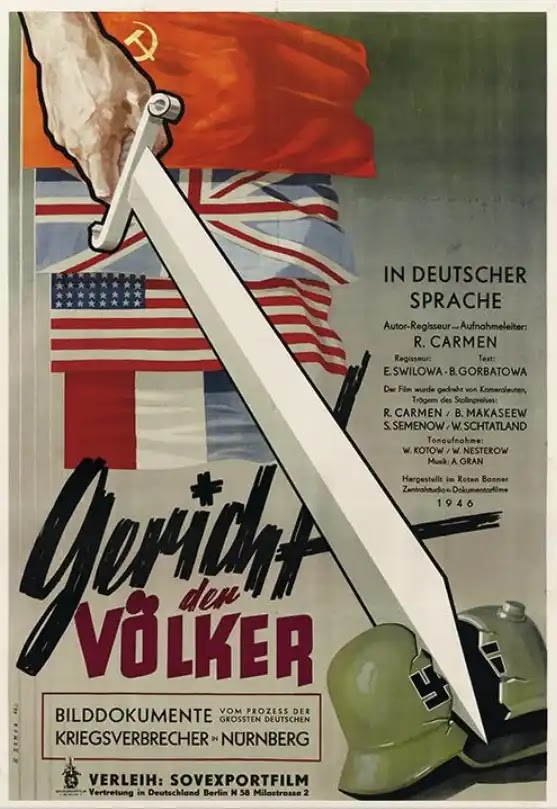
Sud narodov / Nuremberg Trials


Roman Karmen: Суд народов / Sud narodov / Nuremberg Trials (SU 1946).

Суд народов / Nuremberg / Kansojen oikeus / Inför folkens dom.
    SU 1946. PC: The Central Studio of Documentary Film. D: Roman Karmen, Jelizaveta Svilova. SC: Roman Karmen. DP: Roman Karmen, Boris Makasejev, Sergei Semjonov, Viktor Shtatland, J. Stalmakov. M: A. Gran. Reader of commentary: L. Shamara.
    A documentary film of the Nuremberg Trials (20 Nov 1945 - 1 Oct 1946) against the most important surviving leaders of Nazi Germany in the political, military and economic spheres, as well as six German organizations. Nürnberger Prozess gegen die Hauptkriegsverbrecher / Nürnberger Hauptkriegsverbrecherprozess.
    THE ACCUSED (in the order of appearance): Hermann Göring, Rudolf Hess, Joachim von Ribbentrop, Wilhelm Keitel, Ernst Kaltenbrunner, Alfred Rosenberg, Hans Frank, Wilhelm Frick, Julius Streicher, Günter Funck, Hjalmar Schacht, Karl Dönitz, Erich Raeder, Baldur von Schirach, Sauckel, Alfred Jodl, Franz von Papen, Arthur Seyss-Inquart, Albert Speer, Konstantin von Neurath, Hans Fritzsche.
    PROSECUTORS (seen in the film): Robert Jackson (US), Roman Rudenko, Alexandrov, Scheinin, Raginsky, Pokrovsky, Smirnov (SU), Sir Hartley Shawcross, Sir David Maxwell-Fyfe (GB).
    THE JUDGES: Iona T. Nikitchenko, Aleksandr Voltshkov (SU), Sir Geoffrey Lawrence (GB), Norman Birkett (GB), Francis Beverley Biddle (US), John J. Parker (US), Henri Donnedieu de Vabres (FR), Robert Falco (FR).
    66 min. A good 62 min print of the 1960 reissue version with e-subtitles in Finnish by Onni Nääppä.
    Viewed at SEA, Orion, Helsinki, 10 May 2005.

Roman Karmen the daredevil cinematographer was a war correspondent who filmed the war, the capitulation of Dönitz and the (set up) raising of the Soviet flag on the Reichstag building in Berlin. He felt it was his obligation to cover the main Nuremberg trial for the duration, 10 months, from the beginning until the execution.

Theoretically, an ideal pair to Triumph des Willens showing the rightful end of the villains. The authentic documentary footage from ruined Nuremberg and from Nazi horrors, as well as the newsreel footage from the trial with the accused sweating in their stand make this worth seeing. There is also a fascinating montage of the then state-of-the-art technology at the disposal of the court and the press.

But the hectoring commentary spoils the film. Riefenstahl had no commentary and included 20 minute long sequences without speeches. Karmen's film is no work of art. (Kramer's Judgment at Nuremberg, US 1961, does not handle this main trial but a special trial two years later).

This shortened 1970 version never mentions Stalin and has a modern prologue and epilogue heavy-handedly warning against BRD Neo-Nazism and praising the GDR. All the same, worth screening for the interested and attentive audience, who discussed the film quite reservedly after the show.

Friday, April 29, 2005

Der letzte Akt / The Last Ten Days


G. W. Pabst: Der letzte Akt / The Last Ten Days (AT 1955). Albin Skoda (Adolf Hitler), Lotte Tobisch (Eva Braun).

Hitlerin viimeiset päivät / Hitlers sista dagar.
    AT 1955. PC: Cosmopol-Filmproduktion (Vienna). EX: Carl Szokoll. P: Ludwig Polsterer.
    D: G. W. Pabst. SC: Fritz Habeck – based on a treatment by Erich Maria Remarque – based on an outline by Leo Lania – based on the works of Michael A. Musmano, including Ten Days to Die. DP: Günther Anders. PD: Werner Schliching, Otto Pischinger, Wolf Witzemann.
    Filmed at Atelier Wien-Sievering and Baden bei Wien.
    Starring Albin Skoda (Adolf Hitler), Oskar Werner (Captain Wüst), Willy Krause (Goebbels).
    Originally 114', this one 104'.
    A vintage print with Finnish / Swedish subtitles.
    A press screening at Orion, Helsinki, 28 April 2005.

A daring film by Pabst, breaking the German Bilderverbot concerning Hitler, filming in Vienna the taboo subject that was tackled in Germany only 60 years after the fact in Der Untergang. The latter film is superior, but this one is also quite interesting and well acted.

Visually, it is extremely dark, and the Nazi leaders are almost shadows lurking in the bunker. Hitler is portrayed more like a madman than in the Bruno Ganz interpretation. Intriguingly, Pabst wanted Werner Krauss to portray Hitler, presumably because of his ability to portray evil genius and demonic fascination. Albin Skoda is very good, yet somewhere there is a fleeting aspect of something that brings to mind Mike Myers as Dr. Evil.

Unspeakable evil is almost impossible to portray in realistic terms; Caligari and Mabuse were close to the target, as Pabst seems to have realized with his Werner Krauss idea. But the banality of evil that Pabst and Der Untergang highlight is also worth dramatizing. Not one of Pabst's masterpieces, yet a honourable quality production worth seeing. ***