Sunday, October 10, 2004

Paolo Cherchi Usai: The Griffith Project, 8: Films Produced in 1914–1915 (introduction)

The Griffith Project, 8: Films Produced in 1914–1915
Progetto Griffith, parte VIII: I film prodotti nel 1914–1915

Paolo Cherchi Usai (GCM): "Not surprisingly, the years 1914 and 1915 are widely perceived as the best known and the most intensely scrutinized in the career of D. W. Griffith. The background of this eventful period has been established with a certain degree of accuracy: late in 1913, after six years of unrelenting work and almost 500 films directed for the Biograph Company, Griffith signed an agreement with Harry E. Aitken, then co-owner with his brother Roy of two studios – Reliance (New York) and Majestic (Los Angeles) – whose films were released under the Mutual trademark. According to the terms of the contract, Griffith would produce his own feature films while supervising those made by others. By early 1914, the migration of the core Biograph personnel to the Aitken organization (including Lillian and Dorothy Gish, Blanche Sweet, Robert Harron, Henry B. Walthall, Mae Marsh, Donald Crisp, assistant director William Christy Cabanne, and story editor Frank Woods; cameraman Billy Bitzer joined them shortly afterwards) had already taken place. In the course of this annus mirabilis for cinema and world history (war between Germany and Russia was declared on 1 August), Griffith would produce The Birth of a Nation – the most acclaimed and controversial motion picture ever made – and begin working on what would become the “modern story” of Intolerance. This massive epic was bound to occupy him for a good portion of 1915, well into the spring of the following year."

"Film historians have long been accustomed to take The Birth of a Nation as a milestone for the periodization of Griffith’s career: first the Biograph shorts, then the features. In purely auteurist terms, the events of 1914–1915 are firmly established from a filmographic standpoint: four features directed in the first half of 1914 (with The Avenging Conscience becoming the first Griffith film to attract extensive attention in Europe), then The Birth of a Nation, its triumphal or contested screenings throughout the United States, and filming on the first section of Intolerance. Given his hyperactivity, what did Griffith actually manage to supervise for Reliance-Majestic and Fine Arts-Triangle? So far, this question has been marginalized as a footnote in the chronologies of his life. It is by all means an extremely chaotic footnote, made even more confusing by the uneven or contradictory information published by the Aitken companies in the trade journals of the period."

"According to Mutual advertisements, Griffith supervised all Reliance or Majestic productions during much of the first half of 1914. While the features were being marketed through State Rights, the short films in one or two reels were being supplied to theatres through Mutual’s contract distribution organization. They were produced on a regular schedule – a comedy on Monday, a drama on Wednesday, and so on. Hence the first question: Did Griffith have a say in the production of short films as well as the features? The situation is of special interest to early cinema scholarship, as it focuses on an important era in the history of film production: Mutual was in the midst of the transition from shorts to features, and caught between the established market for one-reelers and the growing demand for something bigger and better. There was even some uncertainty on how to define the difference between shorter and longer films – a two-reel film would sometimes be called a “feature”. All in all, Aitken found this new development quite profitable. He was supporting Thomas H. Ince’s ambitious productions, Mack Sennett’s popular comedies, and Griffith’s “masterpieces”, as well as several interesting small companies like Thanhouser. They were all beginning to advertise their stars: Griffith was already a big one, but this was also the time when Chaplin was making his name."

"To further complicate the issue, there is the question of the names given to the production and distribution companies and their corresponding studios. In June 1915, Mutual’s directors replaced Aitken with John Freuler; within a month, Aitken formed the Triangle Film Corporation and took Griffith, Ince, and Sennett with him. Starting with The Lamb (directed by W. Christy Cabanne and released in early October 1915), Triangle became the distributor for all Griffith-supervised pictures. From 1914 to 1919, Griffith rarely moved from his Los Angeles studio at 4500 Sunset Boulevard. Only its name was changed: from the “Reliance-Majestic” studio, to the “Fine Arts” and sometimes “Griffith Studio”, to the “Griffith Artcraft Studio”."

"No systematic attempt has yet been made to bring clarity to this quagmire and determine the extent of Griffith’s participation in these productions (Russell Merritt began tackling the case in his article “The Griffith Third: D. W. Griffith at Triangle”, published in the 1988 Pordenone Festival catalogue Sulla via di Hollywood, 1911–1920). The very term “supervision” is in itself vague enough, as it leaves room for conjecture on whether the term applied to the approval (or even drafting) of the script, cast, and crew, or involved an actual overseeing presence on the set. Both possibilities may apply to Griffith’s case, but the truth on this point may never be known. Inclusion of the “supervised” films in the corpus of The Griffith Project has inevitably been the object of debate within the editorial team since the beginning of this series. Indeed, one is tempted to say that Griffith must have been way too busy with The Birth of a Nation and Intolerance to spend any time on other people’s productions; however, there is adequate proof that many of the films under his nominal responsibility received some degree of personal attention on his part, as testified by trade journal reports and photographs showing him on the set. Several of these production units actually look like small-scale Griffith projects. Their directors were Griffith protégés such as James Kirkwood, Edward Dillon, and Donald Crisp; there were scripts by Anita Loos; and the casts were straight from the Biograph days: Henry B. Walthall, Blanche Sweet, Lillian and Dorothy Gish, Mae Marsh, Spottiswoode Aitken."

"As we felt that this evidence could not be ignored altogether, we have decided to open the debate on this question by incorporating in this and future programs a selection of films credited to Griffith’s supervision, in the hope that further research will shed some light upon this obscure aspect of the director’s activity. The films directed and supervised by Griffith in the years 1914 and 1915 define the parameters of this year’s program, the eighth installment of our multi-year research project involving the analysis of D. W. Griffith’s work. The texts and credits reproduced in this catalogue are excerpts from Volume 8 of The Griffith Project, presented in co-operation with BFI Publishing and available at the Festival.
" – Paolo Cherchi Usai (GCM)

AA resume:

DWG
502  W. Christy Cabanne: The Great Leap - LOST
503  The Battle of the Sexes (feature) - LOST: a 2 min fragment survives
504  James Kirkwood: The Gangsters - LOST
505  The Escape (feature) - LOST
506  James Kirkwood: The Floor Above - LOST
507  W. Christy Cabanne: The Dishonored Medal - LOST
508  James Kirkwood: The Mountain Rat - LOST
509  Home, Sweet Home (feature)
510  The Avenging Conscience
511  Donald Crisp / or Frederick Sullivan: The Painted Lady
512  [Production footage of The Birth of a Nation]
513  The Birth of a Nation (feature)
514  W. Christy Cabanne: Enoch Arden
515  George Nicholls: Ghosts
516  Raoul Walsh: Pillars of Society
517  W. Christy Cabanne: The Martyrs of the Alamo
518  W. Christy Cabanne: The Lamb
519  John Emerson: Old Heidelberg
520  Lloyd Ingraham: The Sable Lorcha - LOST? (KAVI: reels 4+5)
521  Paul Powell: The Lily and the Rose
522  W. Christy Cabanne: Double Trouble
523  Allan Dwan: Jordan Is a Hard Road - LOST
524  John Conway: The Penitentes - LOST
525  Francis Grandon: Cross Currents - LOST
526  Chester M. Franklin, Sidney A. Franklin: Let Katie Do It
527  Lloyd Ingraham: The Missing Links - LOST
528  Edward Dillon: Don Quixote - LOST
529  Paul Powell: The Wood Nymph - LOST
530  John Emerson: His Picture In the Papers
531  Chester M. Franklin, Sidney A. Franklin: Martha's Vindication - LOST
532  W. Christy Cabanne: Daphne and the Pirate - LOST
533  John B. O'Brien: The Flying Torpedo - LOST

32 films - 17 lost
5 DWG-directed features
3 survive
2 lost (fragment of The Battle of the Sexes)

D. W. GRIFFITH AFTER BIOGRAPH

The Birth of a Nation: the big step forward.
All others: a step backward.

The Lamb: Douglas Fairbanks's movie debut - has never screened at Le Giornate del Cinema Muto, nor has His Picture In the Papers
Ibsen: twice.
A new feature: music credits.
Jack Conway: first feature.
Tully Marshall: feature film debut.
The Talmadge sisters arrive, p. 153.
Max Davidson as Sancho Panza, p. 156.
Marie Doro as Prunella, p. 160.
Seena Owen (Signe Auen, of Danish ancestry).
Daphne and the Pirate: "the grandfather of the pirate film" (Paul Spehr), p. 168.

Quality of the cinematography: impossible to assess due to the status of the prints displayed. (Biograph, Pathé).

Dziga Vertov II: Kino-Nedelya 33-35, Godovchina revolyuchii (reels 2, 4) etc., GCM Sacile 2004, narrated by Yuri Tsivian


The 2019 poster of Nikolai Izvolov's reconstruction of: Dziga Vertov: Godovshchina revolyutsii / The Anniversary of the Revolution (Russia 1919). Two reels of Vertov's first feature film were screened in Sacile in 2004. Source: http://www.kinobusiness.com/movies/godovshchina-revolyutsii/ КАРО.Арт, 2019. From: Википедия, Свободная энциклопедия.

DZIGA VERTOV II
Moderator, live translator, narrator and explicador: Yuri Tsivian
Grand piano: Günter Buchwald
Teatro Zancanaro, Sacile, Le Giornate del Cinema Muto (GCM), 10 Oct 2004

Prog. 2 (c. 76’)

KINO-NEDELIA / [CINE-SETTIMANA / KINO-WEEK] NO. 33, 34, 35 (Russia, 1919)
Prod: The Moscow Film Committee [Kinokomitet] of the People’s Commissariat of Enlightenment [Narodnyi Komissariat Prosveshcheniia, Narkompros]; 35 mm, totale: 485 m, 21’ (20 fps), Österreichisches Filmmuseum.
Didascalie in russo / Russian intertitles.

KINO-NEDELIA — 33 / [KINO-WEEK NO. 33] 165 m., 7’
    AA: 31 Jan 1919, the art of observation, trains stuck in the snow.
KINO-NEDELIA — 34 / [KINO-WEEK NO. 34] 160 m., 7’
    AA: 7 Feb 1919, Norway, Danton.
KINO-NEDELIA — 35 / [KINO-WEEK NO. 35] 160 m., 7’
    AA: 14 Feb 1919, Trotsky, fine visual quality.

Yuri Tsivian (GCM): "Heavy snowfalls, which hampered life both at the front and at home, were the recurrent news of the Kino-Week issues of 31 January and 7 February 1919. We see forced labor — a measure taken by the Soviet government to clean streets and sidewalks in Moscow, watch the Red Army’s battle with snowdrifts blocking the tracks, and are shown villagers digging their village out so that children can go to school. The funerals of field commanders are another theme in Kino-Week’s January and February issues — distinct from peace-time obituaries, these events appear before, not after, the rest of the news. The murder of Karl Liebknecht and Rosa Luxemburg in Germany stirs a protest demonstration in Kiev, shows Kino-Week of 14 February 1919 — and everyone seems to be ready to invade Germany to help Communists there. That the civil war in Russia was merely a result of Russia’s internal crisis, caused by Russia’s lack of success in World War I, was not as obvious in 1919 as it is to us today. In those days, many believed that what was going on in Russia was the beginning of the last war on earth — the World Revolution predicted by Karl Marx." – YURI TSIVIAN

GODOVSHCHINA REVOLIUTSII / [L’ANNIVERSARIO DELLA RIVOLUZIONE / THE ANNIVERSARY OF THE REVOLUTION] (Russia, 1918)
Rullo / Reel 2: "GODOVSHCHINA FEVRALSKOI REVOLIUTSIIV PETROGRADE" / ["THE ANNIVERSARY OF THE FEBRUARY REVOLUTION IN PETROGRAD"]
Dir: Dziga Vertov, A.I. Aleksei Savelev; prod: The Moscow Film Committee [Kinokomitet] of the People’s Commissariat of Enlightenment [Narkompros]; rel: 7.11.1918; r. / rl. 2, 35 mm, 308 m., 13’ (20 fps), RGAKFD.
Didascalie in russo / Russian intertitles.

"Vertov’s first feature, The Anniversary of the Revolution, is a found-footage film put together from fragments taken from Kino-Week issues, which explains why many of these only survive in parts. Unfortunately, the same thing happened to The Anniversary of the Revolution, whose footage was so often recycled in later movies dedicated to this event that little of it survives intact to this day. The part we are showing (reel 2 of the original film) deals with the February Revolution of 1917 — the one that resulted in the Tsar’s abdication and the transfer of power to a more-or-less liberal Provisional government, overthrown by the Bolshevists in October. Film historians will remember the head of this government, Aleksandr Kerensky, impersonated by a look-alike in Sergei Eisenstein’s 1928 October. This is our chance to see how Kerensky looked in real life (the resemblance is rather close, one has to admit, including the peacock-like deportment)." – YURI TSIVIAN

AA: High contrast. 25 Feb 1917 Petrograd, Znamensky Square, Kerensky, 4 March 1917 funeral, provisional government, Pavelsky-Pavlovich, Sosnovsky, Schlichter, Proshnyan, Vladimirsky, Schmidt, Demyan Bednyi, Tomsky, Karelin, Sklyansky, Podvoisky, Rattel, Muralov, Schtrodakh, Pechle, Berzin.

MOZG SOVETSKOI ROSSII / [THE BRAIN OF SOVIET RUSSIA] (Russia, 1919)
Dir: Dziga Vertov; prod: The Moscow Film Committee [Kinokomitet] of the People’s Commissariat of Enlightenment [Narkompros]; rel: 1.5.1919; 35 mm, 317m., 14’ (20 fps), RGAKFD.
Didascalie in russo / Russian intertitles.

"The Brain of Soviet Russia constituted the fourth reel of The Anniversary of the Revolution, but it was also shown as a separate film. It introduces the members of the first Soviet government (ten of whom would be shot or assassinated by the one that succeeded it) and their new headquarters, the Moscow Kremlin, where this government moved from St. Petersburg (then Petrograd) in 1918. The Brain of Soviet Russia was released as a separate film on 1 May 1919. Lenin (who here appears on film for the first time after being shot by an assassin) ordered it to be sent abroad, so the world could learn "who was who” in the Kremlin." – YURI TSIVIAN

AA: "Vertov's most bureaucratic film", his business card abroad. Lenin, Bonch-Bruyevich, Trotsky *, Sverdlov, Vatsetitsh, Lunacharsky, Pokrovsky, Chicherin, Karakhan, Steklov, Radek, Sereda, Stuchka, Churyupa, Rykov, Podbelsky, Chlyapnikov, Kamenev, Rakovski, Krasin, Rogov, Zalevski.

PROTSESS MIRONOVA / [IL PROCESSO MIRONOV / THE TRIAL OF MIRONOV] (Russia, 1919)
Dir: Dziga Vertov; prod: The Revolutionary Military Soviet & The Moscow Film Committee [Kinokomitet] of the People’s Commissariat of Enlightenment [Narkompros]; ph: P. Piotr Ermolov; 35 mm, 287m., 13’ (20 fps), RGAKFD.
Didascalie in russo / Russian intertitles.

Yuri Tsivian (GCM): "The Cossack Colonel Filipp Mironov (1872-1921), whose court-martial Vertov recorded on film in 1919, was a well-known and rather unorthodox civil war figure. These two qualities help to explain why he was tried, and why a film crew was sent to film the trial. Formerly an officer in the Tsar’s army and a hero of the Russo-Japanese War, in 1906 Mironov was demoted to the ranks for his Socialist sympathies and his participation in the Cossack revolutionary movement. His military career looked up again in 1914 (he earned four military decorations during the first three years of World War I), and skyrocketed after 1917, when Mironov was made commander of a cavalry division which fought against the White Army in the south. Mironov’s military successes and his relative tolerance (he was known to spare his prisoners and to have outlawed the death penalty in the territories occupied by his troops) won him popularity among the local Cossack population."

"Apparently Mironov did not think much of Lenin and Trotsky as military strategists, for whenever he disagreed with orders from Moscow he did it his own way. It was in the course of an unsanctioned offensive of this kind that the First Red Cavalry Army surrounded and disarmed Mironov’s cavalry unit in August 1919. Mironov was arrested in the town of Balashov and accused of insubordination. Public speeches, as shown in the film The Trial of Mironov, were part of a campaign aimed at explaining to the population why the Bolshevist government decided to court-martial their legendary hero. The Extraordinary Tribunal sentenced Colonel Mironov to death, but by a special decree of the Central Executive Committee he was pardoned "in view of his great former merits for the Revolution”."

"Vertov’s film ends on this note, but not Mironov’s military career. In January 1920 Mironov joined the Communist Party (which automatically made a person subject to Party discipline), and that October he was put in command of the Second Red Cavalry Army, adding two Red Flag Medals to his four pre-Revolutionary decorations. After the war — in January 1921 — Mironov was arrested again, this time in Moscow, on charges of preparing an anti-Soviet mutiny. This time there was no trial. An escort shot him to death in Butyrsky Prison — by chance, according to the official communiqué. In 1921 Vertov included The Trial of Mironov in his found-footage feature The History of the Civil War.
" – YURI TSIVIAN (GCM)

AA: Yuri Tsivian in his live commentary summed up that this is a filmed record of the first show trial in Soviet Russia.

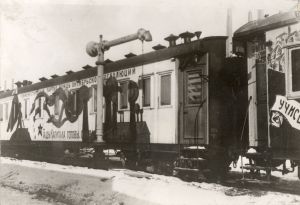
LITERATURNO-INSTRUKTORSKII AGITPAROKHOD VTSIK "KRASNAIA ZVEZDA" / [THE RED STAR LITERARY-INSTRUCTIONAL AGIT-STEAMER OF THE ALL-RUSSIA CENTRAL EXECUTIVE COMMITTEE] (Russia, 1919)
Dir: Dziga Vertov; prod: The Moscow Film Committee [Kinokomitet] of the People’s Commissariat of Enlightenment [Narkompros]; ph: P. Piotr Ermolov, Aleksandr Lemberg; 35 mm, 335 m., 15’ (20 fps), RGAKFD.
Didascalie in russo / Russian intertitles.

Yuri Tsivian (GCM): "The Red Star Literary-Instructional Agit-Steamer of the All-Russia Central Executive Committee is a political travelogue. Covered with slogans and motley political cartoons, agit-trains and agit-steamers were bandwagons of sorts, sent to spread propaganda in Russia’s faraway towns and villages. Some of them carried a film crew and were equipped with a projector; some had well-known political figures travelling on board. The Red Star, a literary-instructional agit-steamer of the All-Russia Central Executive Committee, had both. There were two cameramen on board (P. Ermolov and Aleksandr Lemberg), registering the ship’s progress down the Volga River, and a political celebrity, Lenin’s wife Nadezhda Krupskaia, whom we see first on deck, then ashore, talking to local factory workers. The politkom (political commander) of the Red Star agit-steamer happens to be Viatcheslav Molotov, an upcoming celebrity, Stalin’s future minister of foreign affairs."

"The film begins and ends with views of a barge that the Red Star had in tow. It is a kino-barzha, a movie-barge in which films are shown to the locals when the ship is moored. Vertov’s camera pans along the barge’s hull, decorated with a loudly-colored panel, pausing at an emblem illustrating the objective of the literary-instructional agit-steamer — an open book, and next to it the inscription: "Landowners and bourgeoisie kept the people in darkness — the Soviet power opens a road to knowledge". Note that the agit-steamer is equipped with a radio-station, tuned to the Rosta (Russia’s Telegraph Agency) news service.
" – YURI TSIVIAN (GCM)

AA: Indeed, Molotov and Krupskaya both recorded in this Dziga Vertov film.

Underground


Anthony Asquith: Underground (1928): photos from the souvenir programme. Photos from the article by Samuel Wigley on the website of the BFI.

UNDERGROUND (British Instructional Films, GB 1928)
    Dir/sc: Anthony Asquith; prod: H. Bruce Woolfe; ph: Stanley Rodwell; lighting: Karl Fischer; des: Ian Campbell-Gray; cast: Brian Aherne, Elissa Landi, Cyril McLaglen, Norah Baring; trade show: 7.1928; 35 mm, 7339 ft, 89’ (22 fps), BFI / National Film and Television Archive.
    Unreleased in Finland.
    Didascalie in inglese / English intertitles.
    Grand piano: Gabriel Thibaudeau.
    Viewed at Teatro Zancanaro, Sacile, Le Giornate del Cinema Muto (GCM): Asquith e gli altri, 10 Oct 2004

Bryony Dixon (GCM): "Anthony Asquith’s second feature angered contemporaries by setting a working-class love story in a thoroughly modern London landscape. The critics misunderstood the realistic nature of Asquith’s story. They preferred their working-class protagonists to be salt-of-the-earth Cockneys like Betty Balfour’s Squibs, not independent young ladies with jobs in department stores who travel by Tube. They even criticized the German-influenced lighting schemes from imported expert Karl Fischer. The film was ahead of its time, and now we praise those very elements for which it was criticized."

"Asquith’s original screenplay is a simple tale of light and dark. Two men compete for the affections of beautiful Elissa Landi. One (Brian Aherne) is a pleasant, uncomplicated, upwardly mobile young man, the other (Cyril McLaglen) a dangerous and resentful philanderer in an abusive relationship with a seamstress (Norah Baring), a poverty-stricken victim. The argument between the two men culminates in tragedy atop the Lots Road power station, and finishes in a classic rooftop chase. Watch also for a trademark Asquith shot in the pub sequence, where we see the two fighting men in a smashed mirror. The contemporary detail is fascinating for modern audiences. And for anyone who has observed the strange behavioural etiquette of the London Underground, they will notice that little has changed.
" – Bryony Dixon (GCM)

AA: The second of Anthony Asquith's three great silent films, representatives of the "high silent" years just when the breakthrough of the sound film began. The print screened was gray, in low contrast, before restoration.

BEYOND THE JUMP BREAK: DATA FROM BFI SCREENONLINE:

Im Land der Kinoveteranen: Filmexpedition zu Dziga Vertov / In the Land of Cinema Veterans: A Film Expedition Around Dziga Vertov


Photo not from this film. V Ar 013. Agitzug "Oktjabr'skaja Revoljucija". Photo: Österreichisches Filmmuseum, Collection Dziga Vertov.

IM LAND DER KINOVETERANEN: FILMEXPEDITION ZU DZIGA VERTOV / IN THE LAND OF CINEMA VETERANS: A FILM EXPEDITION AROUND DZIGA VERTOV (Sturzbach-Film, Hamburg / NDR-Television, D 1996)
    Un film di / A film by Thomas Tode & Ale Muñoz; prod. sup. (NDR-Television): Klaus Wildenhahn: ph: Rasmus Gerlach; interviewees: Jakov Tolchan, Viktor Listov; narr. (versione inglese / English version): Stefan Canham, Matthew Partridge; consultant: Viktor Listov; 16 mm, 944 m, 86’ (25 fps), colore e bn / color & b/w, sonoro / sound; Thomas Tode, Hamburg.
    Versione inglese / English narration.
    In the presence of Thomas Tode and Rasmus Gerlach.
    Viewed at Cinema Ruffo, Sacile, Le Giornate del Cinema Muto (GCM), 10 Oct 2004.

1996 Rotterdam Film Festival catalogue: "Film about the great cineaste Dziga Vertov, the poetic-revolutionary filmmaker who, with his "Kino-Eye" theory and films such as Man with a Movie Camera (1929) and Enthusiasm (1931), made his mark on film history. Filmmakers Thomas Tode and Ale Muñoz approach Vertov from the present in their documentary portrait of this revolutionary Soviet filmmaker. They travelled by train to Moscow, not only because Vertov loved trains, but also so that they could mix his train shots with their own. And, of course, so they could tell the legendary story of the agit-prop trains, the mobile cinemas with which Bolshevik filmmakers travelled the Soviet Union in the 1920s to bring their political ideals to the people."

"In the spirit of Vertov, Tode and Muñoz look around present-day Moscow with "kino-eyes", focusing on phenomena illustrative of social change. Their travelogue is continually focused on getting to know more about Vertov, while also showing contemporary Russia. In this idiosyncratic combination, the film distinguishes itself from traditional portraits of great filmmakers and journalistic reports on the social situation of a land in crisis. For instance, the filmmakers talk to Vertov’s cameraman Jakov Tolchan and Russian Vertov researcher Viktor Listov. The film comprises many well-chosen film fragments from the oeuvre of Vertov, and there are plenty of quotes from the film manifestos Vertov wrote.
" — 1996 Rotterdam Film Festival catalogue

AA: A good documentary film in the spirit of Vertov with rare interviews and illuminating samples of Vertov's films. A good 16 mm film projection.

The Invaders (1912)


Francis Ford and / or Thomas H. Ince: The Invaders (1912), starring Francis Ford.

THE INVADERS (New York Motion Picture Co., US, 1912). Producer: Thomas H. Ince. Director: Francis Ford and / or Thomas H. Ince. Writer: C. Gardner Sullivan.
    Cast: Francis Ford (Colonel James Bryson, the cavalry commandant), Ethel Grandin (his daughter), Anna Little (Sky Star), Art Acord (telegraph operator), Ray Myers, Luther Standing Bear and other unidentified Oglala Sioux. 35 mm, 3 reels, 2880 ft, 41 min (18 fps). Preserved by the Library of Congress.
    English intertitles.
    The Invaders (1912) online at the Internet Archive.
    Grand piano: Phil Carli.
    Viewed at Teatro Zancanaro, Sacile, Le Giornate del Cinema Muto (GCM): Treasures from the American Archives, 10 Oct 2004.   

Scott Simmon (GCM): "Thomas Ince’s The Invaders is one of the first great Westerns, a broken-treaty tale whose power owes much to its Native American actors. At three reels its portrayal of reluctant U.S. Cavalry troops forced to battle Sioux and Cheyenne was an epic in 1912, when most films still squeezed their stories into a single reel."

"The change from earlier Westerns was partly in the scale of production. Soon after Ince arrived in Los Angeles in 1911 to take over the New York Motion Picture Company’s Westerns, the company made a deal with “The Miller Bros. 101 Ranch Real Wild West Show” to employ its performers, and leased twenty-eight square miles above Santa Monica. The impressive location—soon known as “Inceville”—could pass for the Dakotas when the camera was pointed away from the surf. Among the 101 Ranch employees were some fifty Oglala Sioux from the Pine Ridge Reservation in South Dakota."

"The Invaders allots equal time for personal dramas among the Native Americans, and is structured through parallel plots within the cavalry post and Sioux village: In each a father must approve a suitor for his daughter. The simple story derives some of its force by combining the two key American fables of self-sacrifice on the frontier: A Custer story (a contingent of the Seventh Cavalry is again slaughtered) is joined to a Pocahontas story (a chief’s daughter again saves a white community)."

"For all the conventionality in The Invaders’ portrait of Indians—who are ultimately both savage and sentimentalized—the film retains surprises. Audiences might presume its title will refer to some rampaging redskins, but it is the Eastern surveyors for the transcontinental railroad, laughing off cavalry protection and treaty terms, who will prove to be “the invaders.”
" – Scott Simmon (GCM)

AA: A powerful Western, with the rough and unvarnished touch of reality typical for Francis Ford. The film is the tragedy of a Sioux maid, comparable with Griffith. (Actually, as Scott Simmon observes, a double tragedy: Pocahontas and Custer). She tried to warn the white surveyors. A full battle breaks out. The Sioux maid alerts the cavalry with her last ounce of strength. The massacre has already taken place. Brutal footage of naked, bloody corpses of surveyors. Escalation to a full war: the Sioux vs. the cavalry. The Cheyenne to the rescue via smoke signals. They crush the cavalry, attack the garrison and set the telegraph pole on fire. Too late! The Sioux girl meant to be a hostage is dead. Good action passages. The end: the last bullet, the last minute rescue. A strong ending in the middle of the Sioux. Finis. A fair print, not prime, a dupe impact, mediocre, with some images of more vivid quality.

From C-V News [Filming Greed in Death Valley]


Not from the newsreel. Erich von Stroheim: Greed (1924). The finale in Death Valley. Photo: IMDb.

From C-V News [Filming Greed in Death Valley] (1923). The violinist and the pianist in Death Valley.

From C-V NEWS [Filming GREED in Death Valley] (Vanderbilt Newspapers, Inc., US, 1923). Director unknown. 35 mm, 4 min (16 fps). Preserved by the UCLA Film and Television Archive.
    English intertitles.
    Grand piano: Phil Carli.
    Viewed at Teatro Zancanaro, Sacile, Le Giornate del Cinema Muto (GCM): Treasures from the American Archives, 10 Oct 2004.   

Scott Simmon (GCM): "The second piece is a tantalizing glimpse of a legendary moment in location filmmaking—Erich von Stroheim’s shooting of Greed in Death Valley—documented in a brief segment from the now-forgotten newsreel series C-V News. In addition to national newsreels, American movie programs in the twenties often included local stories reported by regionally distributed newsreels, such as CV-News. Known only through a few surviving fragments, it appears to have been a short-lived Southern California newsreel from the Vanderbilt tabloid newspaper chain."

"To recreate the final pages of Frank Norris’s McTeague with complete realism, Stroheim chose to shoot in Death Valley during the blinding heat of mid-summer. The men on horseback shown packing equipment also played the posse that trail McTeague after he murders his wife. The most revealing shots follow the intertitle “Countless hardships met with good grace by the company of thirty nine men and one lone woman over a period of thirty seven days.” Stroheim, wearing long white headgear, can be just glimpsed from behind, gesticulating as he walks backward in front of the camera car. Next to him is the “one lone woman,” Eve Bessette, his longtime script clerk. Photographed on horseback is Jean Hersholt as Marcus, who pursues McTeague, played by Gibson Gowland, who is seen (after a jump cut) leading his mule. This footage reveals another fascinating detail. Music was performed regularly on locations in the 1920s to help actors find the right moods, but who would have expected to see a violin and piano duo in the Death Valley summer?
" – Scott Simmon (GCM)

Inklings, Issue 12


Dave Fleischer: Inklings, Issue 12, last item: The House That Jack Built. My screenshot from YouTube.
Dave Fleischer: Inklings, Issue 12, last item: The House That Jack Built. The house is seen to come apart in silhouette animation: "This is the horse and the hound and the horn / That belonged to the farmer sowing his corn / That kept the rooster that crowed in the morn / That woke the judge all shaven and shorn / That married the man all tattered and torn / That kissed the maiden all forlorn / That milked the cow with the crumpled horn / That tossed the dog that worried the cat / That killed the rat that ate the malt / That lay in the house that Jack built." My screenshot from YouTube.
Dave Fleischer: Inklings, Issue 12, last item: The House That Jack Built. In the end, the elements merge and the house comes together again. My screenshot from YouTube.

INKLINGS, ISSUE 12 (Inkwell Studios / Red Seal Pictures Corp., US, 1925). Director / Animator: Dave Fleischer. 35 mm, 6 min (24 fps). Preserved by the Museum of Modern Art.
    English intertitles.
    In the presence of Annette Melville.
    Grand piano: David Drazin.
    Viewed at Teatro Zancanaro, Sacile, Le Giornate del Cinema Muto (GCM): Treasures from American Archives

Scott Simmon (GCM): "The pun in the title Inklings – suggesting both simple drawings and emerging ideas – matches the witty optical illusions in the films themselves. The director and lead animator of the series, Dave Fleischer, had a contentious relationship with his older brother Max, who received more credit for their celebrated Out of the Inkwell collaborations. Inklings was an effort by Dave to go it alone. Only three issues of this forgotten but brilliantly inventive series are known to survive, all preserved by the Museum of Modern Art."

"In this twelfth issue, a painting of a bearded man inverts into the then-familiar image of Rin-Tin-Tin, ink drawings of children grow into unexpected adults, and a black panel is cut by knife to discover the characters literally within “The House That Jack Built”—a favorite children’s rhyme since the eighteenth century. The segments are introduced by the artist’s hand, animating and itself animated.
This Inklings screening will also feature a performance of the new score created by celebrated film and television composer Fred Steiner especially for the More Treasures from American Film Archives DVD set.
" – Scott Simmon (GCM)

AA: An assured touch in a simple and basic but well-made animation with three items: 1) the head of a man turns around and becomes Rin-Tin-Tin, 2) the faces of children change completely when they grow up, 3) the nursery rhyme "The House That Jack Built" is illustrated in silhouette animation. A good print.

The Wonderful Wizard of Oz (1910)


Otis Turner: The Wonderful Wizard of Oz (1910) with Bebe Daniels as Dorothy.

THE WONDERFUL WIZARD OF OZ (Selig Polyscope Co., US, 1910).
    Director/Writer: Otis Turner, from the novel The Wonderful Wizard of Oz (1900) by L. Frank Baum and the stage musical The Wizard of Oz (1902) by L. Frank Baum and Julian Mitchell, with music by Paul Tietjens. Cast: Bebe Daniels (Dorothy), Hobart Bosworth (Wizard of Oz?), Robert Z. Leonard (Tin Woodman?), Eugénie Besserer (Aunt Em?), Winnifred Greenwood, Lillian Leighton, Olive Cox, Alvin Wyckoff, Marcia Moore. 35 mm. 13 min (18 fps). Preserved by George Eastman House.
    English intertitles.
    Grand piano: Donald Sosin .
    Viewed at Teatro Zancanaro, Sacile, Le Giornate del Cinema Muto (GCM): Treasures from the American Archives, 10 Oct 2004.

Scott Simmon (GCM): "This first surviving film of L. Frank Baum’s The Wonderful Wizard of Oz is filled with characters and incidents that have a primal familiarity – thanks to the 1939 MGM musical. Squeezed into one reel are young Dorothy and her dog Toto in rural Kansas; the cyclone that carries them to the land of Oz ruled by its “humbug” Wizard; her faithful companions the Scarecrow, the Cowardly Lion, and the Tin Woodman; the good witch Glinda and a Wicked Witch of the West. Missing are the book’s munchkins and magic slippers, but added are such comic touches as the unionized women workers of Emerald City. As it survives, the film begins abruptly with a glimpse of Aunt Em, Uncle Henry, and the Kansas farm.

Due mainly to a popular musical adaptation that had toured for eight years, the Wizard of Oz story was so familiar by 1910 that the film could be structured as somewhat disconnected scenes. The film retains a charming theatricality as well as the stage version’s dance-and-comedy team of the Scarecrow and the piccolo-playing Tin Woodman. Dorothy is played by nine-year-old Bebe Daniels, and many others in the cast would have long Hollywood careers.

This film was the first of several Selig one-reelers about Oz – all but this one now lost. The sequel, Dorothy and the Scarecrow in Oz, released three weeks later, showed our friends lulled to sleep in the field of poppies and the good witch Glinda helping Dorothy find her way back home.
" – Scott Simmon

AA: The earliest surviving Wizard of Oz movie is a busy adaptation, a lot of fun, with a Méliès impact, vivid, moving. Black is missing from the viewing print. This was Bebe Daniels's second film: she would make for Hal Roach a long series films with Harold Lloyd, play in Douglas Fairbanks's first film, be "Satan Synne" for Cecil B. DeMille in The Affairs of Anatol, and participate in 42nd Street before marrying Ben Lyon and sharing her career with him.  ***

Dziga Vertov I: Kino-Nedelya 1–32, GCM Sacile 2004, narrated by Yuri Tsivian


DZIGA VERTOV I
Moderator, live translator, narrator and explicador: Yuri Tsivian
Grand piano: John Sweeney
Teatro Zancanaro, Sacile, Le Giornate del Cinema Muto (GCM), 10 Oct 2004

Prog. 1 (ca 82’)

VERTOV PRIVATAUFNAME / [VERTOV FILMED IN PERSON] (USSR, 1922, 1923, + post-1930)
ed: Elizaveta Svilova; 35mm, 21 m., 55" (20 fps), Österreichisches Filmmuseum.
Senza didascalie / No intertitles.
This appears to be Elizaveta Svilova’s latter-day compilation of outtakes and cut-outs from films in which Vertov appears. Kino-Pravda issues 8 and 17 can be identified as two of the sources. – YURI TSIVIAN

[VERTOV INTERVIEWS] (USSR, post-1935)
ed: Elizaveta Svilova; 35mm, 15 m., 39" (20 fps), Österreichisches Filmmuseum / Austrian Film Museum.
Didascalia in francese / One intertitle, in French.
Possibly another later compilation by Elizaveta Svilova of documentary shots featuring Vertov. The shots in which Vertov is being interviewed by Sojin Kamiyamo (Japan) may have been taken at the Moscow Film Festival in 1935. – YURI TSIVIAN

KINO-NEDELIA / [CINE-SETTIMANA / KINO-WEEK] NO. 1, 3, 4, 5, 20, 21, 22, 23, 24, 25 (Russia, 1918), NO. 31, 32 (Russia, 1919)
Prod: The Moscow Film Committee [Kinokomitet] of the People’s Commissariat of Enlightenment [Narodnyi Komissariat Prosveshcheniia, Narkompros]; 35 mm, totale: 1820 m, ca 80’ (20 fps), Österreichisches Filmmuseum, eccetto / except No. 20, RGAKFD.
Didascalie in russo / Russian intertitles, except No. 32: Didascalie in norvegese / Norwegian intertitles.

Kullervo Manner, Chairman of the Finnish People's Delegation in January – April 1918, Speaker of the Finnish Parliament in 1917, seeks asylum in Russia from the white terror in Finland. — Kinonedelja No. 1. 20.5.1918. Video Duration: 7 min 55 sec. 1. The Moscow Union of Metal Workers celebrates the centenary of Karl Marx's birth. / A speech by the Soviet Peoples’ Commissar, Comrade Lenin. / Lev Trockij, the Peoples’ Commissar for Military Affairs, reviews the parade. 2. Orša: Refugees return to a province formerly occupied by the Germans. / Refugees at the demarcation line. / Lined up to receive passes. / In Orša, the border between the Russian and German-occupied areas runs through the railway station. / Negotiations between the Russian and German forces. / Due to the shortage of train cars, refugees must wait for weeks to be sent home. 3. Moscow, May 9: The case of P. E. Dybenko comes before the revolutionary tribunal. / The tribunal. / Tribunal chairman Berman. / Comrades Štejnberg and Egorov, counsels for the defense. / The prosecutor, Comrade Krylenko. / The former Peoples’ Commissar Pavel Dybenko, the accused. / Dybenko at Narva. 4. Kursk: Comrade Podvojskij, the Peoples’ Commissar for Military Affairs, at a Red Army parade. 5. Petrograd: The Chairman of the Finnish People's Delegation, Manner, who fled to Russia. 6. Moscow: People strolling in the Virgin-Field (Devič'e pole). / A toy stall. — My screenshots and added opening remarks about Kullervo Manner. — The film and the protocol: Österreichisches Filmmuseum / Collection Dziga Vertov.

KINO-NEDELIA — 1 / [KINO-WEEK NO. 1] 156 m., 6’48"
    AA: Kullervo Manner rescued from the White Terror in Finland. Print good.

KINO-NEDELIA — 3 / [KINO-WEEK NO. 3] 174 m., 7’36"
    AA: Print ok.

KINO-NEDELIA — 4 / [KINO-WEEK NO. 4] 101 m., 4’24"
    AA: 25 June 1918. Council, Helsinki, Ruzhek.

KINO-NEDELIA — 5 / [KINO-WEEK NO. 5] 113 m., 4’56"
    AA: 2 July 1918.

KINO-NEDELIA — 20 / [KINO-WEEK NO. 20] 209 m., 9’08"
    AA: October 1918. NO.

KINO-NEDELIA — 21 / [KINO-WEEK NO. 21] 151 m., 6’35"
    AA: 22 Oct 1918. Cavalry attack.

KINO-NEDELIA — 22 / [KINO-WEEK NO. 22] 190 m., 8’17"
    AA: 29 Oct 1918. Lenin. Good.

KINO-NEDELIA — 23 / [KINO-WEEK NO. 23] 121 m., 5’17"
    AA: 5 Nov 1918.

KINO-NEDELIA — 24 / [KINO-WEEK NO. 24] 169 m., 7’24"
    AA: 19 Nov 1918. Kamenev, Sverdlov. Sevchenko, Robespierre.

KINO-NEDELIA — 25 / [KINO-WEEK NO. 25] 107 m., 4’40"
    AA: 26 Nov 1918. Yesenin, Koltsov, Niku...

KINO-NEDELIA — 31 / [KINO-WEEK NO. 31] 204 m., 8’54"
    AA: Zinovyev.

KINO-NEDELIA — 32 / [KINO-WEEK NO. 32] 125 m., 5’24"
    AA: Agit train. Beautiful snowscapes. Kotcheniko. Nuns.

Yuri Tsivian (GCM): "Kino-Week was a year-long week-by-week record of daily life at the time of the civil war, a war waged on a tangle of fronts. Internally, the Red Army (formed soon after the Socialist Revolution in October 1917) fought against the White Army, loyal to the old Russia of the Tsars. That was the "civil" part of the civil war. The other part was World War I, which Russia entered in 1914 on the side of the Entente, and from which it was now trying to extricate itself. German and Austrian troops advanced in the west, the Turks in the south. But no sooner had Russia’s new government reached a peace with Russia’s old enemies than its former allies marched in. American troops, aided by the Japanese, landed in Siberia, while the French and British landed in the south. Famine led the Bolshevists to the policy of forced product requisitions, which led to peasant mutinies, which encouraged non-Bolshevist revolutionary parties to rise against the party in power. In response, the Soviet Government announced the "Red Terror" policy. The war ended in 1920. All sides paid a high price in blood."

"The entire run of Kino-Week covers the period from May 1918 through June 1919. A total of 43 issues of the film journal were released. It was initially released by Mikhail Koltsov, then by N.P. Tikhonov, E. M. Shneider, and others. Vertov was the author of the text and the director of several issues. Apparently he began making Kino-Week in the second half, or even at the end, of 1918. But even in the Kino-Week issues made under Vertov’s supervision we will not find much that anticipates his later experiments in film form, of the kind found in his Kino-Pravda, the experimental newsreel launched in 1922."

"But even if Kino-Week is not very unusual as a piece of filmmaking, the time it documents makes this newsreel unusual enough. Its first issue (20 May 1918) informs the viewer of the following events: 20 days ago, for the first time in history, the First of May was officially celebrated — we see Lenin and People’s Commissar for Military Affairs Leon Trotsky reviewing the Red Army parade in Red Square. 100 years ago — on 5 May 1818 — Karl Marx was born in Trier, Germany, and a bizarre vehicle called the Anniversary Chariot, constructed for the occasion by the Moscow Union of Metal Workers, circles the streets of Moscow, complete with a tableau vivant staged aboard a truck-driven globe! The celebrated Revolutionary hero, sailor-turned-Peoples’-Commissar-for-the-Navy Pavel Dybenko, appears before the Revolutionary Tribunal on 9 May, charged with having lost the Battle of Narva to the Germans earlier in February (he will be acquitted, but is expelled from the Communist Party all the same). It’s May: The Russians and Germans are already talking, and mutual refugees are being returned. A festive crowd enjoys the Moscow spring. Do not miss the close-up of a handsome homemade mechanical toy which a boy toy-vendor demonstrates to prospective buyers."

"Such, in a nutshell, are the current events depicted in Kino-Week No. 1. Other issues are more or less like the first: a mix of war and peace ("Townspeople planting potatoes" or "A tobacco line in Petrov street"); a living gallery of obscure and all-too-familiar historical figures ("Moscow. Lenin is recovering from wounds"); an occasional scenic picture ("Peter and Paul Fortress during the White Nights"); a record of bizarre anniversaries and endless unveilings of countless short-lived monuments to the new pantheon of heroes: Danton, Robespierre, Radishchev, Bakunin ("Across from the monument to Koltsov stands the monument to Nikitin," pedantically specifies one intertitle from Kino-Week No. 25). Short-lived, because all these 1918 statues (commissioned by the Government in keeping with Lenin’s "Plan for Monumental Propaganda") were quickies made of non-durable materials (plaster and the like). A curious case in the history of monumental art: an entire generation of monuments survives thanks to the fragile medium of film.
" – YURI TSIVIAN (GCM)

AA:  This fantastic collection from the year of the revolutionary warfare made special sense thanks to the live commentary by Yuri Tsivian.

Saturday, October 09, 2004

Film concert The General with Alloy Orchestra (GCM Sacile 2004)


Buster Keaton: The General (1927).

Evento inaugurale / Opening Event

THE GENERAL (Buster Keaton Productions / United Artists, US 1927)
    Dir: Buster Keaton, Clyde Bruckman; prod: Joseph M. Schenck; sc: Buster Keaton, Clyde Bruckman; adapt: Al Boasberg, Charles Smith, dal libro / from the book The Great Locomotive Chase by William Pittenger; ph: J. Devereux Jennings, Bert Haines; ed: J.S. Kell; lighting effects: Denver Harmon; technical dir: Fred Gabourie; asst. dir: Harry Barnes; cast: Buster Keaton (Johnnie Gray), Marion Mack (Annabelle Lee), Glen Cavender (Captain Anderson), Jim Farley (General Thatcher), Frederick Vroom (Southern General), Charles Smith (il padre di Annabelle / Annabelle’s Father), Frank Barnes (il fratello di Annabelle / Annabelle’s Brother), Joe Keaton (Union General), Mike Donlin (Union General), Tom Nawn (Union General), Ross McCutcheon (Norther raider), Snitz Edwards [scenes cut after premiere]; copyright: 22.12.1926; rel: 5.2.1927; lunghezza originale / orig. length: 7500 ft.; 35mm, 7079 ft., 79’ (24 fps), The Douris Corporation.
    Didascalie in inglese / English intertitles.
    Accompagnamento musicale dal vivo di / Live score by Alloy Orchestra.
    Le Giornate del Cinema Muto 2004 Sacile, Teatro Zancanaro, 9 Oct 2004

David Robinson (GCM): "Buster Keaton said, late in his life, that he was more proud of The General "than any picture I ever made, because I took an actual happening out of the Civil War – out of the history book”.  The narrative is closely based on true events recalled at length in William Pittenger’s book Daring and Suffering: A History of the Great Railway Adventure, first published in 1863, reissued in 1893 as The Great Locomotive Chase, and still currently in print.  Pittenger (1840-1904), a corporal in the Northern army, joined a party of 24 men led by a professional spy, James J. Andrews, who made their way, disguised as Southern civilians, from Tennessee into Atlanta.  There they seized a train, drawn by the locomotive The General, while its passengers were at breakfast.  Their plan was to run the train north to Chattanooga, where they would join up with Union troops, having burned bridges and cut communications along the route."

"The train’s conductor, William A. Fuller, accompanied by a passenger, Anthony Murphy, set off in pursuit, at first on foot, then on a handcar, and finally in a succession of three locomotives.  The conspirators were within only a few miles of their destination when Fuller, on The Texas, overtook them and forced them to abandon their prize.  Most of the party were apprehended, and several were executed.  (The story was filmed again by Disney in 1956, as The Great Locomotive Chase)."

"The principal change Keaton and his co-director Clyde Bruckman made to the story was to show it from the point of view of the Southern pursuers: "You can always make villains out of the Northerners,” said Keaton, "but you cannot make a villain out of the South.”  Moreover, the Southerners end up the victors – essential to a comedy resolution.  The names of the characters were changed: The conductor William Fuller becomes the engineer Johnnie Gray (Keaton), with two loves in his life – his locomotive and his girlfriend Annabelle Lee (gallantly played by Marion Mack).  Annabelle – seized by the Northerners along with the locomotive – replaces Mr. Murphy as Johnnie’s companion in the adventure.  Shot without a script, the film has nevertheless an exemplary, symmetrical narrative structure, centring on the sequence of the rescue of Annabelle and The General from the enemy’s headquarters.  After the introductory episode – in which Annabelle Lee spurns Johnnie, not understanding why he is refused by the army – each half of the film is a locomotive chase, with the second a direct reversal of the first.  The Battle of Rock River provides the climactic dénouement."

"Keaton at first intended to shoot The General in the original locations, between Atlanta and Tennessee, but decided that Oregon looked more authentic.  In Oregon, too, he could still find narrow-gauge tracks of the kind used in the Civil War period, now serving the timber mills, and winding picturesquely around valleys, mountains, and lakes.  Keaton asked the Tennessee authorities to loan him the real General locomotive, which was on display in the Chattanooga railroad station, but he was refused.  Undeterred, he made-over three aged locomotives still in use in the lumber camps to look like real period engines.  Some precious 16mm home-movie reportage of the shooting reveals that he worked with parallel tracks and a second locomotive to achieve the astonishing travelling shots of the fast-moving trains."

"Keaton’s restaging of the Civil War – the scenes of the railway marshalling yards and the ambush at Rock River – is no less spectacular or authentic than The Birth of a Nation, Gone With the Wind, or The Red Badge of Courage.  For his armies he engaged 500 men from the Oregon National Guard – as the Southerners they wore grey uniforms and marched from left to right, while as Northerners they adopted dark blue uniforms and marched the other way.  The filming of the Rock River battle – covered by 6 cameras – proved an alarmingly realistic engagement.  At least 9 men were injured, several almost drowned, and Keaton himself was knocked out by the force of an explosion.  The explosives set off a forest fire, which caused location production to be halted for several weeks until rain had cleared away the effects of the smoke."

"The most astonishing scene in the film is the collapsing bridge which hurls a locomotive and its entire train into the water below.  No models were used, and the train is said still to lie immovable in the riverbed.  At $42,000 this is reputed to have been the most costly shot in the entire silent cinema."

"Even Keaton’s face, as James Agee pointed out, has the look of a portrait by Matthew Brady.  The dominant documentary quality of the story and setting gives a unique quality to Keaton’s performance.  His character never appears to be trying to be funny or to do funny things.  Rather, he is totally and intensely concentrated on his life-or-death mission.  The comedy is generated by the mishaps which assault him, and by the ingenuity of his solutions to the problems and hazards.  Dramatic action and comic business are one and interdependent.  The story never appears simply an excuse for the comedy, nor are the gags a decoration planted on the story.  Even so, these gags include some of Keaton’s greatest.  A film built around trains was the culmination of a lifetime’s fascination for Keaton: "Well, the moment you give me a locomotive and things like that to play with, as a rule I find some way of getting laughs out of it.” The General is an exhaustive anthology of railroad gags."

"The film was a commercial disaster for United Artists. It had cost a then-phenomenal $415,232, and grossed little more than that sum domestically.  The General was largely rejected by critics and audiences, who were evidently not yet ready for a comedy of such unprecedented inspiration, innovation, and brilliance.  Variety wrote that it was "far from funny”; Life’s Robert E. Sherwood thought some of its gags "in gruesomely bad taste”, and the New York Times considered it "by no means as good as Mr. Keaton’s previous efforts”.  The financial blow was almost fatal to United Artists, and Keaton was never again to be allowed complete creative freedom.  Time, albeit too late, brings its changes.  Today few would dispute The General’s reputation not just as one of the greatest comedies, but as one of the finest films ever made and one of the 20th century’s enduring works of art.
" – David Robinson (GCM)

Alloy Orchestra’s Score for The General

Ken Winokur: "Alloy has been talking about writing a score for The General for more than a decade. It’s an obvious film for us. There’s such a kinetic quality to the film, with the train chugging back and forth throughout the story, that we thought we could be particularly effective in writing music that mirrored the movie’s rhythm. We felt that our style of music, with its strong emphasis on percussion, would be ideal for the film."

"In the spring of 2003 David Shepard suggested that Alloy create a score for the film that he could use on a DVD, along with our existing score for Steamboat Bill, Jr. We agreed immediately and then started trying to make arrangements to perform it live. I talked to Bill Pence of the Telluride Film Festival, who had previously suggested we tackle The General, and he agreed to host the premiere of our score at the Film Festival."

"The next step was to locate the print we would tour with. At David Shepard’s suggestion, I contacted Tim Lanza, who manages the Rohauer Collection (now called the Douris Corporation). The Rohauer collection contains the best original material on the film. Tim had worked with Alloy only the previous year with the Black Pirate. I was pretty sure that we would be able to make some arrangements with him. As we had done with the Black Pirate, Alloy funded a new print which was struck from the existing negative. The Rohauer collection has the original camera negative of The General, in nearly mint condition. A couple of decades back, they made an excellent safety neg from the nitrate camera neg. Our print, struck by John Allen of Cinema Arts in Pennsylvania, comes from that safety neg. Our new print is astoundingly beautiful - crisp, sharp, excellent contrast, and nearly scratchless."

"When David Shepard sent us the video copy of the film, we started working. We first transfered the video to our computer (a Mac G4, running Digital Performer). After watching the film a couple of times, we started going through the film scene by scene. We always skip the first scene, usually the titles, and leave it till last. As we ran a particular scene, the three of us would improvise ideas and record them to the computer. Unlike most "orchestras" Alloy works collaboratively. Any one of us (there are only 3 members) may suggest an idea. We’ll play around with ideas until we find something that we all like. Alloy works quickly at this stage, making up new song ideas almost as quickly as we can record them."

"Next we’ll start trying to take the simple ideas and turn them into songs. This process takes much longer than writing the simple theses. Usually there will be several sections for each song, and a different song for each scene in the film. Each song is comprised of several different melodies or rhythms. There are usually bridges between these sections and between one song and the next. This process takes quite a bit of time, but it is what makes the music really interesting and makes the film flow naturally."

"As soon as we have a section we’re happy with, we’ll record it into the computer. Usually in one or two takes we have one we are satisfied with. Because of the numerous percussion instruments, we use lots of microphones and set them up so that each is feeding into a channel of the computer. Typically we’ll have 16 tracks ready to record at any time. We’ll shut off the ones we’re not using for that particular song. In this way, we can record quickly without additional setup. We have learned to do all this ourselves, so that we don’t need to hire an audio engineer. After a few listens, we’ll fix any songs we’re not happy with, occasionally having to come up with a entirely new song idea."

"Even though there is a great deal of drumming in this show, we found ourselves relying on the sound traditional orchestral instruments rather than our notorious “rack of junk”. Of course, many of these orchestral instruments are played by Roger Miller on his Kurzweil sampling synthesizer. Because of the period setting of the film we instinctively knew that a more modern sound wouldn’t work. Many of the scenes have no percussion at all. Terry Donahue and I (Alloy’s percussionists) found ourselves contributing an unusual amount of melody – Terry on the accordion and musical saw, and me playing clarinet."

"The next step in the recording process is the overdubbing of sound effects. Because of the precision needed for timing of the effects, we do each one individually. If it’s a little late (they usually are a 1/10 of second late) we’ll move them to the precise moment. This is the one thing for which the computer is indispensable. Before our studio was computerized, all the sound effects had to be performed “live” with no way to easily fix a misplaced effect. It took a lot more practice in those days to get the sound effects just right."

"For the General one of the challenges was getting all the gunshots. During the battle scene at the end, there are literally hundreds of them. We started by creating “gunshots” by recording snare drum hits. Cannons were a combination of snare and bass drum, or floor tom tom. It took a whole day to record a variety of guns, cannons and exploding shells and put them in the proper place. In the end, we used dozens of different sounds so that the various explosions sounded different from one another."

"The last step in the recording process is to mix the entire score. This process takes almost as long as the recording. We spend a couple of weeks carefully balancing the levels of the many tracks, equalizing the sounds, and adding reverb."

"Over the last decade or more, I have been subtly improving the sound of our recordings. I have come to the conclusion that the pristine recording, that is the goal of most recorded music, doesn’t work well for our silent films. I have been experimenting with using fewer microphones, using more omni mics, and using old style mics. I am using more reverb (both natural and digital). The effect of these techniques is to smooth out the often harsh sound of our percussion and to make the whole recording sound like it was performed in a concert hall instead of our small studio."

"The General took us about a month to write and record. The DVD recording was done and sent off to Image Entertainment to be mated with the film."

"Although we had finished the composition we were still unable to perform the score. Typically Alloy spends as much as a couple of months practicing before we premiere our new scores. The General was written and recorded in April 2004. We then started practicing for our premiere in September in Telluride Colorado. We probably rehearsed the film 30 or more times. This score seems quite simple - there are a number of themes that recur through the film. But in reality it’s very hard for us to perform. The themes, although they recur, are often played at different tempos (usually to match the speed of the train). It’s hard to remember exactly what tempo a particular song is played for a particular scene. Also there are lots of sound effect that we perform live. It’s always difficult to get the timing just right on these. There is no substitute for extensive (and often boring) rehearsal."

"With the work finished, a successful premiere, and now about 25 performances under our belt, we can look back and judge our own score. We are very satisfied with this project, and feel that it is one of our best efforts to date (The General is our 20th feature length score). Our style is gradually shifting toward more traditional music. At least that’s true for this film with it’s 19th century setting. We have become much more adept at matching our music to the action of the film. Our scores have become more and more complex over the years, with each scene change or subtle mood change being mirrored by our music. Even though it was the mechanical rhythms of the train that attracted us to this project, it is Keaton’s subtle emotions that make this film so satisfying. Hopefully we have underscored and amplified these subtle emotions with our music.
" – Ken Winokur / Alloy Orchestra (June 27, 2004)

AA: The beloved classic revisited in the jubilant opening event. Alloy Orchestra has a good, strong rhythm, and a perfect sense of the action. The print is neat and clean, but without black levels nor depth. Good but not brilliant. Our well-loved, sonorized Helsinki print is not perfect but neither is it worse than this. The film itself keeps getting better. ****

Dziga Vertov i ego bratia / Dziga and His Brothers


Евгений Цымбал: Дзига и его братья (2002).

DZIGA VERTOV I EGO BRATIA / DZIGA AND HIS BROTHERS (CTB, Russia, 2002)
Dir: Evgeny Tsymbal; prod: Sergei Selyanov, Grigory Libergal; idea: Vladimir Nepevny; ph: Alexander Burov; ed: Evgeny Tsymbal, Vadim Astakhov, Natalia Volkova, Sergei Ryzhov; mus: Roman Riazantsev, i fratelli Pokrass / the Pokrass brothers; sd: Vladimir Golounin; narr: Nicolai Burov; Video, Beta SP, 52’, bn e colore / b/w & color, sonoro / sound, Seagull Films.
Versione russa, con sottotitoli in inglese / Russian narration, English subtitles.
    Viewed at Cinema Ruffo, Sacile, Le Giornate del Cinema Muto (Vertov), 9 Oct 2004

Seagull Films: "Cinema families are a relatively rare phenomenon. One thinks of the Hustons, the Fondas, the Chaplins (Charlie and Geraldine), and now the Coppolas ... but not too many more. Arguably the greatest of these families, and one of the least known, in the United States at any rate, were the legendary Kaufman brothers of Bialystok: cameraman Boris Kaufman, cameraman/director Mikhail (originally Moisei) Kaufman, and the hugely inventive and influential Denis (originally David) Kaufman, better known to the world as Dziga Vertov, the founder of experimental documentary film."

"Evgeny Tsymbal’s award-winning Dziga and His Brothers recounts the brothers’ early formation in the predominantly Jewish city of Bialystok, youngest brother Boris’s early departure for France (where he would eventually film all of Jean Vigo’s masterpieces), the later migration, in the midst of revolutionary turmoil, of Mikhail and Denis to Moscow (where the latter would transform himself into "Dziga Vertov"), and their emergence as major figures of the Soviet cinematic avant-garde of the 1920s."

"We see Vertov and Mikhail rancorously parting ways in the wake of their ultimate collaboration (1929’s Man with a Movie Camera, one of the pivotal masterworks of world cinema), Mikhail’s development into a major documentary artist in his own right, and the increasingly fraught and crushingly oppressive political atmosphere in which the two Soviet brothers sought to work as creative filmmakers from 1930 onward. All the while, and interwoven with exquisite narrative control, we witness the vicissitudes of Boris’s life as he is forced to leave Nazi-occupied France, and his eventual emergence, after years of struggle, as one of the greatest post-WWII cameramen, working with such Hollywood masters as Elia Kazan and Sidney Lumet, and eventually fashioning a remarkable short film with Buster Keaton and Samuel Beckett."

"Narrating these complex life-stories in remarkably compelling and lucid fashion, and offering a wealth of new biographical information unavailable in any of the extant written accounts, Tsymbal’s film provides a vivid mapping of crucial epochs of 20th-century cultural and political history: Jewish Bialystok at the turn of the century; the Soviet Union from 1917 through the early 1980s; the political and artistic ferment of France in the 1930s; the traumas of displacement and persecution under the tsars, Stalin, and the Nazis; and Hollywood and America in the 1950s and 60s.
" (Seagull Films press release)

AA: I love this excellent documentary film with juicy details such as the story about Boris Kaufman having to swear in 1954 that he knew no Communists (while about to shoot On the Waterfront). Beta SP quality. No English subtitles. Instead, English spoken over interviews (dubbed), which is a limitation.

BEYOND THE JUMP BREAK: DATA FROM RUSSIAN WIKIPEDIA:

Egy dollár / [One Dollar]


Uwe Jens Krafft: Egy dollár / [One Dollar], 1923: Ila Lóth. Photo from IMDb.

EGY DOLLÁR / PER UN DOLLARO / [ONE DOLLAR] (Corvin, HU 1923)
    Dir: Uwe Jens Krafft; sc: B. E. Lüthge, based on the short story “Az egyhuszsos leány” [The Twenty-Dollar Girl] (1894–1898), by Mór Jókai; ph: István Eiben, Alfred Hansen; set des: Ludwig Reibert; cast: Ila Lóth (Maggie), Lajos Réthey (Bagger, huckster & loan shark), Gábor Rajnay (Charley Brown, Ilona Mattyasovszky (la madre di Charley / Charley’s mother) Zoltán Szerémy (Mr. Walker, the butler), Ferenc Vendrey (Giovanni, the old servant), Pál Lukács (Norris, sailor), Ödön Bárdi, Alice Erd?s, Irma F. Lányi, Teréz Kürti, Lajos Székely, Marilyn Gyarmathy; 35 mm, 1784 m, 89’ (18 fps), tinted, Hungarian National Film Archive.
    Italian intertitles.
    Grand piano: Günter Buchwald.
    30 min from the beginning viewed at Teatro Zancanaro, Sacile, Le Giornate del Cinema Muto (GCM): Fuori quadro, 9 Oct 2004

Gyongyi Balogh (GCM): "Synopsis: Mrs. Morton sells all her valuables to raise money to travel to see her dying uncle in America, but she still needs one dollar. The only way to raise it is to pawn her little daughter Maggie at Bagger’s, the pawnbroker’s and loan shark’s. Raised in Bagger’s establishment, Maggie grows into a beautiful young woman, and in time two sailors from the ship Liberia, Charley and Norris, compete for her charms. As a last spree in his life, the old pawnbroker joins in the competition. But Maggie will only give herself to the one she truly loves."

"Mór Jókai (1825
–1904), a giant of Hungarian literature, known as the Hungarian Victor Hugo for his many romantic novels, was among the first to welcome moving pictures when he saw them for the first time in Nice in 1895. At the time he could never have dreamed this new invention would one day become an art form, nor could he have suspected his own novels would be brought to life on the screen. Adapting them would be a serious challenge for Hungarian filmmakers, one they regarded with trepidation. Their excessive reverence for Jókai’s work may account for the fact that the first Jókai film was a German-Hungarian co-production filmed at a German studio by a German director (Die armen Reichen, 1915, directed and scripted by Walter Schmidthässler, based on Jókai’s Szegeny gazdagok / Poor Plutocrats), and that the majority of subsequent Jókai screen adaptations were made by German directors working in Hungary."

"Egy dollár (One Dollar) is the work of German director Uwe Jens Krafft, who did not display the same respect as his colleagues for Jókai’s short story, a popular Hungarian classic. Krafft regarded Jókai’s work as raw material only, using the short story's basic plot of the girl in pawn, but changing the amount from the original's twenty-banknote (worth little at the time) to one dollar, as well as shifting the setting from the mid-19th century to the 1920s and relocating it from the banks of the Danube to a seaport. The film was one of the last super-productions of the declining Hungarian film industry of the 1920s, and followed popular American film formulae."

"Maggie is a Cinderella in the house of the rich but tight-fisted loan shark.  She wears clothes one or two sizes too small, has a dishevelled hairdo, and sleeps on the floor beside the dog, wrapping herself in an old man’s coat, and dreaming her shabby clothes are magically transformed into an evening dress beautiful enough to greet the visit of a prince in a stately carriage. The scriptwriter not only adds the successful Hollywood myth of Cinderella to Jókai’s short story, but also inserts the story of the Prodigal Son, borrowed from the Bible."

"A tinted nitrate copy of the film survived in the collection of the Cineteca Italiana, with the main title Per un dollaro and Italian intertitles, but with certain parts already starting to decay. The safety print produced in 1998 at the Hungarian National Film Archive unfortunately reflects image defects arising from the separation of the emulsion.
" – Gyongyi Balogh (GCM)

AA: I saw the first 30 minutes. The story reminds me of Hjalmar Bergman's Mästerman, filmed by and starring Victor Sjöström.

Fox Farm


Warwick Deeping: book cover art for Fox Farm (1911) aka The Eyes of Love.

Fox Farm (1922) opening credits. My screenshot from YouTube.

Guy Newall: Fox Farm (1922) starring Ivy Duke and Guy Newall. Photo: BFI Player.

The finale: Guy Newall: Fox Farm (1922) starring Ivy Duke and Guy Newall. My screenshot from YouTube.

FOX FARM (George Clark Productions, GB 1922)
    Dir: Guy Newall; sc: adattamento dal romanzo di / adapt. from the novel by Warwick Deeping; art titles: Alex Scruby; ph: Hal Young; cast: Ivy Duke, Guy Newall, A. Bromley Davenport, Barbara Everest, Cameron Carr; trade show: 7.1922; 35 mm, 5648 ft, 84’ (18 fps), BFI / National Film and Television Archive.
    Didascalie in inglese / English intertitles.
    30 minutes from the beginning viewed at Teatro Zancanaro, Sacile, Le Giornate del Cinema Muto (GCM) / Asquith e gli altri, 9 Oct 2004

Bryony Dixon (GCM): "Part of the Eminent British Authors series released through the Stoll Film Company, this was the last-but-one collaboration between George Clark and Guy Newall, and it saw the end of a partnership full of potential as the business succumbed to the crisis in the British film industry of 1924–25. It also marked the pinnacle of achievement for the real-life husband-and-wife team of Newall and Ivy Duke, both gifted actors and charming as a couple. Christine Gledhill, in her new book on 1920s British cinema (Reframing British Cinema 1918–1928: Between Restraint and Passion), quotes a contemporary opinion from Kine Weekly on Newall in particular, but which would describe the acting styles of both: “natural without being commonplace, dramatic without being unnatural”."

"This simple rural drama concerns a farmer (Guy Newall) scorned by his wife (Barbara Everest) but loved by a local girl (Ivy Duke). When the farmer is blinded in an accident (that so-common theme of post-war films), the girl gets a job at the farm in order to take care of him. Fine photography by Hal Young of the pastoral English countryside compensates for the lack of production values, and sites us firmly in the Hardyesque tradition of melancholic, “realistic” drama. One wonders that if the British film industry had been allowed to develop along the lines that Guy Newall was working on in these films, it might have attained the heights that French cinema was achieving in the late 1920s.
" – Bryony Dixon (GCM)

AA: I watched 30 minutes of Fox Farm in the first screening of this year's edition of Le Giornate. A sober and moving drama of a farmer turning blind in an accident, being estranged from his wife and a farm girl becoming his new partner, the leading roles played by the real-life couple, the actor-director Guy Newall and Ivy Duke.

Jerry the Troublesome Tyke, 3


Sid Griffiths, Bert Bilby: Jerry the Troublesome Tyke: Jerry Is Too Canny for the Cannibal (1926). My screenshot from YouTube.

Sid Griffiths, Bert Bilby: Jerry the Troublesome Tyke: Treasure Hunting (1926). My screenshot from YouTube.

JERRY THE TYKE, 3
Jerry the Troublesome Tyke

Dave Berry (GCM): "Further animated adventures of that capricious UK canine Jerry the Tyke are released this year, as part of the restoration programme of the National Screen and Sound Archive of Wales and British Pathe. This third successive Jerry presentation at Sacile ensures that the festival has hosted more than 30 of the 40-plus surviving films of the madcap mutt so popular in Pathé Pictorial cinema programmes between 1925 and 1927. The films, a resourceful blend of live action and animation, were made by Cardiff’s Sid Griffiths, working with photographer Bert Bilby, with much assistance (certainly from early 1926) from former Bonzo animator Brian White. The often tetchy interaction between Griffiths and his mercurial creation is a distinctive feature of the series and distinguishes these films, heavily influenced by Felix in style and content, from Otto Messmer’s stylistic preoccupations."

"Since the Jerry films were “rediscovered” in the Pathé vaults at Pinewood in the late 1990s, the lively bad-tempered mutt has become a cult figure in Wales as the mascot of the influential Welsh Animation Group. BBC 2W, the Welsh digital channel, has screened a half-hour documentary on Jerry, as well as 9 episodes with specially commissioned scores by composer John Rea played by members of the BBC National Orchestra of Wales. Soundtracks for 14 episodes have now been completed for the BBC.
" – Dave Berry (GCM)

Series: JERRY THE TYKE (Pathé / United International Corporation, GB 1925–1927)
Dirs: Sid Griffiths, Bert Bilby; anim: Sid Griffiths, Brian White (from 1925 or 1926+); ph: Bert Bilby; 35 mm, (16 fps), National Screen and Sound Archive of Wales / British Pathe.
    English intertitles.
    All film notes by Dave Berry.
    Viewed at Le Giornate del Cinema Muto (GCM), Sacile, 9–16 Oct 2004

A BIRD IN THE HAND (GB, c.1925)
277 ft., 5”.
Jerry finds himself in a battle of wills and ingenuity with a feathered aggressor, and once more reveals his capacity for violence, seen last year in his short Shown Up!
    AA: 9.10.2004.

ALL COD! (GB 1926)
240 ft., 4’.
Jerry once more demonstrates his bellicose talents – tangling with a bear on a fishing trip.
    AA: 10.10.2004.

HE BREAKS OUT! (GB 1926)
246 ft., 4’.
Sid unwittingly engineers Jerry’s downfall as the mutt hits the bottle. The animator experiments with some dizzy POV shots.
    AA: 13.10.2004. * Drunken Jerry, sees the distorted figure of the animator. A favourite of mine among the Jerry cartoons.

JERRY IS TOO CANNY FOR THE CANNIBAL (GB 1926)
257 ft., 4’.
Our hero’s Utopia is soured by a cannibal – deliciously politically incorrect!

JERRY TRACKS THE TREASURE (GB 1926)
283 ft., 5’.
Robinson Crusoe makes a surprise appearance in Jerry’s world, and his parrot becomes another of Jerry’s flighty assailants before the pooch discovers the casket which could change his life.
    AA: 13.10.2004.

JERRY’S TREASURE ISLAND TRAVEL (GB 1926)
c.237 ft., 4’.
A hazardous unscheduled trip on a whale’s back leads to Jerry’s eventful arrival at his island oasis.
    AA: 11.10.2004

A SPLASH AND A DASH (GB 1926)
172 ft., 3’.
More surrealist capers as Sid grants Jerry a holiday, which turns into an ordeal when the pooch is pursued by a sea monster.

SPOOFING A SPOOK (GB, c.1926)
319 ft., 5’.
Jerry applies for a house dog’s job in Easy Street(!), and winds up chasing ghosts.

TREASURE HUNTING (GB 1926)
386 ft., 6’.
Jerry is chased by an octopus during sea, air, and car escapades – merely the prelude to Jerry’s discovery of a treasure map, and the three successive episodes shown here.
    AA: 11.10.2004.

HIS BIRTHDAY (GB 1927)
277 ft., 5’.
The pooch displays his dubious musical talents to liven up his celebrations.
    AA: 15.12.2004. A good pianist: studente SMI. Dog-trot.

GREAT EXPECTATIONS (GB 1927)
278 ft., 5’.
The sequel to the previous episode. The Tyke rides a rocking horse (shades of his 1925 Pathé debut episode Jerry the Troublesome Tyke, and his 1926 cowboy adventure Going West).

AA: This is a series of reduced animation, based on the "out of the inkwell" concept popular in silent animation series, the live-action animator often present in the proceedings. In He Breaks Out! Jerry gets drunk and sees the animator in a distorted vision. A Slap and a Dash is another case of breaking boundaries.

Le Giornate del Cinema Muto 2004 in Sacile


Le Giornate del Cinema Muto 2004
Sacile, 9-16 October, 2004
Teatro Zancanaro, Cinema Ruffo

Premio Jean Mitry: Marguerite Engberg, Tom Gunning
Eventi Speciali: Omaggio a Baby Peggy
Eventi Speciali: Cecil B. De Mille – American Epic
Eventi musicali
Dziga Vertov: The Factories of Facts
Asquith and the Others: New Light on British Silent Film
Fort Lee: Centenary of the Film Town
Omaggio a Mario Quargnolo
Panorama italiano
The Griffith Project, 8
Saving the Silents, 4
Jerry the Tyke, 3
Celebrazione di Mitchell & Kenyon
21th Century Silents
Portraits
Out of Frame
Goodnight, Silents...
The Jonathan Dennis Memorial Lecture: Peter Lord

In the beginning, every year was terra incognita.
Now: reconsidering what we think we knew.
The preservation and restoration efforts have taken us to a new level of silent cinema heritage.

Post-Soviet Vertov: the Soviet ideal of the heroic age before Stalin.