Tuesday, October 12, 2004

Shagai, Sovet! / Stride, Soviet!


Dziga Vertov: Shagai, Sovet! (1926). Poster: photo from Österreichisches Filmmuseum: Collection Dziga Vertov: Shagai, Sovet!

DZIGA VERTOV IX
Moderator, live translator, narrator and explicador: Yuri Tsivian
Grand piano: Tama Karena
Cinema Ruffo, Sacile, Le Giornate del Cinema Muto (GCM), 12 Oct 2004

Prog. 9 (72’)

Dziga Vertov: Goskinokalendar 51. Photo: Österreichisches Filmmuseum, Collection Dziga Vertov.

GOSKINOKALENDAR 51 / [CINECALENDARIO DI STATO / STATE KINO-CALENDAR NO. 51] (Goskino, USSR 1925)
Dir: Dziga Vertov; 35 mm, 153 m., 7’ (20 fps), RGAKFD.
Didascalie in russo / Russian intertitles.

Yuri Tsivian (GCM): "This issue of Kino-Calendar begins with a political sensation: a Polish diplomat in Soviet Russia, Catholic priest Usas, has just been arrested in Moscow on charges of sexual molestation. However, our reason for showing this film before Stride, Soviet! is scholarly, rather than atheist or sensationalistic. The film ends with a report from a rally staged in support of the upcoming elections to the Moscow Soviet, the Soviet equivalent of the municipal council. It’s a rally much like any rally, with crowds, orchestras, banners, and women workers delivering scripted speeches. All this is shown in Kino-Calendar, including the buses which the Moscow Soviet used to round up the participants. A regular kind of event, covered as a regular newsreel should. But do take note of these buses, in order to appreciate what Vertov does with this footage in Stride, Soviet! — a film that is anything but regular." – YURI TSIVIAN (GCM)

AA: Multiple framelines.

Dziga Vertov: Shagai, Sovet! (1926). Frame enlargement from Österreichisches Filmmuseum: Collection Dziga Vertov: Shagai, Sovet!

SHAGAI, SOVET! (MOSSOVET. MOSSOVET V NASTOIASHCHEM, PROSHLOM I BUDUSHCHEM.) / [AVANTI, SOVIET! / STRIDE, SOVIET! (THE MOSCOW SOVIET. THE MOSCOW SOVIET IN THE PRESENT, PAST, AND FUTURE.)] (Goskino [Kultkino], USSR 1926)
Author-Leader: Dziga Vertov; ph: Ivan Beliakov; asst. dir: Elizaveta Svilova; film reconnaissance: Ilia Kopalin; rel: 23.7.1926; 35 mm, 1481 m., 65’ (20 fps), Österreichisches Filmmuseum.
Didascalie in russo / Russian intertitles.

Yuri Tsivian (GCM): "The story of how this film was made is one of crime and punishment — if not a crime, then at least a deception. As the election of a new Mossovet (Moscow Municipal Soviet) was due in 1926, at the end of 1925 the sitting Moscow Soviet passed a resolution to commission a promotional movie which would show all the good things the Soviet had done for the city in the previous year. Kultkino (Goskino’s documentary section, then headed by Vertov) accepted the commission, as it gave Vertov a chance to make a feature-length documentary — a luxury which the poorly funded Kultkino otherwise could not afford."

"Though evidence exists (a formal scenario — even though in his writings Vertov denounced the use of scenarios in filmmaking!) that in the beginning Vertov honestly tried to make the kind of picture the Mossovet was expecting, he obviously soon got into his stride, for in the end Stride, Soviet! is very much a Vertov movie, a film experiment, an emotional film — anything but a promotional picture which would help the functionaries of the Mossovet get re-elected. No sessions are shown, no officials introduced, no names named, and the heroic role of the Moscow Soviet is pretty much relegated to intertitles. I cannot believe Vertov was so naïve as to think that the Soviet would be pleased with the result — he simply wanted to make the movie he wanted to make."

"Stolen freedom is freedom nonetheless. Very soon Vertov would play the same kind of trick with the State Trading Organization, which commissioned an export commercial — and got a totally useless, incoherent, crazy masterpiece called A Sixth Part of the World (wait for Program 11). This time, though, the deception cost Vertov his job. As for Stride, Soviet!, the punishment was lighter: When the film was shown to the Presidium Committee of the Moscow Soviet, the utterly nonplussed Presidium came up with a list of cuts and amendments, the hilarious idiocy of which you will appreciate if you look up the minutes taken at their meeting (translated in Lines of Resistance: Dziga Vertov and the Twenties). In the end, the Mossovet refused to recognize Stride, Soviet! as the film it had commissioned; though it was widely discussed by the press, it was largely boycotted by film theatres."

"On the other hand, put yourself in the shoes of the Mossovet — imagine what the poor Presidium members must have felt as they saw what Stride, Soviet! had made of the election rally orchestrated in front of the Mossovet building — the same rally which Vertov had quite faithfully covered in his 1925 Goskinokalendar. There, there were people, and speeches, and buses waiting to take people home. Here, there are no people, just buses, and cars, and various other vehicles, gathered in the square in front of Mossovet, to listen to a loudspeaker. Not a single human soul is seen speaking, just a mechanical device talking to other mechanical devices about weapons and tools — how during the years of peace hammers and nails came to replace rifles and bullets (all this illustrated by found-footage inserts). The cars and buses are emotionally moved — they applaud (guess how), and as the title card says, "the hearts of the machines are beating," we watch various engine details in action. As the sequence goes on, numerous close-ups of factory machine-tools join this heartbeat percussion."

"All this does not baffle us today as much as it did the Mossovet members — for they hardly knew Vertov’s 1922 manifesto "WE", which declared what his one-time friend Aleksei Gan termed the "metallization of man". No people are shown at the rally? Possibly this somehow relates to the following passage from this manifesto: "For his inability to control his movements, WE temporarily exclude man as a subject for film. Our path leads through a poetry of machines, from the bungling citizen to the perfect electric man." There are other sequences in Stride, Soviet! which make this prospect chillingly visual. Two workers are shown playing checkers. As they do so, Vertov superimposes details of mechanisms on the players’ heads, so that one of them is inscribed in a rounded metallic frame, while the other appears to be wearing an electric helmet of sorts. Or take three frames from another such sequence, in which a worker is — almost literally — dissolved in a spinning part of his machine tool. All this looks like pointless trickery — unless we happen to know its point."

"One last thing. Vertov never shied at re-using footage from his previous films — because, from the kinocs’ standpoint, every new film they made, regardless of its title, was nothing more than a new installment in one continuous documentary, which they called Kino-Eye. Recycled footage only affirmed this overarching unity. Stride, Soviet!, for instance, includes the shot of a factory chimney falling — we recall this shot from his earlier Lenin Kino-Pravda. The handshake with the word "smychka" superimposed on it is also from this film.
" – YURI TSIVIAN (GCM)

AA: Actual duration of the screening: 69'03".

L'Album merveilleux


Gaston Velle: L'Album merveilleux (1905). Photographie et trucages: Segundo de Chomón. My screenshot from YouTube.

L'ALBUM MERVEILLEUX (Pathé, F 1905)
Dir.: Gaston Velle; incompleto / incomplete, 35 mm, 75 ft, 1 min (16 fps), George Eastman House.
    Preserved and printed 2004.
    No intertitles.
    Grand piano: David Drazin.
    Teatro Zancanaro, Sacile, Le Giornate del Cinema Muto (GCM): Fuori quadro, 12 Oct 2004.

Chad Hunter (GCM): "In this beautifully stencilled trick film (Pathé catalogue # 1264), clearly influenced by Georges Méliès’ Le Portrait spirite (1903), a charlatan brings to life the figurines reproduced in a magic album displayed in front of a rich marquis. This film was preserved by Heather Olson (United States), graduate student of the L. Jeffrey Selznick School of Film Preservation (now entering its 9th academic year) and co-recipient of the 2003 Technicolor Creative Services / Film Preservation Fellowship." – Chad Hunter (GCM)

AA: Photographie et trucages: Segundo de Chomón.

Boireau, bonhomme de pain d'épice / [The Gingerbread Man] (2004 preservation George Eastman House / Nasjonalbiblioteket)


Henri Gembart: Boireau, bonhomme de pain d'épice  / [The Gingerbread Man] (FR 1913). André Deed as Boireau. Fresh from the baker's oven, Boireau has turned into a gingerbread man. My screenshot from: / view movie at: Nasjonalbiblioteket: Boireau, bonhomme de pain d'épice. Please click on the photo to expand it.

THE NATIONAL LIBRARY OF NORWAY / GEORGE EASTMAN HOUSE FELLOWSHIP
BOIREAU, BONHOMME DE PAIN D'ÉPICE / [THE GINGERBREAD MAN] (Pathé Frères, F 1913)
    Dir: Henri Gembart; cast: André Deed; incompleto / incomplete, 35 mm, 582 ft, 10’ (16 fps), George Eastman House.
    Preserved in 2004 from a 16 mm acetate positive print.
    No intertitles.
    Grand piano: David Drazin.
    Viewed at Teatro Zancanaro, Sacile, Le Giornate del Cinema Muto (GCM): Fuori quadro, 12 Oct 2004.

Kelli Hicks (GCM): "André Deed’s Boireau character was among the first of Pathé’s series comics, and a consistent audience draw. This incomplete short begins with a plot typical of the Boireau films, but end with a surprisingly dark twist. In a series of slapstick missteps, Boireau, mistaken for an employee of a beauty salon, wreaks havoc on the salon’s well-to-do patrons. His over-enthusiastic attempts at escaping their wrath only create another case of mistaken identity for him, when he lands himself in a hot baker’s oven, becoming the unlikely victim of two charming, but very hungry young girls. Daniel Blazek, 2004 graduate of the L. Jeffrey Selznick School of Film Preservation, preserved this film via the 2004 Mo i Rana Fellowship, with the collaboration of the National Library of Norway." – Kelli Hicks (GCM)

AA: A catastrophe comedy in which Boireau first "wreaks havoc on the salon's well-to-do patrons" to quote Kelli Hicks and then falls into the hot baker's oven, turning into a gingerbread man, "piparkakkumies", eaten by two eager girls who tear him apart.

[Comedia del Taller Garland] / [A comedy by the Garland Workshop]


[Comedia del Taller Garland] / [A comedy by the Garland Workshop], 1927. My screenshot from YouTube.

[Comedia del Taller Garland] / [A comedy by the Garland Workshop], 1927. My screenshot from YouTube.

THE REEL EMERGENCY PROJECT
[COMEDIA DEL TALLER GARLAND] / [COMEDY BY THE GARLAND WORKSHOP]
[Comedia por el Taller Garland]
(Taller Garland, Peru, 1927?)
    Dir: Guillermo Garland [?]; ph: Guillermo Garland [?]; cast: Luis Angosto, Angélica Sánchez, Oscar Lores, Felíscar Sánchez B., Abel Lores, Raquel L. de Garland, Graciela Lores, children: Héctor Garland & Hugo Espinoza; 35 mm, 947 ft, 16’ (16 fps), Archivo Peruano de Imagen y Sonido / George Eastman House. Preserved by George Eastman House on behalf of the Archivo Peruano de Imagen y Sonido, Lima, as part of The Reel Emergency Project (2003).
    Spanish intertitles.
    Introduced by Paolo Cherchi Usai and Irela Núñez del Pozo .
    [Comedia del Taller Garland]: video of the introduction and the film itself in YouTube.
    Grand piano: David Drazin.
    Viewed at Teatro Zancanaro, Sacile, Le Giornate del Cinema Muto (GCM): Fuori quadro, 12 Oct 2004.

Irela Núñez del Pozo (GCM): "Guillermo Garland shot this comedy, using his family and relatives as actors, as a divertimento piece. Using a story outlining the complications of a young limeño in getting rich and settled, Garland succeeds in joining on various levels the dichotomy of city/country, a dominant theme in Peruvian and Latin American cinema in the last years of the silents."

"The film remained in the family house, built in the 16th century in the historic center of Lima, until, almost by a miracle (provoked by a desperate search for possible surviving fragments, due to recently won aid from The Reel Emergency Project), the grandson of the director found the second reel, as well as two negatives of a documentary yet to be identified."

"Garland holds an important place in Peruvian silent cinema history, as the director of many travel documentaries, including the features La conquista de la selva (The Conquest of the Jungle, 1929) and Bajo el cielo peruano (Under the Peruvian Sky, 1931), and as the cinematographer of the sumptuous historical drama La Perricholi (1928), directed by the Genoese pioneer Enzo Longhi, which represented Peru at the  Seville Exposition in 1929 and was also shown in Paris and Santiago de Chile."

"But this family comedy is also a significant surprise, for two reasons. The first is that Garland’s work has hitherto been known only via paper documents, no other films of his having survived. The second resides in the fine level of film language of this exercise: the outstanding treatment of the physical tempo of his spontaneous actors, and the tight editing, a result of a good understanding of genre and its technical rules, while still being, every second, very limeño‚ very much exemplifying the point of view and the social premise on which this situation comedy is based. It is even more important in the context of Peruvian silent film, of which less than 20 reels have survived, not even half of which have been restored until now."

"Film was a precious commodity in Peru in the 1920s. When Mr. Garland himself originally projected the film, slowly turning the crank and sometimes even almost stopping it, to let close relatives or friends read the intertitles or look at the actors’ features, it was a living demonstration of how the film was spared to the utmost. We have calculated that the film was originally projected at 14 fps, which reveals the eternal scarcity of resources in my country in 1927."

"This film was preserved in 2003 by George Eastman House on behalf of the Archivo Peruano de Imagen y Sonido, Lima, as part of The Reel Emergency Project, an initiative aimed at providing support to archives with limited financial resources.
" – Irela Núñez del Pozo (GCM)

The Last Call (A Nick Carter Featurette, 1922) incomplete

THE HAGHEFILM / SELZNICK SCHOOL FELLOWSHIP 2004
THE LAST CALL (M. W. Garsmon, Inc., US 1922)
    series: A Nick Carter Featurette
    Dir: Al Hall [= Alexander Hall]; story: from the Nick Carter Stories by Street & Smith; cast: Edmund Lowe (Nick Carter), Diana Allen (Patsy); incomplete, 35 mm, 1322 ft, 19’ (18 fps), George Eastman House. Preserved and printed 2004 from a 35 mm nitrate positive print.
    English intertitles.
    Grand piano: David Drazin.
    Viewed at Teatro Zancanaro, Sacile, Le Giornate del Cinema Muto (GCM): Fuori quadro: Preservation Awards, 12 Oct 2004

Caroline Yeager (GCM): "This installment in the Nick Carter mystery series appropriates part of the title The Last Call; or, Nick Carter's Patch-Work Problem, published by Street & Smith on 22 November 1913 (five cents at the local newsstand) without the plot. Intrepid detective Nick Carter outwitted the bad guys in a long series of pulp paperbacks, starting with The Old Detective's Pupil; or, The Mysterious Crime of Madison Square, which first appeared in the 18 September 1886 issue of the New York Weekly. The brainchild of Ormond G. Smith, the son of one of the founders of Street & Smith, the first story and its two sequels were the work of John Russell Coryell. Subsequent installments were written by dozens of other authors, the most prolific being “Chickering Carter”, the pseudonym of Frederic van Rensselaer Dey, another dime novelist who wrote a number of the Jack Wright stories."

"The Nick Carter series ran in a variety of different detective magazines, and proved a popular draw when adapted to the screen. Like any noble detective, Nick has his assistants: Patsy Murphy, a bootblack, and Chickering Valentine, a teenage Nevada ranch-hand who is adopted by Nick.  Foursquare, upright, clean living, moral Nick bests criminals with his wits, brawn, and clever use of disguises. The stories were first adapted to the screen in the early 1920s as a series of 2-reelers. MGM produced Nick Carter, Master Detective in 1939, and the stories continued to be source material for sound films in both the United States and France. They were also produced as a popular radio show, Nick Carter Master Detective (1943–1955), and still later they morphed into Nick Carter: Killmaster, a globe-trotting spy who appeared during the James Bond craze of the early 1960s. The Last Call finds clean-cut Nick trying to save an opera singer who has been kidnapped by her own husband!"

"The print shown here was preserved by Annette Groschke, winner of the 2004 Haghefilm Fellowship of the L. Jeffrey Selznick School of Film Preservation, awarded each year to a student of the course held at George Eastman House. The 35 mm nitrate source was affected by terminal decay, with extensive decomposition of the emulsion in several sections.
" – Caroline Yeager (GCM)

AA: Nick Carter was the first action hero of screen serials when Victorin Jasset directed the first installment in France: Nick Carter, le roi des détectives. 1ère série: Le Guet-Apens (1908), seen in 1992 at the great Éclair retrospective at the GCM. There have been many Nick Carter series since, but this Alexander Hall / Edmund Lowe entry seems almost unknown today. Films reflect each other at festivals: the radiophone aspect made me think about Dziga Vertov and Radio-Pravda! Signora Bonelli, the great opera star, is being kidnapped while on the air performing Carmen. "Votre toast, je peux vous le rendre" (The Toreador Aria) is among the tracks performed. The pianist at Teatro Zancanaro blithely ignored the Bizet cues.

[Production footage of The Birth of a Nation]

AA: I did not visit this screening which overlapped with Fuori Quadro at Teatro Zancanaro, but I include Mike Mashon's introduction to keep a complete run of the Griffith Project 8 program notes. NB. In the catalogue the program note is by Patrick Loughney, identifying exactly what this material is.

[PRODUCTION FOOTAGE OF THE BIRTH OF A NATION] (David W. Griffith Corp. / Majestic Motion Picture Co., US 1915)
    Dir.: D. W. Griffith; 35 mm, 1900 ft, 32’ (16 fps), Library of Congress (AFI / AMPAS Collection).
    No intertitles.

Mike Mashon [DWG Project # 512]: "Among the more peculiar discoveries in the wealth of The Birth of a Nation materials at the Library of Congress are two rolls of outtakes, trims, and duplicate footage. While there are no revelations in the footage – and certainly nothing that could prompt a critical re-evaluation of the film – it is nonetheless an interesting historical curiosity. A significant portion of the reels is devoted to extended establishing shots of the Petersburg battlefield, both before the battle scenes and during the action, plus a fair amount of coverage from the South Carolina legislature sequence. The reels also include two costume tests with Lillian Gish, as well as a scene in which she appears to blow a take, smiling during an otherwise tearful moment. Ralph Lewis is featured in another series of trims that appear to be lighting tests. Of particular interest are the few scenes which appear to be alternate takes. One is where Flora Cameron (Mae Marsh) is comforted by her sister Margaret (Miriam Cooper) after the Cameron home is attacked; in these reels, the shot extends for almost a minute, whereas in the release print it is significantly shorter and is not quite as emotionally overwrought. Several scenes from Phil and Tod Stoneman’s visit to the Camerons are also different in terms of action and the number of extras seen on camera. Other shots are clearly trims, while the bulk of the reels duplicate footage found in the release print." – Mike Mashon [DWG Project # 512]

The Painted Lady (Majestic 1914, fragment in 16 mm)

I did not visit the screening which overlapped with Fuori Quadro at Teatro Zancanaro, but I include Russell Merritt's introduction to keep a complete run of the Griffith Project 8 program notes.

This is not D. W. Griffith's The Painted Lady (Biograph, 1912).

THE PAINTED LADY (Majestic Motion Picture Co., US 1914)
    Dir.: Frederick Sullivan; supv.: D. W. Griffith ; cast: Dorothy Gish, Blanche Sweet, W. E. Lawrence; 16 mm, 296 ft (incomplete: rl. 1 of 2), 12’ (16 fps), George Eastman House.
    English intertitles.
    Grand piano: Costas Fotopoulos.
    Cinema Ruffo, Sacile, Le Giornate del Cinema Muto (GCM): The Griffith Project 8, 12 Oct 2004

Russell Merritt [DWG Project # 511]: "When a restless country girl leaves home to find work in the city, her older sister trails her to keep her out of trouble – only to find she is nearly too late. A local Lothario has plied the naïve youngster with liquor and has set her up as his mistress. In order to expose his faithlessness, the older sister vamps the fellow in a restaurant and has him write a note breaking off his affair with her sister (“Let this end it – Am tired of it all”). She then allows herself to be lured to his apartment where the younger sister has been ordered to hide. When the man demands sex at gunpoint, the older sister shoots him and places his note by his body. The police interpret this as a suicide note and the sisters are permitted to leave the city for home and mother."

"Only a one-reel fragment of the 1914 The Painted Lady survives, but it’s enough to confirm that despite Blanche Sweet’s appearance, this painted lady has only the vaguest similarity to its famous Biograph namesake. It might be considered a variation on the original theme, or more precisely a riff on its prototypal plot. What would have happened had the original painted lady never met her false lover, had stayed sane, and had lived to bury her father and look after her feather-brained younger sister? According to this version, she would have saved her sister from her false lover by pretending to be a painted lady, disguising herself to expose the fickleness of the cheat, and in so doing shoot him in order to fend off sexual assault. Hence, no insanity, no reliving the past, in fact no consequences whatever for either sister. According to the plot summary, the police rule the false lover’s death a suicide, and both Dorothy and Blanche are off the hook."

"But to look for comparisons between the two Painted Ladies is a stretch, and an unkindness to Majestic’s two-reeler. As a varation of the Griffith Biograph, the film has been drained of everything that gave original interest, recycling the far more conventional theme of one sister saving another from a romantic folly by seducing the would-be lover, thereby demonstrating his unworthiness. As we have seen, this was a Biograph staple formula, and would also be recycled in the Reliance and Triangle programmers."

"Donald Crisp had been directing bread-and-butter two- and three-reel Majestic programmers while acting in Griffith features ever since his arrival in Los Angeles in February 1914. There is no direct evidence that Griffith’s involvement in the production was anything more than cursory, though as I argued in my study of Griffith at Triangle (“The Griffith Third”, 1988), Griffith made a particular point of looking in on productions featuring his inner circle of protégés, even in the midst of shooting The Birth of a Nation and Intolerance."

"The surviving reel of The Painted Lady has all the earmarks of a routine programmer, although what we’re seeing is no more than two-thirds of the film in somewhat mutilated form. So, we see the original encounter between the naïve Dorothy and city slicker W.E. Lawrence in her hometown, but we miss their assignation in the city where he plies her with liquor and she becomes his well-kept mistress. Except for a closing shot showing Dorothy and Blanche leaving for the country, our fragment ends with Blanche getting Lawrence to write his fateful “Dear Jane” note in the restaurant. But this scene too exists only in skeleton form. In its original release, the film’s opening sequences were apparently longer too, judging from the Moving Picture World review: “The first reel lingers a little and the picture’s whole meaning and object is accomplished in the second which shows how the other sister accomplishes her purpose…. In the first reel there are several places where one notices Griffith mannerisms (whether he made it or not) and these, seen so often, weaken it; but at the climax, Blanche Sweet’s acting is mighty fine.”"

"What these overly familiar Griffith mannerisms were is unclear, because the current version moves so quickly. The expository scenes, featuring Blanche dumping Dorothy out of the hammock, are anything but mannered. But we have no way of knowing what has been cut out. Regardless, the MPW reviewer goes on to praise the scenes missing from the surviving print: “In [the second reel], there is much of the unexpected (it is bold and convincing) and much that is powerfully dramatic and the close gets hold of real life in a strong-souled way that is commendable.” It is tempting to wonder whether the finale, marked by Sweet’s “bold and convincing” performance and a dramatic turn that “gets hold of real life”, doesn’t include her reaction to the murder of the false lover, building on Sweet’s astonishing turn in the original Painted Lady. At all events, the performances are what captured the trade critics’ attention. “At the climax”, The Moving Picture World wrote, “Blanche Sweet’s acting is mighty fine. ” The New York Dramatic Mirror concurred: “It is principally in the artistic work of the two actresses, Dorothy Gish and Blanche Sweet, that the play holds the absorbing interest that it does – not to detract from the value of an exceedingly good plot. It is not an exaggeration to pronounce this one of the best, and surely the strongest of recent two-reel features.
” – Russell Merritt [DWG Project # 511]

Dziga Vertov VIII: Kino-Pravda No. 20–23, GCM Sacile 2004, narrated by Yuri Tsivian


Kino-Pravda No. 20. End of 1924. 15 min 56 sec. Reports of the Pioneers: Excursion to the country, to the zoo etc. Photo and caption: Österreichisches Filmmuseum. Kino-Pravda Online Edition.

DZIGA VERTOV VIII
Moderator, live translator, narrator and explicador: Yuri Tsivian
Grand piano: Tama Karena
Cinema Ruffo, Sacile, Le Giornate del Cinema Muto (GCM), 12 Oct 2004

Prog. 8 (77’)

KINO-PRAVDA NO. 20 (PIONERSKAIA PRAVDA) / [(KINO-PRAVDA DEI PIONIERI) / (PIONEER PRAVDA)] (Goskino, USSR 1924)
A work by Dziga Vertov; ph: Mikhail Kaufman; rel: 12.12.1924; 35 mm, 326 m., 14’
(20 fps), RGAKFD.
Didascalie in russo / Russian intertitles.

Yuri Tsivian (GCM): "Made from footage left over from Kino-Eye and released after it, Kino-Pravda No. 20 should be seen as its mini sequel, a Kino-Eye II, as it were, but compared to Kino-Eye this Kino-Pravda is less ideologically charged, more relaxed, pleasantly trifling. We run into familiar Young Pioneer characters like "Little Smoked Sprat" and "The Gypsy Kid" — captured fondling the youngest of the Pioneers, a four-(or-something)-year-old toddler (thus, a 100% New Person — for he or she was born after October 1917!). Our darling elephant is back too, now in his artificial habitat, the zoo, showing the things he can do with his trunk. If you recall the heavy political load of the term smychka — alliance — explained in the note for Program 6, you will appreciate the humor of the sequence introduced by the title "Smychka s zvermi" — alliance with animals — in which our Young Pioneers, enthralled, if a little tense, are shown hugging a wolf, and being hugged by snakes. There is also an unexpected pun ascribed to a bearded peasant who tells our Young Pioneers how to work. "The one who works is Lenin, the one who does not is lazy," he says, and everyone laughs, for the Russian for "laziness" is len."

"In terms of film style, the most remarkable sequence in Kino-Pravda No. 20 is the railway journey sequence, whose rapid editing and rushing landscapes look almost like a tribute to Abel Gance’s La Roue (that Vertov condemned fiction films does not mean he did not learn from them). Don’t be nonplussed by the fact that the film comes "in five dispatches": the allusion is to mock-military dispatches ostensibly sent by the Pioneer unit to their old friend and comrade, the Kino-Eye." – YURI TSIVIAN (GCM)

AA: Duration of the screening 15'57".

Kino-Pravda No. 21. January 21, 1925. 32 min 28 sec. First anniversary of Lenin's death: 1. Assassination attempt on Lenin and Soviet Russia's progress under his leadership / 2. Lenin's illness, death and funeral / 3. The year after Lenin's death. Photo and caption: Österreichisches Filmmuseum. Kino-Pravda Online Edition.

KINO-PRAVDA NO. 21. LENINSKAIA KINO-PRAVDA. KINOPOEMA O LENINE / [KINO-PRAVDA SU LENIN. POEMA CINEMATOGRAFICO SU LENIN) / (LENIN KINO-PRAVDA. A FILM POEM ABOUT LENIN.)] (Kultkino, USSR 1925)
A work by Dziga Vertov; ph: Grigorii Giber, A. Aleksandr Levistky, Aleksandr Lember, Piotr Novitsky, Mikhail Kaufman, Eduard Tisse, et al.; rel: 22.1.1925; 35 mm, 664 m., 29’ (20 fps), RGAKFD.
Didascalie in russo / Russian intertitles.

Yuri Tsivian (GCM): "Lenin Kino-Pravda is a special, longer-than-usual issue of Kino-Pravda made to mark the first anniversary of Lenin’s death. It consists of 3 parts, announced laconically by I, II, III, and of smaller sections marked by no-less laconic references to years. The one-two-three structure relates the film’s narrative to the famous Hegelian (now also Marxist) dialectical triad. Part I begins with Lenin being wounded by an S.R. assassin (1918); goes on from there to "1919" — the year when the Red Terror policy was declared by the Bolshevik government in response; the "1920", "1921", and "1923" sections are organized around shots of Lenin speaking, intercut with quotations from his speeches and documentary shots which illustrate Soviet Russia’s progress under Lenin’s leadership. This is the thesis. Part II is the antithesis, about the decline in Lenin’s health. We see the title "1922-1923", and then the words: "The iron leader is ill." The course of his illness is represented in what can be seen as a tour de force, Vertov and Rodchenko’s animated titling: we see a table of sorts, with a calendar for dates, a clock for counting the hours, a graph showing the temperature, and two pulsating lines representing Lenin’s pulse and breath rate. The bottom-line inscription says "General state satisfactory", but note how this word — "satisfactory" — is being split by an ominous slit. Then follows the funeral sequence, famous for its antiphony of images and titles; then, the no-less famous progression of mourners: wife, sister, Stalin, etc. — and then, 200,000 — 400,000 — 700,000. Note the way in which the size of the font grows with the size of the figures; note also the size of the font for "Stalin". Remember the all-Union funeral from the 1922 Kino-Pravda No. 13? Vertov already knew how to transform funerary footage into an affecting film."

"Part III was designed to serve as the synthesis of I and II. It looks at the year that has elapsed since Lenin’s death. "Lenin is gone, but his strength is with us," says the title. The most remarkable thing about this part (and, for me, about this film) is the boldness and ease with which Vertov jumps between newsreel and drawn animation. An animated caricature lasting 30 meters shows the face of a Capitalist changing from gloating to despair — as he sees more and more people, crowds of them, join the Communist Party after Lenin’s death (there was a recruitment campaign, exhorting people to join). Note how the animated stream of workers willing to join the Party turns into a photographed one. Peasants are not forgotten, either: we are shown how a worker and a peasant shake hands, then there is a close-up of their handshake with the word "smychka" superimposed on it." – YURI TSIVIAN (GCM)

AA: Duration of the screening: 31'58". Multiple framelines.

Kino-Pravda No. 22. March 13, 1925. 19 min 24 sec. First anniversary of Lenin's death / Smychka - the "alliance" of the city and the village: a group of peasants on their visit to Moscow / Lenin's effect on peasants and oppressed nations. Photo and caption: Österreichisches Filmmuseum. Kino-Pravda Online Edition.

KINO-PRAVDA 22 (KRESTIANSKAIA KINO-PRAVDA. V SERDTSE KRESTIANINA LENIN ZHIV. KINORASSKAZ) / [KINO-PRAVDA NO. 22 (PEASANT KINO-PRAVDA. "LENIN IS ALIVE IN THE HEART OF THE PEASANT. A FILM STORY.") (Kultkino, USSR 1925)
Dir: Dziga Vertov; ph: Mikhail Kaufman, Aleksandr Lemberg, Ivan Beliakov; rel: 13.3.1925; 35 mm, 397 m., 17’ (20 fps), RGAKFD.
Didascalie in russo / Russian intertitles.

Yuri Tsivian (GCM): "Issue 22, entitled "Peasant Kino-Pravda", is all about smychka, the much-desired political alliance between workers and peasants, between the city and the countryside, which Soviet leaders believed Socialist Russia would thrive on. According to Marxism, the peasant class is progressive but backward; it needs the guidance of the worker class to hit the mark. In keeping with this view, Russian peasants were stereotyped as good-hearted, crafty, but slow-thinking bearded men, who required a special approach and extra agit-prop effort in order to be fully converted. This issue of Kino-Pravda (a politically commissioned film, I am sure) was part of this extra effort. Its first subtitle — Peasant Kino-Pravda — means "pravda [truth] made for the peasants"; the second one — Lenin Is Alive in the Heart of the Peasant — sums up its simple message; and the third one, A Film Story (in contrast to Vertov’s usual "film experiment"), signals that this issue (distinct from the previous one) will not be testing new grounds in film form. And it does not. A group of peasants visit Moscow, talk to workers, file through Lenin’s mausoleum, are shown the Kremlin, and visit the Museum of Revolution. The second half of the film is less didactic, however, and should be seen as Vertov’s rough draft for his 1934 Three Songs about Lenin: in it, the oppressed nations (found-footage of Asia and Africa is used) pay tribute to Lenin (via direct-speech intertitles, in which Vertov puts words in their mouths)." – YURI TSIVIAN (GCM)

AA: Duration of the screening: 19'35". Kettle / straw-hut in Finland, Lenin museum. A direct guideline for live music for the screening, not followed.

Kino-Pravda No. 23. 1925. 20 min 03 sec. A peasant buys a receiver at the radio shop / Instructions to attach an antenna / Developing a broadcast station / The broadcasting of a concert. Photo and caption: Österreichisches Filmmuseum. Kino-Pravda Online Edition.

KINO-PRAVDA 23 (RADIO PRAVDA) (Kultkino, USSR 1925)
Dir: Dziga Vertov; ph: Mikhail Kaufman, Ivan Beliakov; anim. des: Aleksandr Bushkin; rel: 3.1925; 35 mm, 406 m., 17’ (20 fps), RGAKFD.
Didascalie in russo / Russian intertitles.

Yuri Tsivian (GCM): "Less than a third survives of this, the 23rd issue of Kino-Pravda — originally 1400 metres long — which, as it happened, turned out to be the last. As its subtitle indicates, it is about that exciting new medium, radio, and its propaganda potential, particularly important for Russia’s vast countryside. The beginning is missing in the available footage, but a title list survives, from which we can judge that this was a classic smychka gambit. The film begins in a city, at a working-class site. A title sets the scene: "A meeting of commissars outside a factory". The following series of intertitles convey what the politically educated workers’ commissars think of peasants, and how they decide to act: "Luring peasants into a reading room is very difficult, to say nothing of women, who are unable to leave their chores," one says. "Installing radio receivers would add life to the situation," adds another. There follows a title, "In the radio shop," and a dialogue ensues between a shop assistant and a peasant who has come to buy a radio receiver: "Will we be able to hear anything in our village, 60 versts away?" "Not only 60 versts but 600 versts." It is here that the surviving part of the film begins — the peasant buys the radio, but there is no antenna in his village. How to get one? The film becomes instructional: go to the woods, chop down a tall tree, make a mast, raise it (via time-lapse animation), and so on. Watch out for Aleksandr Bushkin’s brilliantly animated scene, in which a cross-section of a photographically correct izba [Russian peasant’s log hut] is penetrated by schematically charted radio waves."

"It seems almost symbolic that the last issue of Kino-Pravda is called Radio Pravda — as if Vertov wanted to pass on the baton to the younger medium — even though we know it was not upon Vertov’s initiative that the series was terminated. As for this retrospective, we are not done with Kino-Pravda yet — two more issues will be screened in Program 11." – YURI TSIVIAN (GCM)

AA: Duration of the screening: 8'03" + 14'40". An unassembled workprint. Beautiful imagery. Screened too fast. Shots out of sequence. A sense of urgency. Animation: how a radio antenna is erected. Technical animation: how the radio works. How the telephone works. Radio telegraph. Telephone exchange. Converters.

Phil-for-Short


Oscar Apfel: Phil-for-Short (1919) with Evelyn Greeley. Photo:Wikipedia.

Oscar Apfel: Phil-for-Short (1919) with Evelyn Greeley. Photo: IMDb.

PHIL-FOR-SHORT (World-Peerless, US 1919)
    Dir: Oscar Apfel; sc: Clara Beranger, Forrest Halsey; ph: Max Schneider; cast: Evelyn Greeley, Charles Walcott, James Furey, Hugh Thompson; rel. 2.6.1919.
    35 mm, [5742 ft] / 5670 ft /20 fps/ 76 min, Library of Congress.
    Grand piano: Donald Sosin.
   Viewed at Teatro Zancanaro, Sacile, Le Giornate del Cinema Muto (GCM): Fort Lee, 12 Oct 2004

Richard Koszarski (GCM): "A delightful proto-screwball comedy featuring one of World’s most durable stars, Evelyn Greeley. Damophilia Illington (Phil for short) lives a double life as a boy while pursuing woman-hating academic John Alden. Alden (who bears a remarkable resemblance to former Princeton University historian Woodrow Wilson) prefers to read Sappho in the original. Can Phil, whose own understanding of the classics goes beyond mere theory, tear this desiccated intellectual away from his library? Except for the DeMille films, few of these postwar marital comedies are familiar to modern audiences. If the rest are anything like this one, historians clearly have their work cut out for them." – Richard Koszarski (GCM)

AA: This comedy is certainly special and different, already covering some of the same territory that Katharine Hepburn occupied in her 1930s films with George Cukor and Howard Hawks. The woman-hating professor John Alden (Charles Walcott) reads Sappho's poems in the original classical Greek. Damophilia (Evelyn Greeley) "solved the problem of her name by calling herself Phil for short". "Dress like a boy, work like a boy". She also dances old Greek dances. But the film is not mere superficial amusement. There is wisdom in it about being civilized in an internalized way. The classic Greek philosophy is alive today. Damophilia practises cross-dressing to escape suffocation. A lovely heart vignette. "Teach me discipline". This leads to Bringing Up Baby (Katharine Hepburn / Cary Grant) which fails to absorb all the implications of Phil-for-Short. Actual duration of the screening: 1:22'10" = 83 min  ***

He Did and He Didn't


Roscoe Arbuckle: He Did and He Didn't (1916). The poster from IMDb.

Roscoe Arbuckle: He Did and He Didn't (1916) with Mabel Normand (the doctor's wife), Fatty Arbuckle (the doctor) and William Jefferson (her schoolmate who is paying a visit). My screenshot from YouTube / EYE.

Roscoe Arbuckle: He Did and He Didn't (1916). Fatty Arbuckle (the doctor) and William Jefferson (his wife's schoolmate). The strange events of the night have been a shared hallucination. Oh yes... the lobsters we ate at dinner! My screenshot from YouTube / EYE.

HE DID AND HE DIDN’T (Triangle-Keystone, US 1916)
    Dir: Roscoe Arbuckle; ph: Elgin Lessley; cast: Roscoe “Fatty” Arbuckle, Mabel Normand, William Jefferson, Al St. John, Joe Bordeau; rel. 30.1.1916.
    35 mm, 2 rls., 1440 ft /18 fps/ 21 min, Library of Congress.
    He Did and He Didn't online via EYE Film Institute.
    Grand piano: Donald Sosin.
    Viewed at Teatro Zancanaro, Sacile, Le Giornate del Cinema Muto (GCM): Fort Lee, 12 Oct 2004

Richard Koszarski (GCM): "Adam Kessel and Charles Baumann, operators of the New York Motion Picture Company, were associated with both the Triangle Film Corporation and the Willat Studios, Inc., a laboratory and studio facility which “Doc” Willat opened at the corner of Main Street and Linwood Avenue in 1914. While the stages were often rented by William Fox, in 1916 they were renamed the Triangle East Coast Studios, and Douglas Fairbanks, “Fatty” Arbuckle, and Mabel Normand arrived from California to make pictures in Fort Lee. Arbuckle shot seven of his finest two-reelers here, including The Waiters’ Ball and A Reckless Romeo. Obviously responding to the general acclaim now being accorded Chaplin’s films, Arbuckle had removed himself from Mack Sennett’s supervision to produce a new style of comedy in the East. “I have always thought that there was room for beautiful scenic achievements in comedy as well as the kick and the custard pie,” he told one reporter on the set of this, his first Fort Lee production. Arbuckle may have been striving for beauty, but what he delivered was a precocious black comedy with enough dream imagery to stagger a surrealist. Even he never went there again." – Richard Koszarski (GCM)

AA: Roscoe Arbuckle expanding his horizon with a comedy nightmare about jealousy. He was not the first one in film history to create a black comedy, having been preceded by Europeans and also Americans, but for a Keystone comedy produced by Mack Sennett and co-starring Mabel Normand this was something new. Made just before Arbuckle's most brilliant period.

Kino-glaz / Kino-Eye


Lisää Dziga Vertov: Kino-Glaz (1924). Poster design: Alexander Rodchenko. From: Wikipedia.

DZIGA VERTOV VII
Moderator, live translator, narrator and explicador: Yuri Tsivian
Grand piano: John Sweeney
Teatro Zancanaro, Sacile, Le Giornate del Cinema Muto (GCM), 12 Oct 2004

Prog. 7

KINO-GLAZ (ZHIZN VRASPLOKH) / [CINE-OCCHIO (LA VITA COLTA ALLA SPROVVISTA) / KINO-EYE (LIFE OFF-GUARD)] (Goskino, USSR 1924)
Author-Dir: Dziga Vertov; ph: Mikhail Kaufman; ed: Elizaveta Svilova; film organizer: Abram Kagarlitsky; rel: 31.10.1924; lunghezza originale / orig. length: 1627 m.; 35  mm, 1593 m., 70’ (20 fps), Österreichisches Filmmuseum.
Didascalie in russo / Russian intertitles.

Yuri Tsivian (GCM): "Cine-occhio is Vertov’s first feature-length documentary made not of found-footage but of purpose-filmed shots. Life Off-Guard is not its alternative title — it’s a subtitle. It points to two things at once: the title of a 6-part documentary series which Cine-occhio was originally supposed to set off (which is why Vertov’s writings often call it "Cine-occhio, Part One"), and to the off-guard method of filmmaking — defiantly so, as we learn from Vertov’s introductory speech at the screening that took place on 13 October 1924: "You will be disappointed if you have come here to see an enthralling love story. You will be disappointed if you are expecting an absorbing detective story, disappointed too if you think you are going to see some extraordinary tricks and stunts. But it you take note that what we are going to show you now is just a reconnaissance by a single movie camera feeling its way, if you bear in mind that it’s only the first part, one-sixth of the first journey of the Kino-Eye, then even these simple little pieces of life, filmed as they are and not acted out, will give you a certain satisfaction.""

"The underlying strategy of catching life off-guard was to do as little pre-planning as possible — which entailed that Vertov and his crew were themselves exposed to being caught off-guard by the very life they were after. This was part of the game, part of Vertov’s experiment. Here is how the rules of this game were announced by the newspaper Trud (Labor) on 27 September 1924, shortly before the film’s release: "The kinocs Vertov and his cameraman Kaufman have spent two weeks in a randomly chosen Pioneer camp, following the entire active working day of a Young Pioneer with a movie camera. Their eye — a movie camera, which has the wonderful capacity to see, to capture what it sees, and to reproduce it as it saw it — got up at the same time as the people it was observing, rushed off to have a wash, cooked its breakfast, did its morning exercises, went to work, attended the other games, and so on. No scriptwriter can invent something greater than what happens in real life. … And the Kino-Eye — the movie camera and two or three people — has gone off on a journey from the Pioneer camp, through the peasant courtyards, through the fields, through the markets and slums of the town, with an ambulance car to a dying man, from there to workers’ sports grounds, and so on and so forth, peering into all the little corners of social life. It has looked at and captured life, which has not been changed by its presence, has not smoothed down its hair or taken up a pose, because it has not noticed it.""

"Is this film as unscripted as the above announcement makes it sound? On one hand it is, and this explains why its narrative is so rambling. Take the murdered night watchman, or the Chinese conjurer, or the elephant sequence. An elephant walking in the streets of Moscow — a delightful attraction! — was not something pre-planned; it just happened to arrive on the same train as the Pioneer unit."

"On the other hand, you will hardly find a movie with a conceptual structure more rigid than Kino-Eye. Much like your regular melodrama, its story is structured around the opposition of "bad guys / good guys" — but these, of course, are not the natural-born villains and heroes of the good old days. Amazingly, Vertov actually believed that bad or unhappy people have been turned so by bad and unjust societies, and, conversely, that if a society is just, all its members will be good and honest. This simple thought (today some will call it naïve, but in 1924 such simplistic thoughts were "in") gave structure to Kino-Eye."

"There are two poles to the life which Vertov’s Kino-Eye catches off-guard. At one pole are people of the "New" Russia: Soviet kids organized into Pioneer units (a non-gendered, politicized equivalent of the West’s Boy and Girl Scouts). At the other pole are people exemplifying the "Old" life — drunken peasant women dancing; a bunch of lunatics in a mental asylum (in keeping with then-widespread views, Vertov — formerly a student at the Petrograd Institute of Psycho-Neurology — thought that mental illnesses had social causes); shady black market dealers; an addict sniffing cocaine, and the like. In the film, the heart of all evil is the market where small private traders (allowed under the New Economic Policy) sell their produce. This is how critic Aleksandr Belenson, writing in 1925, described the sequence shot at the marketplace: "In the town the Young Leninists, the children of workers, in their struggle for the co-operative, take on the inspection of a little corner of the Old World, the inspection of the market. ‘Little Smoked Sprat’ and ‘The Gypsy Kid’ (these are their nicknames) hang up posters everywhere, calling for support for the cause of the co-operatives. ‘Little Smoked Sprat’ has hung up one of the posters in the Tishinsky Market, where her mother has come to buy meat. The mother of ‘Little Smoked Sprat’ has gone round a number of private traders looking for meat, but hasn’t bought any: it’s either too expensive, or the meat isn’t fresh. She approaches the poster that her daughter has hung up: ‘Don’t give profits to the merchants; buy in the co-operative.’ The effect of the poster on the woman turns out to be so powerful that she rushes backwards to the co-operative. Kino-Eye shows us that the co-operative gets its meat straight from the abattoir, and putting time into reverse, it turns the meat into a bull and sends it off to graze in the country.""

"In addition to time tricks like the one described above, there is a remarkable spatial trick in Kino-Eye which is rather difficult to figure out, until you have seen the film a couple of times. An extreme long shot of a street, seen from above — taken in the late afternoon, judging by the long shadows cast by the people walking along it — is followed by the intertitle "The same street, as seen from a different camera set-up." The next shot shows the street lying on its side. Motivation? Look at the shadows: they are now walking vertically, as people do, while the people casting them now appear to be gliding behind their shadows. A little perceptual experiment — we can recall the same trick in Rodchenko’s still photographs from around the same time.
" – YURI TSIVIAN (GCM)

AA: Presented by ladies from Österreichisches Filmmuseum, Brigitte Paulowitz. Elizaveta Svilova re-edit. II: Chinese conjurer, poor definition. Ugly visual quality. Actual duration: 75 min 46 sec.

Monday, October 11, 2004

He Comes Up Smiling (the first reel only)


Allan Dwan: He Comes Up Smiling (1918) with Douglas Fairbanks and Marjorie Daw. Poster: IMDb.

HE COMES UP SMILING / DOUGLAS A LE SOURIRE (Famous Players-Lasky Corp. / Paramount-Artcraft, US 1918)
    Dir: Allan Dwan; prod: Douglas Fairbanks; sc: Francis Marion, from the play (1914) by Byron Ongley & Emil Nitray, and the novel (1912) by Charles Sherman; ph: Hugh McClung [some sources credit Joseph August]; cast: Douglas Fairbanks, Herbert Standing, Marjorie Daw, Frank Campeau, Bull Montana, Albert McQuarrie, Kathleen Kirkham, Jay Dwiggins, Billy Elmer; orig. length: 5 rls., 4876 ft; 35 mm, solo Rullo 1 / Reel 1 only, 500 m, 10’ (20 fps), Lobster Films.
    French intertitles.
    Grand piano: David Drazin.
    Viewed at Teatro Zancanaro, Sacile, Le Giornate del Cinema Muto (GCM): Goodnight, Silents, 11 Oct 2004

Serge Bromberg (GCM): "Jerry (Fairbanks) is shut up behind his cashier’s grill, just like the bank manager’s pet canary Agamemnon, which it is Jerry’s duty to care for. But one day Agamemnon escapes, launching Jerry on adventures that lead to his winning of liberty. The rediscovery in France, even of only the first 2 reels of a lost Allan Dwan film, with Douglas Fairbanks, must be regarded as a major event. And the first reel is breathtaking. (The second reel will not be presented.)" – Serge Bromberg (GCM)

AA: The opening footage displays Jerry (Douglas Fairbanks) literally breaking free from a giant birdcage.

I have read the self-help book Laugh and Live (1917) written by Fairbanks: it was translated into Finnish as Elä hymyillen elämäsi (1920) [Smiling Through Your Life]. He celebrates the virtues of positive thinking. He Comes Up Smiling seems like a film adaptation of his book.

When the priceless pet canary escapes, there is a breathtaking chase sequence showcasing Fairbanks's athletic prowess and acrobatic genius. During the chase he meets "the richest man on earth": a hobo. "Freedom is our greatest gift on this earth". Jerry sets the canary bird free – and breaks free from his cage, too, joining the vagrants.

As always, Fairbanks is Mr. Dynamite, an outburst of energy, irrepressibly hyperactive.

Dziga Vertov VI: Kino-Pravda No. 14–17, GCM Sacile 2004, narrated by Yuri Tsivian


Kino-Pravda No. 14. January 29, 1923. 13 min 47 sec. IV. Congress of the Comintern / Congress of the Profintern. Photo and caption: Österreichisches Filmmuseum. Mobile intertitle installation: Aleksandr Rodchenko.

DZIGA VERTOV VI
Moderator, live translator, narrator and explicador: Yuri Tsivian
Grand piano: David Drazin
Teatro Zancanaro, Sacile, Le Giornate del Cinema Muto (GCM), 11 Oct 2004

Prog. 6 (c. 84’)

KINO-PRAVDA NO. 14 (Goskino, USSR 1922)
Experiment in newsreel by Dziga Vertov; intertitles: Aleksandr Rodchenko; ph: Vasilii Bystrov; ed: Elizaveta Svilova; 35 mm, 283 m., 12’ (20 fps), RGAKFD.
Didascalie in russo / Russian intertitles.

Yuri Tsivian (GCM): "We begin with Kino-Pravda No. 14, which I want to announce as a barker might a fairground show: Make sure you are not late, or you will miss Aleksandr Rodchenko’s mobile installations, the likes of which you have never seen, either in film history or in the history of art! Their purpose is as unusual as their look: these installations were made to hold 3-dimensional intertitles, which are read as they roll. Imagine a wooden construction which looks like a crude kitchen stool, but cannot be used as one since its legs are facing in all different directions. This construction is suspended in mid-air by seemingly invisible means and revolves around a vertical axis; as it does so, it displays words and phrases written on its different facets."

"Why did Vertov want intertitles for this film to rotate in space? It turns out that these mobile Constructivist affairs (anything but round) were meant to evoke a globe: as the first of them makes a complete turn the phrase that emerges is "On one side…" What exactly is "on one side" becomes clear in the next shot. It displays another — different — wooden construction, which rotates the same way, only now a word, not a phrase, is revealed to us, letter by letter: A- turn — ME — turn — RI — turn — C … — and when the circle is complete, the first A returns. We are then shown the Land of Capital, its skyscrapers and restaurants, seas of bowler hats. When Vertov wants us to return to what is going on at the same time in Russia, another rotating structure (this one resembling a wooden ancestor of modern radar) unfurls the phrase "On the other side…" Little wonder that the credits for Kino-Pravda No. 14 proudly call this film "Dziga Vertov’s experiment in newsreel", and name Rodchenko as the maker of its intertitles.
" – YURI TSIVIAN (GCM)

Kino-Pravda No. 15. Spring (?) 1923. 22 min 4 sec. Against war / Against Gods / Education / Agitation / Sports and gymnastics / Danger of war. Photo and caption: Österreichisches Filmmuseum.

KINO-PRAVDA NO. 15 (Goskino, USSR 1923)
Experiment in newsreel by Dziga Vertov; intertitles processed by the cameraman Boris Frantsisson; moving intertitles: Ivan Beliakov, Mikhail Kaufman; 35 mm, 450 m., 20’ (20 fps), RGAKFD.
Didascalie in russo / Russian intertitles.

Yuri Tsivian (GCM): "The winter of 1922-23 was the high point of Vertov’s experiments with titling. Another of Rodchenko’s mobile constructions stars in Kino-Pravda No. 15 — this time reminiscent not of a globe, but of a hammer (the emblem of the Proletariat), which slowly rises to hit — what? Religion, of course. The inscription borne by this Constructivist "mobile" reads "With the hammer of knowledge." But (distinct from the previous issue of Kino-Pravda) the emphasis here is not on titles moving in real space, but on ones animated by photographic means. The credits specify: "Intertitles processed by the cameraman Boris Frantsisson. Moving intertitles: Ivan Beliakov and Mikhail Kaufman." A sham searchlight shines on a phrase, "On guard", from the pitch-dark night, and a giant "?" detaches itself from the background and slowly heads towards us. But the most astonishing process sequence in this film is the one featuring agitation artillery. Across a scene showing an artillery mortar in the middle of a wintry landscape preparing to fire (probably filmed during army manoeuvres), a large inscription appears, saying "Agit-shells". Fire! And a firework of newspapers is shown dispersing in the air. A political cliché given life by a film trick." – YURI TSIVIAN (GCM)

AA: The Soviet Union was by now officially established. Against the Church. The projection was a bit fast at 20 fps.

Kino-Pravda No. 16. May 1923 (Premiere: May 21, 1923). 26 min 24 sec. Arts and crafts exhibition / Actions against hunger / Eisenstein's "Dnevnik Glumova" / Young Pioneers / May 1, parades. Photo and caption: Österreichisches Filmmuseum. Featured: Sergei Eisenstein: Glumov's Diary.

KINO-PRAVDA NO. 16
(VESENNIAIA KINO-PRAVDA. VIDOVAIA LIRICHESKAIA KHRONIKA.) / [(KINO-PRAVDA PRIMAVERILE: CRONACA LIRICA DI PANORAMI) /(SPRING KINO-PRAVDA. A LYRICAL VIEW NEWSREEL.)] (Goskino, USSR 1923)
Dir: Dziga Vertov; 35 mm, 541 m., 24’ (20 fps), Österreichisches Filmmuseum.
Didascalie in russo / Russian intertitles.

Yuri Tsivian (GCM): "Tricks and politics — Vertov’s two passions — make strange bedfellows. A review of Kino-Pravda No. 16 (also known as Spring Kino-Pravda), signed by "Z" (some zealot of funerals and parades), published by Pravda on 25 May 1923, accused Vertov of a lack of decorum: "Kino-Pravda, having filmed the May Day parade and the funeral of Vorovsky, considers that it has done its duty, and fecklessly captures on expensive film stock models demonstrating fashions in Petrovka street, or some acrobatic exercises by Proletkult students, to which there is absolutely no need to give broad popularity. The … defect of the issues of Kino-Pravda is a motivation that is insufficiently serious (an attraction to tricks at all costs).""

"But — we could object by the wisdom of hindsight — there is no telling what history will choose to remember. No doubt in May 1923 the recent killing of Vaslav Vorovsky (the Soviet delegate to the Lausanne Conference) by Maurice Conradi (a Russian émigré of Swiss descent, victimized earlier by the Soviet regime) made any other event look trifling, but had Vertov not included what his critic dismissed as "acrobatic exercises by Proletkult students" in the 16th issue of Kino-Pravda Sergei Eisenstein’s first film, Dnevnik Glumova (Glumov’s Diary), would have been lost. Glumov’s Diary was not a movie in the proper sense; it was never meant to be shown in movie theatres, just projected during a stage production. Eisenstein — then a Proletkult theatre director — wanted an on-stage movie show to be part of his eccentric production Mudrets (Wise Man), but as yet had neither the experience nor resources to film on his own. In 1923 the legendary feud between Eisenstein and Vertov (for more about which, see my book Lines of Resistance: Dziga Vertov and the Twenties) had not started. Eisenstein and Vertov (both associates of Left Front of the Arts) hit it off quite well, so Eisenstein asked Vertov, who agreed, to help with stock, camera, and cinematographer. It was to justify these expenses that Vertov included this footage in Kino-Pravda No. 16, under the heading The Spring Smiles of Proletkult. Of course, to a regular filmgoer not familiar with Eisenstein’s theatre production, Glumov’s Diary made little sense. No wonder Vertov’s Spring Smiles made serious people like "Z" angry.
" – YURI TSIVIAN (GCM)

AA: Famine, harvest, peasant children. Fast at 20 fps.

Kino-Pravda No. 17. Mid/End of August (?) 1923. 16 min 12 sec. Hunger and harvest / The alliance between city and country / First All-Russian Agricultural and Craft Exhibition: On the way to the exhibition, construction work and preparations, exhibits, map of the exhibition, visitors. Photo and caption: Österreichisches Filmmuseum.

KINO-PRAVDA NO. 17 (Goskino, USSR 1923)
Experiment in newsreel by the kinoc Dziga Vertov; intertitles & general plan of the exhibition prod. by the kinoc Ivan Beliakov; ph: Mikhail Kaufman; ed: Elizaveta Svilova; 35 mm, 332 m., 14’ (20 fps), RGAKFD.
Didascalie in russo / Russian intertitles.

Yuri Tsivian (GCM): "Kino-Pravda No. 17 credits Elizaveta Svilova as editor, and her work deserves it. Not one reviewer praised Vertov’s Kino-Pravda for its "American montage" — here Svilova out-Americans the Americans. The sequence in which peasant women are shown binding sheaves contains shots less than a second long — some are as short as one-third of a second. Vertov and Svilova were especially fond of applyingfast editing to work processes, as if by so doing they were helping people to work faster. Note also the pleasure Mikhail Kaufman’s camera takes in making house-building scaffoldings look a little like giant Constructivist installations."

"The centerpiece of this issue is the All-Union Agricultural Exhibition, with the alliance of workers and peasants as its central theme. Throughout the 1920s the word "alliance" (smychka — a specially coined one-word slogan) was used to refer to the partnership between two classes: the peasants and the workers, in whose name "the dictatorship of the proletariat" was declared. This term implied that the peasant majority was not oppressed under the proletarian hegemony, but was its lesser (non-hegemonic) partner. The All-Union Agricultural Exhibition in Moscow was part of the smychka campaign: the happy countryside’s visit to the welcoming city. Kino-Pravda No. 17 is edited accordingly, cross-cutting shots of the countryside and shots taken in the city, and ending with workers and peasants reading the newspaper Smychka.
" – YURI TSIVIAN (GCM)

SEGODNIA / [OGGI / TODAY] (Goskino, USSR 1923)
Dir: Dziga Vertov; ph: Mikhail Kaufman; des: Ivan Beliakov, Boris Volkov; frammento/fragment, 35 mm, 15 m., 40" (20 fps), RGAKFD.
Didascalie in russo / Russian intertitles.
Questa mappa è il primo approccio all’animazione di Vertov. / This map is Vertov’s first attempt at animation.

SOVETSKIE IGRUSHKI / [GIOCATTOLI SOVIETICI / SOVIET TOYS] (Goskino [Kultkino], USSR 1924)
Author/Leader: Dziga Vertov; ph: Aleksandr Dorn; anim. des: Ivan Beliakov, Aleksandr Ivanov; 35 mm, 350 m., 13’ (24 fps), Gosfilmofond.
Didascalie in russo / Russian intertitles.

Yuri Tsivian (GCM): "At different times Vertov, too, felt like inventing a new emblem to illustrate this concept. The simplest was a handshake with the word Smychka superimposed over it (seen in Kino-Pravda No. 21, which will be shown in a later program). A more entertaining one can be found in Soviet Toys, the one-reel animation film directed by Vertov and drawn by Ivan Beliakov and Aleksandr Ivanov. Here the alliance between workers and peasants is represented by a bizarre Siamese figure with four feet (two of which are wearing shoes made of bast fiber), two arms, and two faces (looking, Janus-like, in two opposite directions). This two-in-one master of Soviet land is shown admonishing his (their?) class enemy: the fat gluttonous bourgeoisie, whose main occupation is eating, drinking, and vomiting. Vomiting is represented by a railway (with a cute little train) shooting out of the mouth of the bourgeois, followed by the inscription: "He’s gone to Riga." As Natalia Noussinova correctly observed, this image is a visual pun: in older times this phrase — "to go to Riga" — was used by some Russians to refer to this side-effect of gluttony and drinking. There is just one thing I must add to this unappetizing observation: the only reason why such a phrase was coined, was a phonetic similarity between the Russian word "rygat" — to vomit — and the name of a city known, in fact, to be one of the cleanest, greenest, most beautiful towns of the former Russian empire!" – YURI TSIVIAN (GCM)

AA: Apparently the only print, edited by Svilova. High contrast, thick framelines, often double framelines.

A Cottage on Dartmoor / Fången 53


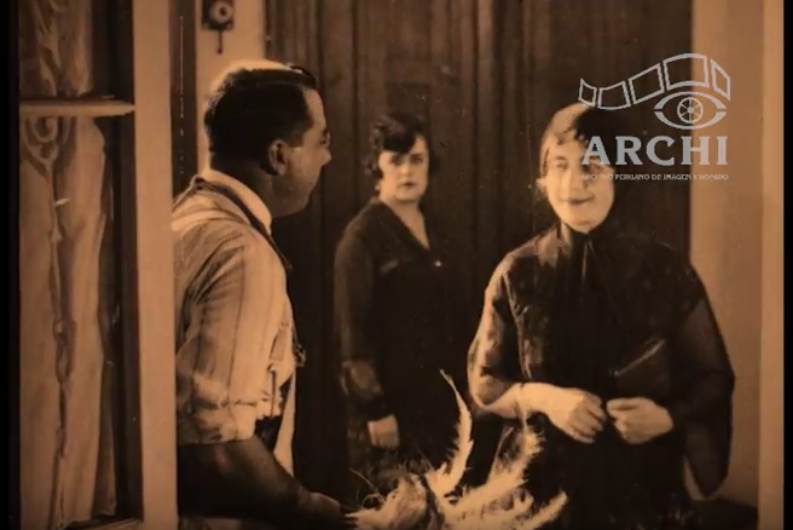
Anthony Asquith: A Cottage on Dartmoor / Fången 53 (1930) with Uno Henning.

A COTTAGE ON DARTMOOR / ESCAPED FROM DARTMOOR (British Instructional Films, GB 1929/30)
Versione svedese (muta) / Swedish version (silent): Fången 53.
    Dir/sc: Anthony Asquith; prod: H. Bruce Woolfe; story: Herbert C. Price; ph: Stanley Rodwell, Axel Lindblom; continuity: Ralph Smart; des: Ian Campbell-Gray;  cast: Uno Henning, Norah Baring, Hans von Schlettow, Judd Green; trade show: 17.1.1930; 35 mm, 7183 ft, 87’ (22 fps), BFI / National Film and Television Archive.
    Didascalie in inglese / English intertitles.
    Grand piano: Stephen Horne.
    Viewed at Teatro Zancanaro, Sacile, Le Giornate del Cinema Muto (GCM): Asquith e gli altri, 11 Oct 2004.

Bryony Dixon (GCM): "Anthony Asquith stayed with producer H. Bruce Woolfe at Welwyn studios for his finest film of the silent era. A small-town hairdresser's is the backdrop for another love triangle, driven by jealousy. The film balances masterly storytelling with technical flair as Asquith explores the creative possibilities of camerawork, fast editing, and experimental special effects. In a climactic scene, Asquith inserts a montage of representative images to show Uno Henning’s jealous rage as it reaches breaking point: a cord unravels and suddenly snaps, a gun goes off and a flash of red lights up the screen, and there he is, brandishing a razor, ready to cut his rival’s throat. There are many of these virtuoso moments. Watch for the scene where the members of a cinema audience first encounter the “Talkies”, and the incredibly clever way Asquith overcomes the technical problems of synchronizing sound (which doesn’t survive) without sacrificing the fluidity of the camera movement, simply by having the cinema audience react to the sound, rather than showing the source of it onscreen. If you are familiar with other “goat-gland” movies such as Lonesome, you don’t need sound to work out the gags associated with sound emanating from an onscreen source. The members of the orchestra, so lively during the silent (Harold Lloyd?) comedy, cease playing and get out a pack of cards; an old lady with an ear trumpet can’t hear properly; then, as the audience settle down, our rapt attention to the screen takes over, and we watch the play of emotions across their faces." – Bryony Dixon (GCM)

AA: The last of Anthony Asquith's excellent "high silent" films. Impressive music interpretation by Stephen Horne. A brilliant print of the Swedish version.

Jeremias / Der Kampf um Jerusalem / The Fall of Jerusalem

THE MYSTERY FILM
THE FALL OF JERUSALEM (Wholesome Film Service, Inc.?, US?, c. 1920)
    Dir: ?; US dist: Wholesome Film Service, Inc.; 35 mm, 4756 ft, 70’ (18 fps), tinted, George Eastman House. Preserved and printed 2001 from a tinted 35 mm diacetate positive print in the collection of Northeast Historic Film, Bucksport, Maine. Color tinting reproduced at the Haghefilm labs using the Desmet process.
    Didascalie in inglese / English intertitles.
    Grand piano: Antonio Coppola.
    20 min from the beginning viewed at Teatro Zancanaro, Sacile, Le Giornate del Cinema Muto (GCM): The Mystery Film, 11 Oct 2004

Caroline Yeager (GCM): "Here’s a challenge. For years now historians have tried to identify this mysterious feature, a lavishly produced biblical epic reminiscent of Judith of Bethulia, replete with picturesque sets and costumes and a large cast.  However, the print shown here lists only the title, and the distribution company, Wholesome Film Service, Inc.  No cast is listed and there are no technical production credits.  The film’s high production values and feature length indicate that it was the product of a skilled filmmaker. But there are no American-made films that match this title; it is thought to have been produced in Europe, possibly in Germany.  The most likely scenario is that Wholesome Film Service purchased the film from a foreign distributor, changed the title, and certainly re-made the intertitles, since they do not match the images in format or style.  As the original source material was a diacetate print (it shows decomposition of the nitrate material it was copied from), it suggests that the film was distributed to religious and educational institutions.  To date, no one has been able to identify any of the actors in the film, but we hope that this screening may jog someone’s memory, and new information will surface that can help solve the mystery of The Fall of Jerusalem. If the Giornate’s expert audience is unable to identify it, nobody will!" – Caroline Yeager (GCM)

MYSTERY SOLVED (BY GERHILD KREBS):
Jeremias / Der Kampf um Jerusalem / The Fall of Jerusalem
    DE 1922. P: Gleissner. Spera-Film Ges. (Berlin).
    D: Eugen Illés. SC: Rudolf Kellaren, Paul Lerch. Cin: Hans Mönling, Eugen Hamm. PD: Siegfried Wroblewsky.
    C: Carl d V. Hundt (Jeremias), Theodor Becker (Nebukadnezar), Jaro Fürth (Bachur, der falsche Prophet), Werner Hollmann (König Zedekiah von Judea), Georg John (Ägypter Emmissary), Mara Markhoff (Rahel, Jeremias' Tochter), Cordy Millowitsch (Esther, Königin von Judea), Walter Rilla (Amosa, Kapitän der Wache), Sazy von Blondel (Mirjam, Jeremias' Tochter), Wilhelm von Haxthausen (Maskir, Schatzmeister des Königs.
    Uraufführung: 26.10.1922 Berlin.

Gerhild Krebs (Internet Movie Database): (...)

"At the screening in Sacile in October 2004 during Le Giornate del Cinema Muto, when everybody was still guessing what this "mystery film" was, I positively recognized juvenile Walter Rilla (=Amosa, captain of the royal guard). I talked to Werner Mohr, a collector of autographed photos from Berlin, who was with me in the identification session held later in the course of the festival, and we agreed it was definitely Rilla."

"I'm researching Rilla's life and work. According to what is known as yet, he was not in films at all prior to mid-1920, and not in co-productions or foreign films prior to 1924–1925 (when he starred in Cutts' The Blackguard, a D/GB co-production). So I simply needed to check titles of German productions post 1919 and prior to 1925 for a film matching the content of the "mystery film"seen in Sacile, and I rapidly arrived at the right title."

"Consequently, the identification of Jeremias aka Der Kampf um Jerusalem, Berlin censorship date Oct 25 1922, has been done very quickly in October-November 2004 by myself (...)."

"The confirmation that I had not only hit upon the right film but that there is also a fragment of it in the Bundesarchiv-Filmarchiv, came from fiction film curator Mrs. Barbara Schütz in an e-mail to me (3.12.2004): The Bundesarchiv-Filmarchiv holds act two of the film. The fragment is a partly b/w and partly tinted & toned print, and already transferred to safety stock. Restoration work on the film will soon begin."

"CineGraph has published an entry on Walter Rilla recently, but amongst his credits Jeremias is not mentioned. Thus my identification of Jeremias adds a new and very early film to Rilla's filmography; to be precise, it marks his second appearance in a film." (...) Gerhild Krebs

...

Hervé Dumont: L'Antiquité au cinéma (2009):

1922
Jeremias / Der Kampf um Jerusalem / Die Zerstörung Jerusalems (Jeremias)
(DE) Eugen Illés ; Illes-Film-Spera Film Berlin, 1725 m. / 6 actes. – av. Carl de Vidal Hundt (Jérémie), Werner Hollman (Sédécias, roi de Judée), Theodor Becker (Nabuchodonosor, roi de Babylone), Cordy Milowitsch (Esther, reine de Judée), Mara Markhoff (Rahel), Sacy von Blondel (Miriam), Walter Rilla (Amosa, chef de la garde royale), Georg John, Jarö Fürth, Wilhelm von Haxthausen (Maskir).
– Jérusalem croule sous les impôts, le peuple gronde. Jérémie met en garde plusieurs fois le roi Sédécias, trop occupé à gâter son épouse favorite, la païenne Esther. Lorsque le souverain de Babylone assiège la ville, Sédécias feint de se rendre mais s’allie secrètement avec l’Egypte. Nabuchodonosor apprend la trahison et lance ses troupes à l’assaut des murailles. La cité est prise, le roi tué, Jérémie part en exil à Babylone avec les survivants. Film peu connu, réalisé maladroitement avec cinq ou six décors et une centaine de figurants à Berlin-Staaken

The Beggar Maid


Herbert Blaché: The Beggar Maid (1921) with Reginald Denny and Mary Astor. Photo: IMDb.

Advertisement for the American short drama film The Beggar Maid (1921), on page 6 of the November 26, 1921 Exhibitors Herald. The lower right side of the advertisement recreates the painting "King Cophetua and the Beggar Maid" by Edward Burne-Jones. Exhibitors Herald (Oct. - Dec. 1921) on the Internet Archive. From: Wikimedia Commons.

THE BEGGAR MAID (US 1921)
    Dir: Herbert Blaché; cast: Mary Astor (Peasant Girl / Beggar Maid), Reginald Denny (The Earl of Winston / King Cophetua); 35 mm, 570 m, 27’ (18 fps), tinted, Idaho Film Collection & Boise State University / AFI.
    English intertitles.
    Wrongly announced as The Wolf’s Brush starring Nell Shipman, the film was identified by DJ Turner during the screening at the Zancanaro.
    Triart Productions, Inc. presents. SC: Reginald Denny. AD: Legaren à Hiller.
    Grand piano: Tama Karena.
    Viewed at Teatro Zancanaro, Sacile, Le Giornate del Cinema Muto (GCM): Fuori quadro, 11 Oct 2004.

Jim Beaver (IMDb): "The painter Burne-Jones and his famed painting "The Beggar Maid" are depicted in this speculative drama about the creation of the painting. Burne-Jones plays matchmaker for a young British nobleman who has fallen in love with a servant girl on his estate. The artist shows that love can thrive between members of different classes by depicting on canvas a picture from Tennyson's poem about the love of King Cophetua for a beggar maid. As he relates the story of the poem in words and through his painting, the young earl sees the application to his own situation."
    —Jim Beaver
 

"The Beggar Maid. First of a series of twelve two reel pictures dramatizing the greatest masterpieces of art, created such a sensation at the Rivoli Theatre, New York City, where audiences considered it the feature attraction that it was held over for a second week at the Rialto Theatre". Exhibitors Herald, 26 Nov, 1921, p. 6.

AA: I declare that in my country "The Beggar Maid" is not a household word, nor is "Cophetua complex". I learn from the Wikipedia article "The King and the Beggar-maid" that it started from a 16th-century broadside ballad about the African king Cophetua and his love for the beggar maid Penelophon. Shakespeare alludes to the ballad in five of his plays.

Alfred Tennyson wrote his poem on the subject in 1833, and Edward Burne-Jones created his painting in 1884. The most famous photograph by Lewis Carroll was of Alice as Beggar-Maid (1858). Further references include: Hugo von Hofmannstahl, Ezra Pound, Julien Gracq, André Delvaux, G. B. Shaw, Agatha Christie, Graham Greene, James Reeves and Alice Munro (The Beggar Maid, 1978).


The story is a byword for love at first sight and a king falling in love with a beggar maid.

There is a long and different article, "Korol Cophetua i nishchenka" in the Russian Wikipedia. 

Herbert Blaché at this stage had hardly advanced from an early cinema approach to storytelling. In the previous year he had managed to make a boring film with Buster Keaton (The Saphead, 1920), Keaton's only boring silent film.

Mary Astor made her first films in this year, 1921, at age 15.

Alfred Lord Tennyson: The Beggar Maid (a poem)


Edward Burne-Jones: (1833–1898): King Cophetua and the Beggar Maid. Painting. 1884. Oil on canvas. 293.4 cm (115.5 in); 135.9 cm (53.5 in). Tate Britain. Photo source: Google Art Project. From: Wikimedia Commons.

Alfred Lord Tennyson
The Beggar Maid

Her arms across her breast she laid;
   She was more fair than words can say;
Barefooted came the beggar maid
   Before the king Cophetua.
In robe and crown the king stept down,
   To meet and greet her on her way;
“It is no wonder,” said the lords,
   “She is more beautiful than day.”

And shines the moon in clouded skies,
   She in poor attire was seen:
One praised her ankles, one her eyes,
   One her dark hair and lovesome mien.
So, sweet a face, such angel grace,
   In all that land had never been:
Cophetua sware a royal oath:
   “That beggar maid shall be my queen!”

Written in 1833.
Published in 1842.

Le Dormeur

LE DORMEUR (CH, 2003)
    Dir/sc/ed: Richard Szotyori; prod: Robert Ralston; prod. co-ord: Imre Légman; ph: Tamàs Keményffy; mus: Enrico Camponovo (Improvisations on a Theme by Chopin); 1st asst. dir: Gàbor Forgàcs; 2nd asst. dir: Matthias Urban; des: Istvàn Balogh, Zoltàn Szabò; asst. ph: Jòzsef Takàcs; 2nd asst. ph: Bàlint Seres, Tamàs Bakos; make-up: Flora Sipos; wardrobe: Dora Hidasi; cast: Richard Szotyori, Camille Bouzaglo, Làszlò Jàszai, Jr., Lajos Mezei; 35 mm, 580 m, 18’ (25 fps), colore / color, widescreen (aspect ratio: 1:1.85), sonoro / sound (Dolby A), Cinémathèque Suisse. Finanziamenti di / Funded by The Fonds Regio, in coprod. con / in co-production with SFDRS /TSR Swiss TV. Realizzato con il sostegno di / Made with the support of The Federal Office of Culture (Berne, Switzerland), Fondation Vaudoise pour le Cinéma, The Culture Percent Migros.
    No intertitles.
    In the presence of Richard Szotyori.
    Cinema Ruffo, Sacile, Le Giornate del Cinema Muto (GCM): Muti del XXI Secolo, 11 Oct 2004

Richard Szotyori (GCM): "Anna and Paul lead a very unremarkable life, composed by mechanical habits. One day Anna decides to leave, just putting a note on the table. When Paul comes home and finds her farewell note on the table, his narrow universe suddenly collapses. Next day, the agent of a washing powder company rings at his door, announcing that Paul is the winner of their quiz. His prize, a fantastic red Lamborghini, is waiting for him down in the courtyard. Paul’s nightmare has begun ....."

"Although exclusively financed by Swiss funds, for aesthetic reasons the film was entirely shot in Budapest. The city offers a distinctive kind of outdated feeling that can scarcely be found elsewhere. The whole architecture of the town carries the marks of a monumental and yet abandoned past, which, remaining functional, creates a very strange state of timelessness. This feeling of having been dropped out of time, the central theme of the film, was also intended to be expressed by the very nature of the film – silent, yet shot in color and widescreen." – Richard Szotyori (GCM)

Richard Szotyori was born on 1 January 1972 in Berne, of Hungarian parents. After studies in Switzerland, he enrolled at the Hungarian National Film School in Budapest, where he studied direction, editing, and acting. While working at the Cinémathèque Suisse in Lausanne he has been directing short films, and is now preparing his first full-length feature. He was an original collegian of the Collegium Sacilense of Le Giornate del Cinema Muto, and his passion for silent cinema was largely aroused “by the extraordinary films I had the chance to discover at this festival”.