Thursday, July 07, 2005

Mixed Babies (1905)


Frank Mottershaw: Mixed Babies (GB 1905). View Mixed Babies at the YFA (Yorkshire Film Archive) / NEFA (North East Film Archive) website. My screenshot.

GB 1905. PC: Sheffield Photo Co. D: Frank Mottershaw. 47 m. BFI/NFTVA. ♪ Maud Nelissen. Wednesday 6 July 2005, Cinema Lumière 1, Il Cinema Ritrovato, Bologna. A young rascal mixes the babies in prams. There is a wild chase, and police at the heels.

Rescued by Rover (version 2)

GB 1905. PC: Cecil Hepworth. D: Lewin Fitzhamon. 120 m. BFI/NFTVA. ♪ Maud Nelissen. Wednesday 6 July 2005, Cinema Lumière 1, Il Cinema Ritrovato, Bologna. Mariann Lewinsky: this film, canonized as a milestone of cinema history for its editing, is not very original from a contents point of view. Cinema adopted an old literary motif, and especially around 1905 children are frequently being searched for in films, either because they were stolen, or because they themselves had stolen something.

Our Baby (1908)

US 1908. 80 m. BFI/NFTVA – Collection Joye. German intertitles. (sostituisce: Bain de Bébé, FR 1903, PC: Pathé, B. 1252). ♪ Maud Nelissen. Wednesday 6 July 2005, Cinema Lumière 1, Il Cinema Ritrovato, Bologna. Educational film on baby care in precise and loving detail.

Le Bébé gourmand / The Greedy Child

Der kleine Vielfrass. FR 1903. PC: Pathé. Scène comique B. 706. 40 m. Filmarchiv Austria. ♪ Maud Nelissen. Wednesday 6 July 2005, Cinema Lumière 1, Il Cinema Ritrovato, Bologna. On a black fond, a baby is fed another chocolate, but there is no end to crying.

Le Déjeuner du savant / The Scholar's Breakfast

FR 1905. PC: Pathé. Scène comique B. 1240. 40 m. AFF. ♪ Maud Nelissen. Wednesday 6 July 2005, Cinema Lumière 1, Il Cinema Ritrovato, Bologna. At breakfast, the scientist senses a foul smell in his bread and puts it under the microscope. The view is like that of the ship doctor's in Potyomkin. He then decides to drink water only, but it occurs to him to examine it, as well. It is full of living creatures.

See also about the Canberra print: The Corrick Collection 7, Programme 2 (2013 Le Giornate del Cinema Muto, Pordenone)

Unter dem Mikroskop: Larve der Wasserfliege

(Possibly: May-Fly Larvae). GB 1903. PC: Charles Urban Trading Co. D: F. Martin-Duncan. 23 m. Filmarchiv Austria. ♪ Maud Nelissen. Wednesday 6 July 2005, Cinema Lumière 1, Il Cinema Ritrovato, Bologna. The beauty of scientific cinema, very close to experimental film.

Our New Errand Boy


James Williamson: Our New Errand Boy (GB 1905).

GB 1905. PC: Williamson Kinematograph Co. D: James Williamson. 109 m. AFF. ♪ Maud Nelissen. Wednesday 6 July 2005, Cinema Lumière 1, Il Cinema Ritrovato, Bologna. A bad dupe, paper print quality. A British remake of Les Farces de Toto gâte-sauce.

Les Farces de Toto gâte-sauce

FR 1905. PC: Pathé. Scène comique, B. 1303. 82 m. NFM. ♪ Maud Nelissen. Wednesday 6 July 2005, Cinema Lumière 1, Il Cinema Ritrovato, Bologna. A good sense of rhythm and movement in the story of the pranks of the young rascal Toto at the pâtisserie. His victims go after him in a wild chase, but he catches them in a trap and sets them on fire (!).

La première sortie d'un collégien / First Night Out

Première sortie / Studentens første lommepenge / Studentens første sold / Nächtliche Bummelei / Первый выход гимназиста / The School Boy's First Outing.
    FR 1905. PC: Pathé. D: Louis J. Gasnier. Starring Max Linder. Scène comique, B. 1254. Originally 110 m, surviving footage 66 m (incomplete). AFF / Lumière Project. ♪ Maud Nelissen. Wednesday 6 July 2005, Cinema Lumière 1, Il Cinema Ritrovato, Bologna. Max in schoolboy uniform getting drunk. The first film of the future star.

...
IMDb: " A young student goes to his father and asks for money. When this isn't enough he goes to his mother who gives him more. Happy, he meets his friends who are at a cafe with two young women. They eat and drink and the waiter comes with the bill and demands the student pay it. A fight ensues and he is brought back to his parents house in a carriage. His parents wake up and rush to their son who can't furnish an explanation.
—Anonymous "

Vie de Moïse

FR 1905. PC: Pathé. Scène biblique en 6 tableaux, B. 1276. 170 m. Colour. Cin. Royale Belgique / Alan Roberts. ♪ Maud Nelissen. Wednesday 6 July 2005, Cinema Lumière 1, Il Cinema Ritrovato, Bologna. The six tableaux: Moïse sauvé des eaux. Le Buisson ardent. Passage de la Mer Rouge. Les Hebreux au désert. Sur le Mont Sinaï. L'Adoration du veau d'or. A fascinating naive, primitive Biblical film. The parting of the Red Sea is realized with paint and reflections. Blasphemously, God is made visible. Moses breaks the golden calf with the tablets of the Law. In the final image he sports long drawn gold horns.

Hundetheater

Hunde Theater. FR ca 1908. PC: Pathé. Scène d'acrobatie. Österreichisches Filmmuseum. ♪ Maud Nelissen. Wednesday 6 July 2005, Cinema Lumière 1, Il Cinema Ritrovato, Bologna. Circus dogs perform in their elaborate show. Even monkeys get to help.

Le Pape Léon XIII au Vatican


Le Pape Léon XIII au Vatican (FR 1903). FR 1903. PC: Pathé. Scène d'actualité, B. 985. Cin. Royale Belgique / Alan Roberts Collection. Photo: Wikipedia.

FR 1903. PC: Pathé. Scène d'actualité, B. 985. 20 m. Cin. Royale Belgique 1994 / Alan Roberts. ♪ Maud Nelissen. Wednesday 6 July 2005, Cinema Lumière 1, Il Cinema Ritrovato, Bologna. The Pope is carried in his sedan chair.

Loïe Fuller (Pathé, scène de danse 1905)


Loïe Fuller (FR 1905). A bat descends from heaven and transforms into a serpentine-dancing Loïe Fuller. My screenshot from / view movie on YouTube: Loie Fuller (1905).

Loïe-Fuller. FR 1905. PC: Pathé. Scène de danse, Cat. Bousquet No. 1201. 28 m. Colour. AFF. ♪ Maud Nelissen. Wednesday 6 July 2005, Cinema Lumière 1, Il Cinema Ritrovato, Bologna. Pochoir colour fantastic. A serpentine dance at its most brilliant, a wonderful apparition.

CENTO ANNI FA: I FILM DEL 1905, PROGRAMMA 5: PROTAGONISTI ED EROI (E NIENTE DIVI)

Prima del divismo – Before Stars. Presenta Mariann Lewinsky. ♪ Maud Nelissen. Wednesday 6 July 2005, Cinema Lumière 1, Il Cinema Ritrovato, Bologna. Prima parte: Protagonisti (5 films), Seconda parte: Sosia – Remake I (2 films), Terza parte: Con dedica – A Boby / Roving around Rover (6 films). – Among the discoveries of this programme: Loïe Fuller and Vie de Moïse. – The actual programme was different from the published ones on the internet and in the catalogue.

Tih Minh 6: Les Oiseaux de nuit, Tih Minh 7: Evocation


Louis Feuillade: Tih Minh 6: Les Oiseaux de nuit (FR 1918). René Cresté (Jacques d'Athys) and Mary Harald (Tih Minh).

FR 1918. PC: Gaumont. D: Louis Feuillade. /18 fps/ 31' + 27'. ♪ Donald Sosin. Wednesday 6 July 2005, Cinema Lumière 1, Il Cinema Ritrovato, Bologna. 

Grâce à la science du docteur, Tih Minh semblait de regaigner la vie. She is a tabula rasa, but her intelligence is revitalized to grow like flowers. Après des semaines de silence, les premiers paroles: "je t'aime". The villains keep lurking in the bushes with wiretaps. Le cousin Baptiste: engaged to serve the diplomat, Sir Grey. But the villains plant a decoy, Dolorès, in the adjoining room, to seduce Baptiste. Interesting touch: the thoroughly disgusted habitus of Dolorès. Still Baptiste is easy prey for her. Beautiful scene: Francis returns, and through the mirror we see the pistol of Dolorès under the bed. Another interesting Feuillade feature: long takes of faces of persons caught in a dilemma. We see them think hard. Oiseaux nocturnes dans Villa Luciola. Marquise Dolorès, une enigme vivante. Placide is the life of the film, great in love scenes with Rosette, amusing in his disappointed reaction to Baptiste. The good doctor hypnotizes Dolorès, and in her hypnotized state we now learn the backstory to everything. In 1911 in Tonkin, Laurençon, le père de Tih Minh... clair de lune... flashback... le voisin: un allemand nommé Marx. Un jour, un vieil Hindu: "je veux parler à un representant de France". The Hindu message from 1870 ("en cas d'une guerre Européenne") gives highly sensitive information for European politics. Tih Minh's memory comes back: Marx = Gilson, he is the murderer of her father, already then in search for the secret document. She senses more: "Marx est ici!". Yes, he is hiding behind the curtain, the nail marks of Tih Minh still on his chin. The villains cut the electricity, and Marx/Gilson manages to escape again.

Wednesday, July 06, 2005

PROGETTO CHAPLIN – KEYSTONE I


Henry Lehrman: Kid Auto Races at Venice (US 1914). Chaplin Opus 2. Charles Chaplin for the first time as the Tramp on screen.

Five restored Chaplin films. ♪ Neil Brand. Wednesday 6 July 2005, Cinema Lumière 1, Il Cinema Ritrovato, Bologna. The photochemical look of the BFI/NFTVA restorations is much more pleasant than the digital look of some other Keystone restorations. The films are usually storywise very crude but visually charming if seen in close-to-the-original prints. It's very gratifying to see new, better prints of films previously known in a highly battered state.

...
MERCOLEDI 6 LUGLIO 2005
16.00 Progetto Chaplin – Keystone
KID AUTO RACES AT VENICE (USA/1914) R.: Henry Lehrman. Int.: Charles Chaplin. D.: 7’. Did. inglesi
MABEL’S AT THE WHEEL (USA/1914) R.: Mabel Normand e Mack Sennett. Int.: Charles Chaplin. D.: 21’. Did. inglesi
A FILM JOHNNIE (USA/1914) R.: George Nichols. Int. Charles Chaplin. D.: 15’
THE PROPERTY MAN (USA/1914) R.: Charles Chaplin. D.: 31’. Did. inglesi Restauro dei film Keystone a cura del National Film and Television Archive, Londra.
GENTLEMEN OF NERVE (USA/1914) R.: Charles Chaplin. Int. Charles Chaplin. D.: 17’. Did. inglesi.  Restauro di un film Keystone a cura della Library of Congress, Washington.
Accompagnamento al piano di Neil Brand 

KID AUTO RACES AT VENICE Usa, 1914 Regia: Henry Lehrman
■ T.it.: Charlot si distingue; Scen.: Henry Lehrman, Reed Heustis; F.: Enrique Juan Vallejo, Frank D. Williams; Int.: Charles Chaplin (il vagabondo), Henry Lehrman (regista), Frank D. Williams (operatore), Billy Jacobs, Thelma Salter, Charlotte Fitzpatrick, Gordon Griffith; Prod.: Keystone Film Company ■ 35 mm. L. 147 m. D.: 7’ a 16 f/s. Bn. Didascalie inglesi / English intertitles ■ Da: British Film Institute - National Film and Television Archive
The film is only about four minutes long, and it consists of nothing more that this single gimmick, repeated over and over. The “drunk” keeps hamming it up for the camera, growing ever more aggressive and determined to ignore the director. When the camera crew tries to photograph the end of the race, he comes running and skipping down the middle of the street, flapping his arms like a bird, tripping over the finish line; when stray kids wander between him and the camera, he shoves them in the face; when the director start knocking him out of the way, he dances around in little circles at the periphery of the shot and sticks out his tongue. Ultimately he “spoils” every scene in the newsreel. He is of course Charlie Chaplin, and the film is Kid Auto Races at Venice, a minor landmark in cinema history because it is the first film in which Chaplin appeared in the costume of the Tramp. James Naremore, Film Quarterly, Winter 1984-85

MABEL AT THE WHEEL Usa, 1914 Regia: Mabel Normand, Mack Sennett
■ T. it.: Mabel al volante; Scen.: Mabel Normand, Mack Sennett; F.: Frank D. Williams; Int.: Charles Chaplin (il cattivo), Mabel Normand (Mabel), Harry McCoy (pilota), Chester Conklin (padre di Mabel), Mack Sennett (cronista), Edgar Kennedy (spettatore), William Hauber (co-pilota di Mabel), Mack Swain, Alice Davenport (spettatori), William A. Seiter, Fred Mace, Joe Bordeaux; Prod.: Keystone Film Company ■ 35 mm. L.: 441 m. D.: 21’ a 18 f/s. Bn. Didascalie inglesi / English intertitles ■ Da: National Film and Television Archive – British Film Institute
If the character of the newborn Charlot-tramp was extremely violent it would not be incorrect to see an extension of this quality, a quality that many have criticised, in the character in Mabel at the Wheel. This bad guy role – a very particular kind of bad guy – stands on the edge of what has later come to be known as the Charlot cycle. But the cruelty, premeditated revenge and destructive hate of this film, written and directed by Mack Sennett and Mabel Normand, has little to do with the pantomime spirit and burlesque poetics that Chaplin experimented with in the comedies in which he gradually turned into the legendary tramp we all know and love.
Thierry Georges Mathieu, La naissance de Charlot. Keystone - 1914, n.6, Ars Regula, 2001

A FILM JOHNNIE Usa, 1914 Regia: George Nichols
■ T. it.: Charlot fa del cinema; Scen.: Craig Hutchinson; F.: Frank D. Williams; Int.: Chaplin (l’attrezzista), Virginia Kirtley (la ragazza della Keystone), Minta Durfee (l’attrice), Mack Sennett (il regista), Mabel Normand (Mabel), Ford Sterling (Ford), Roscoe “Fatty” Arbuckle; Prod.: Keystone ■ 35 mm. D.: 15’ a 18 f/s. Bn. Didascalie inglesi / English intertitles ■ Da: National Film and Television Archive – British Film Institute
A Film Johnnie was an elementary affair, shot around the studio but, like Chaplin’s later films, The Masquerader, His New Job and Behind the Screen, gives us evocative glimpses of life in the early Californian studios. Charlie goes to the cinema and falls for the star of the film. He then pursues her to the Keystone Studios, where he causes havoc among the productions. Fire breaks out and he is squirted by the fire brigade. In a crazy, funny little gag, he twists his ears and thereby gives the fireman a retaliatory squirt. David Robinson, Chaplin. His Life and Art, William Collins, 1985

THE PROPERTY MAN Usa, 1914 Regia: Charles Chaplin
■ T.it.: Dietro le quinte; F.: Frank D. Williams; M.: Charles Chaplin; Int.: Charles Chaplin (trovarobe), Phyllis Allen (Hamlena Fat), Alice Davenport (attrice), Charles Bennett (marito di Hamlena), Norma Nichols (artista del vaudeville), Joe Bordeaux (attore anziano), Harry McCoy (ubriaco), Lee Morris (spettatore), Jess Dandy (Garlico), Joseph Swickard (anziano aiutante di scena), Joe Bordeaux (attore anziano), Gene Marsh (assistente di Garlico), Vivian Edwards, Cecile Arnold (Goo Goo Sister), Mack Sennett, Frank Opperman, George ‘Slim’ Summerville (spettatori); Prod.: Keystone Film Company ■ 35 mm. D.: 27’ a 18 f/s. Bn. Didascalie inglesi / English intertitles ■ Da: National Film and Television Archive – British Film Institute
The Charlot of The Property Man is no longer the character moulded by Sennett during Chaplin’s first months at the Keystone studios. A hewfound inspiration and a different maturity come to the fore hinting at the more accomplished future films. This “Charlot” has of course maintained the characteristics of troublemaker who loves to flirt and, in a way, his status as a free man. His mocking spirit and vindictive nature soon appear behind the scenes as well as on stage, he answers the blows by raising the stakes and creates a terrible commotion in the theatre, even amongst the audience, completing his adventures with a collective watering worthy of Sennett’s burlesque school. Thierry Georges Mathieu, La naissance de Charlot. Keystone - 1914, n.11, Ars Regula, 2001

GENTLEMEN OF NERVE Usa, 1914 Regia: Charles Chaplin
■ T.it.: Charlot e Mabel alle corse; Scen.: Charles Chaplin; F.: Frank D. Williams; Int.: Charles Chaplin (il «portoghese»), Mack Swain (Ambrose), Mabel Normand (Mabel), Chester Conklin (Walrus), Phyllis Allen (sua moglie), Glen Cavender (Poliziotto), Alice Davenport (cameriera), Slim Summerville, Cecile Arnold, Frank Hayes, Charles Parrott [Charley Chase], Gene Marsh, Harry McCoy, Vivian Edwards, Fred Fishback, Tammany Young, Joe Bordeaux, Billy Gilbert, Bill Hauber (spettatori), Dixie Chene; Prod.: Keystone Film Company ■ 35 mm. L.: 314 m. D.: 17’ a 16 f/s. Didascalie inglesi / English intertitles ■ Da: Library of Congress
Gentleman of Nerve is, admittedly, one of Chaplin’s most violent Keystones (spewing, stomping, biting, and burning as well as the usual kicks and punches) and one of his least original (…). However, the film does have one very funny slapstick sequence (Mack in the fence hole) using fluent cross-cutting, and several new gags that are memorable: i.e., Charlie trying to get into the racetrack by walking backward, his theft of soda pop, and his casual “preparation” to help Mabel in distress. Harry M. Geduld, Chapliniana, Bloomington & Indianapolis, 1987

Tuesday, July 05, 2005

I delfini / Silver Spoon Set (in the presence of Francesco Maselli and Betsy Blair)


Francesco Maselli: I delfini / Silver Spoon Set (IT 1960) starring Claudia Cardinale (Fedora), Gérard Blain (Anselmo Foresi), Anna Maria Ferrero (Marina Castelfranco), Betsy Blair Countess Margherita Cherè), Sergio Fantoni (Doctor Mario Corsi), Tomas Milian (Alberto De Matteis), Germana Paolieri (the mother of Anselmo and Elsa Foresi).

(Not released in Finland). The Dauphins. IT 1960. PC: Lux Vides. P: Franco Cristaldi. D: Francesco Maselli. SC: Ennio De Concini, Maselli, Aggeo Savioli, con la collaborazione di Alberto Moravia. DP: Gianni Di Venanzo. M: Giovanni Fusco. Starring Betsy Blair, Claudia Cardinale, Gérard Blain, Anna-Maria Ferrero, Tomas Milian. 110'. Restauro realizzato dalla Cristaldi Film in collaborazione con la Fondazione Scuola Nazionale di Cinema-Cineteca Nazionale e con il contributo dell’Associazione Philip Morris Progetto Cinema, della Regione Marche – Assessorato alla Cultura e del Comune di Ascoli Piceno – Assessorato alla Cultura. In the presence of Betsy Blair (*1923) and Francesco Maselli (*1930). Tuesday 5 July 2005, Cinema Arlecchino, Il Cinema Ritrovato, Bologna. – Betsy Blair, who recently published her memoir, The Memory of All That (2003), was honored in Bologna with a tribute of three films including this quality piece from the golden age of Italian cinema. It's Antonioni land, and the configuration resembles Le amiche. Maselli is a good director of actors, some of them here at the beginning of their careers. It's a complex web of relationships in a little town where everything seems to turn around the town square, Café Meletti, and Villa de Matteis. – The Jewish connection: the foundation of the wealth of one of the rich men of the town is the fact that he has betrayed the trust of his Jewish companion during WWII. – A seguire incontro con Betsy Blair e Francesco Maselli. Betsy Blair was blacklisted in Hollywood and went to a permanent European exile to make films with Bardem, Antonioni, Maselli, etc.

Come fu che l'ingordigia rovinò il Natale di Cretinetti / Greediness Spoiled Foolshead's Christmas


André Deed: Come fu che l'ingordigia rovinò il Natale di Cretinetti / Greediness Spoiled Foolshead's Christmas (IT/FR 1910). André Deed as Cretinetti / Gribouille. Photo from/view movie: Museo Nazionale del Cinema (Torino) / Wikipedia: Comment la gourmandise gâta le Noël de Gribouille (source: Cinematek).

Comment la gourmandise gâta le Noël de Gribouille / How Greediness Spoilt Foolshead's Christmas / Greediness Spoiled Foolshead's Christmas / Wie es kam, dass Müllers Genäschigkeit sein Weihnachtsfest verdarb / Lehmanns Jul / [Cretinetti ja ahneuden palkka / KAVI Orion 2009].
    IT/FR 1910. PC: Itala Film. Starring André Deed (Cretinetti), Emilio Ghione (the Devil). 237 m /16 fps/ 13'. Didascalie olandesi / Dutch intertitles. From: Cineteca di Bologna, Museo Nazionale del Cinema. ♪ Alain Baents. Tuesday 5 July 2005, Cinèma Lumière 1, Il Cinema Ritrovato, Bologna. 
    Programme book: "Cretinetti is a very greedy boy, and he eats ten cakes prepared by his parents for him on the Christmas tree all at once. He then falls asleep and has a bad dream: the ways of the heavens open up before him. After having caused such confusion in heaven that God in person has to intervene, Cretinetti finds himself in hell where some little devils cook him in the pot..."
    AA: At night the impatient boy Cretinetti robs the Christmas tree, and breaks the plates and the toys and eats up the goodies. Santa Claus gets angry, takes him to the sky, even to Heaven, but Cretinetti escapes, sits on God's chair, and takes the key from St. Peter. God gets furious, and Cretinetti lands in hell, but he is too much even for the Devil to handle. The definitive André Deed movie of the ones I have seen.

Cretinetti fra due fuochi / Foolshead Between Two Fires

Gribouille entre deux feux / Müller zwischen zwei Feuern / De vereering van Gribouille / Lehman kaksinkertaisen tulen välissä / Lehman mellan dubbel eld (Swedish title in Finland). IT 1910. PC: Itala Film. Starring André Deed (Cretinetti). 183 m /16 fps/ 11'. Dutch intertitles. NFM. ♪ Alain Baents. Tuesday 5 July 2005, Cinèma Lumière 1, Il Cinema Ritrovato, Bologna. Cretinetti has double-booked a date with two beautiful women. They start a duel with swords and pistols. Cretinetti loses them both to other men.

Cretinetti distratto

Distractions of Foolshead. IT 1910. PC: Itala Film. Starring André Deed (Cretinetti). 168 m /16 fps/ 9'. AFI / Cineteca di Bologna. ♪ Alain Baents. Tuesday 5 July 2005, Cinèma Lumière 1, Il Cinema Ritrovato, Bologna. A sleepwalker's adventures: with a dancer's grace and a pantomime's skill Cretinetti walks through the city wreaking havoc; finally a cigarette lit in the wrong place causes an explosion which lands him back to bed.

["Cretinetti ha ingoiato un gambero"]

Gibrouille heeft... [Catalogue information: IT 1909. PC: Itala Film. Starring André Deed (Cretinetti)] /16 fps/ 10'. Dutch intertitles. NFM. ♪ Alain Baents. Tuesday 5 July 2005, Cinèma Lumière 1, Il Cinema Ritrovato, Bologna. Not André Deed, said Jean A. Gili in the screening. Man eats lobster and transforms into a human lobster, doing everything backwards. Finally, even the carriage he mounts starts to move backwards, and the horse, too. – This film is probably an imitation of a Cretinetti film with the same title and idea.

Cretinetti ficcanaso / Mr. Nosey Parker

Lehman uteliaana / Den nyfikna Lehman / Gribouille trop curieux.
Finnish premiere: 2 Dec 1912.
IT 1909. PC: Itala Film. Starring André Deed (Cretinetti). 99 m /16 fps/ 6'. Cineteca di Bologna / L'Immagine Ritrovata 2005. ♪ Alain Baents. Tuesday 5 July 2005, Cinèma Lumière 1, Il Cinema Ritrovato, Bologna. A wild series of gags where Cretinetti's head becomes an anvil, he gets covered by flour, falls in a pit, and gets stuck in telephone cables.

OMAGGIO A ANDRE DEED – PROGRAMMA 2 (1909–1910)

Five films with André Deed as Cretinetti. ♪ Alain Baents. Tuesday 5 July 2005, Cinèma Lumière 1, Il Cinema Ritrovato, Bologna. In this programme, Come fu l'ingordigia rovinò il natale a Cretinetti is a seminal piece, and Cretinetti distratto another especially successful title.

COMPARISON OF TWO VERSIONS OF LAS AVENTURAS DE ROBINSON CRUSOE

MX/US 1952. PC: Tepayac. D: Luis Buñuel. 10'. Filmoteca Española. DVD, alas. Tuesday 5 July 2005, Cinèma Lumière 2, Il Cinema Ritrovato, Bologna. Two negatives were shot for Robinson Crusoe: an English and a Spanish original version. There are many differences between the two, mainly minor ones. The comparison footage is available as two parallel frames.

[Happy End for Los olvidados]


Luis Buñuel: Los olvidados (MX 1950). Pedro (Alfonso Mejía).

MX 1950. PC: Ultramar Films. D: Luis Buñuel. 5' + 2'. Filmoteca Española. BetaSP, alas. Tuesday 5 July 2005, Cinèma Lumière 2, Il Cinema Ritrovato, Bologna. First the real ending was shown, and then the happy end that was never used: Pedro kills Jaibo in the fight in the attic, gets back the money that was trusted him by the benevolent schoolmaster and stolen by Jaibo, and returns to the school at dawn.

Espagne 1936 / España leal en armas


Espagne 1937 (ES-FR 1937). Only the French version survives of the documentary commissioned by the Spanish Government from Luis Buñuel, produced by the Alianza de Intelectuales Antifascistas in 1936-1937 and directed by Jean-Paul Le Chanois from a screenplay by Buñuel. Espagne 1936 and Espagne 1937 are two different films. Espagne 1936 premiered on 6 April 1937. It had passages of great poetic power and strong emotion. The second film focused on raising morale and advocating solidarity for the fighting democracy of Spain.

ES/FR 1937. PC: Ciné-Liberté. D: Luis Buñuel. SC: Jean-Paul Le Chanois; Pierre Unik, LB. DP: Roman Karmen, Manuel Villagas López. Commentary read by Gaston Modot. Original in French. 35'. Filmoteca Española. BetaSP, alas, bad sound, misframed. Tuesday 5 July 2005, Cinèma Lumière 2, Il Cinema Ritrovato, Bologna. Buñuel worked as a cultural attaché for the Spanish republic in Paris, where he made this film, a history and defense of the Spanish Republic established in 1931 and attacked by the forces lead by Franco. There are powerful images of the Civil War. "Madrid est devenu le Verdun d'Espagne": Spain had to suffer the experience of total war with Franco backed up by Hitler and Mussolini. This film ends on an optimistic note. No pasaran!

...
BOLOGNA 2005:
ESPAGNE 1936 / ESPAÑA LEAL EN ARMAS
Luis Buñuel
F.: Roman Karmen, Manuel Villagas López; M.: Jean-Paul Le Chanois; Commento: Pierre Unik, Luis Buñuel; Voce: Gaston Modot; Prod.: Ciné-Liberté BetaSP. D.: 35’. Bn.
Film Notes
This propaganda documentary produced by the Spanish Republican government, and shot in Paris at a time when the director was stationed at the Spanish embassy in France, is considered by some Buñuel experts to be an authentically Buñuelian film.
Ferrán Alberich.

...
WIKIPEDIA last updated 22 Nov 2025:
Espagne 1937

Espagne 1937 —España leal en armas— es el documental sobre la guerra civil española que encargó el Gobierno de la República a Luis Buñuel. Dirigido por Jean-Paul Le Chanois con guion de Buñuel, fue producido por la Alianza de Intelectuales Antifascistas entre 1936 y 1937, y solo queda la copia en francés.

Historia
Esta película a veces se ha confundido con Espagne 1936 que, dirigida igualmente por Le Chanois y supervisada por Buñuel, se filmó y montó entre 1936 y principios de 1937, proyectándose por primera vez el 6 de abril de 1937.[1]​ Según Román Gubern existen grandes similitudes estéticas y narrativas entre las dos películas, pues ambas se habían promovido desde la Subsecretaría de propaganda de la República Española que desde la Embajada española en París dirigía Luis Buñuel.[2]​ Sin embargo, algunas diferencias son notables entre las dos películas, debido en parte a la evolución de la guerra. Por lo tanto, según Marien Gómez Rogriguez, España 1936 contiene pasajes de gran carga poética, incluyendo un conmovedor final de denunciar la atrocidad de la guerra con niños muertos.[3]​ En contraste con "España 1937", que no contiene imágenes tan emotivas e insiste en la posibilidad de la victoria militar. Cuando la guerra iba avanzando con luchas de poder y debilidad entre las fuerzas republicanas, el documental quiso levantar la moral de las tropas, abogando por la solidaridad internacional a favor de los republicanos.

Contenido
El documental que forma parte de las acciones de propaganda durante la Guerra Civil (1936-1939)[4]​ narra en orden cronológico la llegada del Frente Popular español, su apoyo entre las masas, la agresión exterior y militar y la resistencia civil de la República durante la segunda mitad de 1937. Las imágenes y los comentarios, todo ello en francés, insistían en la disciplina y el valor del ejército, el heroísmo y el martirio de la población de Madrid bombardeado, el papel determinante de los comisarios políticos, la movilización de los campesinos que trabajaban en los campos y simultáneamente eran milicianos, y la de las mujeres que trabajaban en las fábricas. También se narran los esfuerzos para mantener la cultura y la educación. Los bombardeos en Durango, Guernica y Bilbao se mencionan solo por la simple inscripción del nombre detrás de una cortina de llamas. La identidad de los agresores extranjeros no se especifica (excepto por un plan de caja de municiones italiano) y no se hace ninguna referencia a las profundas divisiones políticas dentro de las fuerzas de apoyo a la República. Esta versión para el público francés mantenía las tesis del Partido Comunista Francés (PCF) sobre el conflicto español, muy críticos con la labor de los anarquistas como agitadores políticos y provocadores de huelgas.[5]​

Planos y escenas
A lo largo de todo el documental se van sucediendo imágenes auténticas de la guerra civil española con las siguientes escenas:

Los milicianos pertrechándose para la defensa de la legalidad ante la rebelión militar.
Extensión de la guerra a toda España: y lucha de cuerpo a cuerpo.
Aparición de los aviones alemanes y bombardeos.
Sufrimiento de la población civil: defensa frente al invasor y organización del ejército popular.
Avance por el valle del Tajo y resistencia de Madrid.
Destrucción de barrios enteros y organización del frente.
Desarrollo intelectual y cultural del soldado: difusión de periódicos, talleres culturales, labor de los comisarios políticos.
Participación de las mujeres y creación de una industria para la guerra.
Trabajo en el campo para abastecer a la población.
Organización de hospitales para atender a los heridos de la guerra.
Atención a los niños y su educación.
El frente de Guadalajara y la victoria sobre las tropas extranjeras.
Organización de la retaguardia.
Desfile militar y la organización del ejército en Madrid para reconquistar todo el país con sus recursos militares.
También aparecen las siguientes personalidades: Niceto Alcalá Zamora (Presidente de la República antes de la victoria del Frente Popular), Diego Martínez Barrio (Presidente interino), Lluís Companys (Presidente de la Generalidad de Cataluña), Manuel Azaña (Presidente), el general Miaja, Antón (comisario político). En cuanto a las localizaciones, aparecen los siguientes lugares o monumentos: Madrid (las Cortés), Brihuega, Alcázar de Toledo, Trijueque (Guadalajara).

Equipo técnico
En el equipo técnico participaron:

Fotografía: Roman Karmen, Alain Douarinou y operadores españoles
Edición: Jean-Paul Le Chanois (Jean-Paul Dreyfus)
Locución: Pierre Unik (comentario español: Juan Vicens de la Llave)
Director de Producción: Luis Buñuel
Producción: Alianza Intelectuales Antifascistas para Cine popular, Madrid-París (Partido Comunista de España)
Distribución en Francia: Ciné-Liberté
Música: Fragmentos de Sinfonías 7 y 8 de Beethoven.
De la película no se conservan copias en castellano. La duración es de 35 minutos. Forma parte de la Filmoteca Nacional y se puede contemplar en versión digital. Dada la fecha de su realización está en dominio público.

Fragmentos del documental han sido utilizados por Carlos Saura en la película Jota de Saura y en el capítulo dedicado a José Antonio Labordeta y a la guerra civil española.

Visionado
Guerre d'Espagne, Ciné-Archives, Fonds Audiovisuel du PCF, 

Referencias
1 Pascal Ory (1994) Bella Ilusión. Cultura y la política bajo la bandera del Frente Popular, 1935-1938. Plon. París, 1994.p.563
2 Roman Gubern y Paul Hammond (2009) Los años rojos de Luis Buñuel, Ed. Cátedra.
3 Marien Gómez Rodriguez (2012) La Guerra Civil Española a través del Archivo. Bajo la dirección de Jean-Pierre Bertin-Maghit, Enero 2012
4 W. Martín Hamford Espagne 1936, y Espagne 1937: propaganda para la Republica (Luis Buñuel y la Guerra Civil española) en Secuencias. Revista de historia del cine, nº 3, 1995
5 Gubern, op.cit

[Fragmentos de la filmación de Las Hurdes]

ES 1933–1934. D: Luis Buñuel. (5' announced, much longer in fact). Work print, no sound. Filmoteca Española. BetaSP, alas. Tuesday 5 July 2005, Cinèma Lumière 2, Il Cinema Ritrovato, Bologna. Las Hurdes outtakes: bees, fiesta di alberga, grim rooster rite, a storm hits the trees, in the goat sequence the goats are coaxed to jump, school footage with deleted shots of nice kids.

[Menjant garotes] / [Eating Sea Urchins]


Luis Buñuel: [Menjant garotes] / [Eating Sea Urchins] (ES 1930). Home movie. Photo from: Pedro Cabello: Troublemakerfilms.

ES 1930. D: Luis Buñuel. 4'. Silent, no titles. Filmoteca de Catalunya – Fundació Gala-Dali. BetaSP, alas. Tuesday 5 July 2005, Cinèma Lumière 2, Il Cinema Ritrovato, Bologna. While filming L'Age d'or in Cadaqués, LB shot this home movie at Salvador Dali's father's house. Climax: Dali's parents eat sea urchins, an important sexual symbol for Dali and Buñuel.

DOSSIER BUÑUEL

A cura di Ferran Alberich. Tuesday 5 July 2005, Cinèma Lumière 2, Il Cinema Ritrovato, Bologna. Five shorts or excerpts, all on video, alas!

Le Langage des fleurs (pochoir colour)


Le Langage des fleurs (Pathé Frères, FR 1905) in pochoir colour.

FR 1905. 25 m /16 fps/ 2'. Cin. Royale de Belgique 1997. ♪ Alain Baents. Tuesday 5 July 2005, Cinema Lumière 1, Il Cinema Ritrovato, Bologna. A pochoir colour print featuring a young man and a lady of the court. The colour makes all the difference, completely transforming the film.

Le Langage des fleurs (in black and white)

FR 1905. 25 m. Cin. fr. 1998. ♪ Alain Baents. Tuesday 5 July 2005, Cinema Lumière 1, Il Cinema Ritrovato, Bologna. A black and white print featuring a young man and a lady of the court.

Fâcheuse méprise / Disagreeable Mistake


Fâcheuse méprise / Disagreeable Mistake (FR 1905). Tar instead of holy water.

FR 1905. PC: Pathé. 26 m. AFF. ♪ Alain Baents. Tuesday 5 July 2005, Cinema Lumière 1, Il Cinema Ritrovato, Bologna. Tar instead of holy water causes an unpleasant surprise for two dignified ladies at the church.

The White Caps

US 1905. PC: Edison. D: Edwin S. Porter. 255 m. LoC. ♪ Alain Baents. Tuesday 5 July 2005, Cinema Lumière 1, Il Cinema Ritrovato, Bologna. Vigorous action and strong visualization from the director of The Great Train Robbery. Wife and daughter escape a violent husband. Men in white hoods chase the man and punish him with tar and feathers. The film is surprisingly ambiguous, as the white-hooded men are exactly like a KKK lynch mob. The matter-of-fact presentation of violence is still effective. Certainly a high point in Porter's career.

Le Nègre gourmand / Gluttonous Negro


Le Nègre gourmand / Gluttonous Negro (FR 1905). [D: Ferdinand Zecca?].

En sort lækkermund
FR 1905. PC: Pathé. 25 m. AFF. ♪ Alain Baents. Tuesday 5 July 2005, Cinema Lumière 1, Il Cinema Ritrovato, Bologna. A simple vignette in the Edison style: black man eats cake, drinks champagne.

Le Roi des dollars / King of Dollars


Segundo de Chomón: Le Roi des dollars / King of Dollars (FR 1905).

FR 1905. PC: Pathé. D: Segundo de Chomón. 34 m. A colour print from NFM. ♪ Alain Baents. Tuesday 5 July 2005, Cinema Lumière 1, Il Cinema Ritrovato, Bologna. A beautiful Chomón vignette with extreme close-ups, dominated by the colour of gold: a magician conjures big gold coins from the mouth.

Erreur de porte / Wrong Door


Erreur de porte / Wrong Door (FR 1904).

Ein grosses Malheur. FR 1904. PC: Pathé. 35 m. Filmarchiv Austria. ♪ Alain Baents. Tuesday 5 July 2005, Cinema Lumière 1, Il Cinema Ritrovato, Bologna. A man mistakes a telephone booth for a toilet.

La Lotion magique

Die verhängnisvolle Wirkung. FR 1905. PC: Pathé. 122 m. Filmarchiv Austria. ♪ Alain Baents. Tuesday 5 July 2005, Cinema Lumière 1, Il Cinema Ritrovato, Bologna. The marriage broker brings together a man and a woman who find each other lacking. The broker provides them with wonder lotions, but the bottles are changed, and the woman's breasts start to grow hair and the man's bald head to sport large breasts.

La Confession

FR 1905. PC: Pathé. 27 m. AFF. ♪ Alain Baents. Tuesday 5 July 2005, Cinema Lumière 1, Il Cinema Ritrovato, Bologna. The priest is obviously aroused by the voluptuous confession of a young maid.

Les Martyres de l'inquisition / Martyrs of the Inquisition


Lucien Nonguet: Les Martyres de l'inquisition / Martyrs of the Inquisition (FR 1905). © Collection Legendre. From: BetweenMovies.com

FR 1905. PC: Pathé. D: Lucien Nonguet. 221 m. A fine print from Cin. fr. 1998. ♪ Alain Baents. Tuesday 5 July 2005, Cinema Lumière 1, Il Cinema Ritrovato, Bologna. A veritable anthology of the torture methods of the Inquisition, horrible in its laconic style.

...
Historical scene in 5 paintings
Descriptions translated from French.

Jail (La prison)
The prisons, or rather the dungeons, were deep dungeons, veritable tombs more than thirty feet underground. The unfortunates, condemned to live in these places, to the number of six or eight, were lying on the damp ground in a vitiated atmosphere; they were stripped of clothes and shivering. Among these unfortunates, women and children; how touching are these children who play and laugh alongside pain and death! Every day the executioners came to fetch a few new victims to bring them before the court where they were led with whips.

The gallery of tortures (La galerie des supplices)
In the middle of a vast rotunda, in a deep vault, is the chamber of torment, on the walls are suspended instruments of torture; they are trestles, iron boots, nails of enormous size, ropes of all sizes. We descend into this infernal place by a multitude of small winding stairs. The grand inquisitor makes his entry followed by the apostolic notary and the familiars of the Holy Office, in accordance with article 18 of the code of the Inquisition which required that these two characters were always present to record the statements of the defendants. After a few summary executions such as the punishment of the whip which was applied to all unfortunate people, without distinction of age or sex, which caused some moaning to be heard, a heretic is locked up in the Nuremberg cupboard, an iron box, lined inside with spikes which penetrated into all parts of the body of the victim who was enclosed therein. Another patient is stretched out on a wooden bench, his feet caught in a kind of straitjacket, his hands tied to the foot of the bench so as to bring the body back as if folded in on itself, in such a way that it is impossible for him to make the slightest movement. A blazing brazier is then placed under the patient's feet and coated with oil. The executioner passes them with a hot iron, the action of the fire, excited by the presence of these fatty substances, becomes in a few minutes so penetrating, that the skin splits, the flesh contracts and withdraws, leaving bare the nerves, the tendons and bones. At a sign from the Grand Inquisitor, the executioners bring the accused stripped of his clothes. They want him to confess to a crime he never committed; on his refusal, the masked men seize the unfortunate man, tie his hands behind his back, then, seizing the end of the rope which hangs above his head, tie him to his feet and remove the patient until at the height of the vault. Then they tie a heavy stone to his hands.

The Torture Bench (Le Banc de torture)
The patient lies on a bench in the form of a gutter, just wide enough to accommodate him and arranged so that the head is lower than the feet. At this moment, the torturers violently turn a wooden tourniquet which tightens the ropes to which the victim is bound. They introduce a funnel into his mouth and pour water in small quantities, the victim, whose breathing becomes more and more difficult, makes incredible efforts to swallow this water and suck in a little air, but at each his efforts which necessarily impart to his whole body a painful convulsion, the executioners turn the tourniquet and the cord penetrates to the bones.

The torture of the wheel (Le Supplice de la roue)
Tied to a wooden drum, the victim, whose flesh is already bruised by this circular position, undergoes the most terrifying of tortures. The executioners, in fact who took care to place a fiery brazier below, rotate the wheel at a skillfully calculated speed to graduate the degree of suffering. The body goes back and forth over this brazier that one of the helpers ardently stirs up with the help of a bellows. Then the brazier is replaced by a bench lined with spikes on which the unfortunate man turns and plows his flesh.

The Auto-da-fe (L’Auto-da-fé)
On the widest facade of the square, in front of the palace occupied by the king and his retinue, is erected the stake made of resinous wood, oily materials and straw so that the combustion is faster. To the right of this pyre rises an amphitheater on the steps of which we see the armchair intended for the Grand Inquisitor. The condemned are brought in a procession wearing a mitre. After the sentence is read, they are tied to the stake and the executioner, armed with a torch, comes to set it on fire. Soon a thick and blackish smoke rises around the victims, whose terrible agony begins. During this time, the priests play a verse from the “De Profundis” or the “Miserere”, a lugubrious psalmody which mingles with human lamentations, with the death rattles. And the people, kneeling, remain bent under a deep impression of terror and

[Men In a Swimming Pool]

DE 190X. Coll. Joye X121. 16 m. BFI/NFTVA. ♪ Alain Baents. Tuesday 5 July 2005, Cinema Lumière 1, Il Cinema Ritrovato, Bologna. A view of swimmers much like those by Edison.

[Ski Running]

FR ca 1907. BFI/NFTVA. ♪ Alain Baents. Tuesday 5 July 2005, Cinema Lumière 1, Il Cinema Ritrovato, Bologna. Ski racing with a lot of falls.

[Two Fashion Models in a Garden]

FR 19XX. 16 m. Pochoir colour. BFI/NFTVA. ♪ Alain Baents. Tuesday 5 July 2005, Cinema Lumière 1, Il Cinema Ritrovato, Bologna. Modelling in a colourful garden.

Latina, Contortionist


Latina, Contortionist (US 1905). PC: American Mutoscope & Biograph Co. Cinematographer: G. W. Bitzer. View Latina, Contortionist on the Library of Congress website.

Latina, Contortionist-Act-with-Rings [title in Biograph production log, Biograph production no. 3112, ]
    US 1905. PC: American Mutoscope & Biograph Co. 34 m. LoC. ♪ Alain Baents. Tuesday 5 July 2005, Cinema Lumière 1, Il Cinema Ritrovato, Bologna. Amazing body contortions through a ring performed by the full-figured Latina.

LIBRARY OF CONGRESS DATA BEYOND THE BREAK:

CENTO ANNI FA: I FILM DEL 1905 4: CORPI

Presenta Mariann Lewinsky. ♪ Alain Baents. Tuesday 5 July 2005, Cinema Lumière 1, Il Cinema Ritrovato, Bologna. Parte prima: Corpo e chiesa (6 films). Parte seconda: Comic Relief (3 films). Parte terza: Bianco e nero (5 films). This program contained two unforgettable films of laconic horror (Les Martyres de l'inquisition and The White Caps) and a remarkable comedy (La Lotion magique).

Tih Minh 4: L'Homme dans la malle, Tih Minh 5: Chez les fous

FR 1918. D: Louis Feuillade. /18 fps/ 30' + 27'. Archives Gaumont-Pathé. ♪ Neil Brand. Tuesday 5 July 2005, Cinema Lumière 1, Il Cinema Ritrovato, Bologna. Having been exposed, the crooks undergo a metamorphosis and go on with their villainous ways in a new villa under new guises. But the clever Placide has followed them hidden in a trunk. Tih Minh has regressed to the mental state of a baby, and Placide entices her to follow him with the help of a dog. D'Athys employs the services of two British experts: Dr. Cleuzel, "célèbre psychiatre Anglais", and Sir Francis Grey, a top man in the diplomatic hierarchy. The villains hijack Sir Grey to a mental hospital, "L'Asile Bon Repos" and wiretap the garden of the good guys. Still a great sense of mystery, action and rhythm in these episodes.

Monday, July 04, 2005

Milioni di lettori – centomila diffusori

IT 1950. PC: Partito Comunista Italiano. 10'. Theme: "Cinema di propaganda: 1947 – 1962. Democrazia Cristiana – Partito Comunista Italiano". Monday 4 July 2005, Piazza Maggiore, Il Cinema Ritrovato, Bologna. Documenti provenienti dall'Archivio del Movimento Operaio. Video, alas! I didn't stay.

Two Arabian Knights (2004 Flicker Alley restoration)


Lewis Milestone: Two Arabian Knights (US 1927) with Louis Wolheim (Sgt. Peter O'Gaffney). William Boyd (W. Daingerfield Phelps III) and Mary Astor (Mirza).

Tuhat ja yksi kujetta. US © 1927 United Artists. D: Lewis Milestone. ♪ Robert Israel for 2004 edition. NTSC Digital Video, alas! Flicker Alley for Turner Classic Movies. Monday 4 July 2005, Cinema Lumière 1, Il Cinema Ritrovato, Bologna. The unknown discoveries of Bologna's Lewis Milestone tribute (Two Arabian Knights, The Garden of Eden, The Racket) were shown on video only! I left the room quickly.

Verdun, visions d'histoire / Verdun: Looking at History


Léon Poirier: Verdun, visions d'histoire / Verdun: Looking at History (FR 1929).

FR 1929. PC: Gaumont-Alliance Cinémat. Européenne. D: Léon Poirier. Starring Jeanne-Marie Laurent, Suzanne Bianchetti, Albert Préjean, Antonin Artaud. 1822 m /18 fps/ 89'. AFF. The dialogue as subtitles. ♪ Alain Baents. Monday 4 July 2005, Cinema Lumière 1, Il Cinema Ritrovato, Bologna. The master director of La Brière and La Croisière jaune tackles a big subject, the epochal WWI bloodbath where 600.000 died. There are powerful images here, but somehow it doesn't work, maybe because the silent original was transformed into a sound hybrid. Now shown as a silent with unsuitable piano music.

Une douzaine d'œufs frais

FR 1908. PC: Pathé Frères. D+starring André Deed. 150 m /16 fps/ 9'. AFF. ♪ Donald Sosin. Monday 4 July 2005, Cinema Lumière 1, Il Cinema Ritrovato, Bologna. AD as a character with oversized, sharply pointed shoes in a nightmare of endlessly breaking eggs. Everything breaks in his hands. Finally he returns home with the eggs; by the morning they turn to chicks.

Boireau a mangé de l'ail

FR 1908. PC: Pathé Frères. Starring André Deed (Boireau). 123 m /16 fps/ 7'. Cin. fr. ♪ Donald Sosin. Monday 4 July 2005, Cinema Lumière 1, Il Cinema Ritrovato, Bologna. Having eaten garlic Boireau wreaks havoc with his breath felling a dog, a caretaker, a window cleaner at the top of a ladder, and a newspapeer seller. With his breath he fells the passengers of the subway car, defeats two crooks and two policemen, has a horse gallop backwards and a dog run backwards. Finally, even his own walking stick, his hat, and his mirror image escape his garlic breath.

Boireau fait la noce / Boireau Parties


Photo not from the film: André Deed (1879–1940).

FR 1908. PC: Pathé Frères. D: André Deed. Starring André Deed (Boireau), Aurèle Sydney. 165 m /16 fps/ 10'. AFF. ♪ Donald Sosin. Monday 4 July 2005, Cinema Lumière 1, Il Cinema Ritrovato, Bologna. Escaped from his parents' guard, Boireau invites two beautiful girls to lunch, spends recklessly in a chambre séparée, is thrown out, takes the girls to a ride on a stolen car, causes an accident, and is taken to home by two guys who take advantage of the situation and rob his parental home. (Following the catalogue text). "During his parents absence, Boireau dresses like his father and goes out to party." (GP Archives, 1908PFIC 00031).

Les Apprentissages de Boireau

Jim's Apprenticeship. FR 1907. PC: Pathé Frères. D: Albert Capellani. Starring André Deed (Boireau), Aurèle Sydney. 205 m /16 fps/ 12'. Colour: toned. AFF. ♪ Donald Sosin. Monday 4 July 2005, Cinema Lumière 1, Il Cinema Ritrovato, Bologna. The no good Boireau is thrown out of school, beaten at home by mum and dad, and set to work to a hatter, a grocer, a barber, a baker, and an innkeeper, with catastrophal results everywhere.

Les Débuts d'un canotier (2002 preservation by La Cinémathèque francaise).

FR 1907. PC: Pathé Frères. D: Georges Hatot. Starring André Deed (Boireau). 109 m /16 fps/ 6'. Cin. fr. 2002. ♪ Donald Sosin. Monday 4 July 2005, Cinema Lumière 1, Il Cinema Ritrovato, Bologna. From an open-air dancing stage on the Marne, Boireau starts to learn rowing, wreaking havoc among swimmers, other boatsmen, and fishermen, negotiating a waterfall and being angled with a hook.

La Course à la perruque

FR 1906. PC: Pathé Frères. D: Georges Hatot. Starring André Deed. 130 m /16 fps/ 8’. AFF. ♪ Donald Sosin. Monday 4 July 2005, Cinema Lumière 1, Il Cinema Ritrovato, Bologna. In his first film for Pathé, AD plays the unfortunate man who desperately chases the wig that some childred have swiped from his head (Catalogue). – The wild chase brings him to the Eiffel tower, to the banks of the Seine, aboard a ship. A remarkable breakthrough.

JEAN A. GILI: ANDRE DEED, OMAGGIO A ANDRE DEED – PROGRAMMA 1 (1906-1908)

Jean Gili e Sandro Toni presentano il libro André Deed. Boireau, Cretinetti, Gribouille, Torbio, Foolshead, Lehman… (Edizioni Le Mani, 2005). Monday 4 July 2005, Cinema Lumière 1, Il Cinema Ritrovato, Bologna. From Gili’s introduction: André Deed is one of the great characters of French and Italian burlesque. He distinguished himself above all for his use of surreal elements. Starting with the basic chases, falls and destructions he launched into more refined gags. He is at once material and immaterial, allowing himself to be hit one moment and becoming an invulnerable body the next. Fragila and indestructible, he strikes and penetrates; no walls can resist his assaults. A fusion of Méliès’s inventions, de Chomón’s tricks and Pastrone’s visions, he doesn’t hesitate to bring into the narrative the Itala goddess or the Pathé rooster. – Comments of mine: at his most unforgettable, Deed is a genius of chaos. Often he starts with carrying an impossible burden of luggage, then breaking everything trying to reach for his hat. The scenario of destruction escalates to metaphysical levels. Santa Claus takes him to the sky, where he enters heaven and manages to upset St. Peter and even God himself (interpreted by an actor one step more awesome than Santa). Deed’s wild manner proves intolerable even to Satan, and he is banished from Hell. – Deed belongs to the realm of myth: he is an incarnation of Shiva, the principle of destruction. – AD started with Georges Méliès and became a star with Pathé.

The Battle of Midway


John Ford: The Battle of Midway (US 1942).

US 1942. PC: U.S. Navy. D: John Ford. 18’. In colour. MoMA. Monday 4 July 2005, Cinema Lumière 2, Il Cinema Ritrovato, Bologna. WWII was a turning-point for many American directors, including Ford. This screening was a good way to celebrate the Fourth of July.

Eine Blume der Kasbah

IT 190X. PC: Ambrosio Film. 10 m. BFI/NFTVA. ♪ Alain Baents. Monday 4 July 2005, Cinema Lumière 1, Il Cinema Ritrovato, Bologna. In a circle-form mask the odalisque greets us good night in her see-through negligée.

La Joueuse enragée

FR 1905. 19 m. AFF. ♪ Alain Baents. Monday 4 July 2005, Cinema Lumière 1, Il Cinema Ritrovato, Bologna. Full female nudity with Venus covered.

L’Indiscrét mystifié

FR 1905. PC: Pathé. 50 m. NFM. ♪ Alain Baents. Monday 4 July 2005, Cinema Lumière 1, Il Cinema Ritrovato, Bologna. The image is divided, the Peeping Tom by his hole grimly surprised.

L’envers du théâtre

FR 1905. PC: Pathé. Orig: 60 m, this print 36 m. Cin. fr. ♪ Alain Baents. Monday 4 July 2005, Cinema Lumière 1, Il Cinema Ritrovato, Bologna. A comedy from behind the stage of the theatre.

Quadrille des clodoches


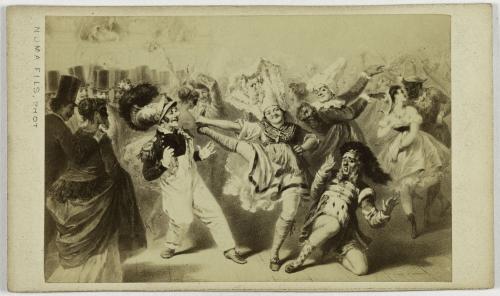
IMAGE: Le Quadrille des Clodoches au bal de l'Opéra. Autor: Numa Fils (vers 1800 - après 1880), photographe. Fecha: Entre 1870 et 1890. Denominación: Photographie. Materiales y técnicas: Tirage sur papier albuminé. Institución : Museo Carnavalet - Historia de París. Número de inventario: PH48586.
NOT FROM THE FILM: Quadrille des clodoches (FR 1903), Pathé frères N° 980, Danses & Ballets (7ème série).

Quadrille Tänzer. FR 1903. PC: Pathé frères N° 980, Danses & Ballets (7ème série). 35 m. Cin. Suisse. ♪ Alain Baents. Monday 4 July 2005, Cinema Lumière 1, Il Cinema Ritrovato, Bologna. A dance for four, with ample sights of petticoats.

Guerre enfantine

Children Playing at War. FR 1905. PC: Pathé. 70 m. BFI/NFTVA. ♪ Alain Baents. Monday 4 July 2005, Cinema Lumière 1, Il Cinema Ritrovato, Bologna. Quite a war game in the same tradition as the Molnár adaptations (Borzage’s No Greater Glory and Zoltan Fabri’s Pal-utca fiúk) and La Guerre des boutons.

Le Raid Paris-Monte Carlo en deux heures

FR 1905. PC: Star Film. D: Georges Méliès. 280 m. BFI/NFTVA. ♪ Alain Baents. Monday 4 July 2005, Cinema Lumière 1, Il Cinema Ritrovato, Bologna. The great race with a lot of mayhem on the road. After endless filling up with fuel the fur-clad mobilists wreak havoc everywhere, flattening policemen, destroying happy homes, bringing disaster to market squares, exploding via animation, conquering the Alps in hand-drawn form, yet reaching the goal, even there breaking everything up. An early French film entry in the car-culture commentary continuing via Godard (Week-End) and Tati (Trafic).

Un drame en mer / A Tragedy at Sea

De scheepsbrand. FR 1905. P: Pathé. D: Gaston Velle. 160 m. NFM. Tinted and toned. ♪ Alain Baents. Monday 4 July 2005, Cinema Lumière 1, Il Cinema Ritrovato, Bologna. A seasick man gets to the cabin. A fire breaks out. The shipwrecked are rescued from a raft.

[Scaphandriers]

[Plongeurs]. GB 190X. PC: Warwick Trading Co. 31 m. Cin. Suisse 2005. Tinted. ♪ Alain Baents. Monday 4 July 2005, Cinema Lumière 1, Il Cinema Ritrovato, Bologna. Divers, the submarine world as a painted backdrop with water in front.

Le Mât de Cocagne

Preisklettern. FR 1905. PC: Pathé. 29 m. AFF. ♪ Alain Baents. Monday 4 July 2005, Cinema Lumière 1, Il Cinema Ritrovato, Bologna. In a climbing contest a boy gets stuck on the pole and is rescued by the police.

De mesavonture van een fransch heertje zonder pantalon aan het strand te Zandvoort / A Gentleman without Pants


Willy Mullens: De mesavonture van een fransch heertje zonder pantalon aan het strand te Zandvoort / A Gentleman without Pants (NL 1905). Starring Willy Mullens. Photo from Wikipedia.

NL 1905. PC: Albert Frères. 141 m. NFM. English subtitles. ♪ Alain Baents. Monday 4 July 2005, Cinema Lumière 1, Il Cinema Ritrovato, Bologna. Caught by the rising tide, the gentleman loses his pants, and gets chased by a crowd through the city.

CENTO ANNI FA: I FILM DEL 1905 PROGRAMMA 3: MACCHIE E COMBINAZIONI

A Hundred Years Ago: The Films of 1905, Program 3: Melanges and Combinations. Presenta Mariann Lewinsky. Monday 4 July 2005, Cinema Lumière 1, Il Cinema Ritrovato, Bologna. ♪ Alain Baents. Melanges and combinations of fiction and non-fiction in three installments: I: 4 films, II: 2 films, III: 5 films.

Tih Minh 2: Deux drames dans la nuit, Tih Minh 3: Les Mystères de la Villa Circé


Louis Feuillade: Tih Minh 2: Deux drames dans la nuit (FR 1918). Tih Minh (Mary Harald) has lost her memory. She is protected by the explorer Jacques d'Athys (René Cresté) and Sir Francis Grey (Édouard Mathé). My screenshot / view film from Wikipedia.

FR 1918. PC: Gaumont. D: Louis Feuillade. /18 fps/ 30' + 37'. Archives Gaumont-Pathé. ♪ Gabriel Thibaudeau. Monday 4 July 2005, Cinema Lumière 1, Il Cinema Ritrovato, Bologna. An amulet with a paralyzing impact, letters with vanishing ink, Tih Minh having lost her memory collecting flowers from the field. The cellar of the Villa Circé full with daughters of the upper circles in their underwear, having lost their identity. Placide the servant infiltrates to Villa Circé, switches water with the consciousness-deleting drug and hides in a trunk as the villains move. Memorable images: the wandering daughters who have lost their souls; the trunk where Placide is hidden shown as a see-through image.

Sunday, July 03, 2005

Heaven’s Gate (2004 MGM/UA restoration) Bologna 2005


Michael Cimino: Heaven's Gate (US 1980) with Isabelle Huppert (Ella) and Kris Kristoffersson (Averill).

US 1980. PC: United Artists. D: Michael Cimino. 225’. 2004 “restoration” by MGM/UA. Presenta Michael Cimino. Sunday 3 July 2005, Piazza Maggiore, Il Cinema Ritrovato, Bologna. I love this film and its powerful imagery, but the print was so bad that I quit after half an hour.

American Madness

US © 1933 Columbia Pictures. D: Frank Capra. Starring Walter Huston, Pat O’Brien, Kay Johnson. 75’. New brilliant print from Sony Columbia. Sunday 3 July 2005, Cinema Lumière 1, Il Cinema Ritrovato, Bologna. A masterpiece, one of the earliest with the full typical Capra touch, a study of hysteria and a defense of the New Deal. Prints don’t come more brilliant than this: ultra sharp in detail and grading of light.

Touchdown Mickey

Mickey Rugbyman. US 1932. P: Walt Disney. D: Wilfred Jackson. Cin. fr. dupe. Sunday 3 July 2005, Cinema Arlecchino, Il Cinema Ritrovato, Bologna. Little Mickey and his team against the overwhelming adversary.

Beyond the Rocks (2003 restoration NFM)


Sam Wood: Beyond the Rocks (US 1922) with Gloria Swanson (Theodora Fitzgerald) and Rodolfo Valentino (Lord Hector Bracondale).

Kallioiden ja salakarien ohi / Förbi klippor och blindskär.
US 1922. D: Sam Wood. Starring Rodolfo Valentino, Gloria Swanson. 80’. Tinted. Restored, some elements digitally, by NFM (Giovanna Fossati) 2003- in three different versions; at Haghefilm; this is the premiere of the third version. Presenta Giovanna Fossati. ♪ Donald Sosin. Sunday 3 July 2005, Cinema Lumière 1, Il Cinema Ritrovato, Bologna. A good job of restoration of a difficult subject. The film is a mediocre triangle melodrama where Gloria gets married to an old millionaire but keeps getting rescued by Valentino (in the sea, in the Alps). The climax takes place in the Sahara, where the millionaire perishes in the attack of Arab bandits. The title refers to the motto about the angel who guides us beyond the rocks to the waters beyond.

The Mating Call

US 1928. D: James Cruze. 72’. Sunday 3 July 2005, Cinema Lumière 1, Il Cinema Ritrovato, Bologna. Video, alas! I walked out.

Gaumont actualités – settimana n. 1 (gennaio)

FR 1914. 8’. Sunday 3 July 2005, Cinema Lumière 1, Il Cinema Ritrovato, Bologna. DVD, alas!

Dix femmes pour un mari / Ten Wives for One Husband


Georges Hatot, Lucien Nonguet: Dix femmes pour un mari / Ten Wives for One Husband (FR 1905). Photo: La Cinémathèque française.

Ti kvinder og een mand / Ti koner og en mand / Десять жен на одного мужа.
FR 1905. PC: Pathé. D: Georges Hatot, Lucien Nonguet. 69 m. Cin. fr. 2000. ♪ Neil Brand. Sunday 3 July 2005, Cinema Lumière 1, Il Cinema Ritrovato, Bologna. A wild chase where a dozen women hunt one man: a remake of an Edison subject, in the same tradition as Keaton’s Seven Chances.

More photos on IMDb.

La presa di Roma / The Capture of Roma


Filoteo Alberini: La presa di Roma / The Capture of Roma (IT 1905). View movie on Italian Wikipedia. Portale Risorgimento.

La presa di Roma 20 Settembre 1870 / Bandiera Bianca - La breccia di Porta Pia.
    IT 1905. PC: Alberini & Santoni. D: Filoteo Alberini. (Original: 250 m, 7 episodes.) Preserved: 75 m, 4 episodes. Centro Sperimentale di Cinematografia/Cineteca Nazionale 1994. ♪ Neil Brand. Sunday 3 July 2005, Cinema Lumière 1, Il Cinema Ritrovato, Bologna. A historical epic of the events of the 20 September 1870. Viva l’Italia!

La Poule aux œufs d’or / The Hen That Laid the Golden Eggs


Gaston Velle & Segundo de Chomón: La Poule aux œufs d’or / The Hen That Laid the Golden Eggs (FR 1905).

De kip met de goude eieren. FR 1905. PC: Pathé. D: Gaston Velle, Segundo de Chomón. 275 m. Dutch titles. Pochoir colour. Beautiful colour print from Filmoteca Española. ♪ Neil Brand. Sunday 3 July 2005, Cinema Lumière 1, Il Cinema Ritrovato, Bologna. The surreal fairytale-fantasy classic always amazes. There is a direct line to Cocteau from here. The hen hatching the golden eggs brings infinite wealth and unspeakable evil with protean forms of the Devil and witchcraft.

Les Chiens contrabandiers / Dogs Used a Smugglers


Georges Hatot: Les Chiens contrabandiers / Dogs Used as Smugglers (FR 1906). Photo source: Candido Aragonese De Faria / Mutual Art.

Dog Smugglers / Hunde som smuglere / Smuglerbandens hunde.
FR 1906. PC: Pathé. D: Georges Hatot. 180 m. Cin. Royale de Belgique. ♪ Neil Brand. Sunday 3 July 2005, Cinema Lumière 1, Il Cinema Ritrovato, Bologna. A wild chase film with dogs as smugglers.

Delhi, grande ville de l’Inde supérieure / Delhi, Great Capital of India


Delhi, grande ville de l’Inde supérieure / Delhi, Great Capital of India (FR 1909). BFI: "Part of India on Film: 1899 – 1947. This collection of newly digitised films is part of the BFI's contribution to the UK-India Year of Culture 2017, in partnership with the British Council. Images of early 20th century Delhi during a Muslim festival. "Delhi at the time of a great Muslim religious festival" is the helpful - to a point - context to this film offered by Pathe's catalogue of the time. Which festival, we're not told. Certainly the streets throng with people and floats, while a number of street performers are on hand to entertain (and presumably profit from) the faithful. From there, the camera moves on to the magnificent Jama Masjid mosque, where worshippers wash themselves in the courtyard's waters before assembling for prayers. This was one of a great number of films made in exotic locations by the Pathe Freres company to showcase its often breathtakingly beautiful stencil-colour processing. Though the images here are mostly well-preserved, time hasn't been altogether kind to the colours of the BFI National Archive's copy, which aren't as radiant as they would once have been. But there's some real charm here nonetheless. The German intertitles in this copy testify to the huge international demand for such films. Watch more on the BFI Player: http://player.bfi.org.uk/ " My screenshot from YouTube.

Delhi, die grosse Stadt in Vorderindien. FR 1909. PC: Pathé. 65 m. Pochoir colour. BFI/NFTVA. ♪ Neil Brand. Sunday 3 July 2005, Cinema Lumière 1, Il Cinema Ritrovato, Bologna. Wonderful general views, miraculous acrobat performances, washing feet.

La Danse du “Kickapoo” / Kickapoo Dance


Gaston Velle: La Danse du "Kickapoo" (FR 1904). As danced at the Casino de Paris by the Elks.

Kickapoo.
FR 1904. PC: Pathé. D: Gaston Velle. 59 m. Cin.fr. ♪ Neil Brand. Sunday 3 July 2005, Cinema Lumière 1, Il Cinema Ritrovato, Bologna. Exotic dancing highlighting the beauty of the movement.

En terre sainte – Jerusalem

In heiligem Lande – Jerusalem. FR 1905. PC: Pathé. 100 m. BFI/NFTVA. ♪ Neil Brand. Sunday 3 July 2005, Cinema Lumière 1, Il Cinema Ritrovato, Bologna. Charming footage, panning shots of major views such as the well of Solomon and the Wailing Wall.

CENTO ANNI FA: I FILM DEL 1905 II

Cento anni fa: i film del 1905 II. ♪ Neil Brand. Sunday 3 July 2005, Cinema Lumière 2, Il Cinema Ritrovato, Bologna. Presenta Mariann Lewinsky. In Italian, earphone translation in English. A period program in honour the centenary of Italian cinema industry. 1: Scène de plein air, 2: Scène de danses, 3: Scène d’actualité, 4: Scène dramatique en six tableaux, 5: Scène comique, 6: Scène à trucs (Pathé) / vue fantastique (Méliès), 7: Scène historique, 8: Scène comique

Tih Minh I: Le Philtre d’oubli (introduced by Francis Lacassin)


Louis Feuillade: Tih Minh I: Le Philtre d’oubli (FR 1918) starring Mary Harald (Tih Minh) and René Cresté (Jacques d'Athys). View serial via Wikipedia. 

Tih Minh. Grand Ciné-Roman en 12 épisodes. Prologue: Le Roman d'un explorateur / Tih Minh I: Le Phyltre d'oubli
FR 1918. PC: Gaumont. D: Louis Feuillade. Starring Mary Harald (Tih Minh), René Cresté (Jacques d'Athys), Louis Leubas (Kistna), Edouard Mathé (Sir Francis Grey), Gaston Michel (Dr. Gilson / Marx), Georges Biscot (Placide), Marquet (Dr. Clauzel), Georgette Faraboni (Dolorès), Jane Rollette (Rosette). 
    /18 fps/ 50’. French / Dutch intertitles. Print quality usually good. Archives Gaumont-Pathé. 
    ♪ Maud Nelissen. 
    Presenta Francis Lacassin. 
    Sunday 3 July 2005, Cinema Lumière 1, Il Cinema Ritrovato, Bologna. 

The "morning serial" of the year. Great cinema with panache, mystery and a sense of humor. In the Côte d’Azur, the explorer d'Athys brings home Tih Minh, an Anamite woman whose life he has saved. In his possession, he has a Hindu book with a pencil-written testament including a clue to a great treasure. Strange crimes occur, the victims of which totally lose their memory. Behind them is the gang of Kistna who sports a turban in the first of his guises. Tih Minh is kidnapped and returned as a blank person with no memory, not even a power of speech. d'Athys’s zealous servant Placide brings forth the Hindu book after having unwittingly erased the testament. A film full of poetry: the photograph turns black after having been examined; the blank sea guards its secret; in her mind, Tih Minh, fantôme mort, is wandering in a deserted cave.