Thursday, December 17, 2009

The Diary of Anne Frank (50th Anniversary Edition) (blu-ray)


Anne Frankin päiväkirja (50-v-juhlalaitos) (blu-ray)
Antti Alanen
Helsingin Sanomat
Dvd-klassikko

ANNE FRANKIN PÄIVÄKIRJA / Anne Franks dagbok (The Diary of Anne Frank). USA 1959 © 1958 Twentieth Century Fox. T+O: George Stevens. KS: Frances Goodrich ja Albert Hackett - näytelmästään (1955) - kirjasta: Anne Frank: Het Achterhuis (kirjoitettu 1942-1944, julkaistu postuumisti toimitettuna 1947). KU: William C. Mellor. LA: George W. Davis, Lyle R. Wheeler. M: Alfred Newman. 
    N: Millie Perkins (Anne Frank), Joseph Schildkraut (isä Otto Frank), Shelley Winters (rouva Petronella Van Daan), Richard Beymer (Peter Van Daan), Gusti Huber (äiti Edith Frank), Lou Jacobi (Hans Van Daan), Diane Baker (Margot Frank), Douglas Spencer (Kraler), Dodie Heath (Miep), Ed Wynn (Albert Dussell). 
    Mustavalkoinen, letterbox 2,35:1, 5.1 DTS HD MA, DD 4.0, pääkuva 179 min 
    Suom. tekstit / svenska texter (myös liitteissä). 
    Bonus: - George Stevens, Jr.:n ja Millie Perkinsin kommenttiraita (2009). - Uudet liitedokumentit (2009): George Stevens in WWII. + The Making of The Diary of Anne Frank: A Son's Memories. + The Diary of Anne Frank: Memories from Millie Perkins and Diane Baker. + Shelley Winters and The Diary of Anne Frank. + The Sound and Music of The Diary of Anne Frank. + The Diary of Anne Frank: Correspondence. Nämä yht. 90 min. - Fox Movie Channel Presents: Fox Legacy with Tom Rothman, 15 min. - The Diary of Anne Frank: Echoes from the Past (Fox TV, 2001), 90 min. - The Diary of Anne Frank Excerpt from George Stevens: A Filmmaker's Journey (1984), 8 min. - George Stevens: Press Conference (1958), 5 min. - Fox Movietonews -otteita (1958, 1959), 7 min. - Millie Perkinsin koekuvaus (1958), 3 min. - Trailerikooste. - Kuvagallerioita. 
    FS Film 16.12.2009

George Stevens oli Hollywoodin suosittujen komedioiden ja musikaalien ohjaaja, jonka ura alkoi kuvaajana Ohukaisen ja Paksukaisen komedioissa 1920-luvulla. Toisessa maailmansodassa Stevens johti armeijan kuvausryhmää Normandian maihinnousussa, Pariisin vapautuksessa ja Dachaun keskitysleirillä. Hänen yksikkönsä kuvaamaa keskitysleiriaineistoa käytettiin todistusaineistona Nürnbergin oikeudenkäynnissä. Frank Capra ja William Wyler ovat kertoneet, että Stevens lakkasi hymyilemästä sodan jälkeen.  Holokaustin käsittelyä vältettiin Hollywoodissa toisen maailmansodan jälkeen, ja on merkittävää, että kun Hollywoodin ensimmäinen suuri holokaustielokuva, Anne Frankin päiväkirja, valmistui, ohjaaja oli goy George Stevens. Elokuvassa vaikuttaa pyrkimys aitouteen. Sen hillityssä tosipohjaisuudessa koskettaa pohjaton suru ja pettymys ihmiskuntaan. Kuvat taivaan linnuista ilmentävät pyrkimystä korkeampaan.  

Anne Frankin päiväkirjasta julkaistiin vuonna 2006 hieno Twentieth Century Classics -laitos ilman lisäaineistoja. Uudessa 50-vuotisjuhlalaitoksessa korkeatasoisia lisäaineistoja on tuntikaupalla. Niiden päätoimittaja on ohjaajan poika George Stevens, Jr., ja sykähdyttävän panoksen tuo mm. pääroolin esittäjä Millie Perkins.

Wednesday, December 16, 2009

Vanishing Point

Nasta laudassa / Med spiken i bottnet. US (c) 1971 20th Century Fox. D: Richard S. Sarafian. SC: Guillermo Cain – based on a story by Malcolm Hart. DP: John A. Alonzo. M: Jimmy Bowen. Tracks: You Got to Believe (Delaney Bramlett, perf. Delaney & Bonnie & Friends), I Can't Believe It (Long-branch / Pennywhistle), Super-Soul Theme and Freedom of Expression (The J.B. Pickers), Got It Together (Mike Settle, perf. Bobby Doyle), Where Do We Go from Here? (Mike Settle, perf. Jimmy Walker), Runaway Country (Doug Dillard Expedition), So Tired (Eve), Dear Jesus God and Over Me (Segarini / Bishop), Welcome to Nevada (Don Lanier & Joe Bob Barnhill, perf. Jerry Reed), Mississippi Queen (West, Laing, Pappalardi & Rea, perf. Mountain), Sweet Jesus (Red Steagal), Love Theme (Jimmy Bowen, Pete Carpenter, perf. Jimmy Bowen Orchestra), Sing Out for Jesus (Kim Carnes, perf. Big Mama Thornton), Nobody Knows (Mike Settle, perf. Kim Carnes).ED : Stefan Arnsten. S: William Edmonson, Tom Edwards, Theodore Soderberg. CAST: Barry Newman (Kowalski), Cleavon Little (Super-Soul), Dean Jagger (desert wanderer), Victoria Medlin (Vera), Paul Coslo (young cop), Bob Donner (older cop), Timothy Scott (Angel), Gilda Texter (nude motorcyclist), Delaney & Bonnie & Friends (J. Hovah's Singers). Original duration 107 min, Finnish / European version 99 min. A vintage print with Finnish / Swedish subtitles by Hellevi Reinikainen / Eirik Udd. Viewed at Cinema Orion, Helsinki (Tarantino Connection), 15 Dec 2009.

A vintage print with faded red colour, lots of scratches, screened at full frame (looks better at Orion that way).

One of the top road movies still looks great, enigmatic, and powerful. And with one of the great pop soundtracks ever, and with one of the great disc jockey star performances: Cleavon Little as the blind disc jockey Super Soul. - I watched just the first 40 minutes (too tired to stay longer).

The Scarlet Pimpernel

Punainen neilikka / Den röda nejlikan. GB 1934. PC: London Film Productions. P: Alexander Korda. D: Harold Young. SC: Lajos Biró, S. N. Behman, Robert E. Sherwood, Arthur Wimperis and Baroness Orczy - based on the play (1903) and the novel (1905) by Baroness Orczy. DP: Harold Rosson. AD: Vincent Korda, David B. Cunynghame. COST: John Armstrong, Oliver Messel. M: Arthur Benjamin. M dir: Muir Mathieson. ED: William Hornbeck. S: A. W. Watkins. CAST: Leslie Howard (Sir Percy Blakeney / The Scarlet Pimpernel), Merle Oberon (Lady Blakeney), Raymond Massey (Chauvelin), Nigel Bruce (The Prince of Wales), Bramwell Fletcher (priest), Anthony Bushell (Sir Andrew ffoulkes), Joan Gardner (Suzanne de Tournay), Walter Rilla (Armand St. Just), Mabel Terry-Lewis (Countess de Tournay), O. B. Clarence (Count de Tour-nay), Ernest Milton (Roberspierre). 98 min. A 1969 re-release print with Finnish / Swedish subtitles by Lea Joutseno. Viewed at Cinema Orion, Helsinki, 15 Dec 2009.

An intact print with little scratches and with an ok, at times slightly duped definition of light.

Baroness Orczy's popular adventure story set during the Great Terror after the French Revolution, with a great cast. Leslie Howard as the seemingly sissy Sir Percy Blakeney, who is actually The Scarlet Pimpernel who saves French aristocrats from the guillotine. Raymond Massey as the cunning French agent determined to expose The Scarlet Pimpernel. Merle Oberon as the Pimpernel's wife, who misunderstands and is misunderstood. I particularly liked the Merle Oberon sections of the film. She is very moving in her close-ups.

Saturday, December 12, 2009

Coco avant Chanel

Coco avant Chanel / Coco, livet före Chanel. FR (c) 2009 Haut et Court. P: Caroline Benjo, Philippe Carcassonne, Carole Scotta. D: Anne Fontaine. SC: Anne Fontaine, Camille Fontaine - based on the book by Edmonde Charles-Roux. DP: Christophe Beaucarne - anamorphic Panavision 2,35:1. M: Alexandre Desplat. CAST: Audrey Tautou (Gabrielle "Coco" Chanel), Benoît Poelvoorde (Etienne Balsan), Alessandro Nivola (Arthur "Boy" Capel), Marie Gillain (Adrienne Chanel), Emmanuelle Devos (Emilienne d'Alencon). 105 min. Released by FS Film with Finnish / Swedish subtitles by Outi Kainulainen / Joanna Erkkilä. Viewed at Kinopalatsi 5, 12 Dec 2009.

The story of the young Gabrielle Chanel, the orphan girl, on her way through the cabarets to a spoiled millionaire's protégée and the lover of Boy Capel and finally to independence as a woman and as a visionary designer, who frees women of corsets and frills. An interesting and well-made film. There is a slightly detached feel, which could be intentional.

A Serious Man


Ethan Coen & Joel Coen: A Serious Man (US 2009). Michael Stuhlbarg (Larry Gopnik).

A Serious Man / A Serious Man. US © 2009 Focus Features. P+D+SC+ED: Ethan Coen, Joel Coen. DP: Roger Deakins – shot on film (Super 35) – 4K digital intermediate by EFilm. M: Carter Burwell. CAST: Michael Stuhlbarg (Larry Gopnik), Richard Kind (Uncle Arthur), Fred Melamed (Sy Ableman), Sari Lennick (Judith Gopnik), Aaron Wolff (Danny Gopnik), Jessica McManus (Sarah Gopnik). In Yiddish, Hebrew, and English. 105 min. A FS Film release with Finnish / Swedish subtitles by Kaisa Cullen / Sylva Lennberg. Viewed at Kinopalatsi 1, Helsinki, 11 Dec 2009.

Thanks to the 4K resolution of the digital intermediate I could not tell that the source of the film print screened was digital.

A black Jewish comedy, maybe the most personal and daring film by the Coen brothers. It goes deep in the mysteries of the Judaic faith. It is an original interpretation of the Book of Job, and one of the essential works of art inspired by Franz Kafka. I was constantly surprised watching the film and I cannot pretend having understood it sufficiently at first viewing. A film that needs and deserves to be revisited.

Friday, December 11, 2009

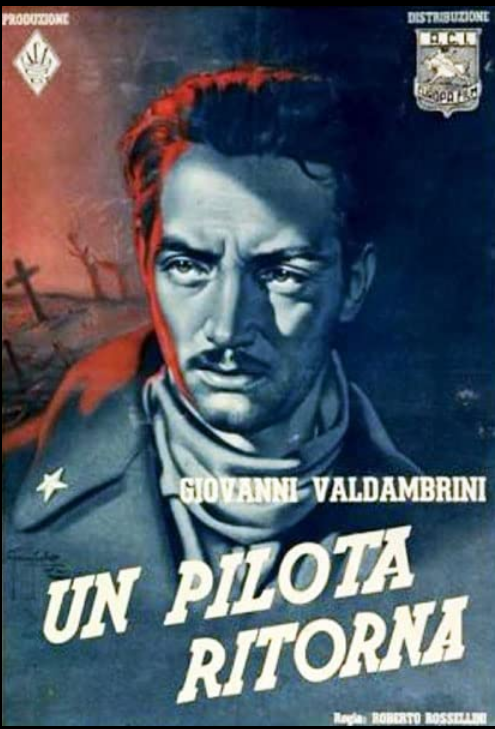
Un pilota ritorna / A Pilot Returns


Roberto Rossellini: Un pilota ritrona / A Pilot Returns (1942) starring Massimo Girotti (lieutenant Giovanni Rossati). Co-screenwriter: Michelangelo Antonioni.

[Lentäjän paluu] / [En flygares återkomst].
    IT 1942. PC: A.C.I. (Alleanza Cinematografica Italiana).
    D: Roberto Rossellini. SC – story: Tito Silvio Mursini (= Vittorio Mussolini) – manuscript: Michelangelo Antonioni, Rosario Leone, Margherita Maglione, Massimo Mida, Roberto Rossellini – dialogue: Ugo Betti, Gherardo Gherardi. DP: Vincenzo Seratrice. Aerial scenes cinematography: Crescenzo Gentili. AD: Franco Bartoli, Virgilio Marchi. M: Renzo Rossellini. S: Franco Robecchi. ED: Eraldo Da Roma. Military advisor: Maj. Filippo Masoero. Aerial advisor: capt. Aldo Moggi.
    C: Massimo Girotti (lt. Gino Rossati), Michela Belmonte (Anna), Gaetano Masier (lt. Trisotti), Elvira Betrone (Signora Rossati, Gino's mother), Nino Brondello (lt. Vittali), Piero Lulli (De Santis), Giovanni Valdambrini (doctor, Anna's father), Piero Palermini (young British officer), Jole Tinta (mother of the sick baby).
    Actual duration 85 min.
    Not released in Finland.
    Print: Cineteca Nazionale (Roma), by agreement with Ripley's Film.
    E-subtitles in Finnish by Lena Talvio.
    Viewed at Cinema Orion, Helsinki, 10 Dec 2009.

The first screening of this film in Finland. The print is good.

The film deals with Mussolini's invasion in Greece in October 1940.

1. Rossellini's second feature film, belonging to his military trilogy La nave bianca, Un pilota ritorna and L'uomo dalla croce, covering the navy, the air force, and the army.
2. Slightly more story-driven than La nave bianca.
3. The slight narrative is little more than a pretext to portray the state of war.
4. The film is official Fascist war propaganda, but it shows the distaste of the flyers for propaganda, and emphasizes the distress of the homeless and the victims more than the derring-do of the flyers.
5. There is a nominal love interest, but the film emphasizes the gravity of the protagonists. Facing death and responsibility for others dying and wounded they have little energy for romance.
6. Massimo Girotti is quite good as the serious flyer who does what is expected of him but could hardly be less excited about the official causes. His final enigmatic expression is memorable.
7. There are some good Rossellinian sequences: a) the sequence at the well with the long queues, b) the sequence of the amputation of a soldier's leg, c) the sequence of the refugees at the bridge which is blown up by the bomber.
8. There is a lot of aerial footage which gives the film an interesting and different look.
9. There are also many montages with newspaper headlines to cover the progress of the war campaign.
10. As Rossellini scholars have noticed, there are indeed some aspects of ellipse and anti-narrativity here, unfinished business, waiting, and deconstructing classical storytelling.

FINNISH FILM ARCHIVE PROGRAM NOTE BASED ON PETER BRUNETTE:

Thursday, December 10, 2009

Tyttö astuu elämään / [A Girl Steps Into Life]


Tyttö astuu elämään (FI 1943). A Red Army officer (Sasu Haapanen) threatens the lotta Elli Arho (Ansa Ikonen). Photo: KAVI

En flicka i grått / [A Girl in Grey].
    FI 1943. PC: Suomen Filmiteollisuus SF Oy. EX: T. J. Särkkä. D: Orvo Saarikivi. SC: Mika Waltari. DP: Armas Hirvonen. AD: Karl Fager. M: Väinö Haapalainen. ED: Orvo Saarikivi, Armas Vallasvuo. S: Pertti Kuusela, Kurt Vilja.
    C: Ansa Ikonen (Elli Arho), Eino Kaipainen (ltn. Arvo Tani), Laila Rihte (Lillukka Koponen), Kyllikki Forssell (Aino Mäkinen), Yrjö Tuominen (director Arho, Elli's father), Ossi Elstelä (draftee Mälli), Eero Eloranta (Veli Arho), Joel Asikainen (Arvi), Sasu Haapanen (Red Army officer), Mervi Järventaus (Maija, collector lotta), Ensio Jouko (colonel), Aino Lohikoski (organizer lotta), Varma Lahtinen (director of the course / the canteen director), Matti Lehtelä (soldier on duty), Veikko Linna (soldier with stubble), Laila Jokimo (dancer).
    Premiere in Helsinki, Kuopio, Lahti and Viipuri, distributed by SF: 28 Feb 1943.
    Original film control length 2500 m [approx.] / 91 min.
    Our digibeta on display /25 fps/ 84 min.
    Screened at Cinema Orion (Lotta Svärd), Helsinki, 9 Dec 2009.

The first public screening of the film since August 1944.

The film has survived with a part of the soundtrack missing (in this screening: from 23 min till 37 min and from 66 min till 75 min).

Tiina Suutala had prepared an electronic subtitling for the parts of the film with missing soundtrack, based on the manuscript by Mika Waltari.

Screened was a short version, self-censored by the production company. Missing from this version:
– the lines of dialogue referring to Suur-Suomi (Greater Finland), common during the enthusiasm of the attack in summer 1941
– president Risto Ryti's radio speech on 26 June 1941
– an episode with Red Army war prisoners

The film deals with what is called in Finland the Continuation War, the Finnish army against the Soviet Union in Summer 1941, as co-belligerent in Hitler's Operation Barbarossa.

The film did not get very positive reviews at the time. However, I was grateful to see it for several reasons.
    1. Ansa Ikonen gives a strong performance as the young graduate Elli Arho who grows up during her first summer after school. It is one of Ansa Ikonen's most memorable film roles. She is very moving having barely survived from the attack on the front canteen.
    2. Ossi Elstelä is good as the draftee Mälli. His disappointment with the lack of interest of Elli. His death at the attack on the canteen.
    3. Although this is war propaganda, the film also shows war as hell.
    4. It is interesting to notice the theme of disillusionment in a film that is set in the summer of 1941. Elli: "Nothing feels the same as before". "Maybe we don't have a future. Maybe we were only given these moments". "The dream is over. Thank you for these vanishing days".
    5. The love scene between Elli and Arvo at Elli's home is unusual for a Finnish film of the time. The sense of the brevity of life. The loss of illusions. Elli is probably a virgin, and Arvo probably deflowers her. This we cannot know, but it certainly seems like it. During the summer, Elli becomes a grown-up woman via the experience of death and love.
    6. The final scene is also unusual. Elli and Arvo return to the front and walk silently away from us. (I don't know if the silence is a conscious decision or another case of a missing soundtrack, but silence works perfectly here).

Fänrik Ståls sägner (1910)


Fänrik Ståls sägner (1910).

Vänrikki Stoolin tarinat / Ensign Stål's Tales.
    SE 1910. PC: Svenska Biografteatern.
    D: Carl Engdahl. Based on the poem by J. L. Runeberg (1848 and 1860). DP: Robert Olsson.
    CAST: Wilgot Ohlsson  (two roles: Ensign Stål and General Sandels), Axel de la Motte (the student [alias J.L. Runeberg]), Gottfrid Hallberg (two roles: officer and doctor), Ellen Hallberg (Ann-Sofi, the daughter of the vicar), Käthie Jacobsson (two roles: Gertrud, the housekeeper of the vicar and the foster sister of the Cloud's brother), Georg Dalunde (two roles: the Cloud's brother and General von Döbeln), Ellen Ströbäck (the daughter at the croft), Ellen Wiktorin (the mother at the croft), Gotthard Jacobsson (two roles: the father at the croft and the adjutant of Sandels), Torsten Jacobsson (two roles: a private at the episode of the Daughter of the Croft and an express messenger at the Sandels episode), Carl Engdahl (parson at Pardala), Oscar Söderholm (Sven Dufva), Frida Greiff (Lotta Svärd), Idoff Bergqvist (two roles: the foster father of the Cloud's brother and a man who visit Sandels at his breakfast).
    394 m /18 fps/ 20 min. Restored by Cinemateket / Svenska Filminstitutet, print at KAVA.
    Viewed at Cinema Orion, Helsinki, 9 Dec 2009.

Print ok, with in places good definition of light, otherwise passable, seems like a complete version with few scratches etc.

The film is a digest from a national poem of Finland, written in Swedish by J.L. Runeberg, which depicts the Finnish War (1808-1809) in which Sweden lost Finland to Russia, Finland having been a part of the Kingdom of Sweden since 1249.

The episodes based on the poem:
1. Hos den gamle fänriken / Visiting the Old Ensign
2. Minnen från flydda år / Memories from Years Gone By
3. Kriget bryter ut / The War Breaks Out
4. Björneborgarnas marsch / The March of Pori
5. Den första skärmytslingen / The First Skirmish
6. Molnets broder / The Brother of the Cloud
7. Torpflickan / The Daughter of the Croft
8. Sandels
9. Döbeln vid Juutas / Döbeln at Juutas
10. Sven Dufva
11. Sägnernas skald Johan Ludvig Runeberg / The Poet of the Tales Johan Ludvig Runeberg

Lotta Svärd has a strong presence in episode 10, Sven Dufva, keeping a stern discipline for the young soldiers. A big, awesome mama presence.

...
Wilgot Ohlsson     fänrik Stål och general Sandels        
Axel de la Motte     student (dikternas berättarjag)        
Gottfrid Hallberg     officer i första återblicken och i Sven Dufva-avsnittet/Läkare i Döbeln-avsnittet   
Ellen Hallberg     Ann-Sofi, kyrkoherdens dotter (se kommentar)        
Käthie Jacobsson     Gertrud, kyrkoherdens hushållerska (se kommentar) och fostersyster till Molnets broder        
Georg Dalunde     Molnets broder och General von Döbeln        
Ellen Ströbäck     torpflicka        
Ellen Wiktorin     torpflickans mor        
Gotthard Jacobsson     torparflickans far och Sandels' adjutant        
Torsten Jacobsson     ordonnans i avsnittet Torpflickan, Ilbud i Sandels-avsnittet        
Carl Engdahl     pastorn i Pardala        
Oscar Söderholm     Sven Dufva        
Frida Greiff     Lotta Svärd        
Idof Bergqvist     Molnets broders fosterfader samt man som passar upp vid Sandels frukost

Saturday, December 05, 2009

Enchanting Beauty - Masterpieces from the Collections of The State Tretyakov Gallery (exhibition)

Enchanting Beauty - Masterpieces from the Collections of The State Tretyakov Gallery / Пленники красоты / Kauneuden pauloissa
Tennis Palace Art Museum, Salomonkatu 15, Helsinki, 21 Oct 2009 - 14 March 2010
Visited on 5 Dec 2009

The official presentation: "Beauty will not fade! If you need proof, come and see Enchanting Beauty at Tennis Palace Art Museum. The exhibition of works from the Russian State Tretyakov Gallery is a splendid selection of academic Salon art that combines virtuoso techniques with an idealised treatment of the subject. These Russian masterpieces from the 19th century marry beauty with the sacred."

"The Enchanting Beauty exhibition is divided into ten thematic sections: Beauty of Everyday Life, A Dream of Italy, Still Life, Portrait, The World of Antiquity, Old Europe, Biblical Themes, Neo–Rococo, The Russian Style and Orientalism.

Mythological themes and historical scenes

There were two main movements in 19th century Russian art, academic Salon art and realism, which challenged it. The most notable representatives of both movements were educated in the same school, the St Petersburg Academy of Arts, which was established in the 18th century to emulate European art academies. Teaching in the St Petersburg Academy was highly disciplined and followed strict rules; technique was honed to perfection, composition was expected to be meticulous, and classical antiquity was set as the highest ideal.

Academically trained artists favoured mythological themes, but also painted historical scenes and portraits. They celebrated sensual pleasure, were intoxicated by the beauty of both women and nature, and depicted the glamour of Rococo costumes in works that were like scenes from the opera. They idealised both the Russian people and the country's landscapes.

European influences assimilated into national tradition

They often furthered their education in France. Russian artists were frequent visitors to the Paris Salons, where the virtuosi of European academic painting exhibited their work annually. Another popular destination was Italy, whose landscapes and Renaissance art inspired Russian artists. When the Russians subsequently assimilated these European influences into their national tradition, the result was breathtakingly beautiful art.

There are about 160 works by 83 artists. In addition to paintings, sculpture, drawings and watercolours, the exhibition also includes objets d’art, some of which are on loan from the National Museum of Finland."

Featuring artists such as Ivan Kramskoi and Konstantin Makovski, this was a display of traditional high art in the 19th century just before the breakthrough of modernism and the decisive impact of photography (and cinema).

The glossy surface realism is astounding in the portraits, which certainly go deeper than the best photography or cinematography, yet the first impression is often that of glamour photography of the highest order.

A fascinating exhibition, yet with no immortal masterpieces that one would expect to revisit time and again.

Täällä Pohjantähden alla (2009) / Under the North Star


Timo Koivusalo: Täällä Pohjantähden alla (2009) / Under the North Star, starring Ilkka Koivula (Akseli Koskela).

Här under Polstjärnan.
    FI (c) 2009 Artista Film.
    P+D+SC: Timo Koivusalo - based on the two first novels (1959, 1960) in the trilogy by Väinö Linna. DP: Pertti Mutanen - scope - digital intermediate. M: Jaakko Kuusisto. "The Akseli And Elina Wedding Waltz" by Heikki Aaltoila. AD: Markku Myllymäki. COST: Leila Jäntti. Make-up and hair: Erja Mikkola. S: Jyrki Luukko, Olli Pärnänen. ED: Jyrki Luukko, Timo Koivusalo.
    CAST: Ilkka Koivula (Akseli Koskela), Vera Kiiskinen (Elina Koskela), Risto Tuorila (Jussi Koskela), Ritva Jalonen (Alma Koskela), Mikko Nousiainen (Aku Koskela), Tuukka Huttunen (Aleksi Koskela), Mikael Salonen (Akseli Koskela as a boy), Hannu-Pekka Björkman (vicar Salpakari), Jonna Järnefelt (Ellen Salpakari), Antti Luusuaniemi (Ilmari Salpakari), Heikki Nousiainen (tailor Halme), Seela Sella (Emma Halme), Esko Roine (Otto Kivivuori), Sara Paavolainen (Anna Kivivuori), Tapani Kalliomäki (Janne Kivivuori), Niko Saarela (Osku Kivivuori), Tomi Salmela (Anttoo Laurila), Eija Vilpas (Aliina Laurila), Elena Leeve (Elma Laurila), Tom Petäjä (Antti Laurila), Risto Korhonen (Uuno Laurila), Arttu Kapulainen (Arvi Laurila), Juhani Niemelä (Töyry), Leena Suomu (the Mistress of Töyry), Janne Hyytiäinen (Arvo Töyry), Sulevi Peltola (Preeti Leppänen), Tuula Väänänen (Henna Leppänen), Kari Ketonen (Valenti Leppänen), Miia Selin (Aune Leppänen), Göran Schauman (the baron), Eija Nousiainen (the baroness), Oiva Lohtander (Mellola), Juhani Laitala (the master of Yllö), Turkka Mastomäki (Uolevi Yllö), Tapio Liinoja (Ylöstalo), Raimo Grönberg (Hellberg), Jukka Leisti (Elias), Risto Salmi (Vikki Kivioja), Pekka Huotari (Lauri Kivioja), Matti Mäntylä (teacher), Pekka Valkeejärvi (the sheriff), Hannu Kivioja (the storekeeper), Kalevi Haapoja (the old vicar), Kristiina Elstelä (the midwife Priita).
    193 min.
    Released by Walt Disney Studios Motion Pictures Finland. Viewed in Bio Bristol, Helsinki, 4 Dec 2009 (day of premiere).

A film print with an obvious digital intermediate look: the colour definition is a bit shabby.

Väinö Linna's historical novel is seminal in Finland as literature and as coming to terms with 70 of the most dramatic years of Finnish history. Importantly, Linna's epic was an act of reconciliation in the 1960s of the White and the Red interpretations of history. The awakening of the national spirit in the 1880s, the working people's fight for justice, the Finnish independence, the Civil War with its atrocities, and the bloody retribution of the Whites are among the themes of the first two volumes covered in this film. The novel is enormously popular, as is the first film adaptation by Edvin Laine (1968, 1970), and there have been many theatre adaptations, as well.

Among my first positive impressions of Koivusalo's film are:

1. I never glanced my watch during the 193 minutes of the film.
2. The film is well edited. There is a full command of the rhythm and the vitality of the epic flow.
3. The visual composition is effective, and to watch the big scope image on the Bio Bristol screen from my favourite first row of the balcony was impressive. Koivusalo and the DP Pertti Mutanen meet the visual challenge of epic cinema.
4. The film is never boring, yet it does not descend to cheap tricks.
5. Daringly, Koivusalo casts Ilkka Koivula with his anti-heroic looks as Akseli Koskela. Koivula is certainly credible as a vigorous settler.
6. The film is well cast, a display of many of Finland's talented contemporary actors.
7. I feel that there is more emphasis on the female roles than in Linna's novel and Laine's film. Vera Kiiskinen, Ritva Jalonen, Sara Paavolainen, et al. are very good.
8. The most poignant is Elena Leeve in her role of Elma Laurila.
9. Heikki Nousiainen carries his central role as tailor Halme splendidly and with conviction.
10. Hannu-Pekka Björkman creates an original interpretation as vicar Salpakari. The contrast of Halme and Salpakari as the central spiritual forces of the epic is well realized.
11. The film faces the terrible themes boldly yet with sophistication. There is no easy way out.
12. An industry insider friend predicted after an industry preview that the film will be a big hit and people will cry. I did not cry during the screening, but I cried the day after, reminiscing the Elma Laurila story.
13. Three days after seeing the film I like it more because of its strong message of fighting for justice.

Thursday, December 03, 2009

Ollin oppivuodet (film concert)

Ollis öden och äventyr / The Apprenticeship of Olli. FI 1920. PC: Osakeyhtiö Suomen Filmikuvaamo. EX: Erkki Karu. D+SC: Teuvo Puro – based on the novel by Anni Swan (1919). DP: Frans Ekebom. AD: Carl Fager. CAST: Jussi Snellman (Olli's father), Ertta Virtamo (Olli's mother), Sirkka Puro (Olli as a little boy), Alfred Idström (Olli as a bigger boy), Eero Kilpi (Kaarle), Mimmi Lähteenoja (Matleena), Erkki Karu (shoemaker Simolin), Aarne Nyman (Ränni-Pelle), Hemmo Kallio (shoemaker Jokela), Ester Henriksson (Hillevi, orphan girl), 1900 m /18 fps/ 92 min [probably the most natural speed], /20 fps/ 83 min, /25 fps/ 66 min. Restored version: KAVA (2008, Tuija Söderman). Projected on Digibeta at 25 fps, with restoration credits 68 min.

Restored in 2008 from archival preservation masters guided by a vintage nitrate screening print. - Restored in 2008 by Tuija Söderman. - Preservation copying by Matti Valtavirta, Tuija Söderman, Pentti Mallinen. - Printed in 2008 by Päivi Hurskainen (Finn-Lab Oy).

Cinema concert at Finlandia Hall, Wednesday, 2 Dec 2009.
A new score composed by Harri Vuori.
Performed by RSO (Radio Symphony Orchestra) with 49 players.
Conductor: Anna-Maria Helsing.

YLE (The Finnish Broadcasting Company) and its RSO launched a magnificent project of new scores by modern composers for old Finnish films with Ollin oppivuodet, the first fiction feature film produced in independent Finland. It is also the oldest Finnish feature film that has survived intact. Ollin oppivuodet was an old-fashioned film even for its time. The contemporary masterpieces from Sweden, Germany, The United States... were a far cry from it. Finnish film production was out of step. Yet Ollin oppivuodet is the foundation stone of an uninterrupted development to the present day in Finland.

Ollin oppivuodet had the gala treatment. The premiere with the new score had already taken place last Friday in Hämeenlinna, and the critics had already praised Harri Vuori's full-blooded, rousing atonal score. The conductor Anna-Maria Helsing had a vigorous grip on the orchestra, while keeping an eye on her stop-watch with an extra large display. Harri Vuori plans an independent orchestral version of his composition. His modern atonal composition deserves full attention independently of the film.

Dr. Anu Juva gave an excellent lecture on music for the silent films before the performance. Finland had a thriving music culture also in the cinemas during the silent era.

After the performance there was a warm reception in the presence of the grandchildren of the director Teuvo Puro, whose daughter Sirkka Puro plays the little Olli.

The film Ollin oppivuodet has multiple symbolic value for the Finnish audience, and with the new score it can experience a revival for new generations.

My criticisms of the performance include the screening from video instead of film, and the projection at the overspeed of 25 fps, which made movement look unnatural.

Despite this it was a warm and engrossing evening.

Wednesday, December 02, 2009

Un secret

A Secret. FR 2007. PC: UGC YM, France 3, Soficinéma 2, Soficinéma 3. D+SC: Claude Miller – based on the novel by Philippe Grimbert (2004). DP: Gérard de Battista. COST: Florie Vaslin. Make-up: Lucía Bretones-Méndez. M: Zbigniew Preisner. ED: Véronique Lange. CAST: Cécile De France (Tania Stirn / Grimbert), Patrick Bruel (Maxime Nathan Grinberg / Grimbert), Ludivine Sagnier (Hannah Golda Stirn / Grinberg), Julie Depardieu (Louise), Valentin Vigourt (François Grimbert at 7), Quentin Dubuis (François Grimbert at 14), Mathieu Amalric (François Grimbert at 37). 105 min. Print: Ministère des Affaires Etrangères et Européennes with English subtitles. Viewed at Cinema Orion, Helsinki, 1 December 2009.- Print ok, with a digital intermediate look in the nature scenes. - The story of a shattering quest into the history of three generations of a French Jewish family starting in the 1930s. - Based on the novel of a French psychoanalyst, tracking the impact of severe traumata across generations, the major viewpoint being that of François Grimbert from the 1950s till the 1980s. This is his Bildungsroman, as he learns the terrible secrets from his family's experiences (the first wife and the first son of his father were murdered in the Holocaust), and how his father always saw him as the clumsy, inadequate substitute for the first, brilliant son. - The form of the film is a mosaic. The film moves freely like a person's mind between various periods of time. The edit is pretty quick. - The mosaic quality and the quick edit are somewhat disturbing, as if the story were too heavy to be taken in larger doses. - This is strong and moving material, the actors are excellent, and there is a special gravity in the film that stems probably from the fact that the family of the director Claude Miller (born in 1942) has had to endure a similar tragedy.

Slavoj Žižek: Cinema and Ideology (lecture / live performance)


Slavoj Žižek at Kiasma Theater, Helsinki, 1 Dec 2009.

Slavoj Žižek: Cinema and Ideology (lecture / live performance). Kiasma Theater, Helsinki, 1 Dec 2009.

The house was packed, and there were two extra spaces with monitors and loudspeakers for those who were not able to fit in the theatre.

Žižek was in full swing with his non-stop repartee, full of associations, a modern incarnation of the classical figure of a philosopher who can inspire an audience with his speech. His range is admirable, with associations around the world and through history. He is also very topical, with insight in our cyber-world.

 He is amusedly aware of his public image as a showman. His appearances are a kind of an intellectual marketing tour for his books.

His articles are stimulating, and the substance of his original thinking is in his serious books, which I have not read, but I know I would love to.

I don't know how much I agree with Žižek, but it feels worthy to respond to his intellectual stimulation and provocation.

Žižek is a prolific writer, and it was interesting to hear that he suffers from a writer's block. This he avoids by conscious self-deception. First he takes notes in full sentences. At a certain point he realizes that he has covered everything. Then he edits his notes, and thus he has accomplished a manuscript by skipping the phase of writing!

Tuesday, December 01, 2009

Žižek!

US/CA (c) 2005 The Documentary Campaign. P: Lawrence Konner. D: Astra Taylor. DP: Jesse Epstein, Martina Radwan. M: Jeremy Barnes. S+ED: Laura Hanna. LOC: Buenos Aires. In English and Slovenian, with English subtitles. 71 min. A video projection at Kiasma, Helsinki, 1 Dec 2009. - A documentary on "the Elvis of cultural studies" and "the Denis Leary of Slovenia". - With his non stop lecture, which is almost like a stream of consciousness, I find him stimulating company, although I don't always believe in what he's saying.

Saturday, November 28, 2009

Jörn Donner: Rapport från Berlin / The Berlin Report 1958-2008 (a book)


Jörn Donner: Jörn Donner: Rapport från Berlin / The Berlin Report (1958). The cover of the first edition in the original Swedish. Photo: Bokbörsen.

Jörn Donner: Berliini-raportti 1958-2008 (original in Swedish: Rapport från Berlin). Finnish translation by Toivo J. Kivilahti. First Finnish edition WSOY 1958. Further editions by Otava 1977, 1989, and 2008.

I read Jörn Donner's acclaimed The Berlin Report for the first time, although I have always been aware of it. The reason for the timing of the reading was the 20th anniversary of the fall of the wall. The value of Donner's book keeps growing. He became a Berlin regular in the 1950s and was able to meet people like Bertolt Brecht and Willy Brandt. He saw the full significance of Berlin as a symbol of the condition of the world during the Cold War.

Myself, I have also "noch einen Koffer in Berlin", and "ich bin auch ein Berliner". The happiest day in my life was the 9th of November 1989. I think it was about 8 pm that a good friend of mine at the YLE (Finnish Broadcasting Company) newsroom called me and told me about the fall of the wall. As I called some of my best Berlin friends, they heard about it from me, and could not believe it!

This year I heard from Claudia Dillmann, director of the Deutsches Filminstitut in Frankfurt, that she flew to Berlin on the 10th of November in 1989, and the pilot took extra rounds over the city and urged the passengers to have a look as the people of Berlin tore down the wall.

The fall of the wall was not a surprise. I remember having said aloud at the Berlin Film Festival the year before that in ten years, the wall will no longer be there. Those years, I visited the Moscow film festivals twice when the glasnost and the perestroika were at full swing. The writing was on the wall - on The Wall.

When I first crossed East Germany and East Berlin in 1981 by a train bound to West Berlin, my first impression of East Germany was of suspicion and surveillance. The East German border patrol inspected the train with their Schäferhunde so that nobody could escape. I paid only a couple of short visits to East Germany. Even a child could see that it was dead already, and that it was a matter of time when a change would come.

The East Berlin people and professionals were always very sympathetic. As I began watching systematically German film classics in the Stiftung Deutsche Kinemathek (then at the Theodor-Heuss-Platz), there was no problem in accessing film prints from the other side of the wall.

The Berlin people were rude but cordial. That was still the time when they barked "alle aussteigen" and "zurückbleiben" with Prussian military harshness at the subway (U-Bahn). I learned to appreciate the "Berliner Witz", the tough and direct way to deal with hard facts with a sense of humour.

An example is the story about Max Ophuls, who left Germany in 1933. When he returned to Berlin after 17 years to market La Ronde, in Hotel Kempinski the staff at the reception was the same. When he ordered a taxi, the taxi driver was familiar, too. "Where have you been?" asked the chauffeur. Ophuls told him. "You didn't miss much", said the chauffeur. ("Da haben Sie nicht viel verpasst".)

Design Forum Finland (Hannu Kähönen – The Kaj Franck Design Prize of 2009 and other exhibitions of 2009)


Design Forum Finland: Hannu Kähönen – The Kaj Franck Design Prize of 2009 Exhibition. "Industrial designer Hannu Kähönen (born 1948) has received the Kaj Franck Design Prize 2009. Hannu Kähönen graduated in 1971 from the University of Art and Design Helsinki. He is a versatile expert in design, whose perspective ranges from the practical design work to national design policy. He has helped to develop the field through his work in national and international positions of trust. Hannu Kähönen has also written about design and has taught design at the university level." Among Kähönen's most beloved designs are the low-floor trams of Helsinki.

I visited Design Forum Finland two days after the announcement that Helsinki will be World Design Capital in 2012 (the third one after Torino in 2008 and Soul in 2010).

1. The Helsinki Design Capital showreel. A loop of design samples.

2. Hannu Kähönen – The Kaj Franck Design Prize of 2009 Exhibition. "Design today must take note of environmental issues – the requirements of sustainable design and changing needs of people and a population that is ageing. Pure materials, ecological and service design solutions will stay important issues in the future".

3. The Sami Knife Exhibition. Great new designs on the traditional big knife of the wild north of Lapland.

4. The Tunne Väri ["Feel the Colour"] Collection: the new colours of the Tikkurila paint company. – 263 new colours, each with an individual name impossible to translate, such as in the Lapponia series of translucent paints: Joiku, Pälvi, Outa, Seita, Sivakka, Kuukkeli, Ahkio, Suopunki...

5. The Design Forum Shop Christmas Collection: new gift items and toys.

Tuesday, November 24, 2009

Suomenlahden sisaret / Sisters Across the Gulf of Finland


Imbi Paju: Suomenlahden sisaret / Sisters Across the Gulf of Finland (FI 2009). The book parallel to the movie.

Systrar över Finska viken / Soome lahen oed. FI © 2009 Film Magica. P: Tiina Butter. D: Imbi Paju. DP: Priit Sooba, Liina Toiviainen, Ants Martin Vahur, Aare Varik. M: Arvo Pärt, Leo Sumera. S: Kirsi Hiltunen. ED: Anders Helle, Riitta Poikselkä. In Swedish, Finnish, and Estonian. 59 min. Digibeta from Film Magica, projection with Finnish subtitles in Cinema Orion, Helsinki, 23 Nov 2009. - A new artistically high profile documentary film from Imbi Paju, revealing aspects of recent history not much discussed publicly. The topic is the collaboration of Lotta Svärd (Finland) and Naiskodukaitse (Estonia) with interviewees such as Elisabeth Rehn, Kyllikki Villa, Hanna Eckert, Greta Kupiainen, Ulla-Marita Rajakaltio, Helvi Hödejärv, Laila Auer, and Helmi Visnapuu. - A film that will merit several viewings.

The Lotta Svärd on Screen (seminar)


Lottia valkokankaalla -seminaari. Antti Alanen, Taru Mäkelä, Tiina Kinnunen, Tiina Suutala, Irmeli Lemberg, Ilkka Vanne, Imbi Paju. Orion, 23 Nov 2009.

Lottia valkokankaalla -seminaari. Cinema Orion, Helsinki, 23 Nov 2009
Moderator: Tiina Suutala
Tiina Kinnunen (docent, Joensuu University): The Lotta in Finnish Cinema from the 1940s till the 1980s - the years of disregard
Taru Mäkelä (film director): The Lotta in the 1990s Fiction and Documentary - the rehabilitation
Irmeli Lemberg (the chair of the Lotta Svärd Institute): The Origins of the Lotta Movie The Promise
Ilkka Vanne (film director): The Promise - A Journey Into My Own History - his mother was a Lotta, and his father, a career officer
Imbi Paju (film director): The Sisterhood of the Estonian and Finnish Lottas Before the War and the Political Silence After the War - the collaboration of Lotta Svärd and Naiskodukaitse
...
Movie: Imbi Paju: Suomenlahden sisaret (2009)
...
The seminar, part of our Lotta Svärd film retrospective, both curated by Tiina Suutala, was a powerful experience of psycho-history on big topics that have been not discussed enough. The Lotta Svärd was essential during the three wars Finland suffered in 1939-1945, and without it Finland would not have survived.

Lotta Svärd and other women's wartime service organizations contributed in a central way to health care, catering, supplies, communication, maintenance and field service (front nurses, front canteens, front communications). They did not carry weapons.

After the wars, the organization was banned and its importance in some circumstances disregarded. Mainly, however, in my experience, it was always highly respected. In my family, for instance. The Lotta Svärd emblem is on the gravestones of my paternal grandmother and my godmother. My maternal grandmother was a Lotta already in the Civil War, and also in WWII, and my mother and her sisters were Lottas or Little Lottas.

..
Imbi Paju: Suomenlahden sisaret (FI 2009).
Carl Engdahl: Fänrik Ståls sägner (SE 1910).
Orvo Saarikivi: Tyttö astuu elämään (FI 1943).
Turo Kartto: Rivilotta (FI 1943).
Reino Tenkanen: Lottatyttö (FI 1944).
Aarne Tarkas: Rintamalotta (FI 1956).
Imbi Paju: Suomenlahden sisaret (FI 2009). Revisited.
Taru Mäkelä: Lotat (FI 1995).

Sunday, November 22, 2009

Marcel Proust: A la recherche du temps perdu 6: Albertine disparue (novel)

Marcel Proust: A la recherche du temps perdu 6: Albertine disparue, also known as La Fugitive. First published: FR 1925. Later, more definitive editions: FR 1954, FR 1962, FR 1987-1989. Read in the Finnish translation, Kadonnutta aikaa etsimässä 9: Pakenija, by Inkeri Tuomikoski, Helsinki: Otava 2003.

Synopsis: Albertine, "the prisoner", is gone. She has left the narrator who has no serious intentions with her, and who tries jealously to guard her from her lesbian passions. The narrator makes ingenious plans to win her back. But, shockingly, he learns that Albertine has died in a riding accident. Even after her death, the narrator continues spying retrospectively on Albertine's lesbian affairs, to learn about her secret life. Everything remains vague. The narrator tries to recover from the pain of losing her via substitutes. Most importantly, he meets his old lover Gilberte, and in a new, sober friendship with her he recovers from the loss of Albertine and is able to visit Venice together with his mother. The voyage to Venice is an experience of transformation and a farewell to youth. The voyage of Venice is also a subjective one, as the sights remind the narrator of his life experiences. On his way back home to Paris the narrator learns that Gilberte is marrying Robert de Saint-Loup. This is the union of the incompatible, and the end of a period in the life that has been depicted. Finally, revisiting Gilberte the narrator learns that from the start she has wanted the same thing that he had not dared to ask.


First impressions of the novel that I had never read before.
1. This novel is a draft that Proust never had the chance to finish. There are repetitions and imbalances due to the manuscript character of the work.
2. It is the portrait of a dandy who is insufferably nestling in his private affairs, not facing the world as a grown-up man. It is impossible to take his lament seriously.
3. His affairs with the young women are superficial. The women are only objects of pleasure for the playboy. There is not even the perspective that he might marry and that the women might become mothers.
4. This obnoxious, self-centered bon vivant is an importunate examiner who delves deep in the psychology of self-deception, and gets lost in the complexities of how much people will lie to keep appearances.
5. There is a strong homosexual and lesbian aspect in the novel, maybe displaced from the narrator himself to other characters such as Robert and Albertine. It has been noted that the narrator's lovers have feminine versions of male names: Albertine and Gilberte.
6. There is also a strong Jewish and anti-semitic theme in the novel, maybe also displaced from the narrator to others, such as Gilberte in this one.
7. Under these superficial and deceptive layers there runs a brilliant line of meditation and reflection.
8. This is one of my life-books. I started reading it, reluctantly, in ca 1970... and when I have finished reading all the volumes in a non-chronological order, I have to read all again.

C’est comme si elle m’avait dit: « Tournez à gauche, prenez ensuite à votre main droite, et vous toucherez l’intangible, vous atteindrez les inaccessibles lointains dont on ne connaît jamais sur terre que la direction, que (ce que j’avais cru jadis que je pourrais connaître seulement de Guermantes, et peut-être, en un sens, je ne me trompais pas) le « côté ».

Saturday, November 21, 2009

Foto Signe Brander (exhibition)


Signe Brander (1907): Panoraama Siltavuorensatamaan. Vasemmalla Siltasaarenkatu 1, John Stenbergin konetehdas. Nykyinen John Stenbergin ranta 4 ja Hakaniementori. Vasemmalla Hakaniemenrantaa Kuvattu Siltavuorelta pohjoiseen. -- negatiivi, filmi, mv. Helsinki, John Stenbergin ranta 4. 18 x 35. Collection: Helsinki City Museum. Blue pencil.svg wikidata:Q2031357 . Accession number: N8382. Source: Finna: m.HKMS000005:km0038c5 . Permission: (Reusing this file): CC BY 4.0 . Public domain. Please click on the photo to view it on the largest screen.


Foto Signe Brander. Exhibition at the Hakasalmi Villa 14 Oct 2009 – 28 March 2010.

Signe Brander (1869–1942) photographs belong to the treasures of the city of Helsinki.

This time, there are 79 photographs from her cityscapes of 900, covering a cross section of Helsinki a hundred years ago.

The glass plate negatives have been digitized in high resolution.

The most popular section was The Time Machine dia show on a big screen, produced some 10 years ago, with contemporary photographs giving us the opportunity to compare Helsinki then and "now". Many cityscapes were unrecognizable (and interestingly, in the last 10 years, many changes have also taken place... !).

Wednesday, November 18, 2009

The Seminar of the Headmasters of Helsinki

Helsingin kaupungin Rehtoripäivät / The Seminar of the Headmasters of the City of Helsinki. Haikko, 18 Nov 2009.
The topic this year was "Aspects of Security". I gave a lecture on media and violence, about new approaches of media criminology since Columbine.
Myself, I learned a lot about the big change in the circumstances of school during the last decade. The internet and the waking hours have changed everything. There is less respect and discipline at school these days.

Sunday, November 15, 2009

Don't Change Your Husband

Älä vaihda miestä / Älä vaihda miestä (liian usein) / Mannen du gav mig. USA © 1918 Famous Players-Lasky Corp. Premiere 1919. Pres: Jesse L. Lasky. D: Cecil B. DeMille. Ass. D: Sam Wood. SC: Jeanie McPherson – based on the novel by David Graham Phillips [Old Wives for New, 1908 or The Husband's Story, 1910]. DP: Alwin Wyckoff. AD: Wilfred Buckland (art director), Howard Higgin (decorations). COST: Margaretta Hoffman. ED: Anne Bauchens. CAST: Elliott Dexter (James Denby Porter), Gloria Swanson (Leila Porter), Lew Cody (Schuyler Van Suthpen), Sylvia Ashton (Mrs. Huckney), Theodore Roberts (the bishop), Julia Faye ("Toodles" Thomas), James Neill (the butler), Ted Shawn (the faun). Print: Jugoslovenska Kinoteka > Cinemateket / Svenska Filminstitutet (reconstructed Swedish titles only):  /22 fps/ 71 min. Viewed at Cinema Orion, Helsinki, 14 Nov 2009. - An incomplete print from a battered source. I realize now that of this film particularly the most brilliant print would have been essential, as this is a glamorization / satire of consumer society. - 22 fps is too fast, we should have screened this at 20 fps. - Revisited a film that is fascinating for many reasons: 1) the launching of the Jazz Age in the cinema, 2) the launching of Gloria Swanson as a new kind of star, 3) the cinema becomes an engine for the consumer society (not just a reflection of it), 4) an important stage in the development of sophisticated erotic comedy, 5) an important step in the comedy of remarriage. - Cecil B. DeMille's visual storytelling is still inspired. Already by 1923 (The Ten Commandments) he was getting more clumsy and awkward. - This film is a great pleasure to see, and it is a story of contradictions. Apparently DeMille was, himself, not happy with this cycle of films, launched by Jesse T. Lasky.

Saturday, November 14, 2009

Jarno Vesala: The Second Floor, Please! (installations)

Toinen kerros, kiitos!
Kluuvi Gallery, The Helsinki City Art Museum, Unioninkatu 28 B (inner yard, 3. floor)

Three installations: 1. Palaan pian [I'll Be Right Back] (2009). 2. Tänne [Hitherto] (2009). 3. Siellä [There] (2009).

A rough translation of mine from Jarno Vesala's introductory text:
"Welcome to the staircase, to the floors, and between the floors!
I have produced to the Kluuvi Gallery three installations which are tightly interwoven. They are like sets, seemingly stagnant situations or subtle moments, which characters created via different techniques are living. In the moments, a recent or forthcoming change can be sensed. The change can be related with a loss, death, happiness, or perhaps a total loss of self.
In my works the spectator is a character among others, a part of the story.
In my installations, the tension arises from expectation and from silent encounters between characters present or absent. In the gallery, an absurdly atmospheric world is built from sound, projection, lighting, water, and suggestive objects.
Forgotten relatives, invisible friends, unknown neighbours...
Who is present, who has already left?
Who is being observed? Who has been forgotten?"

A stark and haunting exhibition. The statue of a human being is a projector projecting a moving video image of a staircase with an elevator going up and down. In a reception cubicle there is a surveillance monitor on the screen of which we see ourselves and the reflection of the staircase with the elevator. In another room, there is a large black mirror on the floor, in which is reflected a woman lying face down. We look up and see the statue of the woman nailed to the ceiling face up.

Friday, November 13, 2009

4K demonstration

Kino Tulio, Kansallinen audiovisuaalinen arkisto, Sörnäisten rantatie 25, Helsinki.

We have installed Finland's first 4K projector (Sony) in our Kino Tulio screening room at our new premises. We saw samples of blu-ray discs and a 4K test programme.
- Flowers in the Netherlands
- A sample of Wallace & Gromit: The Curse of the Were-Rabbit
- Monkeys in a hot spring on a snowy hillside
- A volcano
- Time lapse photo of New York traffic shot from a skyscraper
- India
- Mecca

The blu-ray: I have never seen a better presentation of a home viewing format. But a great 16mm presentation is equally good.

4K: the image is ultra-sharp.
Depth of focus is excellent.
The image can carry great detail from a long distance: a street of New York seen from the top of ?Empire State Building?, ?the Himalaya?, the pilgrims at Mecca.
But the colour in the test is highly saturated, artificially bright and unnatural.
A sense of atmosphere and temperature is missing.
Even the summer scenes feel cool.

We discussed that test shows are produced by engineers, not by artists. Engineers seem to emphasize sharpness and focus and neglect other important parameters.

Une femme douce / A Gentle Woman


Robert Bresson: Une femme douce / A Gentle Woman (FR 1969). Guy Frangin (man), Dominique Sanda (woman).

Suloinen nainen / En ljuv kvinna. FR © 1969 Parc Film / Marianne Productions. P: Mag Bodard. D+SC: Robert Bresson – based on the short story "Krotkaya" (1876) by Dostoevsky. DP: Ghislain Cloquet – Eastmancolor – 1:1,66. AD: Pierre Charbonnier. COST: Renée Miguel. M: Jean Wiener. M excerpts: Henry Purcell's overture ”Come Ye Sons Of Old”; W. A. Mozart. ED: Raymond Lamy. S: Jacques Maumont, Jacques Lebreton, Urbain Loiseau. CAST: Dominique Sanda (woman), Guy Frangin (man), Jane Lobre (Anna). Loc: Paris and its surroundings 2 Sep-12 Nov 1968. 2435 m / 88 min
    Print: La Cinémathèque française. E-subtitles by Lena Talvio, Hamlet dialogue by Paavo Cajander. Viewed at Cinema Orion, Helsinki, 12 Nov 2009.

A brilliant print with a perfect definition of colour. – This film has not in my knowledge been seen in Finland since the 1970s. – Revisited a masterpiece by Bresson which I had seen twice in the 1970s and not since. – A strong, compact, lucid film: the husband's regret over his wife's corpse after she has committed suicide. The story of their relationship through flashbacks. – Interspersed, without confusing the strong central tension, are cultural references. The woman is an avid reader, interested in many things, for instance in birds, in zoology, in bones, in the unity of all living, the raw matter is the same with all animals and humans. She is also a music lover, who switches abruptly like a dj from rhythm music to Mozart. They visit an art gallery with mobiles and kinetic art. They visit the theatre and see the final scene of Hamlet. They visit the cinema and see a historical epic with Pierre Clémenti. On tv, there is car racing, horse racing, and other sports. – There is no or little score music. Instead, the traffic noise is ubiquitous. – This is the story of the meeting of two incompatible people. Yet the relationship is ardently sexual. – The story is profoundly mysterious, yet not mystifying nor absurd. – This affair is a matter of life and death. – "I'll give you all, you'll get paradise". But it is too late.

Wednesday, November 11, 2009

Terje Vigen

Terje Vigen. Skådespel i fyra akter
Terje Vigen

SE 1916. PC: Svenska Biografteatern. P: Charles Magnusson. D: Victor Sjöström. SC: Gustaf Molander, Sjöström – based on the poem by Henrik Ibsen (1852). DP: Julius Jaenzon. AD: Axel Esbensen, Jens Wang. COST: A. Bloch.
M for the cinema: Rudolf Sahlberg. CAST: Viktor Sjöström (Terje Vigen), Bergliot Husberg (his wife), August Falck (the Lord), Edith Erastoff (the Lady). Originally 1129 m. The new restored edition from Cinemateket / Svenska Filminstitutet (2005), 1031 m /17 fps/ 53 min * norske tekster * e-subtitles in Finnish by Saara Villa, operated by Lena Talvio * viewed at Cinema Orion, Helsinki, 10 Nov 2009

Revisited: Victor Sjöströms noble, magnificent film, the first masterpiece of the Golden Age of Swedish cinema, also a contender for Sjöström's best film. The grip is vigorous, more dynamic than in certain later films by Sjöström. - This Swedish film is in Norwegian. We screened this film for the first time in our cinema with Finnish subtitles. Henrik Ibsen's poem has never been translated into Finnish before, and now Saara Villa had created a poetry translation that enhanced the experience.

I lifvets vår / In the Springtime of Life (2009 Helsinki screening)


Paul Garbagni: I lifvets vår / In the Springtime of Life (FR/SE 1912). Selma Wiklund af Klercker (Gerda), Victor Sjöström (Cyril Alm). Photo from IMDb.

I livets vår / Första älskarinnan / I vårens tid / Au printemps de la vie / Le Printemps de la vie
Elämän keväänä / Elämän keväässä

FR/SE 1912.
    PC: Pathé Frères Filial. 
    D: Paul Garbagni. SC: Abdon Hedman – based on the novel Första älskarinnan (1848) by the Swedish author August Blanche. DP: Julius Jaenzon. M for a cinema orchestra: Gustav Erbs (Röda Kvarn, Tukholma), Axel Broberg (Fenix, Tukholma). 
     CAST: Victor Sjöström (Cyril Alm), Anna Norrie (Cyril's mother), Georg af Klercker (commercial counselor von Seydling), Selma Wiklund af Klercker (Gerda von Seydling, his daughter), Mauritz Stiller (lt von Plein), Astrid Engelbrecht (Sara Andersson, widow, Gerda's "substitute mother"), Victor Arfvidson (Brooms, a shady character). 
    1052 m / 17 fps/ 54 min
    Swedish premiere: 16 Dec 1912
    Finnish premiere: 17 Feb 1913
    Restored: Cinemateket / Svenska Filminstitutet (2008) – based on the original negative at La Cinémathèque française – tinting based on original colour information.
    E-subtitles in Finnish by Lena Talvio. 
    Viewed at Cinema Orion, Helsinki, 10 Nov 2009.

Revisited one of the earliest Swedish feature films, for generations believed lost, last year miraculously restored from the original negative. For the aficionado of the golden age of the Swedish cinema, it's a treat with fine cinematography by Julius Jaenzon, the unique chance to see the three top directors Sjöström, Stiller and Klercker as actors in the same film before they become directors, and the only extended surviving sample of Stiller as an actor. - While the film is professionally made, it is not, however, particularly remarkable. - It is notable, though, that the acting is pretty restrained already.

See the blog entry on the 2008 Bologna screening of I lifvets vår.

...

MOVING PICTURE WORLD SYNOPSIS (from IMDb):

Little Gerta, when her mother dies. is brought to her father, Carl Von Seydling, a government official, who deserted his wife and child a few years before. Councilor Van Seydling found the child's presence in his household to be cumbersome and for that reason turned her over to one Sarah Anderson, a nurse. Although Van Seydling did not know it, the Anderson woman was a notorious fagin. She promptly sold Gerta to a beggar, who taught her to beg and to steal. One of her begging trips brings Gerta to the attention of a young man named Alm Stoddard, He becomes interested in the pretty child and upon learning her story is horrified. The police are notified. They arrest her supposed father, but Sarah Anderson escapes. Little Gerta is adopted by Alm's mother and grows to be a beautiful young woman. Alm falls in love with her, but Gerta has lost her heart to the dashing Lieutenant Wiles. Through Alm's efforts the character of this man is shown to Gerta, and thus she is warned in time. Lieutenant Wiles challenges Alm to a duel and in the encounter Alm is wounded slightly. Gerta, frightened by the trouble she has caused, disappears, leaving a note begging the Stoddards to forgive her seeming ingratitude. Some years later a grand opera star, Mlle. Hauser, has taken the public by storm. Among her admirers is Alm Stoddard, although he is too fainthearted to write to her or tell her that he knows her to be little Gerta. She, from behind the footlights, has recognized him but, fearing he has not forgiven her, makes no sign of recognition. Another man, in constant attendance at the opera, is Councilor Van Seydling, who has long since believed his daughter dead. By a strange coincidence Sarah Anderson is employed as Gerta's maid. She has not reformed any and when she steals Mlle, Hauser's handbag she extracts a picture of a very little girl. Looking at the picture Sarah suddenly realizes that Mlle. Hauser is none other than little Gerta. That evening the audience is assembled when a fire breaks out. In the panic that follows Alm is the only one who remembers Gerta. At the risk of his life he brings the unconscious girl out of danger. At the corner drug store Sarah Anderson, mortally injured, is dying. She bares the story of her life and among the listeners is Councilor Von Seydling. The memory of his misdeeds strikes terror to his heart. Van Seydling hurries out and, finding his daughter in the arms of Alm, begs her to forgive him. The girl is mystified, but a little explaining clears the situation. Following custom, Alm asks her father for her hand. Von Seydling asks Gerta to decide and she, clinging to Alm, smiles her contentment.
—Moving Picture World synopsis (from IMDb)

Saturday, November 07, 2009

Helena Westermarck (exhibition)

Helena Westermarck (1857-1938)
Amos Anderson's Art Museum, Yrjönkatu 27

From the Museum's presentation:

"Finnish artist Helena Westermarck's paintings, literary oeuvre and social conscience indicate a rare gift. Few have paved the way for women in the late 1880s in Finland with such versatility and steadfastness than Westermarck through her life's work. As a painter she was radical for her time: depicting maids and servants naturalistically, to the utter dismay of some. Helena Westermarck was faced with the dilemma of having to choose between painting and writing. As time passed, the writer in her took the upper hand. Her considerable literary production encompasses art historical essays as well as women's rights and other social issues.

Westermarck is not as well-known as her closest colleagues the so-called "painter sisters" – e.g. Helene Schjerfbeck or Maria Wiik – who studied art at home and in Paris in the 1880s. For many, Westermarck is better known as an author and advocate for women's rights. Most of her works belong to private collections and are thus seldom exhibited rarities.  The exhibition at Amos Anderson Art Museum is therefore a rare opportunity to familiarise oneself with Westermarck's moving depictions of people and landscapes.

Some sixty of her oil and water colour paintings will be displayed, among them the striking Abyssinian, a study of a model painted in Paris in the 1880s, as well as her most polemical painting An Important question (later known as the Ironers). The exhibition also presents paintings by her contemporaries, e.g. Gunnar Berndtson and Albert Edelfelt who painted subject-matter related to Westermarck´s Ironers. Her relation to the so-called "painter sisters" is elucidated with paintings from Brittany and Paris by Helene Schjerfbeck and Maria Wiik and others."

http://www.amosanderson.fi/#lang=en&page=e86

Fine art in the traditional realistic vein, genre scenes, portraits, showing a new consciousness in the contents but not in the form. Westermarck was an artist all her life, but in later life she focused more on writing and political action. Her brother was the father of Finnish sociology, Edvard Westermarck.

Marko Vuokola (exhibition)

Galerie Anhava, Mannerheiminaukio 3
Digital C-prints, Diasec

Big landscape photographs of shores, surges, islands, dawns. For meditation and imagination.

Veikko Huovinen and the Forest (seminar)

A tribute to Veikko Huovinen at Cinema Orion, Helsinki, 6 Nov 2009.
Together with the Veikko Huovinen Society, as a part of the Metsäpäivät (The Forest Days).
Together with Metsähallitus (The Finnish Forest Administration), bringing to finish our celebration of their 150th Anniversary. The curator of the special series was Tuulikki Halla.

Veikko Huovinen (b. 7 May 1927, d. 4 October 2009, Sotkamo) was to be the guest of honour, himself. In August we got word from him that his presence should not be announced. After a quick and devastating illness he died in early October.

The main speaker was Asko Alanen, my brother, an avid Veikko Huovinen reader since childhood. He spoke about the cinema and television adaptations based on the work of Veikko Huovinen. The first cinema film, Lampaansyöjät [Mutton Eaters] was a disappointment, but the second one, Koirankynnen leikkaaja [Dog Nail Clipper] hit the bull's eye. The third one, Havukka-Ahon ajattelija [The Thinker from the Hawk Meadow] [sorry about the terrible direct translations], on Huovinen's signature protagonist Konsta Pylkkänen, is forthcoming in a few months.

On tv, Veikko Huovinen has been quite well treated, thanks to the inspired direction of Pauli Virtanen and the insight of Heikki Kinnunen as the spirit of Huovinen and also as Konsta Pylkkänen.

The tv miniseries Havukka-ahon ajattelija (1971), Hamsterit (1982), Veikko Huovisen lyhyet erikoiset (1984-1986), Lentsu (1990), and Konstan Pylkkerö (1994) have all been worthy, and the four last-mentioned have been coincidentally published on dvd this year.

Asko emphasized with insight the great question of language. Veikko Huovinen's stories are language-driven, and Pauli Virtanen, for instance, has met the challenge successfully, acknowledging the primacy of the word.

Because of the emphasis on language, Veikko Huovinen belongs to the hidden treasures of Finnish culture. His sense of humour is of the kind that can launch incredible fits of laughter, but only in Finnish.

Thursday, November 05, 2009

Cretinetti As a Master of Italian Comedy

Cretinetti italialaisen komedian mestarina / Cretinetti som den italienska komedins mästare
From: Il Cineteca di Bologna. Viewed at Cinema Orion, Helsinki, 4 Nov 2009

Cretinetti re dei ladri
[Cretinetti, varkaiden kuningas]
IT 1909. PC: Itala Film. Starring André Deed (Cretinetti). 100 m /16 fps/ 6 min
Restored: L'Immagine Ritrovata (2007) in the project of restoring Italian films at Filmoteca de Catalunya, financed by Museo Nazionale del Cinema, Cineteca di Bologna ja Cineteca del Friuli. No titles.
Cretinetti fails as an amateur thief.

Cretinetti ficcanaso
[Cretinetti työntää nenänsä joka paikkaan]
IT 1909. PC: Itala Film. Starring André Deed (Cretinetti). 99 m /16 fps/ 6 min
Restored: L'Immagine Ritrovata (2005) from a nitrate print.
Cretinetti meddles with things and lands into trouble every time, having his head forged on an anvil and falling into a pit on a construction site.

Cretinetti distratto
[Cretinetti hajamielisenä]
IT 1910. PC: Itala Film. Starring André Deed (Cretinetti). 168 m /16 fps/ 9 min
Source of preservation: American Film Institute. No titles.
Cretinetti wakes up in the middle of his sleep and finds himself in outlandish situations, walking through a mirror and falling through the roof.

Come fu che l'ingordigia rovinò il Natale a Cretinetti
[Cretinetti ja ahneuden palkka]
IT 1910. PC: Itala Film. Starring André Deed (Cretinetti). 237 m /16 fps/ 13 min
Source of restoration: Museo Nazionale del Cinema. Dutch titles.
The greedy boy Cretinetti eats up all his Christmas pastries before Christmas. In Cretinetti's nightmare, Santa Claus takes him into Heaven, where he wreaks such havoc that God commits him into Hell.

Il regalo di Cretinetti
[Cretinettin lahja]
IT 1911. PC: Itala Film. Starring André Deed (Cretinetti), Valentina Frascaroli. 164 m /16 fps/ 9 min
Source of restoration: Archivo Nacional de la Imagen - Sodre (Montevideo). Didascalie italiane
Cretinetti tries to bring a gift to his sweetheart. He loses the flowers. The tableware set breaks into pieces. Finally he buys a piano, but in the great chaos he is stuffed inside it.

Cretinetti s'incarica del trasloco
Müller übernimmt den Umzug / [Cretinetti muuttaa]
IT 1911. PC: Itala Film. Starring André Deed (Cretinetti), Valentina Frascaroli. 150 m /16 fps/ 8 min
Deutsche Zwischentitel
Moving Cretinetti style: a tornado of furniture.

Il Natale di Cretinetti
[Cretinettin joulu]
IT 1911. PC: Itala Film. Starring André Deed (Cretinetti), Valentina Frascaroli. 132 m /16 fps/ 8 min
Source of restoration: Archivo Nacional de la Imagen - Sodre (restored 2002). Didascalie italiane
Cretinetti carries an immense load of gifts, including a Christmas tree, a rifle and a wooden horse. He bumps onto a mailman, and accidentally get with him a package with three bottles: elixir of fear, elixir of mirth, and elixir of fury. At the Christmas party, first Cretinetti and soon everybody else is going amok with the elixir.

Wednesday, November 04, 2009

Comique et drames de la Collection Will Day


That Fatal Sneeze (GB 1907). PC: Hepworth Manufacturing Co. D: Lewin Fitzhamon. C: Thornton Harris. An apocalyptic comedy based on the concept of the devastating sneeze.

Comic Films and Dramas from the Will Day Collection / Komediaa ja draamaa Will Dayn kokoelmassa
1901–1913. Compilation: FR 1997. Archives Françaises du Film / Centre National de la Cinématographie. 35 mm, 609 m /20 fps/ 26 min. Titres français / English titles
Viewed at Cinema Orion, Helsinki, 3 Nov 2009 (History of the Cinema / AFF 40th Anniversary)

The Devil in the Studio
GB 1901. PC: Paul's Animatograph Works. D: Walter R. Booth. 33 m
How To Stop a Motor Car
GB 1902. PC: Hepworth Manufacturing Co. D: Percy Stow. Cast: Cecil Hepworth, T.C. Hepworth, Claude Whitten. 54 m
The Village Fire Brigade
GB 1907. PC: Williamson Kinematograph Co. D: James Williamson. 96 m
That Fatal Sneeze
GB 1907. PC: Hepworth Manufacturing Co. D: Lewin Fitzhamon. Cast: Thornton Harris, Gertie Potter. 75 m - the biggest laugh of the programme!
Why Girls Leave Home
US 1908. PC: Edison Manufacturing Company. Cast: Thornton Harris, Gertie Potter. 75 m
[If We Only Knew]
US ?1913. PC: American Biograph. D: attributed to Anthony Sullivan. Cast: Blanche Sweet, Henry Walthall, Dolores Costello, Harry Carey. 231 m

Will Day loved comedy and preserved Walter Booth's 1901 trick film, The Devil in the Studio, pro-duced by Robert W. Paul, and two wonderfully inventive notions from the Hepworth studio, Percy Stow's How To Stop a Motor Car (1902) and Lewin Fitzhamon's That Fatal Sneeze (1907), as well as James Williamson's delicious A Village Fire Brigade (1907). From America comes a witty Edi-son parody of a stage melodrama, Why Girls Leave Home (1909) and in a startling contrast a 1913 drama from Biograph, If We Only Knew, distinguished by Billy Bitzer's spectacularly photographic effects. (David Robinson, Pordenone 1997)

Revisited a funny and touching compilation from the Will Day collection. - In the prints sent to us, the first three films were also included in the Points de vue compilation.

Le Cinéma des origines dans la Collection Will Day


William Friese-Greene: Hyde Park, London (GB ca 1890). Original format 65 mm, ca 1,9 meters.

The Origins of the Cinema in the Will Day Collection / Varhainen elokuva Will Dayn kokoelmassa

1890-1912. Compilation: FR 1997. Archives Françaises du Film / Centre National de la Cinématographie. 35 mm, 230 m /20 fps/ 10 min. Titres français / English titles
Viewed at Cinema Orion, Helsinki, 3 Nov 2009 (History of the Cinema / AFF 40th Anniversary)

Hyde Park, London
GB ca 1890. P+D: William Friese-Greene. Original format 65 mm, ca 1,9 m
Kings Road, Chelsea, London
GB ca 1890. P+D: William Friese-Greene. Original format 60 mm, ca 2 m
Stereoscopic Film: Hyde Park
GB ca 1890. P+D: William Friese-Greene. Original format 166 mm, 4,55 m
Station Ménilmontant, Chemin de fer de ceinture
FR 1896. P: Gaumont-Demenÿ, Comptoir Générale de Photographie. D: Georges Demenÿ. Original format 58 mm
Dancing Girl No. 2
FR 1896. P: Gaumont-Demenÿ, Comptoir Générale de Photographie. D: Georges Demenÿ. Original format 58 mm
Debarcadère du bateau à vapeur Wilhelm Tell
FR 1896. P: Gaumont-Demenÿ. D: Georges Demenÿ. Original format 58 mm
Dispute espagnole
FR 1896. P: Gaumont-Demenÿ, Comptoir Générale de Photographie. D: Georges Demenÿ. Original format 58 mm
[Halle au vin, No 1]
?FR ?GB 1897. PC: Mutoscope and Biograph Company. Original format 68 mm
[Halle au vin, No 2]
?FR ?GB 1897. PC: Mutoscope and Biograph Company. Original format 68 mm
[La Cachette]
?FR ?GB 1897. PC: Mutoscope and Biograph Company. Original format 68 mm
Bain de mer No. 1
GB 1898. Filmed on Biokam camera, 17,5 mm
Bain de mer No. 2
GB 1898. Filmed on Biokam camera, 17,5 mm
The Rival Clothiers
GB 1900. PC: Warwick. D: G. Aubrey Smith. Filmed on Biokam camera, 17,5 mm
[Trichrome Experimental Film]
GB 1903. PC: Jumeaux-Davidson. D: Benjamin Jumeaux, William Norman Lascelles Davidson. Original format 82 mm
[Posters on Hoarding]
GB 1912. PC: Friese-Greene-Lascelles-Davidson. D: William Friese-Greene
Engineer's Shop at Nelson Dock
GB 1896. ?Robert William Paul?. 15 m
Westminster
GB 1896. Robert William Paul. 13 m
Blackfriars Bridge
GB 1896. Robert William Paul. 15 m
Troops Passing Over Mooder River
GB 1899. PC: Warwick. D: John Bennett-Stanford. 20 m
Children Paddling
GB 1896. D: Esme Collings. 20 m
Arrival of Train-Load of Visitors at Henley Station
GB 1899. PC: Hepworth Manufacturing Company. D: Cecil Hepworth. 12 m

This group includes the greatest treasures of the Will Day film collection. The fragments of the films made by William Friese-Greene with his cameras of 1889 and 1890 probably represent the world's first films on celluloid and certainly the first perforated films and the first films shot on out-side locations. In addition there are fine groups of large-format films made by Georges Demenÿ and by the Mutoscope and Biograph Company in 1896-1897, and small-format films shot with the Bio-kam, the earliest home movie device. Also natural colour films made by the 1903 Jumeaux-Lascelles Davidson Trichrome process in 1903, and by the William Friese-Greene and Norman Lascelles Davidson process in 1912; and finally a group of hitherto unknown films from the first days of British cinema, shot by Robert William Paul, Esme Collings, Cecil Hepworth, and the Warwick Company. (David Robinson, Pordenone 1997)

Revisited: the most precious of the Will Day programmes... at least some of the films have been digitally restored, and they look like it, but still it's one of the most marvellous film historical presentations, with excellent editing and introduction work.

Points de vue sur le monde à travers la Collection Will Day


Joe Rosenthal: A Trip to the White Sea Fisheries (GB 1909). Rosie Film Company. My screenshot from: / view movie at: YouTube: A Trip to the White Sea Fisheries. [The White Sea / Белое море / Vienanmeri].

The World Seen Through the Will Day Collection / Maailman kuvia Will Dayn kokoelmassa

1897-1913. Compilation: FR 1997. Archives Françaises du Film / Centre National de la Cinématographie. 35 mm, 587 m /20 fps/ 23 min. Titres français / English titles
Viewed at Cinema Orion, Helsinki, 3 Nov 2009 (History of the Cinema / AFF 40th Anniversary)

The Prince of Wales on the Deck of the "Britannia" on the Riviera
GB 1897. D: John Tester. 16 m
Queen Victoria's State Visit to Ireland
GB 1900. 38 m
Panoramic Views on the Thames. - Panoramic Views of the Paris Exhibition
GB 1900. Cecil Hepworth. 25 m
London Prepared to Make the Coronation of Edward VII a Wonderful Spectacle
GB 1901 or 1902. 25 m
Edward VII's Delhi Durbar
GB 1902. 33 m
Memorial to Indian Prince at Bexhill
GB 1910. PC: Gaumont Graphic. 24 m
St. Martin-De-Ré. A Convoy of Convicts Departs for a French Penal Settlement.
GB 1912. PC: Pathé's Animated Gazette. 25 m
The War of the Five Nations
GB 1912. PC: Pathé's Animated Gazette. 33 m
State Visit of Their Majesties to Berlin for the Wedding of the Kaiser's Daughter
GB 1910. PC: Gaumont Graphic and others. 78 m
French Train Disaster at Melun
GB 1913. PC: Gaumont Graphic. 27 m
London Wants a Dreadnought. The Great Demonstration in Trafalgar Square
GB 1913. PC: Gaumont Graphic. 22 m
A Trip to the White Sea Fisheries
GB 1909. PC: Rosie Films. 228 m

Will Day (1873-1936) was not only the world's first and greatest collector pertaining to archaeology and beginnings of cinema, but also a pioneer collector of actual films. His collection, in 1997 restored by Archives Françaises du Film / Centre National de la Cinématographie, is seen publicly for the first time at Le Giornate Del Cinema Muto. This selection from the film collection of Will Day consists of a group of early actuality films beginning with John Tester's 1897 film of the Prince of Wales on the Royal Yacht, a 1900 montage of Queen Victoria's state visit to Dublin and Cecil Hepworth's impressive panoramas of the Thames and the Paris International Exhibition. Later films include Joseph Rosenthal's visually handsome record of A Trip to the White Sea Fisheries. (David Robinson, Pordenone 1997)

Revisited the Will Day collection of actuality films revealing the past as a foreign country. The films have been professionally edited with introductory titles.

Autour de Will Day / About Will Day (2009 Helsinki screening)


William Friese-Greene (1855-1921), the hero of Will Day (1873-1936) is featured in The Inventor of Kinematography (GB 1921).

Will Day ja elokuvan kehitys
1914-1924. Compilation: FR 1997. Archives Françaises du Film / Centre National de la Cinématographie. 35 mm, 603 m /20 fps/ 25 min. Titres français / English titles
Viewed at Cinema Orion, Helsinki, 3 Nov 2009 (History of the Cinema and AFF 40th Anniversary)

The Evolution of Film
GB 1924. PC: Pathé Pictorial. With: Will Day. 226 m
The Inventor of Kinematography
GB 1921. PC: Gaumont Graphic. 69 m
Whitewashing the Ceiling (extract)
GB 1914. P: Will Day. D: Joe Rosenthal. SC: Will Evans. Cast: Will Evans, Arthur Conquest
[Will Day With His Family and Pets]
[Will Day Outside His Shop at 19 Lisle Street, London W]
GB ?1914. 29 m
In a 10-minute Pathé Pictorial of the early twenties, Will Day (1873-1936) shows off some prize items from his collection, with the cameraman achieving remarkable success in animating some of the archaic moving picture devices. Day is also seen as a bearer at the impressive 1921 funeral of his hero William Friese-Greene; and in home movies, with his family, ca 1910, and outside his shop. Also Day's first effort as a film producer, the knockabout farce Whitewashing a Ceiling. (David Robinson, Pordenone 1997)

Revisited the wonderfully edited programme with pre-cinema treasures from the Will Day collection edited with good introduction titles.

...