Sunday, June 26, 2016

Anno uno 2: Animation, Automation (Lumière)

Arrivée d'un train à Perrache. Vue N° 127. The first train film in the Lumière catalogue had its premiere on 23 March, 1896.

1896. Cinema anno uno – Lumière!
1896. Year One of Cinematography
Programma 2: Animazione, automazione
Programme 2: Animation, Automation


Il Cinema Ritrovato, Bologna
Introduce Mariann Lewinsky
♪ Grand piano Gabriel Thibaudeau
There are no intertitles in the films
Cinema Lumiere – Sala Officinema/Mastroianni, 26 June 2016

Mariann Lewinsky in the Bologna catalog: "We are visual animals, and moving objects arrest and delight us to no end – the natural elements to begin with, waves, clouds, fire. We ourselves are restless and watching animals, dancers, fountains, following and losing ourselves in the rhythm, variations and patterns of their movements, soothes and distracts us. Mechanical devices and machines may have been created initially for practical uses, but as soon as they move they become fascinating visual displays, wonderfully entertaining. Many forms of art and entertainment are based on movement, be it dances, jugglers, fountains, pageants and the like. Until 1895 they defied all forms of representation. Sculpture, painting, photography can try to suggest movement, but only the Cinématographe succeeds in reproducing it in a convincing albeit illusory way. The projected photographs appear to be moving. In 1896 cinematography was all about the spectacle of movement, flaunting this unique capacity. No interest in still-life, then; we want the lion in the zoo to be animated, not asleep." Mariann Lewinsky


Des poissons d’espèces différentes et des grenouilles évoluent dans un aquarium.

Aquarium

n. 3, Louis Lumière, FR 1896


Balançoires à la vogue de Perrache

Balançoires / [Swings]
n. 13, Lyon, FR 1896

Lancement d’un navire. Catalogue Lumière, vue N° 57. Au lancement du navire dont on n’aperçoit que la coque, le public s’écarte. Le nom du navire est la Persévérance, le 3e du nom. Opérateur: [Louis Lumière]. Date: 21 mars 1896. Lieu: France, La Seyne-sur-Mer, chantier naval de la Société des Forges et chantiers de la Méditerranée.

Lancement d’un navire / [The Launching of a Ship]
n. 57, [Louis Lumière], La Seyne-sur-Mer, FR 1896

Anes. Catalogue Lumière. Vue N° 198. Des ânes descendent une passerelle tandis que passent des piétons, une charrette et un fourgon. Opérateur: Alexandre Promio. Date: 15 décembre 1896 - 25 décembre 1896. Lieu: Algérie, Alger

Ânes / [Donkeys]
n. 198, Alexandre Promio, Algiers, DZ 1896

Embarquement d’un cheval. Catalogue Lumière. Vue N° 46. Sur un quai, une grue soulève le box où est enfermé un cheval et pivote. Opérateur: inconnu. Date: [1896] - 13 septembre 1896. Lieu: France, Boulogne-sur-Mer, quai Chanzy (aujourd'hui quai Thurot). Les initiales “S.E.R.” que l'on aperçoit sur le box signifient South Eastern Railway Cy. C'était une des flottes transmanche qui faisaient la liaison entre Londres et Paris, via Folkestone et Boulogne-sur-Mer : “Boulogne bénéficie des choix stratégiques du South Eastern Railway qui construit une voie ferrée de Londres à Folkestone dont le port est aménagé pour servir de base aux paquebots de la compagnie sur la ligne de Boulogne.” (Le Transmanche et les liaisons maritimes, Revue du Nord, n° 9, 1995).

Embarquement d’un cheval / [Shipping a Horse]
n. 46, Boulogne-sur-Mer, FR 1896

Défournage du coke. Catalogue Lumière. Vue N° 122. Sur le plateau de défournement, le coke brûlant est poussé hors du four. Des ouvriers l’éteignent au jet d’eau et le mettent en morceaux. Sur le ponton des fours, d’autres ouvriers avancent des wagonnets. Opérateur: inconnu. Date: [25 janvier 1896] - 12 juillet 1896. Lieu: France, Carmaux, cokerie (aujourd'hui détruite).

Défournage du coke / [Taking Coke from the Oven {fuel coke}]
n. 122, Carmaux, FR 1896

Danseuses des rues. Lumière n. 249. Opérateur: inconnu. Date: [20 février 1896] - 17 mai 1896. Lieu: Grande-Bretagne, Londres, [Drury Lane]. Personnes: Félicien Trewey, à droite sous le parapluie et probablement Jules Fuerst, au premier plan, coiffé d'un haut de forme et portant un parapluie à la main.

Danseuses des rues / [Dancing in the Street]
n. 249, London, GB 1896 - AA: "I'm singin' in the rain', I'm dancin' in the rain!"


Arrivée d’un train à Perrache / [The Arrival of a Train at Perrache]
n. 127, Lyon, FR 1896 - AA: The first of Lumière's "arrival of a train" movies in their catalogue was first screened on 23 March, 1896. There were earlier hors catalogue train movies screened privately, photographs of which were published. The most famous train film, Arrivée d'un train à La Ciotat, Vue N° 653, was shot in the summer of 1897 and first shown in October 1897.

Lion. Catalogue Lumière. Vue N° 54. “Un lion dans sa cage au moment où le gardien lui passe sa nourriture à travers les barreaux.” Opérateur: [Alexandre Promio]. Date: [juillet 1896] - 9 août 1896. Lieu: Grande-Bretagne, Londres, Regent Park, jardin zoologique.

Lion / [A Lion]
n. 54, [Alexandre Promio], London, GB 1896

Assiettes tournantes. Catalogue Lumière n. 1. Opérateur: [Louis Lumière]. Date: [16 janvier 1896] - 9 février 1896. Lieu: France, La Ciotat, Clos des Plages. Félicien Trewey exécute un tour en faisant tourner des assiettes sur une table.

Assiettes tournantes / [Spinning Plates]
n. 1, [Louis Lumière], La Ciotat, FR 1896
AA: The film number one in the Lumière catalogue is reminiscent of the Edison approach of recording famous artists at their acts.

35 mm. Da: Institut Lumière, Lyon.

AA: I copied the information to the captions above from the exemplary official website Catalogue Lumière - L’œuvre cinématographique des frères Lumière, at https://catalogue-lumiere.com/

The images and the official catalogue notes are so informative that there is little to add. These 35 mm prints were produced for the centenary of the cinema in 1995.

A House Divided


William Wyler: A House Divided (US 1931) with Walter Huston (Seth Law), Kent Douglass (Matt Law) and Helen Chandler (Ruth Evans).

William Wyler: A House Divided (US 1931) with Walter Huston (Seth Law).

La sposa della tempesta.
    US 1931. Based on: dal racconto Heart and Hand di Olive Edens. D: William Wyler. SC: John B. Clymer, Dale Van Every. Dial.: John Huston. Cinematography: Charles Stumar. ED: Ted Kent, Maurice Pivar. AD: John J. Hughes.
    C: Walter Huston (Seth Law), Kent Douglass [Douglass Montgomery] (Matt Law), Helen Chandler (Ruth Evans).
    P: Carl Laemmle Jr. per Universal Pictures Corp. [Not released in Finland.] 35 mm. 72′. B&w.
    Il Cinema Ritrovato (Bologna)
    Universal Pictures: the Laemmle Junior Years
    Print from Universal Pictures
    E-subtitles in Italian by Sub-Ti Londra
    Cinema Jolly, 26 June 2016

Dave Kehr (Bologna catalog): "This all but forgotten 1931 feature is arguably William Wyler’s first mature film, after an apprenticeship in westerns and action movies, and seen today it bids to rank with Dodsworth and The Best Years of Our Lives as one of Wyler’s most personal, most fully realized works. As in those later films, the central figure is a father figure in crisis – though Walter Huston’s ferocious performance as the redolently named Seth Law, a charismatic strong man who dominates both his ‘sensitive’ son (Kent Douglass, later billed as Douglass Montgomery) and the small community in which he lives, is the polar opposite of his gentle, dreamy businessman in Dodsworth. This may be the one film of Huston’s – though Anthony Mann’s The Furies comes close – in which the legendary actor displays the tragic scale and temperament that he was reputed to possess on stage."

"The film’s bleak setting – a tiny island off the coast of American’s Pacific Northwest, home to a ragged colony of salmon fishermen – irresistibly suggests Rossellini’s Stromboli of twenty years later, as does the plotline: having lost his wife (apparently to overwork), Huston answers an ad in a lonely hearts magazine, and young Helen Chandler (the vacant, wide-eyed Mina of Universal’s Dracula) appears on his doorstep, a refugee from the Depression-ravaged Midwest. She dutifully marries her sponsor (in a wild celebration that culminates with Huston’s solo performance of a violent Irish clog dance), but is of course drawn to his cringing son. Wyler’s attention to the detail of performance is remarkable; over the course of the film Huston seems to physically transform himself, from a towering giant to a slithering snake, just as Wyler’s camera placement descends from the heights of Huston’s hilltop home to the level ground upon which he finally crawls."
– Dave Kehr

AA: "A house divided against itself cannot stand", stated Abraham Lincoln, but this film is a family tragedy, not a Civil War drama.

There is a mythical, atavistic force in the story. Watching the movie I was thinking about Sigmund Freud's Totem und Tabu and Der Mann Moses. Walter Huston's powerhouse performance as Seth Law has a quality of der Urvater, the tyrannical, bestial father in whose shadow the younger generation must struggle to survive. If the story is not literally about Vatermord, it is certainly deep in that territory: it is about the son about to kill his father twice: first accidentally, crippling him, and another time finally killing him in self-defense. I was also thinking about Dostoevsky's The Brothers Karamazov: Walter Huston's performance would be perfect for Fyodor Karamazov, the monstrous father of the four sons, all with good reasons to murder him.

William Wyler had directed dozens of films for Universal, and his last silent movies such as Shakedown (a first rate boxing drama) and Hell's Heroes (his adaptation of the story best known as John Ford's Three Godfathers) already had an assured and personal approach. Of his early sound films, Counsellor at Law and The Good Fairy, both adaptations of stage plays, I find distinguished but not irresistible. I had tended to think that after his early display of genius in Shakedown and Hell's Heroes Wyler languished at Universal and first blossomed again with Samuel Goldwyn (starting with These Three, Dodsworth, etc.).

But A House Divided is on an entirely different level of intensity than Counsellor at Law and The Good Fairy. It makes me look forward to seeing The Storm, Wyler's first sound film.

Let's first observe that A House Divided has none of the "filmed stage play" quality of many early sound films. It is starkly visual and easy to imagine as a silent film. It has some affinity with the German Kammerspiel school of cinema. Yet it is not a chamber play but a seaside drama, and as such can be compared with contemporary masterpieces such as Jean Grémillon's Gardiens de phare.

The grim, elementary power is there from the start, in the long sequence of the mother's funeral and the wild, offensive commemoration at the saloon. Wyler and his cinematographer Charles Stumar create a powerful mise-en-scène. The camera is mobile, fluid, dynamic and alive, the angles are expressive. There are both long takes and instances of efficient rapid cutting. There are ominous panning shots.

Universal Studios had become "a house of horror" in the 1920s, grooming Lon Chaney into superstardom in the direction of Tod Browning, among others, and with Irving Thalberg as studio manager. When Universal lost all three talents to MGM it also lost its former standing as a film studio, but it reinvented cinematic horror under the leadership of Carl Laemmle, Jr. in an unsurpassed fashion, creating definitive, unforgettable incarnations of mythic monsters for the screen.

William Wyler never directed a horror film but in A House Divided there is a strong touch of "Universal horror" with an unmistakably authentic mythical sense (comparable to Dracula et al.), and with Walter Huston in monster mode. The character he plays is so overbearing that his wife has prematurely died, apparently of overwork, his housemaids flee, and his son asks him to let him go.

Immediately after the wife's funeral Seth asks his son to help to answer to an ad in Heart + Hand, a matrimonial magazine, to acquire a mail order bride. When the original bride, Ada, is not able to come, Ruth Evans comes instead. The actress is Helen Chandler who played Mina Seward, the female protagonist in Universal's Dracula. "I'm afraid of him", Ruth confesses to Matt, the son. "I'll kill myself if you don't let me go", she says to Seth.

"You'll be sorry you didn't finish the job" says Seth to Matt after their first confrontation in which Seth is paralyzed. There is a Lon Chaney intensity in Walter Huston's performance as the crippled Seth, confined to a wheelchair, yet able to threaten both Ruth and Matt even when they are upstairs and Seth is downstairs. Walter Huston's presence here also brings to mind Jack Nicholson in The Shining.

The finale takes place in a thunderstorm at the Pacific Ocean. Ruth who cannot sail is trying to escape from the horror island, and both Matt and Seth go after her on separate boats.

Walter Huston is excellent in his many modes - the funeral mourner, the saloon brawler, the fearless fisherman, the central figure of the little island's community, the master of ceremonies at his own wedding, the ferocious dancer in his wild solo dance, the victim of paralysis who is no less monstrous as an invalid. Perhaps the only point of criticism in this movie might be that Walter Huston does such a thorough job in stealing the show that he throws the entire film off balance, and other characters remain forgettable besides him. That happens to be a central issue in the genre of the horror film. We remember the monsters and forget about the rest.

The print is good, with good black levels, seemingly at some remove from the original negative.

Saturday, June 25, 2016

Bertrand Tavernier: Voyage à travers le cinéma français / A Journey Through French Cinema (introduced by Bertrand Tavernier)


FR 2016. D: Bertrand Tavernier. SC: Bertrand Tavernier, Jean Olle-Laprune, Stéphane Lerouge. ED: Guy Lecorne. M: Bruno Coulais. Commento: André Marcon. P: Frédéric Bourboulon per Little Bear, Gaumont, Pathé Production. DCP. 195’. B&w & col. French version with English subtitles.
    Da: Gaumont
    Subtitles by Cynthia Scoch, Lenny Borger
    Il Cinema Ritrovato (Bologna).
    Documenti e Documentari
    Moderated by Gian Luca Farinelli, introduced by Bertrand Tavernier, in the presence of the producer Jérôme Seydoux (Pathé).
    Apertura ufficiale del Festival

    Cinema Lumière – Sala Auditorium, 25 June 2016

Bertrand Tavernier, Bologna catalog: "This work as a citizen and spy, as an explorer and as a painter, as a columnist and as an adventurer that has been described so well by many authors, from Casanova to Gilles Perrault, it is a beautiful definition of a filmmaker that we want to apply to Renoir, Becker, to the Vigo of L’Atalante, to Duvivier, as well as Truffaut or Demy. To Max Ophuls and also Bresson. And to less known directors, Grangier, Gréville or Sacha, whom, during a scene or a film, sparkle an emotion, find some surprising truths."

"I would like this film to be an act of gratitude to all the filmmakers, writers, actors and musicians that have apparead suddenly in my life. Memory warms up: this film is a bit of coal for winter nights."
Bertrand Tavernier

Todd McCarthy quoted in the Bologna catalog: "One film in Cannes towered over all the rest: Bertrand Tavernier’s exceptional three-hour documentary. A firstclass French director since the 1970s, he knows film history like few others, and here has created a survey that is deep, insightful, extremely entertaining and personal. One of the very greatest documentaries about the history of cinema." Todd McCarthy, “Hollywood Reporter”, 23 May 2016

Lorenzo Codelli in the Bologna catalog: "“It is an impossible film, and I want to make it precisely for that reason”, boasted Jean-Pierre Melville. His student, and former assistant, Bertrand Tavernier has undertaken a la recherche du cinéma perdu which also constitutes an impossible challenge, both to time and to the intricate meanderings of the past."

"Tavernier interweaves autobiographical evocations tinged with self-irony and fabulous discoveries, in the manner of Coup de Torchon, about cineastes whom he has loved since childhood, and whom he later interviewed, frequented, supported and analysed. This irresistible storyteller with a warm Lyon accent draws us, fearlessly like Capitan Conan, through the valleys, hills and summits of French cinema, employing rare archival documents, an ocean of extraordinary film extracts and the precious support of Thierry Frémaux’s Institut Lumière."

"Throughout his unrestrained wanderings, he never forgets the changing, contradictory socio-political contexts: from the Popular Front to Pétain, De Gaulle and Pompidou. Such vast horizons have not been explored since the now-distant days of the episodic television adventures of Mario Soldati, a writer, director and polemicist just as omnivorous and omniscient as Tavernier."

"The series, comprised of nine fifty-minute episodes, will screen in many French cinemas from October, thanks to Pathé Gaumount – and hopefully in Italian cinemas after that. Until then, this brief taster, which was triumphantly received at Cannes, is now served, still warm, at Cinema Ritrovato as a succulent appetizer to the royal banquet to come. Que la fête commence."
Lorenzo Codelli

AA: This engrossing movie by Bertrand Tavernier is evidently inspired by A Personal Journey with Martin Scorsese Through American Movies and Scorsese's other great cinema journey, Il mio viaggio in Italia. The approach is also reminiscent of François Truffaut's book Les Films de ma vie, its title and approach inspired by Henry Miller's The Books in My Life. All share an affinity with Miller's motto: "These books were alive and they spoke to me".

Tavernier is known as a film historian of the highest order, not least thanks to his standard books on the American cinema written together with Jean-Pierre Coursodon (such as 50 ans de cinéma américain, at over 1200 pages). Tavernier is also known as a visionary film programmer at Institut Lumière, and I have seen his inspired programs also at Il Cinema Ritrovato and even in Finland: he planned a memorable touring retrospective of French post-war film noir for Institut Français. Among the films that I have discovered thanks to him is Henri Decoin's La Vérité sur Bébé Donge, one of the most successful Georges Simenon film adaptations.

French cinema is a huge subject. France is the world's second most important film production country, and Paris is the cultural capital of cinema. Tavernier solves the daunting challenge of selection by making it personal. It is about his journey of discovery, as a child and a young man, as a critic, press agent, assistant, and so on. We follow his passions regarding the famous and the less famous ones.

This is not a general overview. 35 years of silent cinema are omitted. Contemporary film-makers are not included. The earliest films discussed are from the 1930s, and the newest artists are ones who started during the Nouvelle Vague (though not necessarily belonging to it).

This focus makes the film stronger, more committed, more original, more passionate. We start with Jacques Becker, covering his full career. From Becker we switch to his mentor Jean Renoir. From Renoir we progress to one of his greatest stars, Jean Gabin, following his career to his late performances. Then we go on to Marcel Carné who cast Gabin into his most mythic roles.

There is a special emphasis on music. For Tavernier, music is the heart of the film. He focuses on two composers. Maurice Jaubert was the key composer of the 1930s, and in Le Jour se lève Tavernier identifies the music theme as being based on the heartbeat and Dies irae. Another great composer, also connected with Carné, especially after the death of Jaubert, was Joseph Kosma. We see the young Yves Montand singing "Les feuilles mortes", written for Carné's Les Portes de la nuit. Kosma's work for Renoir is showcased, as well.

Tavernier highlights three film scores with an emphasis on a solo instrument: Jeux interdits / Forbidden Games (the guitar), Touchez pas au grisbi (the harmonica - the theme became a hit song in Germany as "Wenn es Nacht wird in Paris", in Finland as "Kun yö saapuu Pariisiin" ["When Night Falls in Paris"]), and Ascenseur pour l'échafaud / An Elevator to the Gallows (the trumpet of Miles Davis).

It is not all about the canonized masters. There is an affectionate chapter on Eddie Constantine who made fine films for Jean Sacha (Cet homme est dangereux), John Berry (Ça va barder), and Michel Deville (Lucky Jo). Homage is paid to Edmond T. Gréville, "prince of the fringe directors".

Towards the end we focus on Tavernier's own mentors, Jean-Pierre Melville, and Claude Sautet. Classe tous risques is among the key films discussed.

This three hour "appetizer" to a series of 9 x 50 minutes is Bertrand Tavernier at his best, and it makes me look forward to see all.

DOSSIER DE PRESSE:

Anno uno 1: The Beauty of Lumière Films (2014 digital restorations in 4K by Institut Lumière, Éclair Group, CNC, La Cinémathèque française, etc.) (bonimenteur: Thierry Frémaux)

La famiglia Lumière a tavola. Autochrome Lumière, 1910. Photo: Institut Lumière / Famille Lumière. Please click to enlarge.

1896. Cinema anno uno – Lumière!
1896. Year One of Cinematography
Programma 1: La bellezza dei film Lumière
Programme 1: The Beauty of Lumière Films

Il Cinema Ritrovato, Bologna
Introduced by Gian Luca Farinelli, Mariann Lewinsky, and Thierry Frémaux
Bonimenteur: Thierry Frémaux (Institut Lumière) – commentary, no music
There are no intertitles in the films.
(DCP announced). Screened in ProRes. From: Institut Lumière, Lyon
Cinema Lumiere – Sala Officinema/Mastroianni, 25 June 2016

Thierry Frémaux (Bologna catalog): "A Lumière film is composed of a strip of celluloid 17 meters long and 35 mm wide lasting about fifty seconds. At the time, they were defined as ‘cinematographic views’. The 35 mm format was chosen because it was the same as that used by the American Thomas Edison’s kinetoscope. There was only one difference: four rectangular perforations per frame in Edison’s, but only a round one in the Lumière’s. In this way it is still possible today to recognise a film shot with an original Cinématographe."

"If 80% of silent cinema has disappeared and much of George Méliès’ oeuvre has been lost, Louis Lumière kept his output intact in Lyon, in the cellar of his family’s castle. In 1946 he deposited it in the Cinémathèque française. In the Sixties and Seventies a collector in Lyon, Paul Génard, in turn compiled a good number of films. In 1982-1983, the creation of the Institut Lumière allowed Bernard Chardère to assemble the Lumière’s cinematic output almost in its entirety. In 1991, under the urging of Maurice Trarieux-Lumière, Louis’ grandson and the first president of the fledgling Association des Frères Lumière, the CNC – Archives françaises du film at Bois D’Arcy undertook a first attempt at cataloguing their work. A second attempt has been underway since 2014 and the curator, Béatrice de Pastre, has indicated that the Societé Lumière was directly responsible for producing 1,422 films."

"In 2009, on the occasion of the first edition of the Lumière festival, the Lumière Institute, in collaboration with the CNC and the Cineteca di Bologna, undertook a digital restoration in 2K. In 2013, it was decided that, for the occasion of the 120th anniversary of the Cinématographe’s creation in 2015, about 150 Lumière films would be restored in 4K from negative and positive elements belonging to the collections of the Cinémathèque française, the Institut Lumière and the CNC, conserved at Bois d’Arcy."

"The restoration was conducted in October 2014 by the Éclair Group in Paris and carried out by the Institut Lumière in collaboration with the CNC and the Cinémathèque française, together with the Cineteca di Bologna and its laboratory, L’Immagine Ritrovata. This restoration led to the printing of a new negative, 35 mm copies and a DCP, allowing the films to be projected on screens around the world."
- Thierry Frémaux

Divertimento e lavoro 1896
Leisure and Work 1896


Départ de cyclistes / [The Start of the Cyclists]
n. 33, Louis Lumière, Lyon, FR 1896


Enfants pêchant des crevettes / [Children Fishing for Shrimp]
n. 45, Alexandre Promio, GB 1896


Partie de tric trac / [A Game of Backgammon]
n. 74, Louis Lumière, La Ciotat, FR 1896


Danse au bivouac / [A Dance at the Camp]
n. 266, Alexandre Promio, Madrid, ES 1896


Laveuses sur la rivière / [Washerwomen by the River]
n. 626, FR 1896


Transport d’une tourelle par un attelage de 60 chevaux / [Transport of a Turret by a Team of 60 Horses]
n. 770, FR 1896


Pêche aux sardines
/ [Fishing Sardines]
n. 70, Louis Lumière, FR 1896


Les pompiers, I: passage des pompes
/ [The Firemen, I: The Passage of the Pumps]
n. 778, Paris, FR 1896


Attelage d’un camion
/ [Tow Truck]
n. 627, FR 1896


Écriture à l’envers
/ [Writing in Reverse]
n. 42, Louis Lumière, La Ciotat, FR 1896


Da Lione alla scoperta del mondo e della felicità
From Lyon to Discovering the World and Happiness


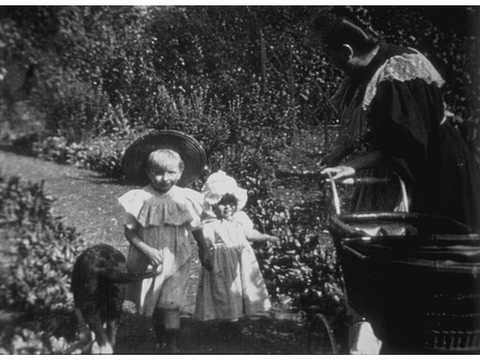
Premiers pas de bébé. Catalogue Lumière. Vue N° 67. “Une maman promène son bébé dans une petite voiture d’enfant, puis le met à terre et s’éloigne un peu en appelant le bébé qui exécute ses premiers pas pour rejoindre sa mère.” Opérateur: [Lumière]. Date: [été 1896] - 6 septembre 1896. Lieu: France, Lyon, Monplaisir, maison Koehler. Personnes: De gauche à droite : Marcel et Madeleine Koehler, et leur mère Jeanne Koehler.

Premiers pas de bébé
/ [The Baby's First Steps]
fuori catalogo [operatore, luogo e anno non identificati]


Place Bellecour. Catalogue Lumière. Vue N° 129. Circulation des piétons et de divers véhicules sur la place. Opérateur: Louis Lumière. Date: [printemps 1896] - 14 juin 1896. Lieu: France, Lyon, place Bellecour.

Place Bellecour
n. 129, Louis Lumière, Lyon, FR 1896

Scaphandrier. Catalogue Lumière. Vue N° 92. Dans un bassin de radoub, des hommes actionnent une pompe à air pour alimenter un scaphandrier qui, une fois sorti de l’eau, est déshabillé par d’autres hommes. Opérateur: inconnu. Date: [16 janvier 1896] - 3 mai 1896. Lieu: France, [port méditerranéen].

Scaphandrier / [The Diver]
n. 92, FR 1896

Entrée du Cinématographe. Catalogue Lumière. Vue N° 250. Une foule sort du cinématographe et se disperse dans la rue tandis que des cabs circulent ou stationnent. Cette vue a été tournée avant le 27 avril puisque sur la pancarte d'un homme-sandwich qui passe dans le champ, il est inscrit : “The Old King's Head - A great billiard tournament Monday april 27, 1896.” Opérateur: [Charles Moisson]. Date: [8 mars 1896] - 27 avril 1896. Lieu: Grande-Bretagne, Londres, Leicester Square. Personnes: L'Empire Theater, où ont lieu les projections Lumière.

Entrée du Cinématographe / [The Arrival of the Cinématographe]
n. 250, Charles Moisson, London, GB 1896

Rentrée à l’étable. Catalogue Lumière. Vue N° 313. “Ces quatre dernières vues [cf. n° 1368 à 1371] ont été prises à Genève, lors de l’exposition de 1896.” Un troupeau de chèvres et de vaches conduit par des gardiens traverse la foule des visiteurs. Opérateur: [Alexandre Promio]. Date: 7 mai 1896 - [12 juin 1896]. Lieu: Suisse, Genève, Exposition nationale, Village suisse.

Rentrée à l’étable / [Return to the Barn]
n. 313, Alexandre Promio, Genève, CH 1896

Déchargement d’un navire. Catalogue Lumière. Vue N° 34. “Des portefaix transportent des colis et des marchandises en traversant la passerelle, tandis que la vapeur sort par le côté du bâtiment.” La sortie contemporaine de cette vue avec celles de Madrid porte à croire qu'elle a pu être tournée par Alexandre Promio, sur sa route vers Madrid, et non à son retour puisqu'il précise dans son “Carnet de route” qu'il est revenu d'Espagne par Bordeaux. Opérateur:[Alexandre Promio]. Date: [21 mai 1896] - [12 juin 1896]. Lieu: Espagne, Barcelone, port.

Déchargement d’un navire / [Unloading a Ship]
n. 34, Alexandre Promio, Barcelona, ES 1896

Descente des voyageurs du pont de Brooklyn. Catalogue Lumière. Vue N° 324. Des piétons et véhicules en tous genres circulent sur la chaussée, tandis que des piétons traversent la passerelle et descendent l’escalier. La vue est prise à Manhattan. Opérateur: Alexandre Promio. Date: [septembre 1896] - 25 septembre 1896. Lieu: États-Unis, New York.

Descente des voyageurs du pont de Brooklyn
/ [Passengers Descending from Brooklyn Bridge]
n. 324, Alexandre Promio, New York, US 1896

Panoptikum-Friedrichstrasse. Catalogue Lumière. Vue N° 219. Circulation de piétons et de véhicules devant le Panoptikum. - Cette vue n'a pu être prise qu'après le 9 juin 1896, premier jour de l'exhibition des “42 wilde Weiber aus Dahomey” [42 femmes sauvages du Dahomey], qui est annoncée sur le fronton du passage.- Des projections Lumière commenceront à Berlin au 65a de cette rue, à partir du 28 avril 1896. Opérateur: inconnu. Date: 9 juin 1896 - 6 septembre 1896. Lieu: Allemagne, Berlin, Friedrichstraße 164-165, angle de Behrenstraße. Personnes: À gauche, le Panoptikum Castan (au 165 Friedrichstraße) ; au centre, l'entrée du Passage-Panoptikum (au 164 Friedrichstraße).

Panoptikum – Friedrichstrasse
n. 219, Berlin, DE 1896

Rue Tverskaïa. Catalogue Lumière. Vue N° 307. Circulation de passants et de voitures dans la rue pavoisée à l’occasion du couronnement du tsar. « Les fêtes du couronnement, Moscou le 21 mai. — […] La rue Tverskaïa : […] Ce chemin mesure une bonne lieue, c’est la rue Tverskaïa, la principale artère de Moscou, qui mène du palais Petrowsky, où l’empereur est descendu lundi en arrivant de Saint-Pétersbourg, à la place Rouge, c’est-à-dire au Kremlin. […] La rue a été couverte d’une épaisse couche de sable jaune qui assourdit le bruit des grandes bottes. » (Le Messager de Toulouse, Toulouse, 22 mai 1896). Si la rue Tverskaïa est pavoisée, c'est parce que le tsar a fait son entrée solennelle dans Moscou par cette rue pour se rendre au sacre. Opérateur: Charles Moisson. Date: 19 mai 1896 - 1er juin 1896. Lieu: Russie, Moscou, rue Tverskaïa.

Rue Tverskaïa.
n. 307, Charles Moisson, Moscow, RU 1896. - "On nous regarde" (T. F.).

Bataille de neige. Catalogue Lumière. Vue N° 101. “Un grand nombre de personnages se battent à coups de boules de neige. Au milieu de cette mêlée, survient un cycliste sur lequel tout le monde lance des boules et qui finit par rouler par terre; il se relève et s’esquive vivement avec sa bicyclette et la bataille reprend de plus belle.” Opérateur: inconnu. Date: 31 janvier 1897 - 7 février 1897. Lieu: France, Lyon, Monplaisir, cours Gambetta (aujourd'hui cours Albert Thomas).

Bataille de neige / [Snow Fight]
n. 101, Lyon Monplaisir, FR 1896. - "Filmed not far from the Institut Lumière" (T. F.).

DCP. Da: Institut Lumière, Lyon

AA: Last year was the 120th anniversary of the cinema as counted from the official premiere of Cinématographe Lumière on 28 December 1895, at the very end of the year. It is well judged for Bologna's Il Cinema Ritrovato to start their new programming concept, Anno Uno, "120 years ago", in 2016, focusing on the first full Lumière year of the cinema, 1896. (Alternatively one could also have defined 1894 as Anno Uno as commercial film production started on 6 March 1894 when Eugen Sandow posed for Edison).

Again, it is amazing to witness how advanced the art of cinema was in the beginning. The films were less than one minute long. They were single shot films. There was no montage. But what they achieved was already often perfect. The art of observation. The beauty of the light. The composition. The mise-en-scène. And a specialty of the Lumière team: a joy of life. There is a sense of a smile in these movies. We feel a delight in the act of the cinematography on both sides of the camera.

There is a focus on Lumière in the Anno Uno series. No Edison movies are included. If they were screened, the contrast would be illuminating. Edison came first, and the presentation of his kinetoscope in Paris in 1894 fascinated the Lumières. Then they proceeded in doing everything differently. Edison was a brilliant engineer, and so were the Lumières, but the brothers were also artists, and they established cinema as an art.

It is always rewarding to watch Lumière films. The prints that I have seen have been wildly disparate. In Finland we used to screen duplicates from the 1960s covering the first shows in Helsinki and Budapest. In 1987 I saw a splendid Cent films Lumières compilation (1895-1905) from CNC in one of the FIAF 50th Anniversary touring shows. And in 1991 there was another great compilation of one hundred films called Les Films de Lumière, Louis Lumière et ses opérateurs 1895-1898, compiled by Vincent Pinel at La Cinémathèque française in six thematic sections. It was the opening programme of a touring show called 100 années Lumière, a magnificent history of French non-fiction, one of the best retrospectives I have seen. The Vincent Pinel programme was based on prints made by the Boyer laboratory for Henri Langlois. I had too little experience for comparisons, but the impression of beauty from this show has been permanent with me. In Pordenone in 1995 in the Centenary of the Cinema screenings there was an illuminating show, Lumière: i primi film / The Early Films, 76 new prints from AFF / CNC with key titles such as Sortie d'usine screened in different versions. In 2006 we acquired from AFF / CNC and Association Frères Lumière good quality new prints of films screened in 1896 in Helsinki; that set we screen regularly. In Bologna in 2010 Thierry Frémaux moderated at Piazza Maggiore a Soirée Lumière compilation (2009) on digital video with 97 titles, many of which I had never seen before.

I am recalling all this now since I was stunned to see the superior visual quality of today's show based on a digital restoration at 4K resolution. Thierry Frémaux stressed the attempt that had been made at catching the photographic quality and texture. I am writing these remarks post festum, after the end of this year's Il Cinema Ritrovato, having seen all but one of the ten Anno Uno shows. This first show was screened for some reason at ProRes, yet it looked both luminous and fine in soft detail. I am truly looking forward to seeing real 4K Lumière projections next. The sense of depth is beautiful in the deep focus compositions. The joyous sense of life has never looked better in the Lumière presentations I have seen before.

NB. To the section "Da Lione alla scoperta del mondo e della felicità / From Lyon to Discovering the World and Happiness" I copied the texts for the captions from the Catalogue Lumière website, https://catalogue-lumiere.com/.  In some cases the info in the Catalogue Lumière site differs from the Bologna catalog. In those cases I presume the Bologna catalog info is correct.

Friday, June 17, 2016

Mannerlaatta / Tectonic Plate


FI 2016
Ohjaus/Director: Mika Taanila
Teksti/Text: Harry Salmenniemi
Graafinen suunnittelu/Graphic Design: Markus Pyörälä
Leikkaus/Editing: Mika Taanila
Ääni/Sound: Olli Huhtanen
Musiikki/Music: Mika Vainio
Tuotanto/Production: Elokuvayhtiö Testifilmi Oy
Tuottaja/Producer: Jussi Eerola
Esityskopio/Print Source: Testifilmi / Mika Taanila
Esitysformaatti/Format: 2K DCP
Kieli/Language: Finnish version
74 min
    Made without a camera on 35 mm film.
    There is a Finnish version and an English version. Neither can have additional subtitles.
    Midnight Sun Film Festival (MSFF), Sodankylä.
    In the presence of Mika Taanila introduced by Olaf Möller.
    Finnish version screened at the Little Top, Sodankylä, 17 June 2016

Lauri Timonen (MSFF catalog): "Mika Taanila is one of Finland’s most important and internationally acknowledged filmmakers. His Tectonic Plates examines the boundaries of the silver screen and the possibilities of expression. The film about fear of flying, security checks and time zones was made completely without a camera, and the segments of the moving image by photocopying documents about flying directly onto film, in addition of which Taanila utilises darkroom-made photograms, thus piercing out the deeper states of existence of banal objects."

"The text stream of announcements and warnings, at the same time familiar-feeling and nightmarish – almost like the pounding waves towards the bow of l’Atalante – flows hypnotically through the silver screen, challenging its boundaries into a virtually cosmic game. The dizzy feeling connected with fear of flying comes across strong, sometimes even ironically enriching the experience from the shadows of the bottle of heartburn pills."

"Using the methods of Lettrism (e.g. Prince’s music video Sign O’ the Times), Taanila searches for the independent echo of letters, syllables and phones over the conventional meaning of words. The various levels of panic and symptoms open up in a way that will burn in the viewer’s mind even weeks after this unique cinematic experience."
(LT)

AA: Mika Taanila has always been interested in films made without camera, without image, even. He is aware that the question about the affinity with radiophony, with the radioplay is then relevant. Tectonic Plate, his Lettrist film, created in collaboration with the poet Harry Salmenniemi, is a film of strong visuals and strong sounds.

Taanila links himself to the official wave of Lettrism launched by Isidore Isou in 1945, its cinematic current launched in 1951 by Isou and Maurice Lemaître. In Finland he quotes the influence of the poet Kari Aronpuro, especially his collage novel Aperitiff - avoin kaupunki (1965). Isou acknowledged that the primus motor for Lettrism was Dadaism, especially Tristan Tzara. Also Apollinaire and the Surrealists were relevant. There are influences in Finland since the 1920s (Tulenkantajat = The Torch Bearers), including also Aaro Hellaakoski's Jääpeili [Ice Mirror].

Tectonic Plate is an original and powerful work of modern poetry in the form of cinema. Every great poem reinvents poetry, and Tectonic Plate is such a poem. Internationally there is an affinity with French artists like Godard, Marker, and Resnais. (Lettrism is relevant also in Godard. In his last period even Walt Disney was influenced by Lettrism in his Winnie the Pooh movies).

This is a stream of consciousness movie. It is about jet lag, and like all experimental films, a philosophical study on perception. Flyers, frequent or not, face the categories of time and space. Boarding passes, security checks, bulletin boards, and announcements in terminals become fodder for this poem.

The jungle of signals, the discomfort of modern flying, the fatigue due to a quick passage to a distant time zone, all contribute to a sense of chaos. But in this film there is an order, a structure, and a rhythm, visually and musically. The rhythm is engrossing, and the film is an exercise in making poetic sense out of incoherence.

Tectonic Plate is witty and humoristic. There are poetic insights, satirical remarks, one-liners, and non sequiturs. Harry Salmenniemi's poetry appears as intertitles. Tectonic Plate is a contender to a list of films with the best intertitles.

EDITED FROM MY NOTES SCRIBBLED DURING THE SCREENING:

Flicker - stardust - scratches - announcements
Thunder - dirt - rhythmical graphic patterns
Escalator - crescendo - visual - aural

Noise - interference - jam - as means of expression
Ritardando - accelerando
Sound - image synchrony

Meaningful text (Salmenniemi)
Meaningless text (graphic static)

Musique concrète
Cosmic music
Space music

Transillumination
X-Ray images

The history of poetry and cinema.
Homer. Goethe. Pushkin. Baudelaire. Runeberg. Ibsen. Auden. Salmenniemi.

Rhythm. Calm / hectic
Action and contemplation
Sound and silence

Ultra fast edits.
Nothingness.
White light.

Self in the modern world.
Echoes of the space.
Black screen.

Philosophy of perception.

The sound of rain from the outside.
The smell of the wet grass in the Little Top.
Fleeting shadows of the tent structure on the screen when there is light from behind.

Text conveying meaning.
Text as a meaningless carpet of letters of the alphabet.

An ultra long zoom-out from the legal terms of insurance.
Security checks.
Landing strips.

Intertitles as lines of poetry / aphorisms / one-liners.
An affinity with Jean-Luc Godard (Adieu au langage).
And Chris Marker (La Jetée) and Alain Resnais (Je t'aime, je t'aime).

Organic / synthetic.
Disparition.
Reinventing poetry. Reinventing music.
White screen / mindscreen.

Nightfall.
Twilight's last gleaming.
An announcement in Japanese.

Jet lag.
Categories of time and space.
Bonus programs for frequent flyers.

Found images and texts.
Attachments of experiences.

The rhythm, the pulse, the sound.
Flight departure announcements.
Flight departure bulletin boards.
Jungles of numbers.

Jacques Tati.
Immanuel Kant: the things that awe me most: the starry sky above me and the moral law within me.

TECTONIC PLATE PRESSKIT

El artista y la modelo / The Artist and the Model


Aida Folch and Jean Rochefort in El artista y la modelo. Please click to enlarge the image.

L'Artiste et son modèle
ES/FR 2012.
Ohjaus/Director: Fernando Trueba
Käsikirjoitus/Screenplay: Fernando Trueba, Jean-Claude Carrière
Kuvaus/Cinematography: Daniel Vilar
Leikkaus/Editing: Marta Velasco
Lavastus/Set Design: Pilar Revuelta
Puvustus/Costumes: Lala Huete
Ääni/Sound: Pierre Gamet, Eduardo G. Castro, Bernard Chaumeil
Musiikki/Music: Duke Ellington, Gustav Mahler
Näyttelijät/Cast: Jean Rochefort, Aida Folch, Claudia Cardinale, Chus Lampreave, Götz Otto, Christian Sinniger, Martin Gamet
Tuotanto/Production: Fernando Trueba Producciones Cinematográficas, Bonne Pioche Productions
Tuottaja/Producer: Cristina Huete
Esityskopio/Print Source: 6sales
Esitysformaatti/Format: 35 mm.
Kieli/Language: espanja/Spanish, ranska/French
Tekstitys/Subtitles: englanti/English
105 min
    Shot in digital, camera: Arri Alexa, source format: ProRes 4:4:4 (1080p/2f), master format DI 2K.
    Black and white in scope.
    Mostly in French with some Spanish.
    Inspiré par la vie de l'artiste Aristide Maillol.
    Tourné dans Perpignan et Céret, les Pyrénées-Orientales. Also in Girona (Catalonia).
    The artist's hands: Michel Brigand.
    Rembrandt: Niño que aprende a andar (1656). Londres, Museo Británico. Tinta marrón.
    The discussion on Rembrandt's drawing inspired by David Hockney.
    Midnight Sun Film Festival (MSFF), Sodankylä.
    In the presence of Fernando Trueba introduced by Kaisu Isto.
    Cinema Lapinsuu, 17 June 2016

Otto Kylmälä (MSFF catalog): "It’s the year 1943 in German occupied France. The Second World War has seized the creativity of an aging artist, Marc (Jean Rochefort). One day his wife Léa (Claudia Cardinale) meets a Spaniard Mercè (Aida Folch) who has escaped from a war camp, Léa brings Mercè home with her. Encouraged by Léa, Mercè agreeds to pose for Marc, who is still struggling to rejuvenate his artistic vitality. The screenwriters of the film Trueba ja Jean-Claude Carrière (Belle de Jour, The Unbearable Lightness of Being) have written a sensitive and mature ode to beauty."

"As in many of Trueba’s films the barbaric madness that is savaging the outer world doesn’t deserve the attention of his characters nor will it get any time on the screen. True poets have the ability and skill to stop and admire the beauty in the world and to concentrate on the meaningful things even in the midst of states of emergency. Once again familiar from his other films eroticism is present in this film as well but this time the comedic touch is in minimum."

"Gorgeous monochrome shooting and unrushed rhythm prove Trueba’s masterfulness to refine and approach his personal themes also from a serious perspective. The film is dedicated to Trueba’s sculptor brother, Máximo that inevitably brings a deep personal angle to the topic. Trueba won the Best Director Award for this film at the San Sebastián Film Festival."
(OK)

AA: A labour of love from Fernando Trueba, a film that he had been hatching all his life. The story of an old artist, Marc, who has been suffering from a creative block for a long time. Along comes Mercè, a young model who inspires him. Mercè is amazed that the portraits do not resemble her. "Like Cézanne, I just consult nature" replies Marc; he does not look for likeness. He wants to have his final say, find something that he has always been looking for. For Marc, God created woman. He did create Eve first, and together with her he had Adam. Adam then was surprised by God together with his mother Eve. That was the original sin. That was when they were banished from paradise.

Marc and Mercè are at first very formal and distant with each other. Gradually they learn to know each other better. A key discussion takes place around Rembrandt's drawing of a child learning to walk (see below). The drawing seems humble and hasty at first sight but on closer inspection it starts to reveal its secrets.

Mercè, it turns out, is a resistance fighter. We are on the Pyrenees next to the Spanish border. France is occupied by Nazis. Mercè helps Jews and other harassed people escape at night through secret mountain passages. She even hides a wounded resistance fighter in the attic of the artist's mountain study.

"Artists and doctors have the right to see a woman naked". Little boys of the neighbourhood want share the view, too. Marc draws and paints Mercè at his study, by a pond, and on the grass in the woods. He molds her in clay and plaster, proceeding to have the work finished in marble. The artist's inspiration is conveyed via delicious superimposed montages of the natural beauty of Mercè. There is an innocence and a purity in the extended nude passages of this movie.

The casting is perfect with Jean Rochefort and Aida Folch in the leading roles. There is an affinity with Limelight in the story of the old dying artist and the young woman who carries the promise of new life. Claudia Cardinale reinvents herself beautifully as the vibrant old wife Léa acting her age. Léa, too, had started as a model. She teaches Mercè that quickly one gets used to nudity in front of artists.

The film has been shot digitally. It is about sculpture, and there is no problem in conveying sculpture in digital. But even the live model, Mercè, looks sculptural in digital. The limitations of digital become evident in the detail of nature. (The limitations of digital are no longer insurmountable as one can see in films such as Mike Leigh's Mr. Turner or Virpi Suutari's Elegance).

Rembrandt: A Child Being Taught to Walk. 1656 © The Trustees of the British Museum. Pen and brown ink on brownish-cream paper.

Sacro GRA


IT/FR 2013
Ohjaus/Director: Gianfranco Rosi
Käsikirjoitus/Screenplay: Gianfranco Rosi, Niccolò Bassetti (tarina/story)
Kuvaus/Cinematography: Gianfranco Rosi
Leikkaus/Editing: Jacopo Quadri
Ääni/Sound: Gianfranco Rosi, Stefano Grosso, Riccardo Spagnol, Giuseppe D’Amato
Esiintyjät/Cast: Cesare, Paolo, Amelia, Roberto, Francesco, Filippo, Xenia, Gaetano
Tuotanto/Production: Doclab, La Femme Endormie, Rai Cinema
Tuottaja/Producer: Marco Visalberghi
Esityskopio/Print Source: Doc & Film International
Esitysformaatti/Format: DCP or HD
Kieli/Language: italia/Italian
Tekstitys/Subtitles: englanti/English
95 min
    Midnight Sun Film Festival (MSFF), Sodankylä.
    In the presence of Gianfranco Rosi introduced by Otto Kylmälä.
    Cinema Lapinsuu, 17 June 2016

Otto Kylmälä in the MSFF catalog: "When Sacro GRA won the main award at Venice Film Festival, the news came as a surprise to many. However, the win in a top-quality contest was well deserved. The main cause for the surprise reaction was the fact that this was the first documentary ever to win the esteemed award. It is hardly a surprise to the Sodankylä audience that art of this calibre can truly rise above formulaic fiction films."

"The Sacro GRA (= the sacred Grande Raccordo Anulare) is an immensely big ring road that circles around Rome. Rosi’s documentary collage gathers together a cavalcade of colourful characters that all live along the throbbing artery of this metropolis. The group includes eel fishermen, noblemen, aging prostitutes and an empathetic ambulance driver called Roberto."

"Rosi got the inspiration for his two-year filming project from Italo Calvino’s novel Invisible Cities, in which Marco Polo makes up trips to non-existent cities as he explains them to Chinese emperor Kublai Khan. In a Calvino-like manner, Rosi whips up invisible worlds and confronts down-and-out people and the ring road residents through an empathetic lens. The portraits and moments of the film show that the international director’s heart still beats for the Italians, too."

"As a final road map for the viewing experience: the most important thing in the search for the Holy Grail is not the destination but the journey.
" (OK)

AA: Sacro GRA is a documentary film, but it also brings to mind a special group of fictional road movies or road sequences in Godard (Week End), Tati (Trafic), and Fellini (Roma - the most gigantic traffic jam of all times, imagined by Fellini, no doubt inspired by Godard, takes place on the very same GRA).

Sacro GRA can also be seen to belong to the esteemed genre of city symphonies. It is a vision of Rome seen from its outer ring. Fellini explored the eight layers of Rome as if they were Dante's circles of hell. Here we observe the entire spectrum of life from one single circle only.

Sacro GRA also belongs to the tradition of multi-character studies (Querschnittfilm, omnibus stories, Un carnet du bal, La Ronde, Preminger, Scola, Altman...).

We witness ordinary life in tenement houses next to the ring road. Gianfranco Rosi has the talent to win the confidence to access the intimate sphere, the private lives of the people living there. We feel like eavesdroppers but everything was shot via permission only.

We learn to know special people: an ambulance driver, a nobleman in his castle, a world class scientist fighting insects (red palm weevils) that are killing millions of palms around Rome, and people worrying about the fate of eels which need to navigate all the way from the Sargasso sea where they reproduce. There are prostitutes, including transvestites. There are sacred scenes and profane scenes. Rosi himself lives in his van 24 hours observing this night and day.

It is as urban as it can get, yet nature is nearby. There is a flock of sheep grazing on the grass, there are dying palms, imperilled eels in the river; the fate of nature is at stake. Focusing on the GRA ring road we build a view of the world.

Rosi is a terrific director-cinematographer who can achieve amazing intimacy as well as epic views of the thunderous traffic on the GRA. He handles the camera well in illuminating close-ups, in distant shots, and in slow panoramic shots on courtyards.

BEYOND THE JUMP BREAK: DIRECTOR'S NOTES

Thursday, June 16, 2016

Fuocoammare / Fire at Sea


Seefeuer / Bortom Lampedusa
IT/FR 2016
Ohjaus/Director: Gianfranco Rosi
Käsikirjoitus/Screenplay: Gianfranco Rosi, Carla Cattani (idea)
Kuvaus/Cinematography: Gianfranco Rosi
Leikkaus/Editing: Jacopo Quadri
Ääni/Sound: Stefano Grosso, Vladan Nedeljkov, Giancarlo Rutigliano, Aleksandra Stojanovic
Featuring: Samuele Caruana, Giuseppe Fragapane, Pietro Bartolo, Maria Costa, Francesco Mannino, Maria Signorello, Samuele Pucillo (as themselves)
Tuotanto/Production: Stemal Entertainment, 21 Unofilm, Cinecittà Luce, Rai Cinema, Les Films d'Ici, Arte France Cinéma
Tuottajat/Producers: Gianfranco Rosi, Donatella Palermo
Esityskopio/Print Source: Doc & Film International
Esitysformaatti/Format: DCP
Kieli/Language: englanti/English, italia/Italian
Tekstitys/Subtitles: englanti/English
108 min
    M: no original score but a beautiful soundtrack based on selections of a radio DJ of a request radio program with Sicilian popular songs and an opera number by Rossini. The title of the film is from one of those songs.
    English subtitles by Susan Adler.
    Midnight Sun Film Festival (MSFF), Sodankylä.
    In the presence of Gianfranco Rosi, introduced by Timo Malmi.
    Cinema Lapinsuu, 16 June 2016

Timo Malmi in the MSFF catalogue: "It is not common that everybody seems to agree that The Golden Bear award of Berlin International Film Festival went to the right address this year when it was given to Gianfranco Rosi for Fire at Sea, a stirring movie about today´s most current theme in Europe – the immigration issue."

"It is exceptional that a documentary wins the Golden Bear. Rosi manages to turn a topic that has been worn out by television reporting into a captivating and humane story. Rosi accomplishes this by familiarizing well with the 13 year old Samuele and his home village by spending few years there."

"The journey begins on Lampedusa Island, in the southernmost point of Italy – closer to Africa than Sicily, where thousands of migrants stop by on their way to Europe of their dreams. There, instead of attending school Samuele prefers to spend his time on the beaches and mountains."

"The paths of two peoples from two very different worlds do not seem to cross each other even though a Lampedusan doctor gives a touching speech about our duties and the immigrants become almost as familiar to us as the locals. Wild rescue operations and shocking destinies are seen during the movie, but what we remember in the end is Rosi´s holistic picture about the state of affairs."
(TM)

AA: One of the key films of the year, Fuocoammare is one of the greatest cinematic interpretations of the Mediterranian immigration tragedy that has been going on for decades and that has truly exploded recently. Gianfranco Rosi confronts the dilemma of documentary ethics (one should not exploit defenseless people) in a humanistic way. His approach is the opposite of exploitation and sensationalism. We see shocking images because we need to be shocked to an awareness of a terrible reality. Rosi's approach is responsible like that of the good doctor of the island. We need to know about the illness in order to cure it.

The nine year old boy Samuele becomes our main conduit, identification figure, providing a child's viewpoint on life on Lampedusa. We follow also other persons' normal life on the island. The islanders have been aware of the tragedy from the start, but the immigrants are not a part of the daily fabric of life on the island.

We spend time on a Cigala Fulgosi category sea patrol ship near the African sea border and witness the reality, the horror there with overcrowded vessels carrying refugees, immigrants. The third major locus is the Lampedusa detention center. A fourth central space is the doctor's office. Dr. Bartolo becomes our second key identification figure, providing the long perspective from an adult viewpoint. He has seen this happening for decades.

The refugees arrive from Somalia, Côte d'Ivoire, Libya, Sudan. We hear nightmarish stories of their flight through Sahara, people dying of thirst, staying in prison in Libya, being raped and killed. On the miserable rafts they suffer from dehydration and malnutrition, and the fuel leaked on the floor causes chemical burns. The ships carrying the refugees turn into death ships.

The soundtrack is provided by the radio DJ playing the listeners' favourites, mostly Sicilian popular songs. Neapolitan songs are world famous; the Sicilian songs are similar but interestingly with even more Mediterranean accents, affinities with Arabic chant and perhaps intimations of ancient Hebrew, Greek or even earlier sounds. The use of the melisma brings a magical sense to this singing. It brings thoughts to ancient tragedies at the Mediterranean, now being repeated. (I have just finished reading Virgil's Aeneid where the survivors of Troy sail via Tunisia and Sicily to Italy).

Gianfranco Rosi is a master in the contemporary rethinking of the documentary film phenomenon. Fuocoammare is a documentary film in the sense of being about reality and featuring people appearing as themselves. It is, however, not about reality caught on the spot, unawares. The cast of characters and the mise-en-scène seem to have been meticulously planned. The characters appear as themselves and play the parts as themselves. While modern, Fuocoammare is also relevant to the Flaherty tradition of film-making: the film-maker becomes a part of the reality he is filming, gaining complete confidence and licence to film the intimate truth about the life lived. We get the inside story. The distinction between documentary and fiction is getting blurred. The experience of Fuocoammare is similar to fictional films of the same subject, like Emmanuele Crialese's excellent Terraferma.

The film is visually so assured that it is incredible that it was shot by the one-man crew of Gianfranco Rosi who was also the cinematographer with his Arri Amira.

P.S. 19 June 2016. Today at the Sodankylä morning discussion Gianfranco Rosi told us that nothing was planned in the shoot. Fuocoammare was a case of parthenogenesis, immaculate conception. The goddess of the documentary was with Rosi, and every time he started to shoot, exciting things took place.

On 16 June when I asked Rosi whether he felt any affinity with neorealism he denied it. Yet while digesting Fuocoammare I kept thinking about Visconti (La terra trema), Rossellini (Stromboli) and Antonioni (he started as a documentarist, there is a strong documentary impulse in L'avventura, and late in his career he made documentaries such as Ritorno a Lisca Bianca, and Noto, Mandorli, Vulcano, Stromboli, Carnevale). All three directors had a documentary impulse and a strong social consciousness.

Rosi's answers to the morning discussion's obligatory questions: 1) the first film you saw: he said that the first film that really impressed him was Antonioni's La signora senza camelie, 2) the desert island film: Buñuel's Los olvidados. His summation of a documentarist's calling was of anthology quality. I look forward to a transcript.
 
GIANFRANCO ROSI: DIRECTOR'S NOTE

Peter von Bagh (2016 documentary by Tapio Piirainen)

Peter von Bagh interviewing Chantal Akerman at the Midnight Sun Film Festival morning discussion in Sodankylä, 1991. This image is not from Tapio Piirainen's film.
FI 2016
Ohjaus/Director: Tapio Piirainen
Kuvaus/Cinematography: Arto Kaivanto
Leikkaus/Editing: Jorma Höri
Ääni/Sound: Timo Hintikka
Musiikki/Music: Dmitri Shostakovitsh, Agustin Barrios
Esiintyjät/Cast: Peter von Bagh
Tuotanto/Production: Yleisradio (2016), Prontosaurus Oy (2008–2015)
Tuottaja/Producer: Liselott Forsman
Esityskopio/Print Source: YLE
Esitysformaatti/Format: DCP
Kieli/Language: suomi/Finnish, englanti/English, italia/Italian, espanja/Spanish
Tekstitys/Subtitles: englanti/English
68 min
    © 2016 Yleisradio / Finnish Broadcasting Corporation.
    First telecast 16 June 2016 [tonight].
    Featuring: Peter von Bagh, also in lot of new footage shot for the purpose of this film.
    Other interviews made for this film include those with: Simo Näyhä (childhood friend), Lasse Naukkarinen (cinematographer of The Count), Gian Luca Farinelli (Bologna), and Marcela Cassinelli (Buenos Aires).
    Music: the theme from the film Ovod (The Gadfly, SU 1955, directed by Alexander Feinzimmer) played by Dmitri Shostakovich on the piano.
    End credit song: "Nuoruustango" (comp. Kaj Chydenius, lyrics by Anu Kaipainen), the theme from The Count sung by Kiti Neuvonen.
    Finnish subtitles by Outi Kainulainen.
    Midnight Sun Film Festival (MSFF), Sodankylä.
    In the presence of Tapio Piirainen and Liselott Forsman. Introduced by Timo Malmi.
    Cinema Lapinsuu, 16 June 2016

Lauri Timonen (MSFF catalog): "Tapio Piirainen’s newly released full-length documentary about Peter von Bagh may be the most comprehensive one of its subject so far. Abundant interview material and treasures from the archives guide us in retracing the journey from the yard of Peter’s first home – the Lapinlahti Mental Hospital, owing to his father’s occupation – to the film screenings in the Oulu of his childhood, from the fan letter addressed to James Mason to the racy and eventful university years in Helsinki; to the shooting and the reception of his feature film The Count, plus his numerous careers as an author, a documentary director, a maker of radio programmes, the editor-in-chief of Filmihullu magazine, and the Artistic Director of the Midnight Sun Film Festival."

"Philosophical deliberations amid the serene nature of the summer place in Sotkamo and the hectic, irresistibly glowing throb of the magic of the seventh art at international film festivals in Bologna and South America provide additional juxtaposing."

"The humorous, intimate, even serious portrait lets the camera closely examine the bookshelves spreading in all directions in the legendary Iso Roobertinkatu den, and the chaotic store room below it, in the middle of which stands – still unopened – a parcel once sent to Chris Marker by Andrei Tarkovsky, ending up along its own routes of logic to Punavuori in Finland."

"The life of the great cinephile was filled with similar correlations where life and cinema journeyed hand in hand, eagerly engaged in a dialogue with each other."
(LT)

AA: Two tv previews were screened before the feature.

Preview to Tapio Piirainen's Peter von Bagh documentary with Esko Salminen (FI 2016). Esko Salminen, one of the greatest actors in Finland, covers his lifelong friendship with Peter in a few heartfelt minutes. How Peter always greeted him by imitating a nose rubbing routine from his early performances. "He made me feel important. He hated flattery. He made me feel dignified, ten feet tall. He signed a beautiful dedication to a book for me: 'elämän lähetille', [hard to translate, approximately: 'to an envoy of life']. Nobody else expressed the calling of the actor like that. That is what one can try to aspire. I really miss him." [This quote is not verbatim.]

Preview to Tapio Piirainen's Peter von Bagh documentary with Aki Kaurismäki (FI 2016). For Aki, Peter was the one whom one could wake up at three o'clock in the morning with a film quiz question, and he never failed to give the right answer. He was the Balzac of film history and many other fields. When he programmed the Finnish Film Archive that was when I received my meager knowledge about the cinema. I teased him with questions. We invited him to direct the Midnight Sun Film Festival. His life achievement consists of monuments like The Blue Song tv series and book. With figures like him 90% of the Finnish intelligentsia has vanished. [This quote is not verbatim.]

We were in tears watching this first screening of Tapio Piirainen's film which had been eight years in the making. Peter von Bagh's own autobiographical Remembrance covers the period of his childhood and youth in the city of Oulu. This authorized portrait covers Peter's whole life, or much of it. There are big areas missing (book publishing, music, concerts and events... ).

This film starts with Peter's earliest childhood in Helsinki, at Lapinlahti Mental Hospital, where his father was a physician. Peter remembers how a mental patient saved him from drowning in a pool. His mother's grave is nearby at Lapinlahti Cemetery. She died early of an illness for which there was no cure then. Simo Näyhä remembers that in Oulu Peter liked to visit a neighbouring home in which there was a beautiful mother. He senses in a distant reverence for a beautiful figure in the clouds a connection to Peter's profound love of the cinema.

Peter insists that the biggest achievement of his life was running film societies in Oulu since age 16. Late in life he still has fond memories of the films screened such as The Lavender Hill Mob, Stagecoach, La Kermesse héroïque, Due soldi di speranza...

Back in Helsinki, studying at the university, Peter switched from medicine to literature, but soon his main occupation was writing about the cinema, prominently for the Ylioppilaslehti [The Student Journal] which was then experiencing a golden age. He "threw his consciousness to the wall" every week. The reviews were passionate, polemical, and aggressive. He lambasted Finnish films mercilessly, including those by Finnish New Wave artists like Eino Ruutsalo and Maunu Kurkvaara, singled out by Tapio Piirainen here. Ruutsalo never greeted Peter again. In his recent interviews Peter laments the state of film criticism today.

There were great commercial expectations for Peter's first and only feature fiction film Kreivi (The Count, 1971), but it was a flop at the box office, and as many critics butchered it Peter now got a taste of his own medicine. As I remember, having seen it then, the film was felt to be too weird by the general audience, and film cultural circles were disappointed by its lowbrow dimension and the grating performance of "The Count" Lindgren playing himself in the main role. The film was difficult to like at first sight and much better the second time with no false expectations. Anyway that was the end of Peter's career in fiction.

Peter's career as a director of television features began. He loved popular music artists and found in their work "a history of emotions and a secret memory of the nation". He covered in many features and series the century of Finnish popular music in the film age and interviewed everybody who was still alive. "Tapsa [Tapio Rautavaara] was the closest for me". "He was like Sillanpää, each word was pregnant".

His project grew into "discovering Finland". He states that he was the son of an immigrant: his father escaped the Russian Revolution from St. Petersburg to Finland, and that had something to do with the fact that "I turned into a hurraa-suomalainen (the jingoist Finn)."

Simultaneously, the project was a personal quest in search of lost time. "My stepmother burned all my childhood things, even my stamp collection". The pressure for reconstruction was personal. "My own childhood, its circumstantial evidence, was gone". Peter interviewed hundreds of people. The first great summing-up of that project was the film Vuosi 1952 (The Year 1952). The project grew during the decades, culminating in the Sininen laulu / The Blue Song series and book. By then many of the key witnesses Peter had interviewed over the years were no longer alive. Peter came to realize the dearth of illuminating vintage documentation. "Of Eino Leino and Juhani Aho [who are among the greatest Finnish writers] there is no film footage. Only their burials were filmed".

Films Bigger Than Life was one of Peter's most famous achievements, a radio series (100 films, each covered in a feature of one hour), also edited as two huge books. Peter takes us to his film library, the best private film library in the country. He loves books. He writes notes in them, and creates an index of his own for each. Lots of things lie dormant, and years later they are activated. Virtual knowledge is superficial. "I interviewed a big range of writers. Many of them had started by reading the books of the village library from the beginning to the end. Duration is essential. A book takes its time. A long attention span is vanishing today". We witness Peter's appearances at book fairs. He was excellent there in the twin roles of an interviewer and an interviewee.

There is a section on Midnight Sun Film Festival, the timelessness of the encounters in the long run: in the Sodankylä perspective we have Jacques Demy, Milos Forman and Francis Ford Coppola meeting in a common heaven of world (film) history. The audience creates the festival, the atmosphere. The second year was one of the most miraculous. We see footage of Aki Kaurismäki and Peter von Bagh interviewing each other at a morning discussion. Peter introduces Helsinki Forever at his 70th birthday open air screening at Helsinki Festival at the Citizen's Square in front of the Helsinki Music Center. Does a city have a soul? That is the question.

We come to Bologna. The selection of Peter as artistic director of Il Cinema Ritrovato was made in the lobby of Cinema Orion in Helsinki. Gian Luca Farinelli tells us why, and we see footage from Bologna. Marcela Cassinelli talks about "Peter's heaven" in Buenos Aires.

We visit the creative chaos of the Nosferatu company's production office when everything is being packed for a move.

Peter's private life was private. It was essential and indispensable, also the fact that it was separate from public life. In this movie he is candid about the fact that his family (his wife, children, and grandchildren) raised him. "I would not have been at home as a fiction film or theatre director", Peter confesses, because he felt too out of touch with life (= the daily fabric of life), "life" meaning approximately the same thing as the Russian expression byt, a keyword in the Chekhov tradition. Chekhov was Peter's favourite writer.

"I resigned from the church during the Salama trials" (the last blasphemy trials in Finland took place against the writer Hannu Salama in the 1960s). Peter confesses that he has no connection to religion. But he has understood that in his films, however, there is a religious connection, including in his Mikko Niskanen series An Artist on His Way to Become a Human Being. He sees an affinity in his films with the ceremony of the funeral. They are about remembering and spiritual resurrection. "In the end, life will overcome".

About death: "There is no eternal life." "Many messages will remain". We see footage from our memorial event for Peter von Bagh at Cinema Orion. It had been scheduled as a tribute for Il Cinema Ritrovato, to be opened by Peter.

Peter von Bagh was in combat with cancer for 20 years, but he refused the role of victim. Instead, he insisted on working to the end. Work was his best medicine. His appearance changed dramatically, but that final face is not how I remember him. For me Peter's last years were more and more about a triumph of the spirit.