Friday, August 05, 2011

Roskisprinssi / Garbage Prince

Sopåkarprinsen. FI / NO © 2011 Periferia Productions / Flimmer Film. EX: Outi Rousu. P: Markku Flink. D: Raimo O. Niemi. SC: Juuli Niemi - based on the novel (1991) by Tuija Lehtinen. DP: Kari Sohlberg. AD: Pirjo Rossi. Makeup: Kristiina Kinnunen. Cost: Ritva Muikku. M: Stein Berge Svendsen. Theme song: "Yhtenä iltana" ["One Night"] by Hector (1990). S: Thomas Angell Endresen. ED: Jukka Nykänen. Loc: Joensuu. CAST: Jon Jon Geitel (Jed), Pihla Maalismaa (Lulu), Kristiina Elstelä (Veera), Heikki Silvennoinen (Saastamoinen), Milla Kaitalahti (Salla), Taisto Reimaluoto (Immonen), Kari Heiskanen (Juhani Pohjakallio), Katariina Kaitue (Eeva Pohjakallio), Milla Kaitalahti (Salla), Antti Virmavirta (Lulu's father, a minister), Marjaana Maijala (Lulu's mother), Oiva Lohtander (Little Antti), Risto Salmi (Big Antti), Jon Eikemo (Børje), Mari Perankoski (Salla's mother). 100 min. Released by Walt Disney Studios Motion Pictures Finland. DCP 2K viewed at Tennispalatsi 11, Helsinki, 5 Aug 2011.

Tuija Lehtinen (born 1954) is a popular Finnish author who has published ca 73 novels since 1984. A large part of her work is targeted to young readers. Roskisprinssi the movie is based on her popular novel. The director is the veteran Raimo O. Niemi who has also often targeted his films to young audiences. The screenwriter was his daughter Juuli Niemi.

An entertaining coming of age story about teenagers. Having just finished school Jed refuses to follow his father's stern advice, drops out, boards a Northbound train and leaves the train in Joensuu on a whim following the smile of a beautiful blonde girl (Salla). He buys a tent and settles down on a camping area. Soon he has used up his pocket money and gets jobs as a newspaper delivery man and by the winter as a garbage truck assistant. In the Joensuu parks Jed meets the elderly Bohemian Veera, who collects bottles etc. on her own and meets her three drinking companions at her Bohemian but cosy wooden house by the forest. Jed persuades Veera to rent him a room in the attic.

Roskisprinssi is a story about teenage confusion, about not yet knowing who one is and what one wants from life.

Initially attracted by Salla, Jed can't help being more interested in Lulu, a confused and talented soulmate. But Lulu has also her reservations about Jed. "Don't you use us as a freak circus footnote in your finely polished CV".

I looked through my fingers at some of the film's easy wish-fulfillment aspects, clumsy features, and a certain lack of edge. But there are things to like such as Pihla Maalismaa's performance in the female lead and the use of the city of Joensuu as the location. As the film went on I liked it more because of the sense of gravity beyond some stereotypical elements. The theme song "Yhtenä iltana" keeps playing in my mind for days.

Critics have compared this movie to Elokuu / August which had its premiere earlier this year. In both a scion of a wealthy family drops out after school and has an adventure which starts in summertime Finland. Both are entertainment films but both also face the serious theme of the necessity of leaving the childhood home and finding out about one's identity alone. Elokuu seems to end more conventionally. Roskisprinssi has an open ending. Both films share a curiously bland performance in the male leading role. Wondering about that I also considered the possibility that that may be intentional.

Reportedly Roskisprinssi is the last film of the master cinematographer Kari Sohlberg. Like his films of the previous years, it's digital. Like often in Raimo O. Niemi and Kari Sohlberg's work, nature is important. Digital is getting better. I appreciated the fine soft detail now evident in scenes in the beginning. Colour is difficult, especially the colour of nature.

Wednesday, August 03, 2011

Marlene before Sternberg

Marlene Dietrich was an international star and a legendary performer until the 1970s. Her breakthrough film was The Blue Angel (1930) directed by Josef von Sternberg for Ufa in Babelsberg. She had by then already appeared in some 18 silent films since 1922 or perhaps even earlier. But Marlene preferred to consider The Blue Angel her debut film, because a silent film career would have made "the world's most glamorous grandmother" (a nickname of hers since 1948!) seem older.

Yet there were accomplishments before The Blue Angel of which she could be proud of, such as Die Frau, nach der man sich sehnt / The Woman Men Yearn for (1929). Leonard Maltin has published illuminating remarks by Eddie Muller during San Francisco Silent Film Festival on that film and Marlene Dietrich and the director Curtis Bernhardt on his website. Please scroll to the end of the SFSFF entry to find them.

Lost and Found: three reels of The White Shadow (Graham Cutts assisted by Alfred Hitchcock)


Graham Cutts: The White Shadow (GB 1924) starring Betty Compson in a dual role.

Alfred Hitchcock's career as a film director started in 1925. Before that he had gathered significant experience as an assistant director for Graham Cutts at the Balcon, Freedman and Saville company. Now half of one of those films, White Shadow (1924), has been discovered in New Zealand, as reported by Los Angeles Times.

One film directed by Alfred Hitchcock, The Mountain Eagle / Der Bergadler (GB/DE 1926), shot in Geiselgasteig in Bavaria for Gainsborough Pictures and Emelka, is still lost.

The early Hitchcock story is equally remarkable for another giant of the cinema: the quality producer Michael Balcon, who got started on his career with Hitchcock.

P.S. 4 Aug 2011. Luke McKernan in his The Bioscope blog comments rightly that we should really be talking about "a Graham Cutts discovery": "Graham Cutts (1885–1958) was arguably the leading British film director of the 1920s. Working with Herbert Wilcox and then Michael Balcon, two of Britain’s top producers of the period, Cutts made stylish romantic dramas characterised by fluid narrative, sumptuous production (on slim budgets) and subtly emotional performances. It could be argued that he was the first British film director to think cinematically."

The Guardian pays tribute to Kevin Brownlow (2011)


2010 Academy Awards: Governors Awards: Honorary Award recipient Kevin Brownlow (left), Irving G. Thalberg Memorial Award recipient Francis Ford Coppola (center) and Honorary Award recipient Eli Wallach. Photo © Academy of Motion Picture Arts and Sciences.

I copy from Luke McKernan's The Bioscope site a link to a tribute to Kevin Brownlow in The Guardian (the same newspaper which achieved the journalistic feat of the year by exposing the News International phone hacking scandal). Kevin Brownlow is a hero among film historians and preservationists. His films, restorations, tv series, and books have inspired generations of experts since the 1960s. Last year he received a special lifetime Academy Award, along with Henri Langlois the only film historian and preservationist to have achieved that.

...
ACADEMY OF MOTION PICTURE ARTS AND SCIENCES
2010 GOVERNORS AWARDS
LAUDATIO: KEVIN BROWNLOW

"Kevin Brownlow has made a career of drawing attention to the work of past cinematic masters, but his own achievements are no less deserving of appreciation. He has spent more than four decades championing filmmakers who might otherwise have been forgotten and introducing once-lost gems to new generations of moviegoers.

Born in Sussex, England, on the eve of World War II, Brownlow was fascinated with film from an early age. At 18 he channeled his interest in World War II into the making of the feature film “It Happened Here,” which depicted a Britain occupied by the Nazis. Co-directed by Andrew Mollo, who was two years younger, the film was ultimately released in 1966 with the help of director Tony Richardson. Despite a minuscule budget, “It Happened Here” was so convincingly realized that it sparked controversy and discussion and is now considered a masterpiece of independent filmmaking.

After a brief career as an editor, Brownlow found his true calling as a film historian and preservationist. The first of his many meticulously researched books, 1968’s The Parade’s Gone By…, swiftly became the definitive source on silent film and a fixture on film scholars’ bookshelves.

In the mid-1970s, Brownlow began a long and fruitful partnership with producer-director David Gill, restoring more than 25 silent films, including classics such as “Intolerance,” “The Thief of Bagdad,” “Ben-Hur” and “The Crowd.”

As filmmakers, Brownlow and Gill produced and directed a series of documentaries that found fresh insights into three pioneers of cinematic comedy, Charlie Chaplin, Buster Keaton and Harold Lloyd, as well as many other intriguing personalities from film history. In 1980 the pair’s 13-part television series “Hollywood” set a modern standard for film studies in its thorough treatment of the silent era.

Soon thereafter, Brownlow’s reconstruction of Abel Gance’s five-hour epic “Napoléon” (1927) was released in U.S. theaters to great acclaim. For Brownlow, this was the culmination of 20 years of effort.

Brownlow, with Gill, restored and introduced to new audiences films including F. W. Murnau’s “Sunrise” (1927), “The Four Horsemen of the Apocalypse” (1921), starring Rudolph Valentino, and “The Phantom of the Opera” (1925), with Lon Chaney. With restorations undertaken by Photoplay Productions, a company founded by Brownlow, Gill and Patrick Stanbury, these and many other films aired on Britain’s Channel 4 Television.

Few film historians have received Oscar® recognition – but then again, few have done as much for film history as Kevin Brownlow.

Did You Know?

At age 15, Brownlow discovered a 9.5 mm roll of film at a Parisian market that contained two reels of Abel Gance’s silent masterpiece “Napoléon” (1927). Brownlow would ultimately spend decades restoring the film to its former glory.

The eight-year production schedule for his first feature film, “It Happened Here” (1966), was dubbed the longest ever by the Guinness Book of Movie Facts and Feats.

To help Brownlow toward the completion of “It Happened Here,” Stanley Kubrick donated short-ends from “Dr. Strangelove.”

Brownlow was an editor on director Tony Richardson’s big-budget 1968 war epic “The Charge of the Light Brigade.”

Kenneth Branagh has served as narrator on five of Brownlow’s documentaries and television series.

He is one of the world’s leading authorities on the screen career of Greta Garbo.

Whenever possible, he utilizes firsthand accounts in his documentaries, letting his subjects tell their stories in their own words.

He once said, “The silent film was not only a vigorous popular art, it was a universal language – Esperanto for the eyes.”"

Selected Filmography

Restorations
“Abel Gance’s Napoléon” (1927, restored 1981)
“The Four Horsemen of the Apocalypse” (1921, restored 1993)
“Sunrise” (1927, restored 1995)
“The Phantom of the Opera” (1925, restored 1996)

Documentaries
“I’m King Kong!: The Exploits of Merian C. Cooper”(2005, director)
“Cecil B. DeMille: American Epic” (2004, director)
“Lon Chaney: A Thousand Faces” (2000, director)
“Universal Horror” (1998, director)
“Cinema Europe: The Other Hollywood” (1995, director)
“D. W. Griffith: Father of Film” (1993, director)
“Buster Keaton: A Hard Act to Follow” (1987, director)
“Hollywood” (1980, director)
“Unknown Chaplin” (1986, producer)
“Abel Gance: The Charm of Dynamite” (1968, director)

Books
In Search of Charlie Chaplin (2005, author)
Mary Pickford Rediscovered (1999, author)
David Lean (1996, author)
Behind the Mask of Innocence (1990, author)
Hollywood: The Pioneers (1979, author)
The War, the West, and the Wilderness (1978, author)
The Parade’s Gone By… (1968, author)

Sunday, July 31, 2011

2011 Norway Terror Attacks


The island of Utøya. On 22 July 2011, a lone gunman dressed as a police officer murdered 77 guests of a youth camp. Photograph: Lasse Tur/AP.

Reflections after having read the morning papers at Punkaharju, 31 July 2011.

Over a week ago, 22 July 2011, the shocking news came from Norway about two terror attacks, a car bomb explosion in the government quarter of Oslo, and a massacre at the youth camp on the island of Utøya. 77 were murdered by the lone killer who was dressed as a police officer. As has been the case in school killings, the killer had prepared an electronic press kit complete with photographs and a manifesto. He committed the atrocities to obtain maximal media coverage. He succeeded completely even in quality media. Every time we mention his name, publish his photograph or discuss his "agenda" we fulfill his deranged mission, become accomplices to his crime and inspire future mass criminals.

J. Hoberman: An Army of Phantoms (a book)

J. Hoberman: An Army of Phantoms. American Movies and the Making of the Cold War. New York, London: The New Press, 2011. Summer reading at Punkaharju, July 2011.

An Army of Phantoms is J. Hoberman's new entry to a projected trilogy of books on American movies in the light of American politics during the Cold War. The first book published, The Dream Life, was dedicated to the Sixties. A final planned volume will take us to the fall of the Wall.

In An Army of Phantoms, the theme is the beginning of the Cold War, and the era discussed is 1946-1956. The Iron Curtain, the nuclear race, the Korean war, the black list, and the Eisenhower years are among the topics. They are reflected in science fiction (aliens from outer space), juvenile delinquency films, Westerns, Biblical epics, and films noirs (Pickup on South Street, Kiss Me Deadly).

In his sober prose J. Hoberman has the talent of finding the absurdity in real life. What actually happened in world politics and Hollywood was often as surreal as the most bizarre inventions of Hollywood fiction. Yet the film discussed in the introduction is The Next Voice You Hear (1950), where God instructs America via radio. The prologue is dedicated to one of the strangest films ever made in Hollywood, Mission to Moscow (1942).

There is new insight into well-known films such as High Noon, Quo Vadis, Rebel without a Cause, and The Searchers. Inspiring reading for anyone interested in popular culture.

Dave Kehr: When Movies Mattered (a book)

Dave Kehr: When Movies Mattered. Reviews from a Transformative Decade. Chicago and London: The University of Chicago Press, 2011. Summer reading at Punkaharju, July 2011.

Dave Kehr is one of the best film critics in the world, currently a dvd critic for The New York Times. When Movies Mattered is a collection of his reviews from 1974 to 1986 for Chicago Reader. Kehr reviewed both new and old films. A special section in the book is devoted to what can retrospectively be seen as "the end of classical Hollywood". Old masters directed their last films, and New Hollywood was blooming. There is also an appendix of Dave Kehr's top ten lists of those years. The book is full of surprises. Many films discussed are not the obvious and familiar ones. After Hours is the Martin Scorsese film included, and Sudden Impact is the Clint Eastwood selection. Worth reading are Kehr's reviews on Manoel de Oliveira's Francisca, and Roberto Rossellini's Blaise Pascal. There is a section on Jean-Luc Godard's films of the period.

The reviews are from the golden age of American film criticism. There was a large, active audience for film culture, and there was ample space in newspapers and journals for extended, serious writing on the cinema. This book is another proof that the perception of the high quality of the writing of those times is not just a golden memory. Film writing such as this is great literature with lasting value.

Where I disagree is the use of the past tense in the title "When Movies Mattered". Movies still matter for new generations, but it is a disaster what has happened with film criticism in print media.

Thursday, July 28, 2011

Harry Potter and the Deathly Hallows: Part 2

Harry Potter ja kuoleman varjelukset,osa 2 / Harry Potter och dödsrelikerna: del 2. GB/US © 2011 Warner Bros. Entertainment, Inc. EX: David Heyman, Lionel Wigram. P: David Barron, David Heyman, J.K. Rowling. D: David Yates. SC: Steve Kloves - based on the novel by J.K. Rowling (2007), in Finnish by Jaana Kapari-Jatta / Tammi 2008. DP: Eduardo Serra. PD: Stuart Craig. COST: Jany Temime. M: Alexandre Desplat - Harry Potter theme by John Williams. AD dept big. Makeup dept big. Art dept big. Special effects dept big. Visual effects dept huge. S: James Mather. Sound dept big. ED: Mark Day. - Cast descriptions copied from the English Wikipedia:

Daniel Radcliffe as Harry Potter, the film's main protagonist.
Rupert Grint as Ron Weasley, Harry's best friend and Hermione's romantic interest.
Emma Watson as Hermione Granger, Harry's other best friend and Ron's romantic interest.

Helena Bonham Carter as Bellatrix Lestrange, a Death Eater and Sirius Black's cousin/murderer.
Jim Broadbent as Horace Slughorn, the Potions master at Hogwarts.
Robbie Coltrane as Rubeus Hagrid, Harry's half-giant friend and a former staff at Hogwarts.
Warwick Davis as Filius Flitwick, the Charms master at Hogwarts; and Griphook, a goblin and former employee at Gringotts Bank.
Ralph Fiennes as Lord Voldemort, an evil, power-hungry wizard, and the leader of the Death Eaters. The chief antagonist of the series.
Michael Gambon as Albus Dumbledore, former headmaster of Hogwarts killed two films earlier by Severus Snape.
John Hurt as Ollivander, a wandmaker abducted by the Death Eaters.
Jason Isaacs as Lucius Malfoy, Draco Malfoy's father and a disgraced Death Eater.
Gary Oldman as Sirius Black, Harry's godfather. Killed in battle three films earlier by Bellatrix Lestrange.
Alan Rickman as Severus Snape, former Defence Against the Dark Arts teacher and the new headmaster of Hogwarts.
Maggie Smith as Minerva McGonagall, the Transfiguration teacher, Deputy Headmistress and future Headmistress at Hogwarts.
David Thewlis as Remus Lupin, a member of the Order of the Phoenix and a former Defence Against the Dark Arts teacher at Hogwarts.
Emma Thompson as Sybill Trelawney, the Divination teacher at Hogwarts.
Julie Walters as Molly Weasley, the Weasley matriarch and a mother figure to Harry.

130 min. Released in Finland by FS Film with Finnish / Swedish subtitles by Timo Porri (relying on the Jaana Kapari terminology) / Janne Staffans. DCP 3D, system: Dolby 3D. Viewed at Killa, Savonlinna, 29 July 2011.

Technical specs (IMDb): Camera: Arricam LT, Cooke S4 Lenses, Arricam ST, Cooke S4 Lenses. - Film negative format: 35 mm (Kodak Vision2 200T 5217, Vision2 500T 5218). - Cinematographic process: Digital Intermediate (master format), Super 35 (source format). - Printed film format: 35 mm (anamorphic) (also Technicolor 3D), 70 mm (horizontal) (IMAX DMR blow-up) (dual-strip 3-D) (Kodak Vision 2383), D-Cinema (also 3-D version). - Aspect ratio: 2.35:1.

The last film in the Harry Potter series is a world-class phenomenon of global popular media culture. Again I'm a stranger in the screening of a film of the phenomenally successful series. The attendance is good, but we are the only ones to watch the ten minutes of end credits of over a thousand artists and professionals (we spot three Finnish names among them) and listen to Alexander Desplat's variations to the Harry Potter theme by John Williams (one of the all-time best theme tunes). I can repeat the remarks I made last year about Harry Potter and the Deathly Hallows: Part 1: much of the film is bleak, slow and of low intensity. A wonderful cast of Britain's top actors perform vividly in their roles, but the leading trio is curiously somnambulistic. They seem like strangers, too, not like heroes in their own lives. Critics have commented on the quality of the 3D created in post-production, but I have nothing against it. More generally, I find the low definition, the absence of full colour and the absence of the warmth of the sun in all the Harry Potter films curious.

The climax is the Battle of Hogwarts. Harry Potter sacrifices himself, is almost dead already, is resurrected, destroys the Elder Wand, and having restored peace in the wizard world returns to normal life.

The Harry Potter saga covers some 40 years of a parallel existence with minimal links to reality. Perhaps that is the point, to create a compelling fantasy world which may be escapism for some and a counter-image for others. And perhaps to understand Harry Potter I would have to read the books, of which the films may be but reflections.

Wednesday, July 27, 2011

Il pianeta azzurro / The Blue Planet


Franco Piavoli: Il pianeta azzurro / The Blue Planet (IT 1981). PS. Included by Alice Rohrwacher in her 2022 Sight & Sound Top Ten.

IT 1981. P+D+SC+ED: Franco Piavoli. Un film di Franco Piavoli, dedicato a Neria. Questo film è stato realizzato nel 1981 da Franco Piavoli e Neria Poli. Montaggio del suono: Giuliana Zamariola. Mixage: Fausto Ancillai. Location: Val Bruna. 88, 83 min. Dvd extra: Interview with Franco Piavoli, 11 min. Watched on dvd at the summer cottage in Punkaharju, 27 July 2011.

Il nascere si ripete
di cosa in cosa
e la vita

a nessuno è data
in proprietà
ma a tutti in uso

– Lucretius: De rerum natura (motto of the film) (Birth spreads itself through one to another, and life is nobody's property but at anyone's disposal)

A visionary non-fiction film about nature. The film follows the four seasons in the countryside. It is a pantheistic, Epicurean film. There is no dialogue and no music in this wonderful, sensual film. There are affinities with Flaherty, Dovzhenko, Renoir (the realist, the love scene in Partie de campagne, the corresponding scene here in even more extreme close-up), Painlevé, Cousteau, Tarkovsky (Solaris, the living sea), Malick, and the topical Océans. From sources I learn that Il pianeta azzurro was Franco Piavoli's first feature film. It is already a work of a master. Unknown in Finland, for instance, Piavoli's work would deserve to be much more shown outside Italy. Thank you, Stefano Antonelli, for this tip.

The Force That Through the Green Fire Fuels the Flower


Otto Kylmälä: The Force That Through the Green Fire Fuels the Flower (GB 2011) starring Michael Eden as Ian.

Voima
    GB 2011. PC: Fargone Films.
    D+SC: Otto Kylmälä. DP: Joni Juutilainen. M: Stephen Horne. AD: Saule Norkute. Ass. Director: Jonas Trukanas. Hair & Make-Up: Monica Rossi. Camera Assistants: Ruby Kobayashi & James Chegwyn. Storyboard and Poster Artist: Marga Doek.
    Cast: Michael Eden (Ian), Carolyn Lyster (Maggie), Edward French (young man), Sarah Wolff (young girl), Emma Packer (karaoke lady), Nick Hoad (bartender), Alan Smith (doctor).
    7.52 min
    A silent film (no dialogue or sound effects). Black and white.
    Watched on Vimeo at the summer cottage in Punkaharju, 27 July 2011.

Vimeo introduction: "The Force That Through the Green Fire Fuels the Flower is a contemporary silent film, which follows a man through a journey of memories in the course of one night."

FB: facebook.com/​#!/​pages/​The-Force-That-Through-The-Green-Fire-Fuels-The-Flower/​165790356811670

"Finnish / National premiere at the 26th Midnight Sun Film Festival in Lapland in 2011. International premiere at the 30th Le Giornate Del Cinema Muto in Italy in 2011 with Stephen Horne's live accompaniment."

"The work has its own mesmerizing tone; it really rewards the eye and ear. It's smart and moving. A thoroughly accomplished work." - Guy Maddin

"It takes '21st Century Silents' to a new level - going far beyond the usual pastiche, to use the silent medium on its own terms and in a fresh and creative way". - David Robinson

“You couldn't imagine the film with dialogue; it's about words unspoken. Stands head and shoulders above most of the modern silent shorts”. - Luke McKernan / The Bioscope.

A lyrical film about an old widowed man whose wife has died in the hospital. He has a glass of beer at a karaoke bar, and the texts of the coasters under the beer ("come closer", "one is not enough") set off chains of memories of awakening love and dying love. Direct, elemental images in a setting of a nocturnal city. The mood is also like in Salvatore Quasimodo's poem "Ed è subito sera".

Ognuno sta solo sul cuor della terra
trafitto da un raggio di sole:
ed è subito sera

Beyond the jump break: "The Force That Through the Green Fuse Drives the Flower" by Dylan Thomas

Anteckningar från den vita staden / Merkintöjä valkeasta kaupungista / Notes from the White City


Georg Grotenfelt: Anteckningar från den vita staden / Merkintöjä valkeasta kaupungista / Notes from the White City (FI 2011). Helsinki: a view over the South Harbour to Katajanokka. In the center: the Uspenski Cathedral, to the right: the Stora Enso head office designed by Alvar Aalto.

FI © 2011 Nostalgiafilmi. 
    P+D+SC+ED: Georg Grotenfelt. DP: Alexander Burov, Georg Grotenfelt, assistant camerapeople: Päivi Kettunen, Jakob Hopmans, Georgi Portnik. On-line: Heikki Kotsalo / Parastus. M: Sanna Salmenkallio. The musicians: Koiton Laulu. Solo vocals: Rosa-Maria Perä. S: Sergei Moshkov. Translations: Jaakko Anhava, Tuomas Anhava. Production manager: Sonja Lindén. 
    54 min
    Telepremiere: 10 Nov 2011 Yle FST5
    A Nostalgiafilmi screener dvd with both a Finnish and a Swedish version.
    Viewed at our summer cottage in Punkaharju, 27 July 2011.

A poetic non-fiction essay on the poet Gunnar Björling (1887-1960).

The Finnish Broadcasting Corporation's presentation (The Documentary Project): "The narrator observes his home town through his notebook during one year approximately. He leads us through the streets, the squares and the parks of the city, he guides us to its architecture and monuments but takes us also behind the facades to search the characteristics of our age, the sense or the senselessness of technocracy and consumption."

"He listens to voices of past generations, the gentle flapping of the wings of history, he pursues our common moments drawn on the tiles of the walls, the paving of the streets and on empty spaces, on our voyage towards timelessness."

"His landscape stretches from the raindrop to the stars on the sky, from morning till night, from one season to another. He writes as he remembers: moving freely in time, moving from a place to another, at times observing precisely, at times looking through the mirror of stories and images. He records events of the year, delights and misfortunes, celebrations and crimes. He reaches towards the future - what is about to disappear, what new is emerging?"

"Each word is tinged with yearning and melancholy: we have to relinquish every moment, but in our mind, in our notebook, in our movie we can conjure up lost time."

The Swedish-speaking Gunnar Björling was one of the greatest Finnish poets. He was a true original, laconic, aphoristic, uncompromising, in his youth Finland's only Dadaist. Inspired by Gunnar Björling's poetry and life Georg Grotenfelt has made a poetic essay on the city of Helsinki in winter. He discovers tape recordings of Gunnar Björling reading his poems. The film has been produced with loving care and sensitivity, complete with an original music by Sanna Salmenkallio and performed by Koiton Laulu. A work of lasting value.

Gunnar Björling's bibliography beyond the jump break.

Jäävuoren varjoon / Iceberg Shadow


Antti Seppänen: Jäävuoren varjoon / Iceberg Shadow (FI 2009), a non-fiction travelogue compilation based on the 8 mm films, postcards and letters by the ship machinist Oiva Kovanen.

FI © 2009 Illume Ltd. P: Pertti Veijalainen.
    8 mm films, postcards and letters: Oiva Kovanen.
    D+SC: Antti Seppänen. Still and video photography: Antti Seppänen, Teemu Liakka. Colour grading: Ilmo Lintonen / Minus Movies Oy. M: Kimmo Mustonen, Antti Kokkola. S: Kimmo Vänttinen. ED: Antti Seppänen, Samu Heikkilä. Voice of Oiva: Aarno Mansikkamäki. Garage sale salesman: Matti Seppänen.
    57 min.
    An Illume dvd with English subtitles by Tiina Kinnunen.
    Viewed at the summer cottage in Punkaharju, 27 July 2011.

The Finnish Wikipedia synopsis: "The narrator finds a cardboard box full of 8 mm films in a garage sale. At home he gets acquainted with the contents of the films and discovers colourful and skilfully recorded footage from every continent of the Earth. The soft images emanating a mysticism of decades past lead the narrator to find out about the identity of the recorder of the images."

Further from the Wikipedia: the 8 mm films turned out to be a part of the heritage of the ship machinist Oiva Kovanen (1911–2001) from Kotka. The film was almost seven years in the making.

DocPoint 2010 catalogue: "Two boxes filled with 8 mm film are found at a garage sale. When the pictures start moving, a treasure is revealed: countless frames taken around the world, someone’s experiences and adventures from decades ago. The filmmaker has immortalised foreign faces in distant harbours, a stormy ocean, the neon lights of Manhattan, the sand-coloured pyramids, Machu Picchu – and his own shadow. Who was this filmmaker and why did his memories end up for sale? This riddle is tackled in the documentary Iceberg Shadow. The name found in the film bags puts the director on the right track. More evidence is uncovered at the War Archive and in the attics: old photos, letters and postcards. These form a picture of lived life, of the man behind the films. The amazing adventures of First Engineer O. V. Kovanen and his beautiful legacy are also a story about what is left of us when we are gone."

AA: Documentary. First Engineer Oiva Kovanen lived during the age of the extremes, but as a cinematographer he focused on the eternal, on the most magnificent views of the world. One of the basic instincts of the cinema was the Lumière impulse to see the world and show its sights. This movie is one man's realization of that impulse – he wanted to film all the continents, and had a good sense of composition and colour in his films.

Antti Seppänen has created a work of art by collecting the materials and constructing the journey format of this film. The 8 mm footage is complemented by photographs and postcards. Quotes from Kovanen's correspondence help make sense of the story. Kovanen habitually sent postcards to himself from his trips around the world.

After retirement Kovanen continued travelling and filming. He was among the victims of a shipwreck in the Antarctic where he lost all his footage shot during the trip, but four years later he made another, his final trip "to the end of the world", now equipped with a video camera.

No relative was present in the funeral of the loner; only his neighbours from his siirtolapuutarha (allotment garden, Schrebergarten) were present. Five years after Kovanen's death, Antti Seppänen found the footage in a garage sale. Among Kovanen's papers he found notes on astronomy and cosmology. Kovanen had seen the Earth and wanted to know more.

The music and sound world of this movie are sensitive. The visual impact is dominated by the warm, lively hues of the 8 mm cinematography which can be felt even on dvd.

An essay on kaukokaipuu, the yearning to faraway places.

BEYOND THE JUMP BREAK: INTRODUCTION BY ILLUME:

Monday, July 25, 2011

Giuseppe Verdi: Don Carlo (opera, Italian version) 2011 Savonlinna Opera Festival, Hungarian State Opera Budapest


Giuseppe Verdi: Don Carlo FR 1867 / IT 1884. Savonlinna Opera Festival. Hungarian State Opera. I saw Ildikó Cserna and Atilla Kiss in these roles, this official photo displays the other casting with Eszter Sümegi (Elisabeth of Valois) and Attila Fekete (Don Carlo). Foto Savonlinna Opera Festival 2011 / Timo Seppäläinen.

Giuseppe Verdi: Don Carlo. Dramma lirico. FR 1867 / IT 1884. Libretto Joseph Méry and Camille Du Locle – based on the play Don Karlos, Infant von Spanien (DE 1787) by Friedrich Schiller – the French libretto translated into Italian by Achille de Lauzières and Angelo Zanardini.

In the Olavinlinna Castle at the Savonlinna Opera Festival, 25 July 2011. In Italian with e-surtitles in Finnish (by Leena Vallisaari) and English. There are 12 versions of Don Carlo / Don Carlos. Presented was the standard Italian version (number 11) in four acts.

Hungarian State Opera Budapest. Conductor: Kocsár Balázs. Stage direction, stage design and lighting design adapted by: Zoltán Horváth. Costume designer: Márk Tivadar.

Filip II, King of Spain, bass: Kolos Kováts
Don Carlo, Infante of Spain, heir to the Spanish throne, tenor: Atilla Kiss / [Attila Fekete 23+26.7.]
Elisabeth de Valois, soprano: Ildikó Cserna / [Eszter Sümegi 23+26.7.]
Princess Eboli, mezzo-soprano: Éva Pánczél
Rodrigo, Marquis of Posa, baritone: Tamás Busa
Grand Inquisitor, bass: László Szvétek
Tebaldo, Page to Elisabeth, soprano: Krisztina Simon
Count of Lerma, tenor: Lászlo Beöthy-Kiss
A Monk, baritone: Ferenc Valter
A Voice from Heaven, soprano: Ingrid Kertesi.

Hungarian State Opera Orchestra.
Hungarian State Opera Chorus.

AA: A historical tragedy that takes place in Spain around 1560, performed in the Olavinlinna castle built in 1475–1483. The dark and devastating story takes a poetic license with details but is firmly grounded on reality. Spain was the most powerful state of Europe. It was the age of Renaissance and Reformation, but Spain was firmly Catholic, and the Spanish Inquisition was a powerful tool of the Counter-Reformation. Central backgrounds are the Revolt of the Netherlands and the Holy League against the Ottoman threat.

This was my first encounter with the story of Don Carlos in any form, opera or play. The musical performance of the Hungarian State Opera was powerful especially from the middle of the second act on. There is like an awakening, and the chorus during the burning at the stake rises to a tremendous force. Filip II and Elisabeth take special seats to watch the "heretics" being burned at the stake.

As a newcomer to this opera I would not have understood what is going on if I had not been read about it in the libretto. I read from the libretto that the voice from heaven is directed to the persecuted martyrs. The actual presentation is so indirect and simultaneous that it is impossible to understand what is going on. Yet I refused to applaud at the end of the act because I felt like it would have meant applauding the massacre and the persecution.

The Oslo massacre had taken place three days ago.

The high spirit of the presentation then lasted to the end of the opera with highlights such as the lament of Filip in the beginning of the third act (the vanity of absolute power) and the duet of the king and the grand inquisitor immediately afterwards. It's not good to be the king in this story. Since I don't know Schiller's play I don't know it the fine literary quality of the text derives from the librettists or from Schiller, himself.

The most striking feature of the art direction / costume design departments was the Grand Inquisitor, inspired by El Greco, and resonating with gothic fantasy films such as Christopher Lee's incarnations of Dracula. A tall, gaunt bass in white, a blind old living dead, yet with a demonic intelligence worthy of Dostoyevsky's legend of the Grand Inquisitor in The Brothers Karamazov.

The psychological fire of the drama comes from the fact that Don Carlos intends to murder his father, Filip II, who has married his beloved Elisabeth.

There are several film and television adaptations of the Schiller / Verdi story, but as far as I know none of them is definitive. Among the high profile versions is Carlos und Elisabeth (DE 1924) directed by Richard Oswald with Conrad Veidt as Don Carlos: I suspect it is interesting but not really great, probably focusing on salacious detail.

Don Carlos is a grand opera in French style. It had its premiere in 1867 in the Opéra le Peletier, known as Opéra de Paris until it burned in 1873. My associations fly to The Phantom of the Opera, inspired by that very disaster.

The age of Filip II was that of Cervantes and Shakespeare. Events of that violent age include the Counter-Reformation atrocities of St. Bartholomew's Day massacre, covered in films like L'Assassinat du Duc de Guise, the film adaptations of Reine Margot, and Griffith's Intolerance. Finland belonged to Sweden, which had to endure the bloody exploits of the sons of Gustav Vasa during the Reformation, plundering the fortunes of the Catholic Church, dramatized in Selma Lagerlöf's Sir Arne's Treasure, adapted for a film by Mauritz Stiller. Russia was under the reign of Ivan the Terrible.

The grandeur of Verdi's music and the tragedy of history resonated magnificently inside the walls of the Olavinlinna castle. The spiritual emptiness of the pursuit of power and glory is a major theme.

Tuesday, July 19, 2011

Kristin Thompson on Albert Capellani

I'm processing slowly my Bologna notes of three weeks ago. Meanwhile, David Bordwell and Kristin Thompson have done major blogging on this year's Il Cinema Ritrovato.

In their latest entry, "Capellani trionfante", Kristin Thompson claims that "Those festival guests who missed the Capellani films missed, in my opinion, the rewriting of early film history. He is not simply another important silent filmmaker to be placed in the pantheon. Film by film, this year and last, I kept comparing what I was watching with what D. W. Griffith had made that same year. In each case, Capellani’s film seemed more sophisticated, more engaging, and more polished."

Friday, July 15, 2011

Koli (national park)

Koli, 15 July 2011. Foto Laila Alanen
The Koli mountain is one of the most familiar national landscapes of Finland. I got to visit the mountain for the first time, climbing on top of the Ukko Koli ("Old Man Koli") with its magnificent views, carefully protected from visible marks of modernization. We sailed over the Lake Pielinen from Lieksa on the car ferry Pielinen enjoying a lunch of freshly caught kuha (zander) during the two hour trip. On the image above the white dot is the ferry returning from Koli to Lieksa. Koli images are famous in Finland, including classic photographs by I.K. Inha and paintings by Eero Järnefelt (a brother-in-law of Jean Sibelius). Koli had a profound influence on Sibelius, as well. Koli has been a familiar sight in movies, too, mostly in travelogues and tourist films, but I don't spontaneously remember a fiction film shot on the Koli. (Except Doctor Zhivago, where the landscape stands for Russia. From IMDb I also discover Sampo, Unna ja Nuuk, and Kulkurin masurkka). My first impression of Koli is that it looks the same as in the famous images of 100-150 years ago. The difference is in the sense of perspective, the wide horizon, the infinity, the eternity, and the freedom of the look, which no images can reproduce. Koli is a popular holiday target, but that does not affect the sense of the sublime at all. Rather the shared awe enhances it.

Tuesday, July 12, 2011

Retretti 2011: Taiteilijapareja / Married to an Artist / [Artist Couples] (exhibition)

Viktor Jansson: A Girl's Head [Tove Jansson], 1920, marble.

Taiteilijapareja / Married to an Artist
    Exhibition at Retretti curated by Riitta Konttinen. Book by Riitta Konttinen: Modernistipareja [Modernist Couples]. Helsinki: Otava 2011, 240, amply illustrated.

Retretti's main exhibition this year is a continuation to last year's theme, "Women Transcending the Limits of Art: Women Artists in Finland in the 19th Century", both curated to Riitta Konttinen. Riitta Konttinen published her book Taiteilijapareja [Artist Couples] in 1991, and last year, she published a new important work, Modernistipareja [Modernist Couples]. Her research is the basis for the Retretti exhibition.

The exhibition offers an impressive and original approach to the history of Finnish art: the road towards the Golden Age, and the early years of Finnish modernism. The combination of the well-known and little-known is well-balanced.

My favourites are the works of Greta Hällfors-Sipilä and Sulho Sipilä.

The most fascinating continuum is the one from the Signe Hammarsten-Jansson and Viktor Jansson in this exhibition to the separate exhibition of Tove Jansson and Tuulikki Pietilä, an artist couple of a next generation.

The couples on display are:

Anna Glad-Holmberg (1834-1909), painter
Werner Holmberg (1830-1860), painter
Werner Holmberg died young but left a legacy of powerful traditional landscape painting. His wife, the Norwegian Anna Glad, was a painter, as well.

Julia Stigzelius-de Cock (1840-1923), painter
César de Cock (1823-1904), painter
The Finn Julia Stigzelius married her teacher, the Belgian César de Cock. They were both skilled landscape and nature painters.

Antoinette Vallgren (1858-1911), sculptor
Ville Vallgren (1855-1940), sculptor
The sculptor Ville Vallgren stayed for a long time at the Montmartre in Paris, where he wed the Swedish engraver and sculptor Antoinette Råström. They inspired each other's work, and when Antoinette died, Ville felt he had lost "his good spirit".

Hilma Westerholm (1864-1952), art student and housewife
Victor Westerholm (1860-1919), painter
Hilma and Victor Westerholm were a "dynamic duo" in everything, but only Victor become a prominent painter and an influential figure in the art world.

Elin Danielson-Gambogi (1861-1919), painter
Raffaello Gambogi (1874-1943), painter
The Finn Elin Danielsson wed the Italian Raffaello Gambogi in Florence. They stayed at Torre del Lago and later at Antignano near Livorno, painting the same subjects. Elin said that work meant for both of them the child they never received. Elin was the one responsible for the affairs of the family, and she conducted extended painting trips to Finland.

Venny Soldan-Brofeldt (1864-1945), painter, drawer
Juhani Aho (1861-1921), author
Juhani Aho (birth name Brofeldt) was the national writer of Finland. The marriage was based on equality, with freedom and space for Venny Soldan-Brofeldt's art.

Eva Mannerheim-Sparre (1870-1957), designer, author
Louis Sparre (1863-1964), painter, graphic artist
The Swedish count Louis Sparre visited Finland invited by Axel Gallén and wed Eva Mannerheim, the sister of Marshal Mannerheim. Both were talented designers and artists. Louis Sparre also directed the first Finnish fiction film, Salaviinanpolttajat [The Moonshiners] (1907).

Hilda Flodin (1877-1958), painter, graphic artist, sculptor
Juho Rissanen (1873-1950), painter
Juho Rissanen came from a worker's family, Hilda Flodin from a wealthy academic background. Their marriage remained short, but both had a fruitful artistic career.

Eva Bremer (1894-1964), painter
Eemu Myntti (1890-1943), painter
Eemu Myntti was a shamanistic painter with an original colour world. Eve Bremer had a similar approach to art, and after Eemu's death she lived as an hermit in the deep forest of Ähtäri.

Meri Genetz (1885-1943), painter
Carl Wargh (1896-1937), painter
Meri Genetz and Carl Wargh were international artists interested in occultism and financially independent.

Lyyli Ollila (1888-1958), painter, critic
Yrjö Ollila (1887-1932), painter
Yrjö Ollila married Lyyli Toikka, and they lived a long time in France. Yrjö Ollila belonged to the modernist Septem group. Lyyli Ollila's paintings are less known, but she was a well-known critic.

Ragni Cawén (1891-1981), painter
Alvar Cawén (1886-1935), painter
Alvar Cawén married Ragni Holmberg, and their atelier home was a favourite meeting place of fellow artists. Alvar Cawén was a prominent artist and an influential figure in the art world. Ragni Cawén was especially active after Alvar's death, starting as a November expressionist and evoluting into a relaxed, colourful direction.

Eva Törnwall-Collin (1896-1982), painter
Marcus Collin (1882-1966), painter
Marcus Collin married his student Eva Törnwall at the Free Academy, and they travelled widely from Karelia to North Africa. Marcus Collin created humoristic paintings of the common people and dark November expressionist visions. Eva Collin created frescoes for theatre buildings.

Signe Hammarsten-Jansson (1882-1970), drawer
Viktor Jansson (1886-1958), sculptor
Victor Jansson was a prominent sculptor, who met Signe Hammarsten in Paris. Their home at the Katajanokka neighbourhood was known as one of the "funniest atelier homes in the world". Signe Hammarsten-Jansson was a caricaturist, illustrator and a postage stamp artist. Of their children, Tove Jansson and Lars Jansson became artists.

Greta Hällfors-Sipilä (1899-1974), painter
Sulho Sipilä (1895-1949), painter, navy officer
Sulho Sipilä and Greta Hällfors got married in 1924 and were inspired by modernism and naivism. They were equally inspired and innovative, central figures of Finnish modern art.

Retretti 2011: Married to an Artist (introduction)

Official introduction: "The main exhibition, Married to an Artist, of the Retretti Art Centre`s summer 2011 programme throws light on the life and oeuvre of Finnish artist couples over a period of one hundred years - on the lives of the artists, the interaction of two artists married to one another and the focus on their work."

"The exhibition comprises works by such well-known masters as Werner Holmberg, Victor Westerholm, Juho Rissanen, Elin Danielson-Gambogi and Alvar Cawén, as well as works by their lesser-known spouses, Anna Glad, Hilma Alander, Hilda Flodin, Raffaello Gambogi and Ragni Cawén. Married to an Artist brings a new perspective to Finland`s Golden Age and Early Modernism. The exhibition has been curated by Emerita Professor Riitta Konttinen."

"The nearly 150 works in Retretti`s exhibition represents the first extensive study of the work of artist couples in Finland and raises issues which have puzzled researches and the public both in Finland and internationally. The contemporary French artist, François Morellet has paradoxically stated that an artist couple "is as one, but which one?" The life shared by two artists has been seen as enriching both lives although problems have aso been recognised: the husband has often been considered to have a self-evident right to the role of "master", whereas his wife has been forced into the background. This has not always been the case, however, and the impact of the twin roles may also have been reciprocal, far-reaching and rewarding."

"Through the work of the artist couples the Retretti exhibition recounts tales of Finnish art life and provides an overview of the development of Finnish art from the Romanticism of the mid-19th century, through Finland`s Golden Age to start of Modernism."

"The exhibition presents paintings, sculptures, drawings, prints and books, concentrating on fifteen major artist couples, in addition to the afore-mentioned, Antoinette Råström and Ville Vallgren, Julia Stigzelius and César de Cock, Venny Soldan and Juhani Aho, Eva Mannerheim and Louis Sparre, Eva Bremer and Eemu Myntti, Meri Genetz and Carl Wargh, Lyyli and Yrjö Ollila, Ragni Holmberg-Cawén and Alvar Cawén, Eva Törnwall-Collin and Marcus Collin, Signe Hammarsten-Jansson and Viktor Jansson, Greta Hällfors-Sipilä and Sulho Sipilä. Their stories will be enriched by works of other artists."

The Retretti Art Centre 2011 Summer Exhibitions


Riitta Konttinen: Taiteilijapareja / [Artist Couples]. 191 pages. Illustrated. 26 cm. Hard cover. ISBN 9511109642 kovakantinen. Helsinki: Otava, 1991. The stunning, pioneering, magisterial work inspired Retretti's main 2011 exhibitions. Cover art: Albert Edelfelt: Ville Vallgren (1855-1940) and Antoinette Vallgren née Råström (1858-1911). Ville is creating a clay sketch for his sculpture Kaiku. Pastel on canvas. 114 cm x 138 cm. 1886. Göteborgs konstmuseum. Wikimedia Commons: Ville and Antoinette Vallgren by Edelfelt.

The Retretti Summer Exhibitions, Punkaharju, 1 June - 28 August, 2011:
1. Married to an Artist - paintings, drawings, sculptures
2. Tove Jansson & Tuulikki Pietilä - paintings, illustrations, cartoons, etchings
3. Carl Barks' Duckburg - oil paintings, cartoon drawings and paintings
4. Heli Ryhänen & Matti Kalkamo - sculptures, installations (bronze, aluminium, reinforced plastic and fabric)
5. Merja Pirilä & Petri Nuutinen - photographs
6. Art Glass from the Kyösti Kakkonen Collection: Sun Bottle, Water Lily, and Harlequin by Helena Tynell, Aimo Okkolin, and Nanny Still
7. Children's Workshop: Africa - making masks, workshop teatre Jewel
8. Punkalive - Karim Rashid's designs
9. Himmelblau Graphic Workshop - Elina Luukkanen, Miina Äkkijyrkkä, Annu Vertanen, Juho Karjalainen, Teija-Tuulia Ahola, Tiina Kivinen, Taru Innanen

Nick James on Sodankylä and Jonathan Rosenbaum on Bologna

I copy from Kalle Kinnunen's blog the link to Nick James's article on Midnight Sun Film Festival that took place a month ago. At the Sight & Sound site I find also already Jonathan Rosenbaum's story on Il Cinema Ritrovato that took place less than two weeks ago.

Sunday, July 10, 2011

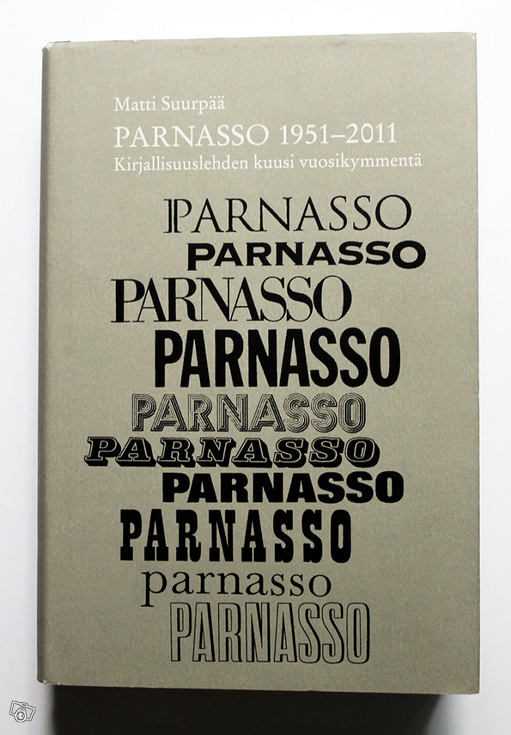
Matti Suurpää: Parnasso 1951–2011 (a book)


Matti Suurpää : Parnasso 1951–2011. Kirjallisuuslehden kuusi vuosikymmentä [Parnasso 1951–2011. Six Decades of a Literary Magazine]. 559 pages. Helsinki: Otava 2011.

Matti Suurpää: Parnasso 1951–2011. Kirjallisuuslehden kuusi vuosikymmentä [Parnasso 1951-2011. Six Decades of a Literary Magazine]. 559 pages. Helsinki: Otava 2011.

Parnasso, Finland's leading literary magazine, established in 1951, soon became a vehicle for young post-war modernist generations who wanted to distance themselves from the pre-war literary establishment. Edited by Kaarlo Marjanen (1951–1954), Lauri Viljanen (1954–1956), Aatos Ojala (1957–1958), Kai Laitinen (1958–1966), Tuomas Anhava (1966–1979), Juhani Salokannel (1980–1986), Jarkko Laine (1987–2002),  Juhana Rossi (2003–2004), and Jarmo Papinniemi (2005– ) it has been a forum for much of the best Finnish poetry, prose, and essay-writing.

Parnasso belonged to my personal favourite reading in the 1960s and the 1970s as soon as I was old enough to understand, and I studied also the back catalogue of the magazine avidly and time and again. Many of the volumes have lasting value. That was the time of the serious discovery of Japanese and Chinese literature in the Finnish language, among other things. Tuomas Anhava was probably the best editor ever in our land. The decades from the 1950s till the 1970s were ones of great discoveries in modern art and world culture. Since then, structures of the mass university have drained much of the best literary talent into the academic world, little known among the general culturally oriented audience.

The model of Parnasso was the great Swedish Bonniers Litterära Magasin (BLM) (1932–2004) which was discontinued because of lack of demand, but Parnasso is going strong with a circulation of some 7000, high by any international standard for an uncompromisingly serious cultural magazine.

The chronicle of Parnasso is an occasion to study profoundly Finnish and world cultural history in a turbulent age – the Cold War, the fall of the Wall, and the new age. Matti Suurpää rises to the occasion in the sturdy volume, which is also a page-turner. There are long lists and summaries, but they are never boring, and Suurpää never loses the big picture. In an age of extremes, Parnasso has represented a cool, sober, modernistic approach, while also serving as a forum for other approaches, also letting prominent cultural figures make big fools of themselves without editorial comment.

"Parody has become impossible: they do it themselves" is a famous quote from the poet Paavo Haavikko, and "They do it themselves" was for a while the headline for a section of juicy quotes in the magazine.

Parnasso has focused on literature, and the human condition has been confronted on a general level, as a concern of our way of living like there is no tomorrow.

Parnasso took cinema seriously from the beginning. Jerker A. Eriksson started to write about films for Parnasso in 1954, followed by Jouko Tyyri, Jaakko Ahokas, Risto Hannula, Matti Salo, Peter von Bagh, Olli Alho, Reijo Lehtonen, and Antti Selkokari. There had been good writing about the cinema from day 0 (the first press screening in Finland by the Lumière company in 1896) but in the 1950s cinema was finally consistently being studied with the same level of ambition as any other art.

Vertigo (1958) was internationally snubbed on its first release (except in France, of course), but it was singled out in the editorial of Parnasso. Finnish poets recognized poetry made in Hollywood.

Matti Suurpää explores many aspects of the success of Parnasso. I would like to add one more keyword: love – the love of good writing, of which Suurpää's book itself is a splendid example. I predict it will be a strong contender for the best Finnish non-fiction book of the year (the Tieto-Finlandia Award).