Showing posts sorted by relevance for query Frantz. Sort by date Show all posts

Saturday, April 08, 2017

Frantz


Frantz. An encounter in 1919 at Frantz's grave in Germany: Frantz's fiancée Anna (Paula Beer) and the Frenchman Adrien (Pierre Niney).

Frantz. Frantz's mother Magda (Marie Gruber), Adrien, Anna, and Frantz's father, Doktor Hans Hoffmeister (Ernst Stötzner). Frantz's family wants Adrien to play, but music has died in the war.

Frantz. A day with swimming. Only Adrien swims; Anna cannot swim. Afterwards Anna notices the battle scars on Adrien's stomach. Please click on the images to enlarge them, especially the last one, to see the scars.

Frantz / Frantz. FR/DE © 2016 Mandarin Films / X-Filme Creative Pool / FOZ / Mars Films / France 2 Cinéma / Films Distribution. In association with Universal Pictures International.
    P: Eric Altmayer, Nicolas Altmayer. Co-P: Stefan Arndt, Uwe Schott. D+SC: François Ozon. Loosely based on Broken Lullaby by Ernst Lubitsch. In collaboration with: Philippe Piazzo. DP: Pascal Marti – negative format: 35 mm – Super 35 – b&w with some shots in colour – scope 2,39:1 – digital intermediate 2K. PD: Michel Barthélémy. Cost: Pascaline Chavanne. Makeup: Lili Rametta. Hair: Franck-Pascal Alquinet. M: Philippe Rombi. S: Benoît Gargonne. ED: Laure Gardette. 113 min
    C: Pierre Niney (Adrien), Paula Beer (Anna), Ernst Stötzner (Hoffmeister), Marie Gruber (Magda), Johann von Bülow (Kreutz), Anton von Lucke (Frantz), Cyrielle Clair (Adrien's mother), Alice de Lencquesaing (Fanny).
    In the credits only the Lubitsch film is given as a source, and Universal Pictures, its copyright holder, has an entry in the production credits. Both films are actually based on the play L'Homme que j'ai tué (1930) by Maurice Rostand, adapted from his own eponymous novel (1925).
    "Chanson d'automne" by Paul Verlaine from Poèmes saturniens (1866).
    Musiques additionnelles: Theme tune: Chopin: Nocturne N° 20 en do dièse mineur, op. posthume (1849). Tchaikovsky: String Quartet No 1. in D major, Op 11: andante cantabile (1871). Nuit d'étoiles (Claude Debussy) ; Shéhérazade, op. 35 (Nikolaï Rimski-Korsakov) ; Über den Wellen (Juventino Rosas) ; La Marseillaise ; Braunschweig-Polka ; Frantz-Polka ; Hupfpolka ; Die Wacht am Rhein.
     Filming locations from the IMDb. SAXONY-ANHALT, GERMANY: Quedlinburg (streets), Görlitz (Nikolaifriedhof cemetery: Frantz's tomb), Wernigerode (Hoffmeisters' home), Osterwieck, Teufelsmauer (hills that Anna and Adrien climb up), Bad Suderode (station where Adrien enters the train). FRANCE: Château du Saussay, Ballancourt-sur-Essonne, Essonne (Rivoire castle), Musée du Louvre, Opéra National de Paris Palais Garnier, 8 rue Scribe (opera house), Eymoutiers, Haute-Vienne (as Saulieu train station), Senlis, Oise (French town center).
    Released by Cinema Mondo on 2K DCP with Finnish / Swedish subtitles by Maaria Uusitalo / Joanna Erkkilä – "La Marseillaise" subtitled in the Finnish translation by Valter Juva.
    French premiere 7 Sep 2016, Finnish premiere 7 April 2017.
    Viewed at Kinopalatsi 9, Helsinki, 8 April 2017.

Frantz is a special case in the œuvre of François Ozon known for his transgressive, twisted and flamboyant virtuoso films. Frantz is a tragic drama distinguished by deep feeling and a frank emotional current. The performances are honest and compelling, and there is a powerful dramatic arch. Ozon displays courage in rejecting irony and playing it straight.

It is interesting to learn that Ozon started to plan filming Edmond Rostand's story initially unaware of the Ernst Lubitsch adaptation The Man I Killed, released as Broken Lullaby in 1932. Also in Lubitsch's œuvre this particular case is exceptional – his only sound film that is not a comedy. The Man I Killed was released during the greatest wave of WWI films which started with The Big Parade in 1925. I have not revisited Lubitsch's film recently, but friends who have discovered it during the current centenary commemorations of WWI have been impressed.

Looking at the mirror Adrien sees Frantz. Adrien has come from France to Germany to know Frantz, the man he killed. It is spring 1919. Only months have passed since the armistice on 11 November 1918. Hate is rampant on both sides of the border. There are blood-thirsty sing-alongs of "Die Wacht am Rhein" and "La Marseillaise". Endless ruins can be seen from train windows. Everywhere there are war invalids, cripples, and men without faces. In Paris there is a mood of degeneration.

Adrien has the exceptional courage to meet Frantz's parents and his fiancée Anna but he cannot bring himself to confess until at the last moment to Anna only before his departure. L'Homme que j'ai tué / The Man I Killed / Frantz is a drama of conscience with philosophical and religious gravity. At war the government orders us to kill, but individual conscience can never be silenced.

One of the significant differences between the adaptations of Lubitsch and Ozon is in the theme of the confessional. In Lubitsch's film the Frenchman confesses to the priest that he has killed – in fact, murdered – and the priest absolves him with the words: "You were just doing your duty". In Ozon's film Anna tells the priest about Adrien's confession, and the priest urges her to "forgive him. That is what Jesus Christ would have done".

During Adrien's stay with Frantz's family and Anna it becomes little by little evident how similar the young men are. Their character is alike. Both are talented at the violin. In Lubitsch's film the current of the story is towards the direction of the Frenchman gradually becoming an adopted son to the family to replace the one who was killed.

Frantz's parents accept responsibility. Frantz was a pacifist. Fathers forced sons to enlist. "We are the responsible ones" declares father Hoffmeister to the revanchist gathering about to start a sing-along of "Die Wacht am Rhein".

There are homosexual overtones. Adrien may have begun to sense that the man he killed might have been a man he could have loved. I am struck by a curious affinity with the story of Tom of Finland, his actual biography and the recent biopic. Tom's key nightmare was about stabbing to death a Soviet paratrooper whose face transformed into a paragon of masculinity which inspired Tom's entire art.

Frantz expands the theme of war trauma. Adrien has been recovering at a mental hospital. Anna, having learned the truth, attempts suicide.

L'Homme que j'ai tué / The Man I Killed / Frantz is also a moving dramatization of the "end of art" and "silence of art" themes relevant to WWI, made explicit in the title Broken Lullaby. Adrien has been a first violinist before the war but after the war "I don't hear notes anymore". When urged by his host family to play Frantz's violin he reluctantly starts but has to interrupt and loses consciousness. The same happens to Anna at Adrien's home: she is unable to play the piano at the family concert.

Watching the film I have associations to others. Pilgrimage, John Ford's grimmest film, about lethal motherly love in WWI. Jules et Jim. And Vertigo: the presence of the dead one, visits to the cemetery and the museum, a haunting image, the power of the past.

Ozon's greatest departure from the original source is in transforming the film into Anna's story. Adrien returns to France. Having recovered from her suicide attempt Anna follows him. She is not quite sure why but she needs final clarity. In France it seems that Adrien is proceeding towards a marriage of convenience.

Among the greatest questions of the film is that of truth and lying. Adrien comes to Germany to tell the truth but succeeds only partially. For Anna the truth is too much to bear. It almost kills her. She is unable to convey it to Franck's family and gets caught up in a chain of lies herself.

The film ends with the enigmatic presence of Edourd Manet's painting Le Suicidé seen at Le Louvre. Anna claims that it gives her an appetite for life. The presence of the image seems to mean that it is time to accept the fact that the past is dead and it is time to move on. But an ambiguity remains.

Visually the screening is clear, sharp and impeccable. Although the film has been shot on 35 mm a slightly airless quality has emerged in the digital intermediate.

There is a very nice summary of Broken Lullaby at the Just Me... Just Sayin' site.

Edouard Manet: Le Suicidé. Oil on canvas. 38×46 cm. Created: between 1877 and 1881. Location: Foundation E. G. Bührle, Zürich, Switzerland. Édouard Manet – The Yorck Project: 10.000 Meisterwerke der Malerei. DVD-ROM, 2002. ISBN 3936122202. Distributed by DIRECTMEDIA Publishing GmbH. Public domain. Wikipédia.

BEYOND THE JUMP BREAK: TEXT FROM THE PRESS BOOK:

Saturday, April 05, 2025

Fanon


Jean-Claude Barny: Fanon (FR/LU/CA 2024). Alexandre Bouyer (Frantz Fanon).

FR/LU/CA © 2024 – Special Touch Studios – Webspider Productions – Paul Thiltges Distributions – Périphéria Productions Inc.
    Producteurs: Sébastien Onomo (Special Touch Studios), Louise Genis Cosserat (WebSpider Productions), Adrien Chef (Paul Thiltges Distributions), Paul Thiltges (Paul Thiltges Distributions), Yanick Létourneau (Peripheria Films), Producteur exécutif : Habib Attia (Cinetelefilm).
    Réalisateur : Jean-Claude Barny
Scénario : Philippe Bernard, Jean-Claude Barny
Directeur de la photographie : Ariel Méthot
Format : couleur (Fujicolor) — 2.35:1 Panavision — 35 mm
Direction artistique : Ariel Methot-Bellemare
Décors : Audrey Hernu
Costumes : Carmen Di Pinto
Musique : Thibault Kientz-Agyeman, Ludovic Louis - "Clameurs" de Jacques Coursil
Son : Éric Boisteau — son Dolby SR
Montage : Maxime Lahaie
Casting: Sylvie Brocheré
    Distribution
Alexandre Bouyer : Frantz Fanon
Déborah François : Josie Fanon
Stanislas Merhar : le sergent Rolland
Mehdi Senoussi : Hocine
Olivier Gourmet : Darmain
Arthur Dupont : Jacques Azoulay
Salomé Partouche : Alice Cherki
Salem Kali : Abane Ramdane
Sfaya Mbarki : Farida
Nicolas Buchoux : Ferrère
Sfaya Mbarki : Farida
Jamal Madani, Moncef Ajengui, Khaled Brahmi.
    Loc: Algeria, Martinique.
    Langue de tournage : Français
    Genre : drame biographique
    Durée : 133 minutes
    Société de distribution : Eurozoom
    Date de sortie : France : 2 avril 2025
    Vu samedi, le 5 avril 2025 UGC Ciné Cité Les Halles, Salle 10, Pl. de la Rotonde Forum des Halles, accès Porte du Jour, M° Les Halles, Ligne 4, Paris 1er  

Unifrance: " Frantz Fanon has just been appointed chief medical officer at the psychiatric hospital of Blida, in Algeria. Very soon, the innovative methods and the humanistic treatment he gives to Algerian patients attracts him the wrath of his colleagues and the director of the institution. However, Frantz Fanon is not a man who lets be stepped on. His determination and his ideas generates interest of FLN and his leader Abane Ramdane, who offers to join the cause. In a context where tensions between the French army and FLN are becoming increasingly evident, Frantz Fanon sounds like a traitor. With his wife Josie, they are caught in a vortex of violence which lead them to take up the cause for the Independence of Algeria.  "

Wikipédia: " Fanon est un film franco-québéco-luxembourgeois réalisé par Jean-Claude Barny et sorti en 2025. Il s'agit d'un film biographique sur le psychiatre, militant anticolonialisme et intellectuel Frantz Fanon, originaire de la Martinique. "

Synopsis (Wikipédia): " 1953. Originaire de la Martinique, le psychiatre français Frantz Fanon est nommé chef d'une division de l'hôpital psychiatrique de Blida en Algérie, dans un contexte de colonisation. Il va y introduit des méthodes très modernes comme la sociothérapie ou psychothérapie institutionnelle, qu'il adapte à la culture des patients musulmans algériens. Ses idées vont cependant s'opposer aux thèses racistes de l'École algérienne de psychiatrie d'Antoine Porot. "

Présentation officielle: " Frantz Fanon, un psychiatre français originaire de la Martinique vient d'être nommé chef de service à l'hôpital psychiatrique de Blida en Algérie. Ses méthodes contrastent avec celles des autres médecins dans un contexte de colonisation. "

" Très tôt dans sa jeunesse et dans sa carrière de cinéaste, Jean-Claude Barny a su qu'il allait dédier un film au psychiatre et écrivain Franz Fanon. « Par une sorte de prémonition, je sentais l’histoire se répéter et je voyais mon histoire de Guadeloupéen se répéter avec les Maghrébins de France », explique le cinéaste, qui présente Fanon. Il précise : « C’est lorsque j’ai senti le vent tourner ici, que j’ai compris que le film devait se faire en Algérie, là où le colonialisme a été le plus barbare et destructeur.  J’espère avoir réussi à montrer de façon quasi pédagogique les rapports que les Français entretenaient avec leurs anciennes colonies. » "

From promotional materials: " Un biopic d'une intensité rare qui retranscrit à merveille la pensée de Frantz Fanon, un acteur principal charismatique, sans oublier une esthétique et une musique agréable. Un beau film d'auteur. "

" Avec ce long métrage consacré à Frantz Fanon, Jean-Claude Barny éclaire, de façon édifiante, l’itinéraire humain, psychologique et politique d’un des plus grands penseurs et militants anticolonialistes du XXᵉ siècle. Sous le biopic, un vibrant questionnement sur la liberté et la haine. "

" C'est le regard de l'autre qui fait le juif, le noir et le fou. "
"It is the gaze of the Other which makes the Jew, the Black and the madman."

AA: I have been aware of Frantz Fanon since 1970, when Les Damnés de la terre / The Wretched of the Earth (FR 1961), complete with the introduction by Jean-Paul Sartre, was published in Finnish as Sorron yöstä, translated by Hilkka Mäki. I still possess my copy from that year. 

Fanon's first major work, Peau noire, masques blancs / Black Skin, White Masks (FR 1952) has not been translated into Finnish, and I have never read it, but Jean-Claude Barny's dignified biographical drama reminds me to fix the matter as soon as possible.

Fanon the movie can characterized as the journey from Black Skin, White Masks to The Wretched of the Earth. It is the story of the genesis of the latter book.

It starts with a flashback to a childhood memory on the Martinique, when the child Frantz is attacked by a giant Caribbean hermit crab, his face scarred for life.

As a young man Fanon joined the French resistance (shades of Howard Hawks's adaptation of To Have and Have Not for a film buff), but was shocked to confront racism almost as rampant as on the Nazi side.

The main action starts in 1953 when Frantz Fanon, MD, is appointed chef de service at the Blida-Joinville Psychiatric Hospital in Algeria. He instantly liberates inmates from chains and brings them from the cells to the sunlit hospital yard. He also wins the respect of the population with his surgical skills. Instead of dehumanization he pursues sociotherapy and institutional psychotherapy. There is a clash with the Algerian school of psychiatry by Antoine Porot.

These are the last decades of traditional colonialism, and in Algeria it is at its most barbaric and destructive. Fanon as a civil servant of the French government finds himself in an extremely conflicted position. Gradually he approaches the Front de Libération Nationale (FLN). He is being spied on and his home and office are ransacked by special forces, but as a doctor he is impartial and respects the Hippocratic Oath.

One of his patients is an expert of torture and settler violence, Sergeant Rolland (Stanislas Merhar whom I remember from another colonial saga, Chantal Akerman's Joseph Conrad film adaptation La Folie Almayer, with Merhar as Kaspar Almayer), whose mental balance has been disturbed, but Fanon steers him back to health again.

Finally in 1956 he submits his letter of resignation and moves to Tunis. Fighting leukemia, he dictates The Wretched of the Earth, which is published posthumously in 1961.

Alexandre Bouyer as Frantz Fanon and Déborah François as Josie Fanon impress with their charisma and silent dignity.

The Fanon story is extremely dramatic, but Jean-Claude Barny's approach is extremely anti-dramatic. He trusts in the inherent power of his subject too much.

Thursday, October 09, 2014

The Bells (1926)

THE BELLS / [Not released in Finland] (Chadwick Pictures Corporation – US 1926) D: James Young; P: I. E. Chadwick; SC: James Young, based on the stage play Le Juif polonais (1869) by Émile Erckmann, Alexandre Chatrian; DP: L. William O’Connell; lighting: Perry Harris; tech. dir: Earl Sibley; C: Lionel Barrymore (Mathias), Caroline Frances Cooke (Catharine), Gustav von Seyffertitz (Jerome Frantz), Lorimer Johnston (Hans), Lola Todd (Annette), Edward Phillips (Christian), Laura Lavarnie (chiromante / fortune-teller), Boris Karloff (mesmerist), E. Alyn Warren (Jethro Koweski; Baruch Koweski), George Austin, John George, Otto Lederer; orig. l: 6300 ft; 35 mm, 5679 ft, 63' (24 fps); titles: ENG; print source: The Museum of Modern Art, New York. Compliments of the John E. Allen Archive.
    With e-subtitles in Italian, grand piano: Philip C. Carli, at Teatro Verdi (Le Giornate del Cinema Muto), Pordenone, 9 Oct 2014

Philip C. Carli (GCM catalog and website): "Plot: Mathias, an innkeeper in an Alsatian village, seeking to ingratiate himself with locals who may elect him as burgomaster, falls in debt to Jerome Frantz, who hopes to seize the inn when Mathias defaults on his debts. Frantz also has his eye on Mathias’ daughter Annette, and offers Mathias the option of cancelling the debt in exchange for permission to marry her. Mathias angrily refuses, and is already in a precarious state when the village holds its annual fair. There he witnesses a mesmerist, who, as a part of a conjuring act, hypnotizes bystanders while claiming that he has the power to force people to disclose their innermost secrets. A fairground fortune-teller, beginning to read his palm, recoils in horror at what she foresees. With the December snows, the inn is visited by Baruch Koweski, an itinerant Polish Jewish merchant. Mathias realizes that Koweski has a money belt full of gold coins. When Koweski leaves in his sleigh – sleigh bells jingling – Mathias follows him, murders him, and burns his body in a lime-kiln. Mathias, now rich and explaining his wealth as an inheritance, becomes burgomaster, and appears to secure his position by betrothing Annette to Christian, the local gendarme. Later, the mesmerist arrives at the inn in company with Jethro Koweski, who announces himself as Koweski’s brother and seeks to apprehend his killer. Mathias, taking Annette’s dowry from the hoard of gold coins, is visited by an apparition of Koweski and imagines that he hears the bells on Koweski’s sleigh. The wedding of Annette and Christian is celebrated. Exhausted from the festivities and nursing his guilt, Mathias falls into a deep dream in which he is on trial for murder, with Frantz as the prosecuting judge. When Mathias denies guilt, Frantz summons the mesmerist, who compels Mathias to re-enact his crime. Sentenced to death in his dream, Mathias seeks forgiveness but suffers a fatal heart attack."

"American director James Young, freeing himself from the constrictions and closed-in darkness of a stage drama that held the international stage from the 1870s into the beginning of the 20th century, has devised a narrative that, unlike the original, actually dramatizes the backstories of the characters who peopled the earlier play and, in the traditional manner of those who bring a stage piece to the screen, “opened out” the setting and action to include a village, a fair, and an on-screen murder."

"Lionel Barrymore, in the central role of Mathias, follows British stage legend Henry Irving (1838-1905) in a part that grew out of the Victorians’ increasing investigation into neuroscience and a consequent public awareness of the human unconscious. Gradually, it was admitted that individuals possessed a secret inner life often at odds, but controlling and interfering, with their outer selves. A side effect of the reports of Anton Mesmer’s hypnotic cures and Jean-Martin Charcot’s psychiatric treatment of hospital patients was from the 1870s observable in the theatres of Europe and America. Dramatic authors, whose stage melodramas had formerly clearly differentiated between heroes and villains, were encouraged by accounts of mental slippages and fractures in identity to fuse the two antithetical roles into a single character: the hero-villain, a character whose inner self erupts and threatens personal stability and whose consuming guilt for hidden crimes cannot be appeased or adequately expiated."

"Barrymore’s interpretation is in the tradition of Irving as a hero-villain – outwardly charming, attractive, powerful, and effective. However, inwardly – and revealed only to appalled audiences – he was a transgressor of moral and social boundaries, secretly devoured and debilitated by festering guilt, in short, a criminal and sociopath. An external cue, a real or imagined jingle of sleigh bells, for instance, triggers a response from the unconscious, overpowering rational behaviour and inducing hallucinations and hideous dreams."

"Six years earlier, in the character of Milt Shanks in the film version of Augustus Thomas’ The Copperhead (1920), reprising a role he had performed to acclaim on Broadway, Barrymore showed both the inner torture and mental fortitude of the silent sufferer, who in this case is erroneously labeled a traitor. This film, now rarely seen, matches the depth of the stage drama and shows Lionel Barrymore at his intellectual and emotional best. Again, in The Bells, Barrymore takes up a similar role, here requiring deviousness, cunning, a calculating intellect, stress-displacing stage business, and occasional jocular just-one-of-the-boys glad-handing. He performs desperation and guilt and unmastered fear in response to terrifying hallucinations. Notably, his scene counting the Jew’s money, an act which drenches his hands in imagined blood, reveals the mind of a murderer who has borne and disguised months of silent corrosive inner torment."

"James Young takes the narrative’s beginning to a village, not snowbound, but in full leaf, and introduces and makes specific the causes of Mathias’ financial peril: an inn where free drink is given to buy votes and a mill where milled flour serves the same purpose. Whereas the Leopold Lewis-Henry Irving stage text offers a Mathias who is secure and universally beloved, Young adds the character of Frantz, a constant local antagonist uncomfortably present at all events, who will feature as prosecutor in the final dream episode but who, earlier, seeks both possession of the inn and Mathias’ daughter Annette. The village fair sequence is added to make what was formerly just the memory of a fairground charlatan into a menacing presence, dangerous because, much like the gratuitous fortune-teller, he has already read Mathias’ potential murderous criminality."

"In partial compensation for this narrative cul-de-sac, Boris Karloff as the mesmerist reveals more menace and danger in his slow rictus smile than Gustav von Seyffertitz as Frantz offers in his numerous scowls, grimaces, and thin-lipped contempt. Young also makes visible the actual visit of Baruch Koweski, the heavy money belt, and the murder itself. All play to cinema’s ability to widen focus and escape the confining stage set."

"Unfortunately, Young misses a trick when Mathias is installed as burgomaster. Hitherto, in the immediate aftermath of the murder, Mathias has instinctively shied away from a looped rope dangling from a beam in his stable. Now, as the mayoral chain of office is placed about his neck, it is merely the reward for years of effective bribery. Young fails to see that the chain of office also foreshadows the hangman’s noose, and allows the moment to pass unremarked. Further, on the evidence of many snowy American winters, sleigh bells were actually a part of a horse’s harness, never held by the sleigh’s driver and never jingled separately, the equivalent of an auto horn to warn of a sleigh’s approach. Here, Young turns harness bells into a hand-prop that he displays in the superimposed visions which harass Mathias. A film audience in 1926 would have known better."

"In all, the film is a mixed blessing. Young has traded the compression, overpowering darkness, and black emotional palette of the stage Bells for the spectacle of jolly rural life with ingénues on hay wagons, a mounted posse of Alsatian cops, Christmas festivities, and a sinister village fair, but has also achieved a tale of excessive ambition, crime, and debilitating guilt, repentance, and unpurged sorrow."

"The stage play of The Bells (1871), in which Henry Irving first realized the role of Mathias in an English-language production, was altogether a different drama. In an era when four-act melodramas were the norm, The Bells required no more than two tense acts. Its plot was similar – but not identical – to the film’s. All that had happened in that Alsatian inn before Mathias began hallucinating the sound of sleigh-bells was explained in exposition, and the stage drama focused upon the last 48 hours of Mathias’ life. In consequence, the play was dark, austere, oppressive, compact, and effectively a one-man show."

"Other actors were on stage, but the play was Irving’s, and with this drama Irving rose to national prominence. It was the brevity of this claustrophobic drama and the weight of the past on the immediate present, as well as Mathias’ welling guilt and his frantic efforts to conceal his criminal past and suppress his rising fear, that give the play its undeniable power."

"The stage history of the text is somewhat complicated. Originally a drama, Le Juif polonais, by the collaborators Émile Erckmann and Alexandre Chatrian and performed at the Théâtre Cluny in Paris in 1869, the play was pirated by a shorthand writer in the audience who copied every word. Three separate translations quickly found their way to London. One of these English translations reached the hands of the alcoholic journalist Leopold Lewis, who brought the script to Irving at London’s Lyceum Theatre, where Lewis and Irving set about adapting it for a British audience and to exploit Irving’s developing acting skills."

"Irving, on his final American tour, performed in The Bells in New York in 1899-1900. Lionel, 21 years old at the time, is likely to have seen Irving in repertory in at least one of his favoured roles: Mathias, Robespierre, and Shylock. So, too, must some or all of the Barrymores caught Irving’s performances. It is interesting to speculate whether Lionel was influenced at all by seeing Irving as Mathias. A further Barrymore link is that Ethel, briefly in England, toured with Irving in 1897, playing Annette in The Bells. Well before his death in 1905, Irving had sold the play publisher Samuel French a deliberately altered version of his script, changing dialogue and reversing stage directions so that other actors could not copy his productions. His own version was later toured by his son, H. B. Irving, in a “replica production”, and still later passed, by personal gift, into the possession of other English actors. This measure ensured that Irving’s version became a legend."

"The Bells was filmed on at least four occasions before this version: in Australia (1911), with Arthur Styan as Mathias, followed by two American screen versions, with George Siegmann (1913) and Frank Keenan (1918), and in Britain (1923) with Russell Thorndike. Further versions followed on sound film and on television, including an early British talkie with Donald Calthrop, a 1931 French film of the original source, Le Juif polonais, starring Harry Baur, and a 1950s BBC television production with Bransby Williams, an actor whose music hall turn had included impersonations of Henry Irving. David Mayer"

"Isaac E. Chadwick (1884-1952) founded Chadwick Pictures Corporation in 1924 with the idea of rising above the majority of independent Hollywood studios and becoming at least a “minor major” turning out high-quality features on modest but not picayune budgets. Notable stars who made films at Chadwick – who were perhaps “between engagements” at the majors, but did good work for the company – included Pauline Frederick, Theda Bara (her last film), Betty Blythe, Betty Compson, George Walsh (after his Ben-Hur debacle), and Lionel Barrymore. Chadwick took trouble to make its films look good, renting out space at Universal and using their standing sets, and employed directors who, if not upper-tier, were good craftsmen, like James Young, Robert F. Hill, Wilfred Noy, B. Reeves Eason, and William James Craft. At first Chadwick was successful and its films were well-received and reviewed, but there was a fatal flaw: I.E. Chadwick’s main business partner was Larry Semon, fresh from being fired at Vitagraph for riotous overexpenditure. Semon’s features – including his infamous 1925 The Wizard of Oz, for which the L. Frank Baum estate was paid an enormous sum for rights – drained Chadwick’s limited capital and did poorly at the box-office. Semon’s return to shorts wasn’t enough to save the company, which ceased production in 1928." Philip C. Carli

AA: A tragedy of murder and an avenging conscience, with touches of horror.

An effective and compact drama has been stylized into the direction of a fairy-tale and a horror story. The characters are drawn strongly, without too much subtle nuance, but the ensemble playing is effective.

This film is relevant from the Jewish angle. It is an inspired idea to have the same actor play the murdered Jewish merchant Jethro and his brother Baruch, both noted by their greeting "peace be with you".

The imagery. After Mathias has strangled Jethro he keeps seeing hallucinations of a noose and hearing hallucinations of the bells of Jethro's horse carriage. The love story of Mathias's daughter with a dashing officer is brought to a happy end, but the wedding bells blend in Mathias's mind with the murdered Jethro's horse carriage bells, and he descends into a final madness and suicide.

Lionel Barrymore and Gustav von Seyffertitz ham it up as the antagonists Mathias and Jerome. It seems to irk Jerome endlessly that Mathias manages to pay his debt.

The most unforgettable performance is undoubtledly that of Boris Karloff as the mesmerist. He is already at his best here, completely modern. He is the scariest figure in the tale, not because he is evil but because he sees through the lies of everybody.

A good print.

Saturday, January 28, 2017

Shoah (2012 restoration in 2K by Why Not Productions)


Shoah. The first sequence. Simon Srebnik returns to Chelmno.

Shoah / Shoah. FR © 1985 Les Films Aleph. PC: Les Films Aleph / Historia Films. Avec la participation du Ministère de la Culture. D+SC: Claude Lanzmann. Direction de la photographie : Dominique Chapuis, Jimmy Glasberg, William Lubchansky, assistés par Caroline Champetier de Ribes, Jean-Yves Escoffier, Slavek Olczyk, Andrès Silvart ‒ negative: 16 mm ‒ original release format: 35 mm ‒ scanned in 2012 in 4K ‒ restored and released in 2012 in 2K. S: Bernard Aubuy, Michel Vionnet (en Israël). Montage: Claude Lanzmann, Ziva Postec, assistés par Geneviève de Gouvion Saint-Cyr, Bénédicte Mallet, Yaël Perlov, Christine Simonot, Anna Ruiz. Montage son : Danielle Fillios, Anne-Marie L’hôte, Sabine Mamou, assistées par Catherine Sabba, Catherine Trouillet. Mixage: Bernard Aubouy. Research assistants: Corinna Coulmas, Irène Steinfeldt-Levi, Shalmi Bar Mor.
    Witnesses:
Simon Srebnik (Chelmno / Israel),
Mordechai Podchlebnik (Chelmno / Israel),
Hanna Zaidel (Israel),
Motke Zaidel (Vilnius / Israel),
Itzhak Dugin (Vilnius / Israel),
Jan Piwonski (Sobibor),
Richard Glazar (Treblinka / Switzerland),
Paula Biren (Auschwitz / Cincinnati),
Mrs. Pietyra (Auschwitz),
Mr. Filipowicz (Wlodawa),
Mr. Falborski (Kolo),
Abraham Bomba (Treblinka / Tel Aviv),
Czeslaw Borowi (Treblinka),
Treblinka villagers,
Treblinka railroad workers,
Henrik Gawkowski (Treblinka / Malkinia),
Rudolf Vrba (Auschwitz / New York),
Inge Deutschkron (Berlin / Israel),
Franz Suchomel (Treblinka / BRD),
Filip Müller (Auschwitz / Czechoslovakia),
Joseph Oberhauser (Belzec / Munich),
Alfred Spiess (prosecutor at the Treblinka trial in Frankfurt 1960),
Raul Hilberg (historian, Burlington, Vermont),
Franz Schalling (Chelmno / BRD),
Martha Michelsohn (Chelmno / BRD),
inhabitants of Grabow,
Moshe Mordo (Auschwitz / Corfu),
Armando Aaron (Corfu),
Walter Stier (executive of Germany's Eastern railway traffic during wartime / BRD),
Ruth Elias (Auschwitz / Israel),
Jan Karski (courier of the Polish government during wartime / professor in the USA),
Franz Grassler (deputy commander of the Warsaw ghetto during wartime / BRD),
Gertrude Schneider and her mother (Warsaw ghetto / New York),
Itzhak Zuckermann, "Antek" (Warsaw ghetto / Israel),
Simha Rottem, "Kajik" (Warsaw ghetto / Israel).
    Telecast in Finland: 17.8.1994 YLE TV2 (Dokumenttiprojekti).
    153 min (I), 120 min (II), 146 min (III), 147 min (IV), total 566 min = 9 hours 26 min
    Digitally scanned in 4K and restored in 2K in 2012, supervised by Caroline Champetier, released by Why Not Productions, available with English subtitles.
    The DocPoint classic documentary of the year: the choice of Mrs. Iris Olsson, the artistic director of the DocPoint Festival.
    Screening introduced by Antti Alanen.
    2K DCP with English subtitles sampled at Cinema Orion (DocPoint), 28 Jan 2017.

Why Not Productions: Numérisation et restauration (2012)
    "Le but principal était de respecter l’aspect de la copie 35 mm originale en utilisant les possibilités offertes par le scan numérique du négatif 16 mm original. L’ensemble du processus de numérisation et de restauration a été supervisé par Caroline Champetier, directrice de la photographie et assistante sur Shoah."
    "Après de nombreux tests nous avons choisi un scan en résolution 4K, bien que la définition 2K semblait initialement suffisante pour le négatif 16 mm. Les deux principales questions concernant cette numérisation étaient le grain de la pellicule 16 mm des années 1970 et le problème du rendu des couleurs. La difficulté était de conserver le grain comme tel, sans le transformer en bruit numérique ou le supprimer artificiellement. Le 4K permet de rentrer plus profondément « à l’intérieur » du grain. Il offre aussi une plus grande marge de manœuvre pour l’étalonnage et la restauration.
La restauration est restée légère afin de conserver de la vie dans l’image numérique, une image propre qui n’efface pas le passage du temps. Elle a suivi un principe simple: mieux vaut un défaut original qu’un artefact digital."
    "Le mix mono original a été respecté, avec une légère correction de l’égalisation."

     "Restauration produite par Why Not Productions en 2012, avec le soutien de La Fondation pour la mémoire de la Shoah, du Centre National du Cinéma et de l’Image Animée et la participation de IFC et Criterion. Scan, restauration, et son: L’Immagine Ritrovata, Bologne; Etalonnage, finalisation: Eclair Group, France."

    "I will give them an everlasting name" – Isaiah 56:5
   
AA: As yesterday was the Holocaust Memorial Day, the timing is appropriate to screen Shoah this weekend. Selected by Iris Olsson, artistic director of the DocPoint festival, as the classic of the year, this is the first screening in Finland of the 2012 digital restoration by Why Not Productions of Shoah. There is capacity audience at Cinema Orion, a perfect space for this intimate epic.

How to express something that exceeds the limits of human understanding? That is the problem faced by every artist who has tried to create an account of the Holocaust. Alain Resnais found a classic solution in Nuit et brouillard (1956), but Claude Lanzmann's approach was more radical. There is no commentary, no soundtrack score music, nor a single historical clip in his 9½ hour Shoah.

In Shoah we only meet the witnesses interviewed by Lanzmann for his film, and we are taken to the landscapes of the tragedy by Lanzmann in the present of the film's production.

A documentary film can achieve heights of tragedy. The theme of Shoah could not be more horrendous. Yet Shoah transcends it by the luminosity of its vision and the profound humanity of its witnesses.

Shoah and Vertigo share a basic theme. Both are about death, a journey to the river of death.

Lanzmann emphasizes the mythical connection by starting his film with Simon Srebnik returning to the river at the former concentration camp of Chelmno. The image immediately evokes ferryman Charon at the river of Styx.

This digital restoration of 2012 has been performed with loving care. For digital, nature is the greatest stumbling block, and Shoah starts with haunting imagery of nature. The visual quality has been preserved with excellent taste and judgment with subtle and refined results. The warm humanity of the witnesses' faces, essential for the spiritual balance of this extraordinary film, has also been perfectly conveyed.

...

P.S. We wanted to invite Claude Lanzmann on the occasion, but heard from Nadège Le Breton at Why Not Productions that " Il se déplace très peu à  l'étranger, ayant dépassé l'âge respectable de 90 ans... ". Claude Lanzmann died on 5 July 2018.

Sunday, October 08, 2023

Le P'tit Parigot [The Little Parisian] 1. Première partie


René Le Somptier: Le P'tit Parigot: 1. Première partie (FR 1926). Lizica Codreanu in a Pierrot Éclair costume designed by Sonia Delaunay. (La bibliothèque nationale de France, Paris)

(FR 1926)
    6 episodes:
1. Première partie; 103 min
2. La belle inconnue; 45 min
3. Le Complot; 46 min
4. Le Mystère du Val d’Enfer; 46 min
5. Zarka la sorcière; 45 min
6. La Loi des jeunes; 41 min
    dir: René Le Somptier. scen: Paul Cartoux, Henri Decoin. photog: Léon Morizet, Henri Barreyre. des: Robert Mallet-Stevens, Robert Delaunay, Sonia Delaunay. cost: Sonia Delaunay, Philippe Gaston (dresses for Mmes. Bosky, Christy, MarieLaurent), Camille (Biscot’s clothes). 
    cast: [Georges] Biscot (Georges Grigny-Latour, “le P’tit Parigot”, rugby captain), Marquisette Bosky (Lucy Mesnil), Georges Melchior (Robert de Monterval), Suzanne Christy (Suzanne Grigny-Latour), Henri-Amédée Charpentier (Paul Mesnil), Jeanne Marie-Laurent (Jeanne Grigny-Latour), Bouboule (Louisette Mesnil), André Dubosc (Anicet Grigny-Latour, Georges’s father), Lionel Salem (Napoléon III), Bernand Billard (Simon), Suzanne Wurtz (Betty), Pauline Carton (Aunt Prudence), Émile Vervet (executioner), Gabrielle Rosny (Sidonie Cazoules), Violette Napierska (Gilberte d’Aragon), Suzanne Lenglen (herself, tennis champion), Marcelle Rahna (the dancer), Georges Pelletier-Doisy (himself, aviator), Marcel Achard (young writer), Yves Du Manoir (himself, rugby player), Frantz Reichel (himself, sportsman, journalist). 
    prod: Les Films Luminor. dist: Les Etablissements Jacques Haïk (Paris) / Pathé Consortium Cinéma. rel: 8.10.1926. copy: 35 mm, 6800 m, 103' (ep. 1) + 45' (ep. 2) + 46' (ep. 3) + 46' (ep. 4) + 45' (ep. 5) + 41' (ep. 6) (24 fps); titles: FRA. 
    source: CNC – Centre national du cinéma et de l’image animée, Bois d’Arcy
    Grand piano: Mauro Colombis.
    Teatro Verdi, Pordenone, Le Giornate del Cinema Muto (GCM): Sonia Delaunay, 8 Oct 2023

Hilde D’haeyere, Steven Jacobs (GCM 2023): " Director René Le Somptier’s Le P’tit Parigot is a serial in six episodes, the first of which premiered in Paris on 8 October 1926. The rights were sold to the evening paper L’Intransigeant, which paralleled each episode with a newspaper adaptation of the story. A mystery thriller in the tradition of a film à suivre, with cliffhangers as well as comic and melodramatic interludes, Le P’tit Parigot tells the story of “the little Parisian” (Georges Biscot), captain of the French rugby team, whose millionaire intellectual father hates sports, urging his son to pursue a “proper” career. In line with the subjects of some Robert Delaunay paintings, the sports theme is developed in cameo appearances by celebrity athletes, including rugby player Yves Du Manoir, swimmer Suzanne Wurtz, aviator Georges Pelletier d’Oisy, and tennis champion Suzanne Lenglen. "

" In the first three episodes of the serial, Biscot attempts to arrive in Paris in time to participate in a rugby match between France and Wales. In the later episodes he becomes the victim of a far-fetched plot involving the abduction of his girlfriend Lucy. "

" Sonia Delaunay provided the costumes and textile design for the female lead, Gilberte d’Aragon, played by German actress Violetta Napierska, who is involved in the kidnapping plot, and for her large entourage of fashionable guests. In a few key scenes, D’Aragon is throwing a very elegant party, which a title card describes as “une soirée extrêmement parisienne” (“an extremely Parisian evening”). "

" According to the opening credits, the interior sets of her lavish Art Deco mansion were designed by “[Robert] Delaunay.” At the center of the elegant home is a huge ballroom with a cozy boudoir corner and a balcony, as well as adjacent rooms such as a bathroom, a kitchen, and a gym with a ladder leading to the roof with a view of the Eiffel Tower – the famous landmark that also features in many Robert Delaunay paintings, including La Ville de Paris, la femme et la Tour Eiffel (1925), which decorates the set, in the company of his Les Coureurs (1925), and works by André Lhote and Albert Gleizes. The concentric circles that cloud the top of the Eiffel tower in Delaunay’s painting mirror Sonia Delaunay’s first Disque painting (1912), a large work of concentric interlocking circles which also overlooks the huge ballroom. "

" Circles, however, not only appear on the (rectangular) canvases, they also spring from the walls and ceiling – evoking abstract flowers in vases with concentric designs – in the form of light
fixtures and a huge chandelier with four tiers of discs. All of these pieces are components in a Gesamtkunstwerk that also includes elaborate drapes, hangings, and pillow covers with interlocking
discs and dazzling zigzag patterns designed by Sonia Delaunay. In this all-art environment, Napierska’s character, a stately schemer, parades at least six different outfits: a party dress, a dressing gown, three day dresses, and a coat with matching hat. The party dress resembles the herringbone design featured in L’Elélégance, while the coat is similar to the Simultaneous coat Delaunay designed for actress Gloria Swanson in 1923-24. The housemaid and some high-profile party guests, including the “P’tit Parigot” himself, are outfitted in eye-catching costumes of equally modernist styles, crossing boundaries of social class and narrative importance. Clearly, these modern items of attire, works of modern art, and the modernist design of the mansion serve to evoke a world imbued with industrial modernity, pictured in impressive footage of urban crowds, jazz bands, sporting events, and mechanized modes of transportation, including trains, boats, bicycles, cars, race cars, motorcycles, and airplanes. Strikingly, when Napierska’s character, dressed in a Sonia Delaunay day dress with a matching coat and hat, reappears in later scenes, she is paired with cars, and hence with the wheels and circles that embody modernity’s dynamic movement. "

" However, in the film, the multi-art environment of Delaunay’s designs acts primarily as a showstopping element, an attraction at the expense of narrative propulsion. As soon as the action shifts to Napierska’s mansion, the story comes to a halt. Characters take statuesque poses, inviting the careful inspection of their dress; groups of people are blocked in harmonic, frontal compositions of patterns and costumes in a static mise-en-scène reminiscent of tableaux in early cinema. A series of close-ups directs the viewer’s eye to a world of assorted objects, a matching hat, a jewelry detail… Instead of advancing the narrative, Delaunay and Le Somptier draw attention to the abundance of geometric patterns and shapes, advertising the latest in modern design, and whetting consumer appetite. "

" The long soirée scene in Le P’tit Parigot almost functions as a fashion reel within the larger narrative of the serial. Costumes and textiles become performative spectacles, explicitly so in the showcase dance of the Pierrot-Éclair, wearing a jumpsuit costume with zigzag-design “lightning” leggings and a disc-shaped collar, or the veil dance, seen through a diaphanous drape in front of a zigzag-patterned curtain. While Robert and Sonia Delaunay evoked movement and rhythm by means of static forms and colors in their paintings, their contributions to film suggest an equal fascination for stasis: the use of tableaux in the mise-en-scène, the ubiquitous presence of modernist artworks, and the presentation of textile and costume displays that stall the action. At most, these interludes are characterized by pictorial rather than cinematic movement. Like the background of the rotating gray-scale disc behind the model in L’Elélégance, or the opening and closing elevator doors in the nightclub in Le Vertige, the dazzling arrangement of geometric patterns on fabrics, costumes, curtains, and props in the “cozy corner” of Le P’tit Parigot, are jaw-dropping two-dimensional displays in a state of narrative rest, rather than dramatic actions that fuel the narrative. The dynamics in the film are first and foremost achieved by the juxtaposition of patterns within the mise-en-scène, rather than through energetic camerawork or editing. " Hilde D’haeyere, Steven Jacobs

AA: I watch the first 40 minutes of the Le P'tit Parigot serial. Played by Biscot = Georges Biscot, "Le P'tit Parigot" is Georges Brigny-Latour, a national hero, a media celebrity, a big rugby star and the captain of Équipe de France.

The serial starts in comedy mode, dramatizing the generation gap and the generation competition. Georges is the scion of an illustrious family that has been prominent in the history of France for generations. 

The rugby hero's huge popularity and media presence is turning insufferable for the pater familias, Anicet Grigny-Latour (André Dubosc), an austere and authoritarian figure.

The pressure at home keeps growing, and since Georges is forbidden to install a gym in his room, he camoflages the equipment ingeniously in the furniture. His morning exercise turns into a funny and original comedy sequence in which the young man unveils one piece of equipment after another.

An invitation to a dinner in the presence of Suzanne Lenglen the Olympic tennis champion (who appears in person) gives Georges an excuse to escape the suffocating atmosphere at home. 

After dinner at the restaurant there is a fabulous spectacle with Lizica Codreanu dancing in Sonia Delaunay's Pierrot Éclair costume seen in the poster art of this year's Le Giornate. The evening continues in Salome mode: female dancers appear first in striking Art Deco costumes designed by the Delaunay couple, then topless, and finally au naturel in the pool.

The Queen of the Racket beats the Captain of the French Team in table tennis. At home, the battle of the generations keeps escalating. Here is where I left Teatro Verdi.

Le P'tit Parigot seems to be a fun serial, and its main attraction and selection criterium for the festival is the design. Unfortunately, the print on display is duped and fails to do justice to the visual design. Nor is it possible to appreciate sufficiently the performances, because facial features remain blurred, and the pantomime can be enjoyed in broad outline only.

Wednesday, August 20, 2008

Occupations

Episode from: Chacun son cinéma ou Ce petit coup au coeur quand la lumière s'éteint et que le film commence.
DK 2007. PC: Zentropa. D+SC: Lars von Trier. Featuring Jacques Frantz, Lars von Trier. Original in English. 3 min. Print: Det Danske Filminstitut. Viewed at Espoo Ciné, Méliès d'Argent, Louhisali, Espoo, 19 August 2008. - A splatter provocation with Lars von Trier meeting an annoying businessman in the premiere of his film. After an interminable monologue the businessman asks about von Trier's occupation. "I kill".

Saturday, March 08, 2025

Bridget Jones: Mad About the Boy


Michael Morris: Bridget Jones: Mad About the Boy (GB/FR/US 2025) with Renée Zellweger (Bridget Jones), Chiwetel Ejiofor (M. Wallaker), Leo Woodall (Roxster).

Bridget Jones : Folle de lui
    GB/FR/US 2025 - sociétés de production : Working Title Films, Studiocanal et Miramax - production : Tim Bevan, Eric Fellner et Jo Wallett - productrices déléguées : Helen Fielding, Amelia Granger et Sarah Jane Wright.
Réalisation : Michael Morris
Scénario : Dan Mazer, Abi Morgan et Helen Fielding, d'après le roman Bridget Jones : Folle de lui de Helen Fielding
Photographie : Suzie Lavelle - format : couleur - 2.35:1
Décors : Kave Quinn
Costumes : Molly Emma Rowe
Musique : Dustin O'Halloran
Soundtrack selections include : "The Sweetest Gift" by Sade ; "Modern Love" by David Bowie ; "What a Wonderful Thing Love Is" by Al Green ; "Mad About the Boy" written by Noël Coward, perf. Dinah Washington ; "Should I Stay or Should I Go" by The Clash.
Son : Glenn Freemantle
Montage : Mark Day
    Distribution
Renée Zellweger (VF : Odile Cohen) : Bridget Jones
Hugh Grant (VF : Thibault de Montalembert) : Daniel Cleaver
Emma Thompson (VF : Frédérique Tirmont) : Dr Rawlings
Chiwetel Ejiofor (VF : Frantz Confiac) : M. Wallaker
Leo Woodall (VF : Gauthier Battoue) : Roxster
Colin Firth (VF : Christian Gonon) : Mark Darcy
Jim Broadbent : Colin Jones
Gemma Jones : Pamela Jones
Isla Fisher : Rebecca
Josette Simon (VF : Nicole Dogué) : Talitha
Nico Parker (VF : Olenka Ilunga) : Chloe
Leila Farzad (en) : Nicolette
Sarah Solemani (VF : Stéphanie Hédin) : Miranda
Sally Phillips : Sharon « Shazzer »
Shirley Henderson : Jude
James Callis : Tom
Celia Imrie (VF : Frédérique Cantrel) : Una Alconbury
Ian Midlane (en) : Paul
    Durée 124 minutes
Langue originale : anglais
Genre : comédie romantique
Série Bridget Jones - Bridget Jones Baby (2016) - Bridget Jones : L'Âge de raison (2004) - Le Journal de Bridget Jones (2001)
    Dates de sortie : 
France : 12 février 2025 - Universal
Royaume-Uni, Canada, États-Unis, Finlande : 14 février 2025
    Vu samedi, le 8 mars 2025, UGC Ciné Cité Les Halles, Pl. de la Rotonde Forum des Halles, accès Porte du Jour, M° Les Halles, Ligne 4, Paris 1er

Wikipédia : " Bridget Jones : Folle de lui (Bridget Jones: Mad About the Boy) est un film multinational réalisé par Michael Morris et sorti en 2025. Il s'agit d'une adaptation du roman du même nom de Helen Fielding publié en 2013. C'est le 4e film mettant en scène le personnage de Bridget Jones incarné par Renée Zellweger. "

" Bridget Jones, maintenant mère de Billy et Mabel, se prépare à sortir pour la première fois depuis des lustres. En attendant l’arrivée de Daniel Cleaver, qui fait du baby-sitting, Bridget décide presque de rester à la maison. Cependant, elle assiste à la célébration de la vie de son défunt mari, Mark Darcy, qui a été tué quatre ans plus tôt lors d’une mission humanitaire au Soudan. Elle passe la soirée tortueuse à accepter ses condoléances et à subir des pressions pour recommencer à sortir avec quelqu’un. "

AA: A joyous atmosphere fills the sold-out cinema already before the beginning of Bridget Jones: Mad About the Boy, starring Renée Zellweger again as the humoristic heroine of the best-selling novel series by Helen Fielding. The feeling of fun only grows during the screening. Comedy is the most difficult genre, the most merciless. The film-makers know what they are doing, and they are not merely repeating a tried (or tired) recipe.

"Annie Had a Baby" was a 1958 hit song by Hank Ballard and the Midnighters, a sequel to "Work With Me Annie". "Annie had a baby, can't work no more / Every time she start to working / She had to stop to walk the baby 'cross the floor". "Now I know I know Annie understood / That's what's happens when the game gets good".

Not this time. Bridget Jones is a single mother in a chaotic household of two children, Billy and Mabel, but after three years of widowhood, it's time to reassert womanhood. "There's a limit to every widow", declares Sonia (Jeanette MacDonald) in Ernst Lubitsch's adaptation of The Merry Widow.

The film celebrates the fact that a woman's sexuality only grows after days of youth. Motherhood brings a new perspective and depth to everything, not least in love life. 

Renée Zellweger is a great comedienne. She has soul, poetry and magic. I think about Marilyn Monroe and Charles Chaplin. Bridget Jones always lands in the most stupid and embarrassing situations, but she never loses her inner dignity. A lesson first displayed in the cinema by Max Linder.

Thursday, January 30, 2020

Likaiset kädet / Les Mains sales / Dirty Hands


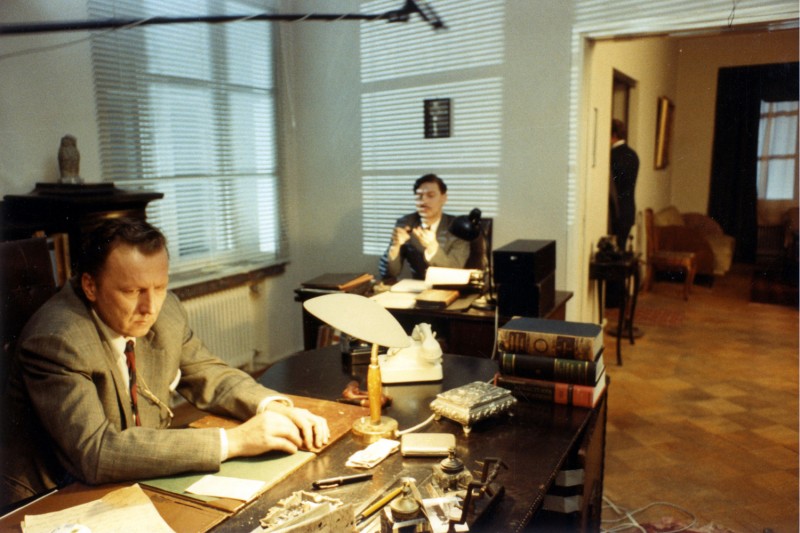
Likaiset kädet / Dirty Hands. Sulevi Peltola (Hoederer), Matti Pellonpää (Hugo).

Die schmutzigen Hände / De smutsiga händerna / Le mani sporche.
    FI 1989. PC: Yleisradio / TV 1 / Teatteritoimitus. – Sputnik Oy. P: Hannu Kahakorpi.
    D+SC: Aki Kaurismäki – based on the play (1948) by Jean-Paul Sartre. Cin: Matti Kurkikangas – 16 mm – colour – 1,33:1. PD: Risto Karhula. Set dec: Risto Jokinen. Cost: Outi Harjupatana, Mari Ropponen. Makeup: Zoe Burtsow. M from: Dmitri Shostakovich. S: Lasse Litovaara (rec), Ari Lyytikäinen (monitoring), Jussi Olkinuora (mixer). ED: Paavo Eskalinen.
    C: Matti Pellonpää (Hugo), Kati Outinen (Jessica), Sulevi Peltola (Hoederer), Kaija Pakarinen (Olga), Pertti Sveholm (Louis), Kari Väänänen (Ivan), Pirkka-Pekka Petelius (Slick), Aake Kalliala (Georges), Esko Nikkari (Karsky), Hannu Lauri (the Prince), Hannu Viholainen (Charles), Asmo Hurula (Frantz).
    68 min
    TV movie.
    Telecast: 5 Oct 1989 Yle TV1 Kunnon Kino.
    2015 digital transfer supervised by Aki Kaurismäki.
    Finnish festival premiere: 2015 Midnight Sun Film Festival, Sodankylä (Peter von Bagh in memoriam).
    International festival premiere: 2015 Il Cinema Ritrovato, Bologna (Peter von Bagh in memoriam).
    2K DCP with English subtitles viewed at Filmmuseum München, Munich, 30 Jan 2020.

AA: Les Mains sales is an interesting exception in Aki Kaurismäki's oeuvre: his only tv movie, shot in seven days, from nine to five, his only period movie, with Total Balalaika Show his only film in 16 mm, and the only one without his trusted DP Timo Salminen. The focus in this film and Total Balalaika Show is not on visual expression.

As for the cast, Aki Kaurismäki's "dream team" is here at its most complete, starting with Kati Outinen and Matti Pellonpää, including the solid presences of Esko Nikkari and Sulevi Peltola, as well as beloved sketch comedians Aake Kalliala and Pirkka-Pekka Petelius. There is little room for self-expression. Actors recite dialogue monotonously. Did somebody mention Straub & Huillet?

Yet the essence of the tragedy comes through. Thinking about Les Mains sales I was struck by an affinity with Martin Scorsese's The Irishman in the drama of the respected leader and his assistant. We can imagine Robert De Niro playing Hugo and Al Pacino as Hoederer.

The distinction of Les Mains sales is that it is Aki Kaurismäki's sole faithful film adaptation. It is probably also his most talkative film. It is based on Jean-Paul Sartre's play from 1948. The play premiered immediately also in Helsinki in the autumn of 1948 at the National Theatre. We still had the Control Commission of the Allied Forces based in Hotel Torni in Helsinki, in reality a Soviet commission. The chairman was no other than Andrei Zhdanov. In December Sartre's play was withdrawn as an act of political self-censorship.

It may seem paradoxical that this film is so faithful to the original play, yet feels integral to the Kaurismäki corpus. But Kaurismäki has been strongly influenced by Existentialism, and at one stage he stated in an interview that he is 60% Existentialist. Some of the most typically Akiesque dialogue in this movie stems directly from Sartre. Most importantly, Sartre's irony has close affinities with Kaurismäki.

(Based on my introduction to the screening.)

BEYOND THE JUMP BREAK: PROGRAM NOTE BY PETER VON BAGH: IL CINEMA RITROVATO, BOLOGNA, 2015:

Friday, June 19, 2020

Frantsuz / The Frenchman


Andrei Smirnov: Frantsuz / The Frenchman (2019) with Evgenya Obraztsova (Kira Galkina) and Anton Rival (Pierre Durand).

Andrei Smirnov: Frantsuz / The Frenchman (2019) with Nina Drobysheva (Olga Obrezkova, Natalia Tenyakova (Maria Obrezkova) and Anton Rival (Pierre Durand). Gradually Pierre gets on track of his lost father. My screenshot. Please click to enlarge the image.

Француз / A Frenchman.
    RU © 2019 Ano "KADR". PC: Marmot-Film. P: Elena Prudnikova, Andrei Smirnov, Valeri Todorovski.
    D+SC: Andrei Smirnov. Cin: Yuri Shaygardanov – b&w – digital. PD: Vladimir Gudilin. Cost: Ludmila Gaintseva. Makeup: Elena Dmitrienko. VFX: CGF. S: Oleg Tatarinov. ED: Alla Strelnikova. Steadicam: Aleksandr Vdovenko. Quadcopter: Andrei Dontsov. Advisor: Arseni Roginsky (Memorial).
    Soundtrack selections include: Ludwig van Beethoven: Opus 27 Nr. 2: Klaviersonate Nr. 14 in cis-Moll „Mondschein“ (1801), played by Pierre Durand to his father at the Pereslavl-Zalessky House of Culture.
    "Bernie's Tune" (Bernie Miller, 1952) and "Donna Lee" (Charlie Parker, 1947) performed by the jazz quintet of Anton Rumyantsev.
    Poems: "Kogda ya ochen zatoskuyu" (Aleksandr Kushner), "Moroz segodnya krepki" (Igor Kholin), "Ivanovy" (Nikolai Zabolotski).
    Paintings by Oscar Rabin.
    C: Anton Rival (French exchange student Pierre Durand), Evgenia Obraztsova (Bolshoi ballerina Kira Galkina), Yevgeny Tkachuk (VGIK student, photographer Valeri Uspenski), Aleksandr Baluev (Tatishchev, night watchman at a bakery, former Count, former White Officer, Gulag survivor), Mikhail Efremov (Valeri Uspenski's dad, former teacher of Marxism-Leninism, Gulag survivor), Roman Madyanov (Chuhnovski, writer), Nina Drobysheva (Olga Obrezkova, former noblewoman, Gulag survivor), Natalia Tenyakova (Maria Obrezkova, former noblewoman, Gulag survivor), Vera Lashkova (Anna Fedorovna, manager of the house of culture), Evgeny Kharitonov (Oscar Rabin, painter), Thomas Alden (Louis), Anna Neverova (Marusya), Alexander Zamuraev (alcoholic), Manuel Sinor (restaurateur).
    Locations: Moscow, Paris.
    128 min
    Dedicated to the memory of Aleksandr Ginzburg.
    Festival premiere: 16 June 2019 Open Russian Film Festival Kinotavr.
    International Film Festival Rotterdam 2020.
    31 Oct 2019 Walt Disney Studios Sony Pictures Releasing (Russia) direct-to-consumer.
    Corona lockdown viewings / Midnight Sun Film Festival (MSFF) online edition / Films by former Sodankylä guests [Andrei Smirnov: 2006].
    From the MSFF FestivalScope screening platform with English subtitles, viewed at a forest retreat in Punkaharju on a tv screen, 19 June 2020.

Official synopsis: "In 1957, a French student, Pierre Durand, comes to Moscow for an internship at Moscow State University. Here he meets the Bolshoi Theater ballerina Kira Galkina and photographer Valera Uspensky. Thanks to these acquaintances, Pierre is immersed in the cultural life of Moscow, not only official, but also underground. For a year, Pierre has lived in Moscow for a lifetime, completely unlike anything he knew. But internship and acquaintance with different aspects of the life of Soviet people is not Pierre's only goal. He is looking for his father, white officer Tatishchev, who was arrested in the late 1930s." (Official synopsis).

International Film Festival Rotterdam: "By the end of the 1970s, Andrei Smirnov had had enough. One of the best and brightest auteurs to emerge from the Soviet 1960s couldn't stand constant harassment from the authorities anymore, and quit cinema for good. At least as a director; he stuck around as a screenwriter and actor. But then, after 32 years, he returned with Žila-byla odna baba (2011). Now A Frenchman suggests he's back to stay, and will continue directing."

"A Frenchman, the story of a French exchange student's adventures in late 1950s Moscow, makes us painfully aware what a formidable cinematic mind and soul Smirnov has: discrete, educated, good-humoured, politically poignant while never dogmatic – the kind of public intellectual we perhaps need these days more than ever. Watching this film is like looking at a lost world, in more ways than one.
" (Rotterdam)
 

AA: Andrei Smirnov belongs to the masters of Thaw cinema, debuting before the beginning of Brezhnev's era of stagnation. His most famous film is Belorusski Station, but my own personal favourite is Angel (1967), suppressed at the time along with the episode film The Beginning of an Unknown Era and only released during Glasnost. One of the greatest Russian films of all times.

After a break of over 30 years Smirnov returned to directing films in the 2010s. I have yet to see the acclaimed Once Upon a Time There Lived a Simple Woman. The Frenchman is such a distinguished achievement that it makes me look forward to seeing not only it but all Smirnov's films again.

The Frenchman combines a strong argument with complexity in its account of character and history. It is a historical drama about a young Frenchman in search of his Russian roots. Pierre Durand is a member of the PCF, the French Communist Party, coming to the Soviet Union for the first time in his life in 1957. His father, a French resistance fighter, has died as a prisoner of the Nazis.

Pierre is both an insider and an outsider. Because he has spoken Russian with his mother all his life, he can instantly connect with everybody. Khrushchev has given his speech denouncing Stalin in the previous year, in 1956, rehabilitated millions purged by Stalin and ousted Stalin hard-liners from the party. Durand is aware of this, but the USSR is still full of surprises for him. And yet somehow, however, he is not surprised. This film is not a satire in the Candide tradition. Smirnov avoids clichés and stereotypes while the message remains strong and clear.

The Thaw liberation is real, but we also meet an opportunistic author, happy to be conform, yet giving Pierre the advice: "Keep your mouth shut. Don't speak to anybody". We meet a KGB officer who tries to engage Pierre as an informer, and Pierre even signs a document but never provides anything (instead, he smuggles samizdat poetry upon his return to France). Spies are everywhere. The walls have ears.

We visit legendary official landmarks of culture: Moscow State University and Bolshoi Ballet (Pierre falls asleep during Swan Lake), but we are also taken to the clandestine atelier of the modernist painter Oscar Rabin, an underground jazz club where the sax virtuoso Zubov gives a brilliant performance of "Bernie's Tune", and most importantly, witness the excitement of samizdat poets such as Joseph Brodsky and Igor Kholin. Period detail feels accurate, including vintage radio broadcasts.

The horror of the recent past starts to emerge. Valeri Uspensky's dad, an ex-teacher of Marxism-Leninism, is a camp survivor. Remote relatives, the Obrezkova sisters, former noblewomen, tell about their Gulag ordeal across the Soviet Union, including the Solovki.

Finally Pierre is given the clue that leads him to Pereslavl-Zalessky, to his biological father, the former Count Tatischev, a White officer, believed lost in Gulag. He has survived Kolyma and other chambers of hell. An alumnus of Mikhailovskoe artilleriskoe uchilishche, a master school of mathematics, he has survived by focusing his mind on Gödel theorems and the Russell paradox. He now works the night shift as a bakery guard. It is not a happy reunion between son and father. Pierre is the result of a summer fling, after which mother left Russia and gave birth in France to Pierre whom the Count has never seen before.

Aleksandr Baluev, Nina Drobysheva, Natalia Tenyakova, Vera Lashkova and Mikhail Efremov give the most memorable performances in the film as the Gulag survivors. Their faces carry the legacy of a terrible past. The young ones lose their illusions but not their hope. The final gestures are full of defiance.

The Frenchman is one of the best films I have seen about life during the Thaw. It has been shot in black and white like contemporary classics by Danelia, Khutsiev and Tarkovsky, but in the digital presentation there is a glacial atmosphere like also for instance in Frantz by François Ozon. A lack of warmth emphasizes a probably unintentional sense of alienation including in the two romantic separations of the film, in Paris in the beginning and in Moscow in the finale.

REMARKS FROM THE OFFICIAL SITE:

"Valeri Uspensky mentions in a conversation with Pierre the name of "his sidekick Alik" and the independent magazine "Gramotei", which he publishes. This is a reference to the Samizdat poetic almanac Syntax, which Ginsburg produced, and for which he received his first term. All the verses read in the picture are from Syntax."

"In the role of Anna Fyodorovna, the manager of the house of culture in Pereslavl-Zalessky, where Pierre and Tatishchev have a conversation, stars Vera Lashkova, a comrade-in-arms of Alik Ginzburg, a typist who was engaged in reprinting the Samizdat collections “White Book” (files from the Sinyavsky and Daniel trials collected by Ginzburg). The dedication at the end of the film – “In memory of Alik Ginzburg and his friends who wanted to live not by lies” – is addressed to Vera Lashkova in particular."

BEYOND THE JUMP BREAK: DATA FROM MSFF ETC.