Thursday, January 30, 2020

Total Balalaika Show


Total Balalaika Show. Mikhail Mozalin (The Alexandrov Red Army Ensemble) and Jore Marjaranta (Leningrad Cowboys) sing "Happy Together".

FI 1993. PC: Sputnik Oy. D: Aki Kaurismäki. Featuring: The Alexandrov Red Army Ensemble and Leningrad Cowboys. Full credits and song list: see my blog note 8 Dec 2010.
    Digital transfer supervised by Aki Kaurismäki in 2014.
    2K DCP viewed at Filmmuseum München, 30 Jan 2020

AA: In today's screening we see two films by Aki Kaurismäki in which he comes closest to making a straight record.

When Mika and Aki Kaurismäki emerged into the Finnish film scene in 1980 there had been an empty period after the death of Risto Jarva in 1977. The brothers cultivated close relations with the new wave Suomi rock music scene, artists such as Sielun Veljet, Eppu Normaali, Juice Leskinen, Rauli Somerjoki und Tuomari Nurmio. They connected in young, irreverent energy.

Aki established a special connection with the comedy rock band Sleepy Sleepers. He directed their short music film Rocky VI where Igor (Sakari Kuosmanen) beats Rocky (Silu Seppälä). In Aki's subsequent music shorts the band transformed into Leningrad Cowboys.

Total Balalaika Show is a document of the concert of Leningrad Cowboys and The Alexandrov Red Army Ensemble on the Helsinki Senate Square, in the monument centre, in front of the Cathedral, on 12 June 1993 not long after the fall of the Soviet Union in December 1991. It was one of the outstanding events celebrating the Fall of the Wall, our counterpart to Roger Waters's The Wall Live in Berlin (1990).

Aki, accustomed to shoot with one camera only, now had four Super 16 cameras at his disposal and a top team of cinematographers (see my previous blog note on this movie).

"The worst rock band" meets one of the best choirs in the world. Anarchy meets discipline. A goofy joke turns serious. Madness became reality.

Chris Marker called this movie "a milestone of post-modern kitsch", a snapshot after the fall of the Brezhnev empire. American film magazines wrote about "the irony curtain". A parody of cold war and iron curtain stereotypes had been a constant in the trajectory of Sleepy Sleepers / Leningrad Cowboys.

A remark about the song selections. The Red Army choir gave their first performance in Finland in 1945, after Finland had lost the war against the USSR and switched to the Allies. The choir arrangement of "Finlandia" by Jean Sibelius was the opening number of the Red Army choir in 1945, ideal for breaking the ice. "Kalinka", the Russian traditional, features prominently in the most popular Finnish film of all, The Unknown Soldier: the soldiers confiscate a Red Army choir record of "Kalinka" as war loot, and it becomes popular among them. "Happy Together" and "Those Were the Days" gain a special meaning in this concert.

Total Balalaika Show is a farewell concert to the iron curtain.

A parody of "peaceful coexistence" now turned into reality.

A big laugh at the paradoxes of the cold war.

The handshake is a key image in Aki Kaurismäki's films. Total Balalaika Show is a film about an epic handshake.

(Based on my introduction to the film).

...

PS. Cinema screenings of this movie are rare at least in Finland (it is mostly being seen in home formats, television, and online services). It was very rewarding to see this film again on the screen. The epic scope of the event can be fully conveyed only in a cinema experience. It keeps growing. The Cold War was a terrible time. The feeling of relief was deep when it ended, and this happy moment is documented here.

Jörn Donner died today, and in Facebook Messenger after the show I got in touch among others with Mauri Sumén who arranged the songs of the film. He told that Leningrad Cowboys were deeply shocked and sent their condolences to the Red Army Choir after their horrible airplane disaster in 2016 in which 64 key choir members died. He told also that Total Balalaika Show was widely circulated in Russia in memorials of the catastrophe. Sumén also mentioned that many of the best music numbers had to be left out of the film for copyright reasons.

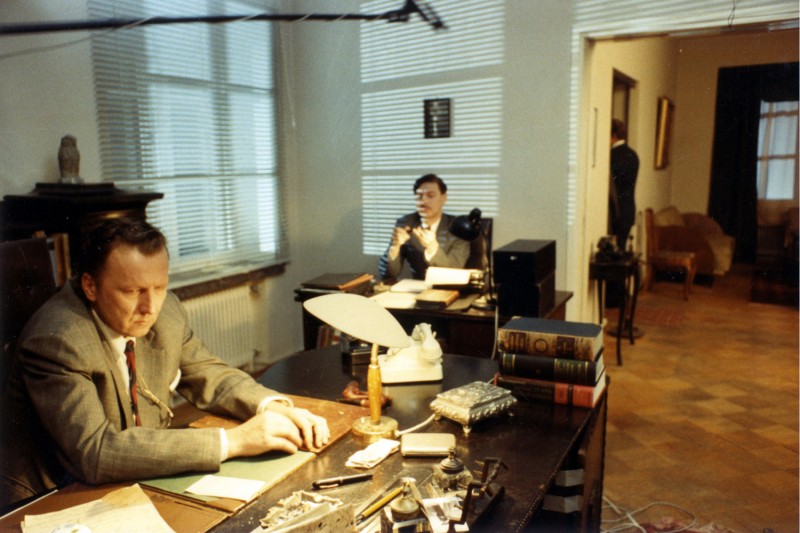
Likaiset kädet / Les Mains sales / Dirty Hands


Likaiset kädet / Dirty Hands. Sulevi Peltola (Hoederer), Matti Pellonpää (Hugo).

Die schmutzigen Hände / De smutsiga händerna / Le mani sporche.
    FI 1989. PC: Yleisradio / TV 1 / Teatteritoimitus. – Sputnik Oy. P: Hannu Kahakorpi.
    D+SC: Aki Kaurismäki – based on the play (1948) by Jean-Paul Sartre. Cin: Matti Kurkikangas – 16 mm – colour – 1,33:1. PD: Risto Karhula. Set dec: Risto Jokinen. Cost: Outi Harjupatana, Mari Ropponen. Makeup: Zoe Burtsow. M from: Dmitri Shostakovich. S: Lasse Litovaara (rec), Ari Lyytikäinen (monitoring), Jussi Olkinuora (mixer). ED: Paavo Eskalinen.
    C: Matti Pellonpää (Hugo), Kati Outinen (Jessica), Sulevi Peltola (Hoederer), Kaija Pakarinen (Olga), Pertti Sveholm (Louis), Kari Väänänen (Ivan), Pirkka-Pekka Petelius (Slick), Aake Kalliala (Georges), Esko Nikkari (Karsky), Hannu Lauri (the Prince), Hannu Viholainen (Charles), Asmo Hurula (Frantz).
    68 min
    TV movie.
    Telecast: 5 Oct 1989 Yle TV1 Kunnon Kino.
    2015 digital transfer supervised by Aki Kaurismäki.
    Finnish festival premiere: 2015 Midnight Sun Film Festival, Sodankylä (Peter von Bagh in memoriam).
    International festival premiere: 2015 Il Cinema Ritrovato, Bologna (Peter von Bagh in memoriam).
    2K DCP with English subtitles viewed at Filmmuseum München, Munich, 30 Jan 2020.

AA: Les Mains sales is an interesting exception in Aki Kaurismäki's oeuvre: his only tv movie, shot in seven days, from nine to five, his only period movie, with Total Balalaika Show his only film in 16 mm, and the only one without his trusted DP Timo Salminen. The focus in this film and Total Balalaika Show is not on visual expression.

As for the cast, Aki Kaurismäki's "dream team" is here at its most complete, starting with Kati Outinen and Matti Pellonpää, including the solid presences of Esko Nikkari and Sulevi Peltola, as well as beloved sketch comedians Aake Kalliala and Pirkka-Pekka Petelius. There is little room for self-expression. Actors recite dialogue monotonously. Did somebody mention Straub & Huillet?

Yet the essence of the tragedy comes through. Thinking about Les Mains sales I was struck by an affinity with Martin Scorsese's The Irishman in the drama of the respected leader and his assistant. We can imagine Robert De Niro playing Hugo and Al Pacino as Hoederer.

The distinction of Les Mains sales is that it is Aki Kaurismäki's sole faithful film adaptation. It is probably also his most talkative film. It is based on Jean-Paul Sartre's play from 1948. The play premiered immediately also in Helsinki in the autumn of 1948 at the National Theatre. We still had the Control Commission of the Allied Forces based in Hotel Torni in Helsinki, in reality a Soviet commission. The chairman was no other than Andrei Zhdanov. In December Sartre's play was withdrawn as an act of political self-censorship.

It may seem paradoxical that this film is so faithful to the original play, yet feels integral to the Kaurismäki corpus. But Kaurismäki has been strongly influenced by Existentialism, and at one stage he stated in an interview that he is 60% Existentialist. Some of the most typically Akiesque dialogue in this movie stems directly from Sartre. Most importantly, Sartre's irony has close affinities with Kaurismäki.

(Based on my introduction to the screening.)

BEYOND THE JUMP BREAK: PROGRAM NOTE BY PETER VON BAGH: IL CINEMA RITROVATO, BOLOGNA, 2015:

Saturday, January 25, 2020

Nran guyne / Sayat Nova / The Colour of Pomegranates


Nran guyne / Sayat Nova / The Colour of Pomegranates. Sofiko Chiaureli.

Nran guyne / Sayat Nova / The Colour of Pomegranates.

Nran guyne / Sayat Nova / The Colour of Pomegranates.

Nran guyne / Sayat Nova / The Colour of Pomegranates. Le sang d'un poète. Il meurt mais sa poésie est immortelle.

Նռան գույնը / Цвет граната / Nran guyne / Sayat Nova / Brotseulis kvaviloba / Tsvet granata / Granaattiomenan väri / Granatäpplets färg.
    SU 1968. PC: Armenfilm. D: Sergei Parajanov. SC: Sergei Parajanov – inspired by and incorporating poems by Sayat Nova. DP: Suren Shahbazyan – 35 mm – colour – 1,37:1. PD: Stepan Andranikyan. AD: Sergei Parajanov. Set dec: Mikael Arakelyan. Cost: Elene Akhvlediani, I. Karalyan, Zh. Sarabyan. Makeup: V. Asatryan, P. Aschyan. VFX: H. Hovhannisyan, L. Karamyan. M: Tigran Mansuryan. Choreography: Sergei Parajanov. ED: Sergei Parajanov, Marfa Ponomarenko. S: Yuri Sayadyan.
   C: Sofiko Chiaureli (Poet as a Youth / Poet's Love / Poet's Muse / Mime / Angel of Resurrection), Melkon Alekyan (Poet as a child), Vilen Galustyan (Poet in the cloister), Gogi Gegechkori (Poet as an old man), Spartak Bagashvili (Poet's father), Medea Japaridze (Poet's mother), Hovhannes Minasyan (Prince), Onik Minasyan (Prince).
    Tournage: 17 Aug 1967 – 22 July 1968 Studios Armenfilm (Yerevan). The baths: shot at the studio in Kiev. – Loc: Armenia: Haghpat Monastery, Sanahin Monastery, Saint John Church (Ardvi), Akhtala Monastery. – Georgia: Alaverdi Monastery, David Gareja monastery complex, Dzveli Shuamta. – Azerbaijan: Old City of Baku, Nardaran Fortress.
    Russian version (1970) edited by: Sergei Yutkevich.
    Digital restoration: 2014 (Film Foundation / Cineteca di Bologna).
    Yerevan premiere: October 1969.
    Moscow premiere: 29 Aug 1970.
    Festival premiere: 25 Nov 1977 Venice Biennale.
    French premiere: 27 Jan 1982.
    Digital restoration premiere: May 2014 Cannes Film Festival.
    No theatrical release in Finland – telecast 11 Feb 2015, 1 March 2017 Yle Teema.
    Film control VET 94355 (film archive screening SEA 1987) – K12 – Russian version 72 min – Armenian version 79 min
    Armenia Fest, Savoy Theatre, Helsinki, 25–26 Jan 2020.
    DCP with English subtitles of the 2014 digital restoration viewed at Savoy, Helsinki, 25 Jan 2020. 

Wikipédia: La vie de Sayat-Nova, poète arménien du XVIIIe siècle, en huit chapitres:
    I : L'enfance du poète.
    II : La jeunesse du poète.
    III : Le poète à la cour du prince / Prière avant la chasse.
    IV : Le poète se retire au monastère / Le sacrifice / La mort du katholikos.
    V : Le songe du poète / Le poète retourne à son enfance et pleure la mort de ses parents.
    VI : La vieillesse du poète / Il quitte le monastère.
    VII : Rencontre avec l'Ange de la Résurrection/Le poète enterre son amour.
    VIII : La mort du poète / Il meurt mais sa poésie est immortelle.

AA: Բարև՛ Ձեզ! Barev dzhez!

I was happy to introduce at the Armenia Fest Sergei Parajanov's Nran guyne / Sayat Nova / The Colour of Pomegranates, a contender for the most beautiful film of all times. It is exceptional that a motion picture manages to pay tribute to a great poet and find the proper wavelength with him. It helps if the film-maker is a great poet herself/himself such as Forough Farrokhzad, Jean Cocteau or Pier Paolo Pasolini. Sergei Parajanov belongs to these happy few.

Nran guyne is inspired by the life of Sayat-Nova, the great Armenian poet who was born in Tbilisi, lived in the 18th century and wrote poetry in four languages: Armenian, Georgian, Azerbaijani and Persian. Equally multi-cultural was Parajanov, also born in Tbilisi whose vibrant Armenian community was also the home of the composer Aram Khachaturian and Rouben Mamoulian the great Broadway and Hollywood director. Parajanov's first languages were Georgian and Armenian, and he went to school in Russian. He directed films in five languages: besides the aforementioned also in Ukrainian and Azerbaijani. "The brotherhood of nations" was a key tenet of the official Soviet ideology, and this particular tenet was cordially embraced by Parajanov in the spirit of old Tbilisi where many cultures had co-existed for centuries without being assimilated or mixed.

Parajanov's career as an assistant director and director started during the Stalin era, and he directed several reportedly conventional films until in 1962 he saw the feature film debut of a much younger colleague: Ivan's Childhood by Andrei Tarkovsky. This film electrified Parajanov who experienced a rebirth as a film artist.

In Ukraine he directed Shadows of Forgotten Ancestors based on a story by Mikhail Kotsyubinsky: a flight of cinematic imagination so extraordinary that one started to speak about Soviet psychedelia. In any event it was a foundation work of the poetic school of 1960s Soviet cinema, following Tarkovsky. The cinematographer was Yuri Ilyenko who was strongly inspired by the Mikhail Kalatozov / Sergei Urusevsky school of the moving, roving, flying, unhinged camera. There was a very big collision with Parajanov who was about to discover his true calling as a poet of the tableau vivant. But they managed to collaborate, and Ilyenko was launched on a career of his own as a director, as one of the masters of Ukrainian cinema together with Leonid Osyka who directed The Stone Cross, both inspired by Parajanov.

The film studios of Georgia, Azerbaijan and Armenia were also impressed, and Parajanov got to direct in all of them, and his next film was the miraculous Nran guyne, a poetic film produced on a big budget. The result was wonderful, but the Thaw period was coming to an end in the Soviet Union, and dozens of remarkable films were being shelved, starting with the long version of Marlen Khutsiev's I Am Twenty (The Gate of Ilyich), soon including Tarkovsky's Andrei Rublyov and masterpieces by Kira Muratova, Otar Iosseliani, Yuri Ilyenko, Aleksandr Askoldov, Larisa Shepitko, Elem Klimov and Aleksei German.

Nran guyne was not banned. It was given a limited release in its Armenian and Russian versions, and screenings were possible on demand. But in contrast to Shadows of Forgotten Ancestors it was not widely released nor sent to international film festivals.

Homosexual acts were illegal in Russia, and the bisexual Parajanov did not live in a closet. There is even a subtle "queer look" in his movies. Sexual identity is fluid also in Nran guyne. There is nothing provocative or intentionally transgressive in this. Instead, Parajanov seems to reach back to something atavistic and primordial. In the prologue of Nran guyne we even hear quotes from the Genesis.

In the 1970s Parajanov landed to the prison archipelago of Siberia in a series of hard labour camps, nominally for indecency but probably the real reason was his openly expressed contempt towards the Soviet system. Andrei Tarkovsky was the first to defend his friend, and there was an international protest movement of prominent artists to support Parajanov. Finally he was released, probably thanks to the intervention of Louis Aragon, Elsa Triolet and John Updike.

In the 1980s Tbilisi became the hotbed of glasnost. It was there that Tengiz Abuladze directed Repentance, the first glasnost film, a direct confrontation with the Stalin legacy. In Tbilisi Parajanov was also able to make his next film, The Legend of Suram Fortress, premiering 16 years after Nran guyne.

Parajanov's art is a unique combination of the archaic and the modern. His cinema was inspired by the naive art of the Georgian painter Niko Pirosmani and by old Iranian miniatures which Parajanov loved to examine in the museums of Tbilisi. His cinema has an affinity with masters of the early cinema starting with the magic visions of Georges Méliès, the tableaux vivants tradition and the symbolism of Maurice Tourneur and Yevgeni Bauer.

But he was also ahead of his time. In the contemporary cinema of the most recent decades there are masters who have revived early cinema approaches. Geographically the nearest one can be found in Sweden: Roy Andersson has directed commercials and feature films with the tableau approach. True, in contrast to Parajanov, the landscapes are drab, the persons are glum and the colours have no glow. Flamboyant colours can be found in the commercials, music videos and feature films of the Indian, Bengalese director Tarsem. When Tarsem visited Helsinki we showed him Shadows of Forgotten Ancestors by his favourite director Parajanov, a film which he seemed not to have seen before.

Parajanov was influenced by Iranian culture, and Parajanov's films have been popular in Iran. Last summer at the Midnight Sun Film Festival among the guests was a famous artist couple of Iranian film-makers: Mohsen Makhmalbaf whose Gabbeh, about making Persian carpets is clearly indebted to Nran guyne, and his wife Marzieh Meshkini whose The Day I Became a Woman is full of imagery with Parajanovian affinities.

Nran guyne is a mysterious film. No matter how often you see it it surprises you. It transcends boundaries – boundaries of cultures, boundaries of history. It is a timeless work of art.

(Based on my introduction to the screenings).

...

I was also happy to catch samples of the wonderful concerts of The Naghash Ensemble and the Vardan Hovanissian Trio.

Savoy used to be a cinema in the 1960s of my childhood, known at the time as Cinerama Savoy. I saw 70 mm screenings there of films such as Ice Station Zebra. I also saw 2001 A Space Odyssey there during its first run. And Savoy was also one of the cinemas rented by the Finnish Film Archive. There I saw for the first time Satan Never Sleeps, very impressive in scope on the giant screen.

Now Savoy Theatre is a vibrant site for concerts, festivals and cultural events. It is occasionally also a cinema, most prominently during film festivals. I was amazed to learn that Savoy Theatre, seating 750, is the biggest cinema in Finland, bigger than Tennispalatsi ISENSE or Bio Rex.

Because I started to frequent Savoy in the 1960s, seeing Nran guyne there was a special memory journey and a magical mystery tour. In the Internet Movie Database there is a well selected suite of 87 photos from Nran guyne. Because it is a tableau vivant film, it is also rewarding to study in photographs.

I have loved Nran guyne since I first saw it in 1983 in a brilliant print in West Berlin. The film was never theatrically released in Finland, and I programmed its first Finnish screenings at the Finnish Film Archive at Cinema Orion in 1987 and wrote the program note. The film is both opaque and accessible, inviting and estranged.

I now saw for the first time the 2014 digital restoration. Well done.

...

I used the opportunity to study two great books:
Érik Bullot : Sayat Nova de Serguei Paradjanov : la face et le profil. Crisnée : Yellow Now, 2007. 110 p. : ill. ; 17 cm. ISBN: 2-87340-212-1 ; 9782873402129.
James Steffen : The Cinema of Sergei Parajanov. Madison : The University of Wisconsin Press, 2013. 306 s. : ill. ISBN: 978-0-299-29654-4.


MY PROGRAM NOTE FOR THE FINNISH FILM ARCHIVE (1987):

1917


Taistelulähetit – 1917 / 1917.
    GB / US © 2019 Storyteller Distribution Co., LLC / NR 1917 Film Holding. PC: Neal Street Productions for DreamWorks Pictures in association with New Republic Pictures. P: Sam Mendes, Pippa Harris, Jayne-Ann Tenggren, Callum McDougall, Brian Oliver. EX: Jeb Brody, Oleg Petrov, Ignacio Salazar-Simpson, Ricardo Marco Budé.
    D: Sam Mendes. SC: Sam Mendes, Krysty Wilson-Cairns. Cin: Roger Deakins – colour – 1, 90:1 (IMAX), 2,39:1 – source format: ARRIRAW4,5K – master format: 4K – release format: D-Cinema.
PD: Dennis Gassner. AD: Simon Elsley, Elaine Kusmishko, Rod McLean, Niall Moroney, Stephen Swain, Robert Voysey (construction foreman). Set dec: Lee Sandales. Cost: David Crossman, Jacqueline Durran. Hair & makeup: Doone Forsyth. SFX: Alicia Davies, Dominic Tuohy. VFX: Sona Pak – MPC – Cheap Shot. M: Thomas Newman. S: Oliver Tarney. ED: Lee Smith. Casting: Nina Gold.
    C: George MacKay (Lance Corporal Schofield), Dean-Charles Chapman (Lance Corporal Blake), Mark Strong (Captain Smith), Andrew Scott (Lieutenant Leslie), Richard Madden (Lieutenant Joseph Blake), Claire Duburcq (Lauri), Colin Firth (General Erinmore), Benedict Cumberbatch (Colonel MacKenzie).
    Filming and production: England and Scotland. For instance in Salisbury Plains, Wiltshire. 1 April 2019 – 7 June 2019.
    119 min
    UK Royal Command Performance: 4 Dec 2019.
    Finnish premiere: 24 Jan 2020 – released by Nordisk Film – Finnish / Swedish subtitles by Jaana Wiik / Jani Kyllönen.
    IMAX screening at Finnkino Itis, IMAX® Premium, Helsinki, 25 Jan 2020.

Tagline: "Time is the enemy".

IMDb capsule: "Two young British soldiers during the First World War are given an impossible mission: deliver a message deep in enemy territory that will stop 1,600 men, and one of the soldiers' brothers, from walking straight into a deadly trap."

Official synopsis: "Sam Mendes, the Oscar®-winning director of Skyfall, Spectre and American Beauty, brings his singular vision to his World War I epic, 1917."

"At the height of the First World War, two young British soldiers, Schofield (Captain Fantastic’s George MacKay) and Blake (Game of Thrones’ Dean-Charles Chapman) are given a seemingly impossible mission. In a race against time, they must cross enemy territory and deliver a message that will stop a deadly attack on hundreds of soldiers—Blake’s own brother among them."

"1917 is directed by Sam Mendes, who wrote the screenplay with Krysty Wilson-Cairns (Showtime’s Penny Dreadful). The film is produced by Mendes and Pippa Harris (co-executive producer, Revolutionary Road; executive producer, Away We Go) for their Neal Street Productions, Jayne-Ann Tenggren (co-producer, The Rhythm Section; associate producer, Spectre), Callum McDougall (executive producer, Mary Poppins Returns, Skyfall) and Brian Oliver (executive producer, Rocketman; Black Swan)."

"The film is produced by Neal Street Productions for DreamWorks Pictures in association with New Republic Pictures. Universal Pictures will release the film domestically in limited release on December 25, 2019 and wide on January 10, 2020. Universal and Amblin Partners will distribute the film internationally, with eOne distributing on behalf of Amblin in the U.K."

AA: In tribute to his grandfather, Sam Mendes has created a memorial film to the First World War. To me it appears as a parallel enterprise to Peter Jackson's They Shall Not Grow Old. Both films are ambitious and experimental super-productions which help us see the much discussed war in a new way.

Both are created around a stunning special effect. Jackson created his vision from vintage propaganda footage at the Imperial War Museum united seamlessly via digital manipulation. Mendes has produced a quasi "single shot" movie, rare in feature films anyway, and unique in a project of such epic scope.

1917 is a magnificent spectacle, focusing on a single storyline that offers an epic cross-section of the war theatre near the Hindenburg Line on the Western Front. Its classical storytelling concept dates back to D. W. Griffith's "race to the rescue" films and Alfred Hitchcock's philosophy of suspense.

There is a crucial difference, however: Griffith and Hitchcock's films were built on parallel montage. Mendes's "single shot" concept eschews montage altogether. The film is like a digital game blown up to an IMAX screen, a relentless nightmare where there is an enemy worse than Germans – time. I also kept thinking about films such as Speed and Lola rennt. Among war films, there is an affinity with Steven Spielberg's Saving Private Ryan which is also about a single-minded pursuit to save a surviving brother.

It's great, but in my opinion both Jackson and Mendes miss the point – the point of the First World War.

It was the first war in Europe with industrial scale slaughter (for instance in Verdun and Somme). Traditional fiction was powerless to depict that. Griffith understood this when he visited the battlefields and stated that no good drama can be made of a war like this.

Massive amounts of newsreels were shot, and I have seen dozens of hours of them during 2014–2018 in the heritage festivals of Pordenone and Bologna. I agree with the historian Marc Ferro that these "authentic" films fail to convey the reality of the war.

Several fiction films from Abel Gance's J'accuse to Joseph Loseys' King & Country managed that very powerfully, and special mention goes deservedly to films like The Big Parade, All Quiet on the Western Front, Les Croix de bois and Paths of Glory.

While Jackson and Mendes clearly know what they are talking about, their films fail to convey the horror of the total war. Unconsciously they revert to old-fashioned ideals of glory – the very ideals which were demolished in WWI.

...
I visited the magnificent Finnkino Itis cinema for the first time and was very impressed by the IMAX cinema where 1917 was screened and its dedicated staff. This movie is not being screened in the legendary IMAX super format which was established in 1970, but a great digital projection was seen on a huge screen in an exemplary cinema.

BEYOND THE JUMP BREAK: SYNOPSIS FROM WIKIPEDIA:

The IMAX Cinema at Finnkino Itis (official information)


Finnkino Itis

Itäkatu 1–7, 00930 Helsinki

Official introduction

Finnkino Itis opened a 9 auditorium cinema in Itäkeskus on 30.11.2018. This cinema has Finland's first IMAX®-auditorium! In addition to IMAX®, six other classic cinema auditoriums and two new LUXE premium auditoriums were opened. LUXE premium auditoriums have been improved with comfortable seating and reclining armchairs as well as their own side tables. A cozy Oscar's Bar was also opened on the 2nd floor of the movie theater, where guests can go for a glass of wine and order some 'movie food' to enjoy before or after the movie, or in premium auditorium during the movie.

IMAX® Cinema's next generation 4K laser projector technology produces crystal clear images. This new optical system delivers better resolution, sharper and brighter images, deeper contrast and a wider color scheme. Combined with IMAX®'s geometric, digital 12-channel audio, it gives movie fans a real cinematic experience as if they were in the movie itself.

The main difference between IMAX® and other cinemas is the larger screen. It literally extends from floor to ceiling and wall to wall. The screen is curved, which makes the image feel real no matter where the viewer sits. The IMAX® Theater is designed to bring the public closer to the screen and better positioned in terms of picture and sound.

Parking

The Itis Shopping Center's parking spaces are always open, so you can drive out of the parking hall after a late movie. The parking lots closest to the theater are P3 Roof Park, -1 Yellow and -2 Blue.

Friday, January 24, 2020

Bié gàosù tā / The Farewell


別告訴她
别告诉她
Jäähyväiset / The Farewell.
    US © 2019 Big Beach LLC. – A24, Big Beach, Kindred Spirit and Ray Production present a Big Beach production in association with Depth of Field and Seesaw. – EX: Eddie Rubin. P: Daniele Melia, Marc Turtletaub, Peter Saraf, Andrew Miano, Chris Weitz, Jane Zheng, Lulu Wang, Anita Gou.
   D+SC: Lulu Wang – based on her story "What You Don't Know" originally shared by Wang on This American Life (2016). Cin: Anna Franquesa Solano – colour – 2,35:1 – ARRIRAW 2.8K – master format: 2K – release format: D-Cinema. PD: Young Ok Lee. AD: W. Haley Ho. Set dec: Joseph Sorelle, Hanrui Wang. Cost: Vanessa Porter, Athena Wang. M supervisors: Susan Jacobs, Dylan Neely. M: Alex Weston. S: Gene Park. ED: Matt Friedman, Michael Taylor. Casting: Anne Kang, Leslie Woo.
    M selections include:
– "Pathetique" (b.o. Beethoven: Klaviersonate Nr. 8 "Pathétique", 1799, Zweiter Satz, cantabile, Träumerei), arr. Alex Weston as a song without words.
– "Killing Me Softly With His Song" (comp. Charles Fox, lyr. Norman Gimbel [inspired by Lori Lieberman inspired by Don McLean], 1971).
– "Caro mio ben (1783, ascribed to Giuseppe Giordani) voc. Hyesang Park, piano Lulu Wang.
– "Come Healing" (Leonard Cohen, Patrick Leonard) perf. Elayna Boynton.
– "Senza di te" / "Without You" (Tom Evans, Peter Ham / Badfinger 1970) perf. Fredo Viola.
C (from Wikipedia): Awkwafina as Billi Wang (Chinese: 王比莉)
Tzi Ma as Haiyan Wang (王海燕), Billi's father
Diana Lin as Lu Jian (陆建), Billi's mother
Zhao Shuzhen as Nai Nai (奶奶), Billi's paternal grandmother
Lu Hong (playing herself) as Little Nai Nai, Billi's grandmother's younger sister
Jiang Yongbo as Haibin (海滨), Haiyan's older brother
Chen Han as Hao Hao (浩浩), Haibin's son
Aoi Mizuhara as Aiko (爱子), Hao Hao's girlfriend
Zhang Jing as Yuping, Haiyan's cousin
Li Xiang as Aunty Ling, Haibin's wife
Yang Xuejian as Mr. Li
Jim Liu as Dr. Song
    Loc: Changchun, China. – New York City, USA.
    Languages: Mandarin, English.
    119 min
    Festival premiere: 25 Jan 2019 Sundance Film Festival.
    US premiere: 9 Aug 2019.
    Finnish premiere: 24 Jan 2020 – released by Cinema Mondo – Finnish  / Swedish subtitles by Janne Mökkönen / Sophie Beckman.
    DCP viewed at Kino Engel 1, Helsinki, 24 Jan 2020.
The Chinese title of the film in translation: "Don't Tell Her".

A24 Press Notes: The Farewell: Synopsis: "In this funny, uplifting tale based on an actual lie, Chinese-born, U.S.-raised Billi (Awkwafina) reluctantly returns to Changchun to find that, although the whole family knows their beloved matriarch, Nai-Nai (grandma), has been given mere weeks to live, everyone has decided not to tell Nai Nai herself. To assure her happiness, they gather under the joyful guise of an expedited wedding, uniting family members scattered among new homes abroad. As Billi navigates a minefield of family expectations and proprieties, she finds there’s a lot to celebrate: a chance to rediscover the country she left as a child, her grandmother's wondrous spirit, and the ties that keep on binding even when so much goes unspoken. With The Farewell, writer/director Lulu Wang has created a heartfelt celebration of both the way we perform family and the way we live it, masterfully interweaving a gently humorous depiction of the good lie in action with a richly moving story of how family can unite and strengthen us, often in spite of ourselves."

AA: Lulu Wang's The Farewell – the Mandarin title of the film translates as "Don't Tell Her" – starts as a series of mundane observations and keeps growing towards a profound vision about the differences of Western and Chinese life.

It is a story of the Wang family, originally based in Changchun, with branches now extending into Shanghai, Japan and New York. The Wang family meets ostensibly for a wedding but in reality to spend time, as they believe, for the last time with the matriarch, "Nai Nai", who has been given by the doctors only months to live.

The central consciousness is that of Billi, a young Chinese American writer who grows to realize that Nai Nai is the heart of her familial love.

The theme is lying, and the tagline is "Based on an actual lie". Associations start running: True Lies... Liar Liar (associating with Lawyer Lawyer)... F for Fake... "Art is a lie that can lead us to truth" (Picasso)... "I am a sincere liar" (Fellini)... "Lie to me. Tell me all these years you've waited". Somehow, probably thanks to Pedro Almodóvar, I first hear the famous dialogue of Johnny Guitar in Spanish: "Dime una mentira. Dime que no me has olvidado en todos estos años". In Nordic countries we know Henrik Ibsen's livsløgn, called in German Lebenslüge, meaning a fundamental lie, a self-deception that becomes a foundation of life.

This story is different. Nai Nai is dying, and nobody tells her the truth because such is the tradition in China. Billi, coming from New York, is appalled. A series of comic and dramatic situations arise from the basic premise in which a wedding is celebrated while a funeral is being prepared.

But then Lulu Wang rises to a more profound level. Western life is based on the individual, Chinese life focuses on society. By lying to Nai Nai the family is saving her from the burden of knowledge and taking the burden to itself. Even the doctor seems to embrace this, becoming an accomplice in the deception.

Doctors' ethics are based on truth and honesty. But I have heard that there are risks of self-fulfilling diagnoses. The more we know, the better is our awareness of the mysteries of health. There is no message in The Farewell, but it may make us think that it pays to be an optimist.

And the family wedding / farewell party gives a lot to think about happiness in the different circumstances of Changchun, Shanghai, Japan, and New York.

BEYOND THE JUMP BREAK: SYNOPSIS FROM WIKIPEDIA:

Tuesday, January 21, 2020

Senses of Cinema World Poll 2019: my favourites


My film of the year: Tottumiskysymys / Force of Habit, a multi-character study with six stories about violence towards women. The most powerful story is Miia Tervo's Oikeudenkäynti / The Trial. It is a sober and realistic account of a rape case at the Helsinki Court House where it is a routine matter, business as usual. There is no melodrama, but this story is the burning heart of the project. It has the impact of a slowly detonating time bomb. The prosecutor Aleksi (Johannes Holopainen) and the victim Niina (Lotta Kaihua). Photo: Johanna Onnismaa © Tuffi Films 2019. Please click on the photo to enlarge it.

Amazing Grace (Alan Elliott, Sydney Pollack, 2018, shot in 1972). The Gospel according to Aretha Franklin, documenting spiritual ecstasy and a moment of crisis in the civil rights movement.

Anthropocene: The Human Epoch (Edward Burtynsky, Nicholas De Pencier, Jennifer Baichwal, 2018). A global odyssey about humans changing the face of the Earth and destroying the sublime of the nature.

Dolor y gloria (Pain and Glory, Pedro Almodóvar, 2019). A message from childhood inspires a film director to reassess his life and art. Almodóvar at his most serene and naked.

First Reformed (Paul Schrader, 2017). Arenas are full when Prosperity Gospel is being taught, but nobody listens to a lonely country priest who warns about the destruction of the planet. Schrader at his best.

For Sama (Waad al-Kateab, 2019). An extraordinary first person documentary of a journalist and mother documenting the destruction of Aleppo.

The Irishman (Martin Scorsese, 2019). Scorsese’s best crime film is an epic shadow history of America. There is a French touch in the account of the ageing mobsters. The parallel montage in three time dimensions is brilliant.

Joker (Todd Phillips, 2019). Robin Wood used the term “an incoherent text” to discuss films like Taxi Driver. Joker is disturbing in a similar way. The reboot of Bob Kane’s character also evokes masterpieces of Weimar cinema.

Marriage Story (Noah Baumbach, 2019). A Nordic viewer familiar with marriage tragedies by Ibsen, Strindberg and Canth can give Baumbach an approving nod. Nothing is sadder than a marriage inferno.

Once Upon a Time… in Hollywood (Quentin Tarantino, 2019). Something new from Tarantino: a portrait of a has-been, with universal appeal as a picture of the world we knew vanishing abruptly. Hollywood 50 years ago is recreated in loving detail.

Sorry We Missed You (Ken Loach, 2019). A film about the gig economy: what happened to society after the 2008 crash. Also a love story about family solidarity. Loach’s talent of observation and crisp storytelling is undiminished.

The Souvenir (Joanna Hogg, 2018). A visual poem, an evocation of mad love inspired by the director’s art school days. An original voice is becoming heard, sensitive to intimate conversations, based on vérité, conveyed via ellipsis.

Systemsprenger (System Crasher, Nora Fingscheidt, 2019). Helena Zengel gives the performance of the year together with Joaquin Phoenix as Joker, both as system crashers. A devastating portrait of a little girl who does not fit in.

Tottumiskysymys (Force of Habit, Kirsikka Saari, Elli Toivoniemi, Reetta Aalto, Alli Haapasalo, Anna Paavilainen, Miia Tervo, Jenni Toivoniemi, 2019). The most epochal movie of the year deals with harassment and violence towards women. I have never before seen a film in which the theme has been treated so comprehensively.

The Two Popes (Fernando Meirelles, 2019). The Church is in crisis and the world is going under. Such epic themes are efficiently dramatized in the screenplay by Anthony McCarten, and Meirelles brings Southern hemisphere passion to the portrait of Pope Francis.

Varda par Agnès (Varda by Agnès, Agnès Varda, 2019). What a way to go! The mother of all new waves, not only in France but everywhere, never lost her youthful zest. She invites us to a walk through her life and oeuvre, her eyes always directed towards the future.

Werk ohne Autor (Never Look Away, Florian Henckel von Donnersmarck, 2018). The glossy surface notwithstanding I love this film covering three Germanies, all of which fail colossally to understand art. Kurt’s trajectory goes from “entartete Kunst” to socialist realism to capitalist realism. What remains: a bottomless sadness in his eyes.

Retrospective

Al-ard (The Land, Youssef Chahine, 1969). The masterpiece, often ranked as the best Arab film, now circulating in a new restoration, seen in Bologna.

Le Charme de Maud (René Hervil, 1913). Maud’s charms bring her so much trouble that she must hide them, risking the love of her life. Seen in Pordenone’s “Nasty Women” series.

Chushingura (Makino Shozo, 1910–1917). A 2019 restoration of the classic, seen in Pordenone with Ichiro Kataoka as the benshi and a Japanese trio of musicians.

Crisis: A Film of the “Nazi Way” (Herbert Kline, Hans Burger, Alexander Hackenschmied, 1939). A shattering documentary of the fate of Czechoslovakia after the Munich Agreement. A 2019 restoration seen in Bologna.

Duck Soup (Fred Guiol, 1927). A 2019 restoration-in-progress. They had not been planned as a comedy team, but in front of our very eyes Laurel and Hardy transform into one. Seen in Pordenone.

Ghazieh-e shekl-e avval, ghazieh-e shekl-e dovvom (First Case, Second Case, Abbas Kiarostami, 1979). A 2018 restoration of Kiarostami’s stark lesson in ethics seen in Bologna.

The Great Victorian Moving Picture Show (W. K. L. Dickson, 1896–1902). The 2018 BFI digital restorations of the technically superior Biograph films, four times as large as the standard. Seen in 4K in Kino Regina, Helsinki.

Oblomok imperii (Fragment of an Empire, Friedrich Ermler, 1929). The definitive experience of the classic film: a film concert of the 2018 restoration with the original Vladimir Deshevov score in Pordenone.

Our Hospitality (Buster Keaton, John G. Blystone, 1923). The beautiful 2019 restoration with a Robert Israel score. Seen in Kino Regina, Helsinki.

State Fair (Henry King, 1933). 2019 restoration by 20th Century Fox. A classic piece of Fox Americana that everybody had heard about but few had seen. The subtle masterpiece was a revelation in Bologna’s Henry King retrospective.

Sången om den eldröda blomman (Song of the Scarlet Flower, Mauritz Stiller, 1919). A centenary restoration of a masterpiece of the golden age of Swedish cinema, complete with the original score by Armas Järnefelt. Seen in a film concert at Helsinki Music Center.

Pordenone revelations included new copies of In the Sage Brush Country (1914), The Aryan (1916), The Gun Fighter (1917) and Wolf Lowry (1917) in the William S. Hart retrospective. On display was also an outstanding first sample of documentaries from Musée Albert-Kahn (1914–1925) and an innovative presentation of Flipbooks (1896–1898) on the screen.

Antti Alanen
Helsinki, film programmer, author, critic, historian.

Saturday, January 18, 2020

Matthias et Maxime / Matthias and Maxime


Matthias & Maxime / Matthias & Maxime.
    CA © 2019 – 9375 5809 Québec, Inc. Filial of Sons of Manual. P: Xavier Dolan, Nancy Grant. Distributor: Les Films Séville.
    D+SC: Xavier Dolan. Cin: André Turpin – shot on 35 mm, 65 mm and 8 mm – colour – 1,85:1 – released on 35 mm and D-Cinema. PD: Colombe Raby. AD: Claude Tremblay. Set Dec: Pascale Deschênes. Cost: Xavier Dolan, Pierre-Yves Gayraud. Makeup: Edwina Voda. Hair: Marie-Lise Taupier. Special make up effects: Erik Gosselin. SFX: Mario Dumont. VFX: Marc A. Rousseau / Alchemy 24. M: Jean-Michel Blais. S: Sylvain Brassard.
    Équipe sous-marine: Aquamédia.
    M selections include (from Wikipedia): Jean-Michel Blais's piano piece called "Solitude" was inspired, amongst other sources, by Franz Schubert's "Themes and Variations". Notable songs used include "Work Bitch" by Britney Spears, "Cosmic Love" by Florence + The Machine, "J'ai cherché" by Amir Haddad, "Always on My Mind" by Pet Shop Boys, "Stranger's Kiss" by Alex Cameron and Angel Olsen and "Song for Zulu" by Phosphorescent.
    Also: Franz Schubert: Impromptu Op. 90 No. 4 (D. 899/4) in As-Dur / A♭ major (1827). – W. A. Mozart: 40. Sinfonie (1788).
    C: Gabriel D'Almeida Freitas (Matthias), Xavier Dolan (Maxime), Samuel Gauthier (Frank), Adib Alkhalidey (Shariff), Anne Dorval (Manon), Catherine Brunet (Lisa), Pier-Luc Funk (Rivette), Antoine Pilon (Brass), Micheline Bernard (Francine), Marilyn Castonguay (Sarah).
    Loc: Montréal, Québec, Canada.
    Language: French.
    119 min
    Festival premiere: 22 May 2019 Cannes Film Festival.
    Canadian and US premiere: 9 Oct 2029.
    Finnish premiere: 17 Jan 2020 – released by Atlantic Film – Finnish / Swedish subtitles by Tytti Heikkilä / Michaela Palmberg.
    DCP viewed at Kinopalatsi 9, Helsinki, 18 Jan 2020.

Cannes synopsis: "Two childhood best friends are asked to share a kiss for the purposes of a student short film. Soon, a lingering doubt sets in, confronting both men with their preferences, threatening the brotherhood of their social circle, and, eventually, changing their lives."

AA: With Matthias et Maxime, Xavier Dolan has accomplished his eighth film by the age of 29 and managed an international cinema release for them. It is an admirable feat for a director who is uncompromising in his personal and experimental touch.

Matthias et Maxime is a free-wheeling film, a turbulent journey of self-discovery shot in the autumn colours of Montréal. By the finale we see the first snowflakes falling.

The film tells about a group of friends fooling around and trying to find their place in society. Maxime / Max (Xavier Dolan wearing a Gorbachovian facial mark) is "a single son" taking care of his violent and abusive mother who has a substance problem. The film's suspense builds on his impending departure to Australia. Matthias / Matt is at the bottom of the ladder in a company, but there are great expectations and a brilliant future foreseen for him.

Something is halting them, and a freak coincidence sets things in motion. To help their friend Erika Rivette with her student film Max and Matt reluctantly agree to kiss. They are deeply disturbed by the experience. Matt embarks on a dangerous swim across a lake. (He is an excellent swimmer, good at the Australian crawl). Max, quarrelling with his mother, is wounded in the forehead when she hits him with the remote device.

Matt's behaviour spirals out of control. He has a girlfriend who starts to nag. A visiting, openly gay lawyer seems to tune in with him. Matt gives an erratic farewell speech to Max, and Matt's mother lambasts him mercilessly in front of everybody. Both Max and Matt seem to have been raised by mothers, but there is no love lost in their homes.

Max has asked Matt to help get a letter of recommendation from his company, and it turns out that Matt indeed has managed that but failed to forward the letter to Max. Max cries when he learns about this. Meanwhile, they have experienced a coming out moment from which they have shied away. A heavy use of tobacco, alcohol and drugs fuels the overheated ambience. Disco beats, sex club surroundings and Matt's colleague's soliloquys about "us all being animals; we don't possess anyone", meant to contribute to liberation, add to the confusion.

Dolan conveys this with a bold and original approach. The main mode is cinéma-vérité / direct cinema, seemingly random: the weeks before the flight to Australia are seen in lyrical, spontaneous, impressionistic, freely flowing images. The water metaphor is apt, symbolically and literally, and Matt's perilous swimming tour is powerfully visualized by a special Aquamédia unit.

Dolan embraces visual motifs such as road markings flashing by, ubiquitous mobile devices and stroboscopic disco lights.

Matthias et Maxime has been shot on photochemical film. There is a lot of handheld footage, passages in slow motion and time lapse. A frenetic search for pleasure goes on. Desire is abundant. Love is scarce. The more we push ahead the further we return to the past. A childhood drawing reveals Max and Matt sharing a bed and living happily ever after in the countryside. All is set for Max's move to the opposite part of the globe, but a reversal of plans seems increasingly probable. The ending remains open in this aching quest for love and identity.

Friday, January 17, 2020

Helene


Laura Birn (Helene Schjerfbeck), Johannes Holopainen (Einar Reuter). Please click on the images to enlarge them!

Helene. Laura Birn (Helene Schjerfbeck).

Helene. Laura Birn (Helene Schjerfbeck).

Helene. Krista Kosonen (Helena Westermarck).

Helene Schjerfbeck: The Sailor (Einar Reuter) (1918). Oil on canvas 70 x 62,5, signed c.r. HS. Ahtela #502. HS 150 #400. Private Collection. Photo: Finnish National Gallery / Hannu Aaltonen. This is a reproduction of the original. In the movie, a variation painted by Anna Retulainen is seen.

Helene.
    FI © 2020 Finland Cinematic Oy. P: Mikko Tenhunen, Antti J. Jokinen. Assoc P: Evelin Penttilä. EX: Mikko Kodisoja, Tom Fanning.
    D: Antti J. Jokinen. SC: Antti J. Jokinen, Marko Leino – based on the novel (2003) by Rakel Liehu. DP: Rauno Ronkainen F.S.C. – colour – scope. PD: Jaagup Roomet. Cost: Eugen Tamberg. Makeup: Kaire Hendrikson. M+S: Kirka Sainio. ED: Benjamin Mercer F.C.E.
    Paintings by Helene Schjerfbeck and four variations of Schjerfbeck's works by Anna Retulainen.
    M selections include Bach, Debussy, Merikanto, Satie, Vivaldi.
    C: Laura Birn (Helene Schjerfbeck), Johannes Holopainen (Einar Reuter), Krista Kosonen (Helena Westermarck), Pirkko Saisio (Olga Schjerfbeck), Eero Aho (Magnus Schjerfbeck), Jarkko Lahti (Gösta Stenman), Saana Koivisto (Tyra Arp).
    Loc: Finland (Helsinki), Estonia.
    In Finnish.
    122 min
    Premiere: 17 Jan 2020 – distributed by Oy Nordisk Film Ab – Swedish subtitles by Heidi Nyblom Kuorikoski.
    DCP viewed at Tennispalatsi 2, Helsinki, 17 Jan 2020.

An extraordinary performance by Laura Birn in the leading role carries Antti J. Jokinen's movie about Helene Schjerfbeck (1862–1946), one of the greatest Nordic painters of all times. Schjerfbeck's most unique achievement was a cycle of devastating self-portraits created during seven decades (1884–1945). Inspired by them Laura Birn takes us on a subtle psychological journey.

She is often seen in close-up and extreme close-up in a way that invites comparison with Ingmar Bergman's work with Liv Ullmann. Birn's is an interpretation rich in nuance, emotion, intelligence, inspiration, sadness, longing, frustration and aggression. Helene's heart has been broken many times, and she has learned to become "hard and clear like metal". Her words are harsh but her gaze is deep.

Schjerfbeck lives in a world of discrimination against women, but she is always confident and inner-directed. She does not want to be labelled as a "woman artist" but artist, period. Already in the 1880s Schjerfbeck displayed genius in abstraction and explorations beyond realism, but she was too much ahead of her time in provincial Finland, and when we meet her in this film, which conveys the period of 1915–1925, she has become a recluse in the towns of Hyvinkää and Tammisaari.

In these very years she finds indefatigable friends and supporters: the art dealer Gösta Stenman and the collector and admirer Einar Reuter who writes the first biography about her. They draw her to recognition and admiration on a permanent and lasting basis. She has always been a seer. Now she is being seen. This is the drama of the movie, based on a novel by the poet Rakel Liehu, devised as a monologue intérieur of the painter.

The cinematographer Rauno Ronkainen succeeds wonderfully in creating a colour vision in synch with Schjerfbeck's idiosyncractic palette: "ochre, cobalt blue and coal black" quoted in the dialogue, not forgetting zinc, vermilion and sienna. "Viridian brings a beautiful glow on the skin". Watching the movie on the scope screen of the cinema we enter the world of Helene Schjerfbeck. It can be seen as a suite of essays on light. Mirror reflections are a central motif.

Reportedly 150 works by Schjerfbeck are on display (from a total oeuvre of some 1000). Four paintings are not seen in originals but in fascinating recreations by the artist Anna Retulainen. They are not certified copies (copies conformes) but subtle variations faithful to the originals. Laura Birn learned to paint for the role, and the movie is rewarding for connoisseurs and professionals of the art scene.

"All artists are sad", states Schjerfbeck, but she has sisters in art such as Maria Wiik, and most importantly Helena Westermarck (Krista Kosonen), a fighter for women's rights (and sister of the progressive sociologist Edvard Westermarck). Helene's next of kin brings her nothing but grief. Her mother Olga (a strong performance by Pirkko Saisio) and brother Magnus (Eero Aho) fail to understand and support her. The lifelong friendship between the two Helenas is the warmest emotional bond of the movie conveyed by Birn and Kosonen in a way that again invites comparison with Bergman.

This is a women's film, but the main plot is about the friendship between Schjerfbeck and Reuter. Reuter and Stenman were the first to recognize Schjerfbeck's achievement in world art. They were her soul brothers. Reuter also became a personal friend, and they shared a passion of painting and art. For Helene the relationship meant even more, but it remained a one-sided love affair. Reuter married another woman and became a father of four children, yet his friendship with Schjerfbeck lasted to the end of her life. She was 19 years older and had had a painting of hers purchased to the Finnish National Gallery before Einar was born.

The male performances are of weaker wattage. Perhaps the film has been tuned intentionally in this way. The presence of Johannes Holopainen as Einar is so distant and laid back that the main relationship never feels as engrossing as we are supposed to think. Even so the reverent friendship is different and unique and a refreshing exception to biopic clichés.

Helene is a welcome entry to the roster of Finnish female biopics among which we have seen in recent years films about Aila Meriluoto, Hella Wuolijoki and Armi Ratia. The film is in Finnish although all characters in reality spoke Swedish. In performing arts since the classical antiquity liberties like this have always been taken for practical reasons. The atmosphere of contemplation is refreshing, but there are needless longueurs, and the film might benefit from pruning twenty minutes. Helene is a quality film, a prestige film and a heritage film, but it transcends the superficial expectations of such categories.

Helene Schjerfbeck was a passionate artist and a stranger in her own exhibitions. Already in the period depicted she stated that she has moved beyond realism long ago. In her haunting self-portraits she even moved beyond identity, towards a transcendence of a unique kind. This film helps convey the cosmic solitude of hers.

On her long trajectory she achieved mastery in completely different idioms. Her early vibrant realism of the 1880s and the 1890s is easy to love, and the radical austerity of her 1940s strikes us as timeless. In between it is complicated. Sometimes, as in certain works recreated in this film, the form and the composition may seem unrewarding, but the viewer is recommended to conduct a "forward tracking movement" to the point of examining brushstrokes. At that point secret gardens, bordering on the abstract, emerge. The thrill of the middle periods lies in surprising revelations like this. Somehow, in Helene the movie, although the paintings are blown up to fill a scope screen, I often fail to discover brushstrokes. They can be examined in the internet in excellent digital reproductions legally online.

I have been a fan of movies on artists since I saw as a child Renato Castellani's La vita di Leonardo da Vinci. Excellent documentary series of artists have been made by Hans Cürlis, Luciano Emmer and Alain Resnais. But also many fictional films have great value, including those by Kenji Mizoguchi (on Utamaro), Vincente Minnelli (on Van Gogh), Andrei Tarkovsky (Andrei Rublev) and Mike Leigh (on Turner). There is something stilted in Helene, but a profound current is alive in it that feels true to the great artist. Helene is a distinguished entry to films about artists.

Saturday, January 11, 2020

Alice in Wonderland (Jonathan Miller, 1966)


Alice in Wonderland (Jonathan Miller, BBC, 1966). Peter Sellers, Anne-Marie Mallik, Alison Leggatt, Wilfrid Brambell.

GB 1966. PC: BBC.
    P+D+SC: Jonathan Miller – based on Alice's Adventures in Wonderland (1865) by Lewis Carroll. DP: Dick Bush – 35 mm – b&w – 1,33:1. PD: Julia Trevelyan Oman. Cost: Kenneth Morey. Makeup: Elleen Mair. Title designer: Jean Braid – based on original drawings by Lewis Carroll. M: Ravi Shankar – perf. Ravi Shankar (sitar) and Leon Goossens (oboe). S: John Murphy. ED: Pam Bosworth. Assistants to director: Sheila Lally, Fraser Lowden, Tony Palmer.
    C: Ann-Marie Mallik (Alice), Freda Dowie (nurse), Jo Maxwell-Muller (Alice's sister), Wilfrid Brambell (White Rabbit), Alan Bennett (Mouse), Finlay Currie (Dodo), Geoffrey Dunn), Lory), Mark Allington (Duck), Nicholas Evans (Eaglet), Julian Jebb (young Crab), Michael Redgrave (Caterpillar), John Bird (Frog footman), Tony Trent (Fish footman), Leo McKern (Duchess), Avril Elgar (Peppercook), Peter Cook (Mad Hatter), Michael Gough (March Hare), Wilfred Lawson (Dormouse), Gordon Gostelow (1st Gardener), Tony Trent (2nd Gardener), Peter Eyre (Knave of Hearts), Alison Leggatt (Queen of Hearts), Peter Sellers (King of Hearts), John Gielgud (Mock Turtle), Malcolm Muggeridge (Gryphon), David Battley (Executioner), Charles Lewson (Foreman of the Jury).
    Primrose (n.c.) (Cheshire Cat).
    Loc: Rousham House and Gardens, Rousham, Bicester, Oxfordshire, England, UK. "Interiors were shot at Netley Hospital (Royal Victoria Military Hospital, the world's longest building at the time it was completed), a mid-19th century building that was demolished not long after the film was made". "The courtroom scene was shot at the BBC's Ealing Studios and involved the building of the largest set that Stage 2 at Ealing had ever seen". (Wikipedia). – Sir John Soane's cabinet-of-curiosities museum.
    73 min at 25 fps
    tx. 28 Dec 1966.
    In memoriam Jonathan Miller (1934–2019), recommended by Tom Luddy.
    A suite of four Vimeo links viewed on the television screen at home, Helsinki, 11 Jan 2020.

AA: I saw for the first time this extraordinary Lewis Carroll interpretation by Jonathan Miller. It is not a children's film but there is nothing unsuitable in it for children, either. The production design and costumes are not far from realism in this reconstruction of the Victorian era. This is the most sober Carroll adaptation ever, yet with an original approach to the uncanny.

There is a firm sense of place in the location shooting, and the feeling for nature on a summer's day is enchanting. Two young sisters take a walk and fall asleep in the meadow. In her dream Alice enters adventures in Wonderland. In this interpretation Lewis Carroll's characters are eccentric but not outlandish fantasy creatures. Even Cheshire Cat is played by a real cat, and the grin in the sky is a superimposition of the cat's head.

The cast is a roll of honour of many of Britain's best actors (Redgrave, Gielgud, Sellers... ), and although they are not incredible fairy-tale figures, at times I was thinking that "too much of the good thing" is possible even in this approach to eccentricism. Where there is no normality, nothing is surprising, but passages in the forest and the seaside help keep a sense of balance. Also Alice herself is well cast with Ann-Marie Mallik in her only film role. She is a center of sanity in the topsy-turvy dreamworld. Again, thoughts inevitably wander to the Carrollian spectacle of Brexit that the United Kingdom has been going through since 2016.

The brilliant cinematography is by Dick Bush for whom Alice in Wonderland was an early assignment although he had already been noted for his work for Peter Watkins and Ken Russell. Jonathan Miller and Dick Bush create magic from reality: from the forest, the meadow, and the seashore, and the large dilapilated building (Netley Hospital).

The mise-en-scène is based on a composition in depth. The camera is often on the move, there are long takes and some well-judged effects such as moments in slow motion, distorted lenses, and direct camera looks. During a forest trek the mobile camera manages a circling 360 degree motion. Carroll's shrinking and growing effects are conveyed with the camera which is at times handheld, and sometimes located on treetops.

Let's also note that Carroll's "through the looking glass" imagery fits perfectly with Miller's obsession with mirror and reflections.

It all adds to the dream mode. Alice in Wonderland is a dream play and a fairy-tale film, but the emphasis is on the lyrical, the personal, the subjective and the chamber play. The dialogue is sometimes reduced to a whisper, with an approach of an inner monologue.

The music is by Ravi Shankar who had became famous for film lovers with Satyajit Ray's Apu trilogy. In 1965 the psychedelic rock of the Byrds was being influenced by Shankar and John Coltrane, and Lewis Carroll's books were favourites of LSD trippers (Jefferson Airplane released "White Rabbit" in 1967). The choice of Shankar to compose the film was imaginative and successful.

Lewis Carroll's books have been popular with film-makers since early cinema: Alice in Wonderland (GB 1903, Cecil Hepworth and Percy Stow) and Alice's Adventures in Wonderland (US 1910, Edwin S. Porter) were among the first prominent interpretations. The first prominent sound adaptation was Paramount's all-star Alice in Wonderland (US 1933, Norman Z. McLeod, with W. C. Fields as Humpty Dumpty). The most beloved interpretation is of course Walt Disney's animation Alice in Wonderland (US 1951). Carroll's true kindred souls include Jan Švankmajer (Něco z Alenky / Alice, CZ 1988) and Tim Burton (Alice in Wonderland, US 2010).

Even the best adaptations suffer somewhat from "too much of the good thing". Jonathan Miller's strength is his fresh and subtle emphasis on realism. At the same time he has a genuine sense of the uncanny, the elusive quality that Freud called das Unheimliche, and that in the French tradition of the cinéfantastique is known as the insolite.

Thursday, January 09, 2020

Whistle and I'll Come To You (1968)


Whistle and I'll Come To You (1968) starring Sir Michael Hordern as the Professor.

GB 1968. PC: BBC.
    P+D+SC: Jonathan Miller – based on the short story "Oh, Whistle, and I'll Come to You, My Lad" in Ghost Stories of an Antiquary (1904) by M. R. James. DP: Dick Bush – 16 mm – 1:1,33 – b&w. PD: Judy Steele. Cost: Ken Morey. Make-up: Eileen Mair. S: Ron Hooper, John Ramsay. ED: Pam Bosworth. Assistants to the Director: Sheila Lally, Paul Stone.
    C: Michael Hordern (traveller, Professor), Ambrose Coghill (Colonel), George Woodbridge (hotel proprietor), Nora Gordon (proprietess), Freda Dowie (maid).
    For Omnibus, BBC1, tx. 7/5/1968
    42 min
    In memoriam Jonathan Miller (1934–2019), recommended by Tom Luddy.
    Viewed on television from YouTube, 9 Jan 2020.

Wikipedia synopsis: "The story tells the tale of an introverted academic who happens upon a strange whistle while exploring a Knights Templar cemetery on the East Anglian coast. When blown, the whistle unleashes a supernatural force that terrorises its discoverer."

AA: I saw for the first time the acclaimed Whistle and I'll Come To You made by Jonathan Miller for the BBC. Sir Jonathan Miller who died last autumn was a great British theatre, opera and television director, excelling in drama (Shakespeare, Verdi) and comedy (Beyond the Fringe), and among many other things also a distinguished author.

One of Miller's books is On Reflection (1998), a study on mirrors. Mirrors and reflections are prominent also in Whistle and I'll Come To You. Together with his cinematographer Dick Bush Miller conveys M. R. James's ghost story in purely visual terms. The vision is based on a composition in depth, and mirrors add an extra dimension. Surprising camera movements and angles add to intensity.

From the ordinary Miller creates something extraordinary. Sounds are used creatively. The wind is a key element in the coastside guesthouse in Norfolk. We can understand how the professor starts to sense that there is an alien presence in the room, evoked by the old whistle he has picked from the embankment of the Knights Templar cemetery. Its Latin inscription means: "Who is this who is coming?".

The main narrative itself has a nightmare approach, but in addition there are dreams within the story. Dreams in films are usually not particularly convincing. In this film they are even more reduced than the main story but genuinely compelling.

Hamlet's lines "There are more things in heaven and earth, Horatio, Than are dreamt of in your philosophy" are familiar in horror fiction from Frankenstein till Lovecraft, and they are also quoted in this film.

Whistle and I'll Come To You belongs to a distinguished lineage that started in the 1940s in subtle horror films such as Dead of Night and The Seventh Victim. Jacques Tourneur revived the Val Lewton legacy in Britain in the most prominent M. R. James film adaptation, The Curse of the Demon, based on Casting the Runes.

But I was also thinking about Roman Polanski (Repulsion) and moments in Alfred Hitchcock's Psycho and his performance in the Psycho maxi trailer. In Michael Horden's excellent performance there are even affinities with Jacques Tati and Les Vacances de M. Hulot.

The tradition to which Whistle and I'll Come To You belongs has been recently revived in new wave horror films such as A Ghost Story and Hereditary.

The film is based on a story by M. R. James, but the film also brings to mind the ghost stories of another James – Henry James (The Turn of the Screw, The Jolly Corner).

This is the first film that I have viewed from YouTube on a television screen. Looks good.

Saturday, January 04, 2020

Cats


Cats / Cats.
    GB / US © 2019 Universal Pictures / The Really Useful Group / Perfect World Pictures. P: Debra Hayward, Tim Bevan, Eric Fellner, Tom Hooper. EX: Andrew Lloyd Webber, Steven Spielberg, Angela Morrison, Jo Burn.
    D: Tom Hooper. SC: Lee Hall, Tom Hooper – based on the stage musical (1981) by Andrew Lloyd Webber – based on T. S. Eliot: Old Possum's Book of Practical Cats (1939, in Finnish: Kissojen kielen kompasanakirja, 2018, Jaakko Yli-Juonikas / Otava). Choreography: Andy Blankenbuehler.
    DP: Christopher Ross – colour – 2,39:1 – source format: ARRIRAW 6.5 K – master format: digital intermediate 2K – release format: D-Cinema. PD: Eve Stewart. AD: Tom Weaving. Set dec: Rebecca Pilkington. Cost: Paco Delgado. Makeup: Nuria Mbomio, Niamh O'Loan. VFX: Mill Film / MPC / Lola. M: Andrew Lloyd Webber. S: John Warhurst. ED: Melanie Oliver. Casting: Lucy Bevan. Cast (from Wikipedia):
    James Corden as Bustopher Jones
    Judi Dench as Old Deuteronomy
    Jason Derulo as Rum Tum Tugger
    Idris Elba as Macavity the Mystery Cat
    Jennifer Hudson as Grizabella the Glamour Cat
    Ian McKellen as Gus "Asparagus" the Theatre Cat
    Taylor Swift as Bombalurina
    Rebel Wilson as Jennyanydots the Gumbie Cat
    Francesca Hayward as Victoria the White Cat
    Laurie Davidson as Mr. Mistoffelees
    Robbie Fairchild as Munkustrap
    Mette Towley as Cassandra
    Steven McRae as Skimbleshanks
    Danny Collins as Mungojerrie
    Naoimh Morgan as Rumpleteazer
    Ray Winstone as Growltiger
    Les Twins as Plato and Socrates
    Jaih Betote as Coricopat
    Jonadette Carpio as Jemima
    Daniela Norman as Demeter
    Bluey Robinson as Alonzo
    Freya Rowley as Jellylorum
    Ida Saki as Electra
    Zizi Strallen as Tantomile]
    Eric Underwood as Admetus
Musical numbers (from Wikipedia) (there is no song listing in the movie):
– "Overture" / "Prologue: Jellicle Songs for Jellicle Cats" – Orchestra/Company
– "The Naming of Cats" / "The Invitation to the Jellicle Ball" – Munkunstrap, Victoria (choreography), Mr. Mistoffelees & Company
– "Jennyanydots: The Old Gumbie Cat" – Jennyanydots, Munkustrap & Company
– "The Rum Tum Tugger" – Rum Tum Tugger, Jennyanydots & Company
– "Grizabella: The Glamour Cat" – Grizabella, Cassandra, Demeter & Company
– "Bustopher Jones: The Cat About Town" – Bustopher & Company
– "Mungojerrie and Rumpleteazer" – Mungojerrie, Rumpleteazer & Victoria
– "Old Deuteronomy" – Munkustrap, Old Deuteronomy & Company
– "Growltiger's Last Stand" – Growltiger & Bustopher Jones (dialogue)
– "The Jellicle Ball" – Company
– "Memory (Prelude)" / "Beautiful Ghosts" " – Grizabella & Victoria
– "The Moments of Happiness" – Old Deuteronomy
– "Gus: The Theatre Cat" – Gus
– "Skimbleshanks: The Railway Cat" – Skimbleshanks & Company
– "Macavity: The Mystery Cat" – Bombalurina, Macavity, Macavity Girls & Company
– "Mr. Mistoffelees" – Mistoffelees, Munkustrap & Company
– "Memory" – Grizabella & Victoria
– "Beautiful Ghosts (Reprise)" - Victoria, Old Deuteronomy & Grizabella
– "The Journey to the Heaviside Layer" – Company
– "Finale: The Ad-Dressing of Cats" – Old Deuteronomy & Company
    109 min
    Gala premiere: 16 Dec 2019 Alice Tully Hall.
    UK and US premieres: 20 Dec 2019.
    Finnish premiere: 3 Jan 2020 – released by Finnkino Oy – Finnish / Swedish subtitles by Outi Kainulainen / Joanna Erkkilä.
    DCP viewed at Tennispalatsi 10, Helsinki, 4 Jan 2020.

Official synopsis: "Oscar®-winning director Tom Hooper (The King’s Speech, Les Misérables, The Danish Girl) transforms Andrew Lloyd Webber’s record-shattering stage musical into a breakthrough cinematic event."

"Cats stars James Corden, Judi Dench, Jason Derulo, Idris Elba, Jennifer Hudson, Ian McKellen, Taylor Swift, Rebel Wilson and introduces Royal Ballet principal dancer Francesca Hayward in her feature film debut."

"Featuring Lloyd Webber’s iconic music and a world-class cast of dancers under the guidance of Tony-winning choreographer Andy Blankenbuehler (Hamilton, In the Heights), the film reimagines the musical for a new generation with spectacular production design, state-of-the-art technology, and dance styles ranging from classical ballet to contemporary, hip-hop to jazz, street dance to tap."

"The film also stars Robbie Fairchild (Broadway’s An American in Paris), Laurie Davidson (TNT’s Will), hip-hop dance sensation Les Twins (Larry and Laurent Bourgeois), acclaimed dancer Mette Towley (featured in videos for Rihanna and Pharrell Williams’ N.E.R.D.), Royal Ballet principal dancer Steven McRae, and rising-star singer Bluey Robinson."

"Universal Pictures presents a Working Title Films and Amblin Entertainment production, in association with Monumental Pictures and The Really Useful Group. Cats is produced by Debra Hayward, Tim Bevan, Eric Fellner and Tom Hooper. The screenplay is by Lee Hall (Billy Elliot, Rocketman) and Hooper, based on Old Possum’s Book of Practical Cats by T. S. Eliot and the stage musical by Lloyd Webber. Cats is executive produced by Lloyd Webber, Steven Spielberg, Angela Morrison and Jo Burn."

"One of the longest-running shows in West End and Broadway history, the stage musical “Cats” received its world premiere at the New London Theatre in 1981, where it played for 21 years and earned the Olivier and Evening Standard Awards for Best Musical. In 1983, the Broadway production became the recipient of seven Tony Awards, including Best Musical, and ran for an extraordinary 18 years. Since opening in London in 1981, “Cats” has continuously appeared on stage around the globe, to date having played to 81 million people in more than fifty countries and in nineteen languages. It is one of the most successful musicals of all time.
" (Official synopsis)

AA: I was positively surprised by Cats. I was not looking forward to it, having been bored by the previous Andrew Lloyd Webber film adaptations Evita (1996) and The Phantom of the Opera (2004).

I'm a lover of film musicals and hard to please. To me the golden age of film musicals ended in the 1950s when specialized musical units of the Hollywood studios closed. But there have been exceptions, most prominently Jacques Demy's cycle of five musicals based on the verismo approach.

Also Cats belongs to the best musicals but in contrast to Demy's verismo it is driven by dream, fantasy and magic. Cats is a magnificent mind trip about rejection and community, solitude and belonging, difference and identity. I like its feeling of meditation and longing, introspection and self-searching. It is a journey into the night, into the unconscious. It is also about the experience of: "I once was lost, now I am found". There is an affinity with some of the reveries by Vincente Minnelli which were produced, incredibly enough, in the heart of MGM.

Cats could have been produced as a straight ballet or animation. The controversial and experimental solution was to interpret it as digitally altered live action. Comparisons can include anything from Polar Express and Avatar to The Irishman.

Like in The Irishman, the uncanny valley of digitally animated live action makes everything strange. In The Irishman mobsters turned into alien monsters. In Cats the characters are extraterrestrial creatures like in Avatar. Neither here nor there, neither human nor animal, they are cinematic chimeras. They are transformers, trespassers, interlopers, new kinds of dream figures. They are strange and haunting. For a while I was also thinking about the Panther Woman in Island of Lost Souls (1932, based on H. G. Wells's The Island of Dr. Moreau), Cat People and Michelle Pfeiffer as Catwoman in Batman Returns.

Cats are cinematic. They are rewarding for animation. Felix the Cat by Pat Sullivan and Otto Messmer was one of the cinema's first animated series. The first film in the series was called "Feline Follies". With its pleasingly round forms and figures Felix was an obvious predecessor and model for Oswald the Lucky Rabbit and Mickey Mouse. The most popular animated feline character is probably Pink Panther. Not forgetting Tigger by A. A. Milne.

In this movie cats are played by people who are naked and fur-covered. The movements are sinuous, slithery and sensuous. The ballerinas wear no tutus, the male dancers no dance belts (thongs). Groins are exposed but genitals are absent. In this sense the characters are like children's dolls. They are both sexual (in movement) and asexual (in appearance). They are sensual eunuchs. We find ourselves in a "doubly uncanny valley".

I have not read T. S. Eliot's "practical cats" poems, but I register the rich and literate quality of the dialogue and lyrics. In this musical Andrew Lloyd Webber is at his best. With effortless flair Cats takes off into the faraway galaxies and milky ways of musical theatre dreamworlds. The actors, dancers and singers are great, and the choreography by Andy Blankenbuehler is marvellous. Tom Hooper has an assured touch in keeping the esoteric dream spheres in constant enchanting movement.

I like this film very much but I have also misgivings. As for musical production numbers, especially dance solos, I prefer the montage interdit, the plan-séquence. When the dancer is great I want to see her/him in long shot and long take. The art of the dance is watered down by fast edit. Perhaps we are being prevented in lingering too long with uncanny views. But the impact of great performances is diminished.

There is a charming new song, "Beautiful Ghosts" (2019), written for the movie by Taylor Swift and Andrew Lloyd Webber, sung first by Francesca Hayward as Victoria and during the end credits by Swift herself. It develops the themes of "Memory", the most famous tune of the musical. There is something intriguingly melancholy and Minnellian in it.

Friday, January 03, 2020

Teräsleidit / Ladies of Steel


Pamela Tola: Teräsleidit / Ladies of Steel (FI 2020) with Leena Uotila (Inkeri), Seela Sella (Raili) and Saara Pakkasvirta (Sylvi).

Stålsystrarna.
    FI © 2020 Helsinki-filmi. P: Aleksi Bardy, Dome Karukoski, Sirkka Rautiainen.
    D: Pamela Tola. SC: Pamela Tola, Aleksi Bardy. DP: Päivi Kettunen. PD: Heini Erving. Cost: Tiina Kaukanen. Makeup: Riikka Virtanen. M: Panu Aaltio. S: Panu Riikonen. ED: Antti Reikko.
    Music in the disco: "Million alyh roz" ("Dāvāja Māriņa", comp. Raimonds Pauls, lyr. Leons Briedis, in Russian Andrei Voznesensky). "Lennän" (comp. Panu Aaltio, lyr. Ilona Chevakova, Pamela Tola). "Musta enkeli" (comp. Panu Aaltio, lyr. Pamela Tola), perf. Ilona Chevakova.
    "Nälkämaan laulu" (comp. Oskar Merikanto, lyr. Ilmari Kianto).
    Original song: "Hei sisko" by Maija Vilkkumaa.
    C: Leena Uotila (Inkeri), Seela Sella (Raili), Saara Pakkasvirta (Sylvi), Heikki Nousiainen (Tapio), Pirjo Lonka (Maija), Jani Volanen (Ville), Samuli Niittymäki (Jarkko), Linnea Skog (Rosa), Mio tola (Roni), Juhani Niemelä (Eino), Rea Mauranen (Hannele), Lauri Tilkanen (teller), Jussi Sorjanen (university functionary), Anna Paavilainen (Taika, university professor), Eero Herranen (Eero, student), Karim Rapatti (Karim, student), Eeva Muttonen (Eeva, student), Janne Saarinen (Janne, student), Markku Haussila (Markku, student), Yasmine Yamajako (Yasmine, student), Anna-Leena Härkönen (car repair person), Ilona Chevakova (Natasha), Pamela Tola (airport attendant), Marja Salo (nurse).
    Loc: Helsinki metropolitan area and North Karelia.
    92 min
    Premiere: 3 Jan 2020 – distributor: SF Studios – Swedish subtitles: Frej Grönholm.
    DCP viewed at Kinopalatsi 5, Helsinki, 3 Jan 2020.

"Go when it is already too late."
– Tagline.

According to the press release, Teräsleidit [Iron Ladies] is a road movie in which age is hardly even a number. Along the many twists in the road both the past and the future are reconfigured, as well as family and private affairs.

AA: Pamela Tola's Teräsleidit is a character-driven farce where three divas of the Finnish stage relish the opportunity to act terribly. The farce is based on the concept of ladies of a venerable age behaving like spoiled brats. The dialogue is sharp and the performances are great.

"Nasty Women" is a series of early slapstick films curated by Maggie Hennefeld and Laura Horak for Le Giornate del Cinema Muto, featuring Léontine, Zoé, Rosalie, Cunégonde and other heroines of catastrophe comedies from the 1910s. The wild and reckless legacy lives on in Teräsleidit.

It's a female road movie like Elma & Liisa (2011) directed by Pamela Tola together with Pihla Viitala in homage to Thelma & Louise. That film also brought to mind Sedmikrásky / Daisies, Boys on the Side, and other "women on the road" movies. The basic premise of Y tu mamá también / And Your Mother Too was also parodied (Elma and Liisa stated that they were on their final journey with only months to live). Finnish points of reference might include Neitoperho / The Collector and Taulukauppiaat / The Painting Sellers. Elma & Liisa was quite original, though.

Elma & Liisa was about a road to nowhere, a desperate, potentially final quest. Elma and Liisa commit fraud. They harass, steal, rob and kill and plan to kill more. The feeling of violence, depression and self-destruction was overwhelming.

A touch of that feeling lingers even in Teräsleidit. All three ladies have murder in mind, and Raili (Seela Sella) does not seem to be joking when she boasts of having killed all five of her husbands. "All were healthy before they met me".

But the genre and the approach are totally different now, perhaps reminiscent of the popular Luokkakokous series based on a Danish original about three men's road trip to a class reunion. Teräsleidit is a gross-out slapstick farce with foul language, vomiting, bared bottoms, men beaten unconscious with a frying pan and creamcake smearings.

What is different and unusual is the fact that the protagonists are old ladies, one of them, Sylvi (Saara Pakkasvirta) even suffering from memory disorder. Nevertheless she is the wildest one. When she has a drop of alcohol, an irrepressible sex urge is released.

The main protagonist is Inkeri (Leena Uotila) who needs to reconstruct her life and collect evidence of her whole trajectory before facing a trial having killed her husband, as she believes. For her the road trip is also a memory journey. She returns to her past as a student radical ("the free girl"), her interrupted academic studies, her unfinished manuscript for a novel. Back home in North Karelia she revisits, after half a century, her flame of youth, now a frail hippie. Together they visit the sauna.

Meanwhile Inkeri's overbearing daughter Maija (Pirjo Lonka) is busy arranging a 75th anniversary surprise party for her mother who has no interest in any such thing. The party turns into a catastrophe with stilted speeches and sing-alongs which nobody joins (people cannot sing anymore nor do they know lyrics). There is a quiz show for the parents which they sabotage in the rudest manner, even expressing regret of ever having married and gotten children. The daughter has a nervous breakdown and starts to demolish the party service. The anthem of the province of Kainuu, "Nälkämaan laulu" ["The Song of the Land of Hunger"] is sung.

Beyond the violent and farcical dimensions there is a dimension of self-searching. The question lingers whether Inkeri, the former student radical, has been reduced to submission and an unlived life next to a domineering husband, Tapio (Heikki Nousiainen). Tapio confesses having been a monster: selfish and grotesque. But Inkeri denies having been victimized and admits responsibility for everything. Nevertheless, Tapio kneels and proposes again in Inkeri's anniversary party.

Memory plays tricks, and this is the source of some of the most original comedy in Teräsleidit. "I do know my own life", exclaims Inkeri, but she keeps being surprised by what she has forgotten or repressed. Sylvi, the victim of a memory disorder, seems the happiest. Raili, the lawyer whose memory is impeccable, is the most heartless. "Marriage: first we fuck like rabbits, then it's all horrible." But Raili also admits that it is she who has been horrible. "I never loved anybody".

The original score by Panu Aaltio is brisk and appealing as are his songs in the disco sequence. I like films where the director composes lyrics to songs like here. During the end credits a new song written by Maija Vilkkumaa for this film is heard.

Slapstick is a difficult style. It works best in short films. In features it's tricky. Three cheers for Pamela Tola for going against the grain in this wild and comic film.

BEYOND THE JUMP BREAK: OFFICIAL PRESS INFO: