Thursday, April 13, 2023

Manet/Degas: To Photograph Or To See III


Collectif : Manet/Degas : Catalogue. Gallimard/Musée d'Orsay. Édition publiée sous la direction de Laurence Des Cars, Stéphane Guégan et Isolde Pludermacher. Livres d'Art, Gallimard, 2023. Chez Manet et Degas, figures essentielles de la modernité des années 1860-1880, les analogies ne manquent pas, qu’il s’agisse des sujets qu’ils imposent, des genres qu’ils réinventent ou encore des cercles où ils se croisent. Ce qui les différencie, voire les oppose, est tout aussi marquant. À la sociabilité ouverte de Manet répond l’entourage restreint de Degas. Leurs convictions politiques ne s’expriment pas de la même manière, et leurs choix en matière d’exposition et de carrière sont source de dissensions, malgré l’amitié qui les lie. Cet ouvrage, qui confronte les chefs-d’œuvre de Manet et de Degas dans un dialogue inédit, nous invite ainsi à renouveler notre regard sur l’éphémère complicité et la durable rivalité de ces deux géants. 272 pages, ill., sous couverture illustrée, 240 x 288 mm. ISBN : 9782073013057.

AA: This blog note is my third commentary on the syndrome of photographing artworks at museums, a follow-up to:
"Le Louvre: To Photograph Or To See" I (2014) and
"Musée d'Orsay: To Photograph Or To See" II (March 2023).

Musée d'Orsay is a wonderful place for photo opportunities. The magnificent architecture offers many excellent alternatives for group photographs. They help sustain happy memories and provide tremendous publicity for Musée d'Orsay. I have nothing but praise for this. The following critical remarks are only about photographing artworks in exhibitions.

The Manet/Degas exhibition offers me the privilege to actually see with my own eyes many of the most profoundly moving artworks ever made. Many are familiar since childhood from high quality illustrations in art books. But this is the real thing at last, lovingly selected from several museums and collections.

I have found the current trend of photographing artworks in exhibitions goofy. The phenomenon in vernissages of journalists rushing through the show while snapping photographs as fast as they can is particularly comic.

Musée d'Orsay lifted its ban of visitors photographing artworks in 2015. The turning-point was l'affaire Pellerin, and quickly the habit has become hugely popular. Today, on my third visit into the museum in March-April 2023, the relentless photographing feels increasingly disruptive.

In cinemas, electronic devices are banned during screenings, because the bright illumination of the display disturbs the viewing for everybody exposed to the dazzling light.

The lighting downstairs at the Manet/Degas exhibition is at times so dim (to protect pastels) that the bright illumination of the mobile phones is overwhelming.

I would like Musée d'Orsay to introduce photograph-free hours for its exhibitions for those visitors who would prefer to focus on artworks.

A side effect of the ubiquitous photographing is that the quality of the exhibition catalogs suffers. Perhaps visitors no longer buy catalogs like before, and there are no longer sufficient resources to provide high quality illustrations.

Photo: Reuters/Charles Platiau. From: Adam Epstein: Technology : Coup d'état : "Photography is now welcome at Paris’s Musée d’Orsay (but selfie sticks are still banned)", Quartz, 19 March 2015.

Manet / Degas (Musée d'Orsay, 2023)


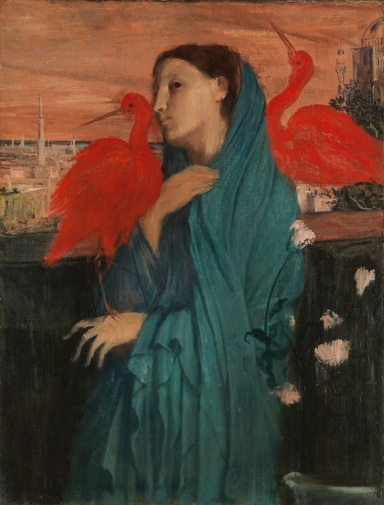
Edgar Degas (1834–1917) : Jeune femme à l’Ibis, 1857–58. Huile sur toile. The Metropolitan Museum of Art, New York, Etats-Unis. © The Metropolitan Museum of Art.

Édouard Manet (1832–1883) : Berthe Morisot étendue. 1873. Musée Marmottan Monet, Paris XVIe. Huile sur toile. Height: 26 cm (10.2 in); width: 34 cm (13.3 in). 6086 (Musée Marmottan Monet). Morisot was Manet's muse.

Manet / Degas
From 28 March to July 23rd, 2023.
    Chief Curator: Laurence des Cars, President – Director of the Louvre Museum
    Curators in Paris:
Isolde Pludermacher, Chief Curator of Painting at the Musée d'Orsay
Stéphane Guégan, Scientific Advisor to the President of the Musée d'Orsay and the Musée de l'Orangerie
    Curators in New York:
Stephan Wolohojian, John Pope-Hennessy Curator in Charge of the Department of European Paintings, The Metropolitan Museum of Arts
Ashley E. Dunn, Curator of Graphic Arts, The Metropolitan Museum of Arts

Musée d'Orsay
Esplanade Valéry Giscard d'Estaing
Esplanade du Musée d'Orsay
62 rue de la Lille
Rue de la Légion d'Honneur
7 quai Anatole France
75007 Paris

Visited on Thursday, 13 April 2023.

Musée d'Orsay : "Édouard Manet (1832–1883) and Edgar Degas (1834–1917) both played a pivotal role in the new painting of the 1860s-80s. This exhibition, which brings together the two painters in the light of their contrasts, forces us to take a new look at their real bond. It shows the heterogeneous and conflicting nature of pictorial modernity and reveals the value of Degas’ collection, in which Manet occupied a larger place after the latter’s death."

"A comparison of artists as crucial as Manet and Degas should not be limited to identifying the similarities in their respective bodies of work. Admittedly, there is no lack of analogies among these key players in the new painting of the 1860s-80s when it comes to the subjects they imposed (from horse races to café scenes, from prostitution to the tub), the genres they reinvented, the realism they opened to other formal and narrative potentialities, the market and the collectors they managed to tame, and the places (cafés, theaters) and circles, whether comprised of family (Berthe Morisot) or friends, where they crossed paths."

"Before and after the birth of Impressionism, which the exhibition looks at in a new light, what differentiated or opposed them is even more striking. From dissimilar backgrounds and with different temperaments, they did not share the same tastes in literature and music. Their divergent choices in terms of exhibitions and career cooled the budding friendship that bound them from 1873–1874 – a friendship strengthened by their shared experience of the Franco-Prussian war of 1870 and the aftermath of the Commune. The quest for recognition of the former with the stubborn refusal of the latter to use the official channels of legitimization defy comparison. While, if we consider the private sphere, once the years of youth were over, everything divided them. Manet's sociability, which was very open and soon quite brilliant, and his domestic choices were matched by Degas' secret existence and his restricted entourage."

"In Degas, Danse, Dessin, where Manet is much talked about, Paul Valéry speaks of these "marvelous coexistences" that border on dissonant chords. By bringing Manet and Degas together in the light of their contrasts, and showing how much they defined each other by differentiating themselves, this exhibition, rich with masterpieces never before brought together and an unprecedented partnership, forces us to take a new look at the ephemeral bond and lasting rivalry of two giants. The exhibition circuit also highlights the conflicting, heterogeneous and unforeseen aspects of pictorial modernity, at its point of emergence, its rise and its subsequent success. Finally, it shows the true value of Degas’ art collection, in which Manet took a more and more commanding place following his death. Death had reconciled them."

"This exhibition is organized by the Musée d'Orsay and the Musée de l'Orangerie and the Metropolitan Museum of Art, New York where it will be presented from September 2023 to January 2024.
"

AA: After having witnessed a display of one decade in the friendly rivalry between Matisse and Picasso at the Orangerie (in the Matisse in the 1930s exhibition) it is now possible to experience a full career-long comparative survey between two giants of the previous century: Éduard Manet and Edgar Degas at the Musée d'Orsay.

Manet and Degas were contemporaries, but where Manet died already in 1883, Degas survived to witness the First World War.

Both artists created severe portraits of their parental families. We must look hard to find signs of love in them. The parents seem to stare at their sons in a spirit of accusation. They seem to condemn them and find that they are wasting their lives. Degas was able to convey barely hidden family sorrow also in group portraits such as the one about the Bellille family.

Both excelled in large size classical subjects like Semiramis (Degas) or the Crucifixion (Manet) and created memorable portraits (Degas on Tissot, Manet on Zola). Both were drawn to the circle of the generous patroness of the arts Berthe Morisot and painted porraits and group portraits focusing on the wonderful hostess.

Horse races were a new trend in Paris, and both painters were greatly inspired by it. Manet caught the heat of the action in blurred vision and elongated views of racing horses. Degas explored refined colour mixes and was moved to capture tragedy on the racetrack.

Great historical events of the age included the U.S. Civil War and France's intervention into Mexico. Manet covered both in paintings of sea battles and the execution of Emperor Maximilian. Both good bourgeois painters were devastated by the Franco-Prussian War and the sémaine sanglante of the Paris Commune.

Women were an esssential subject for both. Manet was more relaxed in his visions of women, but also the more stern Degas was also able to portray interesting women from all walks of life. Degas was also capable of capturing the tragedy of sexual violence. His painting about the aftermath of a rape of an underage girl conveys a horror comparable with Dostoevsky's The Devils. Monet paid the price of his Bohemian ways: he died of syphilis.

Both Manet and Degas were called Impressionists, and both hated the title, preferring to be seen as Realists. But undeniably both created keyworks that belong to the core of Impressionism. As always, labels are for critics and historians, not interesting for artists. One of my favourite juxtapositions in the exhibition offers large size beach scenes by Manet and Degas, both with an Impressionist approach.

The magnificent exhibition is mounted downstairs at the Musée d'Orsay. I view it four times. The lighting is not always as brilliant as in the top floor where there are also several Manet and Degas masterpieces which do not belong to the double exhibition, such as "Le déjeuner sur l'herbe". For instance, "Le Tub" by Degas is not well lit. N.B. I realized later that this must be because it is a pastel, and pastels are more gently lit.

The excellent catalogue offers a lot of fascinating background information and analysis and a full catalogue of the artworks on display. It is a sign of the times that the visual quality of the reproductions is inferior.

Monday, April 10, 2023

Empire of Light


Sam Mendes: Empire of Light

Isabel Pinner (Telluride Film Festival 2022): " Sam Mendes fills his superbly cast, deeply personal drama with surprises, all emerging from a cinema in a working-class town in 1980s England. Hilary (Olivia Colman, in another knockout performance) is a single woman who runs the ticket booth, where she meets Steven (played with stirring confidence by relative newcomer Micheal Ward). Though on its surface a love story, EMPIRE OF LIGHT is not what you might expect, as Mendes sidesteps the expected nostalgia to instead follow the credo written on the cinema’s walls: “Find in light where darkness lies.” The film (which also features Colin Firth and Toby Jones) leads us through the characters’ profound struggles, both internally and with a society encountering massive cultural and economic shifts. Working again with the Oscar-winning cinematographer Roger Deakins, Mendes has created a rich, complex celebration that, at its core, reminds us how music and cinema can bring us together, even as the world drives us apart. –IP (U.K.-U.S., 2022, 119m) In person: Sam Mendes, Micheal Ward "

"Find in light where darkness lies"
- the motto of the Empire theatre

AA: Movies about the sunset of glorious picture palaces are a mini-trend in the history of the cinema. Most famous are the Italian ones by Giuseppe Tornatore (Nuovo Cinema Paradiso) and Ettore Scola (Splendor). Wim Wenders discussed the phenomenon in Im Lauf der Zeit / Kings of the Road. As a sidenote, in Risto Jarva's Onnenpeli there is an unforgettable sequence about the demolition of Finland's grandest palace cinema, Kino Palatsi.

Sam Mendes's film is original and complex. The grand Empire cinema has been built in the 1930s, the golden age of British movie palaces, when cinema was the reigning popular entertainment. It is now (in the year 1981) dilapidated externally but the spirit and the commitment of the dedicated staff are undiminished. The lives and the times are hard, and Mendes discusses the troubles honestly, but essentially Empire of Light is a celebration of the team spirit.

For cinephiles, the sequence in which the projectionist Norman (Toby Jones) shows the machine room to Stephen (Micheal Ward) is an accurate introduction to 35 mm film projection, from carrying the film print to the functioning of the carbon arcs and screening a print via switchover with double projectors.

The professionalism of the staff and the technical skill of the projectionist are there to provide the audience a night of magic. And because of that, after all the turbulences and transformations in the world of media, the cinema is still a temple of movies.

Film titles evoke the period, from Chariots of Fire to Stir Crazy (Gene Wilder / Richard Pryor). Giant marquee letters for Raging Bull are mounted. The most moving scene is the private screening of Being There for Hilary (Olivia Colman) who has never seen a film at her cinema before, being too busy in her job as duty manager. Regarding the cinema's past, the oldest reference is to Greta Garbo's The Painted Veil (1934).

A memorable motif is the pigeon with a broken wing. Stephen, whose mother Delia (Tanya Moodie) is a nurse, knows how to heal it until it is well enough to fly to freedom.

Stephen and Delia know all about racism, grown vicious in the era of Thatcher. Violent skinheads of the local National Front chapter break into the Empire and beat Stephen so brutally that it seems uncertain if he can survive.

Hilary has a medical condition. She suffers from schizophrenia but can cope with Lithium and in a way her position is a shelter job. She is excellent unless she neglects medication. She is also being abused for sexual favours by her boss Donald (Colin Firth).

Stephen and Hilary, the two colleagues with broken wings, become friends and lovers. There is cultural exchange in music: ska and two-tone from Stephen, Bob Dylan and Cat Stevens from Hilary.

Hilary is an avid reader, particularly passionate about poetry: Eliot (The Waste Land: "april is the cruellest month"), Tennyson and Auden. Her parting gift to Stephen is High Windows by Philip Larkin.

"Light is a state of mind". The excellent cinematography in glorious scope is by Roger Deakins. Seen in another way, Empire of Light might be sordid and depressing. But the beam of light transports us to a night of magic.

The most important emphasis is on the inner light, expressed in countless ways, especially in the warm solidarity of the cinema staff to the struggling protagonists, Hilary and Stephen.

Empire of Light might be one of the movies that suffer somewhat from what I call the "pandemic phlegmatic syndrome". It could be more vigorous or compelling. But after the screening, the film grows in my mind and I admire its sonority, the affinity with music and poetry.

Empire of Light was my film selection for my birthday. I saw it at Studio 28, the world's oldest art cinema, established in 1928, with interior decoration by Jean Cocteau, still going strong on Rue Tholozé at Montmartre, the 18th arrondissement of Paris. The motto:

"La salle des chefs d'oeuvres, le chef d'oeuvre des salles" (Jean Cocteau).

Saturday, April 08, 2023

Old Acquaintance


Vincent Sherman: Old Acquaintance (US 1943) avec Miriam Hopkins et Bette Davis.

L'impossible amour / Ystävättäriä / Väninnor.
Vincent Sherman / États-Unis / 1943 / 110 min / 35 mm / VOSTF
D'après la pièce Old Acquaintance de John Van Druten.
Avec Bette Davis, Miriam Hopkins, Gig Young.
La Cinémathèque française : Rétrospective Warner Bros., fabrique de stars
Séance présentée par Serge Chauvin
Salle Henri Langlois, samedi 8 avril 2023, 19h30 21h20
Kit Marlowe, romancière confirmée, fait publier le roman de son amie d'enfance Millie Drake, qui devient un best-seller. Mais Millie ne se rend pas compte que son mari se détache d'elle et tombe amoureux de Kit.

AA: The first film adaptation of John Van Druten's popular play provides an excellent role for Bette Davis in her most golden period (Jezebel, The Private Lives of Elizabeth and Essex, The Letter, The Little Foxes, Now, Voyager). This time, she is not the bitch: instead, Miriam Hopkins is cast in that role. Bette Davis as Kit is the voice of reason and sanity in contrast to Miriam Hopkins's Millie. The story is about the best friends whose closeness has been forged in childhood, and who have become rivals and competitors in work and perhaps love. Many decades are covered. The mystery remains. Kit and Millie have formed each other, which is why they are inseparable.

I also like George Cukor's remake Rich and Famous starring Jacqueline Bisset and Candice Bergen with Meg Ryan in her acting debut as Candice Bergen's daughter. Its finale opens the door to a possible novel twist about the friendship of the women.

The Little Giant


Roy Del Ruth: The Little Giant (US 1933) avec Mary Astor et Edward G. Robinson.


Le Petit géant
Roy Del Ruth / États-Unis / 1933 / 74 min / 35 mm / VOSTF
Avec Edward G. Robinson, Mary Astor.
Not released in Finland or Sweden.
La Cinémathèque française : Rétrospective Warner Bros., fabrique de stars
E-sous-titres français par Scéna Media.
Salle Henri Langlois, samedi 8 avril 2023, 17h15 18h30
À la fin de la Prohibition, un baron de la bière de Chicago cesse ses activités illicites et part pour la Californie en quête de nouvelles opportunités.

AA: The Little Giant starts with a blitz montage about the 1932 United States presidential election in which Franklin D. Roosevelt wins both in the electoral collage and the popular vote, carrying 42 states against 6. New legislation is planned, spelling the end of the prohibition.

In Chicago, gangster boss "Bugs" Ahearn (Edward G. Robinson) sees the writing on the wall and closes shop immediately. He disarms his bootleg operation and grants generous severance payments to gangsters and girlfriend.

In the AFI Catalog, The Little Giant is classified as a comedy. Funny situations emerge as the vulgar gangster reinvents himself as an upper class millionaire in Santa Barbara in sunny California and embarks on refinement. Ahearn as interpreted by Robinson never loses self-confidence although constantly exposed to ridicule.

The hardened criminal Ahearn is so dazzled by the glamour of the Cass family that he never suspects that they are even bigger criminals than he, including daughter Polly Cass (Helen Winson), who pretends to be in love with him. Ahearn's capital is swindled to the Cass family's fraudulent bond business. His eyes at last opened, he calls the old mob once more to rectify everything.

Because Ahearn has never courted a woman, he asks his real estate agent Ruth Wayburn (Mary Astor) to show him the steps to approach Polly in the "proposal racket", including how to kiss a woman. But one thing leads to another in an unexpected way, and a bond is created also by the fact that the Wayburn family has been a major victim of the Casses.

On display was a good 35 mm print.

D’ici à l’infini / From Here to Infinity (Galerie Marian Goodman, 2023)


D’ici à l’infini / From Here to Infinity. Giovanni Anselmo, Lothar Baumgarten, Marisa Merz, Ettore Spalletti. At Galerie Marian Goodman, 79 Rue du Temple, Paris 3.

D’ici à l’infini / From Here to Infinity
Giovanni Anselmo, Lothar Baumgarten, Marisa Merz, Ettore Spalletti
Galerie Marian Goodman | 10 March – 29 April 2023
79 Rue du Temple, 75003 Paris
Visited on Saturday, 8 April 2023.

Official introduction: "Marian Goodman Gallery is pleased to present D’ici à l’infini (From Here to Infinity) a group show that brings together four major European artists for the first time: Giovanni Anselmo, Lothar Baumgarten, Marisa Merz and Ettore Spalletti. Through their respective oeuvre, they all defied the formal conventions of visual arts and developed a profound and conceptual practice focused on our relationship with nature and the universe. The works in the show - in wood, paper, granite, earth, clay, impasto, alabaster - not only convey a sense of tangible reality, a hic et nunc presence, but they also instill a sense of boundless time and space. They exist as a coherent reality, independent of reality itself, allowing viewers to mentally project themselves beyond the exhibition space."

Giovanni Anselmo: Il sentiero verso oltremare, 1992-2023. Ultramarine blue, earth. Dimensions variable.

"Giovanni Anselmo's notable interest in the force of gravity and energy of the Earth, in our connection with the cosmos, dates back to an August day in 1965 when, after climbing to the top of Mount Stromboli, he had a searing observation of his own shadow projected towards ‘infinity.’ This seminal experience has infused his practice to this day. Il sentiero verso oltremare (1992-2023) consists of a path of earth traced on the floor that connects two vertical stripes of ultramarine paint applied on two opposing walls. The blue pigment, originally sourced from imported lapis lazuli, signifies a window to a distant horizon."

"In keeping with his practice of associating several old pieces, Giovanni Anselmo creates a new proposal by linking the path to one of his emblematic works, Direzione (1967-2023). Consisting of a compass embedded in a block of granite, it indicates with precision the direction of the Earth's magnetic North Pole. While one of the projections of Particolare (1972-2023) is oriented directly to the granite block, the other is pointed in another direction within the space, becoming visible only on furtive contact with a body or an object. The notions of visibility and infinitude are further investigated in Particolare del lato in alto della prima I di Infinito 25.04.75 (1975), a series of graphite drawings on paper which reveal only a ‘visible and measurable detail’ of the concept of infinity, in the form of the letter i."

Lothar Baumgarten: Kosmos, 1969. Hazelnut wood branches, Atlas map, paper. Branches: 138 x 19 x 22 in. (350.5 x 48.3 x 55.9 cm). Bird: 12 x 13 in. (30.5 x 33 cm). Overall dimensions variable. Edition of 4 (10673).

"In his multidisciplinary practice, Lothar Baumgarten referred to different systems of thought and representations, focusing on non-Western cosmogonies and cultures. Created prior to his initiatory journey to South America which involved an eighteen-month stay with the Yanõmami indigenous community in southern Venezuela, the early work Kosmos (1969) is composed of hazelnut wood branches and a figure of a bird in paper wrapped in a map of the constellations. Echoing his iconic film Origin of the Night (Amazon Cosmos), (1973-1977) which references the myth of the origin of the night for the Tupi people, the 1969 work links terrestrial ecosystems to the immensity of space. Like his photographs from the series Culture-Nature (Manipulated Reality) (1968-72) as well as his ephemeral sculptural interventions all conceived at the same time in the Rhineland, Kosmos transports us by thought, momentarily, elsewhere."

Marisa Merz: Cielo e Terra, 2005. Spray paint and pastel on Japanese paper, white clay, aluminum. Frame: 70 7/8 x 56 1/4 x 1 5/8 in. (180 x 143 x 4 cm). Sculpture: 6 7/8 x 4 1/8 x 4 7/8 in. (17.5 x 10.5 x 12.5 cm).

"Considering forms as fluid and fragile, Marisa Merz would reshape her earlier works in varying arrangements based on the exhibition space by employing humble materials and non-traditional techniques. The correlation between natural materials and the idea of infinity is also significant in her work, through the representation of human forms that lie between abstraction and figuration. A prominent example is Cielo e Terra (2005), where the artist juxtaposed a large drawing with spray paint and pastel on Japanese paper and a small clay sculpture placed on a tall tripod, as is Untitled (2004), a drawing with graphite, spray paint and gold pigment on paper. These feminine and enigmatic forms inhabit Merz’s work like spiritual or ghostly figures, seeming to float through time and space, and relying, in turn, on the imagination of the viewers to detach them from reality."

Ettore Spalletti: Così com'è, luna, 2018. 2 elements; color impasto on board, gold leaf. Square: 39 3/8 x 39 3/8 x 1 5/8 in. (100 x 100 x 4 cm). Diameter: 46 7/8 x 1 5/8 in. (119 x 4 cm). Overall: 46 7/8 x 89 3/4 x 1 5/8 in. (119 x 228 x 4 cm).

"Acclaimed for his subtle exploration of color and light, Ettore Spalletti has founded a minimal aesthetic through pictorial or sculptural works, which, when presented simultaneously, often form an immersive installation. The monochrome works Così com'è, luna (2018) and Senza titolo, (grigio chiaro) (2019) result from the unchanging process initiated by the artist in the early 1970s – the meticulous application of multiple layers of impasto at the same time of each day over the course of weeks. Like all his work, they are inspired by the landscapes of Abruzzo, the region on the Adriatic coast of Italy where the artist has lived and worked all his life. Each color recalls a specific element of the natural panorama that surrounded the artist. Whether set in alabaster in Scatola di colore (1991) or applied on wooden panels in Così com'è, luna, the colored material encloses space and time. But what is to be contemplated is not so much this materiality as the spirituality infused into the work."

Friday, April 07, 2023

One Way Passage


Tay Garnett: One Way Passage (US 1932) avec Frank McHugh, William Powell et Kay Francis.

Voyage sans retour / Swedish title: Hongkong - San Francisco.
Tay Garnett / États-Unis / 1932 / 67 min / 35 mm / VOSTF
Avec William Powell, Kay Francis, Frank McHugh.
Not released in Finland.
La Cinémathèque française : Rétrospective Warner Bros., fabrique de stars
E-sous-titres français par Scéna Media.
Salle Henri Langlois, vendredi 7 avril 2023, 20h15 21h25
Dan et Joan tombent amoureux lors d'une traversée du Pacifique. Mais ils savent que leur histoire est sans lendemain, car Joan est gravement malade tandis que Dan est un criminel recherché par la police et promis à la peine de mort.

AA: La Cinémathèque française launches a Warner Bros. Centenary tribute, and I start following it with Tay Garnett's powerful and compact pre-Code tale about the voyage of a terminally ill woman (Kay Francis) and a death row prisoner (William Powell) from Hong Kong to San Francisco. I remember One Way Passage as a favourite of my friend Kari Lempinen. Although the story is full of witty incidents and dialogue, there is also time for reflection. The underlying feeling of agony is genuine, and the performances of debonair stars are deeply moving. Especially Kay Francis is at her career best here. The lovers' signature gesture at turning-points is to have a toast and then break the glasses. The final image at their planned next point of encounter, Agua Caliente, is of two broken glasses, but nobody is there. It evokes the finale of Antonioni's L'eclisse. A 35 mm print, heavily used, with joins, out of synch moments, yet radiating a true raw photochemical energy.

Decameron Nights


Hugo Fregonese: Decameron Nights (GB 1954) avec Joan Fontaine.

Pages galantes de Boccace / Decameronen lemmenöitä / Lustans lön.
Hugo Fregonese / Grande-Bretagne / 1954 / 84 min / DCP / VOSTF
Avec Joan Fontaine, Louis Jourdan, Godfrey Tearle, Joan Collins.
La Cinémathèque française : Rétrospective Hugo Fregonese
Digital reproduction from a 35 mm print in the Martin Scorsese collection at George Eastman Museum.
E-sous-titres français.
Salle Georges Franju, vendredi 7 avril 2023, 17h00 18h25
Au XIVe siècle, l'écrivain Giovanni Boccaccio est à la recherche de son grand amour, la veuve Fiametta. Il est invité dans la demeure de la comtesse de Florence, où réside Fiametta, et invente pour la séduire des histoires délicieusement immorales.

AA: Joan Fontaine and Louis Jourdan, the stars of Letter from an Unknown Woman, are reunited in an omnibus film inspired by the life and stories of Giovanni Boccaccio. There is a framing story about Boccaccio (Jourdan) courting the recently widowed Fiametta (Fontaine) and three stories, all about virtue in marriage. Beautifully shot in Spain and Florence, the fairy-tale ambience and the evocation of the period are enchanting. As usual (even in the Pasolini Il Decameron), mostly the frivolous surface of Boccaccio is rendered, and the poetry and the gravity in the shadow of death is ignored. Like in Mark of the Renegade, Hugo Fregonese expands his scope, but does not have quite the talent required for such un jeu d'esprit. A valuable digital reproduction of Martin Scorsese's Technicolor print, in general conveying a lush sense of colour essential for the cinematographer Guy Green's vision. It is illuminating to observe the soft and blurry image, not always in good definition, issues inherent in Technicolor.

Thursday, April 06, 2023

À mon seul désir / My Sole Desire


Lucie Borleteau: À mon seul désir / My Sole Desire (FR 2023) avec Zita Hanrot (Mia) and Louise Chevillotte (Aurore).

Artist: anonymous: À mon seul désir (La Dame à la licorne: La sixième tapisserie). Date: between 1484 and 1500. Medium: tapestry. Height: 377 cm (12.3 ft); width: 473 cm (15.5 ft). Collection: Musée de Cluny, Musée national du Moyen Âge, Paris. Accession number: Cl. 10834 (Musée de Cluny).

FR © 2022 Aspara Films. Année de production 2022, année de sortie 2023 | 1H57 | DCP | 5.1 | SCOPE | COULEUR
    Un long-métrage de Lucie Borleteau. Produit par Aspara Films. Lucie Borleteau: À mon seul désir (2022), Les Vies rêvées (2021), Ils sont vivants (2020).
    Genre : Drame romantique / Langue de tournage : français / Nationalité : 100% français / Numéro de visa : 151.930 / Interdiction : moins de 12 ans.

Direction de production Dimitri LYKAVIERIS
Régie Armel ADOU KOUASSI
Direction de postproduction Victoire BOISSONT-FERTÉ
Production Marine ARRIGHI DE CASANOVA (ASPARA FILMS)
Avec le soutien du CENTRE NATIONAL DU CINÉMA ET DE L’IMAGE ANIMÉE
En association avec PYRAMIDE,
Avec la participation de CANAL + & CINÉ +
Avec le soutien d’ARTE COFINOVA
Avec le soutien de LA PROCIREP
Distribution France et ventes internationales PYRAMIDE

LISTE TECHNIQUE:
Réalisation Lucie BORLETEAU
Scénario Lucie BORLETEAU & Clara BOURREAU avec la collaboration de Laure GIAPPICONI
Directeur de la photo Alexis KAVYRCHINE
Montage Clémence DIARD
Décors Aurélien MAILLÉ
Costumes Alexia CRISP JONES
1er assistant mise en scène Hadrien BICHET
Casting Colia VRANICI
Superviseur musical Frederic JUNQUA
Musique originale Pierre DESPRATS
Chansons originales Rebeka WARRIOR
Ingénieure du son Marie-Clotilde CHÉRY
Montage son Sarah LELU
Mixage Edouard MORIN
Electricité Mariore MANNEVILLE
Machinerie Bruno MARTIN
Étalonnage Yov MOOR

LISTE ARTISTIQUE:
Zita Hanrot : Mia
Louise Chevillotte : Aurore
Laure Giappiconi : Elody
Pascal Casablanc : Pablo
Sieme Miladi : Savannah
Yuliya Abiss : Sati
Tokou Bogui : Candy
Céline Fuhrer : Vergine
Thimotée Robart : Benjamin
Melvil Poupaud

Durée : 1 h 59 min
Sortie de festival: 12 décembre 2022 (Les Arcs Film Festival)
Sortie en France : 5 avril 2023 (en salles)
Viewed at Gaumont Montparnos 20, 16 rue d'Odessa, Paris le 14e, 6 April 2023

Official synopsis: "Vous n’êtes jamais entrés dans un club de strip-tease n’est-ce pas ? Mais vous en avez déjà eu envie ... au moins une fois... vous n’avez pas osé, c’est tout. Ce film raconte l'histoire de quelqu'un qui a osé."

Wikipédia: La Dame à la licorne: "Cinq de ces représentations forment une allégorie des cinq sens, symbolisés par l'occupation à laquelle se livre la Dame :

    Le touché : la dame tient la corne de la licorne dans sa main ainsi que le mât d'un étendard.
    Le goût : la dame prend ce qui pourrait être une dragée d'une coupe que lui tend sa servante, et l'offre à un oiseau ;
    L'odorat : pendant que la dame fabrique une couronne de fleurs, un singe respire le parfum d'une fleur, dont il s'est emparé ;
    L'ouïe : la dame joue d'un petit orgue ;
    La vue : la licorne se contemple dans un miroir tenu par la dame ;

La sixième tapisserie, celle du sixième sens, ne s'interprète que par déduction de l'hypothèse des cinq sens. On peut y lire, encadrée des initiales A et I, la devise « Mon seul désir » au haut d'une tente bleue.

On peut rapprocher ces six tapisseries d'un poème de François Villon, Louange à la Cour ou requête à la Cour de Parlement, qui développe le thème des cinq sens en y ajoutant le cœur, qui serait d'après Jean Gerson un sixième sens, siège des passions et du désir, de l'âme, de la vie morale et du libre arbitre. Dans un poème daté de 1501, Olivier de La Marche écrit à la princesse Éléonore de Habsbourg, de renoncer aux plaisirs de ses sens et d'ouvrir son cœur afin qu'il « soit riche d'aulmosnes généreuses ».

Dans cette sixième tapisserie, la dame se défait du collier qu'elle portait dans les autres tapisseries. À l'inverse de tentures comme celle de la Chasse à la licorne du musée des Cloisters de New York, la licorne, symbole de pureté, ne semble jouer qu'un rôle annexe dans cette tapisserie. On notera aussi un article d’Alain Erlande-Brandenburg, écrit en 1977, où il émet l'hypothèse que la sixième tapisserie pourrait symboliser le renoncement aux sens. Jean Pierre Jourdan a aussi réalisé une étude, qui se base sur le pré-humanisme italien, de Marsile Ficin, optant pour une approche intellectuelle. Pour Jean-Patrice Boudet, cette tapisserie serait une allégorie du cœur, sixième sens, poussant la Dame à la charité chrétienne, revenant ainsi aux dires de Jean Gerson qui introduit la notion de « cœur », mais de manière plus moraliste : « comme d’un sixième sens qui mène les autres et fait la danse » . L'historien de l'art britannique Michael Camille relève que la dame de cette dernière tapisserie est la seule a avoir les cheveux courts, sans doute parce qu'elle a fait don de cheveux à son amant, comme dans de nombreuses sources littéraires.

Œuvre d'art par essence sans signification univoque, le système de la composition donne lieu à toutes sortes d'interprétations de la part de poètes comme d'historiens de l'art.

Parmi ces derniers, Marie-Élisabeth Bruel, propose de lire dans les six tentures, identifiées depuis 1921 comme une allégorie des cinq sens et du désir, les six Vertus allégoriques courtoises que Guillaume de Lorris présente dans son Roman de la Rose. La référence aux sens ne serait qu'accessoire. Les Vertus apparaissent successivement au héros du roman comme autant de femmes au cours du voyage initiatique qu'elles lui font poursuivre :

    Oiseuse, c'est-à-dire l'apparence superficielle, pour la Vue,
    Richesse, c'est-à-dire une forme brutale d'avidité, pour le Toucher,
    Franchise, c'est-à-dire une sensation directe et sans tromperie, pour le Goût,
    Liesse, c'est-à-dire une élévation de l'âme, pour l'Ouïe,
    Beauté, c'est-à-dire un ravissement de l'âme vers l'harmonie, pour l'Odorat.
    Largesse, c'est-à-dire la générosité, vertu suprême, pour "A Mon seul désir".

D'autres rapprochements ont été proposés avec d'autres œuvres littéraires postérieures et moins célèbres, et même avec des thèmes alchimiques.

Quelle que soit l'interprétation, et donc l'ordre des tentures, c'est une conception aristotélicienne d'élévation de l'âme par les sens, c'est-à-dire de subsomption des tendances animales ('επιθυμία) en un désir raisonné propre aux humains (βούλησις), qui est illustrée. Cependant, en mettant en scène le désir féminin, et en le présentant en position de charmer, La Dame à la licorne exprime une condition féminine moins aristocratique, plus bourgeoise, qui n'est plus celle du XIIIe siècle et du Roman de la Rose mais préfigure les précieuses et leur carte de Tendre.
"

AA: My Sole Desire is the name of a little strip-tease cabaret located in the 6th arrondissement of Paris.

The opening image, Gaumont's daisy / Marguerite logo, evokes to me Brigitte Bardot's En effeuillant la marguerite / Plucking the Daisy. Strip-tease in French is "effeuillage".

Aurore (Louise Chevillotte) steps inside the cabaret and is fascinated, even aroused, by the spectacle, especially by the magnetic Mia (Zita Hanrod). The film tells about Aurore's journey to the underworld, the forbidden realm of taboos. She breaks even her own boundaries.

Me Too and the male gaze have been discussed for five years. I guess that no man would now risk making a movie about strip-tease. But when a woman makes such a film it is different and original. In the press dossier, Lucie Borleteau calls it a "paradigm shift".

Based on first hand observation, Borleteau discovers a world of erotic spectacle in which the performers are not victims but in charge. They are not competitors but companions, in a spirit of sisterhood.

The gaze is reversed. The strip-tease dancers are the queens of the gaze, and the male voyeurs are seen exposed, in their full variety from timid boys of the backroom to bachelor night revellers.

In Lucie Borleteau's vision, My Sole Desire grows into a celebration of femininity: the energy, the joy, the fun and the grace of the female life force as God intended. As a strip-tease show, it delivers a full and satisfying evening of entertainment in the company of gorgeous women. It is different from the norm, from clichés, from Moulin Rouge idioms and Las Vegas pole dancing. It is original, playful, humoristic, eccentric, foolish, contemporary and irresistible.

The film is a celebration of bonding, friendship and love among women. Starting as colleagues and partners, Mia and Aurora turn into lovers.

A special feature in My Sole Desire is that having become a strip-tease dancer, Aurore starts to see everybody on the streets undressed, conveyed by charming special effects.

My Sole Desire evokes predecessors. Lorene Scafaria's The Hustlers (US 2019) with Constance Wu and Jennifer Lopez. Paul Verhoeven's Showgirls (US 1995) with Elizabeth Berkley and Gina Gershon. Mathieu Amalric's Tournée (FR 2010), a tour de France with American burlesque queens, with Amalric himself as the impresario.

As a tale about female companionship in sex work, I'm thinking about Max Ophuls's La Maison Tellier and Kenji Mizoguchi's Akasen chitai. Even in such a company, Lucie Borleteau stands up well. She creates a vivid sense of a community of performers from various backgrounds, ages and diversities. And a clientele from all walks of life. Stereotypes are overcome. Everybody is an individual.

Prostitution in France is officially forbidden, but as a private agreement it exists. The dancers are warned against it, but the newcomer Aurore, of all people, crosses the line and explores it. Strippers do private sessions which are monitored, but only within limits. Mia is disgusted when she learns about Aurore's transgression, but Borleteau's view is neutral and matter-of-fact.

The overall impression is amazingly sunny without being naive. We witness transgression attempts. We learn about harassment and abuse.

The erotic shows are real and revealing, mounted in an atmosphere of trust and safety, obeying the rules and regulations of CNC sensitivity training. The fair trade ambience enhances the experience.

The title My Sole Desire derives from a medieval series of tapestries on display in the Cluny Museum near Sorbonne. It is a fascinating artwork about the six senses and the six virtues. In the center is the Woman with the Unicorn, and the unicorn emblem is visible also on the wall outside the cabaret. We are left pondering its multiple meanings.

MATERIALS FROM THE DOSSIER DE PRESSE:

Tuesday, April 04, 2023

Gustave Caillebotte (Musée d'Orsay)


Gustave Caillebotte, Raboteurs de parquet, en 1875, huile sur toile, H. 102,0 ; L. 147,0 cm. , Don, 1984, © RMN-Grand Palais (Musée d’Orsay)/Hervé Lewandowski. Niveau supérieur, Salle 30. Gustave Caillebotte (1848 - 1894).
    "This painting is one of the first representations of urban proletariat. Whereas peasants (Gleaners by Millet) or country workers (Stone Breakers by Courbet) had often been shown, city workers had seldom been painted. Unlike Courbet or Millet, Caillebotte does not incorporate any social, moralising or political message in his work. His thorough documentary study (gestures, tools, accessories) justifies his position among the most accomplished realists."
    "Caillebotte had undergone a completely academic training, studying with Bonnat. The perspective, accentuated by the high angle shot and the alignment of floorboards complies with tradition. The artist drew one by one all the parts of his painting, according to the academic method, before reporting them using the square method on the canvas. The nude torsos of the planers are those of heroes of Antiquity, it would be unimaginable for Parisian workers of those times. But far from closeting himself in academic exercises, Caillebotte exploited their rigour in order to explore the contemporary universe in a completely new way."
    "Caillebotte presented his painting at the 1875 Salon. The Jury, no doubt shocked by its crude realism, rejected it (some critics talked of "vulgar subject matter"). The young painter then decided to join the impressionists and presented his painting at the second exhibition of the group in 1876, where Degas exhibited his first Ironers. Critics were struck by this great modern tableau, Zola, in particular, although he condemned this "painting that is so accurate that it makes it bourgeois"."
    Photo and data: Musée d'Orsay. Please click on the image to enlarge it.

Gustave Caillebotte, Vue de toits (Effet de neige), en 1878, huile sur toile, H. 64,5 ; L. 81,0 cm. , Don Martial Caillebotte, 1894, © RMN-Grand Palais (Musée d’Orsay) / Franck Raux. Niveau supérieur, Salle 32. Gustave Caillebotte (1848 - 1894).
    "At the fourth Impressionist Exhibition in 1879, Caillebotte presented over twenty-five works. These included two roofscapes of which this is one. The large number of paintings he submitted is a measure of Caillebotte's enthusiasm. He had joined the ranks of the Impressionists in 1876, and became one of the most active members of the group, not only as a painter but also as a patron, thanks to his considerable personal fortune."
    "Unlike his scenes of boating enthusiasts and portraits, also exhibited in 1879, his roofscapes provoked little comment at the time. However, they form an important link in the series of urban paintings for which Caillebotte is so popular today. In each of these paintings, whether street scenes of Haussmann's Paris or plunging perspectives painted from his balcony, he invites us to share his unusual view over the city. Besides, his Roofscape had few direct precedents other than in photography, although it is not certain that this was a source for the painter."
    "This painting, an eminently "modern" urban landscape, wonderfully describes the atmosphere of a winter's day in Paris. The heavy sky bathes the snow-covered roofs in grey, brightened with a few notes of soft pink. By thus turning his attention to the effect of the seasons on light and landscape, Caillebotte joined his Impressionist friends Monet, Sisley and Pissarro."
    "Given to the French National Museum by the artist's brother at the same time as the famous Floor Planers, Roofscape is one of the rare paintings by Caillebotte known to the public for a long time, the main part of his oeuvre having stayed in his family for several decades."
    Photo and data: Musée d'Orsay. Please click on the photo to enlarge it.

Gustave Caillebotte, Partie de bateau, vers 1877-1878, huile sur toile, sans cadre H. 89,5 ; L. 116,7 cm avec cadre H. 122 ; L. 149 ; EP. 11,5 cm, Achat grâce au mécénat exclusif de LVMH, Grand Mécène de l’établissement, 2022, © Musée d’Orsay, Dist. RMN-Grand Palais / Sophie Crépy. Niveau supérieur, Salle 30. Gustave Caillebotte (1848 - 1894).
    "Partie de bateau, chef-d’œuvre de Gustave Caillebotte et « icône » de l’impressionnisme encore en main privée, avait fait l’objet d’un classement au titre de « trésor national » le 30 janvier 2020. Grâce à l’exceptionnel mécénat de LVMH, l’œuvre vient de rejoindre les collections nationales. "
    "Ce tableau est exemplaire de la volonté de Caillebotte de produire un art véritablement moderne, exprimant un regard neuf sur le monde."
    "L’artiste choisit comme sujet les nouveaux loisirs de la bourgeoisie urbaine, dont il fait partie. Un homme, dont on ne connaît pas l’identité, fait de la barque sur l’Yerres, la rivière qui coule près de la propriété de villégiature des Caillebotte au sud-est de paris. Le peintre propose un cadrage « immersif » original qui place le spectateur dans la barque et cherche à abolir la distance entre l’espace du tableau et celui du regardeur."
    "Se dégagent de la composition – centrée sur cet homme qui nous fait face mais détourne le regard – une énergie, un sentiment d’assurance, mais aussi de solitude, caractéristiques de l’œuvre de Caillebotte. La touche esquissée et la gamme de tons bleutés évoquent la peinture de plein air, qui séduit de plus en plus l’artiste à cette époque."
    "Partie de bateau fait partie des tableaux envoyés par Caillebotte à la 4e exposition du groupe impressionniste en 1879. La nouveauté du point de vue, alliée à la banalité du sujet, choque les critiques même les plus avancés, et fait dire à certains que le jeune peintre est un provocateur, que ses peintures ne sont pas du grand art mais une simple « photographie de la réalité » (Emile Zola). A cette date, Caillebotte apparaît comme l’artiste le plus radical du mouvement. "
    Photo and data: Musée d'Orsay. Please click on the photo to enlarge it.

Gustave Caillebotte, Les Soleils, jardin du Petit Gennevilliers, vers 1885, huile sur toile, sans cadre H. 130,5 ; L. 105,8 cm avec cadre H. 158,8 ; L. 133,5 ; EP. 4 cm, © Musée d’Orsay, dist. RMN-Grand Palais / Sophie Crépy. Niveau supérieur, Salle 31. Gustave Caillebotte (1848 - 1894).
    2022, accepté par l'Etat à titre de dation pour l'établissement public du musée d'Orsay et de l'Orangerie-Valéry Giscard d'Estaing (conseil artistique des Musées nationaux du 08/12/2021, commission des dations du 13/12/2021, arrêté d'affectation du 22/07/2022).
    "Par sa taille, cette vue du jardin de Caillebotte est une des plus ambitieuses peintes par l’artiste. Elle participe à la redéfinition du genre du paysage opérée par les impressionnistes."
    "Le jardin est un des thèmes de prédilection de Caillebotte, qui prend d’abord pour sujet le parc de la propriété familiale de Yerres, puis, comme ici, son jardin au Petit Gennevilliers, situé à une dizaine de kilomètres de Paris. L’artiste devient un véritable « peintre-jardinier » comme son ami Monet à Giverny et tous deux s’enthousiasment pour les « soleils », grands tournesols cultivés uniquement comme plante d’ornement à cette date."
    "Pour Caillebotte, le rôle de l’artiste – comme celui du jardinier – est tout autant de magnifier que de soumettre la nature à sa volonté. Dans cette composition très structurée, l’épanouissement de la végétation est cantonné à la partie basse du tableau et s’oppose à la solide géométrie des architectures. Le choix d’un étonnant format vertical, et l’écrasement des plans provoqué par la juxtaposition du proche et du lointain, sont peut-être inspirés par l’exemple de l’estampe japonaise et par la photographie. En coupant brutalement les fleurs et maisons sur les bords, le peintre nous fait aussi comprendre qu’il ne s’agit que d’un fragment d’une réalité qui se poursuit au-delà du cadre. Caillebotte semble souscrire à la formule d’Émile Zola ; « l’œuvre d’art est un coin de nature vu à travers un tempérament ». "
    Photo and data: Musée d'Orsay. Please click on the photo to enlarge it.

Gustave Caillebotte, Henri Cordier, en 1883, huile sur toile, H. 65,0 ; L. 81,5 cm. , Don Mme Henri Cordier, 1926, © Musée d’Orsay, Dist. RMN-Grand Palais / Patrice Schmidt. Niveau supérieur, Salle 32. Gustave Caillebotte (1848 - 1894).
    "One of the most delightful aspects of Caillebotte's work is the series of portraits of personalities from his wealthy entourage. The identity of many of these has been lost today, but not so Henri Cordier (1849-1925), a specialist on Chinese affairs, and Professor of history, geography and the legal systems of the countries of the Far East at the School of Oriental Languages in Paris."
    "Cordier lived in China from 1869 to 1876. He edited a bibliography of works on the Chinese Empire, his Biblioteca Sinica published between 1878 and 1895, and was one of the founders, in 1882, of the Revue d'Extrême-Orient. The Great Encyclopaedia also tells us that he was awarded a third class grade in Mandarin Chinese."
    "We do not know how Caillebotte and Cordier came to meet, but they were certainly friends, although the artist never accepted commissions for portraits as he did not need to sell his paintings to live. Here, Caillebotte chooses to focus on Cordier's intellectual side. He is represented deep in concentration, surrounded by books, busy writing in an ill-defined position. The unusual composition, cropping the figure in half and combining it with decorative elements to fill the space, is very typical of Caillebotte's experimental work. In this respect he shows himself to be close to Degas."
    "The textural effects and palette of purplish reflections are found in other works painted by Caillebotte during this period."
    Photo and data: Musée d'Orsay. Please click on the photo to enlarge it.

AA: Visiting Musée d'Orsay I discover for the first time Gustave Caillebotte. Until now I have failed to register this major artist who was an interlocutor between realism and impressionism, important in several currents of art, but with a different vision beyond isms. Isms are of course terms for critics and historians, less relevant or meaningless for artists.

First I pay attention to the striking composition. There is a sense of dynamic energy in Caillebotte's frames. Bold high or low angle shots of cityscapes and interiors remind me of Fritz Lang and Kenji Mizoguchi. Perspectives can be daring. Caillebotte invites us to see in a new way.

Many of Caillebotte's paintings have remained in private collections. Last year, in 2022, Musée d'Orsay received as donations two major rural outdoors paintings, Partie de bateau and Les Soleils, jardin du Petit Gennevilliers, now prominently on display.

I read from the museum's notes that The Floor Planers is a pioneering portrait of the urban proletariat, in the same spirit as Courbet and Millet painted rural working people, which I also revisited today. The Floor Planers is a powerful tribute by the grand bourgeois artist to the nobility of the worker, four years after the Paris Commune. Cailleboutte elevates his subjects even more than his realist predecessors in making them look like Olympian heroes of the Antiquity.

Looking at the planers' gorgeous nude upper torsos I have a fleeting association to Ricardo Montalbán (an object of gay dreams who was straight) whom I saw in Mark of the Renegade on Sunday. Other paintings seem to confirm an intuition about a possible vein in Caillebotte's difference.

Caillebotte had a wide register of approaches, techniques and styles at his disposal, but there was a firm core, an inner vision, a unity in his works. His parcours remained short - he died at age 45 - but he was active during a golden age of French art, active in its currents both as an artist and as a visionary collector and patron of his fellow artists in a phase when they struggled for recognition.

There are prophetic accents in Caillebotte's works that predate later developments, such as the scuola metafisica and surrealism. In the passion for sometimes almost photorealistic painting there is a subtle touch of the uncanny.

...
I viewed seven paintings of Caillebotte (at the Niveau supérieur):
1. Vue de toits (1878) Salle 32
2. Henri Cordier (1883) Salle 32
3. Arbre en fleurs (1882) Salle 32
4. Les Soleils (vers 1885) (new acquisition 2022) Salle 31
5. Raboteurs de parquet (1875) Salle 30
6. Partie de bateau (vers 1877-1878) (new acquisition 2022: Trésor National) Salle 30
7. Voiliers à Argenteuil (1888) Salle 30

Maximilien Luce: Paris en mai 1871 (painting at Musée d'Orsay)


Maximilien Luce, Une rue de Paris en mai 1871, entre 1903 et 1905, huile sur toile, H. 151,0 ; L. 225,8 cm. , Don Frédéric Luce, fils de Maximilien Luce 1946, © Musée d'Orsay / Sophie Crépy. Maximilien Luce (1858 - 1941). Niveau supérieur, Salle 37. Please click on the image to enlarge it.
    "L'histoire sociale et politique trouve aussi sa place dans la peinture. Maximilien Luce rend compte ici de la fin sanglante de la Commune de Paris."
    "Durant la guerre de 1870, Paris assiégée connaît une terrible famine. Mais la capitulation et la proclamation de l’état allemand dans la galerie des glaces de Versailles le 18 janvier 1871 sont vécus comme une humiliation. Conscient de ces tensions, le nouveau gouvernement de Thiers essaie de reprendre les canons installés dans les quartiers populaires de Montmartre et Belleville. Cette décision déclenche le soulèvement et l’élection d’un Conseil de la commune, constitué d’artisans, d’ouvriers et de membres de la petite et moyenne bourgeoisie. La Commune dure de mars à mai 1871."
    "Réfugié à Versailles, le gouvernement de Thiers revient à Paris avec l’armée. La répression est Terrible. Du 21 au 28 mai, les derniers insurgés sont fusillés lors de la « semaine sanglante »."
    "Cette répression a toutefois l'appui des élus républicains de l'Assemblée nationale, qui pour préserver la République, encore fragile, donneront leur accord à Thiers. La plupart des écrivains, dont Zola, se montreront aussi hostiles à la Commune." Text: Bibliothèque nationale de France.

AA: The last painting in the extraordinary section of De l'impressionnisme au néo-impressionnisme is Maximilien Luce's Une rue de Paris en mai 1871, a memorial to the Paris Commune. The following space at the museum is the magnificent Café Campana hall with one of the Musée d'Orsay clocks - the one with the view on the Sacré Coeur de Montmartre, another memorial to the Commune.

Maximilien Luce, one of the great neoimpressionists, kept evolving in his approaches and styles, interested in a wide range of subjects. Like Gustave Caillebotte in Raboteurs de parquet, Luce followed Courbet and Millet in an important current of his work, devoted to the working class. Politically, he was an anarchist socialist. Luce opposed Vichy laws discriminating Jewish artists.

During the Commune, Luce was a 13 year old art school student attending a course on drawing. He participated in the repression of the Communards and was marked for life by the experience.

Sunday, April 02, 2023

Mark of the Renegade


Hugo Fregonese: Mark of the Renegade (US 1951). Lobby card.

Hugo Fregonese: Mark of the Renegade (US 1951). Ricardo Montalbán and Cyd Charisse dance the flamenco.

Hugo Fregonese: Mark of the Renegade (US 1951). Ricardo Montalbán and Cyd Charisse.

Hugo Fregonese: Mark of the Renegade (US 1951) avec Cyd Charisse et Ricardo Montalbán.

Le Signe des renégats / Luopion merkki / Blixtrandre klingor
Hugo Fregonese / États-Unis / 1951 / 81 min / 35 mm / VOSTF
Avec Ricardo Montalbán, Cyd Charisse, J. Carrol Naish.
La Cinémathèque française : Rétrospective Hugo Fregonese
Salle Henri Langlois, dimanche 2 avril 2023, 17h00 18h25
This movie was not included in Bologna's 2022 Hugo Fregonese retrospective.

La Cinémathèque française : "En 1825, lors de l'avènement de la République du Mexique, Marcos Zappa est victime d'un odieux chantage au terme d'un exil forcé de plusieurs années. En échange du silence de Don Pedro García sur son passé, il doit séduire la belle Manuela de Vásquez et l'épouser pour mieux porter le discrédit sur son père."

"Vingt ans avant La Planète des singes et L'Île fantastique, qui le rendront célèbre, le sémillant Ricardo Montalbán pastiche Zorro dans ce film d'aventure exotique. Tantôt western, comédie musicale, film de pirates et de cape et d'épée, Le Signe des renégats vaut aussi pour son Technicolor flamboyant et le numéro imparable de Cyd Charisse.
"

AA: Thom Andersen's cinematic essay Los Angeles Plays Itself (US 2003) is a compilation of 215 films about the City of Angels, but Mark of the Renegade is not included. I cannot recall a film covering an earlier period of L.A. history than this one, set in the year 1825, ten years before Los Angeles got city status. Pueblo de los Ángeles (El Pueblo de Nuestra Señora la Reina de los Ángeles) had been founded in 1781 as a Spanish town. The presidio, the mission and the pueblo appear in Hugo Fregonese's film, which is set in the Mexican period (1821–1846) of California.

That period is best known in popular culture from the adventures of Zorro. The mysterious character had been created by Johnston McCulley in his story The Curse of Capistrano (1919) and promptly adapted as a grand adventure movie by Douglas Fairbanks in The Mark of Zorro (1920). The masked avenger leading a double life as an effete aristocrat and a dashing hero was pathbreaking in popular culture in many ways.

Mark of the Renegade is also based on a story by the prolific McCulley. The protagonist this time is a double agent called Marcos Zappa whose forehead has been branded the with letter R, for Renegade. Even the audience is not let in the secret of his existence until the finale. Mark of the Renegade is a pirate film, a swashbuckler and a romantic adventure story.

Ricardo Montalbán is well cast and gets to display his magnificent nude upper torso as the mysterious emissary.

Hugo Fregonese excels in action and adventure scenes and in the spectacular fiesta sequence. But I was thinking that George Sidney and Vincente Minnelli would have brought even more panache into this tale of make-believe and shifting identities. There is something forced at times in the merry-making.

Cyd Charisse was on the brink of the stardom she soon achieved in Singin' in the Rain, The Band Wagon and Brigadoon. She had been studying dance since 1934 in Los Angeles and the Ballet Russe de Monte-Carlo and appeared in movies since 1941. Here she already brings dignity, elegance and grandeur to her performance.

The electrifying flamenco pas de deux with Montalbán is an absolute highlight of the movie. The passion and the style are compelling. Charisse and Montalbán are among the most unforgettable dancing couples in the history of Hollywood. "Just one look / That's all it took". The chemistry is unmistakable at first glance.

Mark of the Renegade belongs to the movies in which the subject of the cancelled wedding is central.

The colour of the 35 mm print is fine and there is a softness which may be inherent in the Technicolor sources.

Saturday, April 01, 2023

Blowing Wild (restored by Paramount Pictures)


Hugo Fregonese: Blowing Wild (US 1953) avec Barbara Stanwyck, Gary Cooper et Anthony Quinn.

Hugo Fregonese: Blowing Wild (US 1953) avec Anthony Quinn et Gary Cooper.

Le Souffle sauvage / Mustaa kultaa / När marken bränner.
Hugo Fregonese / États-Unis / 1953 / 90 min / DCP / VOSTF
Avec Gary Cooper, Barbara Stanwyck, Anthony Quinn.
Restored by Paramount Pictures in collaboration with Olive Films at Fotokem laboratory, from a 35 mm composite fine grain (2nd generation) and a 35 mm optical track negative.
La Cinémathèque française : Rétrospective Hugo Fregonese
E-sous-titres français n.c.
Salle Henri Langlois, samedi 1 avril 2023 18h00 19h30

The expression "blowing wild" refers to the oil well blowing out of control.

Séance précédée d'un film publicitaire surprise.

La Cinémathèque française : "Au Mexique, Jeff, prospecteur pétrolier fauché, demande la protection d'une compagnie contre les pillards. Mais le patron refuse car Jeff a eu une liaison avec sa femme."

"Un thriller explosif, dont certaines scènes – le transport de dynamite par Gary Cooper et Ward Bond – ne sont pas sans évoquer Le Salaire de la peur, tourné par Clouzot au même moment à l'autre bout du monde. Fregonese distille dans son script le poison du film noir (ici incarné par Barbara Stanwyck, formidable en femme fatale), ainsi que quelques touches de western sud-américain.
"
...
BOLOGNA PROGRAM DATA 2022:
Ballata selvaggia
US 1953. Director: Hugo Fregonese
Scen.: Philip Yordan. F.: Sid Hickox. M.: Alan Crosland Jr. Scgf.: Alfred Ybarra, Edward Fitzgerald. Mus.: Dimitri Tiomkin. Int.: Gary Cooper (Jeff Dawson), Barbara Stanwyck (Marina Conway), Ruth Roman (Sal Donnelly), Anthony Quinn (Paco Conway), Ward Bond (Dutch Peterson), Ian MacDonald (Jackson), Richard Karlan (Henderson), Juan García (El Gavilan). Prod.: Milton Sperling per United States Pictures, Inc. DCP. D.: 90’. Bn.
From Paramount, courtesy of Park Circus. Restored in 2012 by Paramount Pictures in collaboration with Olive Films at Fotokem laboratory, from a 35 mm composite fine grain (2nd generation) and a 35 mm optical track negative
E-subtitles in Italian
Il Cinema Ritrovato (Bologna) 2022: The Drifter's Escape: Hugo Fregonese.
Cinema Jolly, Sunday 26/06/2022 - 21:30, Thursday 30/06/2022 - 11:30

(Ehsan Khoshbakht, Il Cinema Ritrovato, 2022): "Thrilling and grand, this was Hugo Fregonese’s all-star moment – when the ultimate Hollywood wanderer met another drifter, Gary Cooper, who had chosen to leave the US behind and partially settle and work in Mexico for tax reasons. Also featuring Anthony Quinn and Barbara Stanwyck, this story of a male friendship threatened by an old flame – now married to one of the men but secretly desiring the other – sees Fregonese giving familiar clichés a vigorous treatment."

"A patchwork of certain Howard Hawks themes and situations, Philip Yordan’s predictable script – set against the backdrop of oil extraction in an unnamed Latin American country – is elevated by cut-glass dialogue, helping the film stand on its own. More accurate comparisons might be drawn with the work of John Huston, to whom the film owes its sense of empathy for the drifter, in his despair. It also has an uncanny and purely coincidental resemblance to Henri-Georges Clouzot’s Wages of Fear (made at the same time but released earlier) in the subplot, which involves a truckload of nitroglycerin being driven across mountainous terrain."

"Fregonese contrasts nature with manmade structures such as oil rigs, barrels and pipes. Sidney Hickox’s fine cinematography (the film was originally announced as a Technicolor production but later shot in black and white to reduce costs) fully supports this calculated invasion of natural space, through the menacing framing of oil-rig components. At the same time Fregonese makes the rigs synonymous with manhood. The sexual metaphor even extends to the rig’s name, which it shares with the leading female character, Marina."

"Blowing Wild is a hybrid film; beginning as a semi-western and becoming a semi-noir towards the end. It features some eclectic elements, such as the rather intrusive theme song sung by Frankie Laine – transposed right out of High Noon, for which Cooper won an Oscar as he was shooting with Fregonese down in Mexico. Surprisingly, Quinn also won Best Supporting Actor Oscar for Viva Zapata! during the same ceremony, leading to a certain amount of hype around Blowing. But the film’s ultimate lack of success (it was not by any means a failure, however) pushed Fregonese back into his usual business of making small, unglamorous films with a punch.
" (Ehsan Khoshbakht, Il Cinema Ritrovato, 2022)

AA: I missed Blowing Wild in Bologna's Hugo Fregonese tribute last year and was happy to catch up in Paris. The A budget adventure thriller was produced in Mexico on location and at the Churubusco Studios, but after an intervention of the Mexican government, a disclaimer was added after the credits that the story takes place in South America. The adventure is set in the early 1930s.

The action scenes are well handled, covering the oilmen's desperate fight with bandits who pressure them for protection money. Or else the bandits will destroy the oil wells and blow up the derricks with dynamite. Fregonese's breathtaking nitroglycerine transport sequence was shot simultaneously with and independently of The Wages of Fear. Clouzot's film is incomparably better. Barbara Stanwyck is in her element on horseback as Marina, racing against her husband Paco (Anthony Quinn) driving his car. In the most thrilling action scene Jeff Dawson (Gary Cooper) catches the nitroglycerine cylinder hurling out of the oil well "blowing wild".

The 1950s were a decade in which the oil motif was prominent in Hollywood films like Giant and Written on the Wind. The sexual element was more than a symbol. Black sperm was energizing the society. The connection was also openly cultivated in commercials like Marilyn Monroe's Royal Triton and Esso's Put a Tiger in Your Tank. Fregonese navigates skillfully in this volatile and explosive terrain.

Fregonese has an all star cast, but he does not quite know what to do with it. Barbara Stanwyck creates a pitch black femme fatale. Gary Cooper fends off voracious women in every direction. Anthony Quinn is a tough oil magnate with a heart of gold. Ruth Roman is Sal Donnelly, a stranded blackjack dealer, who becomes Jeff's shield from Marina. All are impressive, but they seem to perform on autopilot, as if Fregonese had been overwhelmed by them.

The heart of the narrative belongs to Ward Bond (as Dutch Peterson, Jeff's partner and friend) who is at his best here. He is the voice of sanity and reason amidst the oil madness.

Frankie Laine is the ballad narrator of the movie with his theme song "Blowing Wild (The Ballad of Black Gold)" in the same way as in the previous year's Gary Cooper hit film High Noon, also composed by Dimitri Tiomkin *. Besides, there is an appealing soundtrack of Mexican favourites, including corridos, Mexican narrative songs, such as "La adelita" (the ballad of Mexican revolutionary women), the timeless "La golondrina", and "Las chiapanecas" perhaps revealing the state (Chiapas) where the action takes place, although large scale oil drilling there is a much later phenomenon.

The fine restoration does justice to Sidney Hickox's cinematography both in rich and vivid passages shot on location and stark nocturnal scenes in the film noir tradition.

The announced surprise bonus extra in the beginning was a Holsten Pils beer commercial, recycled from Blowing Wild imagery.

* "The Ballad of High Noon" is sometimes held as the Western's first narrative theme song, but it had been preceded at least by "Legend of Chuck-A-Luck" in Rancho Notorious and "Wagons West" in Wagon Master.