Tuesday, November 29, 2011

The Internet Archive: legally free


From the mail of the European Commission's Audiovisual and Media Policy Unit:

The Internet Archive
The Internet Archive works to bring together anything and everything that resides in the public domain, including movies:
http://www.archive.org/details/movies
For instance, they have gathered together 40 best movies that can be downloaded legally and for free:
http://blog.archive.org/2010/08/12/top-40-best-free-legal-movies-you-can-download-right-now/
The Internet Archive has a collections of some 150 billion web pages, 900,000 audio recordings, almost three million books and more than half a million moving image items.

In the ‘moving images’ list of ‘most downloaded’, cinema content is second only to games with an interesting mix of fiction and documentaries. Some examples include :

- 765,503 downloads for Night of the Living Dead (1968), the first ‘zombie classic’
- 516,196 for Duck and Cover, a 1952 cartoon teaching kids how to protect themselves from a nuclear attack.
- 363,556 for a montage of US Department of Defense footage on Nazi concentration camps
- 279,487 - The Fighting Lady, a 1944 war documentary by William Wyler
- Various Charlie Chaplin’s shorts from the late 1910s regularly score between 250,000 and 280,000 downloads
- 265,636 for D. W. Griffith’s 1930 Abraham Lincoln biography


Sunday, November 27, 2011

Books on my nightstand this week

1. Jukka Kemppinen: Informaatio-oikeuden alkeet [A legal handbook of the information age.  There is no English counterpart for the keyword "informaatio-oikeus" in the book's title] (2011). A comprehensive introduction to many of the most difficult legal problems of the information society written in an understandable language, yet without simplifying genuinely complex cases where there is often a right against another right, an aspect of justice against another aspect of justice.

2. Peter Englund: Menneisyyden maisema (Förflutenhetens landskap. Historiska essäer, 1991) [The Landscape of Times Past] (in Finnish, 2011). Historical essays in which for instance the myth of the military leader is debunked. From a historical perspective things at the battlefield start to seem much clearer than in the chaotic actuality itself. Military leaders often had to make their decisions in situations in which there was even literally hardly any visibility.

3. Jean Lassus: Varhaiskristillinen ja Bysantin taide (Landmarks of the World's Art: The Early Christian and Byzantine World, 1967) (in Finnish, 1968). The thousand years in the history of art after the Classical Age and before the Renaissance. What a downturn. There were even over a hundred years of iconoclasm during which art heritage was systematically destroyed.

4. Arsenal (Berlin), programme booklet, Dezember 2011 with an Andrzej Wajda retrospective (which includes a favourite of mine, the rarely seen Invitation to the Inside, 1978); Magical History Tour: Filmmusik und Musikfilm; Living Archive introducing Mary Ellen Bute; Ulrike Ottinger.

5. Cahiers du Cinéma, Novembre 2011. The cover title is "Adieu 35, la révolution numérique est terminée". Too bad that an intellectual journal adopts the marketing jargon of information technology. Yet information technology engineers are the first to warn that although digital can be great for distribution, the digital world is in constant turbulence. 35 mm film is robust for preservation even for a thousand years. Fortunately the articles in the digital dossier offer more profound reflections of the digital transition.

Saturday, November 26, 2011

Risto

FI © 2011 Yellow Film & TV. P: Olli Haikka, Samuli Norhomaa. D: Tuomas Summanen. SC: Mikko Reitala. DP: Arno Launos. Definition of colour and digital intermediate: Post Control. AD: Kaisa Mäkinen. Cost: Minni Härkönen. Makeup: Laura-Melanie Hecht. M: DJ Slow. S: Erno Kumpulainen. ED: Jyrki Levä. MAIN ROLES: Risto Kaskilahti (Risto "Ripa" Kaskilahti), Aku Hirviniemi (Pasi Happonen), Krista Kosonen (Anna), Elena Leeve (Inka), Jarkko Niemi (Akseli), Jaakko Saariluoma (Erik). SUPPORTING ROLES: Stan Saanila (editor), Mika Nuojua (Tuukka), Mika Räinä (policeman), Elina Knihtilä, Jussi Vatanen (manager), Petteri Summanen (lawyer), Riku Nieminen, Joanna Haartti (teacher), Ville Myllyrinne (producer), Kari Ketonen (assistant director). 98 min. Released by Scanbox with Swedish subtitles by Markus Karjalainen. 2K DCP viewed at Tennispalatsi 6, Helsinki, 26 Nov 2011 (premiere weekend).

From the official synopsis: "The beloved actor Risto (Risto Kaskilahti) gets paralyzed - quadriplegiac - in a studio accident. The accident brings him massive financial compensation and a flood of sympathy. Suddenly there is money for everything that Risto's young and beautiful wife (Krista Kosonen) has always wanted. She gives up her boring job and becomes an artist."

"The brew is mixed by Risto's obsessed little cousin (Aku Hirviniemi) who wants to become an actor and tries to take advantage of Risto by all means. Confusion get even worse by Risto's twenty-something son (Jarkko Niemi) who falls in love with his mother-in-law. And this is just the beginning. There is a surprise twist."

"What happens when Risto experiences a surprising recovery? The beloved star gets well but cannot tell it to the world. Must the popular actor pretend to be paralyzed for the rest of his life? Has Risto found the role of his life which he'll never get rid of?" (my translation).

Black comedy is a difficult genre. The risk is to get so cynical that there is nothing left to relate to.

Risto has been made by television entertainment professionals, and I realize I miss most points because I don't watch tv. My notes written during the screening include words like: "mean-spirited, love is missing, fraud, demoralization, erosion of trust". There is little complexity in the characters.

There are good performers, though, such as Krista Kosonen and Elena Leeve, both among my favourite actors in contemporary Finnish cinema. Elena Leeve plays a religious fanatic, and Krista Kosonen is the young wife of the veteran actor Risto. The most recurrent female figure in contemporary Finnish cinema is the harridan, and now it's Krista Kosonen's turn to play it. Yawn. Why don't their men just say "get out!"

The atmosphere of sleaze is pervasive, most memorably incarnated by Jaakko Saariluoma as the scandal reporter Erik in a performance that can be compared with [Kirk Douglas - Siru, thanks] in The Big Carnival and Burt Lancaster in The Sweet Smell of Success. The absence of conscience is terrifying. The malaise of the yellow press, such as in the contemporary Rupert Murdoch case but also in the Finnish tabloids and the even worse weekly gossip trash, is crystallized in Erik. This kind of comedy is not even funny anymore, and the approach can be compared with the commedia all'italiana of the 1950s and the 1960s, sometimes more grim and severe than so-called serious drama. Speaking of The Big Carnival, Risto brings to mind also another black Billy Wilder satire, The Fortune Cookie, because of its theme (Risto Kaskilahti gets to play the Jack Lemmon role).

There is a flat digital video look in the movie, appropriate to the theme of the degradation of spirit.

Maaginen kristalli / The Magic Crystal [3D]

Den magiska kristallen. FI / BG © 2011 Epidem ZOT / Skyline Animation / Aranéo. P: Mikael Wahlforss, Mark Mertens. D: Antti Haikala. SC: Thomas Wipf, Bob Swain, Dan Wicksman, Nuria Wicksman, Alessandro Liggieri, Kurt Weldon, Antti Haikala, Aki Martikainen - from an idea by Mikael Wahlforss. AN: Anima Vitae - Luca Bruno - Aki Martikainen, Meruan Salim, Antti Ripatti, Teemu Auersalo, Peke Huuhtanen. AD: Antti Haikala. M: Menno van Riet. S: Quentin Collette. ED: Antti Haikala. FINNISH VOICE VERSION: translation: Mari Virtanen; directed by: Antti Haikala; studio: Uptempo; VOICE TALENT: Jukka Nylund (Yotan), Veeti Kallio (Basil), Kiti Kokkonen (Jiffy), Santtu Karvonen (Reindeer), Paula Vesala (Jaga), Henni-Liisa Stam (Didi), Aapo Haikala (Alpo), Jon-Jon Geitel (Smoo), Veikko Honkanen (Santa Claus), Antti Jaakola (Lätty). 76 min. Distributed by Future Film with Swedish subtitles by Janne Staffans. 2D 2K DCP viewed at Kinopalatsi 6, Helsinki, 26 Nov 2011.

I saw this 3D movie in 2D.

From the official synopsis: "A new family adventure animation from the makers of Niko, lentäjän poika (The Flight before Christmas)".

"It's almost Christmas, and the magic crystal of Santa Claus has been stolen! With the help of the crystal Santa Claus delivers the presents to children. The crystal needs to be returned to Santa's headquarters at the Korvatunturi fjell, or there will be no Christmas."

"The crystal has been seized by Basil, the evil twin of Santa Claus, who wants to conquer children's minds and spread evil in the world. A special patrol is sent to redeem the crystal. The human boy Yotan joins the Korvatunturi elves in it."

"During the quest Yotan with his friends experiences exciting adventures, solves difficult problems and gets to test his forces with Basil and his henchmen. Yotan also needs to overcome his own fears and weaknesses" (from the official synopsis, the translation is mine).

There are similarities with The Nightmare before Christmas, but the concept of The Magic Crystal is original. There is an anti-Christmas dimension in the story. "The evil Santa" gets more screen space than the good one. The good Santa and his wife are jovial characters, and the bad Santa is a bit like yet another version of a James Bond villain in a children's animation. "Who would be crazy enough to build an ice castle on top of a volcano?" "I am!" One can already guess what will happen later. The explosive climax is my favourite sequence in this movie. There is a question of rhythm and dynamics here: I would expect a Christmas movie to have some relaxed and peaceful sequences besides the anti-Christmas action setpieces. The Finnish voice approach is based on the Särkkä school of dialogue. The colour palette is artificial and antirealistic.

Friday, November 25, 2011

Apflickorna / She Monkeys


Apinatytöt. 
     SE © 2011 Atmo Produktion AB. P: Helene Lindholm. 
     D: Lisa Aschan. SC: Josefine Adolfsson, Lisa Aschan. DP: Linda Wassberg. PD: Kia Nordqvist. Cost: Kia Nordqvist. Make-up, hair: Sandra Wolterdorf. M: Sami Sänpäkkilä. S: Andreas Franck. ED: Kristofer Nordin. Casting: David Färdmar. 
     Loc: Göteborg (Gothenburg). 
     CAST: Mathilda Paradeiser (Emma), Linda Molin (Cassandra), Isabella Lindqvist (Sara), Sergej Merkusjev (Ivan), Adam Lundgren (Jens), Sigmund Hovind (Tobias), Kevin Caicedo Vega (Sebastian), Nasrin Pakkho (simfröken), Maria Hedborg (voltigetränare), Inger Lindberg (linförare), Elin Söderquist (badvakt), Malin Müller (expedit). 
     90 min
     Released in Finland by KinoScreen Illusion Ltd. with Finnish subtitles by Emmi Juutilainen.
     Viewed at Kino Engel, Helsinki, 25 Nov 2011.

Technical specs (IMDb): Camera: Aaton Penelope - Laboratory: Nordisk Film Post Production, Sweden - Film negative format: 35 mm (Fuji) - Cinematographic process: Techniscope - Printed film format: 35 mm (Kodak Vision 2383, Vision Premier 2393) - Aspect ratio: 2.39:1. --- According to the end credits the digitital intermediate is in 2K.

Svensk Filmdatabas: "She Monkeys is about the art of survival. We follow 15 year old Emma, her seven year old little sister Sara, and Emma’s newfound friend, Cassandra. Emma and Cassandra meet at the vaulting club and soon develop a symbiotic friendship."

"When Emma meets Cassandra a relationship full of brutal physical and psychical challenges starts. Emma does everything to master the rules of the game. Boundaries are transgressed, and the stakes grow higher and higher. Nevertheless Emma cannot resist the intoxicating sense of total control."

AA: A coming-of-age story of two teenage girls, and the seven-year old sister Sara. A tale of the turbulence, disorientation and chaos of youth. These are wild girls like those in Vera Chytilova's Sedmikrasky (Daisies) or Marja Pyykkö's Sisko tahtoisin jäädä (Run Sister Run). Lisa Aschan and Josefine Adolfsson touch especially sensitive ground in the account of the little Sara who is forced to wear a bikini and gets to witness a stallion mounting a mare. I don't know what this modern account of (mostly sexual) awakening is finally all about.

But there is no doubt that Lisa Aschan knows how to tell it. The movie is original and interesting in its mise-en-scène, imagery, rhythm, and visual storytelling. The movie is both exciting and relaxed. The performances seem natural and spontaneous. Probably only women filmmakers could have made such a confidential and intimate film about girls.

The visual quality looks all-photochemical, but according to the end credits there was a 2K scanning. If it is so, congratulations for the soft, natural feeling of sensuality which is still rare in digital intermediates.

J. Edgar

J. Edgar / J. Edgar. US © 2011 Warner Bros. Entertainment, Inc. P: Clint Eastwood, Brian Grazer, Ron Howard, Robert Lorenz. D: Clint Eastwood. SC: Dustin Lance Black. DP: Tom Stern. PD: James J. Murakami. AD: Greg Berry, Patrick M. Sullivan, Jr. Set dec: Gary Fettis. Art dept.: big. Cost: Deborah Hopper. Prosthetic makeup artist (Leonardo DiCaprio): Sian Griff. Makeup dept.: big. S: Bub Asman, Alan Robert Murray. Special FX: Steve Riley. Visual FX: Ollie Rankin, Edison Williams, dept. huge. ED: Joel Cox, Gary Roach. Casting: Fiona Weir. LEADING ROLES: Leonardo DiCaprio (J. Edgar Hoover), Armie Hammer (Clyde Tolson), Naomi Watts (Helen Gandy). SUPPORTING ROLES: Damon Herriman (Bruno Hauptmann), Jeffrey Donovan (Robert F. Kennedy), Judi Dench (Anna Marie, Hoover's mother), Ed Westwick (Agent Smith, Hoover's biographer), Josh Lucas (Charles Lindbergh), Ken Howard (U.S. Attorney General Harlan F. Stone), Stephen Root (Arthur Koehler), Denis O'Hare (Albert S. Osborn), Geoff Pierson (Alexander Mitchell Palmer), Lea Thompson (Lela Rogers), Gunner Wright (Dwight D. Eisenhower), David A. Cooper (Franklin Roosevelt), Jessica Hecht (Emma Goldman), Dermot Mulroney (Col. Schwarzkopf). 137 min. Released in Finland by FS Film. Unsubtitled 2K DCP viewed in an internal screening at Cinema Orion, Helsinki, 27 Nov 2011.

Technical specs (IMDb): Camera: Panavision Panaflex Millennium XL2, Panavision C-Series Lenses, Panavision Panaflex Platinum, Panavision C-Series Lenses. - Laboratory: Technicolor, Hollywood. - Film negative format: 35 mm (Fuji Eterna Vivid 160T 8543, Eterna Vivid 500T 8547). - Cinematographic process: Digital Intermediate (2K) (master format), Panavision (anamorphic) (source format). - Printed film format: 35 mm (Kodak Vision 2383), D-Cinema. - Aspect ratio: 2.35:1.

The official synopsis: "During his lifetime, J. Edgar Hoover would rise to be the most powerful man in America. As head of the Federal Bureau of Investigation for nearly 50 years, he would stop at nothing to protect his country. Through eight presidents and three wars, Hoover waged battle against threats both real and perceived, often bending the rules to keep his countrymen safe. His methods were at once ruthless and heroic, with the admiration of the world his most coveted, if ever elusive, prize."

"Hoover was a man who placed great value on secrets–particularly those of others–and was not afraid to use that information to exert authority over the leading figures in the nation. Understanding that knowledge is power and fear poses opportunity, he used both to gain unprecedented influence and to build a reputation that was both formidable and untouchable."

"He was as guarded in his private life as he was in his public one, allowing only a small and protective inner circle into his confidence. His closest colleague, Clyde Tolson, was also his constant companion. His secretary, Helen Gandy, who was perhaps most privy to Hoover's designs, remained loyal to the end... and beyond. Only Hoover's mother, who served as his inspiration and his conscience, would leave him, her passing truly crushing to the son who forever sought her love and approval."

"As seen through the eyes of Hoover himself, "J. Edgar" explores the personal and public life and relationships of a man who could distort the truth as easily as he upheld it during a life devoted to his own idea of justice, often swayed by the darker side of power." (From the official website.)

Clint Eastwood keeps surprising. J. Edgar is a more irreverent biopic than the production company's official synopsis gives away. All the tabloid ingredients are here, but the treatment of the potentially scandalous subject-matter is sober. The director's touch is solid, maybe even a bit stolid. Eastwood has avoided flamboyance in a story like this.

Dustin Shane Black has written a daring screenplay that covers the entire grown-up life of the protagonist via a mosaic flashback structure. The scope is epic but there is a chamber-play core with the trio of J. Edgar Hoover, Clyde Tolson, and Helen Gandy.

At the first glimpse of Leonardo DiCaprio as the aged J. Edgar Hoover I had to laugh, and in retrospect I think I did not laugh at him but with him. There is somehow the familiar boyish trademark wink in DiCaprio's performance behind the forbidding prosthenic bulldog mask. This is an interesting and memorable performance, much better than DiCaprio's previous efforts as violent and troubled men with wrinkled eyebrows because here DiCaprio has found space for his unique sense of humour. Naomi Watts gives a first-rate performance as Helen Gandy.

The account of J. Edgar Hoover's subdued homosexual love story with Clyde Tolson rings believable. This interpretation is compatible with the classical psychoanalytical view of repressed homosexuality as a possible source of paranoia.

Among the interesting themes of J. Edgar is the power of the media. We see Hoover witness the audience applauding James Cagney as the Public Enemy. Hoover then gets media-conscious and starts a FBI collaboration with Warner Bros. and comic books publishers. In the satirical view of the movie, Hoover, who was a pioneer in serious crime investigation and criminology, got lost in public image fabrications, disinformation, secret files for blackmail, and finally blatant lies.

I have seen The FBI Story which belongs to the FBI's promotion projects with Warner Bros. J. Edgar could not be further from it. Instead, it could form a double feature with the Stasi exposé The Lives of Others (Das Leben der Anderen).

Clint Eastwood's photochemical films always boasted refined dark cinematography. The digitally processed 2K visual quality of J. Edgar is icy, stony, and slightly stuffy.

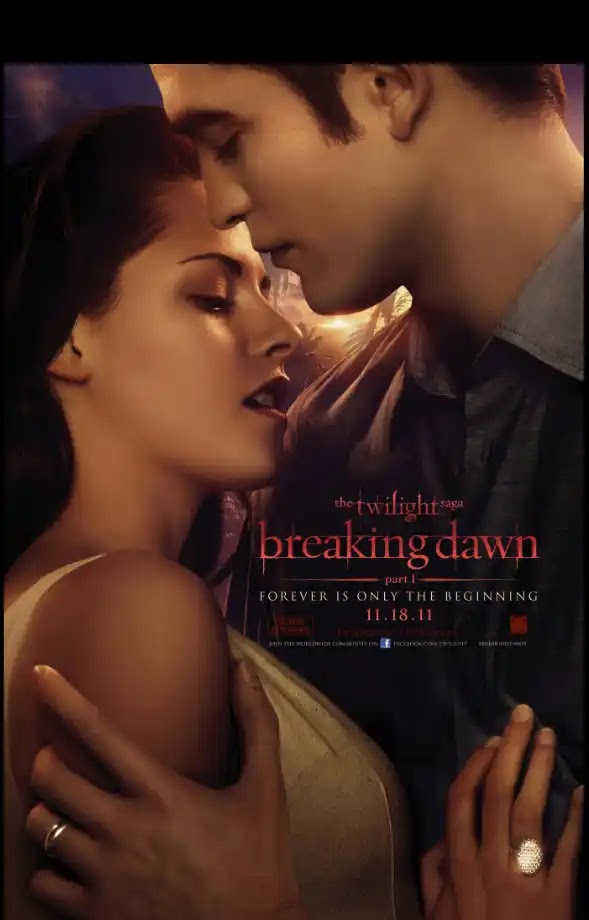
The Twilight Saga: Breaking Dawn - Part 1


Bill Condon: The Twilight Saga: Breaking Dawn - Part 1 (US 2011) starring Kristen Stewart (Bella Swan) and Robert Pattinson (Edward Cullen). 

Twilight - Aamunkoi, osa 1 / Så länge vi båda andas.
    US © 2011 Summit Entertainment. P: Wyck Godfrey, Stephenie Meyer, Karen Rosenfelt.
    D: Bill Condon. SC: Melissa Rosenberg - based on the novel Breaking Dawn (2008) by Stephenie Meyer. (In Finland the Twilight book series is called Houkutus, and the title of this novel is Aamunkoi. The first two novels are translated by Tiina Ohinmaa, and the second two by Pirkko Biström.) DP: Guillermo Navarro. PD: Richard Sherman. AD: Troy Sizemore, Lorin Flemming. Set dec: David Schlesinger. Art dept.: big. Special effects: Alex Burdett, David A. Poole. Visual effects dept.: huge. Animation dept:: Tom Gibbons. Cost: Michael Wilkinson. Animatronics and special makeup dept.: big. M: Carter Burwell. Sound dept.: 18. ED: Virginia Katz. Casting: Debra Zane. Stunt team: big.
    MAIN CAST: Kristen Stewart (Bella Swan), Robert Pattinson (Edward Cullen), Taylor Lautner (Jacob Black).
    SUPPORTING CHARACTERS (as edited in the English Wikipedia): Nikki Reed (Rosalie Hale, a member of the Cullen family who helps Bella through her pregnancy), Peter Facinelli (Carlisle Cullen, a compassionate doctor who acts as a father figure to the Cullen coven), Elizabeth Reaser (Esme Cullen, the most loving member who acts as the mother of the Cullen family), Ashley Greene (Alice Cullen, a member of the Cullen family who can see "subjective" visions of the future and who is close friends with Bella), Kellan Lutz (Emmett Cullen, the strongest member of the Cullen family, and provides the comic relief), Jackson Rathbone (Jasper Hale, a member of the Cullen coven can feel/control/manipulate emotions), Julia Jones (Leah Clearwater, a member of Jacob's pack who is constantly bitter and pained), Booboo Stewart (Seth Clearwater, a carefree member of Jacob's pack), Billy Burke (Charlie Swan, Bella's father and Forks' Chief of Police), Sarah Clarke (Renée Dwyer, Bella's mother who lives in Jacksonville, Florida with her husband Phil), MyAnna Buring (Tanya, the leader of the Denali coven), Maggie Grace (Irina, a member of the Denali coven whose lover, Laurent, was killed by the werewolves), Casey LaBow (Kate, a member of the Denali coven who has the ability to run an electric current on her skin), Michael Sheen (Aro, the leader of the Volturi), Jamie Campbell Bower (Caius, one of the three founders of the Volturi), Christopher Heyerdahl (Marcus, one of the three founders of the Volturi), Chaske Spencer (Sam Uley, the Alpha of the werewolves pack), Christian Camargo (Eleazar, a member of the Denali coven), Mia Maestro (Carmen, a member of the Denali coven).
    119 min
    Released in Finland by Nordisk with Finnish / Swedish subtitles by Hannele Vahtera.
    2K DCP viewed at Tennispalatsi 1, Helsinki, 25 Nov 2011.

Technical specs (IMDb): Camera: Arricam ST, Zeiss Ultra Prime and Angenieux Optimo Lenses, Arriflex 435, Zeiss Ultra Prime and Angenieux Optimo Lenses, Moviecam Compact, Zeiss Ultra Prime and Angenieux Optimo Lenses. - Laboratory: EFILM Digital Laboratories, Hollywood, (digital intermediate). - Film negative format: 35 mm (Kodak Vision3 250D 5207, Vision3 500T 5219). - Cinematographic process: Digital Intermediate (master format), Super 35 (source format). - Printed film format: 35 mm (anamorphic), D-Cinema. - Aspect ratio: 2.35:1.

AA: One of the most scary horror films of all times. The English Wikipedia calls it a "romantic fantasy film". Bella the human gets married to Edward the vampire, gives birth to a monster baby, dies at childbirth, and is resurrected as a vampire by Edward's vampire venom.

This viewing is my first acquaintance with the Twilight phenomenon. The book series (2005-2008) is one of the biggest bestsellers in history. The film series (2008-2012) belongs to the biggest box office phenomena of the period.

The author Stephenie Meyer belongs to The Church of Jesus Christ of Latter-day Saints. Twilight was her debut novel, the inspiration to which she received in a dream.

The twist of contemporary vampire fiction is that vampires have become love objects and identification objects. This is the most astounding volte-face in the history of horror fiction.

The vampire is traditionally an incarnation of the Devil in the same meaning as Jesus was an incarnation of God.

Bill Condon directs this movie with a sense of solemn gravity. Breaking Dawn is like a requiem. There is an affinity with Lars von Trier's Melancholia and with the final episodes of the Harry Potter saga. The visionary horror montage sequences belong to the tradition of experimental film.

I have been fascinated with the cinema's obsession with an interrupted wedding or betrothal. Breaking Dawn is the story of a successful wedding, honeymoon, childbirth and the mother's rebirth... from a vampiric point of view. "Let's start with forever" says Edward in his wedding speech. From a human point of view the story is utter horror almost without redemption, almost without counterforce. The monsters have taken over, and there is hardly anything else.

Except details such as Rio de Janeiro's Christ the Redeemer statue which welcomes the newlyweds to their Brazilian honeymoon. It is an alienated image such as the one in the beginning of La dolce vita.

The horror pregnancy, childbirth and resurrection are the movie's original horror elements. Breaking Dawn goes beyond the Rosemary's Baby, the It's Alive, and The Brood traditions, although it avoids gore and splatter. The ultrasonic test gives no response. No future is visible. The fetus is kept alive by pints of blood.

In the Harry Potter saga I was amazed by the absence of a sense that the protagonists would see themselves as "heroes of their own lives". There was an overwhelming sense of lethargy. In the Twilight saga the lethargy has developed into its logical endpoint, death.

Even visually, there is a death breath in the movie. The digital denaturation of nature is appropriate to the subject.

Tuesday, November 22, 2011

Shelagh Delaney 1939-2011

Morrissey's obituary of Shelagh Delaney (thank you, Antti Nylén, for the link):

21 November 2011
SHELAGH DELANEY

A genuine poet has passed through the world. Shelagh Delaney exercised a wide influence with the shock of plain language, and shafts of satiric wit, into a severe and donnish 1950s world where working-class people had thus far been assumed to be simplistic, flag-waving cannon-fodder. Her writing was a magnificent confession of life as it was commonly lived in her hometown of Salford, with all of its carefully preserved monotony. She was attacked for immorality, which, then as now, is proof that you have hit on something.

'A Taste of Honey' was a sentiment that had not been expressed before its time - far more real than life.

It was the Salford of sagging roofs, rag and bone men, walk-up flats, derelict sites, rear-entrance buses, and life in tight circumstances.

Shelagh Delaney did not become fat with success, or become a celebrity, because she was of richer intellect.

She has always been a part of my life as a perfect example of how to get up and get out and do it. If you worry about respect you don't get it. Shelagh Delaney had it and didn't seem to notice it.

MORRISSEY
Los Angeles, November 2011.

http://true-to-you.net/morrissey_news_111121_02

Sunday, November 20, 2011

Books on my nightstand this week (20 Nov 2011)


Pekka Suhonen: Ei vain muodon vuoksi: Suomen Taideteollisuusyhdistys 125 [Not for Form's Sake Only: Design Forum Finland 125 Years] (2000). Pekka Suhonen (1938-2011) was an expert on Finnish design and architecture.

1. Pekka Suhonen (1938-2011) died a week ago, and I have kept reading his work, essay collections such as Kun Roomasta tuli ikuinen [When Rome Became Eternal] (1995), Rooli ja kohtalo [Role and Destiny] (1996, a third of it dedicated to Marlene Dietrich), Yöllä he menivät uimaan [At Night They Went Swimming] (1998), my favourite of them being Delfiini ja muita esseitä [The Dolphin and Other Essays] (1973, with interesting essays on 1960s architecture and the Alvar Aalto legacy). Suhonen's writing on design and architecture is his most solid and substantial, books such as Tapio Wirkkala (1981, the key article written by Suhonen), Artek (1986, on Alvar Aalto and his colleagues), and Ei vain muodon vuoksi: Suomen Taideteollisuusyhdistys 125 [Not for Form's Sake Only: Design Forum Finland 125 Years] (2000).

2. Jake Nyman: Tähtisumua: unohtumattomia sävelmiä menneestä ajasta [Stardust: Unforgettable Tunes from Lost Time] (2011). Jake Nyman is a leading Finnish expert of popular music. I have started to realize better the full proximity of the cinema and popular music during the last ten years or so, and this book is chock full of further evidence of it.

3. Harvard Film Archive, October November December 2011 programme magazine. Written by Haden Guest, David Pendleton, and Brittany Gravely. Great writing on Frederick Wiseman, the Romanian film essayist Andre Ujica, the cinematographer Agnès Godard, the countercultural star Taylor Mead, the animator Helen Hill, Sergio Leone, and Henri-Georges Clouzot.

4. Markku Kuisma: Sodasta syntynyt: itsenäisen Suomen synty Sarajevon laukauksista Tarton rauhaan 1914-1920 [Born out of War: The Birth of Independent Finland from the Shots of Sarajevo till the Tartu Treaty, 1914-1920] (2010). A broad perspective of world history (including economic history) as a background to the many stages on the road to Finnish independence.

5. The New York Review of Books, 10-23 Nov 2011. Jeff Madrick and Frank Partnoy discuss in their article "Should Some Bankers Be Prosecuted?" the Permanent Subcommittee on Investigation (US Senate): Wall Street and the Financial Crisis: Anatomy of a Financial Collapse (2011), William D. Cohan's Money and Power: How Goldman Sachs Came to Rule the World (2011), and Goldman Sachs: Report of the Business Standards Committee (2011). Thrillers and detective stories seem trite in comparison with these true stories of fraud of world catastrophic dimensions. Madrick and Partnoy suggest measures by which the biggest villains could be prosecuted.

6. On my mother's nightstand I discovered Kiveen hakatut: Urheilijat maineen polulla [Carved in Stone: Sportsmen on Their Way to Glory] written by Arto Teronen and Jouko Vuolle, 2011, with a chapter on Tapani Niku, my grandfather, a ski champion in an era when that sport still had glory. My mother had revealed that Tapani was also interested in nature conservation. Tapani was a bog expert, among other things. Walking on bogs was also supreme training in his youth a hundred years ago. Today's cross-trainer gym machines strive for a similar impact.

Saturday, November 19, 2011

My favourite seat

David Bordwell writes in his and Kristin Thompson's blog about his favourite seat: the middle seat in the very first row. In Finland those seats were called "shell collecting seats" because kids who went to see Westerns used to sit "where the shells flew".

I don't have a consistent answer to the question of my favourite seat. When I visit Finnkino cinemas in Helsinki the ticket seller always asks me to select from among the green dots on a computer screen, and I always authorize the ticket seller to dictate because all Finnkino seats are good. Sometimes I get a first-row seat when the screening is going to be sold out. Sometimes I get to sit in the back, from where I can witness the epic of the audience participating in a hit film. Having already seen the 15 minutes of commercials and previews too often I sometimes arrive later than most, and then it is a good idea to have a side seat by the entrance in order not to bother others. But on the other hand I am also always the last patron to stay to the very end of the end credits, and it is a good idea to be in the middle of the row in new hit movies.

Everything is different at Cinema Orion where I do have a favourite seat, one from where it is easiest to jump away to react if there is something wrong in the screening. It would distract me if I would have to sit elsewhere.

At festivals I would have favourite seats, but the same seats are highly desired by others, and life has been easier since I gave up on them and decided I can sit anywhere.

Friday, November 18, 2011

Hiljaa toivotut / Silent Longing

Stilla längtan. FI 2011. PC: Vaski Filmi. P: Janne Niskala. D+SC: Timo Haanpää. DP: Timo Haanpää, Hannu-Pekka Vitikainen. M: Tapani Rinne. S: Lauri Leskinen, Kimmo Vänttinen. ED: Tuuli Kuittinen. Loc: Helsinki and Tampere. Cast: Heli & Toni, and Matti & Marjaana. 75 min. Released by Suomen Elokuvakontakti with Swedish subtitles by Kajsa Wikström. 2K DCP viewed at Kinopalatsi 6, Helsinki, 18 Nov 2011 (day of Helsinki premiere; the Finnish premiere was in Oulu 11 Nov 2011).

A documentary film on two couples' fertility treatment.

Based on the film's official synopsis: True stories about the joy and the sorrow of trying to become a parent. The film tells about two childless couples, who use fertility treatments to help them get a biological child of their own.

The film is an account of the emotional journeys of two couples through endless hospital visits where their life is divided between home and clinic. Uncertainty about the future and fertility treatments are challenging for relationships. Childlessness forces the characters to make difficult decisions and think about their lives, its meaningfulness and future - with or without a child. The idea of one's own child turns into a silent longing.

Silent Longing tells how much involuntary childlessness can hurt. The protagonists of the film are not alone. Childlessness is common nowadays. In Finland every fifth couple remains involuntarily childless, and the proportion of the involuntarily childless is increasing (based on the film's synopsis).

A straightforward, honest and intimate account of two couple's struggles to get a child. The struggles are difficult and heartbreaking, but there is a happy end for both. The movie is almost artless, a basic newsreel camera record. The approach is factual, medical, practical, and educational, but not cold, indifferent or distancing. The movie is warmly confidential and startlingly candid in extremely private situations where most would never consider camera presence. I keep being amazed at this current age of candid documentary cinema. There is often a low definition video look, but visual quality is hardly the point in this matter-of-fact movie.

There are events and websites around this movie:
http://www.hiljaatoivotut.fi/
http://www.simpukka.info/fi_fi/etusivu/

Jodái-e Náder az Simin / Nader and Simin, A Separation


جدایی نادر از سیمین / Nader ja Simin: ero / Nader och Simin: en separation. IR 2011. P+D+SC: Asghar Farhadi. DP: Mahmoud Kalari. PD: Keyvan Moghaddam. Make-up: Mehrdad Mirkiani. M: Sattar Oraki. S: Reza Narimizadeh. ED: Hayedeh Safiyari.
    Cast: Shabab Hosseini (Hodjat), Sarina Farhadi (Termeh), Merila Zarei (Miss Ghahraii), Ali-Asqhar Shahbazi (Nader's father), Babak Karimi (interrogator), Kimia Hosseini (Somayeh), Shirin Yazdanbakhsh (Simin's mother), Sahabanu Zolghadr (Azam). 123 min.
    A Cinema Mondo release with Finnish / Swedish subtitles.
    2K DCP viewed at Kinopalatsi 5, Helsinki, 18 Nov 2011 (day of Finnish premiere).
    Technical specs (IMDb): Film negative format: 35 mm (Fuji Eterna 500T 8573, Eterna 400T 8583) - 1.85:1.

A modern Iranian couple gets separated because the mother Simin wants to move abroad for the education of their 11-year old daughter Termeh, and the father Nader needs to stay in Tehran to take care of his father who has Alzheimer's disease. They don't get a divorce, so Simin moves to her parents. Nader's father now needs a housemaid, and they get the young, traditionally religious Razief who is pregnant, comes with her little daughter, and has to work in secret from her hot-tempered husband Houjat who is under heavy pressure from debtors. The father's Alzheimer's disease is getting worse, and complications and misunderstandings set in motion a dramatic chain of events.

Nader and Simin is one of the best films of the year. It may be an authentic account of life in modern Tehran, but for a viewer like myself with no acquaintance with Iran its universal values stand out. At first sight, Nader and Simin is about sex, class and religion, but the fundamental concerns of the movie are even deeper than that.

Nader and Simin is a story- and character-driven film. The story and the characters are powerful and full of details worth reflecting. The issues in the dramatic conflicts are relevant, and the strands of the storyline intertwine in meaningful ways. David Bordwell has paid attention to the special kind of suspense in Asghar Farhadi's movies - a suspense often conveyed via dialogue.

Children are prominent in modern Iranian cinema, and in Nader and Simin the two daughters are main carriers of conscience. When Termeh asks: "Father, are you telling the truth?", it is a question that Nader cannot ignore. Honesty is one of the themes of the movie (what if honesty leads to injustice?), pride is another (pride as a form of misunderstood self-respect), and love still another (the imperatives of love may transcend other values). To support her family Razief takes the job about which she has to lie to her husband, and she experiences a miscarriage because of a collision with a car into which she has landed to save the Alzheimerian father in the traffic. (The story's complications include her baby daughter's fiddling with the father's medical equipment, which may have aggravated his condition.) There are no simple solutions. A basic issue is that Nader and Simin live a relatively safe life. Razief and Houjat live in mortal danger: Houjat under a death threat from his debtors, Razief under a death threat from her husband. The priorities of the two couples are incompatible. There are tragic values in Nader and Simin: there is greatness in the pursuits of the protagonists, but they fail because of their own shortcomings such as false pride.

Visually Nader and Simin is largely a realistic chamber piece, based often on medium shots of people in interiors. In the 2K DCP the digital post-production based on the 35 mm film negative looks fine, and there is a refined intensity in the cinematography of the faces.

Thursday, November 17, 2011

Nachrichten aus der ideologischen Antike: Marx/Eisenstein/Das Kapital / [Dispatches from an Ideological Antiquity: Marx/Eisenstein/Das Kapital]


Alexander Kluge: Nachrichten aus der ideologischen Antike: Marx/Eisenstein/Das Kapital / [Dispatches from an Ideological Antiquity: Marx/Eisenstein/Das Kapital] (DE 2008).

DE 2008. D: Alexander Kluge. Original format: dvd. 3-dvd. Duration with extras: 570 min. Frankfurt am Main: Suhrkamp Verlag (Filmedition Suhrkamp), 2008.
    The linear duration is 189 + 120 + 183 = 492 min = 8 h 12 min

AA: A grand, playful dvd essay by Alexander Kluge, updating a critique of Marxist ideology in multiple ways, including interviews, readings, montages, lettering, documentary inserts, enactments, songs, collages, and animation.

Dvd I: Marx und Eisenstein im gleichen Haus [Marx and Eisenstein in the Same House]. The visionary project of Sergei Eisenstein was to film Das Kapital after October, inspired by Ulysses by James Joyce and by the novels of John Dos Passos. Oksana Bulgakova on Eisenstein. Kluge satirizes the ossification of totalitarian state Marxism by having Stasi recruits repeating dogma. Hans Magnus Enzensberger discusses the casting flaws of Marxism.Werner Schroeter discusses the rebirth of Wagner's Tristan und Isolde with Linda Watson and Raimo Sirkiä from the spirit of Battleship Potyomkin. 189 min

Dvd II: Alle Dinge sind verzauberte Menschen [All Things are Enchanted People]. An essay on commodity fetishism. Includes: Tom Tykwer: Der Mensch im Ding [The Man In Things] 12 min, an experimental short film about the things around us in an urban freeze-frame setting. A visit at the official grave of Karl Marx – but there is a true grave that is hard to find. Peter Sloterdijk discusses the metamorphoses of the surplus value. "Only a great storyteller is capable of penetrating the world of Karl Marx – the world of this greatest analyst of enchantment". Oskar Negt: what is the meaning of happy failure in a risk society? Discourses on the French revolution.120 min

Dvd III: Paradoxe der Tauschgesellschaft [Paradoxes of the Exchange Society]. An essay on  second nature. Reflections on the Dialectics of Enlightment by Horkheimer and Adorno. Oskar Negt about the humanization of machines and about how to read Das Kapital. Durs Grünbein on the Manifesto as Lucretian poetry. Karl Korsch's analysis of the impossibility of the Russian and Chinese social experiments. A socialist Robinsonade of Diana Leibowitz on Bear Island in 1942. The history of alienation. Helge Schneider's Marx-relating performance. 183 min

Three-blade shutters at Cinema Orion (16 Nov 2011)


Three blade shutter. Photo: Rosbeek Techniek.

Yesterday we (more precisely: Jarni Susiluoto, our projection wizard) installed at last three-blade shutters at our Cinema Orion. They are basic equipment in silent film projection when the film is projected at speeds slower than the standard 24 fps, as we have always known, but we had not been able to solve issues of lamp brightness before this year. A three blade shutter needs more light than the usual two blade shutter. Starting from tonight's screenings of København ved Nat (DK 1910) and Afgrunden (DK 1910) we can enjoy silent films at Orion without flicker.

Wednesday, November 16, 2011

KAVA buys more rights to the Finnish film heritage

On 16 November KAVA (the National Audiovisual Archive of Finland) has bought from Suomi-Filmi company rights to over 150 Finnish films from the silent era to the 1970s. This is in continuation to the purchase on 29 August 2011 from Finnkino of 300 Finnish feature films that were produced from the 1930s to the 1980s. The whole number of Finnish feature films is 1300.

The incentive to the acquisitions is KAVA's decision to start digitizing in 4K the Finnish film heritage. It makes more sense for the government to fund such a project when it also owns the rights.

The recent purchase includes over 150 feature films produced by the Suomi-Filmi company, and other feature films the rights of which had been transferred to Suomi-Filmi. Also included is a big number of short films and commercials.

Tv rights remain with YLE the Finnish Broadcasting Corporation. The rights to dvd's already published remain with Finnkino during a period of transition.

Among the treasures purchased are the majority of the Finnish silent feature films, the oeuvre of Valentin Vaala (such as Loviisa, for many the all-time best Finnish film), and many other prominent films such as The White Reindeer.

Cinema Context (Amsterdam), "the finest film reference source on the Web"

Luke McKernan keeps plugging Cinema Context: Film in the Netherlands since 1896. An Encyclopedia of Film Culture, as a model for everybody. This is what he had to say four years ago:

“What is the finest film reference source on the Web, for all film let alone silent film? With all due respect to the Internet Movie Database, I think it is Cinema Context, a Dutch site created by Karel Dibbets and the University of Amsterdam. Describing itself as 'an encylopedia of film culture', the site documents film distribution and exhibition in the Netherlands in 1896. It does so through four data collections, on films, cinemas, people and companies, derived from painstakingly researched data on nearly all films exhibited in Dutch cinemas before 1960. The research team located film programmes from 1896 onwards in each of the major Dutch cities, entering all film titles, names, dates, cinemas etc, and then ingeniously matched this data to the records of these films on the IMDb."

"The result is an incomparably rich resource for tracing films, the performers and the producers across time and territories, opening up whole new areas of analysis. Cinema Context also contains comprehensive data from the files of the Netherlands Board of Film Censors 1928-1960. As the site states: 'Cinema Context is both an online encyclopaedia and a research tool for the history of Dutch film culture. Not only can you find information here about who, what, where and when: you can also analyse this information and study patterns and networks. Thanks to Cinema Context, we are now able to expose the DNA of Dutch film culture.' Naturally, it is available in both Dutch and English."

"This is the new film research. Every nation should have the same.”

Luke's view is still the same, only even more so.

Sunday, November 13, 2011

Ski Patrol (1940)


Lew Landers: Ski Patrol (US 1940).

Jägarpatrullen. 
    US © 1940 Universal Pictures Company, Inc. P: Warren Douglas. Associate P: Ben Pivar. 
    D: Lew Landers. SC: Paul Huston. DP: Milton Krasner, A.S.C. AD: Jack Otterson; associate: Ralph M. DeLacy. Set dec: R. A. Gausman. Cost: Vera West. [M: Frank Skinner (n.c.)]. M director: H. J. Salter. S supervisor: Bernard B. Brown. Technician: Robert Pritchard. ED: Edward Curtiss. 
    Cast: Philip Dorn aka Frits van Dongen (Lt. Viktor Ryder), Luli Deste (Julia Engle), Stanley Fields (Birger Simberg), Samuel S. Hinds (Capt. Per Vallgren), Edward Norris (Paavo Luuki), John Qualen (Gustaf Nerkuu), Hardie Albright (Tyko Gallen), John Arledge (Dick Reynolds), John Ellis (Knut Vallgren), Henry Brandon (Jan Sikorsky), Kathryn Adams (Lissa Ryder), Abner Biberman (Russian Field Commander), Wade Boteler (German Olympics Spokesman), Addison Richards (James Burton, American speaker), Reed Hadley (Ivan Dubroski), Trevor Bardette (Aranoff, Russian Tunnel Team Commander), John Gallaudet (Russian prisoner), Jodi Gilbert (Fanni Nerkuu), Nels P. Nelson (Finnish camp cook) Christian Rub (Jakob Sorenson, old villager), Karl Hackett (Gregor, tunnel soldier), Leona Roberts (Viktor's mother), Jack Gardner, George Magrill (Russian soldiers). 
    64 min
    MPPDA certificate 6225. 
    Screener dvd viewed at home in Helsinki, 13 Nov 2011.

The film was not released theatrically or otherwise in Finland.
The film materials had recently burned in the Universal City film vault fire.
Digibeta from Universal Studios / Peter Langs, to be preserved at the Finnish Film Archive.
Finnish screening permission from Finnkino / Markku Koistinen.
The first public screening was ours, the Finnish Film Archive, 30 Nov 2011 (Memorial Day of the Winter War), Orion, Helsinki.

An American film about the Winter War (1939–1940) between Finland and the Soviet Union, based on Luis Trenker's Tyrolean WWI movie Berge in Flammen / The Doomed Battalion (DE 1932). The movie was never released in our land.

There is a 1936 Olympic Games poster behind the opening credits. Bobsleigh, skating, ski jumping, cross-country skiing and downhill racing are among the sports. With a gentlemanly spirit the Finnish Viktor helps Ivan during the race. Ivan (USSR) wins the ski marathon, Viktor (Finland) is second, and Dick (USA) the third. (USSR did not participate in Olympics before WWII). In the medal ceremony the American speaker praises world peace. Cut to a montage of explosions in Ethiopia, China, Austria, Czechoslovakia, and Finland. 

There is an idyllic mountain landscape supposedly in Finland, and a folk dance. (There are hardly any mountains in Finland, and none on the Karelian border. The folk dance scene in all its details is strictly Ruritanian, or perhaps Tyrolean.) Julia is already preparing and in uniform, a member of the Lotta Battalion. We see an image of an Order of General Mobilisation, 8 Jan 1940 (the Winter War started on 30 November, 1939). 

Finns are surprised and reluctant to go to war (in reality there were were special exercises and a general mobilization months in advance, and there was a rare determination to fight). A Red Army plane fires, and Paavo's sister Liisa is the first casualty. 

Magnificent footage of torch-bearing skiers on a nocturnal mountain slope (perhaps from Luis Trenker's movie Berge in Flammen / Doomed Battalion). "There's our stopping place: Silver Mountain, we must hold it." The Finns dig trenches, set up barbed wire, and build a dugout. There is a daredevil sharpshooter Simberg, ready to fight: "I can shoot, I never miss". "Save the bullets for men". 

One of the men is a Nobel Prize winner, and other carry names of prominent artists such as Engel, Gallen, Vallgren and Simberg. The Russians' plan is to explode the mountain. The Finns' goal is to prevent them. Russians launch an avalanche which wipes out the Finns' supply team. We see the daredevil Viktor racing downhill. The men in the dugout cannot sleep listening to the Russians drilling.

Gustav falls down to his death on the ski track at the very moment when his baby boy is born. There is a final race of the Finnish suicide patrol along the mountain slope with great action footage (probably from Trenker's film), and devastating casualties on both sides. When the target is near Viktor is about to shoot a Russian, but it is Ivan, who takes his explosives and refuses to kill Viktor. "The penalty for a traitor is death", says Ivan's officer and executes Ivan point-blank – defusing the explosives and destroying his whole unit. 

At Paavo and Liisa's graves the Finnish officer speaks: "Forgive them, Father, for they know not what they have done. The victory is theirs, but they couldn't realize the cost to them and to us. The flower of our youth trampled by their mad ambition. All of them gone, destroyed before their life has begun. And to what end, my Lord, to what end?"

This is a quickie production with lots of back-projection and zero commitment in the performances (Luli Deste and Samuel S. Hinds are good, though). The film is so oblivious of reality that it would not have been even offensive if it would have been released in Finland at the time. There is a blatant disregard for authenticity. The best aspect of the movie is the downhill racing footage probably lifted from Trenker.

Books on my nightstand this week

1. Pekka Suhonen (1938-2011), a refined man of letters and a critic of architecture and design, died on Friday. Pekka Tarkka's remarkable obituary in today's Helsingin Sanomat alerted me to read Suhonen's first three books, Kootut runot [Collected Poems] (1965), his debut book with a hilariously misleading title, Tytöt lähtevät maailmalle [Girls Get Out to See the World] (1966), a collection of short stories, and Palava omaisuus [Burning Property] (1968), with more poems. There are also film connections, especially in the short story "Garbo at Stiller's Grave".
2. Jorge Luis Borges: Kuvitteellisten olentojen kirja (El libro de los seres imaginarios) (Book of Imaginary Beings), 1957 / 1969, translated into Finnish by Sari Selander, 2009. Adventures of language and imagination in a uniquely humoristic pseudo-encyclopedia, Sari Selander succeeding in an almost impossible translation mission.
3. Aulis Tynkkynen: Muistoja elämästä ja ihmisistä Pahatson lapsuuden kodista 1930- ja 1940-luvulta [Recollections of Life and People in our Childhood Home in Pahatso in the 1930s and the 1940s], 2007. My wife's mother Aino died last month (born in 1917 before Finnish independence but just after the Czar had resigned from power, during the Russian Provisional Government), and these are the recollections of Aino's brother of their childhood and their fighting youth in Punkaharju in Southern Savo. These self-published memoirs are an invaluable record of a traditional way of life that has vanished with modernization.
4. Donald E. Strong: Maailmantaide: Kreikan ja Rooman taide (Landmarks of the World's Art: The Classical World), 1965, in Finnish in 1967. Continuing with a favourite childhood book series, the selection of artworks and the layout of their reproductions consistently in excellent taste. In classical Greece one starts to discover faces and expressions that are recognizable as contemporary with nothing archaic in them. The realism of the discus thrower is still unsurpassed.
5. MMM: Mitä Missä Milloin 2012 [What Where When 2012], 2011. The publishing house Otava's annual yearbook of what has happened in the world, in the society, and in culture. I always spend several hours studying it from cover to cover, my favourite section being "new words of the year". Editors: Tiina Aalto (editor-in-chief), Päivi Syrjänen.
6. Lauri Piispa: Sentimentaalinen marssi [A Sentimental March], 2005. A master's thesis with profound insight into the historical meanings in Marlen Khutsiev's movie Zastava Ilyicha.
7. La Cinémathèque de la Ville de Luxembourg programme booklet, Novembre 2011, edited by Claude Bertemes. Another film archive programme booklet worth reading in its own right, this one especially for the Regards sur le cinéma israélien notes. Other features include: Tous les genres du cinéma; Filmreakter Double Feature (Twin Tales of Terror and Madness); Voir Naples et sourire; Citizen Lumet; Cinema Paradiso for children.
8. Paul Klimpel (ed.): Bewegte Bilder - starres Recht? [Moving Images - Rigid Rights?], 2011. New openings in matters or rights regarding film heritage. Even I contributed an article on the topic of the exceptions to the droit d'auteur (as we say in Europe) / fair use (as they say in the US).

Saturday, November 12, 2011

Immortals 3D


Tarsem: Immortals (US 2011). Henry Cavill as Theseus.

Immortals / Immortals.
    US © 2011 War of the Gods, LLC. P: Mark Canton, Ryan Cavanaugh, Gianni Nunnari.
    D: Tarsem Singh. SC: Charley Parlapanides & Vlas Parlapanides. DP: Brendan Galvin. PD: Tom Foden. AD: Michele Laliberte. Art dept: big. Cost: Eiko Ishioka. Makeup dept: big. Special FX team: big. Visual FX team: really massive. Stunt team: large. M: Trevor Morris. S: Paul Timothy Carden, David Evans, Mandell Winter. Sound dept: big. ED: Wyatt Jones, Stuart Levy. Casting: Andrea Kenyon, Joseph Middleton, Randi Wells.
    Cast: Henry Cavill (Theseus), Mickey Rourke (King Hyperion), Stephen Dorff (Stavros), Freida Pinto (Phaedra), Luke Evans (Zeus), John Hurt (Old Man), Joseph Morgan (Lysander), Anne Day-Jones (Aethra), Greg Bryk (The Monk), Alan Van Sprang (Dareios), Peter Stebbings (Helios), Daniel Sharman (Aries), Isabel Lucas (Athena), Kellan Lutz (Poseidon), Steve Byers (Heracles), Stephen McHattie (Cassander).
    110 min
    Released in Finland by Nordisk Film with Finnish / Swedish subtitles.
    2K DCP viewed in XpanD 3D at Tennispalatsi 3, Helsinki, 12 Nov 2011 (weekend of Finnish premiere).

Technical specs (IMDb): Camera: Panavision Genesis HD Camera - Original format: HDCAM - Cinematographic process: Digital Intermediate (2K) (master format), HDCAM SR (1080p/24) (source format) - Printed film format: D-Cinema (also 3-D version) - Aspect ratio: 1.85:1.

Official synopsis: "Visionary director Tarsem Singh and producers Gianni Nunnari (300), Mark Canton (300), and Ryan Kavanaugh (The Fighter) unleash an epic tale of treachery, vengeance and destiny in Immortals, a stylish and spectacular 3-D action adventure. As a power-mad king razes ancient Greece and threatens to destroy mankind, a heroic young villager rises up against him in a thrilling quest as timeless as it is powerful."

"The brutal and bloodthirsty King Hyperion (Mickey Rourke) and his murderous army are rampaging across Greece, demolishing everything in their wake with ruthless efficiency. Village after village falls to Hyperion's legions and each victory takes him one step closer to his goal: unleashing the power of the sleeping Titans to vanquish both the Gods of Olympus and all of humankind."

"It seems nothing will stop the evil king’s mission to become the undisputed master of the world, until a stonemason named Theseus (Henry Cavill) vows to avenge the death of his mother in one of Hyperion’s raids. When Theseus meets the Sibylline Oracle, Phaedra (Freida Pinto), her disturbing visions of the young man’s future convince her that he is the key to stopping the destruction. With her help, Theseus assembles a small band of followers and embraces his destiny in a final desperate battle for the future of humanity."

AA: Tarsem is an image-driven film-maker, a modern artist who keeps developing the tableau style and the Symbolist approach to the cinema which flourished before WWI, Maurice Tourneur and Yevgeni Bauer among its most talented artists. Influenced by Sergei Paradjanov, Tarsem's cinema has also affinities with the work of Yuri Ilyenko and certain visual aspects of Andrei Tarkovsky. The Cell and The Fall were movies strong with vision and slight with narrative. Immortals has a strong narrative with superficial connections with Greek mythology, but actually it is an original story, and it is only confusing to think about the mythic Theseus here. I feel that the story is only apparently strong and powerful tableaux are still the true raison d'être. The gods at Mount Olympos, the appearance of the virgin oracles in their red robes, certain psychedelic visions, and the tsunami caused by Poseidon are memorable Tarsem tableaux.

Immortals is among other things an explicit movie about brutal, sadistic violence, a splatter movie. I have become bored with splatter ever since I saw the Eugène-Louis Doyen brain surgery movies from a hundred years ago in Bologna's Il Cinema Ritrovato in 2004. I think it is worthwhile to have that experience, but it is not something I look forward to any more. Splatter is something I've seen already.

The 3D here is boldly anti-realistic, psychedelic, and vertiginous. There is nothing wrong with the 3D technically but I often removed my glasses to enjoy a brighter image with full colours, including Tarsem's signature reds. Five years ago The Fall was based on a 4K transfer so successfully that such a digital critic as myself did not find anything to complain. This 2K presentation looked shabbier, perhaps also because of the 3D.