Saturday, June 28, 2014

Emiliano Morreale: Riccardo Freda. A Master of Popular Cinema (Il Cinema Ritrovato 2014 introduction)


Emiliano Morreale (Il Cinema Ritrovato, 2014, catalogue and website): 
"Riccardo Freda’s great period began immediately after the war with the adventure films he made for Riccardo Gualino’s Lux and ended in the 1960s with Lo spettro. During that time the director worked on high-end productions and second-rate ones but always according to his creed of energy and speed. Film is an art to be done in a hurry, as the director often said: “When the production of a film takes too long, enthusiasm drags, and the film’s rhythm is affected by it. Ideally, you put a reel in the camera, call action and never stop”."

"Averse to the quintessential Italian film genre, comedy, and a sworn enemy of Neorealism, Freda always presented himself as an ‘American-style’ director, a master of action movies, a creator of grand melodramas and even a pioneer of Italian horror film. Literature played a leading part in his idea of popular cinema, a veritable storehouse of celebrated and unknown references melding high and low (Dante, Pushkin, Hugo, d’Ennery). Opera librettos and silent films were also great sources of inspi­ration for the director. Aside from literary adaptations, many of his films were remakes of silent films he had been fond of ever since his pied-noir childhood in Egypt: Valentino, Maciste, Griffith… Certainly not a cinephile, Freda nourished himself on film: thinking he was heir to a tradition, he became a master of style. It is not surprising that he is admired by extremely di­verse directors, from Bertrand Tavernier to Giuseppe Tornatore. The classic camera movement in his films, it has been said, was a lateral or diagonal dolly that leads a character into a crowded venue, a place to explore, possibly full of peril, where that char­acter is always at the center of the action and the scene. There is undoubtedly a ‘Freda style’ – wide, curving camera movements, with a dolly and crane – just as there are Fredian heroes – at least during the first phase of his career – who are noble, brave and typical of popular storytelling. But at a certain point (with horror films, for example) it is not a question of good or bad. Freda became more cynical and disappointed with mankind and certainly with filmmaking."

"A total filmmaker and totally popular, Freda was ignored by Italian critics, but he was rediscovered in France through the auteur policy. A banner macmahonien director, he was also admired by the “Positif” crowd. In Italy he has also had tributes and been reinterpreted, especially by the genera­tion that strove to free itself from the ideological hegemony of Neorealism. Thereafter, cinephiles would especially esteem his horror films, but his distinctly classic cinema never did enjoy that perverse, pop or trash type of fascination of the later genres. Freda was perfect for cultural battles and provocation but also for engaging and thrilling generations of audiences and critics alike. His work appears to us today as an example of a lost cin­ema to be read alongside the history of culture, of the modes of production, and of the audience in Italy and beyond." Emiliano Morreale (Il Cinema Ritrovato, 2014, catalogue and website)

Il Cinema Ritrovato's 2014 Riccardo Freda programme curated by Emiliano Morreale.

Thursday, June 26, 2014

Den enfaldige mördaren / The Simple-Minded Murderer

Yksinkertainen murhaaja. SE 1982. PC: AB Svenska Ord, AB Svensk Filmindustri, Stiftelsen Svenska Filminstitutet. P: Waldemar Bergendahl. D+SC: Hans Alfredson based on his novel En ond man (1980). DP: Jörgen Persson. AD: Stig Boquist. SFX: Per-Olof Ohlsson. Cost: Ulla-Britt Söderlund.  Makeup: Horst Stadlinger, Mia Renck. M: Rolf Sersam. ED: Jan Persson. S: Christer Furubrand, Wille Kökeritz. C: Stellan Skarsgård (Sven, ”the Idiot”), Hans Alfredson (Höglund), Maria Johansson (Anna), Per Myrberg (Andersson), Lena-Pia Bernhardsson (Mrs. Andersson) , Tomas Alfredson (Axel), Cecilia Walton (Vera), Nils Ahlroth (Månsson), Lars Amble (Bengt),  Wallis Grahn (Mrs. Höglund), Lena Nyman (the woman without the lower body), Gösta Ekman (the new chauffeur), Else-Marie Brandt (the mother of "the Idiot"), Carl-Åke Eriksson (Wallin), Carl Billquist (Flodin), Anders Granström (engineer Berghald),  Anna-Carin Krokstäde (Märit), Björn Andrésen (an angel), Daniel Alfredson (an angel), Erik Spangenberg (an angel), Georg Årlin (a civil servant), Stellan Sundahl (man at the Nazi meeting), Bengt-Göran Svensson (a man). Helsinki premiere: 29.4.1983 Nordia, released by: Nordfilm Oy – VET 090159 – K16 – 2950 m / 108 min
    Vintage KAVI print (deposited via Nordfilm) with Finnish subtitles viewed at Cinema Orion, Helsinki (Thriller Sweden), 26 June 2014

A strong period film set in the Depression years of the 1930s in Scania (Skåne) in South Sweden. The circumstances are still half-feudal. The lord, the industrialist Höglund, strives for total control in his realm. He lets Sven "the idiot" stay in the cowhouse and treats him like a slave. Girls and women are his to take advantage of. Sven's sister becomes a prostitute. Höglund is an enthusiastic Nazi supporter.

Sven is no idiot, but he is an original and a marginalized figure with a cleft lip which makes his speech hard to understand. His best friend is the wheelchair bound Anna, and he finds family warmth in Anna's family. Sven studies the Bible and sees visions of avenging angels with swords. He is morally sensitive, and the evil of Höglund, who conspires to evict all decent people in his neighbourhood, becomes overwhelming for him. A final straw of humiliation is the wrecking Sven's beloved Indian Big Chief motorcycle which he has renovated with tender loving care. As Sven rises against the tyrant Höglund he is fulfilling the secret wish of most everybody.

A splendid performance by Stellan Skarsgård as Sven "the idiot". The director himself plays the evil and sadistic Höglund. (Hans "Hasse" Alfredson is best-known as a comedian, a partner in the "hasseåtage" duo).

A unique feature of this film is a blend of grim realism and a fairy-tale atmosphere stemming from Sven's worldview.

There is a painterly quality in the cinematography, and an abundance of period detail in the art direction. This is visually an opulent film. The characters are painted with marked contours, almost in caricature. The film is very visual, but there is at times too much dialogue. There is perhaps sometimes something slightly recherché in the account of the period.

The print is basically good, doing justice to the magnificent cinematography and art direction. In the beginning it seemed soft and a generation too far removed from the original, but it got better.

Wednesday, June 25, 2014

Meidän poikamme merellä / [Our Sons at Sea]


Våra gossar till sjöss. FI 1933. PC: Suomi-Filmi Oy. P: Erkki Karu. D: Erkki Karu. SC: Erkki Karu, Georg Malmstén. DP: Theodor Luts. Suomen Joutsenen esittely: Dr. Snellman. Camera assistants: Lennart Brännlund, Kullervo Kari, Sulo Tammilehto. AD: Armas Fredman. Makeup: Hannes Kuokkanen, Aarne Kuokkanen. Olavi Suominen (makeup assistant). M: Georg Malmstén. The reinforced Zamba-orkesteri. ED: Erkki Karu. Choreography (dances): Alexander Saxelin. S: Rafael Ylkänen. Stills: Kalle Havas, Kosti Lehtinen. Military advisor: Vilho Pentikäinen. Errand boy: Olavi Karu. Studio manager: Armas Fredman. C: Georg Malmstén (Pekka Kuusisto, reservin ylikers.), Kati Aspelin (Koiviston kartanon Leila), Aku Käyhkö (lääkäri Väre), Jaakko Korhonen (sukellusveneen komentaja, kapteeniluutnantti), Iivari Kainulainen (pursimies Ville Pirske), Väinö Söderholm, myöh. Serho (Iiska, reservin aliupseeri), Reino Volanen (II reservin aliupseeri / kannibaalikuningatar), Eero Eloranta (avustava lääkäri), Sven Lundevall (viulu), Robert von Essen (piano), Eugen Malmstén (trumpetti, harmonikka), Alexander Wittenberg (saksofoni), Torsten Melander (pasuuna), Sven Grönholm (rummut), B. Wittenberg (viulu), Runar Törnström (saksofoni), G. Gröndahl ja Aimo Andersson (trumpetti), T. Andersson (basso), Viljo Vesterinen (harmonikka), Jaana Ylhä (sotilaskotinainen), Helge Pahlman (virttä laulava reserviläinen), Unto Salminen (res.kers. Salminen), Aino Niska (Manta), Evert Ekman (komentajakapteeni Evert Ekman), Kalle Kärkkäinen (luutn. Kalle Kärkkäinen, adjutantti), Gunnar Bärlund, Laila Richter, Rauni Veivo (kurssijuhlan yleisöä), Margit Tirkkonen (tanssijatar), Sulo Enkiö (yksi tanssijoista). Helsinki premiere: 12.3.1933 Kino-Palatsi – telecasts: MTV2: 10.5.1975, MTV1: 17.1.1982; YLE TV2: 6.91990 ja 1.9.1995; YLE TV1: 30.6.1987 ja 26.4.2002 – classification: A–103 – S – 2995 m / 109 min
    KAVI 2K DCP viewed at Cinema Orion, Helsinki (Erkki Karu), 25 June, 2014

A dreary early Finnish sound film with the distinction of being the first Finnish musical. In his military trilogy, Erkki Karu started by realizing the first film Meidän poikamme largely as a farce; of this second film he made a musical. As a director Erkki Karu had developed rapidly in the early 1920s and was quite good around 1923, but after that his touch became uneven: he still could make an interesting film (Meidän poikamme), but he made also duds (Meidän poikamme merellä). Erkki Karu's sound films as a whole are hard to digest. In his silent films Karu had a certain flair, verve and wit which is mostly missing from his sound films.

For lovers of Finnish popular culture Meidän poikamme merellä is indispensable for the songs and performances of Georg Malmstén, an authentic incarnation of the brave singing sailor. "Sinitakkien marssi" ["The March of the Bluecoats"], "Meidän Maija" ["Our Mary-Ann", about their brig], "Kuu hopeoitaan hohtaa" ["In the Silvery Gleam of the Moon", lyrics by Erkki Karu], "The Hanko Waltz" / "Leila", "Sukellusvenevalssi" ["The Submarine Waltz"], and "Aallokko kutsuu" ["The Call of the Waves", a slow waltz] are fresh and original songs which convey the marine spirit perfectly as do the rousing marches. John Ford would have liked them. - Sound recording is still primitive in this film.

Georg Malmstén became a legendary performer, and already here he is full of life as an entertainer, but the comedy routines are awkward. Equally awkward is the token narrative about the romance of Pekka (Georg Malmstén) and the nurse Leila (Kati Aspelin).

Besides the music the other strength of the movie is the cinematography by Theodor Luts. It is surprising to witness here passages that resemble Battleship Potyomkin - the lyrical sequence of the nocturnal harbour (while "In the Silvery Gleam of the Moon" is playing), and the sequence of the maintenance of the cannons on the battleship. - There is a rich variety of field sizes.

The film has been successfully digitized. With the challenging early soundtrack it might be worth the effort to do some more work.

Friday, June 20, 2014

Remembering Gerry Goffin (1939-2014)

"Gerry Goffin and Carole King at the RCA recording studio in New York around 1959. Credit Michael Ochs Archives, via Getty Images." From The New York Times, 19 June 2014
Gerry Goffin and Carole King favourites:

1961  The Shirelles: "Will You Love Me Tomorrow"
1961  Bobby Vee: "Take Good Care Of My Baby"
1961  The Drifters: "Some Kind Of Wonderful"
1962  The Beatles (1963): "Chains"
1962  Little Eva: "Loco-Motion"
1963  The Chiffons: "One Fine Day"
1963  The Drifters: "Up On The Roof"
1964  Herman's Hermits: "I'm Into Something Good"
1966  The Animals: "Don't Bring Me Down"
1966  Dusty Springfield: "Goin' Back"
1967  The Monkees: "Pleasant Valley Sunday"
1967  Aretha Franklin: "(You Make Me Feel Like) A Natural Woman"
1968  The Byrds: "Wasn't Born To Follow"

Thursday, June 19, 2014

Alphaville

Alphaville ou Une étrange aventure de Lemmy Caution / Lemmy Caution – piru mieheksi / Lemmy Caution – hård kille / Alphaville – ett fall för Lemmy Caution. FR/IT 1965. PC: Chaumiane Productions (Paris) / Filmstudio (Rome). P: André Michelin. D+SC: Jean-Luc Godard. DP: Raoul Coutard - b&w - 1,37:1. M: Paul Misraki. ED: Agnès Guillemot. S: René Levert.
    C: Eddie Constantine (Lemmy Caution), Anna Karina (Natacha von Braun), Akim Tamiroff (Henri Dickson), Howard Vernon (professor Léonard Nosfératu alias von Braun), László Szabó (chief engineer), Michel Delahaye (von Braun's assistant), Jean-André Fieschi (professor Heckell), Jean-Louis Comolli (professor Jeckell), Christa Lang (1st seductress third class), Valérie Boisgel (2nd seductress third class), Jean-Pierre Léaud (cameo as a breakfast waiter).
    Locations: 4.1.-14.2.1965, Paris - Maison de la Radio, Palais des Expositions, Les Machines Bull, EDF building (Paris 12, Paris, France - computer center), Esso tower (La Défense, Hauts-de-Seine), Scribe Hotel (1 Rue Scribe, Paris 9).
    Helsinki premiere 20.8.1965 Ritz, Scala, distributor: Cinelux-Filmi – telecast 5.11.1979 MTV1, 1.2.1989 YLE TV1, 22.5.2009 YleTeema (Kino Teema)  – VET 72304 – K12 – 98 min
    A vintage KAVI print (deposited from Cinelux-Filmi) with Finnish / Swedish subtitles by n.c. / Maya Vanni viewed at Cinema Orion, Helsinki (Jean-Luc Godard), 19 June 2014

"Nous vivons dans l'oubli de nos métamorphoses".
 – Paul Éluard: Capitale de la douleur

Alphaville revisited.
    A film of poetry, myth, dystopia, and mordant gags.
    Yet another of Jean-Luc Godard's genre reversals. He had made crime films (A bout de souffle, Bande à part), a musical (Une femme est une femme), and a war film (Les Carabiniers). Now he turned to science fiction.
    The surface approach is irreverent, dominated by a sense of play. Godard has fun with genre, and with Eddie Constantine's star image as Lemmy Caution. Godard is not laughing at genre or the star system; he is laughing with them. (It is compatible with Rick Altman's genre theory that Alphaville is a genre blender with aspects of science fiction, policier, spy film, and even Western.)
    But more fundamentally, it's deadly earnest. Godard takes the story as seriously as it gets. The basic drive is mythical. "The strange adventure of Lemmy Caution" is an Orphic quest where the hero visits the Land of Death ("The Capital of Pain"). Although Lemmy Caution is introduced as a strong silent man, a gunman with few words or none, surprisingly he finally conquers Alphaville with love and poetry.
   In Finland we can relate this to the Kalevala myth, where Väinämöinen, our Orpheus, conquers Pohjola (The Land of the North) by the power words of his song and poetry.
    Alphaville has been linked with Jean Cocteau's Orphic trilogy where Cocteau modernized the myth. In Alphaville, Godard projects the myth into the future, and postmodernizes it.
    Lemmy is also Theseus who enters the labyrinth and destroys the Minotaur (the monster computer). (Natacha is not an Ariadne figure, although she is Eurydice to the Lemmy-Orpheus).
    Science fiction films can be expensive because of the huge costs of production design and special effects. The great insight and the best joke of Alphaville is that the land of future, the land of death, was filmed in contemporary Paris, without even an art director assigned for the movie.
    Alphaville is no pre-cyberpunk film, but it belongs to the pioneer films about the computer world and the power of information technology, before Stanley Kubrick's 2001: A Space Odyssey. There are some affinities with Fahrenheit 451, the Ray Bradbury story and the François Truffaut film, but in them there is no emphasis on the computer world.
    There are long passages of Lemmy Caution's adventures inside the huge computer center, the machine mind. The computer is growing in impact. People are governed by logic. Emotion and poetry have become capital crimes. But Lemmy fulfills his mission. Professor von Braun, the master of Alphaville, is killed, and the Alpha 60 (Alpha Soixante, α 60) is destroyed. In the maze of the computer centre living dead people are soon wandering about. They are stunned, crushed, deprived of light, like ants. They have been transformed into mutants. The universe saved, Lemmy takes Natacha with him in his Ford Galaxy. "Don't look back", says Lemmy. "Je vous aime", says Natacha.

More remarks:
    The range of the music by Paul Misraki extends from strident 1950s style crime film sounds to romantic harmonies towards the end.
    The Alphaville people have numbers tattooed on their skin like Auschwitz inmates.
    There is an auditorium of electric chairs from where the victims can be easily dumped to a garbage heap.
    Lemmy shines his shoes on the carpet of the hotel stairs.
    The hotel bible is a dictionary which is daily re-edited for illogical words.
    A highlight is the Lemmy-Natacha love montage with close-ups and extreme close-ups of eyes and faces. "I moved towards you. I moved towards light".
    Another fine scene is the car chase shot from a stark high angle from the rooftop.
    Like in Murnau's Nosferatu, there are shots in the negative in the final showdown episode. We are twixt the otherworld and this.

The names of the film production company of Mika and Aki Kaurismäki, Villealfa, and the character of Aki Kaurismäki, Ville Alfa, in Arvottomat / The Worthless, were coined in hommage to the Godard movie.

Raoul Coutard shot Alphaville in Academy, and it must be shown like that. (According to Coutard, all the black and white films of Godard of the period were shot in Academy, and all the colour films in scope). (Although the sixties' subtitles in our copy are printed for widescreen). It consists mostly of nocturnal or interior shots. There is often an intentionally high contrast, and it looks like it's mostly or entirely shot in available light.

The print has been heavily used but a feeling of the original concept of the cinematography is strong and authentic.

La Paresse / Sloth

Eddie Constantine, Nicole Mirel. Click to enlarge.
Credits for the complete film:
Les sept péchés capitaux / The Seven Deadly Sins / 7 kuolemansyntiä / De 7 dödssynderna. IT/FR 1962. PC: Films Gibé / Franco London Films / Titanus. Black and white in scope. Poster design: Jean Effel. Helsinki premiere: 2 November 1962 Gloria, Ritz, released by Suomi-Filmi with Finnish / Swedish subtitles - VET 63123 - K16 - 3140 m / 115 min
    Credits for the Godard episode:
Laiskuus / Lättja. D+SC: Jean-Luc Godard. DP: Henri Decaë. M: Michel Legrand. C: Eddie Constantine, Nicole Mirel (as themselves). 13 min
    A vintage KAVI print, deposited by Suomi-Filmi, viewed at Cinema Orion, Helsinki (Jean-Luc Godard), 19 June 2014

A humoristic sketch on the theme of sloth. Eddie is so lazy that he does not bother to talk with Nicole, nor get out of the car at the service station. Instead, he asks Nicole to fetch for him a sandwich as easy as possible to digest, yet Eddie never eats it. Eddie would even pay for someone to tie his shoestrings. His books remain uncut. Eddie barely manages to unzip Nicole. The naked Nicole: "What are you waiting for?" Eddie: "I would not bother to dress afterwards". Nicole: "Now this really takes the bisquit".
    The "lesson": sloth may be a sin, but it can also can prevent sin.
    In his second scope film Jean-Luc Godard still fools around with the format, starting with the very first shots, of Paris Studios Cinéma, and Eddie's large convertible, both precisely framed for scope.
    A story of lethargy. "Toujours sommeil". Eddie has not had enough to sleep. "Tout me fatigue".
    Nicole has a smart Chanel dress. Eddie is also dressed well, for his next film. But he is just too tired to get in and out of that suit.
    "The cheesy Hawaiian music suits the story well." (Bob Taylor, IMDb, 22 Oct 2002).
    La Paresse is a parody of cool.

The heavily used vintage print has "rain" in changeovers but gives a good sense of the beautiful definition of light of Henri Decaë.

Sunday, June 15, 2014

Suzanne

Sara Forestier, Paul Hamy
Country & year: France, 2013
Director: Katell Quillévéré
Screenplay: Katell Quillévéré, Mariette Désert
Cinematography: Tom Harari
Editing: Thomas Marchand
Set Design: Anna Falguères, Mathieu Guy
Costumes: Moïra Douguet, Virginie Montel
Sound: Yolande Decarsin, Florent Klockenbring, Benjamin Rosier
Cast: Sara Forestier, François Damiens, Adèle Haenel, Paul Hamy, Lola Dueñas, Corinne Masiero, Anne Le Ny
Production: Move Movie, Mars Films, Panache Productions, La Compagnie Cinématographique, Canal+, Ciné+, CNC
Producers: Gaëtan David, Bruno Levy
Language: French
Kesto/Duration: 94 min
    End credit theme song: "Suzanne" (Leonard Cohen), Nina Simone in Rome 1969
    2K DCP from Films Distribution with English subtitles by John Miller and Sionann O'Neill viewed at Cinema Lapinsuu, Sodankylä (Midnight Sun Film Festival), 15 June 2014

Timo Malmi (Midnight Sun Film Festival Catalogue, 2014): "Leonard Cohen’s classic song Suzanne – as Nina Simone’s magnificent live version from 1969 – concludes Katell Quillévéré’s second feature, again a portrayal of a young woman and a family falling apart. Thus are redeemed the promises of Love Like Poison."

"Proficiently interpreted by Sara Forestier, the title character of Suzanne is an unpredictable figure escaping the most conventional psychological characterizations. With no reproach whatsoever, Quillévéré observes Suzanne and her little sister Maria (Adéle Haenel, who received the César Award for her role) over several years from childhood to the teenage years, and to adulthood."

"Their mother is dead, and the single father Nicolas (the Belgian actor François Damiens), an endearingly taciturn truck driver, tries to keep the family together. But a madcap love seizes Suzanne, and crime and drugs step into the picture. The road to reaching one’s own children and the family unit is more than rocky."

"The same way the main characters of the films are different, Suzanne is harsher than Love Like Poison, but this realistic story attaining surprising turns, too, contains its own poetry. The rural town is beautifully sketched again, and the use of music is insightful – creating appropriate feelings, with the dances, lights, and everything. Love and family life can be heartrendingly sad." (TM)

Fine performances, an understanding of light in the cinematography, and an interesting music score belong to the strengths of Suzanne, Katell Quillévéré's acclaimed film tracking 25 years in the life of Suzanne who grows from a little girl to a young woman. Mother has died, and Nicolas tries his best as a single father of two daughters. In the beginning Nicolas is considering dating a woman, but he is too exhausted and busy for that.

The two daughters, Suzanne and Maria, are then left to their own devices a little bit too much. Soon they are teenagers, full of life, and suddenly Suzanne is pregnant. Father hits her. She is too young and inexperienced and alone, she becomes a criminal, and loses her little son to a foster family. Suzanne has a good defence lawyer. After serving a prison term she works as a waitress, but again she meets an exciting guy who turns out to be a criminal, based in Morocco, involved in drug smuggling. Suzanne acquires a second identity as "Jeanne Serein", but having visited the family grave she breaks down and cannot go on with the masquerade. This time, it's maximum security prison.

It's a story of a broken family and a broken life. All the performances are good, but the most touching is that of François Damiens as the tragic father who sees his worst fears come true. Although Suzanne's life course has been catastrophic there is in her a luminous quality, a sense of a life force which might transcend even the crushing turns of fate she has had to endure.

In the imagery a dominant aspect is that of industrial urban views: the father's world of truck driving, truck stops, highways, and their restaurants, and Suzanne's world of cafés, prisons and harbours where the thrilling moments of drug smuggling take place.

Two issues. In the narrative the big jumps and ellipses leave many questions unanswered, but Suzanne is not a modernist or post-modernist film, either. Another issue is that I could not find a persuasive viewpoint or an approach to the story of Suzanne. What are we to make out of it? Suzanne is a film of quality but I found there a vagueness of perspective, which may be entirely due to my own limitations.

Sodankylä morning discussion: Aki Kaurismäki and Peter von Bagh interviewing each other

Peter von Bagh, Aki Kaurismäki, 15 June 2016. Photo: Saana Kotila
The School, Sodankylä (Midnight Sun Film Festival), 15 June 2014

The résumé at The Midnight Sun Film Festival site: "”There was a rumour he would interview me, but I will interview him.” This is how Aki Kaurismäki responded to questions concerning the nature of Sunday’s extraordinary morning discussion. Festival Director Peter von Bagh cornered director Kaurismäki with a slew of familiar choices: Hawks or Ford? Kurosawa or Ozu? Dostoyevsky or Kafka? Red or white wine? Wife or cinema? The hour-long discussion included a lot of debate and consensus on many great films and filmmakers. The topics of discussion were diverse: everything from Chaplin to Aarne Tarkas."

"Kaurismäki reflected on von Bagh’s latest films, such as Remembrance: “The film will disturb viewers who have to go back to their childhood and witness the destruction their home cities have had to endure since then, especially in terms of architecture. The film is very beautiful, it forces the viewers to realize that they never had a childhood in the first place.”"

"On Socialism Kaurismäki said: “The film reveals that Peter has been fooling us all along. He has been pretending to be a tough guy, but Socialism reveals that at the core he is a sensitive person.”"

"Kaurismäki said that the most beautiful period in his life was when on Saturdays the Savoy theatre in Helsinki used to screen films from the archive with introductions by von Bagh. “Everybody came there with bags from the liquor store and the bottles were passed among the audience at a screening of a film such as Pudovkin’s Mother.”"

"Von Bagh on his turn recalled the interview Kaurismäki as an arts journalist made with him in Kaivopuisto park. Although the interviewer needed some help standing up, the article turned out quite well."

"When it came time for the famous question about desert island films, not only von Bagh (Ford’s The Quiet Man) and Kaurismäki (Hawks’ Only Angels Have Wings) were asked the question, but also the audience. Wild Strawberries, Andrei Rublev, Children of Paradise and other answers received approving comments from the stage."

"Films schools with their effect of standardization as well as the digitalization of cinema were both shot down by the pair on stage. According to von Bagh, none of this year’s morning discussion interviewees had received any formal film education. Von Bagh himself would not have been admitted even if he had applied to study film, while Kaurismäki did apply but was not admitted. “They told Aki that he is cynical, although in my view he is the least cynical of all film directors.”"

"For the festival’s Director, Midnight Sun Film Festival represents the complete opposite to cinema’s current direction. “Each year at Midnight Sun Film Festival, cinema is born anew. It is strange that each year quite a large number of us go back to our home towns, but there we are not able to set things right. Authentic cinemas have ceased to exist, the films distributed are drivel and the whole country has changed to digital projection. At Midnight Sun Film Festival, people are sure to witness as much 35mm as possible. As Aki wisely put it, real film is light, digital is mere electronics.”"

"“When there is no play of light on the surface of the picture, cinema no longer affects you, although before it affected so hell of a lot”, Kaurismäki described and summed up the conversation: “We have come to the conclusion that cinema is dead, but fortunately we are still alive.”
" (The résumé at The Midnight Sun Film Festival 2014 website).

http://kuplia.wordpress.com/2014/06/15/sodankylassa-haisee-home/
http://filmiliekki.blogspot.it/2014/06/sodis-14-sosialismia.html
http://rosebudbooks.blogspot.fi/2014/06/everybody-needs-somebody-to-love.html
http://suomenkuvalehti.fi/kuvien-takaa/mista-tarantino-kaurismaki-ja-von-bagh-puhuivat-kun-julistivat-elokuvan-kuolemaa/?shared=2179-3f36fe6a-999
Boris Nelepo's page in facebook
Olli-Pekka Jauhiainen:
http://www.film-o-holic.com/blogi/sodankylan-elokuvajuhlat-2014-valon-dramaturgia-lyhyt-oppimaara/
http://www.film-o-holic.com/blogi/sodankylan-elokuvajuhlat-2014-epaluulon-seitsaman-savya-sodankylan-toinen-paiva/
http://www.film-o-holic.com/blogi/sodankylan-elokuvajuhlat-2014-jos-ette-pida-elokuvasta-voitte-tulla-lyomaan-turpaan-tavallinen-perjantai-ilta-sodankylassa/
http://www.film-o-holic.com/blogi/sodankylan-elokuvajuhlat-2014-nakymia-jumalan-selan-taakse/

Saturday, June 14, 2014

Sokurovin ääni / The Voice of Sokurov (in the presence of Leena Kilpeläinen)

FI 2014
D: Leena Kilpeläinen
SC: Leena Kilpeläinen, Velipekka Makkonen (original idea)
DP: Leena Kilpeläinen, Alexander Burov
ED: Tambet Tasuja
S: Ivo Felt, Jari Kokko
M: Timo-Juhani Kyllönen
Featuring: Aleksandr Sokurov / Alexander Sokurov
PC: Revolver Film Ou, LM-Media GmbH, Illume Oy
P: Merja Ritola
Print: Illume Oy
Format: DCP
Language: Russian
Subtitles: English
84 min
    An Illume 2K DCP with English subtitles viewed at The Little Tent, in the presence of Leena Kilpeläinen, Sodankylä (Midnight Sun Film Festival), 14 June 2014

Lauri Timonen in the Midnight Sun Film Festival Catalogue 2014: "Alexandr Sokurov (born 1951) may well be the internationally best-known Russian director of his generation, but for this artist true to his own voice, the journey in the maelstrom of the System and in the midst of the power wielding and the corruption on the fringes of the film industry has been far from easy. At one time, he received help propelling him forward from e.g. his teacher Andrei Tarkovsky, who himself knew one thing or another of the depravity of the system."

"Against this backdrop, it is magnificent to see and hear Sokurov – a wise, placid and self-taught man – talk about his past and the present state of Russia in the new, excellent documentary by Leena Kilpeläinen. The atmospheric, intense and even spiritual samples of the director’s production supplement the whole, turning it into a polyphonous dialogue between the artist, his works, the Motherland, and history."

"One of the objects of Sokurov’s especial interest is the protection of old buildings being removed to make way for new ostentatious structures. As if surreptitiously, the tragic shutdown of the Russian film studio tradition moves alongside this theme. These immensely enjoyable ninety minutes in the company of an intelligent, thinking person act like a purgative punch of the Kino fist on the screens tarnished by splashes of Coca-Cola and dictator slime." (LT)

A preview of Leena Kilpeläinen's top quality documentary on Alexander Sokurov, a master of world cinema. Five years in the making, based on six lengthy interviews filmed on six different locations in Saint Petersburg, we meet an outspoken artist who covers here his entire life and prolific career. Leena Kilpeläinen told us that the locations were Sokurov's own favourites, where he felt at home. We see Saint Petersburg with Sokurov's eyes.

Chapters include: 1. Day: A Film Artist in Distress, 2. Day: The Limitedness of People, 3. Day: The Heritage of the Past, 4. Day: A Day on the Edge of Life, 5. Day: The Influence of Power, 6. Day: Voice of Loneliness, 7. Day: The Significance of Art.

There is an atmosphere of confidence in this documentary. Sokurov gives an account of his lifelong battle for the integrity of his art. The interview footage is eloquent, and the many illuminating clips have been selected with a good sense of judgement. This is an excellent introduction into the films of Sokurov, and it makes me want to see or revisit his films. I have seen many but not all.

This film covers 35 years of artistic creation in highly varying circumstances: the Brezhnevian years of stagnation, the Perestroika, the fall of the CPSU dictatorship, the years of liberty, and the current Putinian neo-reactionary backlash.

It is an account of the spiritual journey of Alexander Sokurov - and of Russia seen with the eyes of a great artist, a worthy successor to the great tradition of artists who have been mouthpieces for the uncomfortable truth.

Après mai / Something in the Air (in the presence of Olivier Assayas)


Olivier Assayas: Après mai / Something in the Air (FR 2012) avec Clément Métayer, Lola Créton.

Jotain ilmassa / Efter revolutionen
Country, year: France, 2012
Director: Olivier Assayas
Screenplay: Olivier Assayas
Cinematography: Eric Gautier
Editing: Luc Barnier
Set Design: François-Renaud Labarthe, Dorota Okulicz
Costumes: Jürgen Doering
Sound: Nicolas Cantin, Olivier Goinard, Nicolas Moreau, Aude Baudasse
Cast: Clément Métayer, Lola Créton, Felix Armand, Carole Combes, India Menuez, Hugo Conzelmann, Martin Loizillon
Production: MK2 Productions, France 3 Cinéma, Vortex Sutra, Canal+, Ciné+
Producers: Charles Gillibert, Nathanaël Karmitz
Language: French, English, Italian
Duration: 122 min.
    Cinema Mondo 2K DCP with Finnish / Swedish subtitles by Outi Kainulainen / Markus Karjalainen, in the presence of Olivier Assayas, viewed at Cinema Lapinsuu, Sodankylä (Midnight Sun Film Festival), 14 June 2014

Sampsa Laurinen (The Midnight Sun Film Festival Catalogue, 2014): "The original title, Après mai, refers to the spring of 1968 in Paris. We follow the life of six youths some years later."

"In the prologue, we visit a literature class. The teacher reads a text by Pascal from 1670: “Between us and heaven or hell there is only life, which is the frailest thing in the world.” The students are given an assignment to express Pascal's thought through the language of their time. In February 1971, Richard Deshayes wrote: “It is the humiliated and the oppressed who passively tolerate the ruin of the civilization.” Sound familiar?"

"“New ideas call for a new language.” At times, Assayas winks at the reformers of cinema, Godard, Santiago Álvarez, and Madeleine Riffaud whose Laos, images sauvées (1970) is quoted in the film."

"This film about youth is also a dialogue between generations. The search for something new is followed by a rift, fumbling for options and a return – so that at least some of the new could be adapted into the old world. In the silent climax, a girl who has just had an abortion, stops to view the painting The Regentesses of the Old Men's Almshouse (1664), painted by Frans Hals while in his eighties."

"The noble challenge of finding your own way is depicted with humane conscientiousness. No overtly glossy nostalgia or pathos, merely some pause for wistful thinking, a touch of sweet dizziness and beauty stemming from the serious issues." (SL)

Olivier Assayas introduced the screening by stating that Après mai, set in the year 1971, is "as close to autobiographical film-making as it gets". It was extraordinary and scary, constructive and destructive, to see me at 16. You are always close to yourself as a teenager always misunderstood, with contradictions, complexities. You need to reconnect with youth, with the energy, the virginity. The non-professional young actors you have to get back to the period. Always keep in touch with those energies. Living in a moment of crisis, financial and otherwise, there may be nostalgia for revolutionary years. But here I do not issue any kind of statement. I am not reviving the past. There is no nostalgia. I am the least nostalgic person. Past experience only makes sense if it echoes on the present. In France for the first time I had reactions based on the age group. Younger audiences loved it. It addressed them. The older were more conflicted. It was really stratified. This is my first film mostly distributed digitally. It is shot on film. I'm attached to shooting on film. (My notes of the introduction of Olivier Assayas).

Après mai I saw for the first time here in Sodankylä. Importantly, I find it a work of material aesthetics. The insistence on authentic documents, music records, film clips, newspapers, magazines, books, clothes, haircuts, and all kinds of objects is not fetishistic, not a case of stamp collecting, but a true work of a reconstruction in a spirit of historical authenticity to a period forty years ago which it is already difficult to revive or even imagine, so much has the world changed since then.

Student rebellion was a truly global and international phenomenon, but there were huge differences from country to country. For instance the anarchistic, terroristic, and violent currents on display here were foreign to young Finns. Such trends were prominent in Germany, France, and Italy. In our country they were unfathomable, incomprehensible. We read about them in the papers and could not relate to them.

Après mai is a Bildungsroman, a coming-of-age story of the artistically talented teenager Gilles. The post-revolutionary age is the milieu, the atmosphere in which he grows up in a spirit of rebellion to the establishment. The political aspect is mostly expressed in terms of action cinema. This film is not  a discourse on political substance, not about what we are fighting for.

Olivier Assayas had visited this ground twenty years ago in the quite moving L'Eau froide. How he has grown. Après mai is a much more rich, vibrant and resonant work. It might be a new, deeper-reaching anchorage for an autobiographical journey. It is visually rewarding in many ways: in the authentic, unaffected period look, in the evocation of the contemporary art idioms (the radical newsletters, the collages, the light shows, the psychedelia), and in the tracking down of Gilles's development as an artist.

The soundtrack is a labour of love, one of the best compilation soundtracks (see the track list beyond the jump break). The lovingly displayed album cover art is justifiedly a part of the film's visual world.

Olivier Assayas is a good action director who has learned both from the best Hollywood directors and from the golden age of Hong Kong action cinema. His crisp and uncluttered action style is both traditional and personal, not succumbing to the recent curse of the ultra fast edit where nothing makes sense anymore.

I am a contemporary of the director, also born in 1955, and while I find several familiar points of reference, mostly it is an intriguingly strange parallel world that I encounter here. But also my own world forty years ago now seems hauntingly strange to me, albeit in a different way. I have also realized long ago that contemporary compatriots have experienced shared periods so differently that we seem to have existed in separate realities; yet there are enough of those who share the same general notions. The world is now changing so fast that it is getting more difficult to communicate experiences from generation to generation. The matter of screen memories is getting more grave. This is one of the reasons why Olivier Assayas's affectionate empiricism is so important. Documented facts anchor us to reality in a world of media fantasies, illusions, and fabrications. Otherwise stereotypes and cliches may begin to displace original memories. Among Assayas's projects is a battle against cliches.

Shot on 35 mm film, Après mai looks mostly good on digital, with the exception of nature footage which looks denatured. There are passages where the colour seems intentionally desaturated.

Sodankylä morning discussion: Olivier Assayas with Peter von Bagh and Olaf Möller


Olivier Assayas, Sodankylä, Lapland, 14 June 2014. Photo: Annina Mannila.

The discussion was conducted in English. The School, Sodankylä, Midnight Sun Film Festival, 14 June 2016. 

The résumé at the Midnight Sun Film Festival site:

"“I don’t remember what exactly was the first film I saw, but the film that made the strongest impression on me was maybe Ben-Hur or some Disney film”, said French director Olivier Assayas when asked about his early experiences with cinema. Assayas’ parents worked in the film business and cinema was always present at his home. The family was visited by great names of French cinema from René Clair to Abel Gance. Still, cinema was never discussed seriously in the family."

"Assayas began his career in his twenties by working as a secretary for his screenwriter father and later as a substitute writer for television. During this period he also worked as an assistant director on a number of trashy films. He was also an assistant on Richard Donner’s Superman (1980). However, at the end he was more interested in making films of his own. ”I realized that I have to forget everything I had learned from my father and during my time as an assistant. I had to break free.”"

"After directing his first short films, Assayas worked as a writer for Cahiers du cinéma, specializing on Asian films. “We discovered a whole new area in the world of cinema. That does not happen often”, he marveled. Writing André Téchiné’s Rendez-vous (1985) made it possible for Assayas to direct his debut feature Désorde (1986). The crew was made up of young filmmakers who were willing to experiment, instead of old and experienced professionals: “We were like kids that the parents have forgotten in the car”, the director described."

"Assayas said that he makes his scripts as simple as possible, so that they can develop freely during the filming. “The purpose is to discover something completely new and authentic, just like the directors of silent films did during their time”, he said, referring to Victor Sjöström’s The Outlaw and His Wife (1918) that he saw at the festival the previous night. The aspiration for freedom is also evident on Assayas’ films soundtracks, on which he uses individual songs instead of composed music."

"As to digital technology, Assayas said that he likes the way it makes editing easier, but he is still going to keep filming on 35mm as long as possible. The director also talked about how he developed an ability to work in international projects. The key point in this development was the film Irma Vep (1996) and meeting the actress Maggie Cheung. The last question of the interview concerned the influence of Europe’s wild year 1968 on Assayas’ career: “People who have never seen a glimpse of a different kind of society are not able to understand the idea of a more liberated world”, he stated."

"Asked about his desert island film, Assayas picked Visconti’s The Leopard (1963) after a short deliberation." (The résumé at The Midnight Sun Film Festival site).

Friday, June 13, 2014

Sosialismi / Socialism (in the presence of Peter von Bagh)


Peter von Bagh: Sosialismi / Socialism (FI 2014).

FI © 2014 Aamunkoi Productions. D+SC: Peter von Bagh. DP: Arto Kaivanto. S: Martti Turunen. ED: Petteri Evilampi. Archival footage editor: Anna Korhonen. Speakers: Peter von Bagh, Erja Manto, Eero Saarinen. Commentary in Finnish, titles and subtitles in English. 2K DCP. 67 min
    2K DCP viewed at the Big Top, Sodankylä (Midnight Sun Film Festival), in the presence of Peter von Bagh, 13 June 2014

Olaf Möller (The Midnight Sun Film Festival Catalogue, 2014): "For the first time in long, Peter von Bagh looks at a subject vaster than Finnish history: Socialism, the 20th century's greatest dream and source of some of its darkest nightmares. As always, the story develops along a roughly chronological arc: Sosialismi begins with one of cinema's first moving images ever, Louis Lumière's La Sortie de l’Usine Lumière à Lyon (1895) and the energies and theories that gave rise to Marxism, and ends in these our days where the icons of a hope for a juster and kinder world got turned into market commodities, merchandise, shows of opinions instead of a conviction's insignia."

"As always, its all about digressions as the only way towards unattainable but most desirable truth; about jumping back and forth in time, about remembering Spain and at the sight of a Chaplin poster and the Legion Condor crossing the skies like an icon instantly associating eg. Vietnam; about following the figures and landscape, faces and places a song might bring up (the cascade of state funerals gliding by on waves of Auf Wiedersehens is hilarious and haunting and brutally to the point and outrageous, to give but one example); about honouring certain trains of thoughts, images: how Lumières employees become a rally, proletarian fists risen to the sky, become a sea of flags which we all know are red even when the film is in b&w."

"Von Bagh, maybe the truest of all Benjamin'ians in modern cinema, shows how socialism and cinema – all of cinema, be it documentary be it fiction – are one, and how life is all about this sense of never being alone but always one; that cinema and socialism will always be there, just like Tom Joad always knew." (OM)

"Those living a hundred, two hundred years from now, despising us for our silly, mundane lives, may perhaps somehow learn the secret of happiness."
    "Те, которые будут жить через сто, двести лет после нас и которые будут презирать нас за то, что мы прожили свои жизни так глупо и так безвкусно,— те, быть может, найдут средство, как быть счастливыми (...)" - Doctor Astrov in Anton Chekhov: Uncle Vanya, Act IV

Peter von Bagh's new film was finished this week for this first screening.

In his introduction von Bagh stated that the theme of his previous film, Remembrance, was small. The theme of Socialism is big - a guide to the 20th century. In his previous collage films von Bagh often used mediocre and even bad films as source materials. "Here we see some of the great images by great film-makers". The motto is by Anton Chekhov about the great vision of the future.

Chapter headings include: I Cherry Blossoms, II Age-Old Dreams, III The Year 1917, IV The American Dream, V Before the Revolution, VI The War to End All Wars, VII Utopias of Fear and Hope, VIII Hard Times, IX The Land of Spain, X The Story of a Fresco, XI Lenin, XII Life As It Could Be, XIII The Year 1937, XIV Small Finnish Stories, XV Landscape after the Battle, XVI The Working Class Ascends to Heaven, XVII The Long Goodbye, XVIII There Are No Guarantees

Von Bagh has visited this territory before in A Day at the Grave of Karl Marx, a cross-section of the truly international attraction of the socialist idea, beyond the dreary "real existing socialism".

The Man in the Shadow, the story of Otto Wille Kuusinen, made together with Elina Katainen and Iikka Vehkalahti, was a three-part documentary account of a bloody tragedy of Shakespearean magnitude from the Finnish-Soviet perspective, taking us to key events from the national-romantical awakening of the early 20th century to the Thaw after the death of Stalin.

This new movie is a thought-provoking survey of a magnificent and mind-boggling theme, unflinching about the terror that has been inflicted in the name of socialism, yet not cynical about the great ideas of social justice.

I was again thinking what was the hideous curse that catapulted some of the most abject tyrants of history to lead countries that attempted to build socialism. And why such countries become responsible for mass murder in an unprecedented scale.

This film is very dense, and eighteen films could be made from its eighteen chapters. Still key topics remain undiscussed. For example the fact that many of the original demands of the socialist movement have been realized and universally accepted. That is no mean feat, and a major reason for the identity crisis of the contemporary socialist movement.

Yet even the most outrageous offense singled out in the list of urgent tasks to be remedied in the Communist Manifesto in 1848 - child labour - is still a topical issue in huge parts of the world.

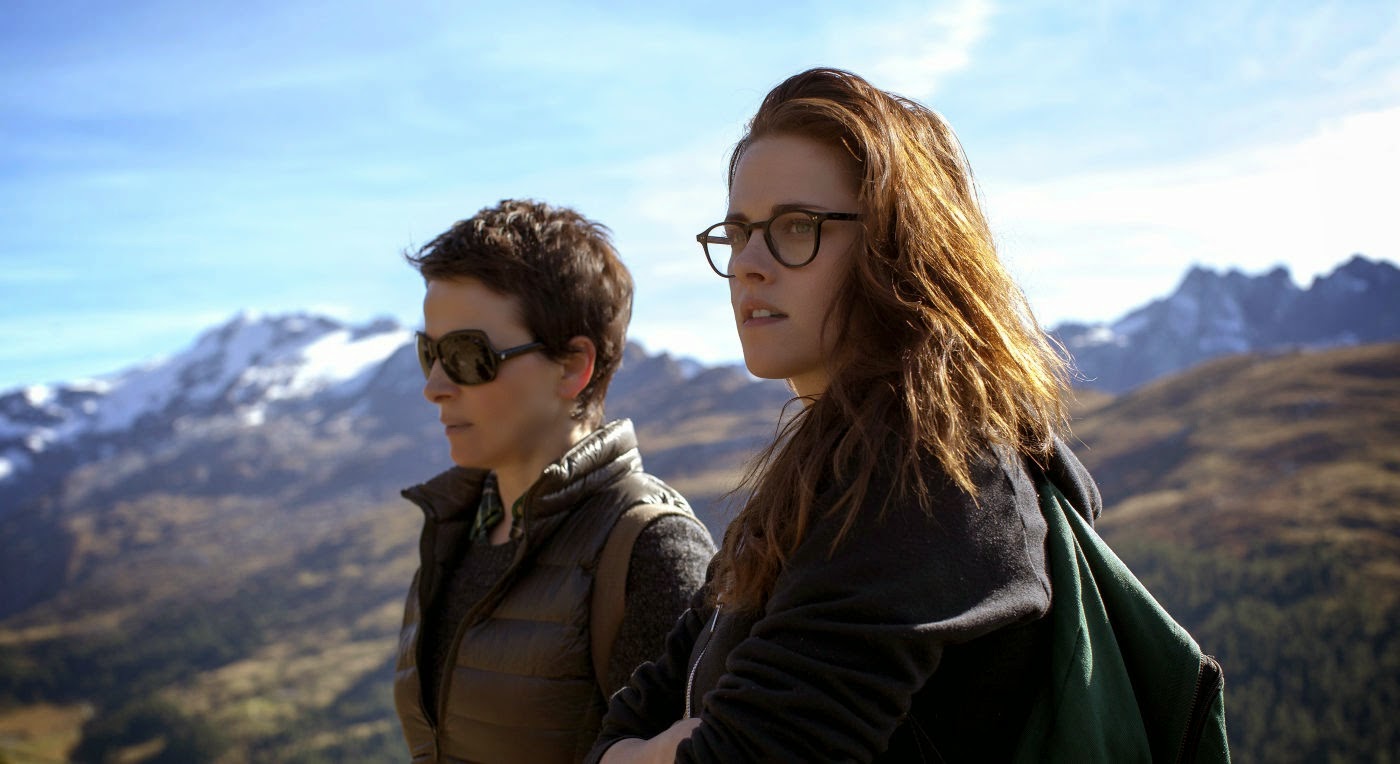
Clouds of Sils Maria (in the presence of Olivier Assayas)


Juliette Binoche, Kristen Stewart
"At the peak of her international career, Maria Enders is asked to perform in a revival of the play that made her famous twenty years ago. But back then she played the role of Sigrid, an alluring young girl who disarms and eventually drives her boss Helena to suicide. Now she is being asked to step into the other role, that of the older Helena. She departs with her assistant to rehearse in Sils Maria; a remote region of the Alps. A young Hollywood starlet with a penchant for scandal is to take on the role of Sigrid, and Maria finds herself on the other side of the mirror, face to face with an ambiguously charming woman who is, in essence, an unsettling reflection of herself."
- Cannes Film Festival (2014)

Sils Maria [French title]. DE/FR/CH 2014
Directed by     Olivier Assayas
Produced by     Karl Baumgartner
Charles Gillibert
Thanassis Karathanos
Jean-Louis Porchet
Gérard Ruey
Written by     Olivier Assayas
Starring     Juliette Binoche
Kristen Stewart
Chloë Grace Moretz
Cinematography     Yorick Le Saux
Editing by     Marion Monnier
Studio     CG Cinéma
Release dates: May 23, 2014 (Cannes)
20 août 2014 (sortie nationale)
Running time     123 minutes
Country     Germany
France
Switzerland
Language     English
C:  Juliette Binoche as Maria Enders
    Kristen Stewart as Valentine
    Chloë Grace Moretz as Jo-Ann Ellis
    Johnny Flynn as Christopher Giles
    Lars Eidinger as Klaus Diesterweg
    Hanns Zischler as Henryk Wald
    Brady Corbet as Piers Roaldson
    Aljoscha Stadelmann as Urs Kobler
    Luise Berndt as Nelly
    Angela Winkler as Rosa Melchior
    Gilles Tschudi as Mayor of Zurich
    Claire Tran as Mei-Ling
    Frank M. Ahearn as Oz
    Jakob Kohn as Jo-Ann's manager
(credits from Wikipedia)
    The film within the film: Das Wolkenphänomen von Maloja (Arnold Fanck, c.m., DE 1924). - Theme tune: Pachelbel's (1653-1706) Kanon in D-Dur.
    2K DCP from CG Cinéma, original in English, in the presence of Olivier Assayas, viewed at Cinema Lapinsuu, Sodankylä, Midnight Sun Film Festival, 13 June 2014

The first international screening after Cannes of the latest film by Olivier Assayas.

Assayas belongs to the directors whose oeuvre makes sense as a whole, the films being stages of a continuous evolution, in a story of constant growth, alternating genre films and unclassifiable ones, big films and small, French films and international productions, always spreading his wings to unexplored territory or returning to familiar territory with deeper insight and a wider perspective.

In the last four films I have sensed a special growth to a new level in Assayas's films. They are more assured, more dense, more resonant. The early films one can appreciate for their raw energy, fresh observations and poetic vitality. The recent films are more complex, their context is larger, the sense of society is fuller.

Clouds of Sils Maria has a more reduced character than Assayas's three previous films. It is mostly a tale of two women, although not in quite such a stark manner as in Ingmar Bergman's Persona. The central action is about the famous actress Maria Enders (Juliette Binoche) rehearsing a major play together with her assistant Valentine (Kristen Stewart). The dialogue of the characters in the play within the play reflects constantly on Maria and Valentine, themselves.

Where Bergman took his two women to the rugged isle of Fårö, Assayas sets the main action to Sils Maria on the Swiss Alps.

A story of alienation, Clouds of Sils Maria also brings to mind Antonioni's L'avventura set on the volcanic Aeolian Islands, and Rossellini's Stromboli and Viaggio in Italia (Pompeii). One of the early masters of soulscape was Victor Sjöström. The mountain film Berg-Ejvind och hans hustru is part of this year's Midnight Sun Film Festival, as well as Viaggio in Italia.

The characters of this movie are strangers to themselves. They remain distant for us. They are in constant communication online with their cell phones and laptops. But their mutual face-to-face communication remains superficial.

Maria Enders realizes that she is the mature woman now, almost 50-something, belonging to the grandmother generation already. The contemporary 20-something women keep puzzling her. Actually she would like to quit the production but she is all tied up. Perhaps the next act after the end of this film could be like the first act of Persona.

More remarks:
    There is a play within the play, and a film within the film: Arnold Fanck's Das Wolkenphänomen von Maloja (1924), an expression, together with the Alps themselves, of the sublime of nature. The film-within-the-film is a purely visual document of the unique "cloud snake" emerging in the Maloja pass.
    The nature is sublime, and the concerns of the characters seem trivial. This was always one of the senses of the mountain film. On the other hand, the grandeur of the mountains was a reflection of the heights of passion / devotion / spiritual endeavour. But here there is a sense of loss, nostalgia, and regret, as the grand master playwright-director is dead. There is a sense of emptiness.
    The main musical theme, Pachelbel's Kanon, also reinforces the dimension of the sublime, missing from the interpersonal story.
    The contemporary film scene is expressed in a delicious parody of lowbrow science fiction in 3D featuring the latest tabloid star Jo-Ann Ellis (Chloë Grace Moretz). "I could feel my brain cells vanishing", comments Maria.
    But surprisingly the real Jo-Ann - who is taking over the part which used to be Maria's breakthrough role -  proves to be an intelligent, talented and courteous person, as is her boyfriend. Maria is even more puzzled now, and she remarks to Valentine that Jo-Ann is "a lot more interesting than the person you described".
    When the mysterious cloud snake emerges, neither Valentine nor Maria are there to witness it. Valentine has disappeared on the Alps (qf. L'avventura, L'eclisse), never to be seen again by Maria.

It is admirable for Kristen Stewart, the most highly paid actress during the Twilight saga, to spread her wings in a distinguished film like this. Perhaps Assayas cast her in part due to her vampire image, her ability to project a cool and callous persona. In Bergman's Persona, the star was the one with a hard surface, and there was a vampiric suction from her to the sensitive aide. Here the star is the more sensitive person (especially vulnerable now, recovering from divorce, the sudden death of the playwright, and from the fact that she is playing the tragic victim in the play in which she had debuted as the predator), and the young women are the tough ones.

Shot on 35 mm film as Assayas always insists to do, the film has gone through the digital intermediate, with predictable results to the sense of the sublime of the nature.

After the screening Olivier Assayas told us that he had always wanted to do a film starring Juliette Binoche. In The Summer Hours Binoche got to play an important part, but Sils Maria is her first leading role in an Assayas film. Their collaboration goes back to Rendez-vous by André Téchiné. Its screenplay was Assayas's breakthrough, and the female lead was Binoche's big break. There are relevant connections between Rendez-vous and Sils Maria, both being films about demon directors and actors reflecting their own identities in the roles they play.

A Fuller Life (in the presence of Samantha Fuller)

Samuel Fuller
Country & year: U.S.A., 2013
Director: Samantha Fuller
Screenplay: Samantha Fuller (concept), Samuel Fuller (autobiography)
Cinematography: Hilton Goring, Seamus McGarvey, Rachel Wyn Dunn
Editing: Tyler Purcell
Sound: Benjamin Rauscher, Gary Coppola
Music: Paul-Alexander Fuller
Cast: Samuel Fuller, Robert Carradine, Joe Dante, William Friedkin, Monte Hellman, Tim Roth, Constance Towers, Wim Wenders, Mark Hamill, James Franco, Buck Henry, Bill Duke, Perry Lang, James Toback, Kelly Ward
Production: Chrisam Films
Producers: Gillian Horvat, Samantha Fuller, Christa Lang-Fuller
Language:English
Duration: 80 min
    Shot on 16 mm, transferred to digital.
    2K DCP from Chrisam Films viewed at Cinema Lapinsuu, Sodankylä (Midnight Sun Film Festival), 13 June 2014

Lauri Timonen (Midnight Sun Film Festival Catalogue, 2014): "A Third Face. My Tale of Writing, Fighting and Filmmaking (2002) is undoubtedly one of the greatest Hollywood memoirs ever written – in more than one sense of the word. The autobiography of the maverick director Samuel Fuller (1912–1997) is extensive enough to cover three different eras from Fuller’s early journalistic career to his later experiences in war. The stories are throughout mind-blowing, captivating and skillfully narrated."

"Of course we also remember the initial energy that Fuller presented for the lucky audience 29 years ago as the star guest of the first ever Midnight Sun Film Festival, in a way even outlining the spirit of the whole festival. This year we welcome his daughter Samantha Fuller with her brand new documentary A Fuller Life, based on her father’s autobiography, where Sam’s friends and fans – including the actors Mark Hamill, Robert Carradine, Constance Towers and Tim Roth as well as the directors Joe Dante, Wim Wenders, William Friedkin and Monte Hellman – read excerpts and stories from the book."

"Fuller, who can be described as the god of film addicts, lived an incredibly eventful life. One example of his unique approach is the way he managed to maintain his personal voice and independent style, even when working as a director within, or at least near by, the Hollywood system. He even almost carried through with the pompous jungle adventure described in Mika Kaurismäki’s Tigrero (1994), the preliminary cast including John Wayne, Ava Gardner and Tyrone Power. In reality, a talented director like Fuller was at his best away from the glamour of the stars; making more intimate films that are precise like news articles and bear the soft scent of cigars, but yet intimate, harsh, strangely gentle and wild, such as The Steel Helmet, Park Row, Shock Corridor, The Naked Kiss, The Big Red One, or the delicate yet brutal masterpiece presented in Lapland this year, Underworld U.S.A." (LT)

Samantha Fuller has filmed the autobiography of her father, Samuel Fuller, by having key people as narrators read illuminating passages from it. Constance Towers is my favourite. Monte Hellman and William Friedkin, among others, catch the Fuller spirit very well.

Fuller's autobiography, A Third Face, belongs, indeed, to the best memoirs of Hollywood film-makers, and it is not only about Hollywood, but also about American journalism and about the Second World War.

I have read the book, so the text was familiar to me, but I was very grateful for the affectionate choice of narrators, the rich selection of photographs and other images, and the clips from almost all of Samuel Fuller's films, as a rule with good visual quality.

As a journalist, Fuller had explored America from coast to coast during the 1920s and the 1930s, and during WWII ("the biggest crime story of the century") he did the long tour in the Big Red One, participating in key battles of the century, most importantly on D-Day.

Fuller's own 16 mm WWII footage is the most stunning discovery of the film. I had seen some of it in previous Fuller docs such as Tell Me Sam and Falkenau. This find is so impressive that I look forward for more.

Sodankylä morning discussion: Alice Rohrwacher with Peter von Bagh


"6.00 in the morning in Sodankylä. Alice Rohrwacher sings her own song near the river, [together with the Cleaning Women trio]. And suddenly I realize that I've never heard anything so beautiful. Because she is a truly friend of beauty. Watch Le meraviglie (THE WONDERS)." Photo: Boris Nelepo. From Boris Nelepo's Facebook page, 15 June 2014, by permission.

The discussion was conducted in English. The School, Sodankylä, Midnight Sun Film Festival, 13 June 2014

The résumé at The Midnight Sun Film Festival site:

"“It all began when I got to know a circus family. I didn’t know any circus tricks so I had to find some other way to join them”, Alice Rohrwacher says. That other way she found in cinema. She created her first documentary film, Un piccolo spettacolo (2005), by doing, daring and experimenting."

"Friday got its start at Midnight Sun Film Festival with morning discussions with two self-made directors. Film guru Olaf Möller interviewed Polish director Pawel Pawlikowski (born 1957), who turned to fiction from BBC’s documentary department, and the Italian-German Alice Rohrwacher (born 1982), who just won the Cannes Grand Prix with her new film The Wonders."

"Rohrwacher is also led by intuition in her filmmaking. That is also why she shoots on film. “When you shoot on film, you have an idea of what you are shooting, but you do not know everything that will end up in the take. It is about the meeting of the filmmaker and the subject. As it is in life or any encounter, you can not know or control everything. But when you shoot on digital, you can modify everything later.”"

"When it comes to staying real and true, Rohrwacher makes no compromises. For her film Corpo celeste, she went through every church in the city to find the one that was right for the film."

"“My beekeeper father taught me that when the flowers are in bloom, then it is time to leave. You can not know it by looking at a clock”, Alice Rohrwacher reflects. To her filmmaking and life are one and the same.
" (The résumé at The Midnight Sun Film Festival site).

Sodankylä morning discussion: Pawel Pawlikowski with Olaf Möller

Pawel Pawlikowski, Olaf Möller, 13 June 2014
 The discussion was conducted in English. The School, Sodankylä, Midnight Sun Festival, 13 June 2014

The résumé at The Midnight Sun Film Festival site:

"Friday got its start at Midnight Sun Film Festival with morning discussions with two self-made directors. Film guru Olaf Möller interviewed Polish director Pawel Pawlikowski (born 1957), who turned to fiction from BBC’s documentary department, and the Italian-German Alice Rohrwacher (born 1982), who just won the Cannes Grand Prix with her new film The Wonders."

"After his parents’ divorce, Pawlikowski moved to England with his mother. The experience was a tough one for the 13-year-old boy: the “holiday trip” turned out permanent as his mother had secretly gotten married with an Englishman. Pawlikowski felt rootless and homeless, and after a series of events he moved to London. There he discovered films and music, began studying philology and wrote his dissertation after completing his studies."

"“It was kind of about trying to avoid working on the dissertation, I guess. My friends were members in a film society, so I also got involved. It was there that I first tried my hand at making films of my own”, Pawlikowski says."

"It was around this time that Pawlikowski noticed an ad for a BBC training program. He ended up getting a job at their documentary department. There he presented some of his ideas, which led to dinner discussions, which in turn led to his ideas being approved for projects. Pawlikowski hadn’t spend a single day in film school, but he knew what he wanted. There already existed enough conventional television documentaries."


"Pawlikowski describes his documentaries as collages. He is particularly interested in individuals, and they take centre stage in his documentaries as well as in his fiction films. The documentary Dostoyevsky’s Travels got its start when Pawlikowski was in Russia at Dostoyevsky’s home museum and met the man who ended up becoming the film’s main character."

"“There was a genteel man who looked like Dostoyevsky sitting in a corner at the museum, and the museum curator urged me to approach him. The man turned out to be the only living relative of Dostoyevsky. I found this character so fascinating that I just had to make a documentary about him. I managed to sell it to BBC as a literature documentary, although the main character hadn’t written a single word in his entire life”, Pawlikowski smirks."
(The résumé at The Midnight Sun Film Festival site).

Thursday, June 12, 2014

Die andere Heimat – Chronik einer Sehnsucht / Home from Home - Chronicle of a Vision


Country & year: Germany / France, 2013
Director: Edgar Reitz
Screenplay: Edgar Reitz, Gert Heidenreich
Cinematography: Gernot Roll
Editing: Uwe Klimmeck
Set Design: Anton Gerg, Hucky Hornberger
Costumes: Esther Amuser
Sound: Philippe Welsh, Daniel Dietenberger, Vincent Demortain
Music: Michael Riessler
Cast: Jan Dieter Schneider, Antonia Bill, Maximilian Scheidt, Marita Breuer, Rüdiger Kriese, Philine Lembeck, Mélanie Fouché
Production: Edgar Reitz Film, Les Films du Losange, ARD Degeto Film, BR, WDR, arte Geie
Producer: Christian Reitz
Language: German
Duration: 225 min
    Black and white in scope. Werner Herzog als Alexander von Humboldt
    2K DCP viewed at Cinema Lapinsuu, Sodankylä (Midnight Sun Film Festival), 12 June 2014

Timo Malmi (Midnight Sun Film Festival Catalogue 2014): "Heimat: A Chronicle of Germany was a beloved TV series also in Finland. Its progenitor Edgar Reitz has once more (at over 80 years of age!) returned to the village of Schabbach in Hunsrück, however this time with a wonderful, over-4-hour-long film intended for the big screen."

"Home from Home “does not offer just a sort of a prehistory for three television epics but proves to be the sum of all of Reitz’s artistic production”, Olaf Möller (Filmihullu 5/2013) writes, continuing that the film “is set in the early 1840s when the establishment of a state called Germany was finally becoming a reality – when millions broke away from their home conditions in order to detach themselves from oppression, exploitation and sometimes immense poverty.”"

"The main group of characters consists of the family of blacksmith Johann (of the familiar Simon family), and the most central person is brainy Jakob who dreams of moving to Brazil. Jakob falls in love with Jettchen who wavers between him and his more practical brother, blacksmith Gustav. “The panorama of leaving and staying becomes wider: waterfalls of colour appear in the wonderfully pretty black-and-white picture. Reitz has a sometimes delicate, sometimes barbarically flamboyant ability to tell the story through grand scenes and insanely huge elliptical condensations; he has the desire and the madness to be swept away by dreams and visions as well as delve into the agrarian culture and the details of mud or cracks in the wood,” Möller praises." (TM)

"EDGAR REITZ was born in Hunsrück in 1932. He studied various art subjects in Munich and participated actively in different fields of culture. Starting in early 1950s he made several short films, was a member of the Oberhausen group and one of the essential names of the new wave of German cinema, which started in 1962. His first feature film Table for Love was awarded at the Venice Film Festival in 1967. Since then he has made numerous feature-length drama films, documentaries and experimental films. Reitz has also taught film studies and written books on film aesthetics and theory. With its several filmed sequels, the TV series Heimat constitutes the core of Reitz’s unique input to German cinema." (Midnight Sun Film Festival Catalogue 2014)

The magnificent Heimat prequel of Edgar Reitz has been called the best German film in years, and I can believe that, although I have not seen enough new German films myself.

It starts in 1842. The most prominent recurrent image is of wagons of emigrants moving in the horizon. Feudalism has not yet disappeared, Rheinland is not a land of freedom, and Brazil, among other countries, is seductive. The original title means "the other homeland", which can mean something concrete (like Brazil), or something transcendent.

The concept of Die andere Heimat is cinematic, not televisual. There are splendid vistas, majestic camera movements, a sense of space. Hawks patrol the skies, and there is a hawk-eye sense in the movie. We see the hills and the meadows and the rafts on the Rhein. The composition is noble and stark, made for the screen. The camera is liable to fly over the treetops to cover the wonderful landscape.

Die andere Heimat is a true epic, covering great social movements such as rebelling against the baron's wine selling privileges, and a great communal Smearcase Fair dance. We see the horrible prison conditions of the rebels.

There is also a story of mismatched loves: the two girls and the two boys do not get the ones they should. Once off guard Henriette surrenders to the wrong guy, and nothing can change the course of life ever since.

There is a strand of technology, of learning to build and operate a steam engine.

There is a strand of medicine: the old mother getting suffocated and being taken to the hills for sun and air. She has a vision of all the six children she has lost.

Devastating weather with snowstorms brings famine and death, and is a final boost to a mass emigration to those who have survived.

Like our native Finnish Elias Lönnrot, Jakob is fond of reading books in trees. The self-taught Jakob has an insight of "the common secret of language", and his discoveries are acknowledged by Alexander von Humboldt (Werner Herzog in a memorable cameo).

The music is constantly interesting.

The excellent cinematography is in black and white and scope, with selected details in red tint and occasionally in other colours.

The digital look is really brilliant, yet somehow the DCP impression is like a landscape after the explosion of a neutron bomb or the moonscape (where there is no atmosphere).

Corpo celeste (in the presence of Alice Rohrwacher)


Alice Rohrwacher: Corpo celeste (IT/CH/FR 2011). Yle Vianello as Marta, about to take her confirmation.

Taivaankappale (Yle Teema 31.5.2024) / Himlakropp.
    IT/CH/FR 2011
D: Alice Rohrwacher
SC: Alice Rohrwacher
DP: Hélène Louvart
ED: Marco Spoletini
AD: Luca Servino
Cost: Loredana Buscemi
S: Daniela Bassani, Cristiano Ciccone, Marzia Cordò, Riccardo Studer
M: Piero Crucitti
C: Salvatore Cantalupo, Anita Caprioli, Renato Carpentieri, Paola Lavini, Pasqualina Scuncia, Yle Vianello
PC: Amka Films Productions, JBA Production, Tempesta
P: Carlo Cresto-Dina
Print: Rai Trade
Esitysformaatti: DCP announced, 35 mm screened
Language: Italian
Subtitles: English
100 min
    Shot on Super 16 mm. Digital intermediate: Deluxe Digital.
    C: Yle Vianello (Marta), Salvatore Cantalupo (Don Mario), Pasqualina Scunca (Santa), Anita Caprioli (Rita), Renato Carpentieri (Don Lorenzo).
    Rai Trade 35 mm print with English subtitles by Charlotte Lantery viewed at Cinema Lapinsuu, Midnight Sun Film Festival, in the presence of Alice Rohrwacher, 12 June 2014

Timo Malmi in the Midnight Sun Film Festival 2014 Catalogue: "It is interesting to compare Alice Rohrwacher’s debut feature film Corpo celeste to Love Like Poison by Katell Quillévéré, another director guest of ours, or maybe to the films dealing with religion by Marco Bellocchio, our Italian guest from last year. They may contain the same kind of dark humour, but perhaps more melodrama, at least in the early works."

"In its slightly dreamlike quality, Rohrwacher’s directional work moves within the forever-interesting area of fiction and documentarism, somewhat in the spirit of cinema vérité. Just like in Love Like Poison, the main character of Corpo celeste is a teenage girl: the 13-year-old Maria who, too, prepares for Confirmation in a remote location in the poor region of Calabria in Southern Italy, where the influence of the Catholic Church lingers as strong as in the French film by Quillévéré. Marta, too, feels like an outsider: she has grown up in a proletarian family in Switzerland – now she has moved to a new area with her sympathetic mother, a jealous big sister, and a little brother."

"Fairly independent for a pubescent girl, Maria searches for her place in the world, continually colliding against the hypocrisy of the grown-ups and the Church. The local priest, the dubious and manipulative Father Mario, is more interested in his career and political activities than in the confirmation school students."

"Hélène Louvart has shot the impressive Corpo celeste (“Celestial Body”) with a Super 16 mm camera and a style serving mundane realism with a direct “gut feeling”, thus moving respectfully along on the trail of the Dardenne brothers (in Sodankylä in 2005). Yle Vianello amazes with her persuasive performance in this intimate coming-of-age story as the young Marta, whose own internal search seems inconsistent with the phony Church and the general atmosphere of the village where people are engaged in the preparation of a visit by the bishop." (TM)

AA: A sensitive account of the 13 year old Marta's passage from childhood towards young womanhood. The film title Corpo celeste, refers to Jesus Christ, the spiritual body, juxtaposed with Marta's physical body undergoing fundamental changes.

It is a story of Weltschmerz. Besides her early teenage angst, Marta is also experiencing a cultural shock, the family having returned from a ten year stay in Switzerland to Southern Italy.

The narrative is about Marta's visiting the confirmation class. She is a hopeless student. Yet gradually we realize that she has interiorized values essential to Christianity.

In a key sequence she is following Don Mario to an abandoned mountain village where they will rescue a lifesize crucifix needed for the confirmation ceremony. The only inhabitant is a hermit priest with whom Marta establishes a connection. As Marta cleans tenderly the dirty crucifix it is an image of her getting closer to Christ, and also closer to the idea of the physical male. Marta is obsessed with the sentence "Eli Eli, lama sabachthani?" ("My God, My God, why have you forsaken me?").

On the steep mountain road the crucifix swings loose and falls deep down to the Mediterranean Sea.

Alice Rohrwacher directs her film in the realistic mode. She thinks in images. The images are memorable yet unobtrusive.

A central image is water / the ocean / the fish. Mother has ceased to buy Mediterranean fish because of the number of corpses of refugees rotting there. The kittens of the parish are drowned in the sea. Also the crucifix lands there. Marta finally takes her real baptism by wading to the sea next to the garbage dump in her white confirmation dress.

The film is full of interesting observations of the contemporary reality of the church. It would be wrong to call the observations satirical. We smile at the pop approach to religious music, the blatant contradiction between the lessons taught and the actual behavior (Marta is slapped: credo!), the attraction of Santa to Don Mario, and Don Mario's suffering looks at the everyday incidents as he desires to be promoted. Despite all these mundane concerns there is a sense of true spirituality and religious community.

The 16 mm cinematography is close to life, and the camera is often subjective. Because I have seen too many films shot with a handheld camera I find that handheld cinematography can seem artificial.

After the screening Alice Rohrwacher was interviewed by Satu Kyösola. Rohrwacher told that Yle Vianello was discovered in a hippie community; she talked Italian without an accent, and she had never been in a city before. - Rohrwacher likes to start a film with lights emerging in the dark. - With Pasolini Rohrwacher shares a sense of respect to the body, with the insight that the body is a temple. - The shooting was conducted with no hidden camera, instead with the attitude of "we are here", the camera on the shoulder. We take responsibility, we breathe, we were there. - Everything is organically connected: the acting, the clothes, the story, the camera. Everything is interconnected. - Simbolo = union, diavolo = separation. Symbols emerge from the ground, like in Out of Africa, the story of the stork.

The passage of the Bible shown to Marta by the hermit priest:

Mark 3
Jesus Accused by His Family and by Teachers of the Law

20 Then Jesus entered a house, and again a crowd gathered, so that he and his disciples were not even able to eat. 21 When his family heard about this, they went to take charge of him, for they said, “He is out of his mind.”

22 And the teachers of the law who came down from Jerusalem said, “He is possessed by Beelzebul! By the prince of demons he is driving out demons.”

The Sodankylä Award to Anssi Luoma


The Sodankylä Award was given to Anssi Luoma from Ylistaro, Seinäjoki, a passionate and visionary cinephile, and a veteran of an old cinema family. He has successfully kept an ambitious cinema afloat in the midst of the digital turbulence, and there is also a new talented generation continuing his work.

SODANKYLÄ-PALKINTO KINOSANKARI ANSSI LUOMALLE
Lehdistötiedote

Elokuvateatterit olivat 1900-luvun siunauksellisia luomuksia. Ne ovat muuttuneet, syvällisesti, eivätkä ehkä parempaan päin. Katsoja kokee yhä harvemmin, että näytöksen keskipisteessä on itse elokuvan maailma. Lisäksi, kaikesta teknologiauskonnosta huolimatta, ilmassa on usein teknisen piittaamattomuuden ja rutiinin ilmapiiri. Siksi "vanhanaikaisesti" hoidetut teatterit - sellaisia yhä on valtakunnassamme - ovat kansallisia aarteita, ja niille omistautuneet ihmiset meille rakkaan taidemuodon tärkeitä esitaistelijoita.

Ylistarossa vaikuttava Anssi Luoma (s. 1950) kuuluu tähän yhä harvinaisempaan ihmislajiin. Elokuvallisen perimätiedon vaalija, kolmannen polven elokuvateatteriyrittäjä, on omistautunut elokuvalle tavalla, josta aistii, ettei mikään muu asia mene edelle. Hänen isoisänsä Matti Luoma perusti teatterin, jonka nimi on yhä hänen muistoaan vaalien sama: Matin-Tupa. Ensimmäiset esitykset Matin-Tuvassa olivat 1941. Vanha rakennus paloi, ja nykyinen, atmosfääriltään taianomainen tupa nousi 50-luvulla, avajaiselokuvanaan T. J. Särkän Juha - ensimmäinen pitkä suomalainen väri- ja laajakangaselokuva. Matin-Tupa on sittemminkin  seurannut aikaansa: se sai digiprojektorin ensimmäisenä maaseututeatterina, mutta on toisaalta pitänyt kiinni filmiprojektoreista - sekä 16 mm:n että 35 mm:n tekniikoista - joiden käytännöstä huolehtii jo seuraava sukupolvi, Anssi Luoman tyttäret.

Teatterissa järjestetään pari-kolme näytöstä päivässä, ja Anssi Luoma - joka on siviiliammatiltaan tierakennusinsinööri Seinäjoella - on aina läsnä. Koneita hän on pyörittänyt melkein lapsesta asti. Ohjelmistossa on Suomen ensiesityksiä melkein joka viikko.

Filmiä ja valoa -festivaali syntyi 2007 Matin-Tuvan ympäristössä, Anssi Luoman luomuksena. Monet vieraat ovat kokeneet kotikutoisen, intiimin atmosfäärin elokuviensa parhaaksi näytösympäristöksi ("hurmaava" on usein kuultu sana). Festivaali täydentää hienosti Matin-Tuvan vuosikymmenten mittaista erityissuhdetta suomalaiseen elokuvaan.

Luoman hieno elokuvatietämys heijastuu hänen komeassa elokuvajulisteiden kokoelmassaan, joka on maan laajin yksityisesti omistettu, ainutlaatuinen visuaalinen johdanto sekä elokuvan levittäjien että kuluttajien makutottumuksiin ja odotuksiin - kulttuuria, joka usein tasaveroisesti elokuvien kanssa luo muiston siitä mitä tietyt elokuvat ovat merkinneet Suomen henkisessä ilmastossa.

Luoma tunnetaan epäitsekkäänä vaikuttajana: hän on monin tavoin edistänyt koko maakunnan elokuvatoimintaa, vailla pienintä ammattikateuden häivää. Hän jakaa tietoa ja kokemusta myös "kilpailijoille".

Sodankylä-palkinto luovutetaan Anssi Luomalle tunnustuksena siitä, että hän on rajusti muuttuneiden olosuhteiden keskellä säilyttänyt elokuvateatterin perinteisen arvokkuuden, viehätysvoiman ja kyvyn tiivistää ihmisen unelmia.