Showing posts with label István Szabó. Show all posts
Saturday, June 13, 2009
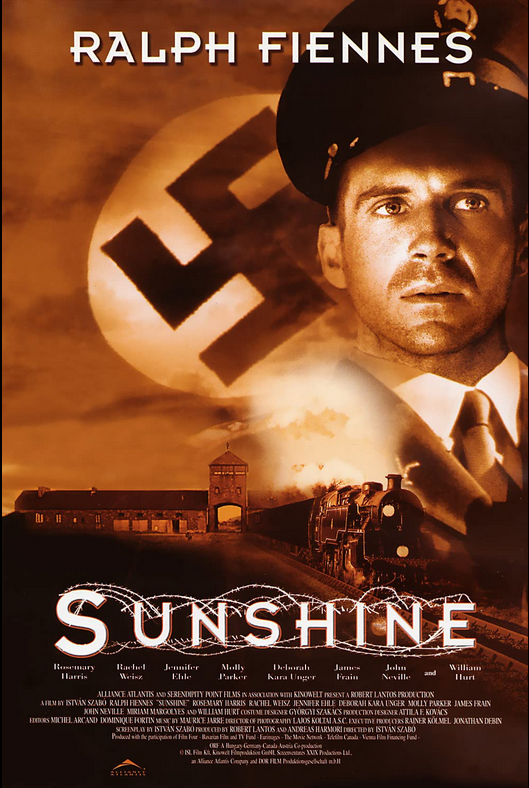
Sunshine
DE/AT/CA/HU (c) 1999 [many production companies]. P: Andras Hamori, Robert Lantos. D: István Szabó. SC: István Szabó, Israel Horovitz. DP: Lajos Koltai - colour and black & white (archival footage) - 1,85:1. M: Maurice Jarre. Egmont overture by Beethoven. PD: Attila Kovács. AD: Zsuzsanna Borvendég. COST: Györgyi Szakács. ED: Michal Arcand. CAST: Ralph Fiennes (Ignatz Sonnenschein / Adam Sors / Ivan Sors), Jennifer Ehle (Valerie Sonnenschein as a young woman) Rosemary Harris (Valerie Sors as a grown-up woman), Rachel Weisz (Greta), Deborah Kara Unger (Maj. Carole Kovacs), John Neville (Gustave Sors as an old man), Miriam Margolyes (Rose Sonnenschein), Rüdiger Vogler (Gen. Jakofalvy), Hanns Zischler (Baron Margitta), Mari Töröcsik (Older Kato), William Hurt (Andor Knorr). 181 min. A Filmunio print, original in English, viewed at Cinema Orion, Helsinki, 12 June 2009. - Print with beautiful colour, pleasant photochemical look, wear and tear in changeovers. - One of the essential films by István Szabó, one of the essential Jewish films of all time, an essential film of reckoning with the Eastern European past, celebrating the 20th anniversary of the fall of the wall. - It is the story of a hundred years in three generations of the Sonnenschein / Sors family. It starts from the shtetl, the family patriarch the inventor of a herbal liquor. Ignatz becomes a judge, and has to change his name. His son Adam becomes an Olympic fencer, and has to convert to Catholicism. That does not prevent him from becoming a victim of the Holocaust. His son Ivan becomes a police officer in Socialist Hungary, to bring the fascists to justice. But witnessing the crimes of Stalinism and the bloody repression of the people's uprising of 1956 he turns his back to the new system. - A unique attempt to cover honestly the various totalitarian administrations in Hungary. - As a Jewish film, it is about the tragedy of forced assimilation and persecution. The Holocaust episode belongs to the most harrowing in the history of the cinema. - Among the recurrent motifs: the lost recipe notebook, the grandfather's watch, the splinters. - Towards the end of the film certain lessons first mentioned in the start get new resonance. "We are afraid to see clearly and to be seen clearly". "If you struggle for acceptance, you'll always be unhappy". "You are not in prison, they are in prison". "One day I'll wipe that smile off your face". "I'm not anybody's wife, I'm myself". - The finest sequence: the 1956 uprising edited to the rhythm of Beethoven's Egmont overture. - There are gorgeous female roles in the film, and especially the scenes with the bright Jennifer Ehle radiate with intelligence, courage, sensuality and frank sexuality. - Rachel Weisz would have deserved more screen time, but of course the film is long as it is. Rosemary Harris is excellent as the grown-up Valerie. - Although Ralph Fiennes in his triple role portrays the three main characters, finally, Valerie is the soul and heart of the film, the only one who never loses her inner compass. - A film I decided I want to see again even while still watching it.
Thursday, June 11, 2009
Being Julia
CA/GB/HU © 2004 2024846 Ontario, Inc. / Being Julia Productions Limited / ISL Film Kft. Serendipity Point Films presents. P: Robert Lantos. D: István Szabó. SC: Ronald Harwood – based on the novel by W. Somerset Maugham (Theatre, 1937, in Finnish Näyttelijätär 1951 J.A. Hollo / Otava, 5. ed. 2005). DP: Lajos Koltai – colour: DeLuxe – 1,85:1. AD: Luciana Arrighi. COST: John Bloomfield. Make-up: Erzsébet Forgács. M: Mychael Danna. S: Jane Tattersall. ED: Susan Shipton. CAST: Annette Bening (Julia Lambert), Jeremy Irons (Michael Gosselyn), Bruce Greenwood (Lord Charles), Miriam Margolyes (Dolly de Vries), Juliet Stevenson (Evie), Shaun Evans (Tom Fennel), Lucy Punch (Avice Crichton), Tom Sturridge (Roger Gosselyn), Maury Chaykin (Walter Gibbs), Sheila McCarthy (Grace Dexter), Rosemary Harris (Julia's aunt), Rita Tushingham (Aunt Carrie). 103 min. A print with Finnish / Swedish subtitles by Sanna Manninen / Hellevi Raita. Viewed at Cinema Orion, 11 June 2009. - A print without joins or scratches but with a digital intermediate look. - A great satire about the theatre, show business, and actors. - Annette Bening is wonderful as the narcissistic theatre diva approaching the age of 50. There is a grand finale in which she faces all the disasters and overcomes them (for the time being) in magnificent theatrical manner. - Mychael Danna's music is very appealing, spiced with 1930s hit songs. - This film belongs to the same tradition as All About Eve: Annette Bening invites comparison with Bette Davis, and Lucy Punch gets the role of Eve. - The victory belongs to Julia Lambert, the character played by Annette Bening. But the most cutting criticism Julia receives from her own son, who accuses her mother that she "does not exist", and that all that she has to say is second hand.
Friday, June 05, 2009
Bizalom
Luottamus / Förtroende. HU 1979. PC: Objektiv Filmstudio. D+SC: István Szabó. DP: Lajos Koltai. CAST: Ildikó Bánsági (Kata), Péter Andorai (Janos). 117 min. A Filmunio print with English subtitles. Viewed at Cinema Orion, 5 June 2009. - A worn print, turned red, shortened by 10 min and badly battered in previous venues. - Revisited: an intensive chamber piece that I had previously seen only on tv, very tired. - One of Szabós best films, still strong, it has stood the test of time well. - Life during the final period of the Nazi occupation in Budapest, when the terror and the persecution were at their worst. This is, however, not a Holocaust story. It's the personal story of the wife of a resistance fighter, who has to lead a double life during the final year of the Nazi occupation. She has to assume a false identity, living in isolation in a room with a fake husband, also a Resistance fighter. - It is about the constant fear of the small detail giving one away. - Elliptic montage. - Ildikó Bánsági has the same kind of nobility in her demeanour as Ingrid Bergman. - Life under extreme pressure. "It does not matter where you are as long as you are at ease with yourself". - This is also an erotic film: sex with the perfect stranger. The sex scenes belong to the best in the history of the cinema, thanks to Ildikó Bánsági's delicate candour. - After the liberation the terror and the persecution start again under a different banner.
Wednesday, May 20, 2009
Szerelmesfilm
Elokuva rakkaudesta / En film om kärlek. HU 1970. PC: Mafilm. D+SC: István Szabó. DP: József Lörincz – b&w and colour – 1,66:1. AD: Tamás Vayer. COST: Erzsébet Mialkovszky. Make-up: Ábrisné Basilides, Edit Basilides, András Tolnai. M: János Gonda. S: György Kovács, György Pintér. ED: György Sívó. CAST: Judit Halász (Kata), András Bálint (Jancsi), Edit Kelemen (Kata as a child), András Szamosfalvi (Jancsi as a child), Rita Békes (Klári), Erzsébet Mialkovszky (young Kata), Éva Berényi (young Jancsi), Mária Baga, Erika Kúnszenti (Jutka), Péter Huszti (Karcsi), Ervin Csomák, Tamás Eröss (Pattantyús), György Aranyossy (Klári férje), Iván Mándy (doctor), Kati Andai (Magdi), Lucyna Winnicka (Ágnes). There is reportedly a 143 min version. This version 123 min. A Filmunio print with English subtitles. Viewed at Cinema Orion, 20 May 2009. - A worn print with scratches, print partly all red, partly reddish, heavy scratches in the changeovers, yet somehow watchable. - The story of Kata and Jancsi, separated by the tragedy of history, Hungary's 1956 uprising and its violent aftermath. - Like in Jules et Jim, tragic truths are approached playfully, yet not flinching from the terror. - A poetic film does not follow the conventions of narration. It moves in various time dimensions, and includes direct address to the spectator. The protagonists are simultaneously children, young persons, and adults in the anti-chronological narration. - There are sequences of rapid cutting. - There are recurrent motifs (holding hands, the carp in the tub). - The main continuity is the adult Jancsi's train voyage from Budapest to Paris to meet Kata. They still love each other after many years and across the cultural and political abyss. - One of Jancsi's friends has become an American soldier and may be on his way to Vietnam. "If we happen to fight on opposite sides one day, don't shoot me". (Qf. Jules et Jim). - Interesting Neo-Baroque music by János Gonda. Virtuoso editing by György Sívó.
Wednesday, May 13, 2009
Rokonok
Relatives. HU 2006. D: István Szabó. Based on the novel by Zsigmond Móricz (1932). DP: Lajos Koltai. CAST: Sándor Csányi (István Kopjáss), Ildikó Tóth (Lina Szentkálnay), Károly Eperjes (Soma Kardics), Erika Marozsán (Magdaléna Szentkálnay), Oleg Tabakov (Mayor), Jiri Menzel (Mr. Menzel). 110 min. A Filmunio (Budapest) print with English subtitles screened at Cinema Orion, Helsinki, 12 May 2009. - Szabó's latest film was seen for the first time in Finland in the presence of the master. - In his introduction, István Szabó told us about the significance of the novel in Hungarian culture, of his long and uninterrupted collaboration with the cinematographer Lajos Koltai since Bizalom, and of the continuing significance of the Hungarian classic tale of nepotism and corruption. - This is a bitterly satirical tale of corruption. A young attorney accepts the post of the prosecutor in a small but wealthy community near Budapest, where all business is gradually revealed to be tainted with corruption. The attorney's wife is concerned and reminds her husband that also honest business exists. She is worried about her husband's interest in buying an expensive villa. It turns out that there is not a single tile in it that is not tainted with crime. The film mixes drama, satire, and comedy, and ends in tragedy. The actors are great, for instance Sándor Csányi and the two leading ladies, Ildikó Toth and Erika Marozsán. - After the screening, several Hungarian friends stated that it's still like that.
István Szabó in Finland
István Szabó visited Finland 11-12 May as the guest of the Hungarian Embassy and our National Audiovisual Archive, and I participated in hosting him. Last time we met at Cinema Orion and at the Hungarian Embassy was in October 1989, just before the fall of the wall.
He is a real gentleman, a thoughtful and sensitive artist.
Hungary had had a special situation in the Eastern Bloc. Although the 1956 revolt was crushed, liberalization happened anyway, and it was also evident in the new Hungarian cinema by István Szabó and his friends but also of older generations.
Hungary became the most liberal zone of freedom in Eastern Europe, and that was also evident in its film culture, one of whose leading artists was Szabó.
The fall of the iron curtain changed everything also in Hungary, although there had been more freedom there than in East Germany, for instance.
In his masterclass presented by Peter von Bagh Szabó downplayed questions of influences, styles and attempts to classify.
As a young man he liked the New Italian Cinema (Visconti, De Sica). He was impressed by la Nouvelle Vague, which changed film-making 100%. He preferred Truffaut and early Godard to the militant Godard.
"I'm not interested in forms. The only thing that interests me is the story: do I get the goosebumps when I read the story."
In Hungary he had lived during the Stalinist rule 1947-1956, and the first five years after the crushing of the people's uprising were hard. "But in 1961-1963 politics changed. The minister said: now is your time. He urged us to do what we want. We did our best work, also Jancsó (The Round-Up), Kovács (Cold Days), Makk (Love), Fabri, Kosa (10.000 Suns), Sara, in 1963-1970. Hungarian cinema was important. "
"There was censorship, we could not blame the USSR, but much was possible. The chief of censorship urged me to be more courageous. It was different in the GDR. Hungarian bureaucrats were pressured from abroad. We developed a flower language."
"I am not aware of having gone deeper and deeper. I tracked down the roots of the problems I dealt with in our Austro-Hungarian background. My grandfather was a village doctor, and he said that every disease has a history."
"Hungarian society is a tribal society the roots of which go back to the feudal era. We had feudal socialism, now we have a feudal tribe democracy. Corruption is difficult to discuss. Character assassination is the way to make life impossible. This habit stems from the middle age. It seems that my films are going back in time."
The long time spans in Fireman Street and in Sunshine, covering many decades. "I was influenced by Dylan Thomas' beautiful radio play Under Milk Wood."
Mephisto: "Klaus Mann's personal knowledge of Nazism was not great, but Erika Mann's first husband was Gustaf Gründgens. Mephisto is also the story of Hungarian society. We have to put our details in the historical films. The paintings on the killing of the children of Bethlehem: Brueghel painted a Dutch village." "You should show the audience Gründgens's Faust film".
"I wanted to find a similar guy to play Höfgren, somebody who has the same power, charisma, energy. Gründgens was refined, Brandauer is a peasant. Film is energy. What is unique in film? What is unique in literature / Dostoyevsky, in painting / Rembrandt, in music / Beethoven? In film, what is unique is the living human face with emotions, emotions in movement, being born, and dying. The energy is on the face of somebody."
"Many fantastic screenplays have been ruined by boring actors. Sometimes, rubbish screenplays turn miraculously, when an actor gives his life, his power to them. The film is always a face. My history of the cinema is only about the faces."
"Face is the essence of the time".
"Garbo: her dignity in the time of the uniform, when people disappeared into a mass. A woman of dignity kept her personality. Marlene: represented danger, the dance on the volcano, in a time when you could be hit by a tiny bullet, and life would be over. Marilyn: We have to enjoy life. The anti-war movement: Jane Fonda, Vanessa Redgrave. Women in power: how cold a woman can be: Faye Dunaway, Catherine Deneuve, ice cold faces. The male stars from Gable to Schwarzenegger. Young man lost in society: Dean. The new fighters: Pacino, Hoffman.
Brandauer. "Colonel Redl: I wrote the script for him. Hanussen was proposed to Brandauer by Artur Brauner."
Taking Sides: "A film based on faces. I wanted to capture the intellectual power of Furtwängler".
Making sense of international production: "I learned from Brandauer. Actors are not really listening to what their partners are saying. Actors communicate with their eyes. Mephisto was filmed in Czech, Polish, Hungarian, and German, and later dubbed into German. The emotions are real, the power is real. The look in the eyes: give energy, take energy, it is an exchange of energy. If the energy is there, language is not that important."
Each society produces its counterforces. "Politics is about reaching power. Humanity is about life. I am not a politician."
An excerpt from Sunshine was shown, where the protagonist condemns Stalinist terror.
"Documents are easy to fake by selection. In Triumph des Willens Hitler is shown as a dangerous seducer. In Stalin footage Stalin's speech is shown without cut in a 10 min long take, he speaks slowly, and all the time plays with a glass of water. They were both mad."
The actor's unexpected behaviour. "I'm always looking forward to that. I invite talented people, and everyone's joy in the work is the basis."
The cinematographer: "He is the most important partner in every detail. The cadrage is planned a year ahead."
Production design: "I never had good relations with the art director. In the beginning I only shot on location, but since the 3. film also in a studio. I believed in La terra trema. Even today, I'm happy to shoot on location. We study the lighting possibilities: where is the door, where is the window."
"But see Ashes and Diamonds, the polonaise sequence. There are 5-6 windows and doors, and from all of them sun is coming in. The scene needs sun from everywhere. It is the fantastic sun of Citizen Kane's library. It is the same sun 17 years later. Light is important."
Digital vs. celluloid: "I like celluloid, it is the habit of the human eye, not so sharp, not so precise, but imperfect. I know the future is different. What is important is the motion picture, the living human face with emotions. I don't care whether it is digital or celluloid."
"Bogart was once asked for a small role in a film. Only one shooting day. - I don't care. No dialogue. - I don't care. What is important is: Who is doing the suffering? Who is representing the pain of the audience?"
He is a real gentleman, a thoughtful and sensitive artist.
Hungary had had a special situation in the Eastern Bloc. Although the 1956 revolt was crushed, liberalization happened anyway, and it was also evident in the new Hungarian cinema by István Szabó and his friends but also of older generations.
Hungary became the most liberal zone of freedom in Eastern Europe, and that was also evident in its film culture, one of whose leading artists was Szabó.
The fall of the iron curtain changed everything also in Hungary, although there had been more freedom there than in East Germany, for instance.
In his masterclass presented by Peter von Bagh Szabó downplayed questions of influences, styles and attempts to classify.
As a young man he liked the New Italian Cinema (Visconti, De Sica). He was impressed by la Nouvelle Vague, which changed film-making 100%. He preferred Truffaut and early Godard to the militant Godard.
"I'm not interested in forms. The only thing that interests me is the story: do I get the goosebumps when I read the story."
In Hungary he had lived during the Stalinist rule 1947-1956, and the first five years after the crushing of the people's uprising were hard. "But in 1961-1963 politics changed. The minister said: now is your time. He urged us to do what we want. We did our best work, also Jancsó (The Round-Up), Kovács (Cold Days), Makk (Love), Fabri, Kosa (10.000 Suns), Sara, in 1963-1970. Hungarian cinema was important. "
"There was censorship, we could not blame the USSR, but much was possible. The chief of censorship urged me to be more courageous. It was different in the GDR. Hungarian bureaucrats were pressured from abroad. We developed a flower language."
"I am not aware of having gone deeper and deeper. I tracked down the roots of the problems I dealt with in our Austro-Hungarian background. My grandfather was a village doctor, and he said that every disease has a history."
"Hungarian society is a tribal society the roots of which go back to the feudal era. We had feudal socialism, now we have a feudal tribe democracy. Corruption is difficult to discuss. Character assassination is the way to make life impossible. This habit stems from the middle age. It seems that my films are going back in time."
The long time spans in Fireman Street and in Sunshine, covering many decades. "I was influenced by Dylan Thomas' beautiful radio play Under Milk Wood."
Mephisto: "Klaus Mann's personal knowledge of Nazism was not great, but Erika Mann's first husband was Gustaf Gründgens. Mephisto is also the story of Hungarian society. We have to put our details in the historical films. The paintings on the killing of the children of Bethlehem: Brueghel painted a Dutch village." "You should show the audience Gründgens's Faust film".
"I wanted to find a similar guy to play Höfgren, somebody who has the same power, charisma, energy. Gründgens was refined, Brandauer is a peasant. Film is energy. What is unique in film? What is unique in literature / Dostoyevsky, in painting / Rembrandt, in music / Beethoven? In film, what is unique is the living human face with emotions, emotions in movement, being born, and dying. The energy is on the face of somebody."
"Many fantastic screenplays have been ruined by boring actors. Sometimes, rubbish screenplays turn miraculously, when an actor gives his life, his power to them. The film is always a face. My history of the cinema is only about the faces."
"Face is the essence of the time".
"Garbo: her dignity in the time of the uniform, when people disappeared into a mass. A woman of dignity kept her personality. Marlene: represented danger, the dance on the volcano, in a time when you could be hit by a tiny bullet, and life would be over. Marilyn: We have to enjoy life. The anti-war movement: Jane Fonda, Vanessa Redgrave. Women in power: how cold a woman can be: Faye Dunaway, Catherine Deneuve, ice cold faces. The male stars from Gable to Schwarzenegger. Young man lost in society: Dean. The new fighters: Pacino, Hoffman.
Brandauer. "Colonel Redl: I wrote the script for him. Hanussen was proposed to Brandauer by Artur Brauner."
Taking Sides: "A film based on faces. I wanted to capture the intellectual power of Furtwängler".
Making sense of international production: "I learned from Brandauer. Actors are not really listening to what their partners are saying. Actors communicate with their eyes. Mephisto was filmed in Czech, Polish, Hungarian, and German, and later dubbed into German. The emotions are real, the power is real. The look in the eyes: give energy, take energy, it is an exchange of energy. If the energy is there, language is not that important."
Each society produces its counterforces. "Politics is about reaching power. Humanity is about life. I am not a politician."
An excerpt from Sunshine was shown, where the protagonist condemns Stalinist terror.
"Documents are easy to fake by selection. In Triumph des Willens Hitler is shown as a dangerous seducer. In Stalin footage Stalin's speech is shown without cut in a 10 min long take, he speaks slowly, and all the time plays with a glass of water. They were both mad."
The actor's unexpected behaviour. "I'm always looking forward to that. I invite talented people, and everyone's joy in the work is the basis."
The cinematographer: "He is the most important partner in every detail. The cadrage is planned a year ahead."
Production design: "I never had good relations with the art director. In the beginning I only shot on location, but since the 3. film also in a studio. I believed in La terra trema. Even today, I'm happy to shoot on location. We study the lighting possibilities: where is the door, where is the window."
"But see Ashes and Diamonds, the polonaise sequence. There are 5-6 windows and doors, and from all of them sun is coming in. The scene needs sun from everywhere. It is the fantastic sun of Citizen Kane's library. It is the same sun 17 years later. Light is important."
Digital vs. celluloid: "I like celluloid, it is the habit of the human eye, not so sharp, not so precise, but imperfect. I know the future is different. What is important is the motion picture, the living human face with emotions. I don't care whether it is digital or celluloid."
"Bogart was once asked for a small role in a film. Only one shooting day. - I don't care. No dialogue. - I don't care. What is important is: Who is doing the suffering? Who is representing the pain of the audience?"
Subscribe to:
Posts (Atom)