Monday, June 27, 2016

Anno uno 6: Italy 1896 – in Honor of Aldo Bernardini

THIS SHOW I MISSED, BUT I INCLUDE IT IN MY DIARY TO COVER THE COMPLETE LIST OF THE ANNO UNO PROGRAMME.

Grand Tour italiano

1896. Cinema anno uno – Lumière!
1896. Year One of Cinematography
Programma 6: Italia 1896 – in onore di Aldo Bernardini
Programme 6: Italy 1896 – in Honor of Aldo Bernardini


Gian Luca Farinelli: "Aldo Bernardini has two parallel, but closely linked, lives: that of a film critic and that of an Italian cinema historian. As a critic he became known and appreciated for his many writings on actors and filmmakers from both Italian cinema and beyond. He collaborated with the principal national newspapers and was chief editor of international encyclopaedias like Schedario Cinematografico and Filmlexicon degli Autori e delle Opere and the “Rivista del Cinematografo”. For several years he was also secretary of the Italian film critics union. As a historian, in 1964 he was one of the founders of the pioneering Associazione Italiana per le Ricerche di Storia del Cinema, the oldest film history research association in the world, which took over from the historical conference that previously took place at the Venice Film Festival."

"Anyone who wants to write about or work with Italian cinema employing a scientific approach must inevitably turn to Bernardini or make use of the research tools he developed. Despite operating outside of academia as a free agent, Bernardini managed to lay the historiographic foundations for the study of Italian cinema. He was one of the first in Europe who, in order to compile a history of Italian cinema, based his research on documents and materials deriving from the Ministry and production companies. An extraordinary task animated by a deep desire to be systematic, which fed into the essential database compiled for Anica."

"We are both happy and honoured to announce that Aldo Bernardini has decided to donate his personal archive to the Cineteca di Bologna, which already houses the Vittorio Martinelli collection. The Cineteca can therefore be proud of now housing the archives of these two great Italian film historians."
– Gian Luca Farinelli

Mariann Lewinsky: "The ideal film to open this programme is lost. La festa inaugurale del monumento a Marco Minghetti was the first film ever shot in Bologna, on June 28, 1896, and the first film ever to appear on a screen in Bologna, on August 27, 1896."

"Film historian Aldo Bernardini found its trace (a screening on July 19, 1896, in Genova) and put it on record in his monumental, meticulously researched Il cinema muto italiano. I film ‘dal vero’ 1895-1914 (2002), along with about forty more lost Italian films from 1896-1899. On the other hand about forty unidentified Italian films shot on Lumière stock, considered views “hors catalogue” or “hors production”, have survived, among them the undated Salone Margherita, shot maybe in 1896, maybe in Naples (and with Lumière operator Alexandre Promio maybe appearing in it)."

"To continue with first times, Levée de filets de pêche seems to be the first film shot abroad ever to be screened back in France, in Lyon, on March 8, 1896, and Bains de Diane became one of the first popular successes of cinematography. It was usually shown twice, the second time backwards, transformed into a surreal trick film with people jumping vertically out of the water up to the diving board, a comic highlight to end the show. Lumière père and frères and their representatives obviously knew about programming."

"The second part of our programme follows a historical screening in Turin (daily from December 20 to 26, 1896). Its finale, Le Serpent, stars the then world-famous performer Félicien Trewey, a close friend of the Lumière family. Louis Lumière filmed several of Trewey’s beautiful music hall numbers in early 1896.
" – Mariann Lewinsky

Salone Margherita
fuori catalogo n. [4026], [Napoli], IT [1896]

Levée de filets de pêche. Catalogue Lumière. Vue N° 58. “Dans le port de Naples, une quinzaine de pêcheurs retirent leurs filets de pêche en tirant sur le câble.” Opérateur: inconnu. Date: [12 mars 1896] - [20 décembre 1896]. Lieu: Italie, Naples, port. Projections: Programmée le 16 octobre 1898 à Lyon (France) sous son titre (Lyon républicain, 16 octobre 1898). Eléments filmiques: négatif Lumière - 2 copies Lumière. Genre: travail, villes et paysages. Sujet: pêcheur.

Levée de filets de pêche / [Fishermen Hauling Their Nets]
n. 58, Napoli, IT 1896

Port et Vésuve. Catalogue Lumière. Vue N° 282. Animation sur le port. La fontaine de l'Immacoletella citée dans le texte du Corriere di Napoli se trouve sur le quai du port de Santa Lucia. Opérateur: inconnu. Date: [12 mars 1896] - [20 décembre 1896]. Lieu: Italie, Naples, port de Santa Lucia. Projections: Programmée le 17 janvier 1897 à Lyon (France) sous le titre Naples. - Port et Vésuve. (Lyon républicain, 17 janvier 1897). Eléments filmiques: négatif Lumière - 2 contretypes Lumière - 1 copie Lumière. Genre: villes et paysages. Objet: bateau, voiture hippomobile.

Port et Vésuve / [The Santa Lucia Harbour in Naples and Mount Vesuvius]
n. 282, Napoli, 1896

Place du Dôme. Catalogue Lumière. Vue N° 278. Circulation de piétons sur la place et passage de tramways. Deux indices permettent d'attribuer cette vue à Charles Moisson : le premier, c'est la présence dans cette vue de sa femme, Marie Moisson, qui apparaît également sur une photo de tournage, appartenant aux descendants de Charles Moisson reproduisant à l'identique le cadrage de la vue. Le second indice, c'est la présence d'un fil impressionné sur chaque photogramme, identique à celui déjà repéré sur les négatifs de vues allemandes, du couronnement du tsar, de Vienne et de Budapest, tournées par Moisson. Ce fil est également présent sur trois vues de Venise dans lesquelles Marie Moisson est présente (cf. n° 1248 à 1250). Opérateur: Charles Moisson. Date: [14 juin 1896] - [2 août 1896]. Lieu: Italie, Milan, place du Dôme. Projections: Programmée le 1er octobre 1896 à Vérone (Italie) sous le titre Piazza del Duomo a Milano col monumento a Vittorio Emanuele [Place du Dôme à Milan avec le monument à Victor Emmanuel] (L'Arena, 1/2 octobre 1896).Programmée le 26 août 1900 à Lyon (France) sous le titre Place du Dôme à Milan (Le Progrès, 1er septembre 1900). Eléments filmiques: négatif Lumière. Genre: villes et paysages. Objet: tramway électrique, voiture hippomobile.

Place du Dôme / [Piazza Duomo in Milan]
n. 278, Charles Moisson, Milano, IT 1896

Bains de Diane. Catalogue Lumière. Vue N° 277. “La scène représente les bains célèbres où les baigneurs se jettent à l’eau d’une hauteur prodigieuse en exécutant des sauts périlleux. Effet très curieux quand on passe cette vue à l’envers.” - Les Bains de Diane se trouvaient à Milan, à l'extérieur de la porte Venezia.- Une autre vue non cataloguée, représente la même scène, prise du même point de vue, mais dans cette version, la pancarte “Bagno di Diana in Milano” n'apparaît pas. Opérateur: Giuseppe Filippi. Date: [12 mars 1896] - 12 juillet 1896. Lieu: Italie, Milan, bains de Diane. Projections: Programmée le 12 juillet 1896 à Vichy (France) sous le titre Bains découverts à Milan (L'Écho de Vichy, 12 juillet 1896). Eléments filmiques: négatif Lumière - 2 contretypes Lumière - 1 copie Edison. Genre: distraction.

Bains de Diane / [The Diana Baths]
n. 277, Giuseppe Filippi, Milano, IT 1896

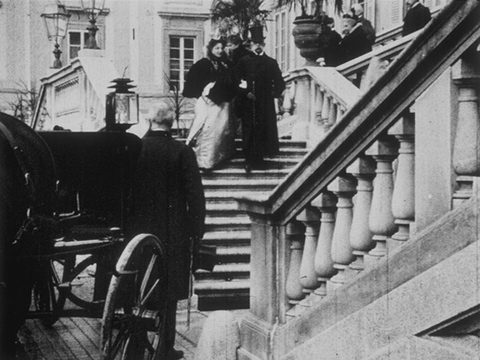
Roi et reine d’Italie. Catalogue Lumière. Vue N° 279. “S.M. le roi Humbert II [sic] et la reine d’Italie à Monza.”Le roi Humbert Ier et la reine Marguerite de Savoie descendent l’escalier, suivis par quelques personnes puis montent dans une calèche. En regard de sa lettre du 25 novembre, Constant Girel est probablement l'auteur de cette vue, ce qu'il a en outre, toujours affirmé (cf. Denise Boehm-Girel, « Un opérateur des Lumière, Constant Girel », Congrès Lumière, Lyon, juin 1995 - Actes à paraître). Cette affirmation est toutefois contredite par une lettre de Vittorio Calcina, conservée au Musée du cinéma de Turin, dans laquelle il s'attribue le titre “S.M. Il Re Umberto et S.M. la regina a Monza il 20/11/1896” [Sa Majesté le roi Humbert et Sa Majesté la reine à Monza le 20 novembre 1896] (cf. Aldo Bernardini, Cinema muto italiano. 1 : Ambiente, spettacoli e spettatori 1896-1904, Roma, Laterza, 1980, p. 22). Mais en sa qualité de concessionnaire, peut-être Calcina s'est-il contenté d'organiser le tournage, puisque parmi les sept autres titres qu'il mentionne, il s'attribue également la vue n° 1191, alors qu'elle est tournée par Francesco Felicetti. Opérateur: [Constant Girel]. Date: [20 novembre 1896]. Lieu: Italie, Monza, palais royal. Personnes: Les souverains italiens descendent les marches du palais Monza : la reine Marguerite de Savoie au bras d'Humbert Ier. Projections: Programmée le 20 décembre 1896 à Turin (Italie) sous le titre Le LL. MM. a Monza (Gazzetta di Torino, 20/21 décembre 1896). Programmation de Roi et reine d'Italie le 25 décembre 1896 à Lyon (France) (Lyon républicain, 24 décembre 1896). Eléments filmiques: négatif Lumière - 1 contretype Lumière - 2 copies Lumière. Objet: voiture hippomobile. Séries: info-five-89.

Roi et reine d’Italie / [The King and Queen of Italy]
n. 279, [Constant Girel], Monza, IT 1896

Cortège au mariage du prince de Naples. Catalogue Lumière. Vue N° 283. Défilé de calèches escortées de cavaliers et mouvement d’une foule de journalistes. Opérateur: Charles Moisson. Date: 24 octobre 1896. Lieu: Italie, Rome, piazza dell' Esedra (aujourd'hui piazza della Repubblica). Personnes: Au fond, la basilique Santa Maria degli Angeli. Projections: Projetée le 16 décembre 1896 au Photo Club à Lyon (France) (Lyon républicain, 17 décembre 1896). Eléments filmiques: négatif Lumière. Personnes identifiées: Hélène de Monténégro, Humbert Ier, identi-780, Marguerite de Savoie. Objet: voiture hippomobile. Séries: Mariage du prince Victor-Emmanuel.

Cortège au mariage du prince de Naples / [The Wedding Procession of the Prince of Naples]
n. 283, Charles Moisson, Roma, IT 1896

Le Forum. Catalogue Lumière. Vue N° 290. Des omnibus traversent la place tandis que des enfants ramassent les piécettes qu’on leur lance. Opérateur: inconnu. Date: [12 mars 1896] - 20 décembre 1896. Lieu: Italie, Rome, le Forum. Projections: Programmée le 20 décembre 1896 à Turin (Italie) sous le titre Foro romano [Forum romain] (Programme du 20 au 26 décembre 1896 du Cinematografo-Lumière situé Via Po, 33).Programmée le 5 mars 1897 à Marseille (France) sous le titre Foro romano (Le Masque, 5 mars 1897). Eléments filmiques: négatif Lumière - 1 copie Lumière. Objet: tramway hippomobile et omnibus, voiture hippomobile.

Le Forum / [The Roman Forum]
n. 290, Roma, IT 1896

Bal d’enfants. Catalogue Lumière. Vue N° 15. Dans une cour, sous le regard d’une femme, dix petites filles dansent une badoise. On ne peut accorder qu'un crédit limité au titre de projection La Bohemienne dei bébés al Monty-Alby di Torino en raison du grand nombre de titres de projection comportant des fausses indications. Opérateur: inconnu. Date: [12 mars 1896] - 13 décembre 1896. Lieu: [Italie, Turin, Institut Monti-Alby]. Projections: Programmée le 13 décembre 1896 à Lyon (France) sous le titre Danse d'Enfants (Lyon républicain, 13 décembre 1896).Programmée le 20 décembre 1896 à Turin (Italie) sous le titre La Bohemienne dei bébés al Monty-Alby di Torino (Gazzetta di Torino, 20/21 décembre 1896).Programmée le 1er janvier 1897 à Marseille (France) sous le titre La Badoise dansée par des petites fillettes (Le Masque, 1er janvier 1897). Eléments filmiques: négatif Lumière - 1 contretype Lumière - 1 copie Lumière. Événement: danse. Genre: distraction. Sujet: enfant.

Bal d’enfants / [The Children's Ball]
n. 15, Torino, IT 1896

Serpent. Catalogue Lumière. Vue N° 90. Félicien Trewey déroule un large serpentin blanc qu’il fait virevolter autour de lui. Titre issu du Catalogue des vues - Première Liste. Opérateur: [Louis Lumière]. Date: [16 janvier 1896] - [9 février 1896]. Lieu: France, La Ciotat, Clos des Plages. Personnes: Félicien Trewey. Projections: Projetée le 20 février 1896 au Polytechnic Institution à Londres (Grande-Bretagne) sous le titre Serpent (Photography, 27 février 1896).Programmée le 22 mars 1896 à Lyon (France) sous le titre Le Serpent (Lyon Républicain, 22 mars 1896). Eléments filmiques: négatif Lumière - 3 copies Lumière. Genre: spectacle. Sujet: acrobate et équilibriste. Objet: costumes. Séries: Félicien Trewey, info-five-32.

Serpent / [The Serpent]
n. 90, [Louis Lumière],
La Ciotat, FR 1896

35 mm. Da: Institut Lumière, Lyon

Laughter in Hell


Laughter in Hell: Marybelle Evans (Merna Kennedy) and Barney Slaney (Pat O'Brien) and the precious watch that means much to him.

US 1933. D: Edward L. Cahn. Based on: dall’omonimo romanzo di Jim Tully. SC: Tom Reed. Cinematography: John Stumar. ED: Philip Cahn. C: Pat O’Brien (Barney Slaney), Merna Kennedy (Marybelle Evans), Berton Churchill (Mike Slaney), Gloria Stuart (Lorraine), Arthur Vinton (Grover Perkins), Clarence Muse (Jackson), Douglas Dumbrille (Ed Perkins). P: Carl Laemmle Jr. per Universal Pictures Corp. [The film was not released in Finland]. 35 mm. 70’. B&w.
    US © 1933 Universal Pictures
    Print from Universal Pictures
    Il Cinema Ritrovato, Bologna
    Universal Pictures: The Laemmle Junior Years
    E-subtitles in Italian by Sub-Ti Londra
    Cinema Jolly, 27 June 2016

Dave Kehr (Bologna catalog): "This astonishing film had been forgotten in the vaults until a new print was created in 2013 for an academic conference on the work of the ‘hobo novelist’ Jim Tully (Beggars of Life). A rising star at Universal, the director Edward L. Cahn (Afraid to Talk) had clearly earned the trust of Junior Laemmle, who allowed him to create one of the most radical works – politically and stylistically – to emerge from that adventuresome studio."

"Pat O’Brien’s Barney Slaney is a railroad engineer who, in an echo of La Bête humaine, murders his unfaithful wife when he catches her with her lover – one of three brothers who have tormented Barney since his childhood. Condemned to a chain gang (where he witnesses a brutal, racially-motivated lynching), he eventually escapes, only to find himself wandering alone through a bleak, lunar landscape – an Expressionist wasteland ravaged by plague and poverty. Redemption seems briefly possible when he meets another refurgee, a young woman (Gloria Stuart) who has lost her family to the spreading disease, but their happiness is only an interlude."

"There is hardly a sequence in the film that is not marked by Cahn’s visual invention, which includes such innovations as a startlingly advanced use of slam zooms to portray Barney’s murderous rampage. The final sequences seem Bergmanese in their bleakness and despair, though the sudden suspension of the narrative at a key moment suggests that the end of Barney’s story, at least as Tully wrote it, was too desolate even for Laemmle. Cahn immediately vanished from Universal’s roster, resurfacing two years later at the Poverty Row studio Mascot – the beginning of a wildly prolific career as a B director that extended into the early 60s."
– Dave Kehr

Laughter in Hell. Lorraine (Gloria Stuart) heals the horse whip wounds on the back of Barney (Pat O'Brien).

AA: Edward L. Cahn, whom Dave Kehr has been championing, is generally known as a director of Our Gang comedy shorts and 1950s exploitation films, most famously It! The Terror Beyond Space, but we have been also aware of his caliber as a director of distinguished work such as Law and Order, a tough Pre-Code version of the Wyatt Earp saga. Thus Laughter in Hell is a revelation as a film and a confirmation of Cahn's talent.

Like Dave Kehr states above there is an affinity with Émile Zola's La Bête humaine in the murderous rage of Pat O'Brien as the engine driver in a role similar to the film adaptations made later by Jean Renoir with Jean Gabin and Fritz Lang with Glenn Ford. There is even an earlier model for the train madness section: Abel Gance's La Roue, but Gance's lightning fast montages are superior to Cahn's.

There is an old family feud between the Slaney and Perkins families. We start with a prologue about Barney's childhood (Edison's Multiphone is introduced as a novelty, and Barney's mother is buried), and then cut forward to the young man Barney who receives a valuable watch as a sign of manhood and his promotion to an engine driver. He is married to his sweetheart Marybelle, but soon the happiness is disrupted by a lover, Grover, one of the Perkins brothers. In a murderous rage Barney kills both Grover Perkins and Marybelle and surrenders to the sheriff expecting to be executed. Instead, he faces a fate worse than death in the chain gang, in hard labour, with Ed Perkins as boss warden.

Immediately Ed crushes Barney's watch with a ball and chain. "You won't be needing to know what time it is any longer". When a fellow prisoner escapes and though he is caught and killed also Barney is punished brutally as a suspected accomplice with a horse whip by Ed Perkins personally. During a prisoners' mutiny on a graveyard worksite Barney manages to escape. He meets a lonely girl called Lorraine (Gloria Stuart) on a desolate farmhouse where everyone has died of plague (qf. the introduction of Louise Brooks in Beggars of Life, also based on a story by the hobo novelist Jim Tully). "I'm from nowhere" is how Barney introduces himself.

They start on their way on a horse driven cart and find shelter with a family. Everyone notices that Barney has no experience with horses and carts. The old man is a veteran of the Civil War. Among their dinner guests is the sheriff who is aware of an arrest warrant for escaped prisoners. In the thrilling sequence probably everyone senses what Barney is. But nobody stops him, and Barney and Lorraine continue to the north. The film ends abruptly.

Whatever happened to the film and why the career of Edward L. Cahn at Universal suddenly ended after it remains a mystery, but much of the film is exceptional and alarming. The storytelling in Barney's saga is not completely believable; there is much that is abrupt and without full development. Among the remarkable features of the film is the account of the black prisoners. Their story is a saga of slavery and brutally hard work. They are deeply religious, and they are treated like animals. Suspected of having poisoned a bloodhound three of them are executed by hanging in a forest of falling autumn leaves.

There is no credited composer, but the music in the opening credits and the trial sequence is powerful and impressive (stock music? themes from the classical repertory?). There are also extended passages of negro spirituals, including, most memorably, in the hanging sequence where the convicts face death singing. I was not able to identify the spirituals except "Goin' Home" from Dvořák's New World Symphony. There is also an engine driver's song; and Marybelle sings and plays the piano.

The cinematography by John Stumar is strong and bold, also in sequences shot in the dark.

The print is first rate.

Sunday, June 26, 2016

Anno uno 5: Spectacle: The Power of the Cinématographe (Lumière)

Mauvaises herbes

1896. Cinema anno uno – Lumière!
1896. Year One of Cinematography
Programma 5: Spettacolo. Il potere del Cinématographe
Programme 5: Spectacle: The Power of the Cinématographe


Il Cinema Ritrovato, Bologna
Introduced by Mariann Lewinsky.
♪ Grand piano John Sweeney, Gabriel Thibaudeau
There are no intertitles in these movies
Cinema Lumiere – Sala Officinema/Mastroianni, 26 June 2016

Mariann Lewinsky (Bologna catalog): "You turn the handle a few times and your machine transforms a pig into appetizing sausages. You turn the handle a few times, and your Cinématographe transforms whatever it films into a spectacular appearance, endowing everything with meaning, mystery and glamour. Everybody becomes a protagonist, a performer."

"This effect is less noticeable in performances such as music-hall numbers and in family films (where people put on little shows for the benefit of the camera) and is at its strongest in apparently unarranged scenes of play or work, such as Bassin des Tuileries, Chargement du Coke and Mauvaises herbes."

"The views Lumière form an amazing documentation of work, much of it collective and unmechanized, done by groups of men, women and animals in orchestrated movements. Captured by the Cinématographe they appear as effortless choreographies when screened now in front of audiences no longer familiar with such kind of work and the sight of it."
Mariann Lewinsky

THIS FIRST FILM WAS AN ADDITION TO THE PRINTED PROGRAMME:

Charcuterie mécanique. Catalogue Lumière. Vue N° 107. “Un cochon est introduit dans un appareil mécanique et il suffit de tourner une manivelle pour faire sortir de l’autre côté: jambons, saucisses, boudins, etc.” Dans le Catalogue des vues - Première Liste qu'il a remis à Georges Sadoul en 1946, Louis Lumière a annoté les vues qu'il s'attribuait dont celle-ci. Opérateur: Louis Lumière. Date: [16 janvier 1896] - 18 avril 1896. Lieu: France, [La Ciotat], [Clos des Plages]. Projections: Programmée le 18 avril 1896 à Lyon (France) sous son titre (Le Progrès, 18 avril 1896). Eléments filmiques: négatif Lumière - 1 contretype Lumière. Genre: comédie, vue comique.

Charcuterie mécanique / [A Mechanized Charcuterie]
Vue N° 107, Louis Lumière, [La Ciotat], FR 1896. - AA: Fiction, comedy, one of the earliest trick films. You put a pig into the machine, and by turning the crank you get hams, sausages, and black pudding.

Cyclistes et cavaliers arrivant au cottage. Catalogue Lumière. Vue N° 247. Dans une rue, un homme salue des passants et accueille deux cyclistes et trois cavaliers qui s’arrêtent le long du trottoir. Opérateur: [Charles Moisson]. Date: [8 mars 1896] - [3 mai 1896]. Lieu: Grande-Bretagne, Londres, [Hampstead]. Personnes: Félicien Trewey avec un haut de forme. Projections: Programmée le 24 mai 1896 à Lyon (France) sous le titre Cyclistes et cavaliers (Le Progrès, 24 mai 1896). Eléments filmiques: négatif Lumière - 3 contretypes Lumière - 4 copies Lumière. Séries: Les premiers tournages à l'étranger.

Cyclistes et cavaliers arrivant au cottage / [Cyclists and Horse Riders Arrive at the Cottage]
n. 247, [Charles Moisson], London, GB 1896

Pigeons sur la place Saint-Marc. Catalogue Lumière. Vue N° 292. Un homme et une femme jettent de la nourriture à une nuée de pigeons. Opérateur: Charles Moisson. Date: [14 juin 1896] - 2 août 1896. Lieu: Italie, Venise, place Saint-Marc. Personnes: Marie Moisson. Projections: Programmée le 2 août 1896 à Lyon (France) sous le titre Venise : les pigeons de la place Saint-Marc (Lyon républicain, 2 août 1896). Éléments filmiques: négatif Lumière - 5 copies Lumière. Genre: distraction, villes et paysages.

Pigeons sur la place Saint-Marc / [Pigeons on St. Mark's Square]
n. 292, Charles Moisson, Venezia, IT 1896

Bassin des Tuileries. Catalogue Lumière. Vue N° 150. Des enfants jouent à pousser leur voilier sur l’eau du bassin. Opérateur: inconnu. Date: [1896] - 5 avril 1896. Lieu: France, Paris, jardin des Tuileries. Projections: Programmée le 5 avril 1896 à Lyon (France) sous le titre Le Bassin des Tuileries à Paris (Lyon républicain, 5 avril 1896). Éléments filmiques: négatif Lumière - 2 copies Lumière. Genre: distraction, villes et paysages. Sujet: enfant.

Bassin des Tuileries / [The Garden Pond of the Tuileries]
n. 150, Paris, FR 1896

Chargement du coke. Catalogue Lumière. Vue N° 123. Des femmes chargent le coke dans des brouettes que d’autres emportent. En 1896, les femmes ouvrières dans les mines de charbon de Carmaux travaillent toutes au jour, depuis une loi de 1874 leur interdisant le travail de fond. Dans leur majorité, elles travaillent toutes comme manoeuvres de force, soit qu'elles chargent comme ici le coke à la pelle, soit qu'elle empilent les briquettes à l'usine d'agglomérés. Opérateur: inconnu. Date: [25 janvier 1896] - 12 juillet 1896. Lieu: France, Carmaux, cokerie (aujourd'hui détruite). Personnes: À l'arrière-plan, les bâtiments de l'entrée du puits minier de Sainte-Barbe. Projections: Projection de vue de Carmaux le 12 juillet 1896 à Toulouse (France) (Le Messager de Toulouse, 12 juillet 1896).Programmée le 26 juillet 1896 à Lyon (France) sous le titre Carmaux : embarquement du Coke (Lyon républicain, 26 juillet 1896). Eléments filmiques: négatif Lumière - 1 contretype Lumière - 3 copies Lumière. Séries: info-five-70.

Chargement du coke / [Loading Coke]
n. 123, Carmaux, FR 1896. - AA: One of the earliest records of hard work.

Comtesse de Montebello. Catalogue Lumière. Vue N° 304. La comtesse de Montebello descend l’escalier et monte dans la voiture qui démarre, puis un homme monte dans une seconde voiture qui s’éloigne également. Voir la remarque de la vue n° 1325. Opérateur: Charles Moisson. Date: [26 mai 1896]. Lieu: Russie, Moscou, [hôtel Cheremetiew (ambassade de France)]. Personnes: Mme Lannes, comtesse de Montebello, s'apprête à monter en voiture. Projections: Projection de 18 vues du couronnement du tsar le 24 juin 1896 à Paris (France) dans les salons du Figaro (Le Figaro, 25 juin 1896).Programmation de Le Couronnement du czar le 21 juin 1896 à Rouen (France) (Le Nouvelliste de Rouen, 21 juin 1896).Programmation de Mme la comtesse de Montebello sortant du Kremlin le 12 juillet 1896 à Mâcon (France) (Le Journal de Saône et Loire, 12 juillet 1896). Eléments filmiques: négatif Lumière. Séries: Couronnement du tsar Nicolas II à Moscou.

Comtesse de Montebello / [Countess de Montebello]
n. 304, Charles Moisson, Moscow, RU 1896

Vienne: retour des courses. Catalogue Lumière. Vue N° 427. Un cortège de voitures à chevaux défile rapidement, occupant toute la largeur de la chaussée. Opérateur: Charles Moisson. Date: 2 juin 1896. Lieu: Autriche-Hongrie (aujourd'hui Autriche), Vienne, Prater, hippodrome de Freudenau. Projections: Programmée le 21 juin 1896 à Lyon (France) sous le titre Les Courses à Vienne (Lyon républicain, 21 juin 1896). Programmée le 28 juin 1896 à Vienne (Autriche) sous le titre Freudenau. Sattelraum nach dem Pisek-Rennen [Freudenau, [.] après les courses de Pisek] (Wiener Zeitung, n° 149, 28 juin 1896). Eléments filmiques: 1 copie Lumière - 1 copie Edison. Genre: distraction, sport, villes et paysages. Objet: voiture hippomobile. Séries: Charles Moisson à Vienne et à Budapest (1896).

Vienne: retour des courses / [Vienna: Return from the Races]
n. 427, Charles Moisson, AT 1896

Course en sacs. Catalogue Lumière. Vue N° 109. “Des jeunes gens font une course en sacs entre deux haies de spectateurs qui s’égayent fort des chutes et des péripéties diverses de cette lutte amusante.” - Dans le Catalogue des vues - Première Liste qu'il a remis à Georges Sadoul en 1946, Louis Lumière a annoté les vues qu'il s'attribuait dont celle-ci.- Il existe un remake non catalogué, comportant plusieurs arrêts caméra, tourné au même moment que les vues n° 588 et n° 589. Opérateur: Louis Lumière. Date: [automne 1896] - 25 octobre 1896. Lieu: France, Lyon, Monplaisir. Personnes: Les ouvriers de l'usine Lumière. Projections: Projetée le 25 octobre 1896 à Boulogne-sur-Mer (France) sous le titre La Course en sac (L'Impartial, 28 octobre 1896). Eléments filmiques: négatif Lumière - 1 copie Edison. Genre: distraction. Objet: instrument de jeu.

Course en sacs / [Sack Race]
n. 109, Louis Lumière, Lyon, FR 1896

Duel au pistolet (longueur: 12 mètres). Catalogue Lumière. Vue N° 35. Deux duellistes, armés de pistolets, font feu : l’un d’eux est touché et s’écroule. On lui apporte les premiers soins, tandis qu’on éloigne l’autre. Du point de vue de la durée de l'action et du jeu des acteurs (en comparaison au n° 235, où il est évident qu'il s'agit d'une reconstitution), la mise en scène est ici si bien réglée qu'elle peut encore faire passer l'action pour un duel authentique. Opérateur: Gabriel Veyre. Date: 12 ou 13 décembre 1896. Lieu: Mexique, Mexico, parc de Chapultepec. Projections: Programmée le 21 février 1897 à Lyon (France) sous le titre Mexique: un Duel au pistolet (Lyon républicain, 21 février 1897). Longueur: 12 mètres. Eléments filmiques: négatif Lumière - 2 copies Lumière. Événement: affrontement. Genre: comédie. Séries: Gabriel Veyre en Amérique latine (1896-1897).

Duel au pistolet (longueur: 12 mètres) / [Pistol Duel (length: 12 meters)]
n. 35, Gabriel Veyre, Ciudad de México, MX 1896. - AA: Fiction, enactment, performed by actors.

Géant et nain. Catalogue Lumière. Vue N° 114. “Lutte comique entre un géant et un nain.” Titre dans le catalogue anglais de la firme H. Jasper Redfern (Sheffield): Giant and Dwarf (Brothers Marco). En outre, d'après Adrian (historien du cirque), leur maquillage indiquerait que ces clowns sont anglais. Opérateur: inconnu. Date: [20 février 1896] - 10 mai 1896. Lieu: [Grande-Bretagne]. Personnes: Les deux clowns dits les “frères Marco”. Projections: Programmée le 10 mai 1896 à Lille (France) sous le titre Le géant et le nain (La Dépêche, 11 mai 1896). Eléments filmiques: négatif Lumière - 1 copie Lumière. Genre: spectacle. Sujet: acrobate et équilibriste, clown. Séries: info-five-30, Les premiers tournages à l'étranger.

Géant et nain / [Giant and Dwarf]
n. 114, GB 1896. - AA: A stunning record of a performance by artists.

Mauvaises herbes. Catalogue Lumière. Vue N° 64. “Des femmes font brûler dans un champ les mauvaises herbes mises en tas, et elles les retournent avec des fourches.” Une autre vue non cataloguée représente la même action dans un cadre différent. Cette vue, probablement tournée à La Ciotat, est la première version de ce sujet. Elle est projetée à Lyon le 29 mars 1896 sous le titre La Destruction des mauvaises herbes (Lyon républicain, 29 mars 1896), puis à Épinal : “Les Mauvaises herbes brûlent autour d'un bois, des paysannes les retournent sur le feu. À noter la fumée qui les voile parfois aux yeux, et le vent qui soulève leur tablier. Le patron se promène sur la lisière à l'ombre. Feignant.” (Le Mémorial des Vosges, Épinal, 25 juin 1896). Cet article indique la présence d'un patron qui se contente de regarder la scène, ce qui correspond à la version non cataloguée. En revanche, dans la vue n° 716, l'homme qui apparaît dans le champ jette des herbes dans le feu depuis une charrette. Il s'agit certainement d'un remake, mais rien ne permet de déterminer de quelle version Auguste Lumière est l'auteur. Opérateur: [Auguste Lumière]. Date: [16 janvier 1896] - [1er mai 1897]. Lieu: France, [La Ciotat], [Clos des Plages]. Projections: Programmation de Mauvaises herbes le 4 janvier 1897 à Auxerre (France) (L'Indépendant Auxerrois, 4 janvier 1897). Eléments filmiques: négatif Lumière - 1 copie Lumière. Genre: travail. Sujet: agriculteur. Objet: machine et outil.

Mauvaises herbes / [Burning Weeds]
n. 64, [Auguste Lumière], [La Ciotat], FR 1896. - AA: A record of work. Simple and eloquent.

35 mm. Da: Institut Lumière, Lyon

AA: Work and play. The accounts of hard work in Chargement du coke and Mauvaises herbes are eloquent. The workers are all women in both. Charcuterie mécanique is one of the earliest trick films. Géant et nain is a stunning straight record of a performance by two British music hall artists. In Course en sacks we see the Lumière workers at play.

The captions are copied from the Catalogue Lumière website. There is little to add to those excellent remarks.

Anno uno 4: Museum of the Here and Now - Actualities (Lumière)

Les souverains et les invités se rendant au sacre (escalier rouge). Catalogue Lumière. Vue N° 300.

1896. Cinema anno uno – Lumière!
1896. Year One of Cinematography

Programma 4: Musei dell'attimo presente – attualità
Programme 4: Museum of the Here and Now – Actualities


Il Cinema Ritrovato, Bologna.
Introduced by Mariann Lewinsky.
♪ Grand piano John Sweeney, Gabriel Thibaudeau
There are no intertitles in the films.
Cinema Lumiere – Sala Officinema/Mastroianni, 26 June 2016

Mariann Lewinsky in the Bologna catalog: "As material objects, these Lumière views are a homogeneous batch. Our screenings take place in 2016, and the 35 mm prints screened here were made twenty years ago, in 1995, via intermediary elements, struck from negatives that were exposed and developed in 1896, a hundred and twenty years ago. What appears today on the screen happened to be in front of a Lumière Cinématographe a hundred and twenty years ago."

"During their screenings, however, the views do not all stay there, in 1896; they behave in many different ways (and individually with different viewers). A flag flying, for example, crosses over easily and reaches the present, so does the play of light and shadow on a Boston tramway, and while a Tsar or a dowager Empress of Russia remains bound to the past, animals and children are free, timeless."

"The uncanny magic of time in these very early films is overwhelming. How is it possible that we should be permitted to see the past, in 50 second glimpses. The old harbour of Marseilles, silvery sardines taken from nets, boys skating back and forth, a bird unfolding its wings – they appear and reappear, and every time we are engulfed in their present time, le vierge, le vivace et le bel aujourd’hui."
Mariann Lewinsky

Port de la Joliette. Catalogue Lumière. Vue N° 136. Circulation de piétons, omnibus, charrettes et calèches sur le port. Opérateur: inconnu. Date: [avril 1896] - 11 avril 1896. Lieu: France, Marseille, port de la Joliette.

Port de la Joliette
n. 136, Marseille, FR 1896

Pêche aux sardines. Catalogue Lumière. Vue N° 70. “De retour de la pêche, les pêcheurs, dans la barque, retirent les sardines prises dans le filet.” Opérateur: [Lumière]. Date: [16 janvier 1896] - 25 avril 1896. Lieu: France, port méditerranéen.

Pêche aux sardines / [Sardine Fishing]
n. 70, [Lumière], FR 1896

Patineurs au Parc central. Catalogue Lumière. Vue N° 327. Trois jeunes garçons chaussés de patins à roulettes évoluent sur la piste. Opérateur: Alexandre Promio. Date: [septembre 1896] - 25 septembre 1896. Lieu: États-Unis, New York, Central Park.

Patineurs au Parc central / [Roller Skaters in Central Park]
n. 327, Alexandre Promio, New York, US 1896

La foule. Catalogue Lumière. Vue N° 418. La foule des spectateurs se presse sur la pelouse, devant la tribune. Opérateur: Marius Sestier. Date: 3 novembre 1896. Lieu: Australie, Melbourne, hippodrome de Flemington. Projections: Programmée le 24 novembre 1896 à Melbourne (Australie) sous le titre The Lawn near the Band Stand [La Pelouse à côté de la Tribune des spectateurs] (The Herald, 24 novembre 1896).

La Foule / [The Crowd]
n. 418, Marius Sestier, Melbourne, AU 1896

Fulton Street. Catalogue Lumière. Vue N° 1330. Circulation des tramways électriques dans la rue. Opérateur: Alexandre Promio. Date: [septembre 1896] - 25 septembre 1896. Lieu: États-Unis, Brooklyn (aujourd'hui New York), Fulton Street. Personnes: Au-dessus du tramway électrique, la ligne du “Elevated Railway”. Projections: Projection d'une série de vues américaines le 16 décembre 1896 au Photo-Club de Lyon (France) (Lyon républicain, 17 décembre 1896).
Eléments filmiques: négatif Lumière - 1 copie Lumière. Séries: Alexandre Promio en Amérique.

Fulton Street
n. 1330, Alexandre Promio, Brooklyn, US 1896

Pélicans. Catalogue Lumière. Vue N° 71. Des pélicans s’ébattent autour et dans un bassin. Un gardien vient leur lancer de la nourriture. Opérateur: [Alexandre Promio]. Date: juillet 1896] - [9 août 1896]. Lieu: Grande-Bretagne, Londres, Regent Park, jardin zoologique. Projections: Programmée le 30 août 1896 à Lyon (France) sous le titre Londres, jardin zoologique : les pélicans (Lyon républicain, 30 août 1896). Eléments filmiques: négatif Lumière - 1 contretype Lumière - 2 copies Lumière. Séries: Le jardin zoologique de Londres, Premier séjour d'Alexandre Promio (1896).

Pélicans / [Pelicans]
n. 71, [Alexandre Promio], London, GB 1896

Les souverains et les invités se rendant au sacre (escalier rouge). Catalogue Lumière. Vue N° 300. Les souverains Nicolas II et Alexandra Feodorovna et leur suite descendent lentement l’Escalier Rouge, précédés d’une compagnie de soldats en cuirasse. Opérateur: Charles Moisson. Date: 26 mai 1896. Lieu: Russie, Moscou, Kremlin, escalier des Lions. Personnes: Les souverains russes descendent l'escalier des Lions: Alexandra Feodorovna au bras de Nicolas II, en bas à droite. Projections: Projetée le 19 juillet 1896 à Bordeaux (France) (La Gironde, 20 juillet 1896). Projection de 18 vues du couronnement du tsar le 24 juin 1896 à Paris (France) dans les salons du Figaro (Le Figaro, 25 juin 1896). Programmation de Le Couronnement du czar le 21 juin 1896 à Rouen (France) (Le Nouvelliste de Rouen, 21 juin 1896). Eléments filmiques: négatif Lumière - 1 contretype Lumière - 1 copie Lumière. Séries: Couronnement du tsar Nicolas II à Moscou.

Les Souverains et les invités se rendant au sacre (escalier rouge) / [The Sovereigns and the Invited Guests on Their Way to the Coronation (The Red Stairway)]
n. 300, Charles Moisson, Moscow, RU 1896 - AA: flanked by the Chevalier Guard on both sides. Among them: Carl Gustaf Emil Mannerheim, later Marshal of Finland. (His image in uniform is included in the Wikipedia article on the Chevalier Guard).

L’Impératrice mère et la grande-duchesse Eugénie en carrosse. Catalogue Lumière. Vue N° 301. Passage de trois carrosses accompagnés de laquais et de militaires. Opérateur: [Francis Doublier]. Date: 26 mai 1896. Lieu: Russie, Moscou. Projections: Programmée le 28 juin 1896 à Lyon (France) sous le titre Impératrice mère se rendant au sacre (Le Progrès, 27 juin 1896).Projection de 18 vues du couronnement du tsar le 24 juin 1896 à Paris (France) dans les salons du Figaro (Le Figaro, 25 juin 1896).Programmation de Le Couronnement du czar le 21 juin 1896 à Rouen (France) (Le Nouvelliste de Rouen, 21 juin 1896). Eléments filmiques: négatif Lumière - 2 copies Lumière. Séries: Couronnement du tsar Nicolas II à Moscou.

L’Impératrice mère et la grande-duchesse Eugénie en carrosse [The Empress Mother and the Grand Duchess Eugenie in the Coach]
n. 301, [Francis Doublier], Moscow, RU 1896

Tsar et tsarine entrant dans l’église de l’Assomption. Catalogue Lumière. Vue N° 302. Tandis que la foule avance lentement, une compagnie de gardes et le dais impérial pénètrent dans l’église. Opérateur: [Francis Doublier]. Date: 26 mai 1896. Lieu: Russie, Moscou, Kremlin (place des Cathédrales). Projections: Projetée le 5 juillet 1896 à Rouen (France) sous le titre Entrée dans l'église de l'Assomption (Le Nouvelliste de Rouen, 5 juillet 1896).Projection de 18 vues du couronnement du tsar le 24 juin 1896 à Paris (France) dans les salons du Figaro (Le Figaro, 25 juin 1896).Programmation de Le Couronnement du czar le 21 juin 1896 à Rouen (France) (Le Nouvelliste de Rouen, 21 juin 1896). Eléments filmiques: négatif Lumière. Séries: Couronnement du tsar Nicolas II à Moscou.

Tsar et tsarine entrant dans l’église de l’Assomption / [The Tsar and the Tsarina Enter the Uspensky Cathedral]
n. 302, [Francis Doublier], Moscow, RU 1896

Enfant et chien. Catalogue Lumière. Vue N° 49. “Un petit garçon donne du sucre à son chien en lui faisant exécuter des sauts en hauteur.” Opérateur: [Lumière]. Date: [printemps 1896] - 25 avril 1896. Lieu: France, Lyon, Monplaisir, maison Koehler. Personnes: Marcel Koehler.

Enfant et chien / [Child and Dog]
n. 49, [Lumière], Lyon, FR 1896

35 mm. Da: Institut Lumière, Lyon

AA: There is little to add to the information on the Catalogue Lumière website which I have copied to the captions. The "Couronnement du tsar Nicolas II à Moscou" series is interesting for a Finnish viewer since that assignment brought the Cinématographe to the Russian Empire, and one month after the coronation the first Cinématographe Lumière screenings took place in Helsinki. There were hors catalogue views shot in Finland. If they survive they have not been screened during the contemporary generations.

Karumen kokyo ni kaeru / Carmen Comes Home (2012 digital restoration by Shochiku)


Hideko Takamine in Carmen Comes Home

カルメン故郷に帰る / Carmen torna a casa. JP 1951. D+SC+story: Keisuke Kinoshita. Cinematography: Hiroshi Kusuda. ED: Yoshi Sugihara. AD: Motoji Kojima. M: Chuji Kinoshita, Toshiro Mayuzumi. C: Hideko Takamine (Okin Aoyama / Lily Carmen), Shuji Sano (Haruo Taguchi, il compositore cieco), Kuniko Igawa (Mitsuko Taguchi, la moglie di Haruo), Chishu Ryu (il preside) Keiji Sada (Mr. Ogawa, il giovane insegnante), Toshiko Kobayashi (Maya Akemi, amica di Okin), Takeshi Sakamoto (Shoichi Aoyama, il padre di Okin). PC: Shochiku. [The film was not released in Finland]. DCP. Col. 86 min
    Music selections (show songs): "My Sweet Home", "A Modern City Girl", "I Love You", "New Look Skirt", "What A Night In Monte Carlo"
    Music selections (villagers): songs sung and/or played by the blind organist, schoolchildren, and Chishu Ryu
    Music selections (Schubert): "Forelle", "Heidenröslein", "Lindenbaum", "Ständchen", "Ave Maria", and other tunes.
    Music selections (other): "Auld Lang Syne"
    2012 digital restoration by Shochiku
    Il Cinema Ritrovato, Bologna
    Richness and Harmony. Colour Film in Japan (part two)
    Introduce Alexander Jacoby, Johan Nordström and Hisashi Okajima
    English subtitles on DCP, e-subtitles in Italian by Sub-Ti Londra
    Cinema Jolly, 26 June 2016

Maya (Toshiko Kobayashi) and Carmen (Hideko Takamine) in Carmen Comes Home

Alexander Jacoby, Johan Nordström (Bologna catalog): "Kinoshita’s first colour film was also Japan’s first full-length feature in colour utilizing domestic colour film stock and shot in the indigenous Fujicolor process. Hideko Takamine stars as a stripper who returns from Tokyo to her hometown in rural Nagano Prefecture. The mountain setting of the film was dictated by practical requirements, since the colour process was judged likely to produce a better image quality in natural light, and certainly the exquisite mountain landscapes are one of the film’s highlights."

"Ironically, outside major cities few Japanese actually saw the film in colour at its premiere; the process of creating a print for screening was so expensive and time-consuming that only a few colour prints were struck, and at first it was shown in colour only in Tokyo, Yokohama, Nagoya, Osaka, and Kyoto. Most rural cinemas screened a black and white version shot simultaneously. Accordingly, scenes were first shot in Fujicolor, and thereafter repeated and shot in black and white. Brian Carr writes, “This may also have necessitated the constant re-application of makeup, as early Fujicolor stock is said to have required actors to wear reddish make-up in order for their skin tones to register naturally on film, and red tones would surely have played havoc with black-and-white filming. Because Maya and Carmen were prone to showing skin, [Toshiko] Kobayashi and [Hideko] Takamine had to apply this pore-clogging greasepaint not only to their faces but also to their entire bodies for certain scenes. As the latter wrote: ‘At one point, I really thought that this film would kill me’”. In addition to revealing an unexpected comic talent on Takamine’s part, the film also contains a rather touching performance from Takeshi Sakamoto, ‘Kihachi’ from Ozu’s late silent period, as Carmen’s father."
– Alexander Jacoby, Johan Nordström

AA: A comedy, a musical, a pioneering Fujicolor film, a contemporary film about the Japanese countryside after WWII.

Watching Carmen Comes Home I was thinking about contemporary 20th Century-Fox musicals with June Haver, Soviet kolkhoz musicals by Pyriev and Alexandrov, and the great popular Indian films with their ubiquitous song and dance numbers. But I was also thinking about my earliest childhood memories from the countryside in Pohjanmaa in the 1950s. In my memories of childhood people were always working and often singing.

It is the period of reconstruction and culture shock in Japan. Carmen comes back to the mountains to visit her childhood home again, bringing with her her friend Maya. They are strippers from Tokyo, and they keep defining themselves as artists. Which they may well be. We remember how André Bazin admired the strip-tease artists of Paris. Carmen and Maya's clothes and make-up are in jarring contrast to the harmonious pastoral colour world of the mountains - juicy material for the first Fujicolor movie.

The legacy of the devastating war is embodied in the character of the blind composer who has lost his eyesight on the battlefield. His wife now has to work for both. The composer has also fallen into debt and lost his organ to Maruju the transportation magnate who is also the conductor of the village band.

There is an optimistic feeling about the future. The opening credit sequence is based on children's drawings. Children's songs, plays, and sport contests are prominent.

A first central sequence is the village festival where Carmen and Maya for the first time attract everyone's attention although they are only spectators. They then decide to mount a show of their own - an all-out strip-tease act which will end without a stitch on. The strip-tease aspect of the movie is directed by Keisuke Kinoshita so discreetly that we do not get to see anything.

Hideko Takamine had already a distinguished career in films by Mizoguchi, Naruse, Kurosawa, and Ozu, among others, before starring in Carmen Comes Home. She was about to become a key actress for Kinoshita and also for Mikio Naruse, especially in his cycle of Fumiko Hayashi films. She was truly versatile, as her role as Carmen proves. She is a brunette but her character has an affinity with the "dumb blonde stereotype" of American cinema.

Carmen's father (Takeshi Sakamoto) is ashamed of his daughter, but even more importantly, he feels pity for her. "Livestock can go around naked", not people. "She got kicked by a cow. Seems it made her head all funny", is the father's assessment of his daughter.

We witness the hard work of the villagers on the mountains. The goofy presence of Carmen and Maya is in colourful contrast to it all. Maybe their act is art after all. It is a counter-image to the daily work. It is a reminder of another way of life. "La beauté est la promesse de bonheur" (Stendhal).

There is a happy ending. The showgirls leave the revenue from their show to the father who donates the sum to the headmaster of the school. Maruju returns the organ to the blind composer who finally gets to perform his paean to the village which the girls' appearance had interrupted. Carmen and Maya embark on a train back to Tokyo.

Carmen Comes Home is a light entertainment film with an undercurrent of gravity and a sense of the stamina for reconstruction after a period of devastation.

The digital restoration conveys the bright colour shock impact of the movie very well.

Senninbari / [The Thousand-Stitch Belt] (2015 digital restoration in 4K by National Film Center)


千人針 / [La cintura dai mille punti]. JP 1937. D: Genjiro Saegusa. SC: Kesshu Tsukuda. Cinematography: Sukeshige Urushiyama. C: Matsunosuke Fukui (Shotaro Saeki), Kuni Sugiura (la madre), Hoshiko Tachibana (Oyoshi, la fidanzata), Fumio Wakamatsu (Takasugi), Shizuko Takazawa (Tokiko, la moglie), Fumiyo Kyomachi (Mieko, la sorella). PC: Dainihon Tennenshoku Eiga Seisakujo (Greater Japan Natural Color Productions). DCP. Col. 19 min
    2015 digital restoration in 4K by National Film Center
    Music selections include "Serenata" by Toselli and "Moldau" by Smetana.
    Il Cinema Ritrovato, Bologna
    Richness and Harmony. Colour Film in Japan (part two)
    Introduce Alexander Jacoby, Johan Nordström and Hisashi Okajima
    English subtitles on DCP by Mia Isozaki, e-subtitles in Italian by Sub-Ti Londra.
    Cinema Jolly, 26 June 2016

Alexander Jacoby, Johan Nordström (Bologna catalog): "This early Japanese colour film, rediscovered in an incomplete print at Moscow’s Gosfilmofond archive, focuses on a boatman whose relationships with his mother and fiancee are disrupted when he is conscripted to fight in China. The title comes from the metre-long belt composed of a thousand stitches which the hero’s grandmother begins to prepare for him. The film is a memento of bellicose times, made in the year when Japan, which had already annexed Manchuria, launched a full-scale war with China."

"Senninbari was the third film produced by the production company Dai Nihon Tennenshoku Eiga Seisakujo (Greater Japan Natural Color Productions), a pioneer of colour cinema in Japan. It is the oldest surviving Japanese colour talkie, made using a two-colour system. Dai Nihon Tennenshoku Eiga Seisakujo was the first production company to adopt the Multicolor process, known as ‘Shanghai color’ at the time. On the film’s release, the “Kinema Junpo” reviewer praised the improvement in the process by comparison with the studio’s first film, Tsukigata Hanpeita (Seika Shiba, 1937), but suggested that the work was lacking in dramatic terms. Director Genjiro Saegusa (b. 1900), is today little-known even in Japan. A contemporary at Nikkatsu of Kenji Mizoguchi, he worked prolifically through the silent era and remained active into the 1950s. His date of death is unknown. David Bordwell speaks of the echoes of French impressionist cinema and Soviet-style montage in his Gunshin Tachibana chusa (Lieutenant Colonel Tachibana, 1926), while his stylish rediscovered action film, Tokkyu sanbyaku mairu (Special Express: 300 Miles, 1928) was well received at screenings in Italy and Germany in recent years."

"It did not prove possible to ship the original material, a nitrate color positive held at Gosfilmofond, to Japan, so a 4K version was produced in Russia and used as the basis for a new method of digital restoration conducted in collaboration with the production companies, IMAGICA Corp and IMAGICA West Corp. By analyzing the data resulting from photochemical simulations at IMAGICA West, it was possible to determine the colour range that the two-colour system could not reproduce, keep that range from being picked up in colour grading, and thereby retrieve the colour of Senninbari."
– Alexander Jacoby, Johan Nordström

AA: A militaristic film, imperialist propaganda in the service of the Japanese invasion to China, Senninbari also belongs to the context of WWII movies produced by the Axis Powers, which also formed the Anti-Comintern Pact.

There are heroic marches and rousing displays of the cavalry, the infantry and the artillery in preparation of a holy war. There is also a sports contest, no doubt in preparation of the war, as well. There is so much music and singing that the film can be partly seen as belonging to the genre of the musical.

The film is very emotional as the old mother says goodbye to her son about to leave to the battlefront tomorrow. She has stiched him a thousand stitch belt, each stitch containing her best wishes. "Now I can die without regrets". "Banzai!" There is a strange (under?)current of self-destructiveness in this movie, similar to German militaristic films of the period.

A fine job of restoration from challenging source materials with many joins. The recreation of the special two-colour Multicolor / Shanghai Color palette looks believably authentic.

Anno uno 3: Movements, Dimensions (Lumière)

Chaudière. Catalogue Lumière. Vue N° 320. Des ouvriers achèvent l’arrimage d’une chaudière sur le pont d’un navire. Opérateur: [Lumière]. Date: [16 janvier 1896] - 19 avril 1896. Lieu: France, [La Ciotat], port.

1896. Cinema anno uno – Lumière!

1896. Year One of Cinematography
Programma 3: Movimenti, dimensioni
Programme 3: Movements, Dimensions

Il Cinema Ritrovato, Bologna.
Introduce Mariann Lewinsky
♪ Grand piano Gabriel Thibaudeau
There are no intertitles in the films.
Cinema Lumiere – Sala Officinema/Mastroianni, 26 June 2016

Mariann Lewinsky in the Bologna catalog: "The power of these films comes from their beauty and one of the aspects of their beauty is the creation – a masterly, essential creation – of dimensionality through movements. Create the perception of center, depth, vertical, horizontal."

"On September 21, 1896 the operator Constant Girel got into a boat and filmed the city of Cologne, located on the banks of the Rhine. It’s the image itself that moves for the first time. This kind of shot, called a ‘panorama’, created the sensation of immediate participation and implicated spectators even more vividly than movements inside the image." Mariann Lewinsky

Cuirassiers: en fourrageurs (charge). Catalogue Lumière. Vue N° 184. Un régiment de cuirassiers charge puis stoppe au premier plan. Opérateur: inconnu. Date: 2 juin 1896 - 5 juin 1896. Lieu: France, Beligneux, camp de La Valbonne.

Cuirassiers: en fourrageurs (charge) / [Cuirassiers: in fourrageurs (charge)]
n. 184, Beligneux, FR 1896

Pont de la Tour. Catalogue Lumière. Vue N° 253. Circulation des piétons et des véhicules sur le pont. Opérateur: [Alexandre Promio]. Date: [juillet 1896] - [9 août 1896]. Lieu: Grande-Bretagne, Londres, Tower Bridge.

Pont de la Tour / [Tower Bridge]
n. 253, [Alexandre Promio], London, GB 1896

Chaudière. Catalogue Lumière. Vue N° 320. Des ouvriers achèvent l’arrimage d’une chaudière sur le pont d’un navire. Opérateur: [Lumière]. Date: [16 janvier 1896] - 19 avril 1896. Lieu: France, [La Ciotat], port.

Chaudière / [A Furnace]
n. 320, [Lumière], [La Ciotat], FR 1896

Dragons traversant la Saône à la nage. Catalogue Lumière. Vue N° 186. Des dragons, montés à cru sur leur cheval, s’enfoncent dans une rivière et gagnent l’autre rive. Opérateur: inconnu. Date: [1896] - 23 août 1896. Lieu: France, Lyon, Île Barbe.

Dragons traversant la Saône à la nage / [Dragoons Crossing the Saône by Swimming]
n. 186, Lyon, FR 1896

Commercial Street. Catalogue Lumière. Vue N° 333. Circulation de voitures et charrettes sur la rue. Opérateur: Alexandre Promio. Date: [septembre 1896] - 20 septembre 1896. Lieu: États-Unis, Boston, Commercial Street.

Commercial Street
n. 333, Alexandre Promio, Boston, US 1896

Panorama pris d’un bateau. Catalogue Lumière. Vue N° 227. Panorama des quais, de la ville et d’un pont de bateaux. « Outre ces vues, qui sont vraiment impressionnantes, il en est une d’un effet absolument nouveau prise sur un bateau en marche, se rendant à Cologne et où l’on voit défiler, sous forme d’un magnifique panorama, les rives si renommées du Rhin. » (Lyon républicain, Lyon, 25 octobre 1896). Opérateur: Constant Girel. Date: 21 septembre 1896. Lieu: Allemagne, Cologne, le Rhin.

Panorama pris d’un bateau / [A Panorama Taken from a Boat]
n. 227, Constant Girel, Cologne, DE 1896

Panorama du Grand Canal pris d’un bateau. Catalogue Lumière. Vue N° 295. Panorama des façades des palais. Opérateur:     Alexandre Promio. Date: [25 octobre 1896] - 13 décembre 1896. Lieu: Italie, Venise, Grand Canal.

Panorama du Grand Canal pris d’un bateau / [A Panorama of the Grand Canal Taken from a Boat]
n. 295, Alexandre Promio, Venezia, IT 1896

Patineur grotesque. Catalogue Lumière. Vue N° 117. “Exercices excentriques d’un patineur muni de patins à roulettes.” Opérateur: Marius Sestier. Date: 14 septembre 1896 - 24 novembre 1896. Lieu: Australie, Melbourne.

Patineur grotesque / [A Grotesque Skater]
n. 117, Marius Sestier, Melbourne, AU 1896 - AA: "Vues comiques" - a clown performing wild acrobatics on skates.

Panorama de la place Saint-Marc pris d’un bateau. Catalogue Lumière. Vue N° 296. Panorama des façades des palais et de la place Saint-Marc. Opérateur: Alexandre Promio. Date: [25 octobre 1896] - [13 décembre 1896]. Lieu: Italie, Venise, Grand Canal.

Panorama de la place Saint-Marc pris d’un bateau / [A Panorama of St. Mark's Square Taken from a Boat]
n. 296, Alexandre Promio, Venezia, IT 1896

Panorama de l’arrivée en gare de Perrache pris du train. Catalogue Lumière. Vue N° 130. Panorama de la ville puis de la gare. Opérateur: inconnu. Date: [25 octobre 1896] - 8 novembre 1896. Lieu: France, Lyon.

Panorama de l’arrivée en gare de Perrache pris du train / [A Panorama of the Arrival on the Perrache Station Taken from the Train]
n. 130, Lyon, FR 1896

Rochers de la Vierge (Biarritz). Catalogue Lumière. Vue N° 87. “Ces rochers, aux environs de Biarritz, sont très connus. La scène représente la mer agitée qui bat leur pied. Il n’y a pas de personnage.” Opérateur: inconnu. Date: [25 janvier 1896] - 7 juillet 1896. Lieu: France, Biarritz, Rochers de la Vierge.

Rochers de la Vierge (Biarritz) / [The Rocher de la Vierge Rocks (Biarritz)]
n. 87, Biarritz, FR 1896

35 mm. Da: Institut Lumière, Lyon

AA: This programme includes some of the first instances of the moving camera in the history of the cinema. In the beginning dolly shots were made using moving vehicles as dollies. Here the dollies are boats - and the train arriving at Perrache, but this time we are on the train itself.

Rochers de la Vierge is a simple and eloquent piece of observation of the eternal movement of the waves against the rocks.

The projection speed was 17 fps to 18 fps in the shows 2-3 of Anno uno.

I copied the information to the captions above from the website Catalogue Lumière - L’œuvre cinématographique des frères Lumière, at https://catalogue-lumiere.com/

Georges Méliès: Une séance de prestidigitation (1896, Méliès op. 2)

[Film lithographique] Une séance de prestidigitation (Georges Méliès op 2, 1896).

Cartone animato tratto da Une séance de prestidigitation di Georges Méliès, 1896. Da: La Cinématheque française
UNE SÉANCE DE PRESTIDIGITATION. FR 1896. D: Georges Méliès. Conjuring. PC: Star-Film. DCP. 1’. B&w. Da: La Cinémathèque française.

[FILM LITHOGRAPHIQUE]. Da Une séance de prestidigitation di Georges Méliès [DE]. DCP. 1’. Col. Da: La Cinémathèque française

Laurent Mannoni (Bologna catalog): "The production of ‘animated cartoons’ began properly in 1897 in Germany, and more precisely in Nuremberg where the principal toy factories were located. The first model of a ‘cinematographic magic lantern’ still ran horizontally, but the film (loops of 35 mm) was projected intermittently thanks to a five-slot Maltese cross. It is a device that had a dual function, as it could also project traditional glass plates. And so cinema had already entered into the home."

"Sometimes the subjects of these early forms of animation are rather surprising, because some of the illustrations replicate, in certain cases down to the tinniest details, the images of films produced by Edison, the Lumières or Méliès. In 2014 a ‘lithographic film’ depicting a magic tick performed by the illusionist Georges Méliès, edited into a loop and in colour, was rediscovered. The images recycle a Méliès film from 1896 of which no copies were known to survive at the time."

"In 2015 there was a second discovery: the same film, edited into a loop, was found in an old box containing a German magic lantern. But this time it was in black-and-white, and not animated: the original film seems to have been transferred onto a filmstrip suitable for use in toy cinema devices. Compared to the original, which lasted 20 m, a few images were missing. Presumably the German manufacturers offered both lithographic films and “true films” utilising photography but of reduced length. This black-and-white film was identified by Jacques Malthête in July 2015. It is probably Méliès’ second film, Une séance de prestidigitation, which is number 2 in Méliès catalogue published in 1896."

"Although it was still incomplete and printed on an unidentified format through a process that it is not entirely clear, the rediscovery of this short Méliès film edited into a loop has great symbolic importance: it is here that Méliès introduced magic into the nascent cinema for the first time."
– Laurent Mannoni

AA: A wonderful recent Georges Méliès discovery, the second film in his catalogue, was presented as an entr'acte in two versions: in black and white and as a colour animation. The first films of Georges Méliès as a magician.