On the Passage of a Few Persons Through a Rather Brief Unity of Time. FR 1959. PC: Dansk-Fransk Experimental-filmskompagni. D+SC Guy Debord. DP: André Mrugalski. ED: Chantal Delattre. Voice 1: Jean Harnois. Voice 2: Guy Debord. Voice 3: Claude Brabant. M: George Frederick Handel, Michel-Richard Delalande. 35mm, B&W, 18 min. A Love Streams / Agnès B. print with e-subtitles in English by Ken Knabb edited by Tommi Uschanov screened at Avanto, Cinema Orion, Helsinki, 14 Nov 2008. - Guy Debord: "The spoken commentary is read in somewhat apathetic and tired-sounding voices by Jean Harnois (Voice 1, tone of a radio announcer), Guy Debord (Voice 2, more sad and subdued) and Claude Brabant (Voice 3, a little girl)."
"The sound track during the opening credits is from a recording of a discussion during the Third Conference of the Situationist International in Munich, primarily in French and German. The Handel theme is from the ballet suite The Origin of Design; the two themes by Michel-Richard Delalande are from Caprice #2 (a.k.a. Grande Pièce)."
"The spoken commentary includes a large portion of detourned phrases, drawn indiscriminately from classic thinkers, a science-fiction novel, and the worst pop sociologists. In order to go against the usual documen-tary practice regarding spectacular scenery, each time that the camera is on the verge of coming upon a monument this has been avoided by shooting in the opposite direction, from the viewpoint of the monument (just as the young Abel Gance shot a passage from the viewpoint of a snowball). The initial plan for this documentary envisaged more détournements from other films, particularly recent ones. (...) These extensive film-quotations were ultimately prevented because several distributors refused to sell reproduction rights for at least half of the scenes selected, which refusal destroyed the montage envisaged. Instead, more exten-sive use was made of the Monsavon soap ad, whose star (actress Anna Karina, trans. note) was to have a brighter future. André Mrugalski is responsible for the sequence of detail photos detourning the style of “art documentaries.”"
"This short film can be considered as notes on the origins of the situationist movement; notes which thus naturally include a reflection on their own language." Guy Debord, 1964.
A brilliant print, cinematography professional, an invigorating sociological essay. Anna Karina appears in a Monsavon commercial.
Friday, November 14, 2008


Hurlements en faveur de Sade
Howls for Sade. FR 1952. D+SC: Guy Debord. Voice 1: Gil J Wolman. Voice 2: Guy Debord. Voice 3: Serge Berna. Voice 4: Barbara Rosenthal. Voice 5: Jean-Isidore Isou. Originally 35mm, B&W, 75 min. The only film print can no longer be screened, and no negative exists. Dvd projection with e-subtitles in English by Ken Knabb edited by Tommi Uschanov at Avanto Festival, Cinema Orion, Helsinki, 14 Nov 2008.
Guy Debord: "Howls for Sade, a feature-length film created in June 1952, contains no images whatsoever. The soundtrack is accompanied by a completely blank white screen during the spoken dialogues. These dialogues, which altogether total no more than twenty minutes, are broken up into short fragments amid passages of total silence totalling one hour (the final portion of the film consisting of an uninterrupted 24-minute period of silence). During the silences the screen, and thus the theatre remains totally dark."
"The film contains no other sound or accompaniment, with the exception of a solo lettrist improvisation by Wolman during the first white screen passage, immediately before the beginning of the dialogue. The first two statements comprise the only credits."
"The content of this film should be considered in the context of the lettrist avant-garde of the period, both on the most general level, where it represents a negation and supersession of Isou’s conception of “discrepant cinema,” and on the anecdotal level, from the mode of using double first names (Jean-Isidore, Guy-Ernest, Albert-Jules, etc.) or the reference to Berna, the organizer of the Easter 1950 scandal at Notre Dame, to the dedication to Wolman, creator of the preceding lettrist film, the admirable Anticoncept. Other aspects should be considered in the light of positions since developed by the situationists, particularly the use of detourned passages."
"The first showing of Howls for Sade — in Paris, June 30, 1952, at the Ciné-club d’Avant-Garde, then directed by A.-J. Cauliez, in the Musée de l’Homme building — was violently disrupted almost from the beginning by the audience and the film club managers. Several lettrists then dissociated themselves from such a crudely extremist film. The first complete showing took place October 13 of the same year at the Ciné-club du Quartier Latin in the Sociétés Savantes room, defended by a group of “left-lettrists” and a couple dozen additional supporters from Saint-Germain-des-Prés. A few months later the presence of these same people prevented the same film club from presenting a Sadistic Skeleton which had been announced and attributed to a certain “René-Guy Babord,” a joke which was seemingly intended to consist merely of turning out all the theater lights for a quarter of an hour." Guy Debord
A dadaistic anti-film with black and white passages only on screen, and dialogue and total silence on the soundtrack. Almost all stayed, only a few members of the audiences left.
Guy Debord: "Howls for Sade, a feature-length film created in June 1952, contains no images whatsoever. The soundtrack is accompanied by a completely blank white screen during the spoken dialogues. These dialogues, which altogether total no more than twenty minutes, are broken up into short fragments amid passages of total silence totalling one hour (the final portion of the film consisting of an uninterrupted 24-minute period of silence). During the silences the screen, and thus the theatre remains totally dark."
"The film contains no other sound or accompaniment, with the exception of a solo lettrist improvisation by Wolman during the first white screen passage, immediately before the beginning of the dialogue. The first two statements comprise the only credits."
"The content of this film should be considered in the context of the lettrist avant-garde of the period, both on the most general level, where it represents a negation and supersession of Isou’s conception of “discrepant cinema,” and on the anecdotal level, from the mode of using double first names (Jean-Isidore, Guy-Ernest, Albert-Jules, etc.) or the reference to Berna, the organizer of the Easter 1950 scandal at Notre Dame, to the dedication to Wolman, creator of the preceding lettrist film, the admirable Anticoncept. Other aspects should be considered in the light of positions since developed by the situationists, particularly the use of detourned passages."
"The first showing of Howls for Sade — in Paris, June 30, 1952, at the Ciné-club d’Avant-Garde, then directed by A.-J. Cauliez, in the Musée de l’Homme building — was violently disrupted almost from the beginning by the audience and the film club managers. Several lettrists then dissociated themselves from such a crudely extremist film. The first complete showing took place October 13 of the same year at the Ciné-club du Quartier Latin in the Sociétés Savantes room, defended by a group of “left-lettrists” and a couple dozen additional supporters from Saint-Germain-des-Prés. A few months later the presence of these same people prevented the same film club from presenting a Sadistic Skeleton which had been announced and attributed to a certain “René-Guy Babord,” a joke which was seemingly intended to consist merely of turning out all the theater lights for a quarter of an hour." Guy Debord
A dadaistic anti-film with black and white passages only on screen, and dialogue and total silence on the soundtrack. Almost all stayed, only a few members of the audiences left.
Wednesday, November 12, 2008
Palava enkeli
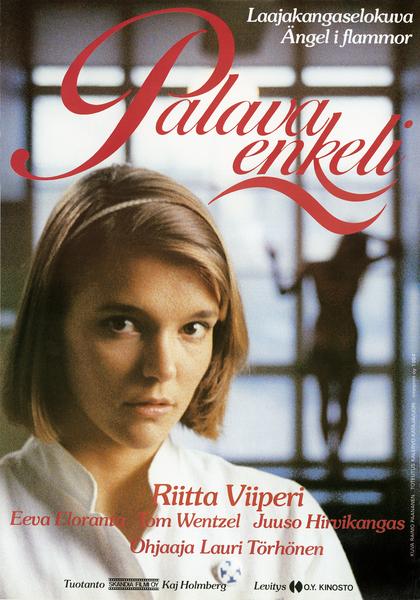 |
| Lauri Törhönen: Palava enkeli / Burning Angel (FI 1984) starring Riitta Viiperi as the psychiatric nurse Tuulikki Merinen. |
Ängel i flammor / Burning Angel.
FI © 1984 Skandia-Filmi. P: Kaj Holmberg.
D: Lauri Törhönen. SC: Hannele Törrönen, Claes Andersson, Lauri Törhönen. DP: Esa Vuorinen – Fujicolor – 1:1,66. AD: Anu Maja. M: Hector. ED: Olli Soinio. S: Johan Hake.
Thanks: Nikkilä Hospital, Laakso Hospital, Kellokoski Hospital, Aurora hospital.
C: Riitta Viiperi (psychiatric nurse Tuulikki Merinen), Eeva Eloranta (Katariina, mental patient), Tom Wentzel (psychiatrist Johan Kukkola, "Juhana"), Juuso Hirvikangas (Mikko, nurse), Elina Hurme (Karin, best friend from the nurse training school), Helena Notkonen (Saimi, patient), Yrjö Pelkonen (Veikko, chauffeur), Marja-Leena Kouki (Maila, nurse), Eeva Mäkinen (Irja, assistant nurse), Hellevi Seiro (Hellevi Härkönen) (Leila, nurse), Vieno Saaristo (Tuulikki's mother), Ritva Arvelo (head nurse), Marjatta Lohikoski (psychologist), Carl Mesterton (chief physician), Annikki Viitala (headmaster of the nurse training school), Jussi Parviainen (man in the discotheque), Ilse Stubbs (assistant nurse), Lasse Lind (colonel, patient), Katja Kiuru, Nina Mattila, Aila Pervonsuo, Tuovi Sundell (patients), Kristiina Kalla (Juhana's girlfriend), Heikki Leppänen, Pauli Tervo (policemen). Raimo Häyrinen (voice of the radio commentator), Heikki Harma (voice of the disc jockey).
105 min
In the presence of Lauri Törhönen, interviewed by Markku Varjola.
Vintage print viewed in Cinema Orion, Helsinki, 12 Nov 2008.
Vintage print with good definition of light, good colour, a scratch through the image during the second half of the film.
LT: "This was my feature film debut, although even my school film was a 50 min fiction film. A friend of mine studies psychology and had experience from a mental institution beyond Joensuu, called Paihola [in the film: Kaihola]. There was a true story behind the script, and because of it, legislation was changed [that a nurse can be a patient in her own ward]."
MV: This was new material in Finnish cinema, maybe only in Radio tulee hulluksi [The Radio Goes Crazy] had treated it before, in a comic way.
LT: "Variety lauded Riitta Viiperi as the most photogenic Nordic female star since Liv Ullmann. But the film had an unknown director, and it received weird reviews. But then it begun to grow, 7. week was better than the 1. [It became the most popular film of the season]. I myself went to Maxim to see it, head deeply buried in my cap, and behind me there was a strange row of spectator, with a brisk lady in both ends. I then learned that from the Nikkilä mental hospital etc. there were whole groups who came to see the film, and it was also used for on-the-job supervision."
MV: The 1980s was the record decade of debut directors. You opened new paths in production, the American way.
LT: "Part of the debut directors never continued beyond the 1980s. Myself, I did more of the artistic stuff for tv, because there, the films always received a million spectators. For the cinemas, it was more about entertainment. Esa Vuorinen was my teacher. [Lauri Törhönen was second assistant director in Warren Beatty's Reds, 1981]. Reds was the craziest adventure on can have, but I learned the American production methods: timetables, shooting schedules, location plans. Riisuminen [The Undressing] I did in 12 shooting days."
MV: What about the technical development.
LT: "Esa Vuorinen is a great artist, the finest Nordic cinematographer alive, he has worked a lot in Sweden. Film-making has been compared with a flight to the moon in the complexity of the logistics".
AA: The young nurse Tuulikki (Riitta Viiperi) comes to a mental hospital and is put in charge of an incurably ill patient Katariina (Eeva Eloranta) in the closed ward. Katariina is obsessed with fire, refuses to drink, and has manic outbursts. While there is a masked ball on the other side of the lake, Katariina dresses as an angel, sets herself to fire and drowns in the lake. Shattered, Tuulikki herself loses her mental balance and becomes a patient in her own ward. In the final image we see her vanish into the happy crowd of a summer music festival.
Still one of the rare Finnish films that portray psychotherapy in a serious way. There is much that is worthy in the performances of the actors. The cinematography is elegant and consistently expressive.
There would be a demand for this film in the dvd market among professionals of psychotherapy.
Sunday, November 09, 2008
SATOSHI KON IN HELSINKI
Cinema Orion, Helsinki, 8 Nov 2008. Mr. Satoshi Kon spoke Japanese, expertly translated into Finnish by Mr. Aleksi Järvelä. There were many previously prepared questions from the audience, and a number of questions in the two-hour-plus session, in addition. - Mentioning a film of his (Perfect Blue, Millennium Actress, Tokyo Godfathers, Paprika) for the first time Mr. Kon asked whether anyone from the audience had seen them, and, happily impressed by the good show of hands, stood up and bowed in gratitude. - Summing up Mr. Kon's comments: "I started with manga, but manga did not sell, so I switched to anime, and the transition was easy. The big difference is that there is a large group of people involved in anime. It is dialogue, it is speaking about images, exchanging thoughts. I had never considered myself as a social person, but it turned out to be the other way around. Anime is being closely followed. There is a lot of mediocre anime. The best anime is created when there is a small compact group involved. It pays to focus on quality."
"My first feature Perfect Blue is based on a novel I had not read myself. About the star and the fan who becomes a stalker. We go inside senses, adopting the first person view of the protagonist. - Anime involves a terrifying amount of images. - In Japan, painting is highly appreciated. - One has to fight for one's position."
About fantastic milieux. "Many critics don't understand anything about making movies. - My starting point is to create fantasy out of the ordinary. - A lot of ideas get discarded. - I develop a web and continuum of ideas. - Paprika was a different process. - Imagery and design are on the forefront. - Usually my starting point is quite realistic, but there are hallucinations involved. - In Paprika, hallucinations dominate. - An unusual parade. - Today reality is emphasized more, and less attention is paid to dreams."
"In my movies, I don't use much the computer, maybe one fifth of the film is computer-generated. It is about the budget: the CG effects are more expensive. Drawing by hand is much cheaper. - Then there is the post-production and the subsidiary production. - In animation, there is not one right way to think."
"I have used my good composer consistently."
"The question of fact/fiction is basic but not all-encompassing".
Do you get mail from people who have had similar experiences of blurring reality and fantasy? "Yes, and sometimes the blurring has become a problem. It can be scary. I don't know whether these persons should watch these films."
Is there a message or vision? "I have to explain a lot, as if I were a radio with non-stop talk. There is none. But one can find ideas hidden in different layers, and it is the viewer's task to find them."
Strong female characters such as Paprika. "As in biology, my characters start as females, but they can transform into men. - The biggest battle I had with the strong female character in Millennium Actress. - The most difficult was Perfect Blue, as the budget was minuscule. - Easy have none of them been."
"My first feature Perfect Blue is based on a novel I had not read myself. About the star and the fan who becomes a stalker. We go inside senses, adopting the first person view of the protagonist. - Anime involves a terrifying amount of images. - In Japan, painting is highly appreciated. - One has to fight for one's position."
About fantastic milieux. "Many critics don't understand anything about making movies. - My starting point is to create fantasy out of the ordinary. - A lot of ideas get discarded. - I develop a web and continuum of ideas. - Paprika was a different process. - Imagery and design are on the forefront. - Usually my starting point is quite realistic, but there are hallucinations involved. - In Paprika, hallucinations dominate. - An unusual parade. - Today reality is emphasized more, and less attention is paid to dreams."
"In my movies, I don't use much the computer, maybe one fifth of the film is computer-generated. It is about the budget: the CG effects are more expensive. Drawing by hand is much cheaper. - Then there is the post-production and the subsidiary production. - In animation, there is not one right way to think."
"I have used my good composer consistently."
"The question of fact/fiction is basic but not all-encompassing".
Do you get mail from people who have had similar experiences of blurring reality and fantasy? "Yes, and sometimes the blurring has become a problem. It can be scary. I don't know whether these persons should watch these films."
Is there a message or vision? "I have to explain a lot, as if I were a radio with non-stop talk. There is none. But one can find ideas hidden in different layers, and it is the viewer's task to find them."
Strong female characters such as Paprika. "As in biology, my characters start as females, but they can transform into men. - The biggest battle I had with the strong female character in Millennium Actress. - The most difficult was Perfect Blue, as the budget was minuscule. - Easy have none of them been."
Môsô dairinin 1: Ohayo! (in the presence of Satoshi Kon)
 |
| Satoshi Kon: 妄想代理人 / Môsô dairinin / Paranoia Agent (JP 2004). |
妄想代理人 / Paranoia Agent 1: Good Morning! TV anime series, first episode of 13. JP 2004. PC: WoWoW. D: Satoshi Kon. Episode 25 min. Dvd projection in Cinema Orion, Helsinki, 8 Nov 2008. Extra screening on the occasion of the visit of Satoshi Kon. - IMDB series summary: "We follow different fates in modern Japan. Each episode ends with an assault by a boy with a golden bat. Throughout the animation series we learn more about the boy." - A fascinating anime with original approaches to the psyche.
Paprika
JP 2006. PC: Madhouse, Paprika Film Partners. D: Satoshi Kon.SC: Seishi Minakami, Satoshi Kon - based on the novel by Yasutaka Tsutsui. M: Susumu Hirasawa. Anime. 2,35:1, colour. 90 min. Blu-Ray projection of the English version with Finnish subtitles in Cinema Orion, Helsinki, 8 Nov 2008. - An extra screening on the occasion of Satoshi Kon's visit. - The Blu-Ray premiere at Orion. There is a depth of image clearly different from dvd. - Plot synopses from IMDB: "When a machine that allows therapists to enter their patient's dreams is stolen, all hell breaks loose. Only a young female therapist can stop it: Paprika." - "Three scientists at the Foundation for Psychiatric Research fail to secure a device they've invented, the D.C. Mini, which allows people to record and watch their dreams. A thief uses the device to enter people's minds, when awake, and distract them with their own dreams and those of others. Chaos ensues. The trio - Chiba, Tokita, and Shima - assisted by a police inspector and by a sprite named Paprika must try to identify the thief as they ward off the thief's attacks on their own psyches. Dreams, reality, and the movies merge, while characters question the limits of science and the wisdom of Big Brother." - "In this Japanese anime epic, humanity's last bastion of privacy has finally been infiltrated by technology, the world of our dreams. The story centers on a new invention called the DC-Mini. With this revolutionary device, psychiatrists are now able to enter a patient's dreams in a therapeutic setting. But when an unknown assailant steals all of the devices, using them to enter peoples minds enacting mind control, chaos ensues as dreams begin to bleed into reality, and the thin line between the conscious and the unconscious begins to blur. Enter a young female researcher named Chiba, who takes it upon herself to delve into the newly anarchic dream world in order to set things straight. In this surreal realm her name is Paprika, and she's out to save the world. Bursting with fantastic imagery and breathtakingly innovative animation." - I could only catch the first 20 minutes of this original and fascinating anime, certainly worth revisiting.
Saturday, November 08, 2008
Maria Larssons eviga ögonblick
Ikuistetut hetket / Everlasting Moments. SE/DK/FI/NO/DE (c) 2008 Final Cut. P: Tero Kaukomaa, Christer Nilson, Thomas Stenderup. D: Jan Troell. SC: Niklas Rådström - based on a story by Agneta Ulfsäter-Troell and Jan Troell. DP: Mischa Gavrjusjov, Jan Troell - colour - 1,85:1 - digital intermediate: Digilab - printed on 35mm film. CAST: Maria Heiskanen (Maria Larsson), Mikael Persbrandt (Sigfrid Larsson), Jesper Christensen (Sebastian Pedersen), Emil Jensen (Englund), Ghita Nørby (Miss Fagerdal), Hans Henrik Clemensen (Mr. Fagerdal), Amanda Ooms (Matilda), Antti Reini (Captain), Birte Heribertsson (Aunt Tora), Claire Wikholm (Grandmother Karna), Hans Alfredson (prison guard). 133 min. Released in Finland by Sandrew with Finnish subtitles by Anitra Paukkula. Viewed at Maxim 2, 7 Nov 2008. - The digital intermediate look is shabby. - It is great to see Jan Troell (born 1931) in good form. He is a director who has always something to say. - This is a story of the power of photography (and cinematography, and art) to transform life, to open new horizons and perspectives. - "The images are taking hold". "They turn me to another being". "They reveal another world". "There is no turning back". "For always, for ever". - Storywise I like the film's portrayal of the everyday working life around WWI, the hard toil, the ascent of the workers' movement. It is naturalistic but not boring. But the imagery as filtered through the digital intermediate is not interesting to look at. It lacks the vibration of life. - The story takes place in Göteborg and in the neighbourhood. - There are the two men in Maria's life: the brutal Sigfrid, to whom she is faithful and whom she manages to transform (even though he has to go to prison after having tried to murder Maria). And there is the platonically friendly owner of the photographer's shop, Sebastian Pedersen, who encourages Maria to her new passion of photography. - Good visual ideas: the image of the butterfly reflected on Maria's hand via the camera lens. - Cinematography: Sebastian Pedersen shoots a newsreel of the three kings' meeting on the eve of WWI. There is a screening of Charles Chaplin's Easy Street with piano and violin accompaniment. [Jan Troell has a an interest in silent cinema representation but also a tendency to exaggerate overspeed, also in Här har du ditt liv.] - A story about art transcending and transforming life.
Quantum of Solace
 |
| Marc Forster: Quantum of Solace (GB/US 2008) with Olga Kurylenko (Camille) and Daniel Craig (James Bond). |
007 Quantum of Solace / 007 Quantum of Solace.
GB/US © 2008 Danjaq / United Artists / Columbia. P: Barbara Broccoli, Michael G. Wilson.
D: Marc Forster. SC: Paul Haggis, Neal Purvis, Robert Wade – inspired by characters created by Ian Fleming.
DP: Roberto Schaefer – colour – 2,35:1 – cameras: Arricam ST/LT, Arri and Angenieux Lenses, Arriflex 235, Arri and Angenieux Lenses, Arriflex 435 Advanced, Arri and Angenieux Lenses, Dalsa Origin, Sony CineAlta HDW-F900R – negative or master format: 35 mm (Kodak Vision2 200T 5217, Vision3 500T 5219), Digital, HDTV Video – cinematographic process: Digital Intermediate (2K) (master format), source formats: Digital (4K) , HDCAM SR (source format), Super 35 (also 3-perf) – printed film format: 35 mm (anamorphic) (Kodak Vision 2383, Vision Premier 2393) [source of technical information: IMDB].
M: David Arnold; James Bond theme by Monty Norman; "Another Way To Die" (Jack White) perf. Jack White & Alicia Keys. Visual effects: several companies.
CAST: Daniel Craig (James Bond), Olga Kurylenko (Camille), Mathieu Amalric (Dominic Greene), Judi Dench (M), Giancarlo Giannini (Mathis), Gemma Arterton (Strawberry Fields), Jeffrey Wright (Felix Leiter).
108 min
Released in Finland by Walt Disney Studios Motion Pictures Finland with Finnish / Swedish subtitles by Marko Hartama / Marko Hietikko.
Viewed in Kinopalatsi 1, Helsinki, 7 Nov 2008.
Digital look mostly hidden by extremely rapid cutting. Steel blue gray colour gamut. When shots linger the limitations of the definition become evident.
The previous Bond film got some of the best reviews of the whole Bond cycle, and it was apparently the financially most successful Bond film of all. This is a direct follow-up. – One of the shortest Bond films, it focuses on action, a little like the hyperkinetic action films that were trendy from the 1980s until the 1990s. The danger is that all action and rapid cutting can get tedious. – As a fan of Marc Forster (Monster's Ball, The Kite Runner) I see no director's touch in this assignment. – Daniel Craig's Bond is made more single-mindedly a killing machine, and there is an acceptance of violent torture that resonates with Abu Ghraib. Bond was always cynical and brutal, but there were more sides to the character before. Now he resonates more with the ugly side of the world espionage. However, there is a division with the bad Americans and the good Americans. There are also critical comments on the cynicism of world politics. – I feel that the spirit of Bond died with the Cold War, and the series now lives an artificial life, but surely it will be continued as long as the success is this phenomenal. – Certainly the Bourne films are now more cutting edge than the Bond films. – I still think they should have more powerful villains and more powerful women (besides Judi Dench as M). – There would be any number of fascinating ways to create modern spy thrillers. The reality is more thrilling than any of the current spy films films, as can be seen in books like Steven Coll's The Ghost Wars. – Now only some details of new technology are interestingly modern. – The score is on the level of the best of the Bond cycle.
Thursday, November 06, 2008
En natt / One Night
 |
| Gustaf Molander: En natt / One Night (SE 1931). |
SE 1931. PC: Svensk Filmindustri.
D: Gustaf Molander. ASS.D: Gösta Hellström. SC: Ragnar Hyltén-Cavallius [based on a true story as told by Armas Järnefelt]. DP: Åke Dahlqvist. ASS.CIN: Rolf Husberg. Lighting: Sixten Andersson. AD: Arne Åkermark. M: Jules Sylvain (= Stig Hansson). Songs: "Internationalen" (Degeyter, Henrik Menander), "Atenarnas sång" (Sibelius, Viktor Rydberg).
C: Björn Berglund (Armas Beckius, the red son), Uno Henning (Vilhelm Beckius, the white son), Gerda Lundequist (the mother, Lady Beckius, a colonel's widow), Ingert Bjuggren (Marja, the Russian red girlfriend of Armas), Karin Swanström (Minka, Marja's mother), Sture Lagerwall (Niku).
C: Björn Berglund (Armas Beckius, the red son), Uno Henning (Vilhelm Beckius, the white son), Gerda Lundequist (the mother, Lady Beckius, a colonel's widow), Ingert Bjuggren (Marja, the Russian red girlfriend of Armas), Karin Swanström (Minka, Marja's mother), Sture Lagerwall (Niku).
Not released nor telecast in Finland.
Long version originally 83 min. The surviving short version 78 min.
A Cinemateket / Svenska Filminstitutet print with e-subtitles in Finnish by Lena Talvio viewed at the Finnish Film Archive, Cinema Orion, Helsinki, 6 Nov 2008.
A brilliant print with a beautiful definition of light.
The story of Finland's Civil War of 1918. Two brothers in Karelia, one is Red, the other is White. The family is torn apart, a symbol of Finland's fate at the dawn of independence.
Although Gustaf Molander was born in Helsinki, the film is inauthentic and unbelievable from a realistic point of view, and it was offensive for both sides. It shows the red rebellion as an export article only with no basis in the circumstances of the country. It shows the whites organizing immediate executions without trial.
The rhetorical dialogue is on the lines of "you don't know what a man's honour is" and "and you have no idea of a woman's love".
This being said, the film looks great, it is one of the best-looking Swedish films. The opening montage of the old mill. The revolutionary montage in the style of the great Russians. The camerawork is consistently interesting with sharp editing, a richness of composition, shots ranging from extreme close-up to impressive long views. There is a good sense of action in the chase sequence. The sensual attraction of Marja is engaging and original. The final dawn takes the breath away.
Long version originally 83 min. The surviving short version 78 min.
A Cinemateket / Svenska Filminstitutet print with e-subtitles in Finnish by Lena Talvio viewed at the Finnish Film Archive, Cinema Orion, Helsinki, 6 Nov 2008.
A brilliant print with a beautiful definition of light.
The story of Finland's Civil War of 1918. Two brothers in Karelia, one is Red, the other is White. The family is torn apart, a symbol of Finland's fate at the dawn of independence.
Although Gustaf Molander was born in Helsinki, the film is inauthentic and unbelievable from a realistic point of view, and it was offensive for both sides. It shows the red rebellion as an export article only with no basis in the circumstances of the country. It shows the whites organizing immediate executions without trial.
The rhetorical dialogue is on the lines of "you don't know what a man's honour is" and "and you have no idea of a woman's love".
This being said, the film looks great, it is one of the best-looking Swedish films. The opening montage of the old mill. The revolutionary montage in the style of the great Russians. The camerawork is consistently interesting with sharp editing, a richness of composition, shots ranging from extreme close-up to impressive long views. There is a good sense of action in the chase sequence. The sensual attraction of Marja is engaging and original. The final dawn takes the breath away.
BEYOND THE JUMP BREAK: MY PROGRAM NOTE FOR THE FINNISH FILM ARCHIVE ON EN NATT (MOLANDER) / SERMENTS (HENRI FESCOURT):
The Wicked Lady (1945)
 |
| Leslie Arliss: The Wicked Lady (GB 1945). Margaret Lockwood (Barbara Skelton) and James Mason (Captain Jerry Jackson). |
Paholaisnainen / Maantierosvojen kuningatar / Svarta damen / Stråtrövarnas drottning.
GB 1945. PC: Gainsborough.
D: Leslie Arliss. SC: Leslie Arliss, Aimee Stuart, Gordon Glennon – based on the novel The Life and Death of the Wicked Lady Skelton (1943) by Magdalen King-Hall. DP: Jack Cox. AD: John Bryan. ED: Terence Fisher.
CAST: Margaret Lockwood (Barbara Skelton), James Mason (Captain Jerry Jackson), Patricia Roc (Caroline), Griffith Jones (Sir Ralph Skelton, magistrate), Michael Rennie (Kit), Enid Stamp-Taylor (Lady Henrietta Kingsclere).
104 min
A Park Circus print viewed at Suomen elokuva-arkisto, Orion, Helsinki, 5 Nov 2008.
A serviceable print. – Energetic entertainment from a female viewpoint. This is libido speak, cinema of transgression in the entertainment sphere. We are asked to identify with the selfish woman, Lady Skelton (Margaret Lockwood), who thinks nothing of breaking her best woman friend's betrothal, seducing her fiancé, marrying for money, already in the wedding party lusting for another man, losing her irreplaceable diadem in a play of the cards, becoming a highwaywoman to retrieve the diadem, starting a wild affair with the real highwayman, Captain Jackson (James Mason), and complaining about her husband, the magistrate Ralph Skelton, devoting himself to work, work work... of containing rampant crime! – Sharp dialogue, knowing looks, double entendres, bulging half-naked bosoms, pulp narrative. The fun of audacity, of doing the wrong thing. – Hitchcock's cameraman Jack Cox in good form. The future Hammer director Terence Fisher as editor. – I watched 40 min.
DOKUMENTIN YTIMESSÄ 44: MANNERHEIM
I dokumentärens kärna 44: Mannerheim / In the Core of the Documentary 44: Mannerheim. Programme curated by Ilkka Kippola, Jari Sedergren. Viewed at Cinema Orion, Helsinki, 5 Nov 2008. Presented by Ilkka Kippola.
Suomen kansallinen sotajoukko. FI 1918. 11 min - good print
Talonpoikaismarssi 7. VII 1930. FI 1930. Excerpts on Betacam SP, 10 min
Mannerheimin 70-vuotispäivän juhlallisuudet. FI 1937. 9 min - good print
Deutsche Auslandswochenschau 563: [Hitler Visits Finland]. DE 1942. DP: Walter Frenz. 11 min excerpt - 16mm. - On the dvd, there is the Finnish newsreel on Hitler's visit to Finland; here we see the German perspective. The viewer is made to understand that Vyborg was conquered from the USSR after Hitler's visit (it was conquered before).
Puolustusvoimain katsaus 52: Suomen marsalkan vastavierailu Saksaan. FI 1942. 16 min. Mannerheim visits Hitler, Göring, Himmler in Germany
[Rintamavierailut syksyllä 1941-42. Unreleased]. FI 1941-1942. Betacam SP with 2008 commentary by Ohto Manninen, Ilkka Kippola. 7 min
[Marsalkan metsästysmaja. Unreleased]. FI 1942. Betacam SP with 2008 commentary by Ohto Manninen, Ilkka Kippola. 11 min
[Päämajakaupunki Mikkeli. Unreleased]. FI 194X. Betacam SP with 2008 commentary by Ohto Manninen, Ilkka Kippola. 9 min
Suomen Marsalkan viimeinen matka. FI 1951. 15 min
Marsalkan päivä. FI 1960. 8 min. Vintage print, colour starting to fade.
A great programme on the public image of C.G.E. Mannerheim, the Marshal of Finland (1867-1951). Although there is now a good dvd of the Mannerheim documentary films, on screen the impact is stronger.
Suomen kansallinen sotajoukko. FI 1918. 11 min - good print
Talonpoikaismarssi 7. VII 1930. FI 1930. Excerpts on Betacam SP, 10 min
Mannerheimin 70-vuotispäivän juhlallisuudet. FI 1937. 9 min - good print
Deutsche Auslandswochenschau 563: [Hitler Visits Finland]. DE 1942. DP: Walter Frenz. 11 min excerpt - 16mm. - On the dvd, there is the Finnish newsreel on Hitler's visit to Finland; here we see the German perspective. The viewer is made to understand that Vyborg was conquered from the USSR after Hitler's visit (it was conquered before).
Puolustusvoimain katsaus 52: Suomen marsalkan vastavierailu Saksaan. FI 1942. 16 min. Mannerheim visits Hitler, Göring, Himmler in Germany
[Rintamavierailut syksyllä 1941-42. Unreleased]. FI 1941-1942. Betacam SP with 2008 commentary by Ohto Manninen, Ilkka Kippola. 7 min
[Marsalkan metsästysmaja. Unreleased]. FI 1942. Betacam SP with 2008 commentary by Ohto Manninen, Ilkka Kippola. 11 min
[Päämajakaupunki Mikkeli. Unreleased]. FI 194X. Betacam SP with 2008 commentary by Ohto Manninen, Ilkka Kippola. 9 min
Suomen Marsalkan viimeinen matka. FI 1951. 15 min
Marsalkan päivä. FI 1960. 8 min. Vintage print, colour starting to fade.
A great programme on the public image of C.G.E. Mannerheim, the Marshal of Finland (1867-1951). Although there is now a good dvd of the Mannerheim documentary films, on screen the impact is stronger.
Wednesday, November 05, 2008
Eternal Love (1929) (Movietone version, UCLA restoration)
%20EL%20ja%20JB.jpg) |
| Ernst Lubitsch directs: Eternal Love (US 1929), starring John Barrymore (Marcus). Oliver Marsh at the camera. |
UCLA restored Movietone version viewed at Cinema Orion, Helsinki, 4 Nov 2008.
Excellent restoration from probably very difficult materials, it looks like a very well made dupe. The image is a little on the soft side, and there are contrast questions in some scenes. The overall impact is consistent and pleasant.
The Hugo Riesenfeld score is a good example of a music score of a late silent film. It is interesting to notice how the most important sound elements (the bells, the gunshots, the door knockers) work perfectly even as silent film images.
"My gun is my life. Who will dare take it away from me?" Ciglia steps forward.
The heavy make-up is distracting.
The influence of Murnau's Faust both in the choice of Camilla Horn and in the final visionary image, so untypical for Lubitsch.
I feel this is an important Lubitsch film, although it is not fully accomplished and although he himself disowned it.
Saturday, November 01, 2008
Standard Operating Procedure
Standard Operating Procedure / Standard Operating Procedure. US (c) 2008 Sony Pictures Classics. EX: Robert Fernandez, Diane Weyermann. P: Julie Ahlberg, Errol Morris. D: Errol Morris. DP: Robert Chappell, Robert Richardson - shot on HDTV - color - 2,35:1 - print on 35mm film. M: Danny Elfman. 118 min. Released in Finland by Cinema Mondo with Finnish / Swedish subtitles by Anitra Paukkula / Markus Karjalainen. Viewed at Kino Engel 1, 31 Oct 2008. - A fine and consistent digital intermediate look. - Powerful imagery helps approach the grim subject matter. Expressive Interrotron close-ups, music by Danny Elfman, sound design. The space of images, photographs, hundreds of them, being structured during the picture. "All the pictures seemed to line up". - Iraq War of 2003-. This is a journey into Abu Ghraib, beyond the sensational images of humiliation (including the sexual pyramid). We get to see them in context, and see them with different eyes. Some images look worse than what happened. But the worst things were never photographed in the first place. Mainly young and inexperienced soldiers were punished. - Saddam did a thousand times more horrible things, but the world had expected more from the US. - An important survey into the Abu Ghraib mess that has come to symbolise the US trouble in the Iraq War of 2003-. - Great, maybe too long?
Wikipedia: "The name "Interrotron" was coined by Morris's wife, who, according to Morris, "liked the name because it combined two important concepts — terror and interview." The device is similar to a teleprompter: Errol and his subject each sit facing a camera. The image of each person's face is then projected onto the lens of the other's camera. Instead of looking at a blank lens, then, both Morris and his subject are looking directly at a human face. Morris believes that the machine encourages monologue in the interview process, while also encouraging the interviewees to "express themselves to camera"."
Wikipedia: "Morris' practice of compensating his interview subjects has caused controversy, although it is not an unusual practice in documentary filmmaking, according to the producer Diane Weyermann, who also worked on An Inconvenient Truth. In a private interview during the Tribeca Film Festival, Morris said: "If I had not paid them, they would not be interviewed.""
Wikipedia: "The name "Interrotron" was coined by Morris's wife, who, according to Morris, "liked the name because it combined two important concepts — terror and interview." The device is similar to a teleprompter: Errol and his subject each sit facing a camera. The image of each person's face is then projected onto the lens of the other's camera. Instead of looking at a blank lens, then, both Morris and his subject are looking directly at a human face. Morris believes that the machine encourages monologue in the interview process, while also encouraging the interviewees to "express themselves to camera"."
Wikipedia: "Morris' practice of compensating his interview subjects has caused controversy, although it is not an unusual practice in documentary filmmaking, according to the producer Diane Weyermann, who also worked on An Inconvenient Truth. In a private interview during the Tribeca Film Festival, Morris said: "If I had not paid them, they would not be interviewed.""
Friday, October 31, 2008
Vicky Cristina Barcelona, soundtrack album

1. Barcelona / Giulia y Los Tellarini 2:22
2. Gorrion / Juan Serrano 3:05
3. Entre dos aguas / Paco De Lucia 6:00
4. El noi de la mare / Jean-Felix Lalanne, Muriel Anderson 2:49
5. Granada / Emilio de Benito 1:53
6. La ley del retiro / Giulia y Los Tellarini 2:14
7. When I Was A Boy / Biel Ballester Trio, Graci Pedro, Leo Hipaucha 3:13
8. Big Brother / The Stephane Wrembel Trio 5:07
9. Asturias / Juan Quesada 7:50
10. Your Shining Eyes / Biel Ballester Trio, Graci Pedro, Leo Hipaucha
11. Entre olas / Juan Serrano
Vicky Cristina Barcelona
Vicky Cristina Barcelona / Vicky Cristina Barcelona. ES/US (c) 2008 Gravier Productions / Mediapro. EX: Jaume Roures. CO-EX: Charles H. Joffe, Javier Méndez, Jack Rollins. P: Letty Aronson, Stephen Tenenbaum, Gareth Wiley. D+SC: Woody Allen. DP: Javier Aguirresarobe - color - 1,85:1. M: "Barcelona" performed by Giulia y los Tellarini. "Entre dos aguas" by Paco de Lucía. "Granada" by Isaac Albéniz, played on guitar by Emilio de Benito. "Asturias" (Leyenda) (fragment) by Isaac Albéniz, played on guitar by Juan Quesada, etc. PD: Alain Bainée. AD: Iñigo Navarro. COST: Sonia Grande. ED: Alisa Lepselter. LOC: Barcelona, Avilés, Oviedo (Catalonia). CAST: Rebecca Hall (Vicky), Scarlett Johansson (Cristina), Javier Bardem (Juan Antonio), Penélope Cruz (Maria Elena), Chris Messina (Doug), Patricia Clarkson (Judy Nash), Kevin Dunn (Mark Nash), Christopher Evan Welch (Narrator). 96 min. In English, partially in Catalan and Spanish. Released in Finland by Scanbox with Finnish / Swedish subtitles by Timo Porri / Saliven Gustavsson. Viewed at Tennispalatsi 3, 31 Oct 2008.
Definition not first-rate, focus questions, sloppy digital intermediate? - Woody Allen's amazing quest continues, this time again without him as an actor or voice, although his gestures and speech rhythms are momentarily recognizable in Scarlett Johansson's performance. - I admire Woody Allen's great continuity since the 1960s to the present. His is a series of relationship studies that can be compared with Eric Rohmer. - This is an interesting and original study of "Americans abroad", recognizing stereotypes, but without succumbing to clichés. There are the obvious Catalonian attractions, and more. - Beneath the "small story" lurk big themes, such as how hard it is to learn to love. The strange roads of passion. - Vicky is the serious woman, Cristina is the wild woman. There is no simple answer to the great questions. Passion is living to the full but risking disaster. Settling for a life with a successful businessman gives security, but life can feel unfulfilled. - "You are a different person here". - Maybe for the first time in a Woody Allen film there is a significant and positive homosexual moment (Scarlett Johansson and Penélope Cruz in the infrared darkroom). - Also maybe for the first time there is a serious new angle to the triangle situation: Juan Antonio and Maria Elena can only be happy and balanced when they are together with Cristina. - Woody Allen is still curious, still exciting.
Definition not first-rate, focus questions, sloppy digital intermediate? - Woody Allen's amazing quest continues, this time again without him as an actor or voice, although his gestures and speech rhythms are momentarily recognizable in Scarlett Johansson's performance. - I admire Woody Allen's great continuity since the 1960s to the present. His is a series of relationship studies that can be compared with Eric Rohmer. - This is an interesting and original study of "Americans abroad", recognizing stereotypes, but without succumbing to clichés. There are the obvious Catalonian attractions, and more. - Beneath the "small story" lurk big themes, such as how hard it is to learn to love. The strange roads of passion. - Vicky is the serious woman, Cristina is the wild woman. There is no simple answer to the great questions. Passion is living to the full but risking disaster. Settling for a life with a successful businessman gives security, but life can feel unfulfilled. - "You are a different person here". - Maybe for the first time in a Woody Allen film there is a significant and positive homosexual moment (Scarlett Johansson and Penélope Cruz in the infrared darkroom). - Also maybe for the first time there is a serious new angle to the triangle situation: Juan Antonio and Maria Elena can only be happy and balanced when they are together with Cristina. - Woody Allen is still curious, still exciting.
Thursday, October 30, 2008
Apinan vuosi / In the Year of the Ape (in the presence of Janne Kuusi)
 |
| Janne Kuusi: Apinan vuosi / In the Year of the Ape (FI 1983). Heikki Salomaa as Ile. |
Apans år.
FI 1983. PC: Elokuvatuottajat Oy. P: Claes Olsson, Matti Penttilä.
D: Janne Kuusi. SC: Harri Sirola, Janne Kuusi – based on the novel Abiturientti (1980) by Harri Sirola. DP: Tahvo Hirvonen - colour - 1:1,66. AD: Erkki Saarainen. COST: Irmeli Toivanen. M: Pekka Rechardt. ED: Anne Lakanen. S: Mikael Sievers.
CAST: Heikki Salomaa (Ile), Tiina Bergström (Suvi), Laura Heimo (Tanja), Rea Mauranen (Maria, the Finnish teacher), Elina Hurme (Sara, the girl in a leather jacket), Ilpo Kotanen (Klasu), Kari Väänänen (Rene), Heidi Krohn (Ile's mother), Aarre Karén (Ile's father), Marja-Leena Kouki (Suvi's mother), Esko Salminen (Suvi's father), Hanna Marttila (Suvi's friend), Ritva Sorvali (laughing woman), Markku Halme, Konsta Mäkelä, Ritva Rantasila (classmates), Kari Paukkunen (psychology teacher), Eero Tuomikoski (janitor), Jussi Parviainen, Tomi Salmela, Tapio Liinoja, Pekka Uotila, Seppo Luukkanen (Rene's henchmen), Timo Eränkö (De Sade), Paul Pentti (Marat), Aki Kaurismäki (Charlotte Corday), the Jack Helen Brut group.
94 min
In the presence of Janne Kuusi hosted by Markku Varjola.
A vintage print screened at Cinema Orion, Helsinki, 29 Oct 2008
MV: the first Finnish surrealistic feature film. - JK: We were on terms with surrealism but tried to avoid aping. Initially planned as a tv movie it became a cinema film. We aimed at cinematic expression. There was in Finland a theatrical tradition and a literary tradition; we wanted to do cinema. The visual outlook is very distinctive. Heikki Salomaa got the lead role, soon to become well-known in the Lapinlahden Linnut team. The soundscape was also very ambitious. The film was the diploma work for Kuusi, Hirvonen, Lakanen, Sievers.
AA: This is the story of the "abiturientti" (candidate for the matriculation examination, graduating senior, preparatory student, upper-secondary school leaver) who is at the threshold of becoming an "ylioppilas" (student, undergraduate, upper secondary school-leaver), qualified to apply for admission to a university. These are the months of transition to adulthood.
Janne Kuusi and Harri Sirola turned Sirola's novel around and created a surrealistic vision. Ile, the young man, wants to apply for admission to the medical faculty. The "ylioppilaskirjoitukset" (the student exam, the written examination for higher certificate) are under way, but there is also partying and meeting girls.
Ile is aimless in his relationships. There is the lovely and playful Suvi (Tiina Bergström), there is the dark, hard-to-get Tanja (Laura Heimo), there is the strongly personal Sara, the girl in the leather jacket (Elina Hurme), and even the striking Maria, the Finnish teacher (Rea Mauranen).
Maria's boyfriend is the violent Rene (Kari Väänänen), and through him there is a criminal gang element in the story. There is no clear line between dream and reality in the film. The "lakkiaisjuhla" (the private party of passing the student exam and getting the white student cap) is a big baroque banquet with scantily clad nymphs on horseback and a living Havis Amanda (the famous nude statue at Helsinki's Market Square, the Venus of Finland) (from the long shot it is difficult to see whether the live Havis Amanda is Tiina Bergström). The mounted nymphs take Ile with them and throw him to the basin at the statue Havis Amanda's fountain (the traditional place where students celebrate the First of May).
Nonstop
Nonstop / Nonstop. FI (c) 1987 Filmitakomo. P: Klaus Heydemann. D+SC: Kari Paljakka. DP: Tahvo Hirvonen - 16mm - b&w. COST: Jaana Mertama. M: Jussi Hirvi; Hanoi Rocks. S: Markku Honkanen. ED: Alvardo Pardo. Cast: Esko Nikkari (man), Armi Sillanpää (woman), Carl-Kristian Rundman (young man), Jane Sarlund (girl), Mikko Rasila (ticketseller woman), Niko Saarela (boy), Vesa Vierikko (bum), Pertti Sveholm (father). 20 min. Print: SES, with English subtitles, viewed at Cinema Orion, Helsinki, 29 Oct 2008. - In the presence of Kari Paljakka interviewed by Markku Varjola. - Print ok, focus problem in the screening. - KP: the film was inspired by M.C. Escher [1898-1972] with his impossible play with the dimensions. The idea was to use the third dimension of the cinema, time, in the same way. The film is based on the rondo idea. Together with Dildo, the film was planned to be a part of the trilogy, but the third film was not made. There was also an inspiration of the anamorphic art of the 17th century (not the same thing as anamorphic cinema image). - A never-ending film which returns to the same moments but with different consequences. A parody of film drama with passion and murder. One of the locations is Cinema Takaportti [Back Door], where soft core films were shown, presumably non stop (the current film seems to be Emmanuelle 5). The story spins in an impossible circle. "Where are you going, wife dear". "Day screening again". "This will hardly ever stop". "Non stop". "Back in a moment".
Wednesday, October 29, 2008
Cluny Brown
Piika, joka ei tiennyt paikkaansa / Husan, som inte visste sin plats. US © 1946 20th Century Fox. P+D: Ernst Lubitsch. SC: Samuel Hoffenstein, Elizabeth Reinhardt – based on the novel by Margery Sharp (1944). DP: Joseph La Shelle. AD: Lyle Wheeler, J. Russell Spencer. COST: Bonnie Cashin. M: Cyril Mockridge. ED: Dorothy Spencer. S: Arthur L. Kirbach, Roger Herman. CAST: Charles Boyer (Adam Belinski), Jennifer Jones (Cluny Brown), Peter Lawford (Andrew Carmel), Helen Walker (Betty Cream), Reginald Gardiner (Hilary Ames), Reginald Owen (Sir Henry Carmel), Sir C. Aubrey Smith (Col. Duff Graham), Richard Haydn (Wilson), Margaret Bannerman (Lady Alice Carmel), Sara Allgood (Mrs. Maile), Ernest Cossart (Syrette), Una O'Connor (Mrs. Wilson). 95 min, 100 min. A Filmoteca Española print of the long version with Spanish subtitles viewed at Cinema Orion, Helsinki, 28 Oct 2008. - Uneven print, sometimes good definition, sometimes low contrast and soft. - The film starts disappointingly with too much talk, the main actors not yet in character. But there is the spirit since Jennifer Jones meets C. Aubrey Smith at the railway station. - This is a comedy of misunderstandings: Cluny Brown is a young woman "who does not know her place". Adam Belinski is an exiled Czech intellectual, an ex-professor, now a bum mistaken for a persecuted resistance fighter. As a foreigner I cannot judge how successful the satire of English class society is in its authentic detail and how convincing Jennnifer Jones is as an English working-class woman. But I like the spirit of the story, about the real worth of the human beings, and how ridiculous external labels can be. - The servants are even more severe about keeping appearances than the masters. - The proper manners of the town chemist as death-in-life, in contrast to Belinski's bum existence. Belinski does not lie, but he does not correct misunderstandings, either. - Shakespeare saves Cluny Brown and Adam Belinski. - "Squirrels to the nuts". - "You know what plumbing does to me". - Final pantomime beyond the bookstore window. "The Nightingale Strikes Again". The end of the last all-Lubitsch film. There were also films started by him and finished by Preminger. I love Preminger, but he didn't have the Lubitsch touch.
Sunday, October 26, 2008
To Be Or Not To Be (1942)
.jpg) |
| Ernst Lubitsch: To Be Or Not To Be (US 1942). Stanley Ridges (Prof. Siletsky) and Jack Benny (Joseph Tura). |
Ollako vai eikö olla / Att vara eller icke vara.
US © 1942 Romaine Film Corporation. Presenter: Alexander Korda.
P+D: Ernst Lubitsch. SC: Edwin Justus Mayer – from a story by Melchior Lengyel [and Ernst Lubitsch]. DP: Rudolph Maté. AD: Vincent Korda. Interior decorations: Julia Heron. Miss Lombard's costumes: Irene. M: Werner R. Heymann. ED: Dorothy Spencer.
CAST: Carole Lombard (Maria Tura), Jack Benny (Joseph Tura), Robert Stack (Ltn. Stanislav Sobinski), Felix Bressart (Greenberg), Lionel Atwill (Rawitch), Stanley Ridges (Prof. Siletsky), Sig Ruman (Col. Ehrhardt), Tom Dugan (Bronski), Charles Halton (producer Dobosch), George Lynn (actor-adjutant), Henry Victor (Capt. Schultz), Maude Eburne (Anna), Halliwell Hobbes (Gen. Armstrong), Miles Mander (Maj. Cunningham), James Finlayson (Scotch farmer).
99 min
A Cinémathèque Royale print with French / Flemish subtitles viewed at Suomen elokuva-arkisto, Orion, Helsinki, 26 Oct 2008.
A worn print with a dark duped fourth reel.
Quite a laugh success with the audience again, the comedy works very well.
The more I see this the more audacious I realize it is: a comedy made in 1942 with topics such as Hitler, the Nazi occupation of Warsaw, concentration camps... and there is nothing cynical in it.
It is a Resistance comedy which does not glorify its heroes nor demonize its villains. They / we are all dumb, frail, inconsistent, erring human beings, capable of good and evil to each other.
"What you are I won't eat".
Maria Tura wears her evening best for the scene where her character is due to the concentration camp.
"Three tons of dynamite in two minutes". - "Take me to 3000 meters".
Maria's reaction to Siletsky's kiss: "Heil Hitler!".
Joseph Tura impersonating Col Ehrhardt: "I'm running out of dialogue".
The real Ehrhardt is the only one who has seen Joseph on stage: "What he did to Shakespeare we are now doing to Poland".
The comedy starts in high gear and manages to climax five times during the last minutes.
Der Baader Meinhof Komplex
 |
| Uli Edel: Der Baader Meinhof Komplex (DE/FR/CZ 2008). |
Baader Meinhof Komplex / Baader Meinhof Komplex.
DE/FR/CZ © 2008 Constantin Film Produktion / Nouvelles Éditions de Films / G.T. Film Production. P: Bernd Eichinger. CO-P: Manuel Cuotemoc Malle.
D: Uli Edel. SC: Bernd Eichinger – based on the book by Stefan Aust (1985, 2008). DP: Rainer Klausmann – 35 mm Kodak – digital intermediate ARRI – released in 35 mm – colour – 1:1,85. PD: Bernd Lepel. ED: Alexander Berner.
C: Martina Gedeck (Ulrike Meinhof), Moritz Bleibtreu (Andreas Baader), Johanna Wokalek (Gudrun Ensslin), Bruno Ganz (Horst Herold), Simon Licht (Horst Mahler), Stipe Erceg (Holger Meins), Sebastian Blomberg (Rudi Dutschke).
152, 157 min.
Released in Finland by Nordisk with Finnish / Swedish subtitles by Tarja Sahlstén / Saliven Gustavson.
Viewed at Kinopalatsi 2, Helsinki, 25 Oct 2008.
A high quality print with many different kinds of imagery (from the sunny beach to the prison world). No objections to the digital intermediate.
The story of the Baader Meinhof terrorist group based on the book of the former editor of the prestigious Der Spiegel magazine, Stefan Aust. It covers the ten years from the Shah demonstrations of 1967 to the German Autumn of 1977. I am not an expert of this subject, but from an outsider's point of view it feels true and plausible. It may even be useful in trying to figure out contemporary terrorism.
It is also a good thriller, without banalizing the subject matter.
I like the basic sense of this film: it strives for honesty and balance in even the most absurd turns of the story, such as the drill at the Arab terrorist training camp. The charisma of Rudi Dutschke and Andreas Baader is evident in the performances of Sebastian Blomberg and Moritz Bleibtreu.
One can understand the indignation of the radicals in the start, but things take a crazy turn.
The film is a veritable panorama of history from the "Crazy Year 1968" with its documentary montages, the Rudi Dutschke assassination attempt, the Middle East situation, bank robberies in West Berlin, the police round-ups, attacks on US military bases, the attack on the Axel Springer building, the prison life of the main terrorists, the trials, Stammheim, the Lufthansa hijack, the liberation of the hostages at Mogadishu, to the collective suicide of the main terrorists and the murder of Hanns Martin Schleyer (the final image).
The performances of the actors are first rate.
The film is a veritable panorama of history from the "Crazy Year 1968" with its documentary montages, the Rudi Dutschke assassination attempt, the Middle East situation, bank robberies in West Berlin, the police round-ups, attacks on US military bases, the attack on the Axel Springer building, the prison life of the main terrorists, the trials, Stammheim, the Lufthansa hijack, the liberation of the hostages at Mogadishu, to the collective suicide of the main terrorists and the murder of Hanns Martin Schleyer (the final image).
The performances of the actors are first rate.
Subscribe to:
Posts (Atom)
