Sunday, September 09, 2012

One of the best books about Alfred Hitchcock is in Finnish: Heikki Nyman's The Hitchcock Touch I–IV


Seeing is believing. Suspicion (1941), starring Cary Grant and Joan Fontaine, is for Heikki Nyman the turning-point in the development of the mature and profound Hitchcock touch.

Heikki Nyman : Hitchcockin kosketus : Alfred Hitchcockin elokuvat I–IV [The Hitchcock Touch : The Films of Alfred Hitchcock I–IV]. Self-published. Helsinki: Yliopistopaino, 1990 (I), 1992 (IV), 1993 (II), 1994 (III). 178 + 400 + 520 + 743 = 1841 p.
There are more books on Alfred Hitchcock than on any other film director, and the level was high from the beginning.

Éric Rohmer and Claude Chabrol's Hitchcock (Paris: Éditions Universitaires, 1957), the first serious book on Alfred Hitchcock in any language, is still an astounding work as a study in forms, Catholic concepts, and basic themes such as the transference of guilt in Hitchcock's work. Published before Vertigo, the reader of this book can already anticipate the formation of Vertigo.

Robin Wood's Hitchcock's Films (London: Zwemmer, 1965, new expanded editions 1969, 1982, 2002) was the first serious book on Hitchcock in English. The first edition focused on Hitchcock's key films, most importantly, on Vertigo. Its insights in close reading and attention to the film text became a model for serious film studies everywhere.

Heikki Nyman is a philosopher who belonged to the close circle of Georg Henrik von Wright. Wright followed Ludwig Wittgenstein as professor at the University of Cambridge but returned to the University of Helsinki in the 1950s. After a remarkable series of excellent Wittgenstein translations Nyman embarked on his huge freelancing Hitchcock project studying Hitchcock's every film and reading almost everything written on him. We tried in vain to get a publisher for Nyman's 1841-page book, and when it proved impossible, Nyman self-published it in a limited edition. Copies can be studied at The National Library of Finland and at the library of the National Audiovisual Archive of Finland.

In his Hitchcock book Nyman approaches the great director as a great thinker, and only in this respect there is a connection with the approach of Gilles Deleuze. Based on the empirical evidence of the movies, themselves, Nyman's labour of love focuses on the philosophical theme of perception as a key to the work of Alfred Hitchcock. The most cinematic expression of the theme of perception is the look, the gaze, seeing in general. A turning point for Nyman is the movie Suspicion (1941) after which all the master's works are profoundly Hitchcockian from Nyman's viewpoint. Yet "the Hitchcock touch" is already present in The Pleasure Garden (1925) and can be tracked down to the very last films. Nyman acknowledges the achievements of previous Hitchcock scholars, Stanley Cavell being one of the most important writers from his viewpoint. Nyman's work would still deserve to be to be translated into English and be much better known. It has permanent value.

Saturday, September 08, 2012

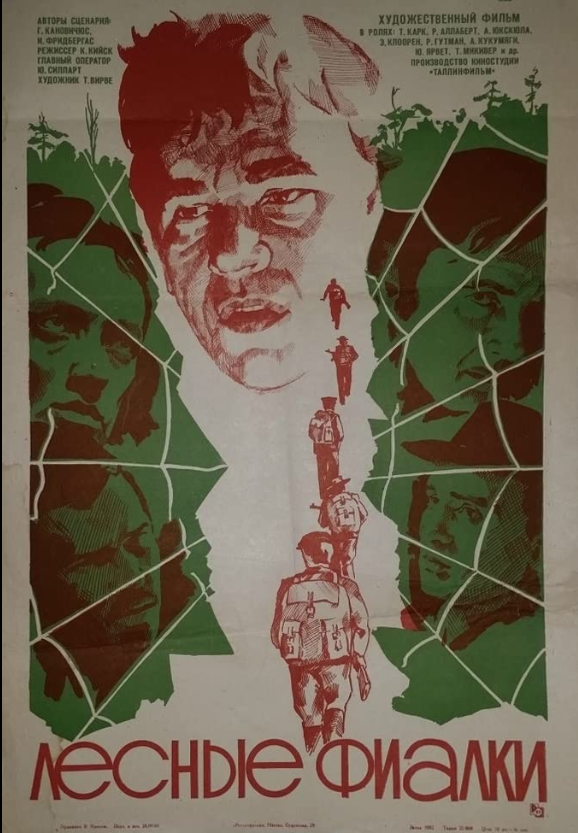
Metskannikesed / Forest Violas


Kaljo Kiisk: Metskannikesed / Forest Violas / Лесные фиалки / Lesnye fialki (EE-SU 1980).

Лесные фиалки / Lesnye fialki / [Metsäorvokit]. EE-SU = Estonian Soviet Socialist Republic 1980. PC: Tallinnfilm.
    D: Kaljo Kiisk. SC: Grigori Kanovičius, Isaakas Fridbergas. DP: Jüri Sillart. AD: Tõnu Virve. Makeup: Helve Sikk. M: Lembit Veevo. M played by: Tallinna Kammerorkester. Conductor: Eri Klas. S: Enn Säde. AD: Kai Schönberg, Merike Ratas. Official KGB experts: Aleksandr Ljaptshihin, Valter Mürik. Filmi direktor: Maret Hirtentreu.
    C: Tõnu Kark (Rein), Rudolf Allabert (Andres), Aarne Üksküla (Juhan), Enn Klooren (Kristjan), Robert Gutman (Kalev), Arvo Kukumägi (Tõnu), Jüri Järvet (Lipp, pharmacist), Tõnu Mikiver (Anti), Tõnu Saar (Lauri).
     Lauri's team: Aldo Tammisaar, Edgar Jõeleht, Lembit Ilsjan.
    Sulev Luik (Sander). – Sander's men: Aleksander Eelmaa, Feliks Kark, Tiit Kaldma, Vello Kont, Uno Kasenurm, Harri Paate, Jaan Rõõmussaar, Jakob Vald, Toomas Vohu, Kaarel Papagoi, Raivo Rüütel.
    Loc: Kohtla-Järve.
    Not released in Finland.
    2489 m / 90 min.
    An Eesti Filmiarhiiv print with electronic subtitles in Finnish by Jenni Kavén viewed at Cinema Orion, Helsinki (Propaganda in Soviet Estonian Cinema seminar), 8 September 2012. Comments after the screening by the historian Pearu Kuusk.

Secret KGB experts: Uno Kask (1927–1981), Valeri Horoshozhenov (1940–2005), Gennadi Levin (*1948).

Propaganda as desinformation: in 1947, desperate Estonian forest bandits are being armed and supported by foreign Western powers, but brave NKVD double agents help contain them.

The real circumstances about the Soviet occupation and the forest brother guerrilla resistance are turned upside down in the movie.

However, little time is wasted on ideological argumentation. Metskannikesed is an action movie with a fresh and modern touch and many aspects of physical realism. The pervasive sense of suspicion and distrust in the complicated double agent narrative brings to mind the novels of Alistair MacLean.

Like in Elu tsitadellis and Valgus Koordis, the bog motif is central. In this movie the bog is a refuge of the forest brothers and a death trap to their enemies. Sounds of birds, such as loons, are ubiquitous.

Pearu Kuusk analyzed the movie at length after the screening.
    Metskannikesed was a patriotic Soviet movie about fighting imperialists supporting forest brothers.
    But the audiences were skilled in reading between lines and finding true information even in stories like this.
    The anti-Soviet partisans were former members of the German army, defence league, and home guard, usually in groups of 5-10, working independently, in total there were some 30.000, of which 2.000 were killed by 1953.
    The last capture of a forest brother was in 1978, and in 1980 the last one was found dead.
    There were guerrilla fighters also in other Soviet occupied territories.
    There was an NKVD anti-banditry combat unit.
    Methods included: military methods, deportations, and the use of the KGB agent network (informers, assassin agents), including faked forest brother teams.
    Karl-Leonhard Paulov (1924–2002) was a KGB assassin agent.
    The agents acquired compromising material on forest brothers, infiltrated in the groups and used methods such as sleeping pills and poison tablets.
    Western intelligence had no clear idea about what was going on in Baltic states.
    There were official KGB experts in the movie: Aleksandr Ljaptshihin (1923–1996) and Valter Mürik (1925–1995), high KGB officials in Estonia.
    There were also secret KGB officials: Uno Kask, Valeri Horoshozhenov (he was also a counselor in Afghanistan), and Gennadi Levin (from Kohtla-Järve, where the movie was shot).
    The movie won high KGB prizes. The actor Tõnu Kark has commented that the movie was "a circus" and "a great Estonian joke" and that he used his KGB prize in useful moments to save his neck.
    The reviewers commented on the tricky plot, unconventional cinematography, and good acting.
    Some scenes such as drinking Ballantine's whisky in the dugout and the communal singing of "nyt vapaaks Viron maa" ("freedom to Estonia") were seen as unconvincing and ridiculous.

The visual quality was bad as the colour of the vintage 32 year old print had completely faded.

Valge laev / The White Ship


Kalju Komissarov: Valge laev / Заблудшие / Zabludshie / The White Ship (EE-SU = Estonian Soviet Socialist Republic 1971).

Заблудшие / Zabludshie / [Valkea laiva]. EE-SU = Estonian Soviet Socialist Republic 1971. PC: Kinostuudio Tallinnfilm. P: Kalju Komissarov, Jüri Garšnek, Rein Raamat.
    D: Kalju Komissarov. SC: Vladimir Vladimirov (Vladimir Vaintšok), Pavel Finn. DP: Jüri Garsnek – colour – scope 2,35:1. PD: Rein Raamat. Set dec: Oleg Kurg. SFX: B. Aretski, L. Aleksandrovskaja. Cost: Piia Järvela, Ell-Maaja Rand-küla. Makeup: Helve Sikk. M: Eino Tamberg. M performed by: Eesti Televisiooni ja Raadiokomitee Estraadiorkester. Conductor: Eri Klas. Consulting colonel: H. Margus = Endel Miller. Filmi direktor: Veronika Bobossova.
    C: Enn Kraam (Juhan), Katrin Kumpan (Linda), Kalju Komissarov (Enn), Ago Roo (Olev), Tõnu Tepandi (Heino), Tõnu Mikiver (Jakob), Einari Koppel (Rudolf Talgre), Gunnar Kilgas (llmar), Aarne Üksküla (Barry), Mikk Mikiver (Matti).
    Loc: Stockholm (Sergelstorget, Millesgården), Lidingö, Pirita harbour.
    Tallinn premiere: 29.3.1971.
    Not released in Finland.
    2474 m / 90 min.
    An Eesti Filmiarhiiv print with Russian subtitles and electronic subtitles in Finnish by Tuula Irene Friman (Tuglas-seura) viewed at Cinema Orion, Helsinki (Propaganda in Soviet Estonian Cinema seminar), 8 September 2012. Comments after the screening by the historian Ivo Juurvee.

Propaganda as desinformation: benign KGB agents help young Estonian dissidents in Stockholm after the ex-SS officer Talgre, now on the CIA payroll, has cheated Linda to marry him and captured and tortured Linda's boyfriend Juhan while pretending to Linda that Juhan has defected to Africa.

This movie was little seen by the Estonian audiences, and a lack of conviction is the fundamental feeling conveyed by Valge laev. Yet it is well made: the direction, the acting, the cinematography, the production values, and the location shooting are at least on a good professional level.

In international spy movies of the 1960s and the 1970s there was a general feeling of disenchantment. Perhaps unintentionally here, the feeling is of going through the motions with the ideology while having fun with the cinematic resources.

The early Soviet Estonian propaganda films Elu tsitadellis and Valgus Koordis were traditional, straightforward, well-made movies. Valge laev and Metskannikesed were movies in tune with their new and different times, with modernist and broken narratives. All people seem ill at ease. "You hate the Soviet regime, yet it is engraved in your being".

The villain Rudolf Talgre is a cynical villain, an alcoholic womanizer. There is some juicy blunt dialogue. Ulla: "You have had many women from many countries". Rudolf: "I am always alone".
 
Rudolf has let operate his SS tattoo away from his arm. After Rudolf succeeds in marrying Linda, Ulla provides Linda with precise instructions how to handle Rudolf. The delicious sequence is like from a Lubitsch movie. "Linda is my Estonia, weak and suffering".

When the past and the double agent role of Rudolf Talgre are exposed he has to leave Sweden, and the only things he packs into his suitcase are bundles of banknotes, an SS uniform, and a revolver. We see Rudolf driving recklessly on a freeway. Juhani loses his sanity, perhaps as a result of the assault and battery of Rudolf. Linda's radio message to Estonians: "Mul on suuri mure" ("My sadness is great").

Strikingly, there is no negative distortion in the location shooting of Stockholm where most of the movie was shot. In the bar scene the label of the Fanta bottle is turned to the camera. Swedish people seem happy and carefree and they indulge in hippie meetings and socialist demonstrations ("Fight Monopoly Capital"). One meeting of the secret agents takes place at Millesgården. There is a picturesque quality, as if the movie had been shot for the Swedish Tourist Board. But Estonians were not allowed to visit Sweden.

The poem central to the movie about the white boat of hope is interesting and eloquent.

In his comments after the movie Ivo Juurvee stated that Valge laev was a KGB production.
    The White Ship is a traditional Estonian metaphor for waiting for a single event that would solve all problems but that never happens.
    The movie is based on reality, on an actual escape by Eugen Adrik and Hilda Proobal in 1957.
    Western radio stations provided constant headache for the Soviets. There were broadcasts in Estonian and Russian. The Soviet regime aimed at an absolute monopoly of information. They fought the Western broadcasts by silencing, jamming, and undermining.
    Ivo introduced the major artists behind the movie: the director-actor Kalju Komissarov (Enn, the poet), Mikk Mikiver (Matti: KGB), Aarne Üksküla (Barry Rose: CIA), Einari Koppel (Talgre: VOA-CIA-SS), Tõnu Kilgas (Ilmar, journalist-KGB agent), Katrin Kumpan (Linda: from obedience to independence).
     The location selection of Lidingö was an inside joke as KGB knew that Western agents were trained on Lidingö.
    The KGB advisors were top officers in Estonia.
    The Moscow screenwriters did not know any Estonian. They were responsible for the ideologically correct frame.
    The production was quite expensive. It was the only Soviet Estonian movie shot abroad, and one of the few Soviet movies shot abroad. It was shown for only two weeks in Tallinn.
    The Western lifestyle was depicted to be very appealing, even better than reality.

The visual quality of the print was quite nice, sometimes with a slightly duped look.

Friday, September 07, 2012

Puhdistus (2012) / Purge


Antti Jokinen: Puhdistus / Puhastus / Purge (FI/EE 2012), starring Laura Birn as Aliide Truu.

Puhastus / Utrensning.
    FI/EE © 2012 Solar Films / Taska Film. EX: Jesse Fryckman, Tor Jonasson, Lone Korslund, Sofi Oksanen. P: Jukka Helle, Markus Selin.
    D: Antti Jokinen (as Antti J. Jokinen). SC: Marko Leino, Antti Jokinen - based on the novel (2008) [and the play (2007)] by Sofi Oksanen. DP: Rauno Ronkainen - camera: ARRI Alexa - lenses: ARRI Master Primes set & Angenieux Optimo zoom 24-290 - Pro Res 4:4:4 1920x1040 HD - post house: Generator Post (Tuomo Hintikka) - definition of colour in the P3 digital cinema colour space (Pentti Keskimäki) in a Base Light unit. AD: Tiina Paavilainen. Set dec: Kristjan Suits. Makeup: Riikka Virtanen. Cost: Anna Vilppunen. Digital VFX: Fake Graphics. M: Tuomas Kantelinen. Violinist: Viktoria Mullova. "Mis maa se on" (song during the end credits). S designer: Kirka Sainio. S editor: Janne Laine. ED: Kimmo Taavila.
    C: Laura Birn (young Aliide Truu), Liisi Tandefelt (old Aliide Truu), Amanda Pilke (Zara), Peter Franzén (Hans Pekk), Krista Kosonen (Ingel), Tommi Korpela (Martin Truu), Kristjan Sarv (Pasa), Jarmo Mäkinen (Lavrenti), Jaanika Arum (Katia), Tomi Salmela (militia officer), Panu Vauhkonen (tall militia officer), Taavi Eelmaa (Jaan Berg), Reino Nordin (forest brother), Pia Piltz (girl), Sonja Nüganen (Linda), Anne Reemann (mother), Elmo Nüganen (father), Petteri Pennilä (Andrei).
    Loc: Estonia.
    125 min.
    Released by Nordisk Film Theatrical Distribution with Swedish subtitles by Carina Laurila-Olin.
    2K DCP of the Finnish-spoken version viewed at Tennispalatsi 1, Helsinki, 7 September 2012 (day of premiere).

Sofi Oksanen's Purge has been a unique cultural phenomenon first as a play and a novel, then as an opera, and now as a movie. Purge the novel is a bestseller which is also a work of art of high quality. The acclaimed, award-winning novel is being translated into 41 languages, and it has been well received in France, among other countries. Purge is about the tragedy of Estonia during the Soviet occupation in 1945-1991, personified in the life of Aliide Truu. The time frame of the novel is from the 1930s to 1992. It is the story of three generations of oppressed women.

There were no press screenings of Purge the movie until the big gala launching of it a week before the premiere. Finnish critics recognized this as a warning signal: the movie might be a turkey which will be marketed by heavy advertising with no bad reviews to hamper its way. However, Finnish film critics were positively surprised, and Purge received good reviews.

Usually I am the only spectator left in the cinema at the end of the end credits. This time, hardly anybody left the biggest cinema of Finland, Tennispalatsi 1, which was quite full. And exceptionally, even minutes after the end credits had disappeared from the screen, groups of viewers still remained in their seats. Clearly Purge had made a deep impression. I predict the movie will be a crossover hit with a slowly expanding one year long theatrical life.

Strengths of the movie: the dramatic, dynamic arc of the play and the novel has been adapted successfully into the movie, yet it never has the feeling of a filmed play. There is a gripping power and a tension which is powerfully resolved in the conclusion.

The performances of Liisi Tandefelt, Laura Birn, Amanda Pilke, and Krista Kosonen are great. The ensemble of the women works well together, and the switch from Laura Birn's young Aliide to Liisi Tandefelt's old Aliide is convincing.

The story has been successfully rethought as a moving image narrative. The opening image of the distant plume of smoke in the cold winter air introduces a mystery. When the image is repeated in the conclusion we know what it is all about. The concept of the purge is expressed in the recurrent image of the bare back of a tortured protagonist in the bathtub.

Drawbacks of the movie include: it is impossible to relate to the male characters, all of whom carry aspects of the cynical slimeball, even, unintentionally Hans as portrayed by Peter Franzén. The male actors don't seem to take their roles seriously. The score music drags slightly, and even the violinist Viktoria Mullova is not able to salvage it. The sexual violence of the movie is grossly emphasized and will probably hamper the commercial success of what is essentially a women's story.

This weekend I was watching four Soviet Estonian propaganda movies in which basic truths about the fate of the country were turned upside down. Yet the Soviet propaganda movies were executed in a sober fashion, and surprisingly, in Valge laev, the capitalist West as it appears in Sweden was fairly and perhaps even idealizingly portrayed. In Purge the movie there is not the faintest effort to portray the enemy in a sober or understandable fashion. They are monsters, and Purge the movie has aspects of a horror story.

"The better the villain the better the movie" said Alfred Hitchcock. Even in his anti-Nazi propaganda film Lifeboat he presented a complex Nazi character. Because of his believability the Nazi character was much more ominous and dangerous and the propaganda message (we the Allies must unite and keep alert) more urgent. (Yet Lifeboat failed as propaganda, as did the Soviet Estonian propaganda movies.) 

Purge the novel is a masterpiece of Finnish literature because of the author Sofi Oksanen's talent, devotion, passion, and sense of urgency in every detail. Purge does not belong to the language-driven = untranslatable cases of Finnish literature which is why Purge has become an international phenomenon in literature.

I'm still digesting Purge the movie and while I appreciate it as a powerful experience I'm still trying to determine what is exactly the contribution of the director Antti Jokinen. Certainly there is the irresistible drive and the ability to create memorable visual motifs. The soul, the essence of Sofi Oksanen's novel I recognize in the performances of the female leads, but how about the artistic depth and balance of the whole?

In the visual quality of the cinematography the restrictions and limitations of the 2K digital intermediate are recognized. There is a lot of handheld camerawork, and the nature looks slightly denatured. The bleak quality of the imagery is intentional and in the service of the concept of the movie.

A LIST OF MUSIC VIDEOS DIRECTED BY ANTTI JOKINEN AFTER THE JUMP BREAK

Valgus Koordis / Light in Koordi


Herbert Rappaport: Valgus Koordis / Light in Koordi Свет в Коорди / Svet v Koordi / Kohtaloita kylässä(EE-SU: Estonian Soviet Socialist Republic 1951) starring Valentine Tern (Aino) and Georg Ots (Paul Runge).

Свет в Коорди / Svet v Koordi / Kohtaloita kylässä / [Valoa Koordissa] / Öden i en by.
    EE-SU: Estonian Soviet Socialist Republic 1951. PC: Lenfilm / Tallinna Kinostuudio. P: Herbert Rappaport, Sergei Ivanov, Semjon Malkin.
    D: Herbert Rappaport. SC: Hans Leberecht, Juri German – based on the novel (1948) by Hans Leberecht. DP: Sergei Ivanov – colour. PD: Semjon Malkin. Set dec: I. Znoinov. Cost: T. Levitskaja. Makeup: V. Sokolov. M: Eugen Kapp, Boris Kõrver. Songs composed by: Boris Kõrver. Lyrics: J. Smuul, A. Gitovitš.  S: Grigori Elbert. ED: D. Lander. Filmi direktor: I. Poljakov.
    C: Georg Ots (Paul Runge), Aleksander Randviir (Vao), Valentine Tern (Aino), Ilmar Tammur (Muuli), Rudolf Nuude (Maasalu), Olev Tinn (Taaksalu), Elmar Kivilo (Semidor), Evi Rauer (Roosi), Hugo Laur (Saamu), Johannes Kaljola (Priidu), Franz Malmsten (Janson), Lembit Rajala (Kurvest), Arnold Kasuk (Kamar), Ants Eskola (Mänd).
    Tallinn premiere: 27.8.1951.
    Helsinki premiere: 26.6.1953 Capitol, distributor: Kosmos-Filmi – VET 36418 – S – Tallinnfilm filmography: 2580 m / 94 min – VET: 2690 m / 98 min.
    An Eesti Filmiarhiiv print with electronic subtitling in Finnish by Jenni Kavén viewed at Cinema Orion, Helsinki (Propaganda in Soviet Estonian Cinema seminar), 7 September 2012. Comments after the movie by the historian Olev Liivik.
    Based on this movie Leo Normet wrote the opera Svet v Koordi (1955).
    The film was also released in a Russian version.

Propaganda as desinformation: Estonian farmers volunteer unanimously to establish a collective farm, the most stubborn sceptics of them having witnessed in the USSR the happiness and abundance brought by the kolkhoz system. In reality the worst operation of totalitarian terror had recently taken place. 20.000 Estonians were deported into Siberia in 1949, and forced collectivization took place in an atmosphere of terror.

Starring the dashing, heroic opera barytone and romantic lead Georg Ots with a proud posture, a winning smile and an aura of irrepressible optimism. The songs include "You Are A Dizzying Country", "There Is No More Beautiful Country Than Our Homeland" (in Russian), "The People At Work" (in Russian), "Should I Become A Kolkhoze Member: Hired Hands Have Become Masters", "Life In A Kolkhoz Is Filled With Joy And Sunshine".

The bog motif: already in the train bringing him back to his homeland after the war has ended in 1945 Georg Ots admires the bog lakes and villages of Estonia. With the resources of the kolhoz it becomes possible to transform bogs into fields.

Valgus Koordis belongs to the genre of the kolkhoz musical as developed by Grigori Alexandrov and Ivan Pyriev. There is a sense of relentless optimism, happiness and forward movement. "We all become masters of the new life". An old blind man is taken to a Soviet hospital where he gets his eyesight back – and the operation is costless. There are rousing montages of harvesting and jubilant song numbers.

Valgus Koordis also repeats familiar motifs from kolkhoz movies such as The Old and the New, The Earth, and The Peasants. There is the tractor which suddenly does not work because of the spark plug. (In The Vow the omniscient Stalin himself fixes the spark plug.) 

In his comments after the movie Olev Liivik introduced the author of the novel on which the movie is based, Hans Leberecht. His novel was translated into 23 languages.
    Koordi really exists, 100 km from Tallinn.
    Valgus Koordis was seen as "an outstanding example of socialist realism". Actually it belongs to the realm of fiction, utopia, illusion, and dream, and it represents only a very narrow range of reality.
    Characteristics of socialist realism included: praising a new life, an ironic attitude to the past, a straightforward motion, a focus on class struggle, and recognizable film characters.

AA: It's hard to believe that the film-makers or the Estonian audiences could have believed in any of this. I have the feeling that the main audience of this movie was Stalin himself. According to Nikita Khrushchev's destalinization speech of 1956 Stalin never visited the Russian countryside, and his prime source of information was Soviet movies.
    If I understood Olev Liivik's remarks during the break correctly, the final polishing to Valgus Koordis was made in Moscow after previews.

The visual quality of the print is good, and the colour seems true to the period. Occasionally there is a slightly duped or soft quality perhaps because inferior source have been used.

Elu tsitadellis / Life in a Citadel


Herbert Rappaport: Elu tsitadelllis / Жизнь в цитадели / Life in a Citadel. (EE-SU: Estonian Socialist Soviet Republic 1947)

Жизнь в цитадели / Zhizn v tsitadeli / Elämä sisärenkaassa / [Elämää linnakkeessa] / Livet i citadellet.
    EE-SU: Estonian Socialist Soviet Republic 1947. PC: Lenfilm. P: Herbert Rappaport, Sergei Ivanov, Jevgeni Enei.
    D: Herbert Rappaport. SC: Leonid Trauberg – based on the play (1946) by August Jakobson. DP: Sergei Ivanov. AD: Jevgeni Enei. SFX: A. Erin. Cost: L. Sildkneht. Makeup: A. Jefimov.  M: Eugen Kapp. Conductor: Leonhard Valter. ED: D. Lander. Filmi direktor: I. Goldin.
    C: Hugo Laur (August Miilas, professor of botanics, bog expert), Aino Talvi (Mrs. Eeva Miilas), Gunnar Kilgas (the son Karl Miilas), Lia Laats (the daughter Lidia Miilas), Betty Kuuskemaa (Anna, the maid), Rudolf Nuude (Ants Kuslap, Anna's son, Soviet major), Andres Särev (Richard Miilas, doctor, the professor's nephew), Lembit Rajala (Ralf, the son of August Miilas from his first marriage), Boris Dobronravov (Golovin, a professor of medicine), Aleksandr Randviir (Heinast, a carpenter), Eduart Tinn (Lillak, a writer).
    Studio: Lenfilm (Leningrad).
    Exteriors: Tallinn (Schnelli park, Pirita-Kose).
    Tallinn premiere: 6.11.1947.
    Helsinki premiere: 12.11.1948 Royal, distributed by Kosmos-Filmi – VET 29243 – S – 2550 m / 93 min, 2472 m / 90 min.
    A Eesti Filmiarhiiv print with Finnish subtitles by Katri Hiovain and Katariina Suurpalo (Tuglas-seura) viewed at Cinema Orion, Helsinki (Propaganda in Soviet Estonian Cinema seminar), 7 September 2012. Comments after the screening: historian Hiljar Tammela.

A version re-recorded in the 1960s because the original Estonian soundtrack had been lost. The film was also released in Russian.

This Soviet propaganda film was the first Estonian feature film after WWII, and it was also the first Estonian feature film in 15 years. This kind of propaganda belonged to the class of desinformation. In this movie we see Estonians welcoming the Red Army as liberators and a neutral scientist giving up his neutrality willingly.

The movie is made professionally with a decent budget, good mise-en-scène, cinematography, lighting, editing, and production values, and talented actors. The sober approach to the narrative might have been thought to make the story easier to take. Images of Stalin are ubiquitous. The professor's oldest son Ralf turns out to be a former Nazi concentration camp leader, and when his father decides to denounce him Ralf tries to kill his father but luckily the son of the maid Anna, the Red Army major Ants, comes to the rescue and shoots Ralf.

The bog motif: professor August Miilas is a bog expert, and he has had a lifelong dream of turning bogs into fields, but first with the socialist system there is interest in his great plan which has been frustrated all his life, and first the socialist collective expresses respect to the professor's vision.

In his comments after the movie Hiljar Tammela analyzed the stereotypic characters of the movie (the Nazi, the major, the partisan, the bourgeois family, the siblings, and the neutral professor).
    He told about the play on which the movie is based. It was frequently produced as there was a shortage of propagandistic plays.
    August Jakobson became a top Stalinist playwright, afterwards a bureaucrat on a high formal post of the puppet parliament.
    Mr. Tammela told about the stereotypes of Nazis (arrogant but cultured) and Soviets (simple and uncultured).
    Stalinist art created a parallel existence, a non-existent world, a better tomorrow.
    In the aftermath of WWII victims of forced Sovietization were killed, injured, arrested, and impoverished, and there was widespread hope for a regime change.
    Lack of audience in theatres was a chronic problem.
    After Stalin's death the movie was forgotten for a decade and then screened now and then as a curiosity.
    Contemporary critics see some value in the performances of talented actors.

The visual quality of the print was often fine, and sometimes there was a sense that shots have been carefully reconstructed from inferior elements.

Propaganda in Soviet Estonian Cinema (seminar)


Herbert Rappaport: Elu tsitadellis / Life in the Citadel (EE-SU 1947, D: Herbert Rappaport).

PROPAGANDA IN SOVIET ESTONIAN CINEMA
SEMINAR 7.–8.9.2012, CINEMA ORION (EERIKINKATU 15)
Curated by Ivo Juurvee and Olev Liivik

FRIDAY 7 SEPTEMBER
9.00 Moderator: Antti Alanen
INTRODUCTION: SOFI OKSANEN, IVO JUURVEE, OLEV LIIVIK

Film: Elu tsitadellis (Life in the Citadel / Elämää linnakkeessa, 1947, D: Herbert Rappaport) 90 min
A QUICK BREAK
11 Comments by historian Hiljar Tammela
12 LUNCH BREAK

13.30 Moderator: Ivo Juurvee
Film: Valgus Koordis (Light in Koordi / Kohtaloita kylässä, 1951, D: Herbert Rappaport) 93 min
COFFEE BREAK
15.20 Comments by historian Olev Liivik

16.00 ENDING OF THE FIRST DAY

SATURDAY 8 SEPTEMBER
9.00 Moderator: Olev Liivik
Film: Valge Laev (White Boat / Valkoinen laiva, 1970, D: Kalju Komissarov) 91 min
A QUICK BREAK
10.45 Comments by historian Ivo Juurvee

12 LUNCH BREAK

13.30 Moderator: Antti Alanen
Film: Metskannikesed (Forest Violas / Metsäorvokit, 1980, D: Kaljo Kiisk) 94 min
COFFEE BREAK
15.20 Comments by historian Pearu Kuusk

15.50 CONCLUSION
16.00 END OF SEMINAR

Arranged by Silberfeldt, Like,Tuglas-seura, and KAVA * language: English * free admission
The films are screened in 35 mm. The films are in Estonian with electronic subtitles in Finnish (courtesy: Tuglas-seura). The film prints are from Eesti Filmiarhiiv with the permission of Tallinnfilm.

Thursday, September 06, 2012

Attendance to Finnish movies has almost doubled

Cinema attendance to Finnish movies has almost doubled in a year according to a report of The Finnish Film Foundation (SES) today. There have been 1,5 million visits to Finnish movies in 2012 so far in our land of 5,4 million inhabitants. Undoubtedly this is a result of the saturation release made possible by digitalization. Never before have so many copies of a Finnish theatrical movie been released simultaneously. The complete attendance records are on the SES website.

Wednesday, September 05, 2012

Mr. and Mrs. Smith (1941)


Alfred Hitchcock: Mr. and Mrs. Smith (US 1941) with Robert Montgomery (David Smith) and Carole Lombard (Ann Smith / Ann Krausmeier).

Herra ja rouva Smith / Lika barn leka bäst.
    US © 1941 RKO Radio Pictures. P: Harry E. Edington.
    D: Alfred Hitchcock. SC: Norman Krasna. DP: Harry Stradling. AD: Van Nest Polglase. Set dec: Darrell Silvera. Cost: Irene. SFX: Vernon L.Walker. M: Edward Ward. Musical director: Roy Webb. ED: William Hamilton.
    C: Carole Lombard (Ann Smith / Ann Krausmeier), Robert Montgomery (David Smith), Gene Raymond (Jeff Custer), Jack Carson (Chuck Benson), Philip Merivale (Mr. Custer), Lucilie Watson (Mrs. Custer), William Tracy (Sammy), Charles Halton (Mr. Deever), Esther Dale (Mrs. Krausheimer), Emma Dunn (Martha), William Edmunds (proprietor of Momma Lucy's), Betty Compson (Gertie), Patricia Farr (Gloria) Pamela Blake = Adela Pearce (Lily), Ernie Alexander (bellhop at lodge), Frank Mills (taxi driver), Alec Craig (Thomas), Robert Emmett Keane (store manager), Jack Gardner (elevator boy), Murray Alper (Harold, taxi driver) Georgia Carroll (attractive woman at the night club), Ralph Dunn (cop), Ralph Brooks (waiter captain), Ronnie Rondell (waiter), Jim Pierce (doorman),  Barbara Woodell (David's secretary), Beatrice Maude (Jeff's secretary), Alfred Hitchcock (man passing David Smith on street).
    Helsinki premiere: 23.8.1942 Savoy, released by Filmituonti Oy  – Finnish classification number 24380 – K16 – 2600 m / 95 min.
    A Cinemateca Portuguesa print with Portuguese subtitles by Antonio Silva Torres viewed at Cinema Orion, Helsinki (Alfred Hitchcock), 5 September 2012

Revisited after 37 years Alfred Hitchcock's only screwball comedy. In the 1930s, before Michael Balcon revived his career in England, Hitchcock directed a number of impersonal assignments. Mr. and Mrs. Smith is the only impersonal assignment in Hitchcock's American career.

Hitchcock had a great sense of humour, but this comedy is not particularly funny. Hitchcock's next film, Suspicion, although a dark and disturbing suspense thriller, is much more humoristic, sparkling with wit. Interestingly, Hitchcock would have wanted Cary Grant to the male lead in Mr. and Mrs. Smith. Carole Lombard was the driving force behind the movie, and she would have wanted Cary Grant, too. Although Hitchcock and Lombard understood each other well, the script was fine, the cinematography was excellent, and the movie was well produced, there is a fundamentally forced quality in it.

There are memorable sequences, though. The opening is mysterious until we learn that Ann and David have made a pact that neither may leave the room until a dispute is settled. The "nostalgic visit" to the honeymoon restaurant Momma Lucy's is a big disappointment as the place is now run down, and hungry slum kids are staring through the window. Ann has a thing with feet: she likes to slip her feet inside David's trouser legs. In the end Ann pretends to be helpless prey for David with her cross-locked skis.

Heikki Nyman has written perceptive comments about the failure of Mr. and Mrs. Smith. There are references to the Hitchcockian theme of "seeing unclearly" in the sauna and in the Ferris wheel, and there is the "staring contest" at Momma Lucy's, but basically "the Hitchcock touch", the philosophical dimensions of the themes of the look and the vision, are missing.

Heikki Nyman also remarks that while obeying the rules of the screwball comedy Hitchcock gets into conflict with his own personal sense of humour.

The visual quality of the print is often very good, and sometimes there is a sense of a careful reconstruction from inferior elements.

Aventure malgache / Madagascar Landing


Alfred Hitchcock: Aventure malgache / Madagascar Landing (GB 1944).

[Seikkailu Madagascarilla]. GB 1944 [unreleased at the time]. PC: Un film Phoenix Londres / Ministry of Information [GB]. D: Alfred Hitchcock. SC: Jules François Clermont (story material), Angus MacPhail (n.c.). DP: Günther Krampf. PD: J. Charles Gilbert. M: Benjamin Frankel. C: Théâtre Molière [Paul Bonifas (Michel, Chef de la Sûrété), Paul Clarus (Jules François Clermont), Jean Dattas (man behind Michel reading a telegram), André Frère (Pierre), Guy Le Feuvre (the General), Paulette Preney (Yvonne)]. Version originale française. 32 min. A BFINA print with electronic subtitles in Finnish by Lena Talvio viewed at Cinema Orion, Helsinki (Alfred Hitchcock), 5 September 2012.  

Background information from correspondence published in Senses of Cinema: "Mons. Jules François Clermont was a French lawyer who practised in Madagascar, was imprisoned by supporters of the Vichy government, escaped and worked for the British through “Madagascar Libre” broadcasts from Mauritius. Later, he came to London with Paul Bonifas’ Moliere Theatre."

"From the very beginning the idea failed to win the support of French Section and representatives of the French Resistance here in London, but the film was completed. When it was shown to the film officer and his staff in Paris, however, he advised against its release and the project was abandoned."

Because of alleged defamation issues this unreleased movie was extremely difficult to see for fifty years.

Howard Maxford synopsis: "Members of the Molière Players are preparing to go on stage when one of them begins to recall his adventures with the Resistance in Madagascar, which involved manning an illegal radio station denouncing the Vichy regime, which was colluding with the Nazis."

Totally different from Bon voyage, which is a grim and surprising Resistance / espionage drama.

Not a good movie, Aventure malgache is also full of surprises as it moves into To Be Or Not To Be territory. There are Michel Simon jokes about Jean Michel, head of the security service. There is a juicy trial sequence. Immediately upon the news about the occupation of France there are plans for resistance - only the general is not very brave. A would-be rebel is pardoned by Pétain because he is a veteran of Verdun. Aventure malgache is not effective, moral boosting propaganda; it is almost a satire on the disunity among the Frenchmen. "The drama is over - let's get on the stage!"

A fair print.

Bon voyage (1944)


Alfred Hitchcock: Bon voyage (GB 1944).

GB 1944 (unreleased at the time). PC: Phoenix / Ministry of Information [GB]. D: Alfred Hitchcock. SC: Angus MacPhail, J. O. C. Orton, Claude Dauphin – based on a subject by Arthur Calder-Marshall. DP: Günther Krampf. AD: J. Charles Gilbert. M: Benjamin Frankel. Cast: John Blythe (Sgt. John Dougal), The Molière Players. Version originale française. 26 min. A BFINA print screened with electronic subtitles in Finnish by Lena Talvio at Cinema Orion, Helsinki (Alfred Hitchcock), 5 September 2012.

The Molière Players (in British exile) were not credited to protect their families from the Nazis.

Synopsis by Howard Maxford: "RAF pilot Sergeant John Dougal (John Blythe) recounts to an officer of the French Free Force in London how he escaped from occupied territory with the help of a Polish Resistance fighter named Stefan Godowski. Recalling their various adventures, he reveals how Godowski had to kill a Vichy informer so as to save their skins. However, at the end of his story, Sergeant Dougal is informed that Godowski was in fact a Gestapo agent, using Dougal as a means to flush out as many Resistance fighters as possible, among them the Vichy informer whom he murdered, who was in fact another Resistance worker".

A twice-told tale: first we receive the RAF gunner's account, then the true account in which everything we have seen gets a new, often reversed, meaning. We learn that the farm girl, Dougal's last helper, whom Dougal had planned to visit after the war, was murdered by the Gestapo immediately after Dougal's departure. Under the Arc de triomphe there should be a grave for the Unknown Civilian.

Not a great film, but interesting to watch every now and then. "The spies are a species of their own". There is a ring of truth in many details of the resistance operations and Gestapo's spy methods, and in this the film brings to mind the best movie I have seen of the subject, 13 Rue Madeleine. Might it have been influenced by Bon voyage? The humoristic details include the meaning of smoking British or French cigarettes.

A fair print.

...
FRENCH WIKIPEDIA SYNOPSIS

Le film commence dans un bureau des services de renseignement français à Londres. Un officier, du deuxième bureau, assisté de son homologue anglais, interroge John Dougall, sergent de la RAF qui s'est enfui d'Allemagne en compagnie d'un autre détenu, sur les conditions de son arrivée dans la capitale britannique. John Dougall s'exécute de bonne grâce.

À Reims, Stéphane, le codétenu avec lequel il s'était évadé, alors qu'il tentait de prendre contact avec un réseau de résistants, est repéré par un homme de la milice. Il réussit à abattre l'individu et à rejoindre John Dougall qui l'attend à l'entrée de la ville. Après une brève discussion, les deux hommes décident de revenir sur place afin de faire disparaître le corps. Mais la résistance est passée avant eux.

Finalement, les deux résistants qui se sont chargés du mort leur fournissent des indications qui les conduisent jusqu'à une ferme d'où John Dougall s'envole pour l'Angleterre.

Dans la deuxième partie du film, l'officier révèle à John Dougall que les événements ne se sont pas déroulés comme il le croit, que sous l’apparente réalité s'en cache une autre ! En fait Stéphane est un agent de la Gestapo et s'il a abattu un membre de la milice ce n'est que dans le but d'attirer l'attention de la résistance. Ainsi la Gestapo a pu infiltrer le réseau de combattants et le démanteler.

Si John Dougall a pu regagner Londres ce n'est pas parce qu'il n'y avait qu'une place dans l'avion mais parce que Stéphane ne pouvait pas quitter la France et parce qu'il voulait utiliser John Dougall comme messager.

Tuesday, September 04, 2012

Ohayo / Good Morning


お早よう / Hyvää huomenta / God morgon.
    JP 1959. PC: Shochiku. P: Shizuo Yamanouchi.
    D: Yasujiro Ozu. SC: Yasujiro Ozu, Kogo Noda. DP: Yuharu Atsuta – Agfa-Shochikucolor. AD: Tsatsuo Hamada. M: Toshiro Mayuzumi. S: Yoshisaburo Seno. ED: Yoshiyasu Hamamura.
    C: Chishu Ryu (Keitarô Hayashi), Kuniko Miyake (Tamiko), Koji Shitara (Minoru Hayashi), Masahiko Shimazu (Isamu), Keiji Sada (Heiichirô Fukui), Yoshiko Kuga (Setsuko Arita), Haruko Tanaka, Hajime Shirata (Kozo).
    Telecast in Finland: 5.10.1968 MTV, 7.7.1981, 14.2.1999 YLE 1, 23.10.2005 YLE Teema. 94 min.
    A Carlotta Films print avec sous-titres français par Catherine X viewed with Finnish subtitles by Eija Niskanen at Cinema Orion, Helsinki (Carte blanche à Lasse Naukkarinen), 4 September 2012.

Introduced by Lasse Naukkarinen, a distinguished film director and cinematographer whose 70th anniversary we celebrate this autumn by his carte blanche series. Lasse reminisced how he saw Ohayo for the first time in the Finnish Film Archive's first Ozu retrospective in the autumn 1963 in what was then called Cinema Orion but which was a different theatre at Kalevankatu 12 than our current one at Eerikinkatu 15; the Kalevankatu 12 building has since been demolished. A personal Ohayo connection is that Naukkarinen has often portrayed children in his movies. - L'Atalante may have influenced his Matkamuistoja [Souvenirs] and the way the ending of Peter von Bagh's Kreivi (The Count) was shot. - Vilgot Sjöman's I Am Curious movies influenced Jaakko Pakkasvirta's Kesäkapina [Summer Rebellion]. - Raoul Coutard's use of available light in Lola was a big influence, but when Coutard was asked what was the magic secret, his answer was about the film stock Gevapan 36, which was sensitive and rich-toned.

Donald Richie's synopsis:  "Two little boys live with their parents in suburban Tokyo housing development. A misunderstanding among the neighbor ladies is innocently compounded by the two boys. After an argument with their parents (they want a television set and their father refuses to buy one), they are told to shut up. Taking their parents at their word they shut up completely, not speaking to anyone, even the neighbours. These ladies, finding that the customary morning greeting (ohayo) goes unanswered, at once assume the boys' mother is angry with them, and a neighbourhood quarrel begins. Finally, the father relents, the television is bought, the boys answer the neighbour ladies politely, and all ends happily."

Farting has been a recurrent subject in Western movie comedy since Mel Brooks's Blazing Saddles, but in Japan it seems to have a long tradition. It can hardly be presented more charmingly than here.

Ohayo is another of Ozu's films about the clash of the generations, and the focus here is on themes of communication, discussed at length by David Bordwell in his Ozu book. The breakthrough of television is taking place, and the boys want to watch sumo wrestling on tv. Since there is no tv set at home, they go to a neighbour's and even to a store window to watch it. Their English studies at school are in danger because of too much tv viewing, but they do their best to appease their mother and other ladies by repeating "I love you".

One of the funniest scenes of the movie is the family debate about idle talk. The boys exclaim that also grown-ups speak a lot of nonsense, empty phrases such as "hello, how are you, have a nice day, how wonderful". When dad tells the boys to shut up, they rebel by taking it literally and don't say a word to anybody for a couple of days. They try to communicate via pantomime, signs such as a circle made with fingers, and a knock on the forehead. And farting. Empty phrases are being compared with farting. One of the jokes is about a family father who farts, too, and the mother who enters to ask: "What did you say?"

Some of the grown-ups pause to think what the boys have said: that much of what we say is no more than empty phrases. Important matters remain unsaid, like that Fukui loves Setsuko. Instead, idle phrases about the weather are expressed. Yet words can also be like oil in life: even apparently empty phrases have an intrinsic value as they bring people together and keep them together.

More dangerously, words can hurt and rumours based on misunderstanding can damage reputations as we observe in the parallel story of a lost payment for the women's association.

Finally, the television set is bought, but the boys are required to do their homework before they may watch it. The story has brought their sister Setsuko in touch with the boys' English tutor Fukui. In the conclusion they meet each other at the railway station and exchange empty phrases about the weather.

Ohayo is a gentle contemporary comedy.

In his second colour film Ozu uses the Agfacolor palette in a subdued way, with occasional red spots important for the colour dynamics. The print looks fine, but as I have not seen this movie for a long time I have no point of comparison to judge whether it might be slightly soft.

Saturday, September 01, 2012

Terraferma


Emanuele Crialese: Terraferma (IT/FR 2011).

Terraferma / Terraferma.
    IT/FR © 2011 Cattleya / Babe Film / France 2 Cinéma. P: Marco Chimenz, Fabio Conversi, Giovanni Stabilini, Riccardo Tozzi. 
    D: Emanuele Crialese. SC: Vittorio Moroni, Emanuele Crialese - story: Emanuele Crialese. DP: Fabio Cianchetti - cameras: Arriflex Cameras - laboratory: Cinecittà Laboratories - negative: Super 35 mm Kodak - digital intermediate: 2K - released on Fuji 35 mm and 2K DCP - 2,35:1. PD: Paolo Bonfini. Cost: Eva Coen. Makeup: Alessandra Vita. Hair: Massimo Gattabrusi. VFX: Stefano Marinoni. M: Franco Piersanti. S: Loïc Prian. ED: Simona Paggi. Casting: Chiara Agnello. 
    C: Filippo Pucillo (Filippo), Donatella Finocchiaro (Giulietta), Beppe Fiorello (Nino), Mimmo Cuticchio (Ernesto), Martina Codecasa (Maura), Tiziana Lodato (Maria), Claudio Santamaria (Finanziere). 
    Loc: Linosa (Agrigento, Sicily). 
    Languages: Italian, Sicilian, Amharic. 
    Released by Cinema Mondo with Finnish / Swedish subtitles by Mika Kaarlela / Markus Karjalainen. 
    2K DCP viewed at Kinopalatsi 6, Helsinki, 1 September 2012.

After Nuovomondo Emanuele Crialese has made another powerful movie about immigration.

Terraferma is also an impressive contemporary movie about the Mediterranean Sea, set on a Sicilian island "so little that it is not marked on maps".

Life has changed drastically in a generation. Previously there were huge catches of fish with which one could live and raise big families. Now in the sea there are African refugees, dead and alive. Every morning the coast is full of debris, human waste, plastic and other rubbish. The old fishers receive 100.000 Euro if they give up fishing.

The son Pietro disappeared at sea three years ago, and now he is officially given a funeral. Another son is running the tourist business at the beach. Pietro's son, the young Filippo, would like to continue in his father's and grandfather's profession.

The propeller of their boat gets broken from the debris at the sea, and they consider giving up fishing, but they fix the propeller once again, also because Giulietta, Pietro's widow, has rented rooms to three young tourists from Padova and promised them boat trips.

The next day they face a raft overcrowded by African refugees and alert the coast guard, but some of the refugees are about to drown, including a pregnant woman and her little son, and they save them.

The police investigates and finds out that they have no permission to transport tourists, that the boat is in the deceased Pietro's name, and that they have failed to report illegal refugees. The boat is confiscated.

The modern EU law stipulates that private citizens may not intervene in refugee situations. The primordial law of the sea decrees that the drowning one must be saved.

At night Filippo takes the tourist girl Maura to a sea trip with a stolen boat, but when it is surrounded by seabound refugees, he abandons them and even hits them on their hands and arms to prevent them from boarding. This is a shocking turning-point to both Filippo and Maura as Filippo even fails to report the refugees to the police. In the morning the refugees drift to the shore dead or barely alive. Further tragedy is unveiled as it turns out that the African family they are hiding has made a two year trip from their native Ethiopia. In a Libyan prison the mother has been raped in front of her son, and now she has given birth to the baby conceived in that rape. The little son wants to kill the baby because he is afraid that his father who is already in Italy, in Turin, will abandon them. The ports are closely watched by the police, but the desperate Filippo, full of remorse, decides to find a way out.

Terraferma is a good drama on urgent issues.

Shot on photochemical 35 mm film Terraferma has gone through the 2K digital intermediate process. Mostly it looks fine, but at times the restrictions and limitations of the digital become apparent or they have been turned into means of expression.

Cosmopolis

Cosmopolis / Cosmopolis. Country of origin according to the end credits: Canada. FR/CA/PT/IT © 2012 Cosmopolis / Alfama Films / France 2 Cinéma. P: Paulo Branco, Martin Katz. D+SC: David Cronenberg - based on the novel (2003) by Don DeLillo, Finnish translation forthcoming: Tammi, 2012. DP: Peter Suschitzky - camera: ARRI Alexa - lenses: Cooke S4 and Angenieux Optimo - source format: ARRIRAW 2,8K - digital intermediate: 2K - Éclair Numérique - Deluxe - print formats: 35 mm, 2K DCP - Panavision - 1,85:1. PD: Arvinder Grewal. Cost: Denise Cronenberg. Makeup: Seth Rossman. SFX: Warren Appleby, etc. VFX: Dennis Berardi, etc. Paintings by Mark Rothko and Barnett Newman. M: Howard Shore. Perf: Metric. S: Michael O'Farrell. ED: Ronald Sanders. Casting: Deirdre Bowen. C: Robert Pattinson (Eric Packer), Juliette Binoche (Didi Fancher), Sarah Gadon (Elise Shifrin), Mathieu Amalric (Andre Petrescu), Jay Baruchel (Shiner), Kevin Durand (Torval), K'NAAN (Brutha Fez), Emily Hampshire (Jane Melman), Samantha Morton (Vija Kinsky), Paul Giamatti (Benno Levin), Philip Nozuka (Michael Chin). 109 min. Released by Cinema Mondo with Finnish / Swedish subtitles by Minna Franssila / Joanna Erkkilä. 2K DCP viewed at Tennispalatsi 8, Helsinki, 1 September 2012 (weekend of Finnish premiere).

This seems to be a moment for road movies. Jack Kerouac's On the Road has been ambitiously filmed by Walter Salles. Mika Kaurismäki, the Finnish road movie expert, has made The Road North.

Based on the novel by Don DeLillo, Cosmopolis is the road movie of the multibillionaire Eric Packer's trip, inching in his stretched limousine from his Manhattan penthouse to get a haircut from his old barber on the other side of the town. The barber has known him since childhood. Maybe he is the only one who is in touch with Eric as a human being.

The stretch limo is for Eric a second home and a second office, full of high tech equipment. The floor is built of Carrara marble, and the limo is "Prousted" = cork-lined for soundproofing. In the limo Eric conducts his business, stays au courant of the world, meets his wife Elise Shifrin, negotiates with his art dealer Didi Fancer, makes love to Didi, receives his daily medical examination, and uses the car's own toilet.

The trip is filled with obstacles. The President visits the city, there is a anarchistic "rat riot" ("a spectre is haunting the world"), and a funeral procession of a Sufi rap star. There are threats on Eric. His limo is smutted, stained, and painted with graffiti. He receives a cream cake on his face. Finally he meets the man who has threatened to assassinate him.

The concept of art keeps reappearing. Eric wants to buy the Rothko chapel. The acts of smudging Eric's limo and Eric himself are compared with action painting.

Cosmopolis is a global thriller with topical issues. Sex is commodified and has nothing to do with love (but maybe with friendship). In the world of cyber capital, "money is talking to itself", and if time is money, now nanoseconds count. Eric has bought a private bomber plane which can carry nuclear bombs. "The logical extension of possession is murder". Eric sees how the director of the IMF (the International Monetary Fund) is stabbed in the eye on live television. When Eric finally meets his assassin, Benno Levin, he turns out to be a deranged loser, a nervous wreck, who feels he can only prove his existence by murdering Eric. The yuan may collapse at any moment, Eric's portfolio may be ruined and the world economy may collapse, but Elise, his wife in their Platonic marriage, promises support although she wants a divorce after a marriage of a few weeks.

Many of the issues in Cosmopolis are the same as in The Dark Knight Returns.

Cronenberg proves himself again as an adapter of "unfilmable" novels, like he did with Naked Lunch by William S. Burroughs. In Videodrome Cronenberg was a pioneer of cyberpunk, and Cosmopolis is also relevant to cyberworld issues: it is a saga about cybermoney. We can see Eric as cybermoney personified. Whatever we call the age after post-modernity, Cosmopolis is relevant to it.

Vampire actors carry a lifelong curse from their role. Bela Lugosi never overcame it. Christopher Lee is still struggling. In Robert Pattinson's performance it is impossible to forget his role as Edward Cullen in the Twilight series.

Cosmopolis is a sharp, literate, and disturbing movie, Cronenberg at his best. I haven't read Don DeLillo's novel, but Sight & Sound's reviewers find the movie better than the novel.

Cosmopolis has been digitally shot, and there is an intentional look of digital gloss, slightly lifeless and airless, in the movie.

A great David Cronenberg interview in Film Comment, 23 August 2012, by Amy Taubin
http://www.filmcomment.com/entry/interview-david-cronenberg

Friday, August 31, 2012

Suspicion

Vaarallisia valheita / Farliga lögner. US 1941. PC: RKO Radio Pictures, Inc. P: Harry E. Edington. D: Alfred Hitchcock. SC: Samson Raphaelson, Joan Harrison, and Alma Reville – based on the novel Before the Fact (1932, translated into Finnish as Rakkaani, paholainen by Eero Ahmavaara, WSOY / Korppisarja, 1962) by Francis Iles (= Anthony Berkeley).  DP: Harry Stradling. FX: Vernon L. Walker. ED: William Hamilton. AD: Van Nest Polglase. Set dec: Carroll Clark. Cost: Edward Stevenson. Makeup: Mel Berns. SFX: Vernon L. Walker. M: Franz Waxman. Love motif: "Wiener Blut" by Johann Strauss. S: John E. Tribby. C: Joan Fontaine (Lina MacLaidlaw Aysgarth), Cary Grant (Johnny Aysgarth), Cedric Hardwicke (General MacLaidlaw), Nigel Bruce (Gordon Cochrane "Beaky" Thwaite), Dame May Whitty (Mrs. Martha MacLaidlaw), Isabel Jeans (Mrs. Newsham), Heather Angel (Ethel, maid), Auriol Lee (Isobel Sedbusk), Reginald Sheffield (Reggie Wetherby), Leo G. Carroll (Captain George Melbeck), Alfred Hitchcock (man mailing letter).  Helsinki premiere: 11.9.1944 Adlon – vhs and dvd releases: Castle Video, Gerit Oy, PAN Vision – Finnish classification number 24983 – K16 – 2730 m / 99 min. A Svenska Filminstitutet / Filmarkivet print with Swedish subtitles viewed at Cinema Orion, Helsinki (Alfred Hitchcock), 31 August 2012.

Revisited the first half an hour of the Alfred Hitchcock masterpiece.

Hitchcock admired the Lubitsch touch, and this movie is the first great appearance of a similar mercurial wit in Hitchcock's oeuvre. Suspicion is also the first appearance of Cary Grant in a Hitchcock movie. Later, To Catch a Thief was another Hitchcock movie with Lubitsch inspiration (Trouble in Paradise) and with Cary Grant starring.

The sparkling screenplay is by Samson Raphaelson, Joan Harrison and Alma Reville. Raphaelson was Lubitsch's screenwriter in eight movies or so (not always credited).

In Suspicion and Notorious Hitchcock emphasizes the dark side of Cary Grant. There is a Finnish saying "miksi naiset rakastuvat renttuihin?" ("why do women fall in love with scoundrels?"), and Suspicion is a movie about just that.

Suspicion, like Dial M for Murder, is also one of Hitchcock's movies about the worst nightmare in marriage: that the spouse who supposedly loves you actually intends to kill you.

The duped print does not do justice to Harry Stradling's cinematography.

Clean (2004, Olivier Assayas)


Olivier Assayas: Clean (FR/GB/CA 2004) starring Maggie Cheung (Emily Wang).

FR/GB/CA © 2004 Rectangle Prod. / Rhombus Media / Haystack Prod. / Arte / Forensic Films. EX: Aline Perry, Rupert Preston. P: Niv Fichman, Xavier Giannoli, Xavier Marchand, Edouard Weil.
     D+SC: Olivier Assayas. DP: Eric Gautier – camera: Aaton 35-III – lenses: Cooke S4 – Super 35 (KodakVision2 500T 5218) – laboratory: DeLuxe (London) – 2,35:1. PD: William Fleming, François-Renaud Labarthe. Cost: Anaïs Romand. Makeup: Thi-Loan Nguyen. Hair: Franck-Pascal Alquinet, Debra Johnson. M: Brian Eno, David Roback, Tricky, Elizabeth Densmore, Metric, Joey Ramone, Britta Phillips & Dean Wareham, The Notwist, z'Howndz. Maggie Cheung sings herself in her song sequences. S: Bill Flynn. ED: Luc Barnier. Casting: Shaheen Baig, Antoinette Boulat, John Buchan, Millie Tom, Isabelle Ungaro.
    C: Maggie Cheung (Emily Wang), Nick Nolte (Albrecht Hauser), Béatrice Dalle (Elena), Jeanne Balibar (Irene Paolini), Don McKellar (Vernon), Martha Henry (Rosemary Hauser), James Johnston (Lee Hauser), James Dennis (Jay), Rémi Martin (Jean-Pierre), Laetitia Spigarelli (Sandrine). As themselves: Tricky, David Roback, Liz Densmore.
    Loc: Paris, Hamilton (Ontario), London, San Francisco, Vancouver (British Columbia), Whitby (Ontario).
    Languages: French, English, Cantonese.
    110 min.
    Not released in Finland.
    A 35 mm print from Institut Français with English subtitles by Andrew Litwack viewed at Cinema Orion, Helsinki (Olivier Assayas), 31 August 2012.

A cool, sober, and strong movie about picking up the pieces and starting anew. The rocker Lee overdoses, his companion Emily goes to prison for possession, she is denied the right to meet her son when she is released, and everybody thinks she is responsible for the death of the highly regarded Lee. Also Lee's mother thinks so and has even told Emily's little son so.

The approach is matter-of-fact, focusing on practical circumstances of life and business arrangements such as recording deals and re-release plans.

Clean is a tale of a disaster and the long and humiliating road – the via dolorosa – that Emily needs to go, but she never gives up.

The parallel story is about Lee's parents: his mother Rosemary turns out to be incurably ill and facing imminent death. Nick Nolte portrays Albrecht, Lee's father and Rosemary's husband, who faces the twin tragedy with silent dignity. His is a great performance.

It seems impossible that Emily might be able to even meet her son Jay, but she succeeds. It's disastrous as first as Jay hates his mother for killing his dad. Emily's heart is broken, and she bursts into tears, but Albrecht believes that people change.

The climax and the turning-point is where Emily gets the chance to talk honestly with Jay about what has  happened. The encounter is psychologically believable and deeply moving, and we believe that Jay changes his mind and wants to stay with his mother now. These sequences are remarkable.

The print is clean and complete. There is an intentionally cold, bleak, urban, and industrial look. Clean has been shot on photochemical 35 mm film, but in this print there is a look which is either duped or like struck from a digital intermediate.

Critics between Arts (international seminar of the Finnish Critics' Association)

Ateneum-sali, Ateneum the Finnish National Gallery, 31 August - 1 September, 2012

Topical issues of art criticism were discussed at the international seminar organized by SARV (Suomen Arvostelijoiden Liitto = The Finnish Critics' Association). I participated in the programme of the first day in which the cinema was included.

It was a pleasure to meet Ph. D. Ronald Bergan, regular contributor to The Guardian, former Vice-President of FIPRESCI (International Federation of Film Critics), and current president of Fedeora, a new federation of European and Mediterranean film critics, and author of many distinguished film books.

Ronald Bergan discussed cinema as the synthesis of all the arts and the meaning of the individual signature in a film.

I argued that a film critic can benefit from the study of all other arts and critics of all other arts can benefit from the study of the cinema. - My focus was on the digital transition which transforms all aspects of film production and distribution - also the art of seeing needs to be reinvented. - A hundred years ago film producers devoured prestigious classics of the past in literature, theatre, and opera in the Film d'Art phenomenon and its imitators, but simultaneously cinema itself was already a force of the future, radicalizing art, a source of inspiration for modernism in phenomena such as montage, collage, surreal juxtaposition, the dream mode, and the stream of consciousness. - Serious art criticism is more important then ever in the era of the deluge of information. I agree with Nicholas Carr (The Shallows: What the Internet is Doing to Our Brains): internet is good for surfing, but printed media is necessary for profound thought. - We need to fight for better conditions for professional art critics who deserve to be well paid for their expertise.

PROGRAM
Friday, August 31st 11.00 – 16.15
11.00 Opening words, president Elisabeth Nordgren, The Finnish Critics´ Association
David Mawby, speaker of the seminar
11.15 – 11.45 Ronald Bergan: "The Seventh Art" (film)
11.45 – 12.15 Antti Alanen: "Cinema between Arts" (film)
12.15 – 13.15 Lunch break
13.15 – 13.45 Mette-Marie Zacher Sørensen: "Where Are the Borders of Literature? On the Critique of Digital and Multimodal Genres" (literature)
13.45 – 14.15 Maaria Pääjärvi: "The Otherness of Experimental Poetry?" (literature)
14.15 – 14.45 Coffee
14.45 – 15.30 Fisun Güner: "Do Artists Make Better Art Critics Than Non-Artists?" (art)
15.30 – 16.15 General discussion on the topics of the day, chair Heikki Kastemaa

Saturday, September 1st 12.00 – 16.15
12.00 – 12.30 Jan Granlie (music)
12.30 – 13.00 Osmo Tapio Räihälä (music)
13.00 – 14.00 Lunch break
14.00 – 14.30 Donald Hutera (dance and theatre)
14.30 – 15.00 Pekko Koskinen (theatre and games)
15.00 – 15.20 Coffee
15.20 – 16.00 General discussion on the topics of the day, chair Elisabeth Nordgren
16.00 – 16.15 Final words, Elisabeth Nordgren

Thursday, August 30, 2012

Shadow of a Doubt


Alfred Hitchcock: Shadow of a Doubt (US 1943) with Joseph Cotten (Uncle Charlie = Charles Oakley), Teresa Wright (Charlotte "Charlie" Newton).

Epäilyksen varjo / Skuggan av ett tvivel. 
    US 1943 (New York premiere: 12 January 1943) © 1942 Universal Pictures. PC: Jack H. Skirball Productions. P: Jack H. Skirball. 
    D: Alfred Hitchcock. SC: Thornton Wilder, Alma Reville, Sally Benson – based on a story by Gordon McDonnel. DP: Joseph Valentine. AD: John B. Goodman. Set dec: R.A. Gausman. Cost: Adrian, Vera West. M: Dimitri Tiomkin. Franz Lehár: "The Merry Widow Waltz". ED: Milton Carruth. S: Bernard B. Brown. 
    C: Joseph Cotten (Uncle Charlie = Charles Oakley), Teresa Wright (Charlotte "Charlie" Newton), Macdonald Carey (Detective Jack Graham), Patricia Collinge (Emma Newton, mother), Henry Travers (Joseph Newton, father), Hume Cronyn (Herbie Hawkins), Wallace Ford (Detective Fred Saunders), Edma Mae Wonacott (Ann Newton), Charles Bates (Roger Newton), Irving Bacon (station master), Clarence Muse (porter), Janet Shaw (Louise), Estelle Jewell (girlfriend), Minerva Urecal (Mrs. Henderson), Isabel Randolph (Mrs. Green), Frances Carson (Mrs. Poetter), Constance Purdy (Mrs. Martin), Edward Fielding, Sarah Edwards (a doctor and a wife on the train), Grandon Rhodes, Ruth Lee (Reverend and Mrs. MacCurdy), Alfred Hitchcock (man on the train playing cards). 
    Loc: Santa Rosa (California). 
    Helsinki premiere: 2.9.1945 Astor, released by Astor Film – Finnish classification number 25617 – K16 – 2850 m / 104 min. 
    A BFINA print viewed at Cinema Orion, Helsinki (Alfred Hitchcock), 30 August 2012.

Revisited a key work of Alfred Hitchcock, one that he at times called his personal favourite.

My previous main impression of Shadow of a Doubt was that it is about the torment of living in a permanent lie. A criminal's whole existence is a fake because he has to keep up an unremitting masquerade and any little detail may give him away. Unusually, the serial killer is the real protagonist of this movie. We are made to identify with him from the start when the policemen get on his trail. But there is another man who becomes the prime suspect, and when he dies Uncle Charlie gets a real opportunity to live the rest of his life undetected. Yet his niece Charlotte, also called "Charlie", instinctively knows the truth, and she becomes the sole remaining obstacle for Uncle Charlie.

On this viewing, my main impression of the movie was that it is about the young girl's endless disappointment and sorrow. She has idolized Uncle Charlie to be a fantastic and spectacular character, out of the ordinary, the opposite to the everyday life in the small town ("I don't like to be from an average family"). And yes, Uncle Charlie is all that, and how. Little disappointments give away the bigger ones. The valuable emerald ring Uncle Charlie gives to her niece bears an inscription belonging to a murdered wealthy widow.

Shadow of a Doubt is the first movie in Hitchcock's Übermensch ("Superman") cycle, also including Lifeboat, Rope and Strangers on a Train. The Übermensch theme was famously studied by Dostoyevsky in Crime and Punishment.

Shadow of a Doubt also belongs to Hitchcock's studies about doubles like Strangers on a Train. In both there is a nice person who is so normal and balanced that it is difficult / impossible for him / her to even believe in such an evil that exists in the other. The outlandishness of the evil is a factor in making the crimes possible because others have a hard time in believing in and relating to its existence. The Dostoyevskian connection here is The Idiot with its train motif and its Myshkin / Rogozhin dichotomy.

Shadow of a Doubt is also a growing up story of the young Charlotte. She remains alone in her doubt, and she is alone to face Uncle Charlie's three murder attempts, and to finally fight Uncle Charlie in the conclusion. In its psychological dynamics Shadow of a Doubt anticipates The Silence of the Lambs, the Clarice Starling / Hannibal Lecter battle of the souls.

Shadow of a Doubt belongs to Hitchcock's expressionist movies with pronounced shadows appearing over sunny California: the exaggerated smoke from the train that brings Uncle Charlie to Santa Rosa, and the Langian-Nosferatuan shadows in scenes where Uncle Charlie appears.

Like in Lifeboat, I have a hard time in relating to the misanthropic aspect of Hitchcock's story: the villain is so powerful, and the other characters, except Charlotte, are sketchy and caricatured to my taste. The performances of Joseph Cotten and Teresa Wright are great.

There is a duped look in this print.

Wednesday, August 29, 2012

demonlover


Olivier Assayas: demonlover (FR 2002).

FR © 2002 Elizabeth Films, M6 Films, Citizen Films. PC also: Forensic Films. P: Edouard Weil, Xavier Giannoli, Andrés Martin, Robin O'Hara, Jean Coulon, Claude Davy.
    D+SC: Olivier Assayas. DP: Denis Lenoir – 2K scan – colour. PD: François-Renaud Labarthe. AD: James David Goldmark. Cost: Anaïs Romand. M: Sonic Youth, Jim O'Rourke. S: Philippe Richard, Olivier Goinard, Dominique Gaborieau. ED: Luc Barnier. Assistant D: Marie-Jeanne Pascal. P manager: Sylvie Barthet.
    C: Connie Nielsen (Diane de Monx), Charles Berling (Hervé Le Millinec), Chloë Sevigny (Elise Lipsky), Gina Gershon (Elaine Si Gibril), Jean-Baptiste Malartre (Henri-Pierre Volf), Dominique Reymond (Karen), Edwin Gerard (Edward Gomez), Thomas M. Pollard (American lawyer), Abi Sakamoto (Kaori).
    129 min.
    Not released in Finland.
    A 35 mm print from Institut Français with English subtitles by Andrew Litwack viewed at Cinema Orion, Helsinki (Olivier Assayas), 29 August 2012.

In this movie Olivier Assayas approaches the cinéma du look territory of Beineix, Besson, Carax, and Jeunet-Caro of the 1980s and the early 1990s, but his heart is not in it, and the very failure of the movie may be a good testimony about Assayas.

There are also connections with Far Eastern action cinema, but maybe the most prominent impression of demonlover is Assayas' lack of conviction in superficial action. When there is more substance in the characters, he is a good action director.

B. Kite has written a fine double-edged essay on demonlover. In it he compares demonlover with Fritz Lang's Dr. Mabuse movies, and there are fascinating and relevant connections both in the concept and in the detail: both start with the theft of an attaché case with an important contract. The difference is that Lang invests an extraordinary, burning, unforgettable visual charge in pulp fiction, but Assayas is not a director "who believes in the image" in the Bazinian sense. Assayas at his best "believes in reality" and is the more Bazinian of the two.

Yet demonlover is interesting and relevant in an Assayas retrospective. It is a thriller with global, metaphysical concerns. It is a story about media industry. Let's not forget that super action fantasies started in France in the serials of Louis Feuillade (Irma Vep... ) and Victorin Jasset even before Feuillade. But Assayas is no Tarantino. He cannot sustain enthusiasm and passion for such genres.

One of the rewards of watching the films of a director back to back in a retrospective is realizing how a director may elicit completely different performances from his favourite ensemble of actors, such as Charles Berling, Dominique Reymond, Jean-Baptiste Malaltre, and Jean-Pierre Gos here. Some of them I saw yesterday in period costume in Les Destinées sentimentales, and now in cyberpunk fiction about interactive sadistic cyberporn.

The most impressive scene is between Diane (Connie Nielsen) and Hervé (Charles Berling) in the Japanese restaurant. After it, Hervé rapes Diane, and Diane shoots Hervé. Connie Nielsen is an intelligent actress whose roles have often been underdeveloped, and even here there is a constant expectation of a fuller characterization, frustrated because of the script.

The 2K digital intermediate look in the 35 mm print is intentionally cold, soulless, and drab.

Tuesday, August 28, 2012

Les Destinées sentimentales / Sentimental Destinies


Olivier Assayas: Les Destinées sentimentales / Sentimental Destinies (FR/CH 2000) starring Emmanuelle Béart (Pauline).

Les Destinées / Ödets vägar.
    FR/CH © 2000 Arena Films / TF1 / CAB Prod. PC also: Arcade / Canal+ / TSR. P: Bruno Pésery, Jean-Louis Porchet, Gérard Ruey.
    D: Olivier Assayas. SC: Jacques Fieschi, Olivier Assayas – based on the novel trilogy (1934–1936) by Jacques Chardonne. DP: Éric Gautier – camera: Aaton 35-III (Technovision/Cooke and Kowa Prominar lenses) – Éclair – Fuji – colour – Kowa Scope and Technovision 2,35:1. PD: Katia Wyszkop, Frédéric Bénard, Gérard Marcireau, Jacques Mollon, Ivan Niclass. SFX: Hans Frei. Cost: Anaïs Romand. Makeup: Véronique Hebet, Thi Thanh Tu Nguyen. Hair: Fabienne Bressan, Christine Leaustic, Annie Marandin. M: compositions by Guillaume Lekeu perf. L'Ensemble de Musique Oblique. Waltzes by Emile Waldteufel and Olivier Metra perf. L'Ensemble Sorties d'Artistes. S: Jean-Claude Laureux, William Flageollet. ED: Luc Barnier. Casting: Antoinette Boulat. Assistant director: Marie-Jeanne Pascal. Production manager: Jean-Yves Asselin.
    C: Emmanuelle Béart (Pauline), Charles Berling (Jean Barnery), Isabelle Huppert (Nathalie), Olivier Perrier (Philippe Pommerel), Dominique Reymond (Julie Desca), André Marcon (Paul Desca), Alexandra London (Louise Desca), Julie Depardieu (Marcelle), Louis-Do De Lencquesaing (Arthur Pommerel), Mia Hansen-Løve (Aline), Georges Wilson (Robert Barnery).
    Locations: Indre-et-Loire, Charente.
    180 min.
    Not released in Finland.
    An Institut Français print with English subtitles by Ian Burley viewed at Cinema Orion, Helsinki (Olivier Assayas), 28 August 2012.

Three parts: I La Femme de Jean Barnery, II Pauline, III Le Service ivoire.

As in Carlos, Assayas displays here his mastery with the form of the historical epic. The historical arc here extends from the year 1900 to the mid-1930s.

There is in Assayas' films a real interest in production and design, in arts and crafts. In this film: porcelain and cognac production; in other films: cybermedia, rock industry, and film production are examined also from a practical point of view. In Summer Hours the fate of art and design objects is an economical question for the family.

Jacques Chardonne (1884–1968), whose work I have not read, was reportedly a conservative writer, and after WWII he served a prison sentence for his active collaboration with the Vichy government. I would guess that his great novel trilogy is a work of capitalist realism. Richard Suchenski writes that the film adaptation by Assayas is faithful to Chardonne.

Les Destinées sentimentales belongs to the rare tradition of the cinema of the Viscontian epic, and I cannot think of another movie which would come closer to the Viscontian standard of Il gattopardo. In these works their creators are proud of their stance of objectivity. The protagonists are the masters of a vanishing glory, facing their destinies with dignity. The story has also affinities with the bourgeois family sagas of Thomas Mann.

The love story in the heart of Les Destinées sentimentales between Pauline (Emmanuelle Béart) and Jean (Charles Berling) is moving, unique and surprising to the end. There is a period of paradise in Switzerland, a period of estrangement ("I don't remember the man I was then"), and a period of final reconciliation.

French Protestantism is an important element. Jean starts as a minister, and there are affinities in Charles Berling's performance to those of Lars Hanson as Gösta Berling (pun intended) and Dimmesdale (The Scarlet Letter).

The print looks immaculate. In the beginning and later there are visual effects of a monochrome / tinted look. At times the print looks like duped or like it has been struck from a digital intermediate. The fine distinctions of celadon and ivory hues, important for this family saga in big porcelain business, are unrecognizable in this print.