|
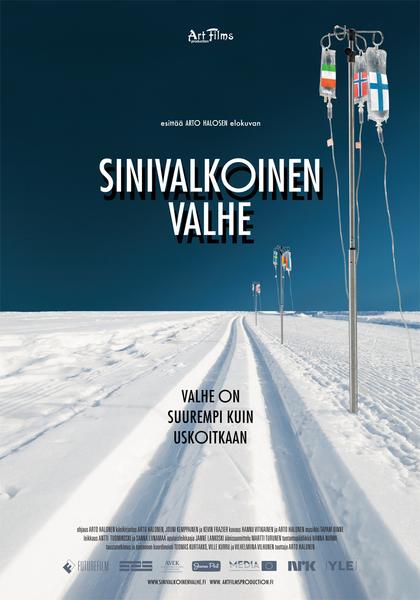
Arto Halonen: Sinivalkoinen valhe / When Heroes Lie (FI 2012).
|
Den blåvita lögnen / När hjältarna ljuger [Swedish title in Sweden] / Når heltane lyg [Norwegian title].
FI © 2012 Art Films Productions AFP Oy.
P+D: Arto Halonen. SC: Kevin Frazier, Arto Halonen, Jouni Kemppainen - idea: Iikka Vehkalahti. DP: Arto Halonen, Hannu-Pekka Vitikainen - many different cameras, many cameramen - main camera a big HD camera with a zoom lens and HD resolution. D-cinema mastering: Tommi Gröhn. Colour grader: Pasi Mäkelä. M: Tapani Rinne. S: Martti Turunen. ED: Sanna Liinamaa, Antti Tuomikoski.
Multi-lingual.
119 min.
Released by Future Film with Finnish / Swedish subtitles n.c. 2K DCP (presumably).
Viewed at Kinopalatsi 5, Helsinki, 26 Oct 2012.
Interviewees: JOHANNA AATSALO, TIMO ARASOLA, RENZO BARDELLI, MAGNAR DALEN, MANUELA DI CENTA, BJÖRN EKBLOM, PEKKA HOLOPAINEN, SONJA HUTTUNEN, VEIJO HÄMÄLÄINEN, TIMO HÄRKÖNEN, MIKKO JAATINEN, KARI KAJAUS, KAARLO KANGASNIEMI, EDO KELTER, SAMULI KIVIRANTA, SARI KOPRA,
ERJA KUIVALAINEN, HEIKKI LAAPIO, PEKKA LEHTINEN, INGGARD LEREIM, SUVI LINDÉN, MARJO MATIKAINEN-KALLSTRÖM, RAIMO MATIKAINEN, PIRKKO MÄÄTTÄ, EIJA PELKONEN, JARI PIIRAINEN, RIKU RANTALA, SEPPO REHUNEN, TAPANI RISSANEN, VILJO SADEHARJU, JAANA SANTALA, TIMO SEPPÄLÄ, ELENA SIMANAINEN, JARKKO SIPILÄ, HARRI SYVÄSALMI, ERKKI VETTENNIEMI, JUHA VIERTOLA, KARI VÄISÄNEN, JAN ANDERSSON, SILVANO BARCO, DARIO BELLODIS, MAURILIO DE ZOLT, SANDRO DONATI, SAMI HEISKANEN, TIMO HUOVINEN, PERTTU HUUSKO, KAIJA HÄRKIN, HANNU ITKONEN, MARKKU JYLHÄSALO, TAPIO KALLIO, ESA KATTAINEN, LEILA KETOLA, JOUKO KOKKONEN, ARI KORHONEN, IMMO KUUTSA, MATTI LEHESJOKI, ANTTI LEPPÄVUORI, SARAH LEWIS, JOHANNA MATINTALO, JUHA MIETO, JUSSI MERIKALLIO, HELGE OFTEBRO, PAAVO M. PETÄJÄ, GIUSEPPE PULIÈ, OLLI RAUSTE, JARMO RISKI, SEPPO ROMPPAINEN, BENGT SALTIN, JAANA SAVOLAINEN, SUVI-ANNE SIIMES, JUSSI SIMANAINEN, PIERGUIDO SOPRANI, ARI TUULI, TAPIO VIDEMAN, KIMMO VIRTANEN, EMMA ÅMAN.
The official synopsis:
"When Heroes Lie is a daring documentary which deals with the grim history of doping in Finnish cross country skiing and exposes the web of lies in world championship sport. The FIS Nordic World Ski Championships 2001 in Lahti was designed to be yet another climax in Finnish cross-country skiing. It was not to be. Instead, there was a "shame of catastrophic dimensions" as six Finnish skiers were caught in the use of forbidden substances. After the collective bust questions remained: was it all about a fleeting transgression and "amateurish dabbling" or a systematic, fully planned and global fraud?"
"When Heroes Lie covers the history of doping in cross-country skiing since the 1970s until today, the dramatic turns of the Lahti Ski Championships in 2001 and the doping news trial against STT [Suomen Tietotoimisto, the leading Finnish news agency] which started in 1998. As a result of a long and comprehensive reasearch the movie offers a lot of new information about the doping culture in Finnish cross-country skiing: how it started, how widespread it was and who were the central players. The movie contains interviews with Finnish and international experts, coaches and sportspeople and archival material from different sources. They contribute to a ruthless picture about a system in which heroes were created at no matter which cost - by any means necessary and the audience was not too particular, either."
"Via the example of sport the movie shows how our society creates a foundation for a hypocritical pursuit of victory. It also raises the question whether the distortions of sport are reflections of the distortions of the society. Whether the society in general functions along similar ground rules." (The official synopsis, translation mine).
Cross-country skiing is my favourite sport as an occasional Sunday sportsman, but I haven't watched sports games since I was a kid in the 1960s. I feel sympathy for the Finnish
"karpaasi" top skiers who were caught in the doping scandals in 2001. They did the wrong thing, but they would have been great athletes - or even greater ones - if they had not resorted to doping. Watching this movie I realise how overwhelming the pressure must have been since the 1970s.
The key testimony comes from Kaija Härkin who found religion and a way out of the anxiety that led her to depression and suicidal thoughts because of the vicious circle of sedatives and stimulants required of her. According to her the general brutalization took place in the 1970s. Previously the ski sport was basically clean.
Sinivalkoinen valhe is a settling of accounts of the huge web of lies related to the ubiquitous doping culture in Finnish ski sport. Much of this has been in general knowledge, but the movie expands its wings to cover a wider field.
Listening to testimonies from Sweden, Norway and Italy one cannot help but deduce that doping is the global modus vivendi in top ski sport. The evidence is convincing, and the footage of the squirming interviewees who try to testify otherwise is telling.
Mika Myllylä (1969-2011) is a martyr of this story. "What is the point of sustaining such an enormous system of fraud?" "You have to store in your memory every single step sign: how did I lie here?"
A movie which occurred to me after seeing Sinivalkoinen was Shadow of a Doubt by Alfred Hitchcock. At my most recent viewing of it I paid attention to the gallows humour about the crushing stress of Uncle Charlie having to lie at every single step and to remember how he has lied in order to avoid being exposed as a serial killer.
Even more generally, Sinivalkoinen valhe is a contribution to the Ibsenian theme of
livsløgn - the life-lie - a fraudulent foundation myth.
For top skiers a gold medal translated into big money (ten million Finnish marks) in sponsorship deals. For some of the skiers a top career opened up in politics. The Italian MP Manuela Di Centa's interrupted interview is memorable. The agony on the Finnish MP Marjo Matikainen's face is the most unforgettable impression of the movie. They should tell all, they should tell the truth, and everybody would be happier and freer. Their talent is undeniable, and it is wrong that they had to compete in a system that forced them to resort to doping.
Compilation quality with lots of low definition television and video footage. No problem with new interview close-up footage made for this movie. There is no attempt to convey visually the grandeur of the ski sport.