Saturday, June 14, 2014

Après mai / Something in the Air (in the presence of Olivier Assayas)


Olivier Assayas: Après mai / Something in the Air (FR 2012) avec Clément Métayer, Lola Créton.

Jotain ilmassa / Efter revolutionen
Country, year: France, 2012
Director: Olivier Assayas
Screenplay: Olivier Assayas
Cinematography: Eric Gautier
Editing: Luc Barnier
Set Design: François-Renaud Labarthe, Dorota Okulicz
Costumes: Jürgen Doering
Sound: Nicolas Cantin, Olivier Goinard, Nicolas Moreau, Aude Baudasse
Cast: Clément Métayer, Lola Créton, Felix Armand, Carole Combes, India Menuez, Hugo Conzelmann, Martin Loizillon
Production: MK2 Productions, France 3 Cinéma, Vortex Sutra, Canal+, Ciné+
Producers: Charles Gillibert, Nathanaël Karmitz
Language: French, English, Italian
Duration: 122 min.
    Cinema Mondo 2K DCP with Finnish / Swedish subtitles by Outi Kainulainen / Markus Karjalainen, in the presence of Olivier Assayas, viewed at Cinema Lapinsuu, Sodankylä (Midnight Sun Film Festival), 14 June 2014

Sampsa Laurinen (The Midnight Sun Film Festival Catalogue, 2014): "The original title, Après mai, refers to the spring of 1968 in Paris. We follow the life of six youths some years later."

"In the prologue, we visit a literature class. The teacher reads a text by Pascal from 1670: “Between us and heaven or hell there is only life, which is the frailest thing in the world.” The students are given an assignment to express Pascal's thought through the language of their time. In February 1971, Richard Deshayes wrote: “It is the humiliated and the oppressed who passively tolerate the ruin of the civilization.” Sound familiar?"

"“New ideas call for a new language.” At times, Assayas winks at the reformers of cinema, Godard, Santiago Álvarez, and Madeleine Riffaud whose Laos, images sauvées (1970) is quoted in the film."

"This film about youth is also a dialogue between generations. The search for something new is followed by a rift, fumbling for options and a return – so that at least some of the new could be adapted into the old world. In the silent climax, a girl who has just had an abortion, stops to view the painting The Regentesses of the Old Men's Almshouse (1664), painted by Frans Hals while in his eighties."

"The noble challenge of finding your own way is depicted with humane conscientiousness. No overtly glossy nostalgia or pathos, merely some pause for wistful thinking, a touch of sweet dizziness and beauty stemming from the serious issues." (SL)

Olivier Assayas introduced the screening by stating that Après mai, set in the year 1971, is "as close to autobiographical film-making as it gets". It was extraordinary and scary, constructive and destructive, to see me at 16. You are always close to yourself as a teenager always misunderstood, with contradictions, complexities. You need to reconnect with youth, with the energy, the virginity. The non-professional young actors you have to get back to the period. Always keep in touch with those energies. Living in a moment of crisis, financial and otherwise, there may be nostalgia for revolutionary years. But here I do not issue any kind of statement. I am not reviving the past. There is no nostalgia. I am the least nostalgic person. Past experience only makes sense if it echoes on the present. In France for the first time I had reactions based on the age group. Younger audiences loved it. It addressed them. The older were more conflicted. It was really stratified. This is my first film mostly distributed digitally. It is shot on film. I'm attached to shooting on film. (My notes of the introduction of Olivier Assayas).

Après mai I saw for the first time here in Sodankylä. Importantly, I find it a work of material aesthetics. The insistence on authentic documents, music records, film clips, newspapers, magazines, books, clothes, haircuts, and all kinds of objects is not fetishistic, not a case of stamp collecting, but a true work of a reconstruction in a spirit of historical authenticity to a period forty years ago which it is already difficult to revive or even imagine, so much has the world changed since then.

Student rebellion was a truly global and international phenomenon, but there were huge differences from country to country. For instance the anarchistic, terroristic, and violent currents on display here were foreign to young Finns. Such trends were prominent in Germany, France, and Italy. In our country they were unfathomable, incomprehensible. We read about them in the papers and could not relate to them.

Après mai is a Bildungsroman, a coming-of-age story of the artistically talented teenager Gilles. The post-revolutionary age is the milieu, the atmosphere in which he grows up in a spirit of rebellion to the establishment. The political aspect is mostly expressed in terms of action cinema. This film is not  a discourse on political substance, not about what we are fighting for.

Olivier Assayas had visited this ground twenty years ago in the quite moving L'Eau froide. How he has grown. Après mai is a much more rich, vibrant and resonant work. It might be a new, deeper-reaching anchorage for an autobiographical journey. It is visually rewarding in many ways: in the authentic, unaffected period look, in the evocation of the contemporary art idioms (the radical newsletters, the collages, the light shows, the psychedelia), and in the tracking down of Gilles's development as an artist.

The soundtrack is a labour of love, one of the best compilation soundtracks (see the track list beyond the jump break). The lovingly displayed album cover art is justifiedly a part of the film's visual world.

Olivier Assayas is a good action director who has learned both from the best Hollywood directors and from the golden age of Hong Kong action cinema. His crisp and uncluttered action style is both traditional and personal, not succumbing to the recent curse of the ultra fast edit where nothing makes sense anymore.

I am a contemporary of the director, also born in 1955, and while I find several familiar points of reference, mostly it is an intriguingly strange parallel world that I encounter here. But also my own world forty years ago now seems hauntingly strange to me, albeit in a different way. I have also realized long ago that contemporary compatriots have experienced shared periods so differently that we seem to have existed in separate realities; yet there are enough of those who share the same general notions. The world is now changing so fast that it is getting more difficult to communicate experiences from generation to generation. The matter of screen memories is getting more grave. This is one of the reasons why Olivier Assayas's affectionate empiricism is so important. Documented facts anchor us to reality in a world of media fantasies, illusions, and fabrications. Otherwise stereotypes and cliches may begin to displace original memories. Among Assayas's projects is a battle against cliches.

Shot on 35 mm film, Après mai looks mostly good on digital, with the exception of nature footage which looks denatured. There are passages where the colour seems intentionally desaturated.

Sodankylä morning discussion: Olivier Assayas with Peter von Bagh and Olaf Möller


Olivier Assayas, Sodankylä, Lapland, 14 June 2014. Photo: Annina Mannila.

The discussion was conducted in English. The School, Sodankylä, Midnight Sun Film Festival, 14 June 2016. 

The résumé at the Midnight Sun Film Festival site:

"“I don’t remember what exactly was the first film I saw, but the film that made the strongest impression on me was maybe Ben-Hur or some Disney film”, said French director Olivier Assayas when asked about his early experiences with cinema. Assayas’ parents worked in the film business and cinema was always present at his home. The family was visited by great names of French cinema from René Clair to Abel Gance. Still, cinema was never discussed seriously in the family."

"Assayas began his career in his twenties by working as a secretary for his screenwriter father and later as a substitute writer for television. During this period he also worked as an assistant director on a number of trashy films. He was also an assistant on Richard Donner’s Superman (1980). However, at the end he was more interested in making films of his own. ”I realized that I have to forget everything I had learned from my father and during my time as an assistant. I had to break free.”"

"After directing his first short films, Assayas worked as a writer for Cahiers du cinéma, specializing on Asian films. “We discovered a whole new area in the world of cinema. That does not happen often”, he marveled. Writing André Téchiné’s Rendez-vous (1985) made it possible for Assayas to direct his debut feature Désorde (1986). The crew was made up of young filmmakers who were willing to experiment, instead of old and experienced professionals: “We were like kids that the parents have forgotten in the car”, the director described."

"Assayas said that he makes his scripts as simple as possible, so that they can develop freely during the filming. “The purpose is to discover something completely new and authentic, just like the directors of silent films did during their time”, he said, referring to Victor Sjöström’s The Outlaw and His Wife (1918) that he saw at the festival the previous night. The aspiration for freedom is also evident on Assayas’ films soundtracks, on which he uses individual songs instead of composed music."

"As to digital technology, Assayas said that he likes the way it makes editing easier, but he is still going to keep filming on 35mm as long as possible. The director also talked about how he developed an ability to work in international projects. The key point in this development was the film Irma Vep (1996) and meeting the actress Maggie Cheung. The last question of the interview concerned the influence of Europe’s wild year 1968 on Assayas’ career: “People who have never seen a glimpse of a different kind of society are not able to understand the idea of a more liberated world”, he stated."

"Asked about his desert island film, Assayas picked Visconti’s The Leopard (1963) after a short deliberation." (The résumé at The Midnight Sun Film Festival site).

Friday, June 13, 2014

Sosialismi / Socialism (in the presence of Peter von Bagh)


Peter von Bagh: Sosialismi / Socialism (FI 2014).

FI © 2014 Aamunkoi Productions. D+SC: Peter von Bagh. DP: Arto Kaivanto. S: Martti Turunen. ED: Petteri Evilampi. Archival footage editor: Anna Korhonen. Speakers: Peter von Bagh, Erja Manto, Eero Saarinen. Commentary in Finnish, titles and subtitles in English. 2K DCP. 67 min
    2K DCP viewed at the Big Top, Sodankylä (Midnight Sun Film Festival), in the presence of Peter von Bagh, 13 June 2014

Olaf Möller (The Midnight Sun Film Festival Catalogue, 2014): "For the first time in long, Peter von Bagh looks at a subject vaster than Finnish history: Socialism, the 20th century's greatest dream and source of some of its darkest nightmares. As always, the story develops along a roughly chronological arc: Sosialismi begins with one of cinema's first moving images ever, Louis Lumière's La Sortie de l’Usine Lumière à Lyon (1895) and the energies and theories that gave rise to Marxism, and ends in these our days where the icons of a hope for a juster and kinder world got turned into market commodities, merchandise, shows of opinions instead of a conviction's insignia."

"As always, its all about digressions as the only way towards unattainable but most desirable truth; about jumping back and forth in time, about remembering Spain and at the sight of a Chaplin poster and the Legion Condor crossing the skies like an icon instantly associating eg. Vietnam; about following the figures and landscape, faces and places a song might bring up (the cascade of state funerals gliding by on waves of Auf Wiedersehens is hilarious and haunting and brutally to the point and outrageous, to give but one example); about honouring certain trains of thoughts, images: how Lumières employees become a rally, proletarian fists risen to the sky, become a sea of flags which we all know are red even when the film is in b&w."

"Von Bagh, maybe the truest of all Benjamin'ians in modern cinema, shows how socialism and cinema – all of cinema, be it documentary be it fiction – are one, and how life is all about this sense of never being alone but always one; that cinema and socialism will always be there, just like Tom Joad always knew." (OM)

"Those living a hundred, two hundred years from now, despising us for our silly, mundane lives, may perhaps somehow learn the secret of happiness."
    "Те, которые будут жить через сто, двести лет после нас и которые будут презирать нас за то, что мы прожили свои жизни так глупо и так безвкусно,— те, быть может, найдут средство, как быть счастливыми (...)" - Doctor Astrov in Anton Chekhov: Uncle Vanya, Act IV

Peter von Bagh's new film was finished this week for this first screening.

In his introduction von Bagh stated that the theme of his previous film, Remembrance, was small. The theme of Socialism is big - a guide to the 20th century. In his previous collage films von Bagh often used mediocre and even bad films as source materials. "Here we see some of the great images by great film-makers". The motto is by Anton Chekhov about the great vision of the future.

Chapter headings include: I Cherry Blossoms, II Age-Old Dreams, III The Year 1917, IV The American Dream, V Before the Revolution, VI The War to End All Wars, VII Utopias of Fear and Hope, VIII Hard Times, IX The Land of Spain, X The Story of a Fresco, XI Lenin, XII Life As It Could Be, XIII The Year 1937, XIV Small Finnish Stories, XV Landscape after the Battle, XVI The Working Class Ascends to Heaven, XVII The Long Goodbye, XVIII There Are No Guarantees

Von Bagh has visited this territory before in A Day at the Grave of Karl Marx, a cross-section of the truly international attraction of the socialist idea, beyond the dreary "real existing socialism".

The Man in the Shadow, the story of Otto Wille Kuusinen, made together with Elina Katainen and Iikka Vehkalahti, was a three-part documentary account of a bloody tragedy of Shakespearean magnitude from the Finnish-Soviet perspective, taking us to key events from the national-romantical awakening of the early 20th century to the Thaw after the death of Stalin.

This new movie is a thought-provoking survey of a magnificent and mind-boggling theme, unflinching about the terror that has been inflicted in the name of socialism, yet not cynical about the great ideas of social justice.

I was again thinking what was the hideous curse that catapulted some of the most abject tyrants of history to lead countries that attempted to build socialism. And why such countries become responsible for mass murder in an unprecedented scale.

This film is very dense, and eighteen films could be made from its eighteen chapters. Still key topics remain undiscussed. For example the fact that many of the original demands of the socialist movement have been realized and universally accepted. That is no mean feat, and a major reason for the identity crisis of the contemporary socialist movement.

Yet even the most outrageous offense singled out in the list of urgent tasks to be remedied in the Communist Manifesto in 1848 - child labour - is still a topical issue in huge parts of the world.

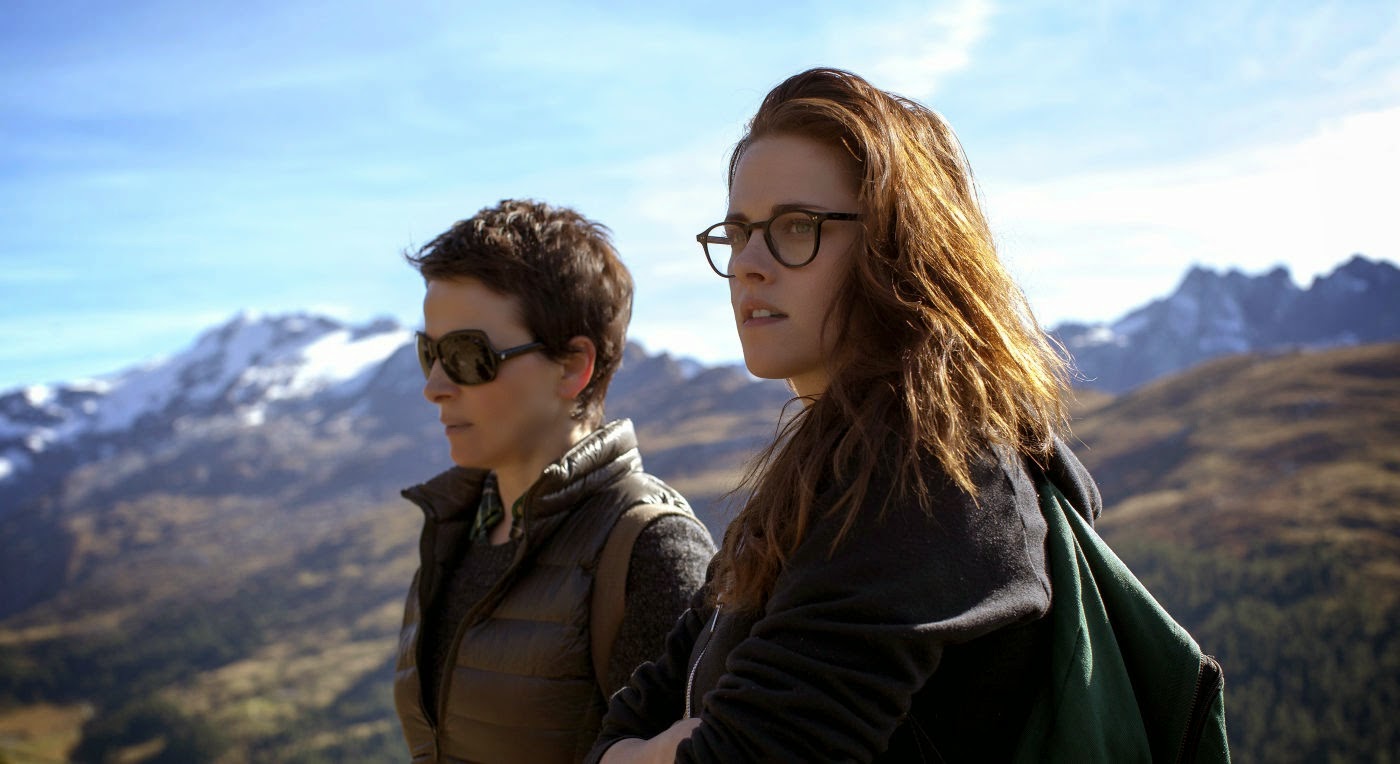
Clouds of Sils Maria (in the presence of Olivier Assayas)


Juliette Binoche, Kristen Stewart
"At the peak of her international career, Maria Enders is asked to perform in a revival of the play that made her famous twenty years ago. But back then she played the role of Sigrid, an alluring young girl who disarms and eventually drives her boss Helena to suicide. Now she is being asked to step into the other role, that of the older Helena. She departs with her assistant to rehearse in Sils Maria; a remote region of the Alps. A young Hollywood starlet with a penchant for scandal is to take on the role of Sigrid, and Maria finds herself on the other side of the mirror, face to face with an ambiguously charming woman who is, in essence, an unsettling reflection of herself."
- Cannes Film Festival (2014)

Sils Maria [French title]. DE/FR/CH 2014
Directed by     Olivier Assayas
Produced by     Karl Baumgartner
Charles Gillibert
Thanassis Karathanos
Jean-Louis Porchet
Gérard Ruey
Written by     Olivier Assayas
Starring     Juliette Binoche
Kristen Stewart
Chloë Grace Moretz
Cinematography     Yorick Le Saux
Editing by     Marion Monnier
Studio     CG Cinéma
Release dates: May 23, 2014 (Cannes)
20 août 2014 (sortie nationale)
Running time     123 minutes
Country     Germany
France
Switzerland
Language     English
C:  Juliette Binoche as Maria Enders
    Kristen Stewart as Valentine
    Chloë Grace Moretz as Jo-Ann Ellis
    Johnny Flynn as Christopher Giles
    Lars Eidinger as Klaus Diesterweg
    Hanns Zischler as Henryk Wald
    Brady Corbet as Piers Roaldson
    Aljoscha Stadelmann as Urs Kobler
    Luise Berndt as Nelly
    Angela Winkler as Rosa Melchior
    Gilles Tschudi as Mayor of Zurich
    Claire Tran as Mei-Ling
    Frank M. Ahearn as Oz
    Jakob Kohn as Jo-Ann's manager
(credits from Wikipedia)
    The film within the film: Das Wolkenphänomen von Maloja (Arnold Fanck, c.m., DE 1924). - Theme tune: Pachelbel's (1653-1706) Kanon in D-Dur.
    2K DCP from CG Cinéma, original in English, in the presence of Olivier Assayas, viewed at Cinema Lapinsuu, Sodankylä, Midnight Sun Film Festival, 13 June 2014

The first international screening after Cannes of the latest film by Olivier Assayas.

Assayas belongs to the directors whose oeuvre makes sense as a whole, the films being stages of a continuous evolution, in a story of constant growth, alternating genre films and unclassifiable ones, big films and small, French films and international productions, always spreading his wings to unexplored territory or returning to familiar territory with deeper insight and a wider perspective.

In the last four films I have sensed a special growth to a new level in Assayas's films. They are more assured, more dense, more resonant. The early films one can appreciate for their raw energy, fresh observations and poetic vitality. The recent films are more complex, their context is larger, the sense of society is fuller.

Clouds of Sils Maria has a more reduced character than Assayas's three previous films. It is mostly a tale of two women, although not in quite such a stark manner as in Ingmar Bergman's Persona. The central action is about the famous actress Maria Enders (Juliette Binoche) rehearsing a major play together with her assistant Valentine (Kristen Stewart). The dialogue of the characters in the play within the play reflects constantly on Maria and Valentine, themselves.

Where Bergman took his two women to the rugged isle of Fårö, Assayas sets the main action to Sils Maria on the Swiss Alps.

A story of alienation, Clouds of Sils Maria also brings to mind Antonioni's L'avventura set on the volcanic Aeolian Islands, and Rossellini's Stromboli and Viaggio in Italia (Pompeii). One of the early masters of soulscape was Victor Sjöström. The mountain film Berg-Ejvind och hans hustru is part of this year's Midnight Sun Film Festival, as well as Viaggio in Italia.

The characters of this movie are strangers to themselves. They remain distant for us. They are in constant communication online with their cell phones and laptops. But their mutual face-to-face communication remains superficial.

Maria Enders realizes that she is the mature woman now, almost 50-something, belonging to the grandmother generation already. The contemporary 20-something women keep puzzling her. Actually she would like to quit the production but she is all tied up. Perhaps the next act after the end of this film could be like the first act of Persona.

More remarks:
    There is a play within the play, and a film within the film: Arnold Fanck's Das Wolkenphänomen von Maloja (1924), an expression, together with the Alps themselves, of the sublime of nature. The film-within-the-film is a purely visual document of the unique "cloud snake" emerging in the Maloja pass.
    The nature is sublime, and the concerns of the characters seem trivial. This was always one of the senses of the mountain film. On the other hand, the grandeur of the mountains was a reflection of the heights of passion / devotion / spiritual endeavour. But here there is a sense of loss, nostalgia, and regret, as the grand master playwright-director is dead. There is a sense of emptiness.
    The main musical theme, Pachelbel's Kanon, also reinforces the dimension of the sublime, missing from the interpersonal story.
    The contemporary film scene is expressed in a delicious parody of lowbrow science fiction in 3D featuring the latest tabloid star Jo-Ann Ellis (Chloë Grace Moretz). "I could feel my brain cells vanishing", comments Maria.
    But surprisingly the real Jo-Ann - who is taking over the part which used to be Maria's breakthrough role -  proves to be an intelligent, talented and courteous person, as is her boyfriend. Maria is even more puzzled now, and she remarks to Valentine that Jo-Ann is "a lot more interesting than the person you described".
    When the mysterious cloud snake emerges, neither Valentine nor Maria are there to witness it. Valentine has disappeared on the Alps (qf. L'avventura, L'eclisse), never to be seen again by Maria.

It is admirable for Kristen Stewart, the most highly paid actress during the Twilight saga, to spread her wings in a distinguished film like this. Perhaps Assayas cast her in part due to her vampire image, her ability to project a cool and callous persona. In Bergman's Persona, the star was the one with a hard surface, and there was a vampiric suction from her to the sensitive aide. Here the star is the more sensitive person (especially vulnerable now, recovering from divorce, the sudden death of the playwright, and from the fact that she is playing the tragic victim in the play in which she had debuted as the predator), and the young women are the tough ones.

Shot on 35 mm film as Assayas always insists to do, the film has gone through the digital intermediate, with predictable results to the sense of the sublime of the nature.

After the screening Olivier Assayas told us that he had always wanted to do a film starring Juliette Binoche. In The Summer Hours Binoche got to play an important part, but Sils Maria is her first leading role in an Assayas film. Their collaboration goes back to Rendez-vous by André Téchiné. Its screenplay was Assayas's breakthrough, and the female lead was Binoche's big break. There are relevant connections between Rendez-vous and Sils Maria, both being films about demon directors and actors reflecting their own identities in the roles they play.

A Fuller Life (in the presence of Samantha Fuller)

Samuel Fuller
Country & year: U.S.A., 2013
Director: Samantha Fuller
Screenplay: Samantha Fuller (concept), Samuel Fuller (autobiography)
Cinematography: Hilton Goring, Seamus McGarvey, Rachel Wyn Dunn
Editing: Tyler Purcell
Sound: Benjamin Rauscher, Gary Coppola
Music: Paul-Alexander Fuller
Cast: Samuel Fuller, Robert Carradine, Joe Dante, William Friedkin, Monte Hellman, Tim Roth, Constance Towers, Wim Wenders, Mark Hamill, James Franco, Buck Henry, Bill Duke, Perry Lang, James Toback, Kelly Ward
Production: Chrisam Films
Producers: Gillian Horvat, Samantha Fuller, Christa Lang-Fuller
Language:English
Duration: 80 min
    Shot on 16 mm, transferred to digital.
    2K DCP from Chrisam Films viewed at Cinema Lapinsuu, Sodankylä (Midnight Sun Film Festival), 13 June 2014

Lauri Timonen (Midnight Sun Film Festival Catalogue, 2014): "A Third Face. My Tale of Writing, Fighting and Filmmaking (2002) is undoubtedly one of the greatest Hollywood memoirs ever written – in more than one sense of the word. The autobiography of the maverick director Samuel Fuller (1912–1997) is extensive enough to cover three different eras from Fuller’s early journalistic career to his later experiences in war. The stories are throughout mind-blowing, captivating and skillfully narrated."

"Of course we also remember the initial energy that Fuller presented for the lucky audience 29 years ago as the star guest of the first ever Midnight Sun Film Festival, in a way even outlining the spirit of the whole festival. This year we welcome his daughter Samantha Fuller with her brand new documentary A Fuller Life, based on her father’s autobiography, where Sam’s friends and fans – including the actors Mark Hamill, Robert Carradine, Constance Towers and Tim Roth as well as the directors Joe Dante, Wim Wenders, William Friedkin and Monte Hellman – read excerpts and stories from the book."

"Fuller, who can be described as the god of film addicts, lived an incredibly eventful life. One example of his unique approach is the way he managed to maintain his personal voice and independent style, even when working as a director within, or at least near by, the Hollywood system. He even almost carried through with the pompous jungle adventure described in Mika Kaurismäki’s Tigrero (1994), the preliminary cast including John Wayne, Ava Gardner and Tyrone Power. In reality, a talented director like Fuller was at his best away from the glamour of the stars; making more intimate films that are precise like news articles and bear the soft scent of cigars, but yet intimate, harsh, strangely gentle and wild, such as The Steel Helmet, Park Row, Shock Corridor, The Naked Kiss, The Big Red One, or the delicate yet brutal masterpiece presented in Lapland this year, Underworld U.S.A." (LT)

Samantha Fuller has filmed the autobiography of her father, Samuel Fuller, by having key people as narrators read illuminating passages from it. Constance Towers is my favourite. Monte Hellman and William Friedkin, among others, catch the Fuller spirit very well.

Fuller's autobiography, A Third Face, belongs, indeed, to the best memoirs of Hollywood film-makers, and it is not only about Hollywood, but also about American journalism and about the Second World War.

I have read the book, so the text was familiar to me, but I was very grateful for the affectionate choice of narrators, the rich selection of photographs and other images, and the clips from almost all of Samuel Fuller's films, as a rule with good visual quality.

As a journalist, Fuller had explored America from coast to coast during the 1920s and the 1930s, and during WWII ("the biggest crime story of the century") he did the long tour in the Big Red One, participating in key battles of the century, most importantly on D-Day.

Fuller's own 16 mm WWII footage is the most stunning discovery of the film. I had seen some of it in previous Fuller docs such as Tell Me Sam and Falkenau. This find is so impressive that I look forward for more.

Sodankylä morning discussion: Alice Rohrwacher with Peter von Bagh


"6.00 in the morning in Sodankylä. Alice Rohrwacher sings her own song near the river, [together with the Cleaning Women trio]. And suddenly I realize that I've never heard anything so beautiful. Because she is a truly friend of beauty. Watch Le meraviglie (THE WONDERS)." Photo: Boris Nelepo. From Boris Nelepo's Facebook page, 15 June 2014, by permission.

The discussion was conducted in English. The School, Sodankylä, Midnight Sun Film Festival, 13 June 2014

The résumé at The Midnight Sun Film Festival site:

"“It all began when I got to know a circus family. I didn’t know any circus tricks so I had to find some other way to join them”, Alice Rohrwacher says. That other way she found in cinema. She created her first documentary film, Un piccolo spettacolo (2005), by doing, daring and experimenting."

"Friday got its start at Midnight Sun Film Festival with morning discussions with two self-made directors. Film guru Olaf Möller interviewed Polish director Pawel Pawlikowski (born 1957), who turned to fiction from BBC’s documentary department, and the Italian-German Alice Rohrwacher (born 1982), who just won the Cannes Grand Prix with her new film The Wonders."

"Rohrwacher is also led by intuition in her filmmaking. That is also why she shoots on film. “When you shoot on film, you have an idea of what you are shooting, but you do not know everything that will end up in the take. It is about the meeting of the filmmaker and the subject. As it is in life or any encounter, you can not know or control everything. But when you shoot on digital, you can modify everything later.”"

"When it comes to staying real and true, Rohrwacher makes no compromises. For her film Corpo celeste, she went through every church in the city to find the one that was right for the film."

"“My beekeeper father taught me that when the flowers are in bloom, then it is time to leave. You can not know it by looking at a clock”, Alice Rohrwacher reflects. To her filmmaking and life are one and the same.
" (The résumé at The Midnight Sun Film Festival site).

Sodankylä morning discussion: Pawel Pawlikowski with Olaf Möller

Pawel Pawlikowski, Olaf Möller, 13 June 2014
 The discussion was conducted in English. The School, Sodankylä, Midnight Sun Festival, 13 June 2014

The résumé at The Midnight Sun Film Festival site:

"Friday got its start at Midnight Sun Film Festival with morning discussions with two self-made directors. Film guru Olaf Möller interviewed Polish director Pawel Pawlikowski (born 1957), who turned to fiction from BBC’s documentary department, and the Italian-German Alice Rohrwacher (born 1982), who just won the Cannes Grand Prix with her new film The Wonders."

"After his parents’ divorce, Pawlikowski moved to England with his mother. The experience was a tough one for the 13-year-old boy: the “holiday trip” turned out permanent as his mother had secretly gotten married with an Englishman. Pawlikowski felt rootless and homeless, and after a series of events he moved to London. There he discovered films and music, began studying philology and wrote his dissertation after completing his studies."

"“It was kind of about trying to avoid working on the dissertation, I guess. My friends were members in a film society, so I also got involved. It was there that I first tried my hand at making films of my own”, Pawlikowski says."

"It was around this time that Pawlikowski noticed an ad for a BBC training program. He ended up getting a job at their documentary department. There he presented some of his ideas, which led to dinner discussions, which in turn led to his ideas being approved for projects. Pawlikowski hadn’t spend a single day in film school, but he knew what he wanted. There already existed enough conventional television documentaries."


"Pawlikowski describes his documentaries as collages. He is particularly interested in individuals, and they take centre stage in his documentaries as well as in his fiction films. The documentary Dostoyevsky’s Travels got its start when Pawlikowski was in Russia at Dostoyevsky’s home museum and met the man who ended up becoming the film’s main character."

"“There was a genteel man who looked like Dostoyevsky sitting in a corner at the museum, and the museum curator urged me to approach him. The man turned out to be the only living relative of Dostoyevsky. I found this character so fascinating that I just had to make a documentary about him. I managed to sell it to BBC as a literature documentary, although the main character hadn’t written a single word in his entire life”, Pawlikowski smirks."
(The résumé at The Midnight Sun Film Festival site).

Thursday, June 12, 2014

Die andere Heimat – Chronik einer Sehnsucht / Home from Home - Chronicle of a Vision


Country & year: Germany / France, 2013
Director: Edgar Reitz
Screenplay: Edgar Reitz, Gert Heidenreich
Cinematography: Gernot Roll
Editing: Uwe Klimmeck
Set Design: Anton Gerg, Hucky Hornberger
Costumes: Esther Amuser
Sound: Philippe Welsh, Daniel Dietenberger, Vincent Demortain
Music: Michael Riessler
Cast: Jan Dieter Schneider, Antonia Bill, Maximilian Scheidt, Marita Breuer, Rüdiger Kriese, Philine Lembeck, Mélanie Fouché
Production: Edgar Reitz Film, Les Films du Losange, ARD Degeto Film, BR, WDR, arte Geie
Producer: Christian Reitz
Language: German
Duration: 225 min
    Black and white in scope. Werner Herzog als Alexander von Humboldt
    2K DCP viewed at Cinema Lapinsuu, Sodankylä (Midnight Sun Film Festival), 12 June 2014

Timo Malmi (Midnight Sun Film Festival Catalogue 2014): "Heimat: A Chronicle of Germany was a beloved TV series also in Finland. Its progenitor Edgar Reitz has once more (at over 80 years of age!) returned to the village of Schabbach in Hunsrück, however this time with a wonderful, over-4-hour-long film intended for the big screen."

"Home from Home “does not offer just a sort of a prehistory for three television epics but proves to be the sum of all of Reitz’s artistic production”, Olaf Möller (Filmihullu 5/2013) writes, continuing that the film “is set in the early 1840s when the establishment of a state called Germany was finally becoming a reality – when millions broke away from their home conditions in order to detach themselves from oppression, exploitation and sometimes immense poverty.”"

"The main group of characters consists of the family of blacksmith Johann (of the familiar Simon family), and the most central person is brainy Jakob who dreams of moving to Brazil. Jakob falls in love with Jettchen who wavers between him and his more practical brother, blacksmith Gustav. “The panorama of leaving and staying becomes wider: waterfalls of colour appear in the wonderfully pretty black-and-white picture. Reitz has a sometimes delicate, sometimes barbarically flamboyant ability to tell the story through grand scenes and insanely huge elliptical condensations; he has the desire and the madness to be swept away by dreams and visions as well as delve into the agrarian culture and the details of mud or cracks in the wood,” Möller praises." (TM)

"EDGAR REITZ was born in Hunsrück in 1932. He studied various art subjects in Munich and participated actively in different fields of culture. Starting in early 1950s he made several short films, was a member of the Oberhausen group and one of the essential names of the new wave of German cinema, which started in 1962. His first feature film Table for Love was awarded at the Venice Film Festival in 1967. Since then he has made numerous feature-length drama films, documentaries and experimental films. Reitz has also taught film studies and written books on film aesthetics and theory. With its several filmed sequels, the TV series Heimat constitutes the core of Reitz’s unique input to German cinema." (Midnight Sun Film Festival Catalogue 2014)

The magnificent Heimat prequel of Edgar Reitz has been called the best German film in years, and I can believe that, although I have not seen enough new German films myself.

It starts in 1842. The most prominent recurrent image is of wagons of emigrants moving in the horizon. Feudalism has not yet disappeared, Rheinland is not a land of freedom, and Brazil, among other countries, is seductive. The original title means "the other homeland", which can mean something concrete (like Brazil), or something transcendent.

The concept of Die andere Heimat is cinematic, not televisual. There are splendid vistas, majestic camera movements, a sense of space. Hawks patrol the skies, and there is a hawk-eye sense in the movie. We see the hills and the meadows and the rafts on the Rhein. The composition is noble and stark, made for the screen. The camera is liable to fly over the treetops to cover the wonderful landscape.

Die andere Heimat is a true epic, covering great social movements such as rebelling against the baron's wine selling privileges, and a great communal Smearcase Fair dance. We see the horrible prison conditions of the rebels.

There is also a story of mismatched loves: the two girls and the two boys do not get the ones they should. Once off guard Henriette surrenders to the wrong guy, and nothing can change the course of life ever since.

There is a strand of technology, of learning to build and operate a steam engine.

There is a strand of medicine: the old mother getting suffocated and being taken to the hills for sun and air. She has a vision of all the six children she has lost.

Devastating weather with snowstorms brings famine and death, and is a final boost to a mass emigration to those who have survived.

Like our native Finnish Elias Lönnrot, Jakob is fond of reading books in trees. The self-taught Jakob has an insight of "the common secret of language", and his discoveries are acknowledged by Alexander von Humboldt (Werner Herzog in a memorable cameo).

The music is constantly interesting.

The excellent cinematography is in black and white and scope, with selected details in red tint and occasionally in other colours.

The digital look is really brilliant, yet somehow the DCP impression is like a landscape after the explosion of a neutron bomb or the moonscape (where there is no atmosphere).

Corpo celeste (in the presence of Alice Rohrwacher)


Alice Rohrwacher: Corpo celeste (IT/CH/FR 2011). Yle Vianello as Marta, about to take her confirmation.

Taivaankappale (Yle Teema 31.5.2024) / Himlakropp.
    IT/CH/FR 2011
D: Alice Rohrwacher
SC: Alice Rohrwacher
DP: Hélène Louvart
ED: Marco Spoletini
AD: Luca Servino
Cost: Loredana Buscemi
S: Daniela Bassani, Cristiano Ciccone, Marzia Cordò, Riccardo Studer
M: Piero Crucitti
C: Salvatore Cantalupo, Anita Caprioli, Renato Carpentieri, Paola Lavini, Pasqualina Scuncia, Yle Vianello
PC: Amka Films Productions, JBA Production, Tempesta
P: Carlo Cresto-Dina
Print: Rai Trade
Esitysformaatti: DCP announced, 35 mm screened
Language: Italian
Subtitles: English
100 min
    Shot on Super 16 mm. Digital intermediate: Deluxe Digital.
    C: Yle Vianello (Marta), Salvatore Cantalupo (Don Mario), Pasqualina Scunca (Santa), Anita Caprioli (Rita), Renato Carpentieri (Don Lorenzo).
    Rai Trade 35 mm print with English subtitles by Charlotte Lantery viewed at Cinema Lapinsuu, Midnight Sun Film Festival, in the presence of Alice Rohrwacher, 12 June 2014

Timo Malmi in the Midnight Sun Film Festival 2014 Catalogue: "It is interesting to compare Alice Rohrwacher’s debut feature film Corpo celeste to Love Like Poison by Katell Quillévéré, another director guest of ours, or maybe to the films dealing with religion by Marco Bellocchio, our Italian guest from last year. They may contain the same kind of dark humour, but perhaps more melodrama, at least in the early works."

"In its slightly dreamlike quality, Rohrwacher’s directional work moves within the forever-interesting area of fiction and documentarism, somewhat in the spirit of cinema vérité. Just like in Love Like Poison, the main character of Corpo celeste is a teenage girl: the 13-year-old Maria who, too, prepares for Confirmation in a remote location in the poor region of Calabria in Southern Italy, where the influence of the Catholic Church lingers as strong as in the French film by Quillévéré. Marta, too, feels like an outsider: she has grown up in a proletarian family in Switzerland – now she has moved to a new area with her sympathetic mother, a jealous big sister, and a little brother."

"Fairly independent for a pubescent girl, Maria searches for her place in the world, continually colliding against the hypocrisy of the grown-ups and the Church. The local priest, the dubious and manipulative Father Mario, is more interested in his career and political activities than in the confirmation school students."

"Hélène Louvart has shot the impressive Corpo celeste (“Celestial Body”) with a Super 16 mm camera and a style serving mundane realism with a direct “gut feeling”, thus moving respectfully along on the trail of the Dardenne brothers (in Sodankylä in 2005). Yle Vianello amazes with her persuasive performance in this intimate coming-of-age story as the young Marta, whose own internal search seems inconsistent with the phony Church and the general atmosphere of the village where people are engaged in the preparation of a visit by the bishop." (TM)

AA: A sensitive account of the 13 year old Marta's passage from childhood towards young womanhood. The film title Corpo celeste, refers to Jesus Christ, the spiritual body, juxtaposed with Marta's physical body undergoing fundamental changes.

It is a story of Weltschmerz. Besides her early teenage angst, Marta is also experiencing a cultural shock, the family having returned from a ten year stay in Switzerland to Southern Italy.

The narrative is about Marta's visiting the confirmation class. She is a hopeless student. Yet gradually we realize that she has interiorized values essential to Christianity.

In a key sequence she is following Don Mario to an abandoned mountain village where they will rescue a lifesize crucifix needed for the confirmation ceremony. The only inhabitant is a hermit priest with whom Marta establishes a connection. As Marta cleans tenderly the dirty crucifix it is an image of her getting closer to Christ, and also closer to the idea of the physical male. Marta is obsessed with the sentence "Eli Eli, lama sabachthani?" ("My God, My God, why have you forsaken me?").

On the steep mountain road the crucifix swings loose and falls deep down to the Mediterranean Sea.

Alice Rohrwacher directs her film in the realistic mode. She thinks in images. The images are memorable yet unobtrusive.

A central image is water / the ocean / the fish. Mother has ceased to buy Mediterranean fish because of the number of corpses of refugees rotting there. The kittens of the parish are drowned in the sea. Also the crucifix lands there. Marta finally takes her real baptism by wading to the sea next to the garbage dump in her white confirmation dress.

The film is full of interesting observations of the contemporary reality of the church. It would be wrong to call the observations satirical. We smile at the pop approach to religious music, the blatant contradiction between the lessons taught and the actual behavior (Marta is slapped: credo!), the attraction of Santa to Don Mario, and Don Mario's suffering looks at the everyday incidents as he desires to be promoted. Despite all these mundane concerns there is a sense of true spirituality and religious community.

The 16 mm cinematography is close to life, and the camera is often subjective. Because I have seen too many films shot with a handheld camera I find that handheld cinematography can seem artificial.

After the screening Alice Rohrwacher was interviewed by Satu Kyösola. Rohrwacher told that Yle Vianello was discovered in a hippie community; she talked Italian without an accent, and she had never been in a city before. - Rohrwacher likes to start a film with lights emerging in the dark. - With Pasolini Rohrwacher shares a sense of respect to the body, with the insight that the body is a temple. - The shooting was conducted with no hidden camera, instead with the attitude of "we are here", the camera on the shoulder. We take responsibility, we breathe, we were there. - Everything is organically connected: the acting, the clothes, the story, the camera. Everything is interconnected. - Simbolo = union, diavolo = separation. Symbols emerge from the ground, like in Out of Africa, the story of the stork.

The passage of the Bible shown to Marta by the hermit priest:

Mark 3
Jesus Accused by His Family and by Teachers of the Law

20 Then Jesus entered a house, and again a crowd gathered, so that he and his disciples were not even able to eat. 21 When his family heard about this, they went to take charge of him, for they said, “He is out of his mind.”

22 And the teachers of the law who came down from Jerusalem said, “He is possessed by Beelzebul! By the prince of demons he is driving out demons.”

The Sodankylä Award to Anssi Luoma


The Sodankylä Award was given to Anssi Luoma from Ylistaro, Seinäjoki, a passionate and visionary cinephile, and a veteran of an old cinema family. He has successfully kept an ambitious cinema afloat in the midst of the digital turbulence, and there is also a new talented generation continuing his work.

SODANKYLÄ-PALKINTO KINOSANKARI ANSSI LUOMALLE
Lehdistötiedote

Elokuvateatterit olivat 1900-luvun siunauksellisia luomuksia. Ne ovat muuttuneet, syvällisesti, eivätkä ehkä parempaan päin. Katsoja kokee yhä harvemmin, että näytöksen keskipisteessä on itse elokuvan maailma. Lisäksi, kaikesta teknologiauskonnosta huolimatta, ilmassa on usein teknisen piittaamattomuuden ja rutiinin ilmapiiri. Siksi "vanhanaikaisesti" hoidetut teatterit - sellaisia yhä on valtakunnassamme - ovat kansallisia aarteita, ja niille omistautuneet ihmiset meille rakkaan taidemuodon tärkeitä esitaistelijoita.

Ylistarossa vaikuttava Anssi Luoma (s. 1950) kuuluu tähän yhä harvinaisempaan ihmislajiin. Elokuvallisen perimätiedon vaalija, kolmannen polven elokuvateatteriyrittäjä, on omistautunut elokuvalle tavalla, josta aistii, ettei mikään muu asia mene edelle. Hänen isoisänsä Matti Luoma perusti teatterin, jonka nimi on yhä hänen muistoaan vaalien sama: Matin-Tupa. Ensimmäiset esitykset Matin-Tuvassa olivat 1941. Vanha rakennus paloi, ja nykyinen, atmosfääriltään taianomainen tupa nousi 50-luvulla, avajaiselokuvanaan T. J. Särkän Juha - ensimmäinen pitkä suomalainen väri- ja laajakangaselokuva. Matin-Tupa on sittemminkin  seurannut aikaansa: se sai digiprojektorin ensimmäisenä maaseututeatterina, mutta on toisaalta pitänyt kiinni filmiprojektoreista - sekä 16 mm:n että 35 mm:n tekniikoista - joiden käytännöstä huolehtii jo seuraava sukupolvi, Anssi Luoman tyttäret.

Teatterissa järjestetään pari-kolme näytöstä päivässä, ja Anssi Luoma - joka on siviiliammatiltaan tierakennusinsinööri Seinäjoella - on aina läsnä. Koneita hän on pyörittänyt melkein lapsesta asti. Ohjelmistossa on Suomen ensiesityksiä melkein joka viikko.

Filmiä ja valoa -festivaali syntyi 2007 Matin-Tuvan ympäristössä, Anssi Luoman luomuksena. Monet vieraat ovat kokeneet kotikutoisen, intiimin atmosfäärin elokuviensa parhaaksi näytösympäristöksi ("hurmaava" on usein kuultu sana). Festivaali täydentää hienosti Matin-Tuvan vuosikymmenten mittaista erityissuhdetta suomalaiseen elokuvaan.

Luoman hieno elokuvatietämys heijastuu hänen komeassa elokuvajulisteiden kokoelmassaan, joka on maan laajin yksityisesti omistettu, ainutlaatuinen visuaalinen johdanto sekä elokuvan levittäjien että kuluttajien makutottumuksiin ja odotuksiin - kulttuuria, joka usein tasaveroisesti elokuvien kanssa luo muiston siitä mitä tietyt elokuvat ovat merkinneet Suomen henkisessä ilmastossa.

Luoma tunnetaan epäitsekkäänä vaikuttajana: hän on monin tavoin edistänyt koko maakunnan elokuvatoimintaa, vailla pienintä ammattikateuden häivää. Hän jakaa tietoa ja kokemusta myös "kilpailijoille".

Sodankylä-palkinto luovutetaan Anssi Luomalle tunnustuksena siitä, että hän on rajusti muuttuneiden olosuhteiden keskellä säilyttänyt elokuvateatterin perinteisen arvokkuuden, viehätysvoiman ja kyvyn tiivistää ihmisen unelmia.

Sodankylä morning discussion: Alain Bergala with Peter von Bagh

Alain Bergala, 12 June 2014. Photo: Annina Mannila
The discussion was conducted in French. The School, Sodankylä, The Midnight Sun Film Festival, 12 June 2014

The résumé from The Midnight Sun Film Festival site:

"”Listening to him, we realize what cinema is really about, what it is in cinema that needs to be saved.” This is how Peter von Bagh summarises the relevance of French director, critic, film educator and Cahiers du Cinéma veteran Alain Bergala in the field of cinema."

"“The first film that made an impression on me was Cecil B. DeMille’s The Ten Commandments and particularly the scene where they cross the Red Sea. Later I heard that many men of my generation experienced the same Big Bang when witnessing that scene”, says Bergala and adds that many films can be seen as generational experiences, although the phenomenon is not as prevalent during the era of television."

"“As a kid I went to see films by myself and didn’t talk about them with anyone. The films ran wild in my mind for a long time and left indelible marks”, Bergala reflects. Later he was deeply involved in film societies. “Film societies taught a lot about how films can be discussed with people – how this world can be shared with others.”"

"Bergala’s family was poor and there was no ready-set direction for him to take in life. Fortunately a primary school teacher urged his parents to send him to study further instead of making him work. Still, the gates of heaven did not open up for Bergala until he was in university. “My literature studies were not very demanding, so finally I was able to dedicate my time to watching films with people who were interested in the same kind of cinema that I was into.” According to Bergala he watched about 700 films a year. At times he drove as far as 200 kilometres away just to see a film recommended by Cahiers du Cinéma."

"Jean-Luc Godard is an important person to Bergala both as a friend and as a colleague. “In Cahiers du Cinéma, Godard was just another writer and he wasn’t given much space in the magazine. Rivette, Truffaut and Rohmer were the major critics of Cahiers du Cinéma.” Bergala recalls that Godard had a unique style from the beginning. “He is not able to link things together. If Godard orders a steak and fries, the waitress won’t understand him, because his discourse lacks linear logic.” According to Bergala the relevance of Godard lies precisely in his distinctive way of perceiving the world. “Godard is all about form. In each of his films he conveys something relevant about the era they were made in. Other people lag years behind Godard.”"


"“Godard has done things no one else has had the courage to do ever since. He wrote articles in interview-form without ever having met the director in question. We can only guess as to why Bazin allowed those articles to be published in the magazine.” Bergala calls special attention to Godard’s Histoire(s) du Cinéma (1998), on which the director worked on constantly for 15 years. “If all films were suddenly destroyed, we would still have this summary of what cinema might have been”, Bergala surmises."

"As a film educator Bergala is concerned about the current generation, who live in the world of the internet. “There is a constant flicker and throb, but one has to learn how to get sustenance from the constantly moving mass.” Bergala’s book on the subject, The Aesthetics of Film, has just been published in Finnish."

"And which film would the director take with him on a desert island? The answer is short and concise: “Jean Luc-Godard’s Le Mépris (1963)”."
(The résumé from The Midnight Sun Film Festival site).

Wednesday, June 11, 2014

Grigris

Souleymane Démé as Grigris
Country & year: France, Chad, 2013
Director: Mahamat-Saleh Haroun
Screenplay: Mahamat-Saleh Haroun
Cinematography: Antoine Héberlé
Editing: Marie-Hélène Dozo
Costumes: Anne-Marie Giacalone
Sound: Bridget O’Driscoll, André Rigaut, Julien Cloquet, Helene Lelardoux
Music: Wasis Diop
Cast: Souleymane Démé, Anaïs Monory, Cyril Guei, Marius Yelolo, Hadje Fatime N’Goua, Abakar M’Bairo, Youssouf Djaoro
Production: Pili Films, Goï Goï Productions, France 3 Cinéma
Producer: Florence Stern
Language: French, Arabic
Duration: 101 min.
    Scope.
    2K DCP with English subtitles by Melissa Chackway viewed at Cinema Lapinsuu, Sodankylä (Midnight Sun Film Festival), 11 June 2014

Timo Malmi (Midnight Sun Film Festival 2014 Catalogue): "Director Mahamat-Saleh Haroun accounts the inspiration to his latest work for Souleymane Démé who plays Grigris, the leading character. He is indeed a remarkable sight – a dancer with a paralyzed leg who night after night steals the show in a Chadian nightclub, charming the audience with his extraordinary moves like a local Travolta."

"Opening with compelling dance scenes, the story then transfers into Grigris’ everyday life, revealing him to be a photographer struggling to get by. His time is shared between two people; Mimi, a stripper-prostitute willing to get her picture taken but becoming the target of Grigris’ hopeful love, and a critically ill uncle whose treatment requires great financial sacrifice, which Grigris eventually resolves by working for petrol traffickers common in Chad."

"Haroun’s thriller adaptation with hints of Afro culture and feminism successfully avoids clichés – or uses them to meet his cinematic needs. His talent lies in telling the story of the underprivileged through solidarity and love with unexpected results."

"Haroun’s humane perspective even reaches a surprisingly sympathetic gangster boss whom he uses to convey humour even at the toughest of times; before going out to do a job, the criminals bow down to pray." (TM)

As Timo Malmi states above, Grigris is character-driven. It is built around the leading actor Souleymane Démé, the invalid acrobat, the human rubber band with miraculous movements, all muscle, all grace, yet with a humble and nice character. Further memorable aspects:
    Grigris is a photographer's assistant, aware of the fact that "the time of photography is over" because "now everybody is a photographer".
    Yet when Mimi arrives as a client in need for some seductive photographs the results are wonderful, and certainly not "everybody" could have achieved such beauty.
    Helping his uncle with a need for an impossible amount of money for the hospital Grigris gets involved with gangland. The petrol traffickers brutally beat Grigris having found out that money is missing, and Grigris looks for shelter with Mimi who soon lands under threat, herself.
    Grigris and Mimi elope to Mimi's home village. Haroun displays an original approach to sensuality in the paradise sequence that ensues. It turns out that Mimi is pregnant (not by Grigris), and Grigris proposes to Mimi, promising to take care of the baby. Grigris the dancer becomes a favourite of the village children.
    A gangster soon arrives in this car, about to execute Grigris. But the village ladies (men are absent) gather around him with their heavy sticks. The corpse of the gangster is burned in his car.

The story has parallels with the Western and the film noir, but it is fully African in both the urban and the rural episodes. Haroun has a firm touch on the milieu and the characters, and the colours are beautiful. The rhythm is languid at times, probably intentionally.

There is a digital look in the presentation, missing the juiciness of atmosphere that would come naturally to photochemical film.

Nachalo / The Beginning


Gleb Panfilov: Начало / Nachalo / The Beginning (SU 1970). Inna Churikova as Jeanne d'Arc.

Gleb Panfilov: Начало / Nachalo / The Beginning (SU 1970). Inna Churikova as Jeanne d'Arc.

Начало / Natshalo / Alku / Debuten
SU 1970
Director: Gleb Panfilov
Screenplay: Gleb Panfilov, Jevgeni Gabrilovich / Gabrilovitš
Cinematography: Dmitri Dolinin
Editing: Mariya Amosova
Set Design: Marksen Gauhman-Sverdlov
Costumes: Natalja Vasiljeva, G. Antipina
Sound: Galina Gavrilova
Music: Vadim Bibergan
Cast: Inna Churikova / Tšurikova, Valentina Telitškina, Tatjana Stepanova, Leonid Kuravljov, Mihail Kononov, Nina Skomorohova, Tatjana Bedova
Production: Lenfilm Studio
Producers: A. Tarasov
Language: Russian
Duration: 91 min
    Black and white in Sovscope. 
    A vintage KAVI print with Finnish / Swedish subtitles Ulla-Liisa Heino / M. Nylander and e-subtitles in English viewed at Cinema Lapinsuu, Sodankylä (Midnight Sun Film Festival), 11 June 2014

Velipekka Makkonen (The Midnight Sun Film Festival 2014 Catalogue): "In No Ford Through Fire Inna Churikova had shown such irresistible charm that Gleb Panfilov didn’t have to think twice before casting her to the lead of The Beginning. It was easy for him to see her as a young woman in a crossroads – no wonder, for they were married."

"The Beginning is the story of Pasha, a working woman with passion for acting. She is an actress at the local amateur theatre, but thanks to her unusual appearance she often ends up playing the role of a witch. When a real film director visits looking for a lead for his upcoming filming about Joan of Arc, he is drawn to Pasha. So the young woman is caught in an adventure in the great film industry; something that her friends and family find hard to understand."

"In his second feature film, Panfilov has wandered far off the road of socialist realism with his gentle way of portraying the everyday reality. He is following in the footsteps of Milos Forman and other Czech directors, introducing real life on the socialist screen. His mission is supported by Mihail Dolin with subtle black and white shooting; furthermore, Panfilov shows boldness by connecting the spiritual battle of Joan of Arc to the everyday Soviet reality." (VpM)

AA: No Ford Through Fire (В огне брода нет) had been the stunning debut feature of Gleb Panfilov and Inna Churikova. The Beginning has stood the test of time well, too. One may detect in it strong probable sources of influence, but they have been digested and merged into a personal whole.
    The story within the story, Jeanne d'Arc, is stark, and the interpretation can be compared with the very best in the history of the cinema Dreyer and Bresson, to start with. It is about the inquisition, the torture, the confessions, the show trial, the burning at the stake. Clearly the formidable energy of this story stems from the direct relevance to the Great Terror during Stalin. "But my soul is not in your power". "I will announce later that the confession was elicited violently".
    But in the non-chronological episodes of the Jeanne d'Arc story she is also seen as the ruthless founder of the French military forces. Deserters are to be executed mercilessly. 
    The Inna Churikova film stardom story brings to mind the great Italians Bellissima and especially the Giulietta Masina characters in the 1950s films of Federico Fellini.
    The "behind the scenes" dimension of the big film production has also documentary value about  many aspects of film-making: planning, shooting, post-production, the grand premiere.
    The Leonid Kuralyov character brings to mind Vasili Shukshin's debut film There Lives a Lad. He is again a happy-go-lucky fellow, but now growing older and more tired.
    The sense of humour in this film can be compared with Fellini and Shukshin. 

The cinematography black and white in scope is rich and striking, with long takes, long pans, and long tracking shots. The approach is epic, giving us a revealing picture of society.

Two words for The Beginning: gravity and electricity.

This vintage, used print is worn, and it has not been good to begin with. There is a soft quality, and deep black is missing. The subtitles are in focus.

Apeiron (in the presence of Maria Ruotsala)

Sampo Sarkola as Umbra
FI 2013.
Director: Maria Ruotsala
Screenplay: Maria Ruotsala, Leena Krohn (novel)
Cinematography: Kimmo Koskela
Editing: Ulrika Enckell
Set Design: Tiina Paavilainen
Costumes: Anu Gould
Sound: Olli Huhtanen, Mikko Oinonen, Sami Sarhamaa, Heikki Savolainen
Music: Miika Hyytiäinen
Cast: Sampo Sarkola, Irina Björklund, Niklas Groundstroem, Eeva Muilu, Elin Petersdottir, Katariina Lohiniva, Robert Enckell, Maria Heiskanen
Production: Koskela Art & Media House
Producer: Merja Ritola, Kimmo Koskela, Klaus Heydemann
Language: Swedish
Duration announced: 90 min, actually 96 min
    Paintings: Giotto. - Drawings: Escher. - Digital post: Post Control. - Troll VFX. - Locations: Helsinki. - Second unit: Dubai.
    2K DCP from Koskela Art & Media House with English subtitles by Mikko Lyytikäinen viewed at Cinema Lapinsuu, Sodankylä (Midnight Sun Film Festival), in the presence of Maria Ruotsala, 11 June 2014

Hannu Björkbacka (Sodankylä 2014 Festival Catalogue): "As a science fiction about good and evil, Maria Ruotsala’s Apeiron is an original and visually impressive version of Leena Krohn’s ”impossible to film” novel Umbra – silmäys paradoksien arkistoon."

"In a closed facility for dangerous cases, a researcher couple called Umbra and Iris (Sampo Sarkola, Irina Björklund) are monitoring their patients. Umbra is transforming into someone like his inmates. He does not want the child that Iris is about to have. Iris responds to this cynicism with the hope of new life. That is what she wants to offer also a self-destructive woman called Lucy (Eeva Muilu)."

"The adaptation detaches itself from the original work and takes off into another direction. Krohn’s accurate expression receives an equally thought out cinematic counterpart. What suddenly becomes visible in the sci-fi is the inner space of the mind – in the spirit of Kubrick, Tarkovsky and Lynch, but also Pasolini, Buñuel and Malick."

"As an art film, Apeiron surpasses the clichés of realism and genre by the freedom of surrealism and avant-garde. It has been made with love and not money, with thought and not effects, but it still fulfils the requirements of science fiction. The result is fabulous."

"Miika Hyytiäinen has composed the score which is full of rich elements. Among them, Daniel Schultz with his bright soprano rises above the rest." (Hannu Björkbacka, Sodankylä 2014 Festival Catalogue)

Maria Ruotsala, one of the most prominent Finnish contemporary artists, has been interested in the cinema for a long time and studied it professionally. Apeiron, inspired by a novel by Leena Krohn, is her first feature film.

Apeiron is image-driven, and a strong and original approach emerges in it. Impossible to classify, I was thinking about affinities with Expressionists and Surrealists, the nightmares in The Hour of the Wolf, the visit to the gallery in Vertigo. For a while I thought that it is futile and impossible to imitate Tarkovsky, but the film gets stronger towards the end: the images get more compelling and original.

Made on a very low budget, the financing came from Finland's Swedish-speaking television, and Swedish is not the mother's tongue for the director or the male lead. It is a distancing factor. Although screened on 2K DCP, the film often looks like it has been shot in low definition. Despite these limitations Apeiron is compelling.

It is a dystopian vision. The main location is an asylum for dangerous mental patients, and the leading couple are doctors there. We embark on a journey into madness, also into new kinds of madness. The work follows the doctors to their home, but "jag vill inte höra djävulens röst här hemma", "I don't want to hear the devil's voice here at home", states Irina to Sampo.

There is a woman who has become a circle (evoking la Grande Hystérie of the Salpêtrière days of Charcot, recently covered by Alice Vinocour in Augustine). There is a space traveller who has lost his mind and become a deranged violent criminal. The novel and the film are meditations about existence on our way to a Weltanschauung informed by quantum physics. They are meditations of "en större, ogripbar ordning", "a bigger, unfathomable order". The meaninglessness, the emptiness. On the journey to space nothing unexpected happened. "Where were you really?" There were no contures, no form. Where were you? Where you belong, on the other side of the big bang, on the arrow of time, in the wind of time.

During the last half an hour there are unforgettable visions: - "The woman without a face" (her face impressively disfigured, not quite an Elephant Woman). - The parallel woman to Irina Björklund. "I am the other woman whom you left alone in the night". - The boy beyond the mirror. - The visit to the gallery, to see the Adoration of the Magi by Giotto. - Sampo Sarkola trading places with an asylum inmate. - A theatre performances with a real rape about to be enacted in the presence of the woman's mother and brother. The auditorium turns into a lynch mob.

There is a cosmic sense with recurrent images of the sky, the space, the ocean. The sky is the ceiling in the final theatre sequence.

The music and the sound are impressive.

I look forward to seeing Apeiron again, and I look forward to more films from Maria Ruotsala.

Saturday, June 07, 2014

Bright Star


Yön kirkas tähti / Bright Star [Swedish release title] / O stjärna klar [Swedish title on print].
    GB/AU/FR © 2009 Pathé Productions Limited, Screen Australia, British Broadcasting Corporation, UK Film Council, New South Wales Film and Television Office and Jan Chapman Productions Pty Ltd. P: Jan Chapman, Caroline Hewitt. D+SC: Jane Campion – an original screenplay with research from Keats, A Biography (1997) by Andrew Motion. Poems by John Keats:
    "Endymion"
    "When I Have Fears That I May Cease To Be"
    "The Eve of St Agnes"
    "Ode to a Nightingale"
    "La Belle Dame Sans Merci"
    "Bright Star"
DP: Greig Fraser – color – 1,85:1 – Super 35 – 35 mm (Kodak Vision2 50D 5201, Vision2 250D 5205, Vision3 500T 5219) – master format: digital intermediate (4K) – digital intermediate: EFilm Australia. AD+Cost: Janet Patterson. VFX & Title Design: FSM. Makeup: Fulvia Bartoli, Emma Sheldrick. M: Mark Bradshaw. – “Serenade in Bb, K361, Adagio” by W. A. Mozart (1781). “The Sussex Waltz K536 No.2 (Trio)” by W. A. Mozart. ED: Alexandre de Franceschi. S: Craig Butters. Advisor: Andrew Motion. Casting: Nina Gold.
    C: Abbie Cornish (Fanny Brawne), Ben Whishaw (John Keats), Paul Schneider (Mr. Brown), Kerry Fox (Mrs. Brawne),  Edie Martin (Toots), Thomas Brodie-Sangster (Samuel), Claudie Blakley (Maria Dilke), Gerard Monaco (Charles Dilke), Antonia Campbell-Hughes (Abigail), Samuel Roukin (Reynolds), Amanda Hale (sister of Reynolds), Lucinda Raikes (sister of Reynolds), Samuel Barnett (Mr. Severn), Jonathan Aris (Mr. Hunt), Olly Alexander (Tom Keats), Francois Testory (dancing master), Teresa Watson (Charlotte), Vincent Franklin (Dr. Bree), Eileen Davies (Mrs. Bentley), Roger Ashton-Griffiths (merchant), Sally Reeve (landlady), Sebastian Arnesto (Mr. Haslam), Adrian Schiller (Mr. Taylor), Alfred Harmsworth (Charles Dilke Jnr), Lucas Motion (man at the ball), Tony Fish (Topper).
     Loc: Bedfordshire.
     ISAN 0000-0002-0A7E-0000-X-0000-0000-C
     Helsinki premiere: 9.4.2010 Maxim 1, distributed by: Atlantic Film Oy – Finnish / Swedish titles by Saliven Gustavsson – John Keats translations into Finnish by Saliven Gustavsson, into Swedish by Gunnar Harding – VET 232674 – S – 3335 m / 120 min
    KAVI print, deposited by Atlantic Film, viewed at Cinema Orion, Helsinki (Jane Campion), 7 June 2014

"Bright star! would I were steadfast as thou art"
– John Keats, the last sonnet

Director’s Notes 
"The film is in itself a kind of ballad, like Keats’s 'Eve of St Agnes' – it is a story about the love affair of Fanny Brawne and John Keats. The story progresses in verses charting their increasing involvement and attachment as well as their deepening difficulties."

"The storytelling’s restraint mimics Fanny’s own life restraint, the passive waiting fate of any young woman of her time: the life amongst the family, her obsession with sewing, the restrictions on her activities and her chaperoned outings. Against all these restraints, her determined passion for John Keats expressed through the notes she left under his pillow or by presenting herself at his window when he was sick, seem all the more remarkable."

"The most important quality of this story was to get across the intimacy of the characters to the viewer. Rehearsal was very important for this as it helped the actors to establish a subtle Being. Both Ben Whishaw and Abbie Cornish have a particular delicious charisma which, through the rehearsal period, they gave their characters claim to. The more real they are, the more the mystery of their unique personalities is allowed to fascinate us, capturing our imagination and our hearts."

"I see the world of Keats and Fanny as light filled, literally leaking light, and even though the film ends with Keats’s death, the lamp lit by his poetic genius and unique spirit cannot be extinguished. It is Bright Star’s ambition to sensitize the audience, to light the lamp."
– Jane Campion, writer and director

Of England's great Romantic poets John Keats (1795–1821) was born last, and he died first. A son of a good home, his parents died early but managed to launch their children to a very good school. Studying to become a pharmacist (and perhaps later a doctor), Keats was exposed to poetry at the age of 18, and soon became so devoted to poetry that he gave up his studies. Caught by TB he died at the age of 25. But he had already composed an oeuvre of great poetry full of life and love for the great tradition of culture dating back to Classical Greece.

"Darkling, I listen", a line from Keats's "Ode to a Nightingale" was a working title for Vertigo. I am grateful for Bright Star that it inspired me to read Keats, a great poet for the ages. He faced death and the death drive without self-pity or excess. Near death there was heightened clarity in his vision of eternal love and poetry.

It is easy to see why Jane Campion was attracted to the subject. She has always been interested in portraits of artists as young women and men (An Angel at My Table), growing-up stories of young women in search of their identity (The Piano, The Portrait of a Lady), sensual imagery (Holy Smoke, In the Cut), and lush period subjects. Among other things, Campion is a Neo-Romantic.

Bright Star is not a full John Keats biopic. Of his short life, the movie focuses on an even shorter phase at the end of his life when Keats fell in love with Fanny Brawne and wrote many of his greatest poems. (The film follows Keats during two years from September 1818 until September 1820 when he sailed to Italy to save his health.)

Bright Star is seen from the viewpoint of Fanny, a 18 year old girl most interested in fashioning beautiful clothes for herself and participating in balls. Meeting the poet friends Keats and Brown changes something in her, and she starts to devote herself to poetry, as well. (Reportedly some of the finest correspondence in English poetry was written by John to Fanny.) In Bright Star, Fanny is pronounced /ˈfʌni/ , not the usual /ˈfæni/, perhaps to avoid the double entendre.

The film is well cast. Abbie Cornish and Ben Whishaw create a sympathetic portrait of young love, immortal despite the fragility due to TB. They did not have penicilline then. Keats does not abuse the young girl.

Jane Campion is aware of the social conditions of England at the time. An orphaned young poet can barely manage alone and is not able to carry the financial responsibility of raising a family.

Bright Star is a film of dignity and restraint. I would like to love it more, but on this first viewing I did not feel an irresistible drive.

There are affinities with the so-called heritage film, and what François Truffaut called the cinema of quality, but clearly Bright Star is a personal project, perhaps a bit in the same way as Truffaut later turned to the cinema of quality, himself.

In painting, Bright Star has some affinities with genre views: there is something slightly academic, impeccable and perfectly executed. No surrealism, no wild splendour here.

Bright Star has been shot on location on photochemical film but it has gone through the digital intermediate, and the colour has been digitally manipulated. The sublime of the nature has been the aim, but the restrictions and limitations of digital are a handicap.

The print is perfect and complete.

William Hilton: John Keats (1822). London: National Portrait Gallery. From F. J. Billeskov Jansen, Hakon Stangerup, P. H. Traustedt: Verdens litteraturhistorie 7: Romanticism (1800–1830).

Friday, June 06, 2014

Mannen från Mallorca / The Man from Majorca


Mies Mallorcalta.
    SE/DK © 1984 Drakfilm. PC: Drakfilm Produktion AB, Stockholm, för Stiftelsen Svenska Filminstitutet, Stockholm / AB Svensk Filmindustri, Stockholm / Sveriges Television AB TV2, Stockholm / AB Filmhuset KB, Stockholm / Crone Film Sales ApS, København. P: Göran Lindström.
    D+SC+ED: Bo Widerberg – based on the novel Grisfesten / The Pig Party (1978) by Leif G. W. Persson – translated into Finnish by Kari Koski / Otava (2010) as Possujuhla. DP: Thomas Wahlberg – Fujicolor – vidfilm 1,66:1. AD: Jan Öqvist. Cost: Karin Sundball. Makeup: Carolina Tenne. M: Björn J:son Lindh. S: Björn Gunnarsson, Stefan Ljungberg – Dolby Stereo 04. P manager: Brita Werkmäster.
    C: Sven Wollter (kriminalinspektör Bo Jarnebring på spaningsroteln), Tomas von Brömssen (kriminalinspektör Johansson, "Johan", Jarnebrings kollega), Håkan Serner (kriminalinspektör Andersson på våldsroteln), Ernst Günther (kommissarie M. Dahlgren, chef för våldsroteln), Thomas Hellberg (byråchef Berg), Ingvar Hirdwall (Fors), Niels Jensen (Roger "Rogge" Jansson), Tommy Johnson (kriminalinspektör Rundberg på våldsroteln), Rico Rönnbäck (Kjell Göran Hedberg vid säkerhetspolisen), Hans Villius (justitieministern), Sten Lonnert (Erik Olsson, alkis), Nina Gunke (Eva Zetterberg, prostituerad), Margreth Weivers (Alva Wiström), Gun Karlsson (fru Forsberg, vittne till postrånet), Marie Delleskog (Janna, Rogges syster), Carl-Olof Alm (Sven-Roland Martinson, fånge på rymmen), Tord Norlund (Vindeln, alkis), Karin Bergstrand (fru Wahlberg, Eva Zetterbergs granne), Ole Ränge (Persson), Ann-Christin Santesson (Johanssons ex-fru), Johan Widerberg (Johanssons son), Jerry Martinger (åklagaren), Johnny Lonn (mannen som sätter in en mikrofon i Johanssons armbandsur), Gert Fylking (Öst), Mona-Lis Hässelbäck. 2925 m / 107 min
    KAVI print with Finnish subtitles by Mikael Wiik viewed at Cinema Orion, Helsinki (Thriller Sweden), 6 June 2014

A strong police thriller in the realistic mode, one of the best films of Bo Widerberg and one of the best Swedish films of the 1980s.

Like Mannen på taket, this film reveals corruption inside the police itself, and even at the very top. The minister of justice (Attorney General) has been honey-trapped.

The police team Jarnebring & Johansson are on the vice beat when a brilliantly executed post office robbery happens next to them at Stockholm 6. The robber is a top professional, but tiny clues and two odd murders lead the duo to an incredible yet convincing case: the robber-murderer is Kjell Göran Hedberg from the security police. Immediately the clues start to disappear. Hedberg has protection from the top, and Jarnebring & Johansson, themselves, land under special surveillance. There is no case anymore.

Based on the first novel of the policeman and professory of criminology Leif G. W. Persson, who himself was in the police force during the "bordellhärvan och Geijeraffären" ("the bordello tangle and the Geijer affair") in 1976 when there were security police warnings of Eastern Bloc espionage at the house of Doris Hopp. The madame claimed to have regular customers from the top of the society. There was a special security police warning about Lennart Geijer, the minister of justice, that visits to prostitutes could be a security risk because of the opportunity for blackmail. There was no evidence that Geijer did visit such houses, and Persson has denied that other politicians did. No murders were committed, either.

"The man from Majorca" and "the pig party" refer to a group of men who have happened to meet on a Majorca holiday. Their paths cross during the post office robbery, and then two of them are eliminated by Hedberg.

The film is story-driven but open-ended. Plot points remain unresolved, and there is no end to this story.
    The action scenes are well-made in a realistic mode.
    The story and the chases are exciting, but not an end in themselves. They serve an epic social approach, a rich and dense cross-section of society. I happened to live in Stockholm at the time when the movie was made and I smiled at familiar details.
    The dialogue is true to life.
    I like the sense of humour in this film. The jokes tread on familiar ground but there is a fresh bite and the twists are novel. The whole atmosphere is rich with humour. This is true in jobs where one faces something overwhelming. There is a successful balance between the grim realities of police work and a humoristic attitude which never trivializes things.
    This is a Christmas film. The robbery takes place on the Santa Lucia Day (13 December), and a policeman has to start his guard shift in the middle of Donald Duck's Christmas Special.

The vintage print is still ok.

Wednesday, June 04, 2014

Meidän poikamme / [Our Sons] (KAVI 2K DCP, 2014, of the SEA 2005 restoration with the original score recorded on the soundtrack played by Panssarisoittokunta, arr. and cond. Raine Ampuja)


Erkki Karu: Meidän poikamme / [Our Sons] (FI 1929). Poster designed by Kalle Havas. Please click on the image to enlarge it.

Våra pojkar / Våra gossar.
    FI 1929. PC: Suomi-Filmi Oy. P+D+SC+ED: Erkki Karu. DP: Eino Kari, Frans Ekebom. AD: Carl Fager. Makeup: Hannes Kuokkanen. M for a cinema orchestra: Lauri Näre, Emil Kauppi. 
    C: Axel Slangus (Matti Korpi), Waldemar Wohlström (Matti's father), Olga Leino (Matti's mother), Birgit Sergelius (Kerttu Koskinen), Helge Ranin (Pekka Peltola), Uuno Montonen (Juho Peltola), Margit Tirkkonen (Katri Peltola, Pekka's little sister), Reino Volanen (Otto Oikarila), Otto Kotilainen (Otto's father, the master of Oikarila), Kaarlo Saarnio (Kauppa-Kalle / Kalle the Merchant), Uuno Laakso (Santtu), Ossi Korhonen (Captain Torkko), Aili Kari (a woman at the celebration), Miss Paavola (Pekka's beloved). 
    Helsinki premiere: 18.2.1929 Kino-Palatsi. Classification: 15404, 13.2.1929 – 2800 m /24 fps/ 101 min
    Restored, tinted and toned (SEA 2005): 2783 m /24 fps/ 101 min
    M (1929): arranged by Lauri Näre, Emil Kauppi.
    M arranged and conducted for the restored edition (2005): Music Major Raine Ampuja. Performed 6.10.2005: Panssarisoittokunta (15 musicians), kantele Eva Alkula.
    2K DCP (2014) viewed at Cinema Orion, Helsinki (Erkki Karu, Puolustusvoimain lippujuhlan päivä / Defence Forces' Day), 4 June 2014

We broke the Erkki Karu chronology to screen this film on Defence Forces' Day, also because the DCP was not yet ready a few months ago.

The Finnish National Filmography editors state that Meidän poikamme is one of Erkki Karu's three main films along with Koskenlaskijan morsian and Nummisuutarit. I agree.

The narrative is slim to the point of nonexistence, a merest trifle for a celebration of the Finnish infantry and navy, with an emphasis on the infantry. With this movie Erkki Karu launched his defence forces trilogy, his next entries focusing on the navy and the air force. Simultaneously in the U.S., John Ford, Raoul Walsh, and Frank Capra were busy, with film cycles of their own dedicated to military life.

The narrative is slight (boys grow to men, boys get girls) and the structure is simple: military life vs. country life, army life vs. navy life, drill vs. pranks.

The military service of Matti (Axel Slangus) in the army and Pekka (Helge Ranin) in the navy, their growth "from boys to men" is the main story. The film is a piece of conscription propaganda for the newly independent nation. Ten years had passed from the devastating Civil War. Wounds had not healed.

True problems are ignored. Meidän poikamme is the opposite to the collection of short stories, Kenttä ja kasarmi [The Field and the Barracks] (1928) by Pentti Haanpää, based on his first hand observations on the reality of the army.

Erkki Karu was committed to a project of national healing. The simple farm guys are the heroes. The lazy idler son of the big farm is the villain.

As a director Karu is still inspired. The film is rich with visualized thoughts, memories, and visions. There are epic long shots and revealing close-ups.

The momentum stems from the documentary impulse. Karu is delighted to show us all aspects of army life: the supply depot, the field drill, learning the military ranks and the insignia, canteen antics, bunk pranks, shooting at the range, the playing field, the sauna, the swimming, the night watch, the summer camp, the morning calisthenics, washing clothes, winter exercises on the ski.

The culmination is the grandes manœuvres, a big show exercise of all what the defence forces can do, a long montage sequence including the cavalry, the artillery, bicycle troops, machine guns, and the air force. A series of explosions shatter the forest. Epic long shots cover the troops, and in Helsinki, a military parade fills the Senate Square.

The foundation work of the Finnish military film is also the foundation of the Finnish military farce. The approach to the military service is farcical except the culminating military exercise where it's all business. Boys have become men.

Axel Slangus, born in 1890, is twenty years too old for the leading role, but his filmography provides interesting links to the classical authors Aleksis Kivi (Esko in Nummisuutarit) and J. L. Runeberg (Sven Dufva in Fänrik Ståls sägner). Slangus had specialized in simple but strong characters who can be more complex than expected. Matti is clearly a new version of Sven Dufva.

Helge Ranin, born in 1897, was too old, too, but he seems more youthful, and one can't here help remembering his son Matti Ranin who played Kariluoto in one of the leading roles in The Unknown Soldier, the all-time most popular Finnish film.

Matti's service starts in rivalry with his fellow soldier Santtu (Uuno Laakso) in the bunk below, and they keep playing pranks on one another. The film could have evolved to a Finnish version of What Price Glory?, but after midpoint the Matti-Santtu rivalry is simply forgotten.

The film is beautifully shot by Eino Kari and Frans Ekebom.

The score is by Lauri Näre, a pioneer of Finnish military music, and Emil Kauppi, a pioneer of quality scores in the silent era. It is exhilarating as arranged and directed by Raine Ampuja and played by Panssarisoittokunta at Cinema Orion in 2005. The joy and the impact of Meidän poikamme is doubled with this score with historical references dating back to the Thirty Years' War in the early 17th century. I love also the "storytelling quality" in the music to the bridging passages. The brass band alternates with delicious kantele solos by Eva Alkula.

The score has also documentary value as the music selections (see beyond the jump break) are the ones that were actually played by military orchestras and still are. The value of the work of Lauri Näre has been that lasting.

There is a soft image quality in much of this DCP. Pekka Tähtinen told me that it stems from the camera negative. Could it be that much of the film was shot with filters to try to conceal the age of the middle-aged "boys"? If that was the plan, it failed.