Sunday, April 12, 2020

Women Make Film 3: Conversation, Framing, Tracking


From Chapter 6: Conversation. The Virgin Suicides / Kauniina kuolleet / Sofia Coppola, US 1999. Screenshot from the Women Make Film website.

From Chapter 7: Framing. Outrage / Ida Lupino, US 1950. Screenshot from the Women Make Film website.

From Chapter 8: Tracking. D'Est / From the East / Chantal Akerman, BE/FR/PT 1993. Screenshot from the Women Make Film website.

Women Make Film. A New Road Movie Through Cinema
Women Make Film. Uusi matka elokuvaan

GB © 2019 How To Make A Movie Ltd. PC: Hopscotch Films. P: John Archer. EX: Clara Glynn, Tilda Swinton. Assistant P: Sonali Choudhury. Associate P: Carl Beauchamp, Catherine Glynn Benkaim, Barbara Timmer.
    D+SC: Mark Cousins. Sound mixing: Diane Jardine. S: Joe Harfield. ED+script consultant: Timo Langer. Online: Chas Chalmers. Edit assistant: Scott Bilsbrough. P coordinator: Mhairi Valentine. P team: David Brown, Rowan Ings, Raja Kryda. World Sales: Dogwoof. Head of sales: Ana Vicente. Legal: David Burgess.
    https://www.womenmakefilm.com/
    14 hours
    Festival premiere: 1 Sep 2018 Venice Film Festival
    Finnish telepremieres of the 14 episodes: 3.3.2020, 10.3.2020, 17.3.2020, 24.3.2020, 1.4.2020, 8.4.2020, 15.4.2020
    Corona lockdown viewings.
    Yle Areena.
    Viewed on a 4K tv set at home in Helsinki, 12 April 2020.

Official synopsis: "The epic, four years in the making, still in production, is made up of forty “chapters” to be narrated by Tilda Swinton, Jane Fonda and other key women in cinema, still to be announced. Women Make Film: A New Road Movie Through Cinema follows in the footsteps of Mark Cousins’ The Story of Film: An Odyssey, to give us a guided tour of the art and craft of the movies. Using almost a thousand film extracts from thirteen decades and five continents, Cousins asks how films are made, shot and edited; how stories are shaped and how movies depict life, love, politics, humour and death, all through the compelling lens of some of the world’s greatest directors – all of them women."

Episode 3/14: Conversation, Framing, Tracking
Jakso 3/14: Dialogi ja kuva

Narrator: Tilda Swinton
Finnish / Swedish subtitles: Tiina Kähkönen / Sari Östman

Chapter 6. Conversation

Plätze in Städten / Places in Cities / Angela Schanelec, DE 1998 [unreleased in Finland]
Middle of Nowhere / Ava DuVernay, US 2012 [unreleased in Finland]
Bande de filles / Girlhood / Céline Sciamma, FR 2015 [unreleased in Finland]
L'une chante l'autre pas / One Sings, The Other Doesn't / Onni on olla nainen / Agnès Varda, VE/FR/BG 1977
Älskande par / Loving Couples / Rakastavia pareja / Mai Zetterling, SE 1964
Dong fu ren / 董夫人 / The Arch / Cecile Tang Shu Shuen / Tang Shu Shuen / Shu Shuen Tong, HK 1968 [unreleased in Finland]
A Girl Walks Home Alone At Night / A Girl Walks Home Alone At Night / Ana Lily Amirpour, US 2014
The Virgin Suicides / Kauniina kuolleet / Sofia Coppola, US 1999
By the Sea / Meren äärellä / Angelina Jolie, US 2015
Together / Lorenza Mazzetti, GB 1956
Sparsh / स्पर्श / The Touch / Sai Paranjape, IN 1980 [unreleased in Finland]
Come Early Morning / Joey Lauren Adams, US 2006
Deutschland bleiche Mutter / Germany Pale Mother / Saksa, kalvas äiti / Helma Sanders-Brahms, DE 1980
Privarzaniyat balon / Привързаният балон / The Attached Balloon / Binka Zhelyazkova, BG 1967
The Arbor / Clio Barnard, GB 2010 [unreleased in Finland]
Harlan County U.S.A. / Harlan County U.S.A. / Barbara Kopple, US 1976
Melancholian 3 huonetta / The 3 Rooms of Melancholia / Pirjo Honkasalo, FI/DK/DE/SE 2004
Tomboy / Céline Sciamma, FR 2011 [unreleased in Finland]

Chapter 7. Framing

L'une chante l'autre pas / One Sings, The Other Doesn't / Onni on olla nainen / Agnès Varda, VE/FR/BG 1977
Lourdes / Jessica Hausner, AT/FR/DE 2009 [unreleased in Finland]
La niña santa / The Holy Girl / Lucrecia Martel, AR/IT/NL/ES 2004 [unreleased in Finland]
Wanda / Barbara Loden, US 1970 [unreleased in Finland]
O něčem jiném / Something Different / Jostakin muusta / Věra Chytilová, CZ 1963
Napló gyermekeimnek / Diary for My Children / Päiväkirja lapsilleni / Márta Mészáros, HU 1984
The Hitch-Hiker / Varo vapaamatkustajia / Ida Lupino, US 1953
Dong fu ren / 董夫人 / The Arch / Cecile Tang Shu Shuen / Tang Shu Shuen / Shu Shuen Tong, HK 1968 [unreleased in Finland]
Shar nokhoïr tam / Шар нохойн там / Die Höhle des gelben Hundes / The Cave of the Yellow Dog / Keltaisen koiran luola / Byambasuren Davaa / Dawaagiin Bjambasüren, DE/MN 2005
Blue Steel / Kylmää terästä / Kathryn Bigelow, US 1990
Ostatni etap / The Last Stage / Ken tästä käy / Wanda Jakubowska, PL 1947
Vor der Morgenröte / Stefan Zweig: Farewell to Europe / Stefan Zweig – jäähyväiset Euroopalle / Maria Schrader, AT/DE/FR 2016
Hard, Fast and Beautiful / Hän möi tyttärensä / Ida Lupino, US 1951
A New Leaf / Kun mies on mies / Elaine May, US 1971
O něčem jiném / Something Different / Jostakin muusta / Věra Chytilová, CZ 1963
Ellen / Mahalia Belo, tv, GB 2016 [unreleased in Finland]
Outrage / Ida Lupino, US 1950 [unreleased in Finland]
Olympia, 2. Teil – Fest der Schönheit / Olympia Part Two: Festival of Beauty / Olympia II: Kauneuden juhla / Leni Riefenstahl, DE 1938
Olympia, 1. Teil – Fest der Völker / Olympia Part One: Festival of the Nations / Olympia I: Kansojen juhla / Leni Riefenstahl, DE 1938
Le Bonheur / Onnen hetket / Agnès Varda, FR 1965
Marseille / Angela Schanelec, DE/FR 2004 [unreleased in Finland]
Surname Viet Given Name Nam / Trinh T. Minh-ha, US 1989 [unreleased in Finland]
La Pointe Courte / Agnès Varda, FR 1955 [unreleased in Finland]

Chapter 8. Tracking

Face / Face / Antonia Bird, GB 1997
La Pointe Courte / Agnès Varda, FR 1955 [unreleased in Finland]
Outrage / Ida Lupino, US 1950 [unreleased in Finland]
Home / Ursula Meier, CH/FR/BE 2008 [unreleased in Finland]
Wayne's World / Wayne's World / Penelope Spheeris, US 1992
Annas Sommer / Anna's Summer / Annan kesä / Jeanine Meerapfel, DE/GR/ES 2001
Le Lit / Vuode / Marion Hänsel, BE/CH 1982
D'Est / From the East / Chantal Akerman, BE/FR/PT 1993 [unreleased in Finland]

AA: Discoveries and re-discoveries: via clips from a film called The Arch we meet Cecile Tang, pioneer of the art cinema in Hong Kong. A special moment in the Conversation chapter is from Sofia Coppola's The Virgin Suicides: the boys communicate with the virgins via phonograph records played over the telephone. In Harlan County U.S.A. the policeman learns for the first time to understand what is really going on in the miners' strike.

In the chapter on Framing there are several clips displaying the mise-en-scène of Ida Lupino. Particularly striking is Outrage, a drama about rape, a film that was never released in Finland.

The Tracking chapter ends and climaxes with an unforgettable slow documentary tracking shot by Chantal Akerman taken from Moscow after the fall of the Soviet Union. The faces and the expressions speak volumes.

Women Make Film 2: Believability, Introducing a Character, Meet Cute


From Chapter 3: Believability. Selma / Ava DuVernay, GB/US 2014. Screenshot from the Women Make Film website. Please click to enlarge!

From Chapter 4: Introducing a Character. Tsuki wa noborinu / 月は上りぬ / The Moon Has Risen / Kinuyo Tanaka, JP 1955. Screenshot from the Women Make Film website.

From Chapter 5: Meet Cute. Yek. Do. Yek / یک، دو، یک  / One. Two. One / Mania Akbari, IR 2011. Screenshot from the Women Make Film website.

Women Make Film. A New Road Movie Through Cinema
Women Make Film. Uusi matka elokuvaan

GB © 2019 How To Make A Movie Ltd. PC: Hopscotch Films. P: John Archer. EX: Clara Glynn, Tilda Swinton. Assistant P: Sonali Choudhury. Associate P: Carl Beauchamp, Catherine Glynn Benkaim, Barbara Timmer.
    D+SC: Mark Cousins. Sound mixing: Diane Jardine. S: Joe Harfield. ED+script consultant: Timo Langer. Online: Chas Chalmers. Edit assistant: Scott Bilsbrough. P coordinator: Mhairi Valentine. P team: David Brown, Rowan Ings, Raja Kryda. World Sales: Dogwoof. Head of sales: Ana Vicente. Legal: David Burgess.
    https://www.womenmakefilm.com/
    14 hours
    Festival premiere: 1 Sep 2018 Venice Film Festival
    Finnish telepremieres of the 14 episodes: 3.3.2020, 10.3.2020, 17.3.2020, 24.3.2020, 1.4.2020, 8.4.2020, 15.4.2020
    Corona lockdown viewings.
    Yle Areena.
    Viewed on a 4K tv set at home in Helsinki, 12 April 2020.

Official synopsis: "The epic, four years in the making, still in production, is made up of forty “chapters” to be narrated by Tilda Swinton, Jane Fonda and other key women in cinema, still to be announced. Women Make Film: A New Road Movie Through Cinema follows in the footsteps of Mark Cousins’ The Story of Film: An Odyssey, to give us a guided tour of the art and craft of the movies. Using almost a thousand film extracts from thirteen decades and five continents, Cousins asks how films are made, shot and edited; how stories are shaped and how movies depict life, love, politics, humour and death, all through the compelling lens of some of the world’s greatest directors – all of them women."

Episode 2/14: Believability, Introducing a Character, Meet Cute
Jakso 2/14: Toden tuntu ja henkilöt

Narrator: Tilda Swinton
Finnish / Swedish subtitles: Jaana Wiik / Ann-Sofi Pettersson

Chapter 3. Believability

Warum ist Frau B. glücklich? / Why is Frau B Happy? / Erika Runge, DE 1968 [unreleased in Finland]
The Hurt Locker / The Hurt Locker / Kathryn Bigelow, US 2008
El camino / Ana Mariscal, ES 1963 [unreleased in Finland]
Lore / Lore / Cate Shortland, DE/AU/GB 2012
Chto by ty vybral? / Что бы ты выбрал? / Which Would You Choose? / Dinara Asanova, tvm, SU 1981
Meek's Cutoff / Meek's Cutoff / Kelly Reichardt, US 2010
Hedi Schneider steckt fest / Hedi Schneider is Stuck / Sonja Heiss, DE 2015 [unreleased in Finland]
Chto by ty vybral? / Что бы ты выбрал? / Which Would You Choose? / Dinara Asanova, tvm, SU 1981
Toni Erdmann / Isäni Toni Erdmann / Maren Ade, DE/AU/CH/RO 2016
Point Break / Myrskyn ratsastajat / Kathryn Bigelow, US 1991
The Blot / Lois Weber, US 1921
Frozen River / Frozen River / Courtney Hunt, US 2008
Selma / Ava DuVernay, GB/US 2014
Not a Pretty Picture / Martha Coolidge, US 1976 [unreleased in Finland]
Sib / سیب / The Apple / Omena / Samira Makhmalbaf, IR/FR 1998

Chapter 4. Introducing A Character

Tsuki wa noborinu / 月は上りぬ / The Moon Has Risen / Kinuyo Tanaka, JP 1955 [unreleased in Finland]
Deutschland bleiche Mutter / Germany Pale Mother / Saksa, kalvas äiti / Helma Sanders-Brahms, DE 1980
Somewhere / Somewhere / Sofia Coppola, US 2010
Nana / Valérie Massadian, FR 2011 [unreleased in Finland]
The Connection / Shirley Clarke, US 1961 [unreleased in Finland]
The Watermelon Woman / The Watermelon Woman / Cheryl Dunye, US 1996
Wayne's World / Wayne's World / Penelope Spheeris, US 1992
Fish Tank / Fish Tank / Andrea Arnold, GB/NL 2009
Bande de filles / Girlhood / Céline Sciamma, FR 2015 [unreleased in Finland]
Toni Erdmann / Isäni Toni Erdmann / Maren Ade, DE/AU/CH/RO 2016
Povest plamennykh let / Повесть пламенных лет / The Story of the Flaming Years / Liekehtivän taivaan alla / Yuliya Solntseva, SU 1961

Chapter 5. Meet Cute

Kranes konditori / Krane's Confectionery / Astrid Henning-Jensen, NO 1951 [unreleased in Finland]
Korotkie vstrechi / Короткие встречи / Brief Encounters / Lyhyitä kohtaamisia / Kira Muratova, SU 1968
La Coquille et le clergyman / The Seashell and the Clergyman / Germaine Dulac, FR 1928
The Heartbreak Kid / Sydäntenmurskaaja / Elaine May, US 1972
Grand central / Rebecca Zlotowski, FR/AT 2013 [unreleased in Finland]
Yek. Do. Yek / یک، دو، یک  / One. Two. One / Mania Akbari, IR 2011 [unreleased in Finland]
Die Besucherin / The Visitor / Lola Randl, DE 2008 [unreleased in Finland]
A Girl Walks Home Alone at Night / A Girl Walks Home Alone at Night / Ana Lily Amirpour, US 2014
Yaksha gaanam / യക്ഷഗാനം / Sheela, IN 1976 [language: Malayalam] [unreleased in Finland]
Wanda / Barbara Loden, US 1970 [unreleased in Finland]
Sans toit ni loi / Vagabond / Kuin taivaan lintu / Agnès Varda, FR 1985
Trecatoarele iubiri / Fleeting Loves / Ohikiitävät rakkaudet / Ohikulkevat rakkaudet / Malvina Ursianu, RO 1974
Töte mich / Kill Me / Emily Atef, DE/FR/CH 2012 [unreleased in Finland]
Trolösa / Faithless / Uskoton / Liv Ullmann, SE/IT/DE/FI/NO 2000

AA: In my blog entry on the first episode of Women Make Film I jotted down some general remarks about Mark Cousins's wild and wonderful mega compilation. His forty thematic chapters are for me mostly excuses to screen a lot of exciting clips from films well-known and unknown. There is never a dull moment.

I keep discovering completely new works – such as a Malayalam language horror film called Yaksha gaanam by Sheela. It is also wonderful to revisit here the Romanian director Malvina Ursianu whose films were screened at the Finnish Film Archive and on Finnish television almost 50 years ago. From Kinuyo Tanaka I have only seen Eternal Breasts; Cousins's clips whet my appetite to see all. Lois Weber's The Blot seems both timeless and topical after the 2008 crash which increased poverty everywhere. The corona pandemic will make scenes like this even more topical, we all fear.

The discourse is full of provocative ideas. Mark Cousins is not a preacher but a teacher in the school of Plato's Academy: he urges us to question him and think for ourselves. For instance about the punctum theory of believability. And about the advice of doing it in real time if you want to achieve believability.

Women Make Film 1: Introductions, Openings, Tone


From the Introduction. A byahme mladi / А бяхме млади / We Were Young / Binka Zhelyazkova, BG 1961. Screenshot from the Women Make Film website.

From Chapter 1: Openings. The Black Dog / Alison de Vere, GB 1987. Screenshot from the Women Make Film website.

From Chapter 2: Tone. A New Leaf / Kun mies on mies / Elaine May, US 1971. Screenshot from the Women Make Film website.

Women Make Film. A New Road Movie Through Cinema
Women Make Film. Uusi matka elokuvaan

GB © 2019 How To Make A Movie Ltd. PC: Hopscotch Films. P: John Archer. EX: Clara Glynn, Tilda Swinton. Assistant P: Sonali Choudhury. Associate P: Carl Beauchamp, Catherine Glynn Benkaim, Barbara Timmer.
    D+SC: Mark Cousins. Sound mixing: Diane Jardine. S: Joe Harfield. ED+script consultant: Timo Langer. Online: Chas Chalmers. Edit assistant: Scott Bilsbrough. P coordinator: Mhairi Valentine. P team: David Brown, Rowan Ings, Raja Kryda. World Sales: Dogwoof. Head of sales: Ana Vicente. Legal: David Burgess
    https://www.womenmakefilm.com/ – excellent screenshots from each of the 1000 clips.
    14 hours
    Festival premiere: 1 Sep 2018 Venice Film Festival
    Finnish telepremieres of the 14 episodes: 3.3.2020, 10.3.2020, 17.3.2020, 24.3.2020, 1.4.2020, 8.4.2020, 15.4.2020
    Corona lockdown viewings.
    Yle Areena.
    Viewed on a 4K tv set at home in Helsinki, 12 April 2020.

Official synopsis: "The epic, four years in the making, still in production, is made up of forty “chapters” to be narrated by Tilda Swinton, Jane Fonda and other key women in cinema, still to be announced. Women Make Film: A New Road Movie Through Cinema follows in the footsteps of Mark Cousins’ The Story of Film: An Odyssey, to give us a guided tour of the art and craft of the movies. Using almost a thousand film extracts from thirteen decades and five continents, Cousins asks how films are made, shot and edited; how stories are shaped and how movies depict life, love, politics, humour and death, all through the compelling lens of some of the world’s greatest directors – all of them women."

Episode 1/14: Introductions, Tone
Jakso 1/14: Aloitus ja tunnelma
Narrator: Tilda Swinton
Finnish / Swedish subtitles: Tiina Kähkönen / Sari Östman

Introductions

A byahme mladi / А бяхме млади / We Were Young / Binka Zhelyazkova, BG 1961 [unreleased in Finland]
Ty i ya / Ты и я / You and Me / Sinä ja minä / Larisa Shepitko, SU 1971
On the 12th Day of Christmas / Wendy Toye, GB 1955 [unreleased in Finland]
Korotkie vstrechi / Короткие встречи / Brief Encounters / Lyhyitä kohtaamisia / Kira Muratova, SU 1968

Chapter 1. Openings

Dongfang hong / 东方红 / 東方紅 / The East is Red / Wang Ping, CN 1965
First Comes Courage / Dorothy Arzner, US 1943 [unreleased in Finland]
Samt el qusur / صمت القصور  / The Silence of the Palaces / Palatsin hiljaisuus / Moufida Tlatli, TN 1994
Strange Days / Strange Days / Kathryn Bigelow, US 1995
Harlan County U.S.A. / Harlan County U.S.A. / Barbara Kopple, US 1976
Innocence / Viattomuus / Lucile Hadžihalilović, FR 2004
L'Avenir / Things To Come / Tämän jälkeen / Mia Hansen-Løve, FR 2016
Je tu il elle / Chantal Akerman, FR/BG 1974
All For Mary / Wendy Toye, GB 1955 [unreleased in Finland]
Sweetie / Jane Campion, AU 1989
Thumbelina / Peukaloinen / Lotte Reiniger, GB 1954
Le Bonheur / Onnen hetket / Agnès Varda, FR 1965
Faunovo velmi pozdní odpoledne / The Very Late Afternoon of a Faun / Faunin iltapäivä / Věra Chytilová, CZ 1983
The Black Dog / Alison de Vere, GB 1987
Melancholian 3 huonetta / The 3 Rooms of Melancholia / Pirjo Honkasalo, FI/DK/DE/SE 2004
Roozi ke zan shodam / روزی که زن شدم / The Day I Became A Woman / Marziyeh Meshkini, IR 2000
Takhté siah / تخته سیاه  / Blackboards / Liitutaulut / Samira Makhmalbaf, IR/IT/JP 2000
Attenberg / Athina Rachel Tsangari, GR 2010 [unreleased in Finland]
Mein Stern / Be My Star / Valeska Grisebach, DE 2001 [unreleased in Finland]
Die Besucherin / The Visitor / Lola Randl, DE 2008 [unreleased in Finland]
Pora umierać / A Time to Die / Dorota Kędzierzawska, PL 2007 [unreleased in Finland]
Butter on the Latch / Josephine Decker, US 2013 [unreleased in Finland]
Ostatni etap / The Last Stage / Ken tästä käy / Wanda Jakubowska, PL 1947
La ciénaga / Kuuma suo / Lucrecia Martel, AR/FR/ES/JP 2001

Chapter 2. Tone

Merrily We Go to Hell / Dorothy Arzner, US 1932 [unreleased in Finland]
Wanda / Barbara Loden, US 1970 [unreleased in Finland]
Pet Sematary / Uinu, uinu lemmikkini / Mary Lambert, US 1989
Tank Girl / Tank Girl / Rachel Talalay, US 1995
On the 12th Day of Christmas / Wendy Toye, GB 1955 [unreleased in Finland]
By the Sea / Meren äärellä / Angelina Jolie, US 2015
Peel / Jane Campion, AU 1982
Beau travail / Claire Denis, FR 1999 [unreleased in Finland]
Olivia / Jacqueline Audry, FR 1951 [unreleased in Finland]
Mädchen in Uniform / Murrosiässä / Leontine Sagan, DE 1931
Dva v odnom / Два в одному / Two in One / Kira Muratova, UA-RU 2007 [unreleased in Finland]
American Psycho / Amerikan psyko / Mary Harron, US 2000
A New Leaf / Kun mies on mies / Elaine May, US 1971
Betoniyö / Concrete Night / Pirjo Honkasalo, FI/SE/DK 2013

AA: A thousand excerpts from films directed by women, arranged not chronologically but thematically, making this a discourse of the art of cinema covering almost its entire 125-year old history (Alice Guy started in 1896).

Who else could pull this off than Mark Cousins whose scope is comprehensive both historically and globally – Women Make Film is also a film atlas taking us to all continents and many film cultures that have not entered into the Western awareness as prominently as they deserve.

It's a playful compilation, based on many criteria, but the main one is artistic / poetic. The isolated moment cannot do justice to an entire work of art, but it can have independent value, as we can experience here. Even screenshots have been selected with great taste as can be seen on the Women Make Film website.

For a film archive programmer this is familiar ground. "Women Make Film" style programming has been prominent in cinematheques over the years. But I guess for all of us Mark Cousins offers many new discoveries.

When I started at the Finnish Film Archive in 1985 the first season in which I worked full time boasted a retrospective called "Women at the Helm". It was the last season signed by Peter von Bagh; I contributed and wrote the programme text. 27 films by women film directors were programmed.

The 1980s in Finland were the first decade in which there were many women with careers as film directors. Pirjo Honkasalo (prominent in Mark's anthology) was the first Finnish woman with a regular career as a film director. Others active in the 1980s included Eija-Elina Bergholm, Kanerva Cederström, Ingemo Engström, Päivi Hartzell, Liisa Helminen, Katariina Lillqvist, Taru Mäkelä, Riitta Nelimarkka, Tuija-Maija Niskanen, Marja Pensala, Kaisa Rastimo, Riitta Rautoma, Antonia Ringbom and Raili Rusto.

Already in 1985 we heard from them that "we are not women film directors" but film directors, period. Yet in the year 2020 we are still in a period of transition. The slogan 5050 2020 was being promoted as a motto for this year. The Finnish Film Foundation has achieved it. Of course the corona pandemic is now pulling the rug under everybody.

Friday, April 10, 2020

BBC Arena: Jonathan Miller (2011)


BBC Arena: Jonathan Miller (2011, D: David Thompson). Teatro del Maggio Musicale Fiorentino in 2011. My screenshot.

BBC Arena: Jonathan Miller (2011, D: David Thompson). Jonathan Miller at home in 2011, presenting family documents. My screenshot.

GB © 2011 BBC. P+D: David Thompson. Arena Series Editor: Anthony Wall. Production Team: Alexandra Mattholie, Rosemary Tratt. Camera / Sound: Justin Evans, Malcolm Hicks. On-Line Editor: Paul Ingvarsson. Film Editor: Anne Dummett. Researcher: Serena Brown.
    With thanks to Will Wyatt, Kate Bassett, Peter Eyre, Isabella Bywater.
    St John's College, Cambridge – The Old Vic Theatre – Teatro del Maggio Musicale Fiorentino – Museo della Speccola – Museo Bardini – Cenacolo di Santo Spirito – Museo dell'Opera del Duomo.
    John Harris, Kimberley Thomas, Francesca Zardini, Luigi Cuppellini, Ludovica Sebregondi, Fausto Barbagli, Elena Pianea.
    Featuring: Jonathan Miller, Rachel Collet, Oliver Sacks, Eric Korn, Eric Idle, Humphrey Burton, John Bird, Anne-Marie Mallik (Anne-Marie Huxstep), Penelope Wilton, Elijah Moshinsky, Roger Norrington, Kevin Spacey, Christopher Frayling, Patrick Uden.
    Excerpts from: Donizetti: Don Pasquale (Florence 2011), The Body in Question (1978), Torres Straits (1998), The Zoo in Winter (1969), Beyond the Fringe (1964), The Drinking Party (1965, based on Plato's Symposium), Alice in Wonderland (1966), The Zoo in Winter (1969), The Merchant of Venice (1970, starring Laurence Olivier), King Lear (1975), Horizon: Ivan (1984), Intimations (1965), Rigoletto (1982, mafia style), Così fan tutte (1995, with a mobile phone playing the Nokia tune), Long Day's Journey Into Night (1986, with Jack Lemmon and Kevin Spacey), The Mikado (1986, with Eric Idle), St. Matthew Passion (1994, dramatized production for BBC).
    90 min
    Recommended by Tom Luddy, a private Vimeo link viewed on a 4K television set at home in Helsinki, 10 April 2020.

In memoriam Jonathan Miller (19342019).

Official BBC introduction:
    "Documentary exploring the extraordinary life of Sir Jonathan Miller CBE."
    "Jonathan Miller is usually described as a 'polymath' or 'Renaissance man', two labels he personally dislikes. But no-one quite like him has made such an impact on British culture through the medium of television, radio, theatre and opera. He has straddled the great divide between the arts and the sciences, while being a brilliant humorist, a qualified doctor and even a practising artist."
    "With the man himself and a host of distinguished collaborators, including Oliver Sacks, Eric Idle, Kevin Spacey (who owes his first break to Miller) and Penelope Wilton, this Arena profile explores Miller's rich life and examines through amazing television archive – mostly from the BBC – how he makes these connections between the worlds of the imagination and scientific fact." (BBC)

AA: As a birthday present to myself I watched this wonderful and stimulating television profile of the late Jonathan Miller, the great British doctor, director and author who died last November.

After a prologue in Florence where Miller is directing his current production (Gaetano Donizetti's opera Don Pasquale) we are invited to his home in Camden Town where Miller talks about his parents. His father Emanuel Miller was a pioneer of child psychology and a military psychologist during WWI, dealing with victims of war trauma. It was a background of "old-fashioned Jewish Bloomsbury intellectuals". In the opening shots we also meet Jonathan's wife Rachel, his "anchor of serenity".

Having studied at Cambridge and University College Hospital Miller qualified as MD and worked as a doctor. His fellow students Oliver Sacks and Eric Kohn became lifelong friends. Already as a student Miller became known as a humorist, and his career in comedy started as a parallel to his medical profession. During the film we share Miller's passion for natural history museums which seem to have inspired his mise-en-scène as a director. The fascination for zoology, biology, embryology, social anthropology, the history of medicine and madness provides material for many extraordinary television series such as The Body in Question. His passion for animals goes so far that he becomes a brilliant mimic of animal voices, startling even for the animals themselves. He even loves snakes.

With Dudley Moore, Alan Bennett and Peter Cook Miller presents the tv comedy series Beyond the Fringe in which "every authority figure is fair game for mockery" (Eric Idle). Visiting New York Jonathan meets Robert Lowell, Woody Allen, Norman Mailer and Mort Sahl, gets acquainted with the founders of The New York Review of Books and becomes a contributor, reviewing Arthur Miller's After the Fall and Roman Polanski's A Knife in the Water, among others. As editor and presenter of the cultural magazine Monitor he covers a lot of ground. We see a glimpse of Peter Brook rehearsing Mahabharata. An infamous piece with Susan Sontag has not survived, only a parody remains, sampled here, "on true phoniness". Also glimpsed is a modernization of Plato's Symposium called The Drinking Party. It started to rain when it was filmed, and shots of umbrellas inspired Miller to abstraction.

For Miller, Alice in Wonderland was "a melancholy journey of growing up". We see footage of Miller meeting the leading actress, Anne-Marie Mallik, as a grown-up woman. Miller admired her "solemn mirthless appearance", her being "not the least bit impressed" by any of the fantastic occurrences. The disconnectedness of the dream mode intrigued Miller.

In 1968 Miller was launched on a career as a theatre director. He felt confident to do anything. We see Laurence Olivier at Old Vic as Shylock in modern dress as an ordinary businessman, appropriating Hitler's victory step after the occupation of Paris. "As a doctor I look for the small detail all that theatre is about", like geriatric boards look for signs of dementia. Miller is fascinated by the nature of disgust which he must face also in the The Body in Question, the history of medicine, holding a human heart or brain in his hand. He is interested in machine analogies. The Horizon feature called Ivan focuses on Parkinson's disease, how its symptoms may be overcome by little schemes. Medicine: "in a way I never left it".

As an opera director a key for Miller is to find an artist of the same period such as Nicolas Poussin in directing Claudio Monteverdi's Orfeo. Miller is an avid visitor of art museums in which he finds inspiration for his set-ups. In his staging of Rigoletto he found a parallel in the mob milieux of New York's Little Italy. In Così fan tutte he introduced the mobile phone to the opera stage. "But I would never change the period of Don Giovanni or Le nozze di Figaro".

With Jack Lemmon and Kevin Spacey (whom he launched) Miller stages A Long Day's Journey Into Night defying O'Neill estate strictures by introducing overlapping dialogue. Breaking all rules, Miller starts to make art from found objects such as obsolete locks. His sculptures and collages have affinities with the work of Kurt Schwitters. Junk can become art. In his staging of Gilbert & Sullivan's The Mikado Miller throws the japonaiserie out of the window and finds inspiration in Duck Soup of the Marx Brothers.

It is Easter, I am watching this on Good Friday, and fittingly the program ends with St. Matthew Passion by J. S. Bach which Miller in a ground-breaking way stages as a theatrical spectacle for the BBC, a work with "some of the most dramatically convincing and eloquent music ever written". We see the self described "Jewish atheist" Miller directing the scene where Peter hears the cock crow for the third time. "Erbarme dich, Mein Gott".

Miller contemplates his life after having gone "Beyond the Fringe". "He is full of regrets", comments Patrick Uden, and disappointed with "the way the world has treated him", a reaction which is for Uden totally unjustified. The film ends with Miller listening to a record of the Comedian Harmonists performing "Wochenend und Sonnenschein" ("Happy Days Are Here Again").

Elsa la rose


Photo not from the film: Henri Matisse: Elsa Triolet (1946).

FR 1966. Ciné-Tamaris présente Elsa la Rose produit par Pathé en 1966. Elsa la Rose © Agnès Varda 1998.
    Elsa racontée par Aragon. Elsa filmée par Agnès Varda.
    Poèmes dits par: Michel Piccoli.
    Musique: Simonovitch, Ferrat, Moussorgsky, Gershwin, Handy.
    D: Agnès Varda, Raymond Zanchi. SC: Louis Aragon, Agnès Varda. Cin: Willy Kurant, William Lubtchansky. S: Bernard Ortion, Jacques Bonpunt. ED: Jean Hamon.
    Featuring: Elsa Triolet (elle-même), Louis Aragon (lui-même).
    20 min
    Court métrage documentaire. L'histoire d'amour de Louis Aragon et Elsa Triolet.
    Date de sortie: 23 Oct 1966.
    Elsa la rose is available on Vimeo with English subtitles.
    Vimeo link viewed on a 4K television screen at home in Helsinki, 10 April 2020.

"Je suis plein du silence assourdissant d'aimer."

"I'm full of the deafening silence of love": the film begins with Louis Aragon writing these words about his wife, the writer Elsa Triolet. The film is a poem about their love, a tender and playful montage of Elsa's childhood days as "zemlyanka" ("the wild strawberry"), her first marriage which took her to Tahiti, her meeting with Viktor Shklovsky in Berlin after the Revolution, the love affair of Elsa's sister, Lili Brik with Vladimir Mayakovsky, and Elsa's fatal meeting with Louis Aragon in 1928 ("she has been escaping me 37–38 years"). Together Elsa and Louis combat Fascism in the 1930s and participate in the Resistance in the 1940s. Louis keeps being inspired by Elsa's love all his life: "I am a shadow in your feet", "I became myself with your touch". Beautiful music, including a song by Jean Ferrat to Aragon's lyrics, is heard on the soundtrack.

A poetic love story about two poets in love.

Panu Rajala: Kansallisrunoilija. J. L. Runebergin elämä (a book on the poet J. L. Runeberg)


Helene Schjerfbeck: En sårad finsk krigare utsträckt på snön / A Wounded Warrior in the Snow (1880). Oil on canvas. 39 x 59,5, signed b.r. H Schjerfbeck. There are other variants of the subject. Opus 52 in the 2012 HS Catalogue / Ahtela 1953 #52. Not an illustration of Runeberg's The Tales of Ensign Stål but a work of Runebergian inspiration. The painter was 17 years old, and her work was at once purchased to what is today called the Finnish National Gallery. From the Finnish National Gallery website.

Helene Schjerfbeck: Wilhelm von Schwerins död / The Death of Wilhelm von Schwerin (1886). Oil on canvas, 90 x 117,5, signed b.r. H. Schjerfbeck, 1886. Opus 139 in the 2012 HS Catalogue / Ahtela 1953 #148. Åbo konstmuseum, Finland. Source of image: Pinx - maalaustaide Suomessa: Suuria kertomuksia. Weilin+Göös 2001. Based on J. L. Runeberg's poem "Wilhelm von Schwerin" in The Tales of Ensign Stål. The middle one of three different versions, the others being from the years 1879 and 1927. Photo from Wikipedia.

Helene Schjerfbeck drew the illustrations to Runeberg's poem Grafven i Perho / Hauta Perhossa / The Grave at Perho, to its editions in 1884 (in Swedish) and 1896 (in Finnish). The artist's credit is missing from the illustrations of the 1896 edition (there is only the signature of the printer-publisher Tilgmann) but Leena Ahtola-Moorhouse confirms that they are all by Schjerfbeck (e-mail 13 April 2020). The complete 1896 edition is free online as a handsome digital publication in Doria.

Panu Rajala: Kansallisrunoilija. J. L. Runebergin elämä / [National Poet. The Life of J. L. Runeberg]. Helsinki: Minerva Kustannus Oy, 2020. 416 p. Illustrated.
    Runeberg's language was Swedish. This book is in Finnish, but the poems are both in Swedish and Finnish.

The author Panu Rajala keeps a breathtaking pace in creating a one-man library about giants of Finnish literature.

Last week he published a biography of J. L. Runeberg, a weighty addition to an incredible series published in less than 15 years, subjects including Yrjö Jylhä (twice: 2019 and 2009), Ilmari Kianto (2018), Eino Leino (2017), I. K. Inha (2015), F. E. Sillanpää (2015), Olavi Paavolainen (2014), Veikko Huovinen (2012), Juhani Aho (2011), Aila Meriluoto (2010), Mika Waltari (2008) and J. H. Erkko (2006).

Certainly all his books contain a lot of familiar material. But all also offer something new and interesting and provide an original twist to the well-known. The fact that these books have been written fast means that it is futile to expect vast original research of details. On the other hand, a new context is created since many of the subjects were contemporaries, and all were influenced by their predecessors in one way or another. Having studied the lives and letters of so many artists in such detail Rajala has an unusually rich and vast source from which to draw. Everything connects in original ways.

J. L. Runeberg (1804–1877) was born to what was then the Finnish side of the Kingdom of Sweden. When he was still a little boy in 1809 Finland became an autonomous principality in the Russian Empire. There was no official title of a poet laureate in Finland, but Runeberg certainly achieved an equivalent status.

Runeberg's funeral, engagingly discussed by Rajala, was one of the most prominent events in the history of Finland, not only because of the attention and respect on display, but because it contributed powerfully to a spirit of freedom and independence just when a current of national awakening was building momentum, leading to a Golden Age of Finnish culture.

Runeberg was a high profile successor to the finest legacy of Swedish poetry, he gave a voice to the newly autonomous Finnish spirit, and he expressed that spirit proudly in the circumstances of the Russian Empire. He also inspired many other artists, including composers (Jean Sibelius wrote many songs to Runeberg's poems), painters (Albert Edelfelt, Helene Schjerfbeck) and film-makers. The lyrics of Finland's national anthem are by Runeberg, and he wrote dozens of hymns that are still part of the living legacy.

Runeberg's magnum opus was The Tales of Ensign Stål, Finland's greatest epic poem after Kalevala. It is the saga of the Finnish War of 1808-1809 when Sweden lost Finland to Russia. It belongs to the sagas about "triumph in defeat". The war is lost, but the spirit is indomitable. The heroic poem became a bestseller, and it was still a major boost of morale in our wars against the USSR in 1939-1944. Runeberg's view of the people in war was challenged by Väinö Linna in The Unknown Soldier in 1954, but Jyrki Nummi discovered in his dissertation Jalon kansan parhaat voimat that Linna was also profoundly influenced by Runeberg not only in The Unknown Soldier but also in his epic Under the North Star. A new twist in Panu Rajala's new book is that Runeberg actually already promoted key viewpoints that have been thought original to Linna.

Besides epic poetry, Runeberg excelled in lyrical poetry. A favourite selection of mine is the one made by Bo Carpelan for the series Den finlandssvenska dikten, curated by Jörn Donner. Many of the finest poems were composed by Jean Sibelius with immortal dignity. Other evergreens include "Joutsen" ("The Swan") and "Lähteellä" ("At the Fountain") by other composers.

In Runeberg's private life Panu Rajala goes further than his predecessors. Johan Ludvig raised a large family with his wife Fredrika, née Tengström. All their eight sons became prominent cultural figures (there were no daughters, to the parents' dismay).

Johan Ludvig had also a long love affair with the poet Emilie Björkstén from the late 1830s to the end of his life. It was not a physically consummated affair but its impact was profound. Fredrika certainly suffered, but the relationship was not clandestine, and the two women remained friends.

Today we are no longer looking for scandal, nor are we easily scandalized. What is most precious remains a secret, but the account of the love affair is meaningful because it was a major source of inspiration for the poet. After what was understood was the final meeting of Emilie and Johan Ludvig, he suffered a debilitating stroke and became paralyzed and unable to write. I am grateful for the tact Panu Rajala displays in his discussion of the love story which was much more important than we have known.

The book contains a fine and representative selection of Runeberg's poetry. All poems are in the original Swedish, and of all there are translations in Finnish from a wide variety of translators from three centuries. The references to a vast field of Runeberg research extend to January 2020.

Thursday, April 09, 2020

Dylda / Beanpole


Дылда / Beanpole – den väldiga kvinnan.
    RU ©  2019 OOO "Non-Stop Prodakshi". P: Natalia Gorina, Sergei Melkumov, Ellen Rodnyansky, Aleksandr Rodnyansky.
    D: Kantemir Balagov. SC: Kantemir Balagov, Aleksandr Terekhov. DP: Kseniya Sereda – digital – colour – 1,85:1 – camera: Arri Alexa Mini. PD: Sergei Ivanov. Cost: Olga Smirnova. VFX: Algus Studio. M: Evgueni Galperine. S: Rostislav Mixer. ED: Igor Litoninski. Casting: Vladimir Golov.
    C: Viktoria Miroshnichenko (Iya Sergeyeva), Vasilisa Perelygina (Masha), Andrei Bykov (Nikolai Ivanovich), Igor Shirokov (Sasha), Konstantin Balakirev (Stepan), Kseniya Kutepova (Lyubov Petrovna), Alyona Kuchkova (Stepan's Wife), Timofei Glazkov (Pashka), Benjamin Katz (Sasha's friend), Denis Kozinets (Sasha's father).
    Loc: Saint Petersburg.
    137 min
    Festival premiere: 16 May 2019 Cannes Film Festival (Un certain regard: winner of Best Director Award and FIPRESCI prize)
    Russian premiere: 20 June 2019.
    Viewed from a private Vimeo link with English subtitles on a 4K television screen at home in Helsinki, 9 April 2020.

Synopsis (Cannes Film Festival: Un certain regard): "1945, Leningrad. World War II has devastated the city, demolishing its buildings and leaving its citizens in tatters, physically and mentally. Although the siege – one of the worst in history – is finally over, life and death continue their battle in the wreckage that remains. Two young women, Iya and Masha, search for meaning and hope in the struggle to rebuild their lives amongst the ruins."

AA: Inspired by Svetlana Alexievich's first book, War Does Not Have a Woman's Face (1985), Kantemir Balagov presents a film about the war like has never been seen before.

In his second film Balagov has much more substantial resources, and he is able to create a stunning period reconstruction of Leningrad's first autumn after the Great Patriotic War, after a horrendous siege that lasted two and a half years.

The city and its people are reeling from the devastation. Key milieux include a kommunalka, a big hospital, a laundry room, overcrowded trams, and a bathhouse. We can witness the hardship in every detail.

But like in his debut film Closeness, Balagov does not underscore the austerity of the circumstances with drab visuals. On the contrary, the visual concept is ein Gegenbild, a counter-image. With his cinematographer Kseniya Sereda Balagov brings a warm glow to the film. The colour palette is vivid and glorious.

There is a feeling of heightened reality, but Balagov is far from going over the top. Kseniya Sereda's Arri Alexa Mini catches unusual angles, including extreme high angles. The cinematography is digital this time, an obvious reason being the need for digital art direction in a period story.

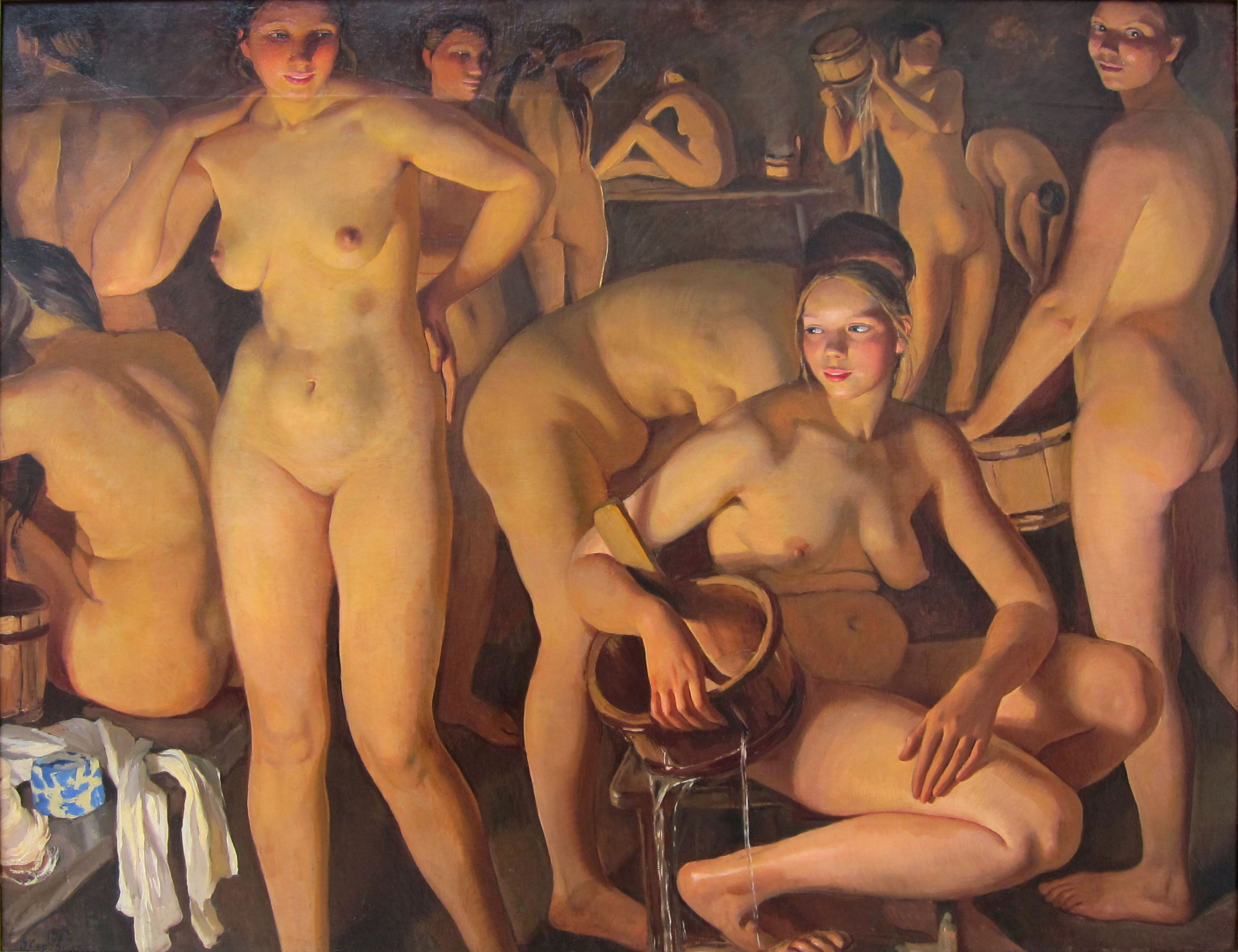
Dylda is a colouristic film, and a painterly film. Vermeer lighting is on display in eerie, soulful close-ups of Viktoria Miroshnichenko in the title role of Dylda, the Beanpole, aka Iya Sergeyeva. Zinaida Serebryakova's painting Banya (Sauna, 1913) is evoked in a delicious long shot of a women's bathhouse.

I would compare the decision of Balagov and Sereda with classics of Italian neorealism. The Italians of the 1940s showed views of heart-breaking poverty, but the cinematography was brilliant and glorious, conveying an irrepressible inner force that can overcome all external obstacles.

The powerful light in Balagov's films is a transcendent one. It is an inner light and also a light from beyond.

The balance of the physical and the metaphysical is delicate, and Balagov sustains it with the certainty of a sleepwalker.

The visual look is just a surface expression of a particular intensity of being that Balagov is able to catch. I don't know if the Russian word byt (быть) might be used here. But Balagov, like Ozu and Kiarostami, can convey an intensity of presence even when nothing happens.

The narrative breaks conventions in every turn. The protagonists are women who are frontline veterans. Unprotected women cannot survive there, states the chief physician of the hospital, a lady herself. We witness the humanity of people who have experienced things beyond humanity. A child who does not know what a dog and a pig are (they had all been eaten up during the siege). A war hero who only wants to die, because "I'm not a person anymore". We witness the most tender act of euthanasia in the history of the cinema, different from Michael Haneke's Amour. Balagov's avoids clichés in his sex scenes. They are awkward and embarrassing, yet with a touch of tenderness.

As a story of friendship and a potential of love between two women, Iya and Masha, Dylda is original. Balagov's understanding of love, emotional and physical, is wider and opener than the standard language allows. For the feelings that evolve here, conventional terms may be too restrictive.

From time to time Balagov has a penchant for scenes of long duration. I confess my limitations here. I have admired films with scenes of long duration all my life, since the 1960s (I can still remember the impact of 2001: A Space Odyssey in 1968 and the frisson of the finale of L'eclisse when it was in its original run). After they became fashionable in this millennium and started to appear all over the place, I sometimes feel that the device is becoming over-familiar.

BEYOND THE JUMP BREAK: GRISHA FREIDLIN'S INTERVIEW WITH KANTEMIR BALAGOV:

Wednesday, April 08, 2020

Tesnota / Closeness


Kantemir Balagov: Tesnota / Closeness (2017) starring Darya Zhovner as Ilana "Ila" Koft.

Теснота.
    RU © 2017 Nekommertsestki fond podderzhki kinematografa "Primer Intonatsii" (Fond Aleksandra Sokurova). © 2017 Olo "Kinostudija Lenfilm". P: Eduard Pichugin, Aleksandr Sokurov, Nikolai Yankin. Supervisor: Aleksandr Sokurov. Director of Lenfilm: Eduard Pichugin. Director of the fund Primer Intonatsii: Nikolai Yankin. Khudozhestvennyi rukovoditel filma: Aleksandr Sokurov.
    D: Kantemir Balagov. SC: Anton Yarush, Kantemir Balagov. Cin: Artem Emelianov – negative: 35 mm. PD: Aleksei Paderin. Cost: Lidia Kryukova. Makeup: Elena Grigorieva. S: Andrei Nikitin. ED: Kantemir Balagov. With: Anatoli Berdyugin. Casting: Vladimir Golov.
    Musical themes: State Anthem of Kabardino-Balkaria "Adyjge Nyse". Zhy: "Psykhag". Mr. Credo: "Mama Aziya". Tatyana Bulanova: "Ne Plach". Virus: "Ty menya ne ishchi". Timur Muchuraev: "Jerusalem".
    C: Darya Zhovner (Ila / Ilana Koft), Olga Dragunova (Mother / Adina Koft), Artem Cipin (Father / Avi Koft), Nazir Zhukov (Zalim), Benjamin Katz (David Koft), Anna Levit (Lea).
    Loc (exteriors): Nalchik, Kabardino-Balkaria, North Caucasus, Russia. – Bolshaya Khoralnaya Synagoga Sankt-Peterburga. Mostly shot in St. Petersburg.
    Languages: Russian, Kabardian.
    118 min
    Festival premiere: 24 May 2017 Cannes Film Festival: Un certain regard (winner of the FIPRESCI prize).
    Russian premiere: 3 Aug 2017.
    YouTube link with English subtitles provided by a friend.
    Viewed on a 4K television screen in Helsinki at home, 8 April 2020.

Larry Gross (Telluride Film Festival 2017): "Ila (Darya Zhovner), a twenty-something tomboy, works alongside her dad (Artem Cipin) in his auto repair shop. She teases David (Benjamin Katz), her about-to-be married brother, and resents Dina (Olga Dragunova), her domineering mother. It’s a tight-knit Jewish family that’s found a way to coexist in Nalchik, a dismal Muslim city in Russia’s Northern Caucasus region in 1998, the time of the Chechen war. When disaster strikes, Ila explodes in a drug-and-sex fueled rebellion that exposes the emotional secrets and lies that religious doctrine and family loyalties have suppressed. The 25-year-old old writer-director-editor Kantemir Balagov grew up in Nalchik, where a similar true story happened. Balagov’s talent for observing emotional violence and in shaping Zhovner’s utterly riveting performance made TESNOTA a winner at Cannes, and an unforgettable debut. The Russian master and past Telluride tributee Alexander Sokurov, Balagov’s mentor, serves as executive producer." – Larry Gross (Telluride Film Festival 2017)

"Only a close person can really hurt you" (Kantemir Balagov on Closeness in Yuri Dud's YouTube interview).

AA:  These are my first impressions of the first Kantemir Balagov film I have seen. By coincidence the previous film that I had seen was a Thaw era film adaptation of Leo Tolstoy's The Cossacks, set in Chechenia, an account of the Caucasian War in 1817–1864, this particular dramatization ignoring the war and emphasizing the brotherhood of peoples.

Balagov's film takes place in 1998, between the Chechen wars (1994–1996, 1999–2009). In a turning-point of the film a group of Kabardian friends watch video footage of Russian atrocities against Chechens. In the narrative itself there is little overt violence, but a sense of threat is ubiquitous.

One of the Kabardian friends is Zalim, the boyfriend of the protagonist Ilana who is told to remember this: "you are Kabardian". But she is Jewish, a member of a closely knit Jewish family and community. They are living in Nalchik, the capital of Kabardino-Balkaria, a hotbed of Islamist fanaticism and extremism. An expression of this is Timur Muchuraev's apocalyptic music video "Jerusalem", an incantation of blood and thunder in a mission to destroy Jews.

A kidnapping of Ilana's brother David and his fiancée Lea brings to an end the family's precarious existence in Nalchik. To pay the ransom they have to give up everything, including the beloved car repair shop in which Ilana has developed into a wizard as a car mechanic. It becomes too dangerous to stay. The utmost insult is an arranged marriage plan for Ilana which the young woman immediately sabotages.

As soon as David and Ilana start to grow roots and become a part of a milieu in which they live they are asked by their parents to move. "We are guests everywhere". Nowhere at home. "When do we stop moving around?" "Your tribe turned its ass on you. I won't belong to that tribe". But with Ilana they stay together.

There is a personal spirit, a special intensity, and a rare intimacy in Tesnota. Ilana's Bildungsroman is unique and unusual. She is a young woman who does not hide her masculine dimensions. In the family, David is the softer of the siblings. Ilana and David are not shy in their mutual tenderness, but their relationship is not transgressive. The parents, Adina and Avi, are overwhelmed in the circumstances of brutality and discrimination, and now their children are growing out of their reach. "They are not ours any longer".

The visual concept is intensive. Artem Emelianov has shot the film on 35 mm. The narrative is dark, but the images are lush, vibrant and full of life: the bustle at the car repair shop, the warmth of the meals of the family and the Jewish community, the wild energy of the parties of the young ones.

The cinematography is eloquent in many ways. The warm light has a painterly quality. The studies of faces, often in close-up or extreme close-up, are vivid. There is a feeling of desolation in many city milieux. At night, the party gets wilder, under hard drugs, and psychedelic lights convey altered states of consciousness. We move to the dimension of experimental cinema. Parts of the film belong to the cinema of duration, even longueurs.

In the morning we return to everyday consciousness. The protagonists appear as silhouettes at dawn. The final escape takes us to a mountain road in the Caucasus. The car breaks down, and it is getting cold. A sublime waterfall is thundering from a source or lake above. "I don't know what happened to these people thereafter".

BEYOND THE JUMP BREAK: KANTEMIR BALAGOV, CANNES INTERVIEW:

Tuesday, April 07, 2020

Kalle Kinnunen and Matti Rämö: Hymypoika. Dome Karukosken tie Lepsämästä Hollywoodiin (a book on the director Dome Karukoski)


Kalle Kinnunen and Matti Rämö: Hymypoika. Dome Karukosken tie Lepsämästä Hollywoodiin. [The Smiling Boy. The Way of Dome Karukoski from Lepsämä till Hollywood]. Helsinki: Otava, 2020. 352 p.

FEATURE FILMS DIRECTED BY DOME KARUKOSKI:
Beauty and the Bastard (Tyttö sinä olet tähti) (FI 2005)
The Home of Dark Butterflies (Tummien perhosten koti) (FI 2008)
Forbidden Fruit (Kielletty hedelmä) (FI 2009)
Lapland Odyssey (Napapiirin sankarit) (FI 2010)
Heart of a Lion (Leijonasydän) (FI 2013)
The Grump (Mielensäpahoittaja) (FI 2014)
Tom of Finland (FI 2017)
Tolkien (US 2019)

The title of the book is a reference to a tradition in Finnish schools since 1954. The Smiling Boy and the Smiling Girl busts are awards for fair and friendly behaviour in the school community.

The title is poignant and meaningful in many ways because Dome Karukoski was the victim of brutal school bullying for many years. He transcended this and became well-known for his sunny disposition and sportsmanship. The English idiom "a good sport" might come close to "hymypoika".

The brutal school years have been frankly discussed over the years by Dome Karukoski himself, who has become a champion in fighting school bullying. We know that it can injure and scar a person permanently. Teachers and school psychologists do nothing. They look the other way and perhaps perform some cosmetic action, and nothing changes. Usually the victim must move to another school, just like Dome Karukoski had to do.

The biography written by Kalle Kinnunen and Matti Rämö, two of the most experienced film journalists in Finland, is surprisingly candid in discussing this and other adversities that Karukoski has faced. The book is a tale of the spirit. A spirit that is indomitable. The word in Finnish is sisu, which means perseverance, grit, nerve, cojones, never giving up, going against all odds.

The book is a jungle adventure in the tough world of film production. Dome Karukoski got a flying start with his first six Finnish films which were all good, popular and well received by critics. More than that, Karukoski has launched careers of beloved actors who have become mainstays. Films directed by him have spawned sequels. Karukoski is equally at home in comedy and tragedy, and he knows that the best comedy is founded in tragedy.

The going gets tougher in international co-production. Ingmar Bergman warned Jörn Donner: "never make a film with more than one financer". Directors like Jim Jarmusch, Pedro Almodóvar and Aki Kaurismäki have solved this by establishing production companies of their own.

With co-production or as a part of a huge commercial juggernaut a dispiriting and soul-wrenching process may start where bit by bit you lose the inspiration which made you want to do the film in the first place, and the end result may turn out to be bland, predictable and without personality. But of course with edge and a tough skin you can survive in conditions like this and bring about personal work. It's much more difficult than it used to be in the classical studio era of film production.

Kalle Kinnunen and Matti Rämö present a wealth of fascinating minutieae about the concrete processes of film production from modest Finnish home market circumstances to Hollywood size budgeting. It is a rewarding nonfiction book with an emphasis on the external and practical side of movie-making. (I find incomprehensible the occasional penchant for an art vs. commerce dichotomy. From day one, since 125 years this year, art and commerce have walked hand in hand in the cinema: Edison, Lumière, Méliès, Paul, Dickson, Pathé, Gaumont, Nordisk, Griffith... ).

Dome Karukoski has had an original spirit and a personal voice from the start. His is a spirit of generosity. He understands young people (Tyttö sinä olet tähti) and old-timers (The Grump: the curmudgeon of this tale is a Finnish equivalent to About Schmidt). He goes deep into the phenomenon of Neo-Fascism (Heart of a Lion) but also into the international gay liberation (Tom of Finland). Napapiirin sankarit is a poignant comedy about marginalization beyond the Polar Circle in Lapland. The director himself and the writers of this book do not seem to appreciate very much Forbidden Fruit which to me is special: a tender and unexpected growing-up tale in a severe religious community. I predict that its value keeps growing, as does the value Dome Karukoski's oeuvre in general.

Sunday, April 05, 2020

Yuri Dud: vDud: Balagov – yemu 27, a on snova na Canneskom festivale / [Balagov – He's 27 and He's at the Cannes Film Festival Again] (YouTube)


Yuri Dud: vDud: Балагов – ему 27, а он снова на Каннском фестивале. YouTube 11 June 2019. Kantemir Balagov and Yuri Dud.

Балагов – ему 27, а он снова на Каннском фестивале
[Balagov – He's 27 and He's at the Cannes Film Festival Again].
    RU 2019. P: Yuri Dud, his vDud channel in YouTube at UCMCgOm8GZkHp8zJ6l7_hIuA
    D+SC: Yuri Dud. Camera: Sergei Lynkov, Danila Yakovlev, Yuri Burykin. нежный редактор: Tatyana Mingalimova. опорный редактор: Yevgeni Statsenko. новенький: Aleksandr Golovin. императорский монтаж: Dmitri Paryonin.
    Yuri Dud interviews: Kantemir Balagov, Vladimir Bitokov (young director colleague who also visited Sokurov's workshop), Aleksandr Rodnyansky (producer of Beanpole).
    76 min
    Geheimtip from a trusted friend.
    Viewed at home in Helsinki with English subtitles on a television screen, 5 April 2020

Yuri Dud is a sports journalist who also runs the popular YouTube channel vDud. He interviews prominent Russian and CIS region figures and has more than 6 million subscribers.

Kantemir Balagov has been winning awards in Cannes for his first feature films Closeness (Теснота, 2017) and Beanpole (Дылда, 2019).

Coincidentally, having seen yesterday the Leo Tolstoy film adaptation The Cossacks (1961), set in Chechenia, I now view Yuri Dud's YouTube programme which starts in the neighbouring Kabardino-Balkarian Republic in the North Caucasus.

We find ourselves in its capital, Nalchik, the home town of the film director Kantemir Balagov. We get acquainted with its Potemkin facades and reminiscine on three movie theaters which carry heroic Soviet era names. A ghostly image of Stalin appears on a wall. Georgia is to the south from here, on the other side of the Caucasus.

As Yuri Dud and Kantemir Balagov wander around the discussion moves from self-censorship ("Russian cinema is afraid of its own shadow") to a lost sense of good neighbourhoodness, tattoos and clothes as statements ("green and ochre: the rust of life"), the key influence of Alexander Sokurov's workshop in Nalchik in 2010 and the moral inspiration of Svetlana Alexievich. Men are more deeply stuck in tradition while women have more freedom and strength of character. "I have deleted my Twitter and Instagram accounts to avoid distraction". Time is the greater auditor of a film's merit, not awards. When would you say that you have justified it all? "When Alexander Nikolayevich Sokurov says I made a good, worthwhile film".

Balagov's favourite Russian films: The Cranes Are Flying, My Friend Ivan Lapshin and Flights in Dreams and in Reality (Полёты во сне и наяву, Roman Balayan, SU 1983). Favourite actors: Andrei Mironov, Oleg Yankovsky, Daniel Day-Lewis.

"Only a close person can really hurt you" (Kantemir Balagov on Closeness).

Saturday, April 04, 2020

Kazaki / The Cossacks (1961)


Kazaki / The Cossacks (1961). Maryana (Zinaida Kirienko). From: Internet Movie Database.

Kazaki / The Cossacks (1961): Maryana (Zinaida Kirienko) and Olenin (Leonid Gubanov). Poster art and design: Mikhail Nakhmanovich Khazanovski; ОАО «Рекламфильм» (издательство, выпустившее киноплакат). http://cinema.mosfilm.ru/films/film/1960-1969/kazaki/. From: Russian Wikipedia.

Казаки.
    SU 1961. PC: Mosfilm. P: Aleksandr Ashkinazi.
    D: Vasili Pronin. SC: Viktor Shklovski – based on the long story (povest) (1863) by Leo Tolstoy. Cin: Igor Gelein, Valentin Zakharov – Sovcolor. PD: Mikhail Bogdanov, Gennady Myasnikov. Cost: Mikhail Chikovani. Makeup: N. Antonova, B. Vikentyev. M: Gavriil Popov. Orchestra: Orkestr upravleniya po proizvodstvu filmov. Conductor: Veronika Dudarova. S: Evgeniya Indlina. ED: Yelena Kamagorova.
    C: Leonid Gubanov (Dmitri Olenin), Zinaida Kirienko (Maryana), Boris Andreyev (Eroshka), Eduard Bredun (Lukashka), Boris Novikov (Nazarka), German Kachin (Vanyusha), Vera Yeniutina (Maryana's mother).
    Shot at the studio of Mosfilm.
    2660 m / 97 min.
    Festival premiere: May 1961, Cannes Film Festival – Palme d'Or.
    Soviet premiere: 16 Aug 1961.
    Not released in Finland.
    Free online access: Online-kinoteatr Mosfilma / YouTube.
    Viewed at home with English subtitles on a television screen, 4 April 2020.

Leo Tolstoy wrote The Cossacks in 1863 as a kind of a sequel to his trilogy of youth, Childhood, Boyhood and Youth, soon after getting married, to clear his gambling debts. The Bildungsroman of Olenin, a young nobleman, proceeds in the spirit of Rousseau. Olenin enters Caucasus as a cadet (junker) to fight among its wild peoples in the Caucasian War. The Cossacks is a war story without hate or racism.

Agonizing at the emptiness of his life Olenin suffers from an identity crisis. He starts to wear Cossack dress and falls in love with Maryanka although she has already been promised to his friend Lukashka. He fails in bonding with the peoples of the mountains, and Maryanka turns him down. The foreign peoples remain foreign, but their freedom fight is discussed with respect and dignity.

The young man's inner crisis, "a philosophical adolescence" and the problem of consciousness had already been discussed by Tolstoy in his trilogy so incisively that the philosopher G. H. von Wright has seen in it "in a way a philosophical achievement".

During a hunting trip in the forest Olenin gets lost – and finds himself. He finds a path out of his identity crisis. He has an epiphany and finds an insight into the secret of happiness. Until now he has been gazing inside. Now there is a reversal to the world outside: "Happiness lies in living for others".

This is a profoundly Tolstoyan moment, his first turning-point of such magnitude, decisive in Tolstoy's oeuvre as a writer and also in his own life, first as the father of a large family, and later as a prophet of mankind for whom everybody is equal in value and dignity regardless of wealth, status, class, nationality, education or race.

The film adaptation of The Cossacks (1961) is a rare case of a major Soviet film (a Palme d'Or winner in Cannes) of its period that has never been screened in Finland. I became intrigued having read Valérie Pozner's discussion in the book Tolstoï et le cinéma (2005), and happily it's available in Mosfilm's Online Cinema in YouTube.

The screenwriter of not only this but also a previous film adaptation, The Cossacks (1928), was Viktor Shklovsky, a major Tolstoy expert. Paradoxically, he was also well-known for his conviction that a successful film adaptation of a work of literature is impossible because of the incompatibility of the verbal and the visual.

According to Pozner, both times Shklovsky's screenplay was fundamentally changed in the production process. In the 1928 adaptation the anticolonialistic, anti-imperialistic angle was so heavily emphasized that Olenin's coming of age story turned to its opposite, a tale of corruption. On the plus side, produced by Georgian-Film, the film was shot on location.

In the 1961 version topical new emphases of the party line were observed: the fight for peace and the condemnation of an offensive war. There was a problem of how to discuss an internal war. The doctrine of the brotherhood of peoples made it necessary to tone down the conflicts between Checkens and Cossacks. They are seen as deeply familiar, their disagreements of a provisional nature – a horse theft. Chechens checked the screenplay and their remarks were observed.

Ingushetia had voluntarily joined Imperial Russia in 1810, and in 1859 Chechnya was annexed to Russia during the Caucasian War. In the USSR the Checheno-Ingush autonomous republic was disbanded by Stalin in 1944 after accusations of collaboration with invaders and separatism. The republic had been restored in 1957 by Khrushchev.

The plan had been to shoot The Cossacks on location in the Checheno-Ingush republic in the summer of 1960. A Cossack village had been designed in the neighbourhood of Stavropol but there was no view of the Caucasian mountain tops from there. The planned location was changed to Grozny, but the bureaucracy of licenses took too long. The production was delayed, the original producer became incapable, and the production was executed at the Mosfilm studios instead of on location.

A mediocre director took the helm instead of Boris Barnet who had been the original choice. Vasili Pronin had been an excellent cinematographer in the 1930s but he never seems to have directed an outstanding film. Leonid Gubanov is a decent Olenin: his presence is convincing. But particularly great is Zinaida Kirienko (Quiet Flows the Don, A Poem of the Sea, The Fate of a Man, The Story of the Flaming Years, The Enchanted Desna) in the female leading role as Maryanka. Her proud demeanour is right for the part.

It could have become an engrossing film, but a major directorial voice, somebody like Mark Donskoy, Mikhail Kalatozov or, why not, Sergei Bondarchuk, would have been needed to lift the film from mediocrity. The scene of Tolstoyan epiphany during the hunting trip is included, but it lacks build-up and a devastating conviction.

The force of the revelation should have been of the caliber of Rainer Maria Rilke in "The Archaic Torso of Apollo": you must change your life.

OFFICIAL SYNOPSIS FROM THE MOSFILM WEBSITE
О фильме:
По одноименной повести Л. Н.Толстого. Несмотря на юные годы, богатый московский барин Дмитрий Оленин уже успел наделать немало ошибок, разочаровался в жизни и решил уехать юнкером на Кавказ. Прибыв к месту службы в казачью станицу, Оленин начинает жадно впитывать новые впечатления. Он покорен величественной кавказской природой, его привлекают цельные, сильные характеры казаков, их вольная жизнь. В фильме показан мучительный поиск нравственного идеала через попытку приобщения к простой жизни народа, к природе.
https://cinema.mosfilm.ru/films/34740/

Rainer Maria Rilke: Archaïscher Torso Apollos / Archaic Torso of Apollo (a poem, 1908)


Dugald Stewart Walker: title-page illustration in Rainer Maria Rilke: Poems (1918). Processed with IrfanView, gray-scaled; contrast heightened by 50; gamma correction of 2.5. Source: archive.org. From: Wikisource.

The poem collection is dedicated to Rodin. Rilke had been Rodin's secretary and biographer. French sculptor Auguste Rodin (1840-1917) in his Paris studio in 1905. Photograph by Frances Benjamin Johnston (1864-1952). This image is available from the United States Library of Congress's Prints and Photographs division. Photo, caption and data: Wikipedia.

A possible inspiration for Rilke. Unknown: Male torso. Statue. Between 480 and 470 BC. Parian marble. 132 cm. Louvre Museum. Antiquités grecques, room 3: Epoque du style sévère, 480 - 450 avant J.-C.. Denon, Entresol. Accession number Ma 2792. Object history: 1873: discovered by Olivier Rayet and Albert Thomas (Miletus). 1873: given to Louvre Museum by Salomon and Gustave de Rothschild. References: Musée du Louvre, Atlas database: entry 5482. Authority control: wikidata: Q20018546: Q20018546. Atlas: 5482. Data and photo: Wikipedia.

Wir kannten nicht sein unerhörtes Haupt,
darin die Augenäpfel reiften. Aber
sein Torso glüht noch wie ein Kandelaber,
in dem sein Schauen, nur zurückgeschraubt,

sich hält und glänzt. Sonst könnte nicht der Bug
der Brust dich blenden, und im leisen Drehen
der Lenden könnte nicht ein Lächeln gehen
zu jener Mitte, die die Zeugung trug.

Sonst stünde dieser Stein entstellt und kurz
unter der Schultern durchsichtigem Sturz
und flimmerte nicht so wie Raubtierfelle;

und bräche nicht aus allen seinen Rändern
aus wie ein Stern: denn da ist keine Stelle,
die dich nicht sieht. Du mußt dein Leben ändern.

Rainer Maria Rilke: Der neuen Gedichte: Anderer Teil. À mon grand ami Auguste Rodin. Leipzig, im Insel-Verlag, 1908.

Archaic Torso of Apollo

We cannot know his legendary head
with eyes like ripening fruit. And yet his torso
is still suffused with brilliance from inside,
like a lamp, in which his gaze, now turned to low,

gleams in all its power. Otherwise
the curved breast could not dazzle you so, nor could
a smile run through the placid hips and thighs
to that dark center where procreation flared.

Otherwise this stone would seem defaced
beneath the translucent cascade of the shoulders
and would not glisten like a wild beast's fur:

would not, from all the borders of itself,
burst like a star: for here there is no place
that does not see you. You must change your life.

From Ahead of All Parting: Selected Poetry and Prose of Rainer Maria Rilke, translated by Stephen Mitchell and published by Modern Library. © 1995 by Stephen Mitchell.

Friday, April 03, 2020

Reading Tolstoy, reading about Tolstoy


Leo Tolstoy tells a story to his grandchildren Sonya and Ilya in 1909 in Kryokshino, Moscow province. According to Tatiana Tolstoy (Anni con mio padre, Garzanti, 1978) the story is about a boy who enters a garden and eats cucumbers, each one bigger and bigger. Photo: Vladimir Chertkov. From: Толстой Лев Николаевич. Собрание сочинений / Электронное издание. - ИДДК, 2001. Photo and data from Wikipedia.

Leo Tolstoy tells a story to his grandchildren Sonya and Ilya in 1909 in Kryokshino, Moscow province. According to Tatiana Tolstoy (Anni con mio padre, Garzanti, 1978) the story is about a boy who enters a garden and eats cucumbers, each one bigger and bigger. Photo: Vladimir Chertkov. From: http://jecoutemaconscience.one-voice.fr/leon-tolstoi-precurseur-de-la-non-violence [extinct]. Photo and data from Wikipedia.


During the corona lockdown I have been reading Leo Tolstoy, also works that I did not know before. It's all free online in many languages. I think Tolstoy would have embraced the Internet.

Leo Tolstoy (1892): Luonnosta ja elämästä. Satuja ja kertomuksia lapsille [About Nature and Life. Fairy-Tales and Stories for Children]. Porvoo: WSOY 1892. A selection from Tolstoy's Russkaya kniga dlya cheniya collections (1875). – Web: Projekti Lönnrot n:o 951 http://www.lonnrot.net/etext.html#Tols
    Leo Tolstoy (2008): Kuinka hanhi jaetaan. Satua ja totta [How To Share a Duck. Fairy-Tales and True Stories]. Ed. and Finnish trans. Martti Anhava. Helsinki: Otava. A selection from Tolstoy's Russkaya kniga dlya cheniya collections (1875).
    A special talent of Tolstoy's was his ability to write for children – both original stories and adapted ones. He wrote fiction and non-fiction with equal flair. In his novels animals and trees are almost characters in their own right: Vronsky's mare Frou-Frou in Anna Karenina, the ancient oak at Bald Hills on the Bolkonsky country estate in War and Peace. In the stories for children his fauna expands from elephants to silkworms and his flora opens to an entire series about trees, among others. He even widens his field to the non-organic in stories about dew, fog, wind and magnetism. The suite of eight stories about his hunting dogs Burka and Milton has also been published as a separate volume.

"God Sees the Truth, But Waits" ("Бог правду видит, да не скоро скажет", 1872). Stephen King's novella "Rita Hayworth and Shawshank Redemption" (1982) was inspired by this Tolstoy tale about an innocent man framed for murder and sentenced to hard labour in Siberia. Online: Project Gutenberg. The Literature Network.
"The Prisoner in the Caucasus" ("Кавказский пленник", 1872). One of the most beloved stories written by Tolstoy for his ABC book, still a perennial favourite for schoolchildren. One of Tolstoy's memories from his service in the Caucasian War, distinguished by a sense of mutual respect between Chechens and Russians.
"What Men Live By" ("Чем люди живы", 1881). A haunting mystery play written as a short story. I find in it an affinity with the saga of Philemon and Baucis (Ovid's Metamorphoses, VIII). A film adaptation: Wilhelm Dieterle's first film as a director, Der Mensch am Wege (1923) with himself as Archangel Michael.
"Where Love Is, God Is" ("Где любовь, там и бог", 1885). A reworking of Ruben Sailers's Vater Martin, the story of a cobbler who loses everything and discovers everything. The story had come to Tolstoy's knowledge without a credited source, and he apologized for the recycling when he found out about the author. He made the story his own anyway.
What Then We Must Do? / What To Do? / What Is To Be Done? (Так что же нам делать?, 1886). A full-length pamphlet, a classic exposé on urban poverty in Moscow, and a key document of Tolstoy's awakening to the social reality in Imperial Russia. The Aylmer Maude translation is available online. In Finnish: Mitä meidän siis on tekeminen?, translated by K. W. Järnefelt, Helsinki: Otava, 1908. There are several editions in Project Gutenberg.
"How Much Land Does a Man Need?" ("Много ли человеку земли нужно", 1886). For James Joyce "the greatest story that the literature of the world knows" and a favourite of Ludwig Wittgenstein's. Stefan Zweig compared it with the stories of the Old Testament. A classic story about greed. How much land does a man need? Six feet above his head. Hans-Jürgen Syberberg filmed it as Scarabea. The title of the story has become a winged word, ἔπεα πτερόεντα.
"Croesus and Fate" ("Крез и судьба", 1886). Tolstoy retelling of the opening of Herodotus' Histories: the tale of Croesus, Solon and Cyrus.
"Kholstomer" ("Холстомер", 1888). Told largely in flashback, much of it a first-person narrative of a horse made into a gelding, his story compared with that of a land-owner who is being weighed and found wanting. I am reminded of Robert Bresson's Balthazar.
"Walk in the Light While There is Light" ("Ходите в свете, пока есть свет", 1893). A tale of the Early Christians in the Roman Empire from the period of the Christian persecutions after Nero, the tale of Julius torn between the Roman and the Christian ways. Much of it is an intelligent dialogue for an against Christianity. Could this tale have influenced Henryk Sienkiewicz's Quo vadis (1895–1896)? King James: John 12:35 "Then Jesus said unto them, Yet a little while is the light with you. Walk while ye have the light, lest darkness come upon you: for he that walketh in darkness knoweth not whither he goeth." Johannes 12:35 Jeesus sanoi heille: »Vielä hetken aikaa valo on teidän keskellänne. Kulkekaa niin kauan kuin teillä on valo, ettei pimeys saisi teitä valtaansa. Joka kulkee pimeässä, ei tiedä, minne on menossa. 36 Niin kauan kuin teillä on valo, uskokaa valoon, jotta teistä tulisi valon lapsia
"Divine and Human, Or, Three More Deaths" ("Божеское и человеческое", 1906). A sequel, written decades after the original story "Three Deaths", now focuses on political and religious persecution in Russia. This story inspired Paolo and Vittorio Taviani in their modern adaptation San Michele aveva un gallo (1973). In Finnish in the collection Jumalallista ja inhimillistä eli vielä kolme kuolemaa (in Finnish by K. Suomalainen, Porvoo : WSOY, 1907).
"I Can't Be Silent!" ("Не могу молчать!", 1908). One of Tolstoy's most famous declarations: against the capital punishment inflicted on rebellious peasants in mass hangings (thousands were executed). In the final paragraph he also condemns the Russian Empire's actions against Finns.

Leo Tolstoy (1928–1958): Polnoye sobraniye sochinenii L. N. Tolstogo v 90 tomah [The Complete Works of L. N. Tolstoy in 90 Volumes]. Moscow: Gosudarstvennoye izdatelstvo ”Hudozhestvennaya literatura”, 1928–1958. Web: http://tolstoy.ru/creativity/90-volume-collection-of-the-works/ – I cannot read Russian, but this resource is a goldmine, and one can get an overview of the scope of Tolstoy's interests and achievements. In the hosting Tolstoy.ru homepage there are also photographs, paintings and films.

Aylmer Maude (1908): The Life of Tolstoy. First Fifty Years. London: Archibald Constable and Co., Ltd.
    Aylmer Maude (1910): The Life of Tolstoy. Later Years. London: Constable and Company Limited.
    A. N. Wilson (1988) : Tolstoy : A Biography. London: Hamish Hamilton.
    The Aylmer Maude biography, totalling over a thousand pages, is an invaluable first hand source written by Tolstoy's friend, translator and publisher. It was published during Tolstoy's lifetime: the preface of the second volume is signed in August 1910, and Tolstoy died in November 1910. It is an authorized work fact-checked by Countess Sophia Andreyevna Tolstaya. Maude gives a honest and critical acccount of Tolstoyanism. A. N. Wilson's book is a good overview. On second reading, he seems slightly condescending. I think both Maude and Wilson have a good instinct about the truth about the Tolstoy family. It's all true, life is complex, we can never know everything, and it is none of our business.

Valérie Pozner (2005), ed.: Tolstoï et le cinéma. Cahiers Léon Tolstoï 16. Paris: Institut d’Études Slaves.
    Anna Kovalova (2018): ”Anna Karenina (1914) : Reconstructing and Interpreting a Lost Russian Film". Film History, Volume 30.2, pp. 35–78.
    The book edited by Valérie Pozner gives a wonderful Tolstoy filmography and a set of in-depth excursions, rewardingly on the two Soviet film adaptations of The Cossacks by Pozner herself. Anna Kovalova performs a miraculous job of conjuring a virtual reconstruction of the lost first feature length film adaptation of Anna Karenina of which only fragments remain.

Georg Henrik von Wright (1955): Tanke och förkunnelse [Thought and Sermon]. Helsingfors: Söderström. Includes four essays on Tolstoy, first published in Nya Argus 1952–1954, in Finnish Jussi Aro in Ajatus ja julistus, Porvoo – Helsinki: WSOY, 1961. Republished in Tieto ja ymmärrys, Helsinki: Otava, 1999.
    Harold Bloom (1994): The Western Canon. New York: Harcourt Brace. 14. Chapter ”Tolstoy and Heroism”.
    G. H. von Wright's essays on Tolstoy and Dostoevsky have a classical status in Swedish and Finnish. He brings his full philosophical weight into them. Wright does not seem to have understood what Tolstoy means when he says that all men are created equal. Harold Bloom's stunning essay on Hadji Murat builds on Viktor Shklovsky's insight in defamiliarization (остранение): "This technique of strangeness, combined with Tolstoy's tonality, results in the reader's happy conviction that Tolstoy enables him to see everything as if for the first time, while also giving him the sense that he has seen everything already. To be both estranged and at home seems unlikely, but that is Tolstoy's all but unique atmosphere." Then Bloom remarks that being at once uncanny and natural is a feature in all of the highest fictions. In them those antithetical attributes are fused.