I missed the morning visit to Bio Grand, Tikkurila, presented by Kimmo Lohman, Cinema Manager.
At the Flamingo Cinema, Vantaa, Ari "Jaska" Saarinen, Technical Supervisor and Manager (Finnkino) gave the presentation "D-Cinema, What Cinema Owners Don't Know Or Normally Forget To Think About", a brilliant no-nonsense all around survey highly appreciated by the experts present.
Jaska started with an eulogy to D-Cinema and a thrashing of 35 mm. According to him, 2K is enough for a 15 m screen, 4K for a screen over 15 m. His presentation was ultra-fast, with more information in the quick PowerPoints than was possible to digest. He stressed that besides resolution one must consider speed, contrast, and colour. It is important to acquire 2K equipment that can be upgraded to 4K.
Jaska stressed aspects such as DCI compatibility, the need to upgrade, spare part availability and price, support availability also on weekend. He strongly advised to buy the same model and size for all projectors. Projectors are not getting cheaper. He warned against silver screens because of the hot spot effect. He discussed the considerations of Xenon bulbs, ventilantion requirements, projection windows, soundproofing, electricity, higher cleanliness requirements.
Jaska discussed the four 3D systems of RealD, Dolby 3D, Master Image, and XPand. Finnkino uses XPand.
Jaska emphasized factors such as reliability, quality, warranty, training, correct installation, spare part availability, and automatical upgrading.
Jaska has developed for Finnkino a sound system of their own (AS2) with a non-perforated screen and Dolby reference level Vol 7. Front speakers are above the screen, and there are six subwoofers.
We saw three D-Cinema (2K) demonstrations at Flamingo:
1. Sherlock Holmes, opening, visually brilliant, I have no quarrel with this.
2. John Lasseter: Tokyo Mater (US 2008), great digital animation, colour intentionally anti-realistic.
3. Avatar, the attack on the life tree, experts present said they'd never seen it better expect in the special gala events with four projectors. My comment: this is a fantasy film with anti-realistic colour (the green is grayish, there is a lack of warm shades in the colour palette).
There is a trend in D-Cinemas that projectionists are going to be replaced with computer experts.
Back at the Finnish Film Foundation there was a symposium of digitalization providing a chance for a wider choice offered to cinema spectators (session on contents: films and alternative contents). - Erik Hamre (Emerging Pictures, Denmark) gave a rousing presentation of opera distribution in cinemas (live and canned). - Pilvi Burman (FS Film, Finland) predicted that the distributors will soon support digital releases only, and no 35 mm. She examined three experiences in 3D. Journey to the Center of the Earth was the nice learning experience, and the Finnish result was the best in the Nordic countries. Ice Age 3 was the most popular film of 2009. And finally Avatar, the turning-point in digital. - Fabrice Testa (Vice President Sales & Business Development, XDC) discussed VPF arrangements and alternative content (specific audiences, high ticket prices, optimizing off-peak times, additional revenue). He emphasized dynamism from the exhibitior, considering season tickets and memberships, accessing specific client groups, doing local marketing (flyers, posters, season catalogues, radio campaigns, trailers), event-like cinema experiences with introductions, Q & A, drinks afterwards. Revenue sharing 50% non-live, 35% live.
Fabrice Testa gave also a presentation on the role of integrators. XDC is the n:o 1 digital cinema company in Europe, a comprehensive European Networks Operations Center, an Integrated Full Service Company. Aiming to increase direct and indirect revenue, to reduce operational costs, requiring a specific business model, as it takes 10 years to collect VPF to cover the roll-out cost of D-Cinema.
Friday, February 19, 2010


Thursday, February 18, 2010
DigiTraining Plus (Day Two)
At the Finnish Film Foundation, Helsinki, 18 Feb 2009.
Presentations by Kerstin Degerman (MEDIA Desk Finland), Leena Laaksonen (Senior Advisor, Ministry of Education and Culture, Finland), Elisabetta Brunella (Secretary General of MEDIA Salles), Michael Karagosian (MKPE), Oleg Berezin (Managing Director of Nevafilm, Saint Petersburg), Harri Ahokas (Head of Domestic Distribution, Finnish Film Foundation), Ramon Reissmüller (Digitalt Projekt, Svenska Filminstitutet), Rolf Gjestland (Adviser in cinema technology and design, Film & Kino, Norway), Jan Petersen (IT manager of Nordisk Film Biografer, Denmark), Daniel Hromadko (BrickBox Digital Media, Czech Republic), Marieke Jonker (Amstelfilm, The Netherlands), Ami Dror (Xpand).
Leena Laaksonen stated that there has been a 51% increase in 3 years in Government film funding. 90% of the cinemas would vanish without public funding. Municipalities cannot afford to support cinemas. Virtual Print Fee is not a solution in a small market like Finland. Public funding is necessary. Problems include the lack of competition and the high cost of other digital stuff. Public funding has to be carefully prepared, with national, cultural criteria, and cinemas need to be treated equally.
Elisabetta Brunella reported that 2009 has been a year of exceptional growth in European cinemas, 6,3% more spectators. The trend has been especially strong in Germany, France, and Great Britain, as well as in Austria, The Netherlands, and Sweden, but also in Russia, Romania, Poland, and Slovakia. The average ticket price rose due to 3D. There was a 70% growth in digital screens during the first half of the year. France grew to be the European leader in digital screens, beating Great Britain. Penetration of 3D in digital screens will reach 55%.
Michael Karagosian gave the keynote speeches. Studio revenue is declining due to the costly transition to D-cinema. The bulk of the growth is due to 3D. 3D is the driver. In 2009, 15% of the global screens were digital. There is a decline of digital screens per site due to 3D. Karagosian presented the complex structures of the Virtual Print Fee, the Deployment Deal Structure, the 10 year warranty procedure, the free rider arrangement, and the film cutoff calculation.
Instead of standards, Mr. Karagosian spoke of compliances.
1. The DCI compliance with six major studios. There is no standard, but the procedure is evolving. D-Cinema has started developing before there were standards.
2. SMPTE DCP compliance: moving towards standards.
3. Accessibility compliance. For the first time ever films can be supplied with audio and subtitling alternatives royalty free. The previous techniques were proprietary.
Mr. Karagosian underlined the issue of managing trust and developing a standards-based security key management. It is a huge issue.
KDM = Key Delivery Message
FLM = Facility List Message
DCP = Digital Cinema Print
CCM = Cinema Communication Message
COMBI = Common Media Block INterface
Further, Mr. Karagosian talked about visual acuity limits. I disagree with him about 2K resolution being a sufficient replacement for 35 mm film.
Piracy is a major issue. Equal in profit to that of cocaine. 300-400% higher profit than on heroine, but penalties are lower. Piracy costs the industry more than digital cinema. In the USA 6,1 Billion estimated consumer losses. The ability to trace is developing, all content is marked in some way. Camcorder detectors.
Q & A: - The windows are shorter, even 12 weeks only, due to piracy.
- There was discussion whether digital cinema is a speculative bubble about to burst in a few years.
- The durability of the D-cinema hardware: one can expect the server to last 5 years, and the D-projector 10 years. We are on a learning curve, and updates take place every 3-5 years. We are still taking baby steps. It will take years to reach a robust stage. Digital cinema equipment is a part of the information technology development.
Rolf Gjestland (Norway): film distribution in Norway is to be all digital, with no 35 mm distribution.
Jan Petersen (Denmark) was more cautious, critical of the endless upgrades. D-Cinema is not as stable as desired. There is no business in 2D D-Cinema. 3-D is very good business: Avatar, and also Metropolitan Opera, Oscar Gala, Super Bowl, Champions League. The prerequisites for a digital shift include: - a substantial price reduction - smaller size of 2K projectors - full DCI compliance - in two years a full roll-out in Denmark is expected
Conclusion: every country has a different situation. It is a difficult area.
Wednesday, February 17, 2010
DigiTraining Plus (Day One)

DigiTraining Plus: European Cinemas Experiencing New Technologies. A five-day course organized by: Media Salles Training. An initiative of the MEDIA Programme of the European Union with the support of the Italian Government. At the Finnish Film Foundation (SES), Helsinki, 17-21 Feb 2010.
The seventh edition of a five-day intensive course for European exhibitors, devoted to the present state and future prospects of digital screening. The official agenda:
Do you want to:
- get ready to deal with the digital transition?
- keep up with the burning issues involved?
- get to know the latest news on digital projection presented by well-known international professional players?
- visit the cinemas that are pioneering the new technologies?
The presentations are or will be available also on the Media Salles website:
http://www.mediasalles.it/training/training.htm
The presentations of the previous six courses are available there, as well.
There are 59 European participants from Finland, Sweden, Italy, Ireland, Germany, Norway, Poland, Spain, Czechoslovakia, Great Britain, Austria, and the Netherlands, plus organizers from Italy and Great Britain. Opening speeches by Michael Vickers (Treasurer of MEDIA Salles), Irina Krohn (CEO of SES), presentation of the course by Anthony Williams (moderator of the course).
Tero Koistinen (CEO, Finnish Film Chamber), presented Finnish viewpoints. Last year screened were 2546 prints in 35 mm, and 649 digital files. The average ticket price is 8,3 E. Finnkino has a 73% market share. There were 48 digital screens (16,2%), most of them supported by SES. Barco was the dominant digital projector, Dolby the dominant server, and Xpand the dominant 3D system.
3D has been the driving force. Other incentives include getting premieres immediately, flexibility of programming, reduction of staff costs, and other digital stuff (opera, theatre, Formula 1, local documentaries).
Trouble includes higher maintenance costs, spare parts are expensive, there are no spare parts in Finland, and no competition between dealers.
There are no list prices, but in reality the projector and the server cost some 60.000-70.000 E, plus 3D some 15.000, the total installation cost with the ventilators and 3D desinfectors is some 100.000-120.000 E.
In 3D screenings the average price is 9,3 E.
Public support is necessary. The virtual print fee still in development.
Digitalization benefits studios and producers.
For the cinemas the problem is financial: it is impossible to cope without financial support from the government or from the studios.
Monday, February 15, 2010
Berlin Film Festival: The Complete Metropolis Exhibition
The Complete Metropolis (exhibition) at Deutsche Kinemathek, Museum für Film und Fernsehen, Filmhaus am Potsdamer Platz, Potsdamer Strasse 2. 15 Feb 2010.
The book: Deutsche Kinemathek (Hg.): Fritz Langs Metropolis. München: Belleville Verlag, 2010, 400 S., 600 Abbildungen.
A wonderful exhibition and a high quality coffee table book to celebrate the new 2010 reconstruction of the quasi-complete Metropolis (1927) incorporating the lost footage found in Buenos Aires.
"Tief unter der Erde lag die Stadt der Arbeiter". The stark and disquieting vision of the divided world is still unfortunately valid.
The dance of the fake Maria: the darkly satirical view of the abuse of female sexuality is explicitly reflected in the image of Madonna, with direct links to Brigitte Helm's performance.
Saturday, February 13, 2010
Berlin Film Festival: The Forum
Also the Forum is celebrating an anniversary, the Fourtieth, and also the Forum has a programme with retrospective features.
There is a restored version of the Bill Douglas trilogy (My Childhood, GB 1972, My Ain Folk, GB 1973, and My Way Home, GB 1978).
There is also a tribute with prints of restored versions from Festival Tokyo FilmEx dedicated to Yasujiro Shimazu, with Konyaku sanbagarasu (The Trio's Engagements, JP 1937), Asakusa no tomoshibi (The Lights of Asakusa, JP 1937), and Ai yori ai e (So Goes My Love, JP 1938).
Berlin Film Festival 2010: The Retrospective
I'm visiting Berlin just for meetings, no films. This is what I'm missing:
The retrospective of the Berlin Film Festival 2010 is dedicated to the 60 years of history of the festival, covering films like Fröken Julie, A bout de souffle, Lebenszeichen, La notte, Ai no corrida, The Deer Hunter, The Thin Red Line, Hong gaoliang, Duoluo tianshi, and Yella.
The special gala concert was of Metropolis (DE 1927, restored version 2010), with the 30 minutes recovered from a battered Argentinian 16 mm print incorporated, now running 147 min, format: High Definition. The film was played with the original music by Gottfried Huppertz played live by Rundfunk Sinfonieorchester Berlin conducted by Frank Strobel at the Friedrichstadtpalast and transmitted simultaneously on an open-air screen at the Brandenburger Tor. I would look forward to seeing Frank Strobel with Metropolis in Helsinki.
In Zeit-Magazin 7/2010 there is an interesting article by Karen Naundorf and Matthias Stolz: "Metropolis Die Lang-Fassung". Martin Koerber (Berliner Filmmuseum) and Anke Wilkening (Friedrich-Wilhelm-Murnau-Stiftung) made the structural reconstruction of the film together with Frank Strobel (conductor, Rundfunk Sinfonieorchester). Strobel knows the 1028 precise timings of the original score by Gottfried Huppertz, and he states that for the first time in his lifetime the score really fits well. The computer expert Thomas Bakels developed a new computer program that he has named Rettmagic to restore digitally the image from terrible Buenos Aires source material. Martin Koerber had said that he had never seen such bad source material with faulty framelines, instability of the image, black scratches overall, loss of light definition, holes in the image, double exposure through careless printing from the worn 35 mm onto 16 mm. Magic would seem to be the word for a case like this.
Rainer Werner Fassbinder's science fiction tv film Welt am Draht ("The World in a Web", DE 1973), 185 min, has been difficult to see in decades, and now it is being shown in a cinema in a restored version, and also released on dvd. Prophetically, it is about the cyberworld. To quote from the programme information: "In 1973 Rainer Werner Fassbinder made a film about computer-simulated realities. The plot of the two-part production fro television revolves around a supercomputer that is able to create a completely artificial world. The machine is being developed in an institute, whose director experiences hallunicatory changes in consciousness. Fassbinder used "classic" genre motifs to effectively reflect on the question of corruption and manipulation. Welt am Draht will have its first ever cinema screening at the Berlinale."
Berlin Film Festival 2010: The Competition
 |
| Semih Kaplanoğlu: Bal – Honig / Honey (TR 2010). Winner of the Golden Bear. |
The 60th Berlin Film Festival has started, and I'm visiting Berlin just for a couple of days for meetings, no films. Berlin is snow-bound but not cold. Winter Berlin at its best. Several entries of the competition are being shown as D-Cinema, including Howl and Shutter Island.
THE COMPETITION
Bal – Honig / Honey, Semih Kaplanoğlu, TR 2010), Enigmatic bee disease hits Anatolia.
Kyatapira (Caterpillar, Koji Wakamatsu, JP 2010). In WWII an officer comes home without arms and legs.
Der Räuber (The Robber, Benjamin Heisenberg, DE 2010). Double life of a marathon man as a bank robber.
En ganske snill man (A Somewhat Gentle Man, Hans Petter Moland, DK 2010). A convict (Stellan Skarsgård) returns to everyday life after 12 years in prison in a black comedy.
En familie (A Family, Pernille Fischer Christensen, DK 2010). The story of what we in Finland call uusioperhe (what is the English word? a family reinvented, reconstructed, reassembled... ?) with the current and present spouses and children from various relationships together.
Eu cand vreau sa fluier, fluier (If I Want To Whistle, Whistle, Florin Serban, RO 2010). A boy in a prison for young offenders falls in love and kidnaps a girl visitor only five days before his release.
OUT OF COMPETITION: Exit Through the Gift Shop (Banksy, US/GB 2010). The elusive graffiti artist makes a semi-documentary about a man who tries to break his wall of secrecy.
Greenberg (Noah Baumbach, US 2010). An independent comedy with Ben Stiller about a 40-year-old's search for his place in life.
Howl (Rob Epstein, Jeffrey Friedman, US 2010). The story of the obscenity trial of Howl with James Franco as Allen Ginsberg.
Jud Süss - Film ohne Gewissen (Jew Süss - Rise and Fall, Oskar Roehler, DE/AT 2010). How Goebbels pressured Ferdinand Marian, whose wife was Jewish, to star in an antisemitic hate film.
Kak ja provel etim letom (How I Ended This Summer, Aleksei Popograbski, RU 2010). Two men in an Arctic station in the summer.
Mammuth (Benoît Delépine, FR 2010). Tragicomedy about an ageing man (Gérard Depardieu) whose documents needed for his pension are missing. He mounts his Mammuth motorbike in search of his past.
My Name is Khan (Karan Johar, IN 2010). Unusual Indian musical about Muslims in western societies, starring Shah Rukh Khan.
Na putu (On the Path, Jasmila Zbanic, BA 2010). The story of an air stewardess and an air traffic controller at the Sarajevo airport.
CLOSING FILM, OUT OF COMPETITION: Otouto (About Her Brother, Yoji Yamada, JP 2010). Yamada's return to the present, a family drama about siblings.
Please Give (Nicole Holofcener, US 2010). A successful Manhattan couple expects the elderly lady neighbour to die soon so they can buy her apartment, but things are complicated by friendship.
Rompecabezas (Puzzle, Natalia Smirnoff, AR 2010). The mother's puzzle passion shakes the life of the whole family.
San qiang pa an jing qi (A Woman, a Gun, and a Noodle Shop, Zhang Yimou, CN 2010). A Chinese remake of Blood Simple.
Shahada (Burhan Qurbani, DE 2010). The story of three young Muslims in Germany, a Turkish policeman, a gay man from Nigeria, and a Westernized daughter of Turkish heritage.
Shekarchi (The Hunter, Rafi Pitts, IR 2010). The revenge of the outlaw whose wife and daughter have been killed by the police in a demonstration.
OUT OF COMPETITION: Shutter Island (Suljettu saari, Martin Scorsese, US 2010). Two policemen (Leonardo DiCaprio, Mark Ruffalo) try to solve the riddle of a supernatural disappearance on a closed prison island for the mentally ill.
Submarino (Thomas Vinterberg, DK 2010). The reunion of two brothers. One is an alcoholic bodybuilder who has served time in prison. The other is a single father fighting a heroin addiction.
The Ghost Writer (Haamukirjoittaja, Roman Polanski, FR/DE/GB 2010). A political thriller based on the novel by Robert Harris. The ghost writer (Ewan McGregor) finds out of the ex-prime minister of Britain (Pierce Brosnan) a secret which puts his life in danger.
The Kids Are All Right (Lisa Chodolenko, US 2010). A female couple (Annette Bening, Julianne Moore) has two children. There is a twist to their life as the children demand to meet their biological father (Mark Ruffalo).
The Killer Inside Me (Michael Winterbottom, US 2010). Based on the Jim Thompson novel about a cop who is a sadistic serial killer. Starring Casey Affleck.
OPENING FILM: Tuan yuan (Apart Together, Wang Quan'an, CN 2010). After 50 years a group of Chinamen that had moved to Taiwan get the permission to revisit the Chinese mainland.
Friday, February 12, 2010
Veijo Hietala: Sex in the Finnish Cinema (lecture)
In the lecture series "Sexuality on Screen" by the Film Society of the Helsinki Students' Association. Cinema Orion, Helsinki, 12 Feb 2010.
With a great sense of humour Veijo Hietala started from early cinema (Sylvi, 1913), proceeded to the studio era (The Vagabond Waltz, 1940), discussed the train piston innuendo in Hannu Leminen's The Beautiful Inkeri of the Railway Yard (1950), examined the special case of Teuvo Tulio, noted the natural nudity (not necessarily sexual) in traditional Finnish cinema, and proceeded via the 1960s (A Cone Under My Back, 1966) to the present day, where in Hietala's opinion there is now less sex since the frank and popular The Restless (2000). Hietala wondered also whether American puritanism about nudity has influenced Finns. Hietala, donning his trademark beret, impressed the audience with analogue technology, complete with overhead projector sheets and samples from a vhs tape.
With a great sense of humour Veijo Hietala started from early cinema (Sylvi, 1913), proceeded to the studio era (The Vagabond Waltz, 1940), discussed the train piston innuendo in Hannu Leminen's The Beautiful Inkeri of the Railway Yard (1950), examined the special case of Teuvo Tulio, noted the natural nudity (not necessarily sexual) in traditional Finnish cinema, and proceeded via the 1960s (A Cone Under My Back, 1966) to the present day, where in Hietala's opinion there is now less sex since the frank and popular The Restless (2000). Hietala wondered also whether American puritanism about nudity has influenced Finns. Hietala, donning his trademark beret, impressed the audience with analogue technology, complete with overhead projector sheets and samples from a vhs tape.
Tuesday, February 09, 2010
Midnight Ramble
Midnight Ramble: Oscar Micheaux and the Story of Race Movies. US © 1994 Northern Lights Productions / WGBH Productions. P: Pam A. Thomas, Bestor Cam. COORD. P: Beth Deare. D: Pearl Bowser, Bestor Cam. SC: Clyde Taylor. DP: Bestor Cam, Bruce Johnson. COMMENTARY: James Avery. FEATURING: author Toni Cade Bambara, historian Robert Hall, illustrator Elton Fox, archivist Pearl Bowser, film director Carlton Moss, actress Frances Williams, actress Shingzie Howard McClane, journalist St. Claire Bourne, Sr., actress Edna Mae Harris. Original format: video. 58 min. Dvd 54 min. Viewed at Cinema Orion, Helsinki (Black History Month), 9 Feb 2010.
Revisited Pearl Bowser and Bestor Cam's excellent survey into the birth of the African-American cinema. In the early days, audiences were segregated, and black people had to watch films after midnight. The terrible insult of The Birth of a Nation. The rise of the independent African-American cinema and its story from the 1910s till the 1930s. Noble Johnson. The story of Oscar Micheaux, the top African-American director of his time.
Revisited Pearl Bowser and Bestor Cam's excellent survey into the birth of the African-American cinema. In the early days, audiences were segregated, and black people had to watch films after midnight. The terrible insult of The Birth of a Nation. The rise of the independent African-American cinema and its story from the 1910s till the 1930s. Noble Johnson. The story of Oscar Micheaux, the top African-American director of his time.
Black and Tan
US 1929. D: Dudley Murphy. 19 min. Viewed on 9 Feb 2010 at Cinema Orion (Black History Month), Helsinki.
Revisited: Duke Ellington is dignified composing Black and Tan Fantasy. Fredi Washington is the dancer who performes the dance of death. Duke Ellington and his Cotton Club Orchestra play Black and Tan as her requiem.
With Barney Bigard (clarinet), Wellman Braud (bass), Joe 'Tricky Sam' Nanton (trombone).
St. Louis Blues
US 1929. D: Dudley Murphy. 16 min. Viewed on 9 Feb 2010 at Cinema Orion (Black History Month), Helsinki.
Revisited the definitive Bessie Smith film record. Bessie Smith is cheated by Jimmie the Pimp (Jimmy Mordecai) and sings the blues from the bottom of her heart.
Revisited the definitive Bessie Smith film record. Bessie Smith is cheated by Jimmie the Pimp (Jimmy Mordecai) and sings the blues from the bottom of her heart.
Saturday, February 06, 2010
Baadasssss (in the presence of Mario Van Peebles)
US 2003. EX: Michael Mann, etc. P: Mario Van Peebles, etc. D: Mario Van Peebles. Based on the book by Melvin Van Peebles: Sweet Sweetback's Baadasssss Song: A Guerrilla Filmmaking Manifesto. Starring Mario Van Peebles (Melvin Van Peebles). Cinema Orion, Helsinki (Black History Month), 6 Feb 2010.
In the presence of Mario Van Peebles, who gave a rousing presentation of the story behind the film. Having spent a week in Finland (Helsinki, Tampere, and Oulu), with great media coverage (newspapers, radio, tv) this was the last public appearance of Mario's tour. I followed Mario's presentation only.
In his presentations Mario Van Peebles emphasized the meaning of images projecting role models. In the 1980s, two of the most popular tv series were The Cosby Show, with a positive image of a black family, and Miami Vice, created by Michael Mann, pairing a white cop and a black cop. A generation later, nobody has trouble accepting a black president for the U.S.A.
Nikolai Gogol: Taras Bulba (a novel)


Тарас Бульба. First version: RU 1835. Second, revised version: 1842. (First translated into Finnish in 1878, Samuli S.). This translation, based on the revised version of 1842: Juhani Konkka 1940, second edition 1941. Helsinki: WSOY.
Having watched the film Taras Bulba starring Yul Brynner (great in the title role) and with a magnificent epic account of the siege of Dubno I realized I had never read Nikolai Gogol's novel. It was one of Ernest Hemingway's ten favourite books, and it is the book that the young Alyosha reads aloud to the boatmen in Maxim Gorky's My Childhood. After Pushkin, this novel was the second most important inspiration to the great Russian writers. It echoes clearly in the work of Gorky and in Leo Tolstoy's magisterial Hadzhi Murat.
It is a tale of terror in the steppes of Ukraine, starring Zaporozhian Cossacks in the 16th Century. It is written vigorously, with gusto, unflinching about the terrible deeds the Cossacks are able to commit.
The book is, among other things, also atrociously anti-semitic. The Jew Yankel became the anti-semitic stereotype in Russian literature (greedy, cowardly, ridiculous, repulsive). It was disquieting to notice that this edition was published in Finnish in 1940 and in 1941. In the Yul Brynner film the Jewish theme has been completely omitted. The film is also otherwise sanitized: the terror of the Cossacks is generally toned down.
The novel is a half-way masterpiece with a disgusting aspect. The impact can be compared with D. W. Griffith's The Birth of a Nation, which can be screened today with apologies only.
Friday, February 05, 2010
The Love Goddesses (lecture)
 |
| Marlene Dietrich as Amy Jolly in Morocco. |
Antti Alanen: Valkokankaan seksipommit. My lecture in the Cinema and Sexuality lecture series arranged by the Film Society of the Helsinki Students' Association. Cinema Orion, Helsinki, 5 Feb 2010.
The views of Edgar Morin, Richard Dyer, and Richard deCordova.
The birth of the star system, its development, and the end of the classical star system in the 1960s.
Edgar Morin's view of from gods to mortals: from the divine stars to profane ones.
A new age of celebrity culture and a new level of star power.
The feminist criticism: the stereotyping of women, Molly Haskell's From Reverence to Rape view.
The sex star as object and subject.
There have been no magnificent new sex stars of the cinema since the 1960s, of the caliber of Garbo, Dietrich, and Monroe.
The great legendary stars of today are pop stars. No film star's death would be world news in the same way as Michael Jackson's. No film star galvanizes global audiences like Madonna.
With the legalization of hard core pornography since 1969 mainstream cinema lost much sexual steam. There are also stars in pornography, thousands of them, but they are less unique, more expendable.
Ten profiles: Asta Nielsen, Louise Brooks, Greta Garbo, Marlene Dietrich, Mae West, Marilyn Monroe, Brigitte Bardot, Jeanne Moreau, Sophia Loren, Sharon Stone.
Sharon Stone created only one mythic sex role (in Basic Instinct), but there are no directors in Hollywood today who like Stiller and Sternberg could have directed her in further films of equal charismatic power.
Followed by a screening of The Love Goddesses (1965), by Saul Turell and Graeme Ferguson, with William K. Everson, Paul Killiam and Gideon Bachmann among the contributors, one of the all-time most wonderful compilation films, with fascinating clips from films some of which are very hard to see (A Woman of the World, The Love of Sunya... ).
...
FINNISH FILM ARCHIVE PROGRAM NOTE
Suomen elokuva-arkisto
Finlands filmarkiv
The Love Goddesses
Rakkauden jumalattaret / Kärleks gudinnor
Yhdysvallat 1965. Tuotantoyhtiö: Paramount Pictures. Tuottaja: Graeme Ferguson, Saul J. Turell. Ohjaus: Saul J. Turell. Käsikirjoitus: Saul J. Turell, Graeme Ferguson. Musiikki: Percy Faith. Leikkaus: Nat Greene, Howard Kuperman. Pääosissa: Carl King (kertoja). Helsingin ensiesitys: 9.7.1965 Maxim, maahantuoja: Filmipaja Oy / Mäkelä – tarkastusnumero 72107 – K16 – 2165 m / 79 min
Elokuvahistorialliset kompilaatiot ja antologiat ovat parhaimmillaan itsenäisiä taiteellisia saavutuksia. Antologioiden aateliin kuuluu Graeme Fergusonin ja Saul J. Turellin The Love Goddesses (1965) jossa asiantuntijoina olivat William K. Everson, Paul Killiam ja James A. Lebenthal. Siihen sisältyy näytteitä mm. seuraavista elokuvista:
Josef von Sternberg: Vaalea Venus (Blonde Venus, 1932) ja
Josef von Sternberg: Morocco (Morocco, 1930) Marlene Dietrich
Thomas A. Edison: The Kiss (1896) May Irwin ja John C. Rice
D. W. Griffith: True Heart Susie (1919) Lillian Gish
Wesley Ruggles: Leopard Woman (1920) Louise Glaum
J. Gordon Edwards: Kleopatra (Cleopatra, 1917) Theda Bara
D. W. Griffith: Suvaitsemattomuus (Intolerance, 1916) Mae Marsh
Cecil B. DeMille: Norsunluukuningas (The Cheat, 1915) Fannie Ward ja Sessue Hayakawa
George Melford: Sheikki (The Sheik, 1921) Agnes Ayres ja Rudolph Valentino
Victor Fleming: Hula (Hula, 1927) Clara Bow
Fred Niblo: Verta ja hiekkaa (Blood and Sand, 1922) Nita Naldi
Malcolm St. Clair: Maailmannainen (Woman of the World, 1925) Pola Negri
D. W. Griffith: Paholaisen surut (The Sorrows of Satan, 1926) Lya De Putti
Albert Parker: Kohtalon kuvastin (The Love of Sunya, 1927) Gloria Swanson
G. W. Pabst: Kadotetun päiväkirja (Tagebuch einer Verlorenen, 1929) Louise Brooks
Gustav Machaty: Hurmio (Extase, 1933) Hedy Lamarr
G. W. Pabst: Kadonnut maailma (L'Atlantide, 1932) Brigitte Helm
Erik A. Petschler: Maailman Matti (Luffar-Petter, 1922) Greta Garbo
Frank Capra: Platinapommi (Platinum Blonde, 1931) Jean Harlow
Michael Curtiz: Cabin in the Cotton (1932) Bette Davis
Mervyn LeRoy: Kultakalat 1933 ( Gold Diggers of 1933, 1933) Ruby Keeler ja Dick Powell
Wesley Ruggles: Mies minua varten (No Man of Her Own, 1932) Carole Lombard ja Clark Gable
William A. Seiter: Professional Sweetheart (1933) Ginger Rogers ja Norman Foster
Rouben Mamoulian: Rakasta minua tänä yönä (Love Me Tonight, 1932) Jeanette MacDonald, Myrna Loy, Maurice Chevalier ja Charles Ruggles
Wesley Ruggles: En ole enkeli (I'm No Angel, 1933) Mae West
Alfred E. Green: Vaalea viettelijätär (Baby Face, 1933) Barbara Stanwyck
Henry Hathaway: Varkain paratiisiin (Now and Forever, 1934) Shirley Temple
Mervyn LeRoy: Olen syytön (They Won't Forget, 1937) Lana Turner
Raoul Walsh: Svengiä kerrakseen (College Swing, 1938) Betty Grable
George Archainbaud: Viidakkorakkautta (Her Jungle Love, 1938) Dorothy Lamour ja Ray Milland
Charles Vidor: Gilda (Gilda, 1946) Rita Hayworth
George Stevens: Paikka auringossa (A Place in the Sun, 1951) Elizabeth Taylor ja Montgomery Clift
Billy Wilder: Piukat paikat (Some Like It Hot, 1959) Marilyn Monroe
Melville Shavelson: Romanssi Caprilla (It Started in Naples, 1960) Sophia Loren ja Clark Gable
J. Lee Thompson: Kohtalokas kotiinpaluu (Tiger Bay, 1959) Hayley Mills ja Horst Buchholz
William Wyler: Loma Roomassa (Roman Holiday, 1953) Audrey Hepburn ja Gregory Peck
Jack Clayton: Tilaa huipulla (Room at the Top, 1958) Heather Sears ja Simone Signoret
Claude Autant-Lara: Rakkaus on kohtaloni (En cas de malheur, 1958) Brigitte Bardot
Val Guest: Café Expresso Bongo (Expresso Bongo, 1959) Sylvia Syms
Cecil B. DeMille: Cleopatra (Cleopatra, 1934) Claudette Colbert
AA 1991
Tuesday, February 02, 2010
Sweet Sweetback's Baadasssss Song (2010 introduced by Mario Van Peebles)
 |
| Melvin Van Peebles: Sweet Sweetback's Baadasssss Song (US 1971). |
US 1971. D: Melvin Van Peebles. Print: The Museum of Modern Art, the restored version, with funding provided by The Hollywood Foreign Press Association and The Film Foundation. Cinema Orion (Black History Month), Helsinki, 2 Feb 2010.
It was a special pleasure to screen this landmark film with an introduction by Mario Van Peebles. This time I just listened to Mario's introduction.
Pirkka Kivenheimo: African American Cinema (a lecture, 17 April 2009).
Monday, February 01, 2010
Classified X
Melvin Van Peebles' Classified X. FR / US / GB 1998. TV documentary. PC: Centre National de la Cinématographie (CNC) / Channel 4 Television Corporation / Ecoutez Voir / La Sept-Arte / Les Films d'Ici / Procirep / TP / Yeah, Inc. EX: Melvin Van Peebles, Patrick Dumez, Yves Jeanneau. P: Yves Jeanneau, Christine Le Goff. D+DP: Mark Daniels – original format: video – has been also available on 35 mm. SC: Melvin Van Peebles. S: Olivier Schwob. ED: Janince Jones, Catherine Mabilat. NARRATOR: Melvin Van Peebles. PERFORMERS IN ARCHIVAL FOOTAGE: Margaret Barker, Joanna Barnes, Ethel Barrymore, Harry Belafonte, Ingrid Bergman, David Brian, Lloyd Bridges, Steve Brodie, Charles Bronson, Jim Brown, James Burke, Jeff Corey, Lou Costello, Jeanne Crain, Tony Curtis, Dorothy Dandridge, Gloria DeHaven, Douglas Dick, Tamara Dobson, Kirk Douglas, James Edwards, Mel Ferrer, Errol Flynn, Nina Foch, Ava Gardner, Will Geer, Mel Gibson, Lillian Gish, Danny Glover, Cary Grant, Kathryn Grayson, Pam Grier, Juano Hernandez, Lena Horne, Katharine Houghton, John Hud-kins, Richard Hylton, Rex Ingram, Claude Jarman, Jr., Al Jolson, Martin Luther King, Kevin Kline, Burt Lancaster, Canada Lee, Vivien Leigh, Frank Love-joy, Lee Marvin, Harpo Marx, May McAvoy, Hattie McDaniel, Nina Mae McKinney, Adolphe Menjou, Zakes Mokae, Barry Nelson, Laurence Olivier, Frederick O'Neal, Ron O'Neal, Maureen O'Sullivan, Beatrice Pearson, Sidney Poitier, Dick Powell, Mickey Rooney, Richard Roundtree, Robert Ryan, George Siegmann, Kenneth Spencer, James Stewart, Woody Strode, Shirley Temple, Peter Ustinov, Ethel Waters, Johnny Weissmuller, Richard Widmark, Martin Wilkins, Dooley Wilson, Penelope Wilton, Malcolm X. 53 min. Dvd screened in Cinema Orion (Black History Month), 1 Feb 2010.
An excellent survey of representations of African-Americans in the cinema as seen by Melvin Van Peebles. It starts with Edison (the watermelon contests) and the montages of racial stereotypes make quite shocking viewing. Black people as clowns, cowards, victims of lynchings, figures of shame. - New images in Pinky, Lost Boundaries, Intruder in the Dust. - Control of the media: black independent cinema, Oscar Micheaux. - African-American stereotypes were so pervasive that African-Americans accepted them themselves. - Carry the plate figures. - Entertainment: black musicals, Lena Horne. - The disappearance of black independent cinema for 30 years. - White fantasies on what black people would like to see. - Omnipresent marginalization. - Blaxploitation. - The colour of money is not black or white but green. - A great and worthy compilation essay.
An excellent survey of representations of African-Americans in the cinema as seen by Melvin Van Peebles. It starts with Edison (the watermelon contests) and the montages of racial stereotypes make quite shocking viewing. Black people as clowns, cowards, victims of lynchings, figures of shame. - New images in Pinky, Lost Boundaries, Intruder in the Dust. - Control of the media: black independent cinema, Oscar Micheaux. - African-American stereotypes were so pervasive that African-Americans accepted them themselves. - Carry the plate figures. - Entertainment: black musicals, Lena Horne. - The disappearance of black independent cinema for 30 years. - White fantasies on what black people would like to see. - Omnipresent marginalization. - Blaxploitation. - The colour of money is not black or white but green. - A great and worthy compilation essay.
Special guest: Mario Van Peebles
Mario Van Peebles, film and tv director, actor, producer, and writer, tours Finland this week honouring our Black History Month dedicated to the representations of African-Americans in the cinema. Mario is not only a talented artist but also a serious thinker in world affairs, a nice guy and a devoted father of five children. He gave an inspired speech to launch our historical retrospective of African-American cinema. Also Pirkka Kivenheimo, the leading Finnish expert on the topic, gave a solid introduction. The cinema was packed. Organized by the U.S. Embassy. Cinema Orion, 1 Feb 2010.
Sunday, January 31, 2010
The Jussi Awards for 2009
The Finnish cinema awards for films premiered in 2009.
BEST MOTION PICTURE OF THE YEAR
Kuulustelu [The Interrogation] - P: Misha Jaari, Mark Lwoff
* Postia pappi Jaakobille [Letters to Father Jacob] - P: Lasse Saarinen, Rimbo Salomaa
Täällä Pohjantähden alla [Under the North Star] - P: Timo Koivusalo
ACHIEVEMENT IN DIRECTING
* Kielletty hedelmä [Forbidden Fruit] - Dome Karukoski
Muukalainen [The Stranger] - Jukka-Pekka Valkeapää
Postia pappi Jaakobille [Letters to Father Jacob] - Klaus Härö
PERFORMANCE BY AN ACTOR IN A LEADING ROLE
Haarautuvan rakkauden talo [The House of Forking Love] - Hannu-Pekka Björkman
* Postia pappi Jaakobille [Letters to Father Jacob] - Heikki Nousiainen
Väärät juuret [Wrong Roots] - Pertti Sveholm
PERFORMANCE BY AN ACTRESS IN A LEADING ROLE
Haarautuvan rakkauden talo [The House of Forking Love] - Elina Knihtilä
* Kuulustelu [The Interrogation] - Minna Haapkylä
Postia pappi Jaakobille [Letters to Father Jacob] - Kaarina Hazard
PERFORMANCE BY AN ACTOR IN A SUPPORTING ROLE
* Rööperi [The Red Hill] - Peter Franzén
Täällä Pohjantähden alla [Under the North Star] - Heikki Nousiainen
Täällä Pohjantähden alla [Under the North Star] - Esko Roine
PERFORMANCE BY AN ACTRESS IN A SUPPORTING ROLE
* Kielletty hedelmä [Forbidden Fruit] - Amanda Pilke
Maata meren alla [Earth Under the Sea] - Marja Packalén
Täällä Pohjantähden alla [Under the North Star] - Miia Selin
SCREENPLAY
Kuulustelu [The Interrogation] – Olli Soinio
* Skavabölen pojat [The Boys from Skavaböle] - Antti Raivio, Jan Forsström, Zaida Bergroth
Postia pappi Jaakobille [Letters to Father Jacob] - Klaus Härö, Jaana Makkonen
ACHIEVEMENT IN CINEMATOGRAPHY
Kuulustelu [The Interrogation] - Pirjo Honkasalo
* Muukalainen [The Stranger] - Tuomo Hutri
Postia pappi Jaakobille [Letters to Father Jacob] - Tuomo Hutri
ACHIEVEMENT IN MUSIC
Liikkumavara [The Leeway]– Ville Riippa
Muukalainen [The Stranger] - Helena Tulve
* Postia pappi Jaakobille [Letters to Father Jacob] – Dani Strömbäck
ACHIEVEMENT IN SOUND DESIGN
Muukalainen [The Stranger] - Micke Nyström
* Skavabölen pojat [The Boys from Skavaböle] - Janne Laine
Postia pappi Jaakobille [Letters to Father Jacob]– Kirka Sainio
ACHIEVEMENT IN FILM EDITING
Haarautuvan rakkauden talo [The House of Forking Love] - Jukka Nykänen
* Muukalainen [The Stranger] - Mervi Junkkonen
Postia pappi Jaakobille [Letters to Father Jacob] – Samu Heikkilä
ACHIEVEMENT IN ART DIRECTION
Kuulustelu [The Interrogation] - Pentti Valkeasuo
Muukalainen [The Stranger] - Kaisa Mäkinen
* Rööperi [The Red Hill] – Pirjo Rossi
ACHIEVEMENT IN COSTUME DESIGN
Kuulustelu [The Interrogation] - Auli Turtiainen
* Rööperi [The Red Hill] – Tiina Kaukanen
Täällä Pohjantähden alla [Under the North Star] – Leila Jäntti
BEST DOCUMENTARY FEATURE FILM
* Kansakunnan olohuone [The Living-Room of the Nation] - Jukka Kärkkäinen
Liikkumavara [The Leeway] – Annika Grof
Magneettimies [The Magnetic Man] - Arto Halonen
LIFE AWARD
Lasse Pöysti, actor, director, since 70 years, still active
The 2010 Jussi Gala
 |
| Lasse Pöysti received the Concrete Jussi Award for Life Achievement. |
The Jussi Gala took place at the Merikaapelihalli of the Kaapelitehdas on 31 Jan 2010. The place was packed with film professionals. Before the beginning I had the pleasure to meet Lasse Pöysti, with a film career of 70 years, and counting. He was in the company of his granddaughter Alma Pöysti. He was maybe the only one present who had attended already the first Jussi Gala in 1944. He reminisced old greats of the Swedish theatre and cinema such as Lars Hanson, Victor Sjöström, and Ingmar Bergman. I was co-hosting Mario Van Peebles, who had arrived from Los Angeles, and was often gloriously bored, as all the talk was in Finnish only. There were two standing ovations. For Heikki Nousiainen, who after retirement is at the top of his game with four film roles last year, including two Jussi nominations, both in the supporting role of tailor Halme in Under the North Star, and in the leading role of Letters to Father Jacob. And for Lasse Pöysti, of whom every Finn has fond memories, including as a favourite teller of children's fairy-tales.
Saturday, January 30, 2010
Marilyn, dernières séances / Marilyn: The Last Sessions
 |
| Patrick Jeudy: Marilyn, dernières séances / Marilyn: The Last Sessions (FR 2008). |
Marilynin viimeiset sessiot.
FR © 2008 Les Films d'Ici. D: Patrick Jeudy. Based on the book Michel Schneider (2006). "I'm Sorry" sung by Brenda Lee. A tv documentary. 91 min. Viewed on dvd at home, 30 Jan 2010.
AA: There is a lot of rare authentic footage in this film, as well as fabrications and simulations.
The main source of Michel Schneider's book is John Miner, who claims to have heard tapes made by Marilyn Monroe at home free-associating for Ralph Greenson in 1962, the year she died. Miner, then deputy district attorney of Los Angeles County, says he listened to the tapes with Greenson on 6 Aug 1962. Miner claims to have made transcriptions of them later.
John Miner, now ca 90 years old, is the only witness to the claim that such tapes have existed. His transcriptions, first published in Los Angeles Times (5 Aug 2005), and subsequently in the world press, do not feel credible. They would only make sense if MM would have taped interviews for publication. It is highly improbable she would have made tapes anyway. If she had, their publication would be macabre and tasteless and against the principles of the confidentiality of the medical profession. John Miner is reportedly a decent man who wants to protect Greenson's reputation, but unfortunately his transcriptions sound like fabrications. He says that he believes that Greenson, who died in 1979, destroyed the tapes.
Although the film does not claim to present the tapes, there are illustrations of a magnetic tape, and a simulated woman's voice. There is also the MM lookalike Arline Hunter's The Apple, Knockers and the Coke nude film; Jeudy hints that it might be MM, herself.
My personal comment to this: the truth of Marilyn's last sessions we'll never know, but one can guess that it was much more terrible than is generally known, and certainly no entertainment.
MM's diagnosis confirmed by her two psychiatrists in 1962 was of a grave borderline psychic disorder that was beyond the domain of psychoanalysis. Her desperate doctors were aware that it was a matter of life and death and did their best to save her life. They were not able to follow the rules of their profession, and they jeopardized their careers to rescue a woman.
Aho & Soldan 3: The Nation
 |
| Heikki Aho & Björn Soldan: Lappi rakentaa (FI 1946). Alvar Aalto plans the new Rovaniemi. In the 1944-1945 Lapland War between Nazi Germany and Finland, the retreating Germans pursued scorched-earth tactics and razed the town of Rovaniemi to the ground. My screenshot from YouTube. |
Aho & Soldan 3: Kansakunta. Compiled by Ilkka Kippola, Jari Sedergren, Erkko Lyytinen, and Jarmo Nyman. 93 min. One 35 mm print and a Digibeta. Introduced by Jari Sedergren. Viewed at Cinema Orion (DocPoint), Helsinki, 30 Jan 2010.
35 mm:
Finland kallar / Suomi kutsuu / Finland Calling. FI (1932, 1936, 1937) 1940. Ministry for Foreign Affairs. PC: Aho & Soldan. M: compiled from 22 compositions by Jean Sibelius, arr. Jussi Blomstedt, perf. Helsingin Teatteriorkesteri. 22 min. - Swedish version. - A good definition of light in a used print. - The forest, the winter, the spring, the lumberjacks, the lumber industry. - Explosions, the mining industry. - The metal industry. - Pottery, ceramic industry. - Sailing, the lakes, the sea. - Helsinki, Torni, the market square. - Beach life. - Addendum: the Winter War.
Digibeta:
Finland försvarar Nordens frihet [Finland Defends Nordic Freedom]. SE/FI 1940. Commentary read by Ella Eronen. 9 min. - In Swedish. - The Winter War.
Tasavallan presidentti puhuu 26.6.41 [The Address of the President of the Republic on 26 June 1941]. FI 1941. PC: Puolustusvoimat (Finnish Defence Forces). M: selections from Jean Sibelius. 5 min. - President Risto Ryti's address for the war between Finland and the Soviet Union that started on 25 June 1941. He talks about the arch-enemy which Finland has fought for centuries. "This is our second battle of defense. Now we have a better chance than ever for a final victory".
Sireenien kukkiessa 1941 [Lilac Time 1941]. FI 1941. PC: Valtion tiedoituslaitos [The State Information Centre]. D: Hannu Leminen. Commentary read by Hilkka Helinä and Turo Kartto. M: The Jäger March by Sibelius, etc. 10 min. - The weeks before the start of the war on 25 June 1941. - The Soviet Embassy evicted. - The German General Erfurt pays a visit to the graves of the brothers in arms. "That brotherhood is still going strong". - Midsummer at the Observatory Hill. - The war breaks.
"Elämä alkaa taas Karjalassa". Kuvaus sotilashallintoalueelta. Puolustusvoimien katsaus 42 ["Life Begins in Karelia Again". An Account from the Military Command District. Finnish Defence Forces Newsreel 42]. FI 1942. D: Björn Soldan. ED: Heikki Aho. M: Jussi Blomstedt. Commentary read by Kaarlo Marjanen. 19 min. - Devastation in Karelia: ruins, refugees, reconstruction. Noble music, a calm tone in the commentary.
Lappi rakentaa 1-3 [The Reconstruction of Lapland 1-3]. FI 1946. Maatalousministeriö / Asutusasiain osasto; Lapin Maakuntaliitto. PC: Aho & Soldan. M: selections from Jean Sibelius. Featuring Kaarlo Hillilä, Emil Luokka, Veikko Vennamo, Alvar Aalto. 21 min. - Devastation in Lapland. The retreating Wehrmacht burned and destroyed everything they could in the Lapland War that started in September 1944. - Ruins. - Roads, railways, and railway stations destroyed, mines everywhere. - The faces of children. - 90.000 people had been evacuated, 48.000 into Sweden. Reconstruction is much more difficult. - Life below the hunger limit. - Alvar Aalto plans the new Rovaniemi. - Veikko Vennamo on settlement. - Dams and power plants need to be re-built. - This film was for me the discovery of this programme, an important Finnish entry to the Germania anno zero theme.
Kaikkien aikojen vappu [The All-Time First of May]. FI 1946. PC: Aho & Soldan. SC and reader of his commentary: Arijoutsi. 8 min. - Incorporating vintage Oscar Lindelöf footage, reportedly from 1917, 1913, and 1906 (ending with the oldest images of great partying).
An excellent and deeply moving programme of great historical value.
Friday, January 29, 2010
Aho & Soldan 2: Claire Aho
 |
| Heikki Aho: Laulu meren kaupungista [A Song About the City by the Sea], FI 1950. DP: Claire Aho. Screenshot from Yle Areena. "Pääkaupunkimme Helsingin ennätettyä kypsään 400 vuoden ikään, valmisti elokuvayhtiö Aho & Soldan juhlaelokuvan syntymäpäivän kunniaksi. Mahtipontisen kauniissa elokuvassa merellisestä pääkaupungista kuljetaan ympäri Helsinkiä Ella Erosen lausunnan siivittämänä. Kameran linssin läpi kiteytetään Helsinki alle kymmeneen minuuttiin. Kallion "pauhusta ja jyskeestä, kalskeesta ja ryskeestä" saavutaan Eduskuntatalolle, jossa "sykkii ja lyö maan valtavaltimot". Helsingin maa sykkii tehtaiden ja työläisten askelten tahtiin. Rauhaa haetaan Hietaniemen hautausmaalta, alta "vanhain vaahterain, jossa lepäävät isiemme ihmiskohtalot". Isänmaan kulttuurin ylpeydet, Lönnrot, Snellman ja Kivi, ansaitsevat kunniakäynnin. Kesäinen Helsinki uhkuu energiaa, iloa ja kauneutta. Valkeisiin pukeutuneet ylioppilasneitoset marssivat sankarihaudoille ja juovat mehua Esplanadin Kappelissa. Kauempana ulapalla, lipuu yksinäinen purjevene, Suomen Joutsen." Teksti: Sanna-Katja Pohjalahti (Yle Areena). |
Compiled by Ilkka Kippola, Jari Sedergren, Erkko Lyytinen, and Jarmo Nyman. 79 min. A Digibeta and one 16 mm print. Viewed at Cinema Orion (DocPoint), Helsinki, 29 Jan 2010.
Introduced by Jari Sedergren, interviewing Claire Aho, born 2 Nov 1925, who has come from Stockholm for this tribute. The bright artist is in good spirits.
The Claire Aho compilation on Digibeta:
[Claire ja elokuvakamera] [Claire and the Movie Camera] (1950), footage on Claire Aho shot by her father Heikki Aho, 3 min [with Freeplaymusic 2010]
Elokuvaaja kesälomalla [The Cinematographer's Summer Holiday] (1936), excerpts including footage on Heikki Aho the avid fisherman, the young Claire Aho clearing nets, and her grandmother, the painter Venny Soldan-Brofeldt, excerpt 5 min [with Freeplaymusic 2010]
Laulu meren kaupungista [A Song About the City by the Sea] (1950), D: Heikki Aho, DP: Claire Aho, based on a poem by Toivo Lyy, recited by Ella Eronen, music a Sibelius compilation, 11 min
Suomi - värien maa [Finland - a Land of Colours] (1951), Ministry for Foreign Affairs, PC: Aho & Soldan, DP: Claire Aho, pioneering colour views of Finland, excerpts 26 min
Muistojen kisakesä 1952 [The Memorable Summer of the Olympics 1952] (1956), Olympia Filmi, one of the cinematographers: Claire Aho, excerpts 23 min. - Fascinating aspects on the biggest Olympics so far, in Helsinki during the Cold War, with the Soviet Union participating for the first time, their Olympic Village decorated with a big portrait of Stalin. This international event was very important in Finland, which was struggling successfully to emerge from the devastation of the war and its bitter losses. Coca Cola came to Finland. But paradoxically, in Helsinki Finland lost irrevocably its status as a major country of Olympic winners (made possible also by the exclusion of many countries so far).
...
On 16 mm:
Jean Sibelius kodissaan [Jean Sibelius at Home] (1962), Sibelius-Seura esittää, P: Martti Vuorenjuuri, Claire Aho, 12 min. - Nb. there are three different Aho & Soldan films by the same name (1927, 1945, and 1962). This is the colour film, incorporating footage from the two previous ones. - I saw this film for the first time, and loved it. The excerpts from the letters and notebooks of Sibelius are selected well. - The composition is like a butterfly. If you touch it with your fingers, something is lost. Why I had to move out from Helsinki in order to concentrate on composing. - The reader is Kaarlo Halttunen. - The music was recorded in 1958, with Paavo Berglund conducting, during the Sibelius Weeks (nowadays known as Helsinki Festival). - Unfortunately, the print has turned red, and the film would be worthy for restoration.
Thursday, January 28, 2010
Aho & Soldan 1: The Spectrum of Genres
Aho & Soldan 1: Lajien kirjo. Compiled by Ilkka Kippola, Jari Sedergren, Erkko Lyytinen, and Jarmo Nyman. 80 min. A Digibeta with Freeplaymusic. Viewed at Cinema Orion (DocPoint), 28 Jan 2010.
Introduced by Ilkka Kippola and Jari Sedergren. In the presence of Claire Aho and Jussi Brofeldt.
Outokumpu (1933) 22 min
Raudan jalostusta Suomessa [Iron Refining in Finland] (1934) (a fragment) 21 min
Atlas (1931) 13 min
Kaakko-Junnon parannustaikoja [Kaakko-Junno's Magic Cure] 12 min
I.S.K. 40 v. riemujuhlanäyttely Pieksämäellä [The I.S.K. 40th Anniversary Jubileum Country Fair] 12 min [I.S.K. = Itä-Suomen Karjanjalostusyhdistys = The Cattle Breeding Society of Eastern Finland]
Partiointia pakkasessa [Patrolling in the Cold] (1938) 6 min
The great variety of the output of the Aho & Soldan company. The source materials are extremely difficult, and I'd look forward to seeing these works on film, but Kippola, Sedergren, and Nyman had done a great work with this compilation.
Moana
Moana, auringon poika / Moana, solens son. US 1926. D: Robert J. Flaherty. 97 min. The Monica Flaherty sound version (1980). Print: Sami van Ingen, 16 mm (the Monica Flaherty sound version only exists on 16 mm). Viewed at Cinema Orion (DocPoint), Helsinki, 28 Jan 2010.
The first public screening in Finland of the Monica Flaherty sound version of Moana.
Introduced by Sami van Ingen. He told the long story of the production of Moana and of Monica Flaherty's work to produce a soundtrack to it from original Samoan songs, music, and sounds.
Revisited the vision of the paradise island produced when it was still just barely possibly to reconstruct the traditional way of life of the Samoans. A dream-like reconstruction with profound roots in ancient reality, in ways of life completely different from modernity.
See my previous Moana remarks on 9 Feb 2009.
Wednesday, January 27, 2010
Tempo Film Concert
The films, a selection from Aho & Soldan:
Tempo (1934) 23 min
Savutupien mailta [From the Land of the Chimneyless Huts] (1936) 8 min
Malmin lentokentän vihkiäiset [Inauguration of the Malmi Airport] (1938) 5 min
Aulanko - Hämeenlinna (1932) 9 min
Kun elohopea laskee [When the Mercury Sinks] (1933) 9 min
Raudanjalostus Suomessa [Iron Refining in Finland] (1934) 7 min
Suomen puu- ja paperiteollisuus [The Finnish Paper and Wood Industry] (one part) (1930) 11 min
Total 65 min
Compiled by Ilkka Kippola, Jari Sedergren, and Erkko Lyytinen.
New prints from KAVA (2010) viewed at Bio Rex (Doc Point Aho & Soldan Gala Concert), 27 Jan 2010
Music: The Five Corners Quintet. Jukka Eskola, Teppo Mäkynen, Antti Lötjönen, Mikael Jakobsson, and Timo Lassy. - Saxophone, trumpet, double bass, drums, piano.
A wonderful tribute to Aho & Soldan with an inspired performance by The Five Corners Quintet, a jazz approach to the spirit of the 1930s.
The Land
US 1941. PC: The Agricultural Adjustment Administration of the United States Department of Agriculture. D+SC+DP: Robert J. Flaherty. Ass: Irving Lerner. M: Richard Arnell. ED: Helen van Dongen. Commentary read by Robert J. Flaherty. 42 min. A BFINA print viewed at Cinema Orion (DocPoint), Helsinki, 27 Jan 2010.
Flaherty's sole work of social criticism appeared belatedly during WWII. It is a grand vision of the state of agriculture in the U.S.A. after the devastating Depression of the 1930s. A main topic is erosion. The loss of the soil. In every state. This is a parallel work to The Grapes of Wrath: the dust bowls, the migrant workers, the effective farming where there are four crops a year, the alienation of labour, the alienation of man from the land. The film ends with images of the mechanical world. The music is too heavy. The images are unforgettable.
Flaherty's sole work of social criticism appeared belatedly during WWII. It is a grand vision of the state of agriculture in the U.S.A. after the devastating Depression of the 1930s. A main topic is erosion. The loss of the soil. In every state. This is a parallel work to The Grapes of Wrath: the dust bowls, the migrant workers, the effective farming where there are four crops a year, the alienation of labour, the alienation of man from the land. The film ends with images of the mechanical world. The music is too heavy. The images are unforgettable.
Industrial Britain
GB 1931. Gaumont-British. PC: Empire Marketing Board Film Unit. P: John Grierson, Robert J. Flaherty. 22 min. Print: British Film Institute National Archive. Viewed at Cinema Orion (DocPoint), Helsinki, 27 Jan 2010.
Revisited: a vision of the tradition of skilled labour, traditionally in arts and crafts, now in heavy industry, in Flaherty's opinion. This is about labour as love. The emphasis on quality, the tradition of skill. The vision of unalienated labour must have seemed very strange at the age of Depression. Flaherty blithely ignores the contemporary crisis of industry. His perspective is timeless.
Revisited: a vision of the tradition of skilled labour, traditionally in arts and crafts, now in heavy industry, in Flaherty's opinion. This is about labour as love. The emphasis on quality, the tradition of skill. The vision of unalienated labour must have seemed very strange at the age of Depression. Flaherty blithely ignores the contemporary crisis of industry. His perspective is timeless.
The Twenty-Four Dollar Island
US 1926. P+D: Robert J. Flaherty. Unseen Cinema Dvd with music by Donald Sosin (35 mm print was not available) (this version based on material from Nederlands Filmmuseum, Robert and Frances Flaherty Film Study Center, and Gosfilmofond), 13 min, viewed at Cinema Orion (DocPoint), Helsinki, 27 Jan 2010.
The history of Manhattan, starting in 1626 when Dutch merchants established New Amsterdam having bought the island with 24 dollars from the Indians. Flaherty's attempt in city symphony. Montages of the harbour, the ships, construction sites, skyscrapers. A vision of the mechanical, urban, man-built world.
The history of Manhattan, starting in 1626 when Dutch merchants established New Amsterdam having bought the island with 24 dollars from the Indians. Flaherty's attempt in city symphony. Montages of the harbour, the ships, construction sites, skyscrapers. A vision of the mechanical, urban, man-built world.
Tuesday, January 26, 2010
Man of Aran
Aransaarten mies / Mannen från Aran. GB (c) 1934 Gainsborough Pictures. P: Michael Balcon. D+SC+DP: Robert J. Flaherty. M: John Greenwood. ED: John Goldman. FEATURING: Colman "Tiger" King (A Man of Aran), Maggie Dirrane (His Wife), Michael Dirrane (Their Son), Pat Mullin (Shark Hunter). 77 min. Print: Cinemateket / Svenska Filminstitutet. Viewed at Cinema Orion (DocPoint), Helsinki, 26 Jan 2010
Revisited the great film about people facing the elements on the islands of Aran, to the West of Ireland, in the special circumstances of which the storm waves of the Atlantic Ocean reach the sky. The film was criticized in its time of neglecting contemporary concerns and problems, but Flaherty had a completely different perspective.
It is a reconstructed vision based on the timeless theme of the battle of survival. The islanders perform a family and reconstruct ancient ways to catch basking sharks. There is Melvillean dignity in the shark sequence.
A poetic vision with a sense of the elements and a story of perseverance.
Friday, January 22, 2010
Just One Kiss - The Fall of Ned Kelly (Film Concert)
Just One Kiss - The Fall of Ned Kelly. An expansive cinema work by Sami van Ingen. FI 2009. PC: Jinx Oy. P+D+SC+ED: Sami van Ingen. A meta-film based on The Story of the Kelly Gang (John Tait, Nevin Tait, AU 1906). Thanks: National Film and Sound Archive (Canberra). 35 mm. 47+ min. Film Concert at Cinema Orion, Helsinki, 22 Jan 2010 (Finnish premiere)
The new experimental feature film by Sami van Ingen has already been shown in Canada (Victoria, Toronto), Belgium (Mechelen), and Edinburgh. Each time the music has been different.
In Helsinki, we heard Nieminen & Litmanen. Sami Nieminen and Juha Litmanen played on a Hammond organ (1953 vintage) and a drum kit.
Just One Kiss is Sami van Ingen's experimental reconstruction of the first feature length narrative film, The Story of the Kelly Gang, co-directed by the Australian brothers John Tait and Nevin Tait in 1906. The film is lost, and based on the very short surviving fragments and the synopsis Sami van Ingen has constructed a playful meta-text replacing the missing film with found footage.
Nieminen & Litmanen responded to the film with their live performance of groove, lounge, jazz, and soul music. A joyful experience.
Film concert Bronenosets Potyomkin / Battleship Potemkin (Frank Strobel compilation from Shostakovich / 2010 Finlandia Hall / 2005 restoration))
 |
| Sergei Eisenstein: Броненосец Потёмкин / Bronenosets Potyomkin / Battleship Potemkin (SU 1925). |
SU 1926. D: Sergei Eisenstein. Deutsche Kinemathek (Berlin) restored version (2005) /18 fps/ 70 min, with e-subtitles in Finnish by Kirsi-Annele Vähälä. Film concert at the Finlandia Hall, 22 Jan 2010.
Introduction before the concert: Jarko Tirkkonen at the Elissa-Sali.
Music: a new compilation by Frank Strobel from symphonies of Dmitri Shostakovitch: especially No. 11 (The Year 1905), but also No. 4, 5, 8, and 10.
Performed by: The Radio Symphony Orchestra of Finland with 92 musicians.
A magnificent surprise, fresh musical insight into the familiar classic. The music was great, but with the full orchestra there was a bit too much light on the screen. I look forward to hear more of Frank Strobel.
Finnish Film Foundation: Opening of the Film Year
Speeches by
Irina Krohn, CEO of the Finnish Film Foundation
Aino Sinnemäki, Minister of Labour
Timo Koivusalo, film director
The house was packed with the who's who of the Finnish film scene.
Irina Krohn, CEO of the Finnish Film Foundation
Aino Sinnemäki, Minister of Labour
Timo Koivusalo, film director
The house was packed with the who's who of the Finnish film scene.
Tuesday, January 19, 2010
Nanook of the North
Nanook, pakkasen poika / Nanook, köldens son. US/FR (c) 1922 Pathé Exchange. PC: Révillon Frères. D+SC+DP+ED: Robert J. Flaherty. Featuring: Allakariallak (Nanook), Nyla (Nyla, Nanook's wife, the smiling one), Cunayou (Cunayou), Allee (Nanook's son), Allegoo (Nanook's son), Comock.1534 m /20 fps/ 67 min. A 1968 SEA (KAVA) print with Finnish subtitles by Eeva Kurki, source: British Film Institute / National Film Library, duplicated from a 1920s release print. Viewed at Cinema Orion, Helsinki, 19 Jan 2010.
Revisited the first 20 minutes of this immortal film. It is a loving reconstruction of the ancient ways of life of the native people from the North of the Hudson Bay. The whole family and the dog packed into a kayak. The huskies. The inland, the land of death, if there is no catch of deer. Fishing.
The Flahertyan hallmark: a feeling for the joy of life.
The Pottery Maker
 |
| Robert J. Flaherty: The Pottery Maker. An American Episode of the XX Century (US 1925). Screenshot from YouTube. |
The Pottery Maker. An American Episode of the XX Century
US © 1925 The Metropolitan Museum of Art. D: Robert J. Flaherty. A documentary film. /18 fps/ 16 min. Print: MoMA. Viewed at Cinema Orion, Helsinki, 19 Jan 2010.
A print with a beautiful definition of light. Slight water damage signs from the source for a short while.
A classic Flahertyan documentary film.
Synopsis: The Greenwich house pottery. One of the earliest crafts, and one of the first of the arts. The potter's wheel as it has been used since thousands of years. - A grandmother and a little girl visit the potter. - The girl breaks the still moist clay vase by accident. - The potter starts from the start. He prepares the clay. He wedges the moist clay to take our air bubbles. Then we see how he works at the potter's wheel. He lets the clay rise and pushes it down. The clay is slowly shaped into a vase. - Glaze is poured over the dried vases. The vases are packed in the kiln and fired. The potter lays bricks to close the oven. - The little girl gets a little vase as a goodbye gift.
The art of the hand. The total concentration of the craftsman. The Flahertyan philosophy: to catch the person when he is totally immersed in what he is doing.
Saturday, January 16, 2010
Veikko Huovinen: Havukka-ahon ajattelija (novel)
A Finnish novel. Porvoo / Helsinki: WSOY 1952. I read the tenth edition from 1958.
Re-read the most famous novel of Veikko Huovinen (1927-2009), this reading inspired by Kari Väänänen's film. Veikko Huovinen is one of my favourite writers in any language, and he belongs to the special brand of Finnish writers whose work is based on word magic. They create new words and expressions which have onomatopoietic, magical, almost carnal relations to the things they describe. They are also interested in animism. Yet they also have a sober and humoristic viewpoint. Writers in this tradition include Aleksis Kivi, Pentti Haanpää, and Veikko Huovinen. They are prose writers whose language has special qualities of poetry. I don't think there has ever been a good translation of any of their works, and the task of translation may be impossible.
Konsta Pylkkänen, Veikko Huovinen's favourite character, appeared in three books of his, the last one written six years before his death. In the deep forest he thinks big thoughts. He is a free wanderer but not a hermit. In his observations there is a view of the history of Finland from the great hunger years of the 1860s (Aleksis Kivi's era) to the present day of the nuclear danger. His mother had died of hunger during the Great Depression.
Despite the gravity of his basic themes Veikko Huovinen can also be enjoyed as pure word gravy.
Friday, January 15, 2010
Havukka-ahon ajattelija
[Konsta (name of the novel in translation)]. FI (c) 2009 Matila Röhr Productions. P: Marko Röhr, Mikko Tenhunen. D+SC: Kari Väänänen - based on the novel by Veikko Huovinen (1952). DP: Timo Salminen -colour. Aerial camera operator red stab c: Peter Degerfeldt. Digital intermediate 2K: Generator Post. AD: Markku Pätilä. COST: Johanna Heikkilä. Make-up: Terhi Väänänen. M: Pessi Levanto. S: Jyrki Rahkonen. ED: Benjamin Mercer. LOC: Kuhmo. CAST: Kai Lehtinen (Konsta Pylkkänen), Ilkka Heiskanen (Mooses Pessi), Hannu-Pekka Björkman (Magister Ojala), Tommi Korpela (Magister Kronberg), Konsta Pöyliö (little Nikke from Havukka), Vesa Vierikko (Ooke Iso-Kilpukka), Aake Kalliala (Kuoliaaksinaurattaja [= the one who can make you die of laughter]), Kati Outinen (Kuoliaaksinaurattajan tytär [= the daughter of the one who can make you die of laughter]), Juhani Niemelä (master of the house of Ukonkuivuuvaara), Maria Aro (mistress of the house of Ukonkuivuuvaara), Kari Väänänen (Severi). 110 min. A Nordisk Film release, print without subtitles, viewed at Kinopalatsi 1, Helsinki, 15 Jan 2010 (day of the Helsinki premiere; the national premiere was some weeks earlier in cities of the North)
Obviously from a digital intermediate. There is a loss of natural feeling of colour and fine soft detail.
Veikko Huovinen's Havukka-ahon ajattelija is one of the most beloved Finnish novels, and Kari Väänänen has succeeded in his interpretation very well. The film is faithful to the novel. The main arrangement is that the role of Little Nikke has been expanded, and Konsta's long monologues have been turned into dialogues between Konsta and Nikke.
Veikko Huovinen has inspired Kari Väänänen to create a humoristic, pantheistic film that is set in the forests of Kuhmo, in the region of Kainuu, in Eastern Finland. The strong feeling for nature is one of the most appealing things in this film.
The character of Konsta Pylkkänen belongs to the lumberjack tradition of the Finnish literature and cinema. But Konsta is completely original. He is a slightly eccentric character. He is an expert lumberjack, forester, hunter, and fisher. He knows the nature very well. He is also a philosopher and raconteur who likes to contemplate the mysteries of the universe. Väänänen brings the dimensions of the microcosmos and the macrocosmos to the story in humoristic special sequences and dream sequences.
The actors are first-rate and authentic in their roles from the viewpoint of a Helsinki-dweller.
One omission I regret. The story takes place in the late 1940s or the early 1950s, and Konsta is deeply concerned about the nuclear catastrophe. This theme, organic to the novel and to the work of the committed pacifist Veikko Huovinen, is missing from the film. Also the episode with Konsta planning a nuclear shelter in the caves has been omitted. And the detail of Kronberg's missing finger (lost during the war).
The name of the novel and the film is untranslatable, but a clumsy literal translation would be "The Thinker from Hawk Meadow". The theme of the hawk is central. "The thought is free as a hawk" is one of Konsta's mottoes. The sense of freedom and of the widening of perspectives is conveyed visually in the film via magnificent aerial views (but presented with lossy digital compression).
I predict that this film will become an evergreen in Finland. For the non-Finnish viewer it can be warmly recommended, with the reservation that the film is language-driven. Almost every sentence is language gravy, impossible to translate.
Saturday, January 09, 2010
Väärät juuret / Twisted Roots
 |
| Saara Saarela: Väärät juuret / Twisted Roots (FI 2009). |
Vridna rötter / Twisted Roots.
FI © 2009 Edith Film. P: Liisa Penttilä.
D: Saara Saarela. SC: Selja Ahava-Foster, Saara Saarela. DP: Rauno Ronkainen – colour – 2,35:1 – digital intermediate 2K: Generator Post / Tommi Gröhn. AD: Anu Maja. COST: Tiina Kaukanen. Make-up: Marjut Samulin. M: Marko Nyberg. S: Janne Laine. ED: Harri Ylönen. Production manager: Mark Lwoff. LOC: Oulu.
CAST: Pertti Sveholm (Mikko Kuura), Milka Ahlroth (Mirjami), Niko Saarela (Sakari), Emma Louhivuori (Pihla), Silva Robbins (Lumi), Johannes Holopainen (Kosmo), Vieno Saaristo (grandmother Maikki Savio), Antti Litja (grandfather), Jarkko Pajunen (Janne), Meri Nenonen (Marlene).
99 min.
Screener dvd from Edith Film with English subtitles by Aretta Vähälä viewed at home, Helsinki, 9 Jan 2010.
I caught on dvd this movie which I had missed during its theatrical run.
Mikko Kuura (Pertti Sveholm), owner of an antique store that has belonged a hundred years to the family, has been diagnozed with Huntington's disease, a genetic disorder which causes dementia. In old times it was called "the dancing disease", and its carriers were burned as witches. Only Mikko's wife Mirjami (Milka Ahlroth) is aware of it, and Mikko finds it impossible to tell their two children. There is a 50% risk for the children to inherit the disease.
But everybody else has their secrets, as well. Mirjami has not told about a 150.000 E collateral she's taken for her rascal brother, which threatens to collapse the family's finances. The daugher Pihla (Emma Louhivuori) fears she's pregnant. The adopted Chinese daughter Lumi (Silva Robbins) has "a China syndrome" of her own: she starts to dig a tunnel into China. Mikko's grown-up son, the peacekeeper Sakari (Niko Saarela) from a previous marriage, has not told about his child out of wedlock.
Top actors. Top cinematographer Rauno Ronkainen catches wintry visions around Christmas and the New Year. Wonderful music by Marko Nyberg brings a feeling of elevation to the somber subject.
Unfortunately the direction by Saara Saarela fails to achieve momentum.
Magneettimies / The Magnetic Man
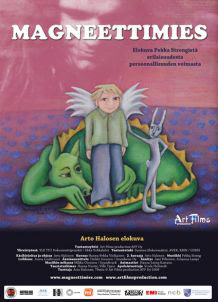 |
| Arto Halonen: Magneettimies / The Magnetic Man (FI 2009). |
A portrait documentary on the singer-songwriter Pekka Streng (1948-1975).
FI © 2009 Art Films. P+D+SC: Arto Halonen - based on the poems, letters, and writings of Pekka Streng. DP: Hannu-Pekka Vitikainen. AN: Hanna-Leena Kartano. S: Heikki Innanen. ED: Joona Louhivuori. Documentary film, colour, widescreen, 79 min
Pekka Streng (lyrics and composition): "Gilgameš", "Kaukana", "Auringon lapsi", "Olen eläin", "Makea Sandra", "Pitkä kieli", "Takaisin virtaan", "Puutarhassa", "Kylmä kaupunki", "Pelle", "Sammakko Sim", "Sinua ikävöin", "Luumupuupoika", "Kanttorinpoika Max", "Keijut", "Sisältäni portin löysin", "Olen erilainen", "Matkalaulu", "Olet onnellinen", "Roope hattu", "Emmauslaulu", "Ahnehtiva Kud", "Katsele yössä", "Muumipeikon tassuttelu".
"Perhonen" (comp. Pekka Streng, lyrics from a Czech children's poem, Finnish translator Eeva-Liisa Manner), "Suruperhonen" (comp. Pekka Streng, lyrics Arja Kanerva), "Mutta minä lähden" (comp. Pekka Streng, lyrics Semjon Kirsanov, Finnish translator Markku Lahtela), "Sinä aamuna" (comp. Pekka Streng, lyrics Arja Kanerva).
"Puutarhassa" perf. Emma Salokoski & Olympia-Orkesteri.
"Sisältäni portin löysin" perf. Vesa-Matti Loiri; Eero Raittinen; Ritva Oksanen & Pedro Hietanen; Outi Popp, Paavo Kerosuo & Jiri Kuronen; Lasse Aitokari, Sami Lamppu & Pilvi Hämäläinen.
"Katsele yössä" perf. Olavi Uusivirta, Jarkko Martikainen, Kärtsy Hatakka, Pauli Hanhiniemi, Emma Salokoski.
Olavi Uusivirta (the voice of Pekka Streng).
Featuring: Matti Streng (father), Sonja Lehto (sister, album cover artist), Juuso Salokoski (cousin), Lasse Streng (brother), Jori Sivonen (friend, composer), Vilho Sääksjärvi (friend, photographer), Sinikka Haapanen (friend), Jukka Lindfors (webmaster of www.pekkastreng.com), Emma Salokoski (artist, Juuso Salokoski's daughter), Irmeli Isomäki (friend), Keijo Siekkinen (friend, writer), Joonia Streng (son), Juha Hurme (director, screenwriter and writer inspired by Pekka Streng), Calle Lindholm (colleague, artist), Jukka Hakoköngäs (producer of the posthumous Pekka Streng album), Jonna Tervomaa, Atte Blom (co-founder of Love Records), Tapio Korjus (impresario, conducted the only Pekka Streng interview), Vesa-Matti Loiri, Kaarina Valoaalto (writer, friend), Nanna Varrio (schoolgirl, a Pekka Streng aficionado), Timo Kämäräinen, Mikko Oinonen, Jukka Perko, Jasse Hast, Arto Halonen.
Screener dvd from Pirkanmaan Elokuvakeskus viewed at home, Helsinki, 9 Jan 2010.
I missed the theatrical screenings of this deeply felt documentary film by Arto Halonen on Pekka Streng (1948-1975, died young of cancer), talented Finnish artist of progressive rock, who published only two albums, Magneettimiehen kuolema [The Death of the Magnetic Man] (1970), with the band Tasavallan Presidentti, and Kesämaa [Summerland] (1972), with Olli Ahvenlahti and Hasse Walli among others. In 2009, the posthumous album Unen maa [Dreamland] was produced based on demo tape recordings with Olympia-Orkesteri.
Inspired by Pekka Streng's lyrics and music, the documentary is built on reminiscences of his family and friends. Arto Halonen has a sensitive touch, and he has managed to create a confidential atmosphere in his interviews.
I'm not a Pekka Streng connoisseur, but I have always respected his songs such as "Sisältäni portin löysin" [I Found a Gate Within].
The film succeeds in the essential: the spiritual dimension.
http://www.magneettimies.com/english
Thursday, January 07, 2010
Täynnä Tarmoa
[Full av Iver] / [Full of Vigour]. FI (c) 2008 Tuotantoyhtiö Kuvaputki Oy. P+D+SC: Oskari Pastila. DP: Jarmo Tahvanainen, Janke Öhman. Colour definition: Juha Laine (Generator Post). Graphic design: Eevaliina Rusanen, Miikka Poutiainen. M: Shinge Joonas Shigeki Tamura. S: Kimmo Vänttinen. ED: Jukka Nykänen. A documentary film. LOC: Porvoo. Featuring: The Porvoon Tarmo basketball team and its foreign guest players, coaches, guardians, and fans. 72 min. Print: Bio Rex Distribution, English dialogue sections with Finnish subtitles, viewed at Cinema Orion, 7 Jan 2010.
The title is a wordplay. "Tarmo" is the name of the team, and the word means "vigour". "Täynnä Tarmoa" means both "full of vigour" and "fed up with Tarmo".
Elias Anhela, our doorman, commented that this film is the Spinal Tap of basketball. But, incredibly, this is an actual documentary film. It is an amazing account of gross incompetence in basketball management. Bafflingly, the people featuring in this film have apparently given their consent to film the most embarrassing moments... the new manager is a walking definition of dishonesty... he lacks elementary budgetary skills... the manager and the new coach are not on speaking terms... they read about each other's essential decisions from the newspaper... but they slander each other... black athletes from Africa and America are grossly exploited... nobody is responsible for their budget... their lodgings are uninhabitable, or the rental agreement has been terminated... the squirming sponsors want to cut their participation... beautiful female basketball fans waste little time in checking out new athletes... fiscal fraud is chronical... cooked account books are exposed...
One of the documentary films that prove that truth is stranger than fiction.
In 2006-2007 the quota restricting foreign players in Finnish basketball was abolished. Porvoon Tarmo doubled its budget and hired a new manager and a new coach.
The new manager also commissioned Oskari Pastila's team to produce a reality tv series about the team. The series never happened, and maybe this film is the vengeance of Pastila's team.
The film is not a real sports documentary, and it neglects to tell that Porvoon Tarmo, which had so far been a minor team, actually succeeded well despite all this.
Wednesday, January 06, 2010
Lotat / Women in War
 |
| Taru Mäkelä: Lotat / Women in War (FI 1995). |
D: Taru Mäkelä. SC: Taru Mäkelä, Irma Taina. DP: Jouko Seppälä - colour - 1,66:1 - shot on 16 mm - printed on 35 mm. M: Pekka Sirén. S: Ulla Turunen. ED: Irma Taina.
Featuring: Aino Meriläinen, Aini Kaprio, Laina Ojaniemi-Hakala, Martta Arffman, Eeva Tapio.
50 min.
The Kinotar 35 mm print was temporarily missing, and we had to screen a Digibeta without subtitles. Finnish Film Archive, Orion, Helsinki, 6 Jan 2010.
The final film of our tribute to Lotta Svärd, the Finnish voluntary auxiliary paramilitary organization for women (1918-1944). Lotta Svärd and other women's organizations were indispensable in saving Finland in the hell of WWII.
The five interviews with Aino Meriläinen (catering lotta), Aini Kaprio (air defense lotta), Laina Ojaniemi-Hakala (signal corps lotta), Martta Arffman (medical lotta), and Eeva Tapio (young lotta) cover a lot of ground. There is room to get profound, to the hard and terrible experiences.
Aino Meriläinen transported a field kitchen between the lines on the front, and the stunned enemy ceased fire. Aini Kaprio tells she was too young to be afraid, but a woman changes after childbirth.
Laina Ojaniemi-Hakala reports that sometimes the lottas had to beware of their own soldiers, who threatened with violence having gotten drunk. She also tells that there was an initial shock at the start of the actual front duty, a hardening and brutalization even for the lottas.
Martta Arffman conveys unforgettably the task of facing the huge piles of corpses which needed to be washed, identified, and shipped home. Corpses with limbs missing, faces blown away. Reason ceased to function, but one has to get used to anything.
Eeva Tapio was a young lotta, only 13 years. The age limit for actual lottas was 16 years, but she was accepted to the emergency room, as her father was a doctor. She fainted immediately, and soon again at an amputation, but she decided to stay. Among the tasks of the lottas was to write soldiers' letters by dictation. There was little lament in those letters.
It all unwound first when it was over. There were many nightmares, even much later. But one rather smiled. It was the end of childhood.
The artistic level of this documentary film is high. The decision to focus on these five women is well-considered. There is enough time for depth. The faces come alive in the cinematography.
Suomenlahden sisaret
FI 2009. Imbi Paju's new groundbreaking documentary film Suomenlahden sisaret was first screened in the opening seminar of our Lotta Svärd series curated by Tiina Suutala, and in the final show of the series, on the Holiday of Epiphany, it was screened again to an appreciative audience. Memorable interviews with Elisabeth Rehn, Kyllikki Villa, Hanna Eckert, Greta Kupiainen, Ulla-Marita Rajakaltio, Helvi Hödejärv, Laila Auer, and Helmi Visnapuu.
Digibeta from Film Magica with Finnish subtitles, 55 min, at Cinema Orion, Helsinki, 6 Jan 2010.
Digibeta from Film Magica with Finnish subtitles, 55 min, at Cinema Orion, Helsinki, 6 Jan 2010.
Saturday, January 02, 2010
Catarina Ryöppy: Time – Borders (exhibition)
 |
| Catarina Ryöppy: Time Unknown. |
Exhibition at the Amos Anderson Art Museum, 13.11.2009–4.1.2010. Viewed 2 Jan 2010.
From the official presentation: "Catarina Ryöppy layers moving images and still photos with objects creating singular settings and moods. Mysterious scenes materialize as the past intertwines with the present. Her works examine concepts such as longing, marginalization and transience, and form poetic entities that elude fixed readings."
"The exhibition comprises four installations. The latest piece Time – Borders, photographed and shot in Alaska, takes borders as its theme. Borders – tangible or conceptual – are endemic to human existence. By building unyielding barriers we often create antagonism; someone or something is excluded. But a life without boundaries falls on its own absurdity. "In Time – Borders... birds specifically symbolize freedom and independence. Their flight through blue eternity seems to be unrestricted. Yet they congregate to form large flocks, in which individuality disappears and merges with others. Apparent freedom ultimately proves to be a prelude to unity based on diversity. This is also the case in human existence. Differences to the contrary, other people are a necessary part of meaningful life", writes art critic Leena Kuumola in the accompanying publication."
"Catarina Ryöppy (b. 1939) lives and works in Helsinki. She studied at Ecole des Beaux-Arts (1957–1961) in Lausanne, Switzerland, and debuted in 1960 at the Young Artists' Exhibition, Helsinki as well as at the Salon des Jeunes, Lausanne. Her works are represented in Finnish collections such as Helsinki City Art Museum, Museum for Contemporary Art Kiasma, Amos Anderson Art Museum, and international collections such as Ecole Cantonale des Beaux-Arts, Lausanne and the Pablo Neruda collection, Prague."
A meditative experience, my first encounter with Catarina Ryöppy. The exhibition was accompanied by a fine book with an essay by Marja-Terttu Kivirinta: "Humanity That Breathes Through Pictures. Disappeared, Lost, Or Otherwise Absent".
Friday, January 01, 2010
Rachel, Rachel
 |
| Paul Newman: Rachel, Rachel (US 1968) starring Joanne Woodward (Rachel Cameron). |
Rachel, Rachel – haluan rakastaa / Rachel, Rachel – jag vill älska.
US © 1968 Kayos Productions.
P+D: Paul Newman. SC: Stewart Stern – based on the novel A Jest of God (CA 1966) by Margaret Laurence. DP: Gayne Rescher – Technicolor – 1,85:1. AD: Robert Gundlach. COST: Domingo A. Rodriguez. Make-up: Robert Phillipe. Hair: Colleen Callaghan. M: Jerome Morosss. S: Alan Heim. ED: Dede Allen. LOC: Bethel, Connecticut.
CAST: Joanne Woodward (Rachel Cameron), James Olson (Nick Kazlik), Kate Harrington (mother Cameron), Estelle Parsons (Calla Mackie), Donald Moffat (Niall Cameron), Terry Kiser (preacher), Frank Corsaro (Hector Jonas).
101 min.
Released by Warner Bros. with Finnish / Swedish subtitles.
Viewed at Cinema Orion (Paul Newman in memoriam), Helsinki, 1 Jan 2010.
A heavily used vintage print, complete, with colour (real Technicolor?) intact.
The story of an adult woman's awakening, growing up. Ein Bildungsroman.
I saw for the first time Paul Newman's first film as a director; he directed six. Rachel, Rachel is completely different from the mainstream films in which Newman starred. It is un-melodramatic, intimate, psychological, sensitive, non-commercial. Constantly through the film there are childhood memories, dreams, and visions.
In a little country town the 35-year-old Rachel is a teacher at an elementary school. Although a teacher, she is also herself still partially stuck in the world of childhood.
During the summer vacation, her colleague Calla invites Rachel to a revival house, a tabernacle, where the preacher teaches that we are all alone, cut off, and we all need love. Against her will, the shocked Rachel is invited to the circle of believers who hold hands, hug each other, and declare that they need love.
The next shock is Calla's quick revelation of her lesbian affection. This is directly but discreetly handled. The women soon arrive at reconciliation after Rachel's rejection.
The third shock comes in the form of a direct pick-up invitation of a male teacher colleague from the city, Nick, who has come to spend a part of his holiday in the country. Nick and Rachel are childhood friends, and they have not seen each other in a very long time. Nick invites Rachel to the movies, to a bar, and to a night of lovemaking.
Rachel turns out to be a virgin. Nick treats her with respect, although she is clumsy during the first night of love-making. "It's never so good the first time". The next time is beautiful. But Nick leaves the town without saying good-bye.
Rachel thinks she is pregnant and goes to the doctor's, but instead she has a harmless cyst. This is the definitive shock, as Rachel had already decided to keep the baby.
In the conclusion Rachel decides to move to Oregon. Her mother is devastated but joins her. During the closing credits we see Rachel with a little child on a seashore.
Memorable in the film:
1. Joanne Woodward's performance as the grown-up woman who experiences a complete change in her life.
2. Estelle Parsons as Calla. Lesbianism is treated sincerely. Rachel congratulates Calla for "pushing things out of their cages". Rachel's final words to Calla: "I hope you'll find what you want".
3. The revival house sequence is powerful. The tremendous force of religion is evident.
4. Rachel's initiation to love-making is beautifully depicted in two very different sequences.
5. As a teacher, Rachel has been taking care of "temporary children"... "but so are everyone's".
6. The music by Jerome Moross is sensitive in the same way as Elmer Bernstein's for To Kill a Mockingbird.
7. The editing by Dede Allen.
Subscribe to:
Posts (Atom)
