Thursday, September 17, 2009

Noidan kirot / Curses of the Witch (1995 Centenary of the Cinema restoration)


Teuvo Puro: Noidan kirot / Curses of the Witch (FI 1927). Hannes Närhi (the evil spirit of Jantukka, witch doctor from Lapland).

Trolldomens förbannelse / [Curses of the Witch]. FI 1927. PC: Suomi-Filmi. P: Erkki Karu. D+SC: Teuvo Puro - based on the novel by Väinö Kataja (1914). DP: Frans Ekebom. AD: Carl Fager. CAST: Einar Rinne (Simo of Utuniemi), Heidi Blåfield-Korhonen (Selma, Simo's wife), Irmeli Viherjuuri (Aaprami of Utuniemi), Kaisa Leppänen (Elsa, Simo's blind sister), Hemmo Kallio (Esa of Rantamaula, Selma's father), Olga Leino (mistress of Rantamaula, Selma's mother), Nisse Karlsson (Aapo of Rantamaula, Selma's brother), Yrjö Tuominen (Sakari Kippari, "Fat Sakari", a lumber boss), Hannes Närhi (Jantukka, a witchdoctor from Lapland). 
2070 m /24 fps/ 71 min
A Centenary of the Cinema tinted and toned jubileum print. 
Viewed at Finnish Film Archive, Orion, Helsinki, Kino Metsä [Kino Forest] 16 Sep 2009.

Our speed was too fast; 20 fps would have been more appropriate. The colour was too heavy, taking away the luminosity from the image.

Revisited a stolid Finnish mainstream studio film of the late silent era.

The film is at best mediocre. No sense of cinematic expression, just clumsy shots one after the other. No suspense, no psychology, no cinematic direction of actors. I would not include this in an account of Finnish horror cinema.

The best moment is towards the end: the reconciliation.

A typical example of the boring mainstream cinema against which the young Valentin Vaala and Teuvo Tulio rebelled. The Suomi-Filmi studio was completely out of touch withthe international development of cinema.

My blog notes on Noidan kirot:
16 Sep 2009  SEA Kino Metsä, Orion
27 Oct 2010 Film concert Noidan kirot (comp. Tapio Tuomela, cond. Jan Söderblom, Radio Symphony Orchestra, Finlandia Hall)

Suomen metsät VII

[Finlands skogar VII] / [The Forests of Finland VII]. FI 1933. PC: Aho & Soldan. Silent. 10 min. Digibeta, alas. Viewed at Cinema Orion, Helsinki, 16 Sep 2009. - In the presence of Jussi Brofeldt. - The intertitles have a literary value. Timber floating. The birch stocks form a jam. Lunch break of the lumberjacks. The stocks are rolled down the hill into the river. A pipe is built for the stocks. Beams. Bundles. Shadow of the cinematographer. Sunset.

Wednesday, September 16, 2009

The Go-Between

Sanansaattaja / Budbäraren. GB © 1971 EMI. D: Joseph Losey. SC: Harold Pinter - based on the novel by L.P. Hartley (1953). DP: Gerry Fisher - Technicolor. M: Michel Legrand. LOC: Norfolk. CAST: Julie Christie (Marian Maudsley / Lady Trimingham), Alan Bates (Ted Burgess), Margaret Leighton (Mrs. Maudsley), Michael Redgrave (Leo Colston - adult), Dominic Guard (Leo Colston - boy), Michael Gough (Mr. Maudsley), Edward Fox (Viscount Hugh Trimingham). 116 min. A vintage print with Finnish / Swedish subtitles by Lea Joutseno / Börje Idman. Viewed at Cinema Orion, Helsinki, 15 Sep 2009.

A worn vintage print with colour fading, yet still passable. - Joseph Losey at his best: my two favourite Losey films are King and Country and The Go-Between. - This belongs to the rare cases where a great film is based on a great novel. With the novel in fresh memory, it was a pleasure to notice the inevitable differences. The novel is based on the adult Leo's memory of his boyhood impressions half a century ago. - In the film, such a subjectivity would not be possible. One of the differences is that we realize from the looks of Mr. and Mrs. Maudsley that they realize what is going on between Marian and Ted. Probably also Hugh Trimingham is aware, but he is not easily offended. - In this film, Losey puts aside his 1960s experiments, and just proceeds as a profound cinematic storyteller, with a sure sense of the mise-en-scène. The film is both refined and powerful. The milieux, the performances, the music, all work perfectly. - There are two main victims of the web of deceit: Ted who commits suicide, and the young and innocent Leo, who will never recover.

The Salvation Hunters


Josef von Sternberg: The Salvation Hunters (US 1925) starring Georgia Hale and George K. Arthur.


US © 1925 Academy Photoplays. Original distributor: United Artists. Financier: George K. Arthur. P+D+SC+story+AD+ED: Josef von Sternberg. DP: Edward Gheller. Assistants: George Ruric, Robert Chapman.
    LOC: San Pedro (California).
    CAST: George K. Arthur (boy), Georgia Hale (girl), Bruce Guerin (child), Otto Matiesen (man), Nellie Bly Baker (woman), Olaf Hytten (brute), Stuart Holmes (gentleman).
    5930 ft / 1807 m /20 fps/ 79 min.
    A Fondazione Cineteca Italiana (Milano) print from MoMA.
    Viewed at Cinema Orion, Helsinki, 15 Sep 2009.

A passable dupe print with signs of wear and tear and occasional signs of nitrate decomposion in the source. - Revisited: Josef von Sternberg's poetic and boldly original first feature film, "dedicated to the derelicts of the earth". - "They have conquered a mighty battle over themselves".

Tuesday, September 15, 2009

Indians on the American Screen (lecture)


Maurice Tourneur & Clarence Brown: The Last of the Mohicans (1920). Please click to enlarge the image.

Opening of our Autumn Season in Cinema Niagara, Tampere, 14 Sep 2009. I gave an introduction for the retrospective on Indians in American Cinema, connected with the exhibition The Life and Times of Sitting Bull in the Vapriikki Museum in Tampere. http://www.vapriikki.net/sittingbull/

I was grateful for the invitation, as it gave me the impetus to read a wonderful book:

Angela Aleiss: Making the White Man's Indian: Native Americans and Hollywood Movies. Westport, Connecticut: Praeger Publishers, 2005.

She detects a strange regularity in key Indian Westerns: Broken Arrow (1950), Little Big Man (1970), Dances With Wolves (1990). One might expect the next key Indian Western to be released in 2010!

- In popular fiction, there has always been a duality regarding Native Americans: the wild barbarians, and the noble savages

- This duality has also been characteristic to the movies. There have been cycles of noble Indians and savage monsters

- The main general trend has, however, been towards more balanced and positive images

- In Finnish we may speak of "intiaanit", whereas in the U.S. Native Americans is the correct term

- Indians belong to the original subject-matter of the cinema. Already in 1894, Edison filmed The Sioux Ghost Dance and other performances from Buffalo Bill's Wild West circus

- At that time, James Fenimore Cooper's noble Indian characters were well-known, already also in Finland

- historical figures like Hiawatha and Pocahontas were a part of popular imagination, and Helen Hunt Jackson's novel character Ramona, as well - they were all often adapted in and referred to in films

- in the cinema, Indians most typically appear in Wild West stories, the most popular era being the ca 35 years from after the Civil War to the end of the 19th century

- films made about modern Indians have not been successful

- there have always been real Indians in the movies, but usually the performers have been non-Indians. Anthony Quinn had some Indian heritage

- Remarkably, there have always been high profile fake Indians in the movies, and it seems that real Indians have tacitly supported them

- My question here is about the prohibition of the image in the Indian culture. Taking one's picture takes one's soul. Might it be that true-believing Indians actually prefer fake performers to take their place in the movies?

- Will Rogers (largely a Cherokee) and Wes Studi have had the liberty to portray non-Indians

- The Chickasaw Edwin Carewe directed over 60 films

- A recurrent theme is the love between the Indian and the Caucasian. That theme was not banned by the Production Code, like the love between the Black and the Caucasian

- The children of the Indians and the Caucasians, formerly called "half-blood" (!) have always been portrayed with sympathy in movies like The Broken Lance (Robert Wagner), The Searchers (Jeffrey Hunter), and Flaming Star (Elvis Presley)

- Positive Indian figures have always been typical to A Westerns, negative figures to B westerns (stock characters in run-of-the-mill films)

- In early cinema Indians were portrayed with sympathy, as victims of the greed and cruelty of the whites

- D.W. Griffith directed 30 Indian films, 22 of which were positive to the Indians, and in the others, too, Indians were usually provoked by the crimes of the Whites

- Thomas H. Ince hired an Oglala Sioux tribe and produced 80 Indian Westerns

- Also Buffalo Bill produced films such as The Indian Wars

- Cecil B. De Mille's first film The Squaw Man was a milestone in film history, a foundation of Hollywood, and Paramount

- James Fenimore Cooper's work was often filmed, most notably by Maurice Tourneur (The Last of the Mohicans)

- The Covered Wagon (1923) revived the evil Indian, the obstacle for the Manifest Destiny

- but the pro-Indian Zane Grey wrote The Vanishing American (1925) for the screen, although his condemnation of the wrongdoings of the white man were toned down

- In The Big Trail (1930) John Wayne declared that Indians are his friends

- the romance of the lost paradise (of the South Seas, Alaska... ) was popular in the movies of the 1920s and the 1930s, and that reflected also on the image of the Indian

- Warner Bros. and Massacre (1933) with Richard Barthelmesss

- The Plainsman revived the cliched cowboy and Indian dichotomy, and Stagecoach did it again. The savagery of the Indians was stressed in the 1930s

- but Darryl F. Zanuck at 20th Century Fox produced the pro-Indian Shirley Temple movie Susannah of the Mounties

- at Warner in They Died With Their Boots On history was fantastically re-written to portray General Custer as the Indian's best friend

- in Fox's Buffalo Bill, Buffalo Bill, as well: "they are all friends of mine"

- Delmer Daves became one of the most important film-makers to depict Indians: Broken Arrow, Drum Beat

- since the 1950s several pro-Indian A movies were produced: Apache, Jim Thorpe All American, The Story of Will Rogers, The Searchers, Broken Lance, Devil's Doorway, Run of the Arrow, Two Rode Together, Cheyenne

- in New Hollywood the anti-Western emerged: Little Big Man, Soldier Blue, Tell Them Willie Boy Is Here

- the survival films: Ulzana's Raid, A Man Called Horse, Jeremiah Johnson

- the revival of the Western: Dances With Wolves, The Last of the Mohicans, Geronimo, Pocahontas

- the modern Indian: Thunderheart

Keywords: Native American in the cinema. Native Americans in the cinema. Indians in film. Indians in the cinema. 

Monday, September 14, 2009

Tokyo senso sengo hiwa / The Man Who Left His Will On Film


Nagisa Oshima: 東京戦争戦後秘話 / Tokyo senso sengo hiwa / The Man Who Left His Will On Film (JP 1970).

東京戦争戦後秘話 / Tokyo senso sengo hiwa: Eiga de ishi o nokoshite shineda – otoko no monogatari / He Died After the War / A Secret Post-Tokyo War Story / [Mies, joka teki testamenttinsa filmille] / [Mannen som upprättade sitt testamente på film]. JP 1970. PC: Sozosha-ATG. EX: Takuji Yamaguchi. D: Nagisa Oshima. SC: Masataka Hara ja Mamoru Sasaki – based on a story by Nagisa Oshima and Tsutomu Tamura. DP: Toichiro Narushima – shot on 16 mm and 35 mm – print 35 mm – b&w. AD: Jusho Toda. M: Toru Takemitsu. ED: Keiichi Uraoka. CAST: Kazuo Goto (Motoki Shoichi, student), Emiko Iwasaki (Yasuko, Shoichi's girlfriend). Members of the POSIPOSI, a film society of young radicals: Sugio Fukyama (Yazawa), Tomoyo Oshima (Akiko), Kenichi Fukuda (Matsumura), Hiroshi Isogai (Sakamoto), Kazuo Hashimoto (Takagi), Kazuya Horikoshi (Endo). 94 min. Print: New Yorker Films (New York), English subtitles. Viewed at Cinema Orion, Helsinki, 13 Sep 2009. - A good definition of light in a print that has signs of wear and tear, but not too much. - Anti-film, metafilm, a film that questions itself and student radicalism. The story of an impasse. - Ironic, witty, philosophical. - The cinematography is remarkable. The sense of landscape and urban living is on the level of Antonioni, but brilliantly original. Many shots can be appreciated as independent photographs. - The man who left his will on film mostly shot cityscapes. He maybe never existed, and at least there is a vicious circle of young men who leave their wills on film, as the story starts again in the end. - Disturbing: the theme of sexual violence. The young men seem to enjoy taking their girls violently, and the girls seem to enjoy it. - I have now seen all Nagisa Oshima's cinema films, and I can confirm that they are all different: each has a different way of storytelling, a different cinematography, and different music and sound solutions. - In Godard, the parallel would be Weekend.

Sunday, September 13, 2009

Kagi (Junichiro Tanizaki evening: reading and film)

Kagi – outo ahdistus / Lidelsernas hus / Odd Obsession. JP 1959. PC: Daiei (Kyoto). EX: Hiroako Fujii. P: Masaichi Nagata. D: Kon Ichikawa. SC: Keiji Hasebe, Kon Ichikawa, Natto Wada – based on the novel by Junichiro Tanizaki (1956, Finnish translation Avain 1961 Tuomas Anhava / Tammi, based on the English translation by Howard Hibbett, The Key). DP: Kazuo Miyagawa – Daieicolor – Daieiscope 2,35:1. M: Yasushi Akutagawa. S: Kenichi Nishii. ED: Hiroaki Fujii, Kon Ichikawa, Tatsuji Nakashizu. CAST: Ganjiro Nakamura (Kenji Kenmochi), Machiko Kyo (Ikuko Kenmochi), Tatsuya Nakadai (Dr. Kimura), Junko Kano (Toshiko Kenmochi), Tanie Kitabayashi (Hana, maid), Ichiro Sugai (Ichizuka, masseur), Jun Hamamura (Dr. Soma), Mantaro Ushio (Dr. Kodama), Kyu Sazanka (antique dealer), Mayumi Kurata (Ms. Koike, nurse), Saburi Date (1. policeman), Hikaru Hoshi (2. policeman), Shizuo Nakajo (3. policeman). 107 min. A Japan Foundation print with English subtitles. Viewed at Cinema Orion, Helsinki, 12 Sep 2009. - Preceded by a Junichiro Tanizaki reading by the actors, Mr. Jussi Lehtonen, and Ms. Hanna Ojala. - A print with pleasantly authentic-looking colour. - I saw this film for the first time and was impressed by the black humour of it. I had read Tanizaki's novel as a teenager and did not like it then or maybe missed the point.Watching the film I realized that the sexual material is not the focus. It is about virility, but in a much wider sense. - Ichikawa has a fine touch in this story, and Kazuo Miyagawa's brilliant cinematography and Yasushi Akutagawa's music contribute to it in en exciting way.

Saturday, September 12, 2009

Keltainen kirjasto (The Yellow Library) and Cinema: a 55th Anniversary Seminar


Jean-Luc Godard: Le Mépris (1963) with Brigitte Bardot at Villa Malaparte on the Isle of Capri. Based on the novel Il disprezzo (1954) by Alberto Moravia. Keltainen kirjasto n:o 10: Keskipäivän aave, translated by Kai Vuosalmi (1956).

Hannu Harju, Hannu K. Riikonen, Laura Lindstedt, Jarl Hellemann, Antti Alanen at Cinema Orion, 12 Sep 2009. Photo: Laila Alanen.

Keltainen kirjasto (The Yellow Library) is the most important book series dedicated to modern quality literature in Finland. The legendary series has been the publisher of many Nobel Prize winners, usually before they became ones.

Organized by Kronoptikon (Martti-Tapio Kuuskoski, Laura Lindstedt), the publishing house Tammi, and KAVA, in Cinema Orion, 12 Sep 2009.

Guest of honour: Mr. Jarl Hellemann, founder of the Keltainen kirjasto.

Martti-Tapio Kuuskoski: Stretching the Limits of Film Adaptation (John Steinbeck: Of Mice and Men, James Joyce: Ulysses, Franz Kafka: Amerika).

Jarl Hellemann: Stages in the Development of Keltainen kirjasto.

Antti Alanen: Film Adaptations of the Keltainen kirjasto (focus on To Have and Have Not, Breakfast at Tiffany's, James Joyce, Bertolt Brecht, Morte a Venezia, The Go-Between, Aleksandr Solzhenitsyn, Jhumpa Lahiri, and José Saramago).

Sampsa Laurinen: The Sanctity of Desecration, or the fate of Alberto Moravia's ghost in Jean-Luc Godard's Le Mépris.

Hannu K. Riikonen: James Joyce's Dubliners and John Huston's The Dead.

Miika Pölkki and Lauri Kitsnik: Tanizaki's keys and Ichikawa's openings.

The Dead (James Joyce evening: reading and film)


John Huston: The Dead (US/GB 1987).

Muistot / De döda. US/GB 1987. D: John Huston. SC: Tony Huston - based on last short story in Dubliners (1914) by James Joyce. CAST: Anjelica Huston, Donal McCann. A vintage print with Finnish / Swedish subtitles. Viewed at Cinema Orion, 11 Sep 2009. - Introduced by the actor, Mr. Seppo Pääkkönen reading James Joyce (25 min). - Revisited the beginning of John Huston's last film, to many his masterpiece, preceded by a reading of the original text. - James Joyce is a central force in the film age, although this movie is probably the only masterful cinema adaptation of his work.

Taking Woodstock


Ang Lee: Taking Woodstock (US 2009).

Taking Woodstock / Taking Woodstock. 
    US © 2009 Focus Features. P: Ang Lee, James Schamus. 
    D: Ang Lee. SC: James Schamus - based on the book Taking Woodstock: A True Story of a Riot, a Concert, and a Life (2007) by Elliot Tiber and Tom Monte. DP: Eric Gautier - Arricam Cameras, Zeiss and Angenieux Lenses - Super 35 (3-perf) - DeLuxe - digital intermediate 2K - print 35mm 1,85:1. M: Danny Elfman + a great compilation score. 
    CAST: Demetri Martin (Elliot Tiber), Imelda Staunton (Sonia Teichberg), Henry Goodman (Jack Teichberg), Liev Schreiber (Vilma), Jonathan Groff (Michael Lang), Emile Hirsch (Billy, a recently returned Vietnam vet), Paul Dano and Kelli Garner (a hippie couple in a VW), Jeffrey Dean Morgan (Dan, Billy's brother and in opposition to the festival), Eugene Levy (Max Yasgur). 
    110 min
    A FS Film release with Finnish / Swedish subtitles by Taina Komu / Ditte Kronström. 
    Viewed at Tennispalatsi 14, 11 Sep 2009 (Finnish premiere).

A cheap digital look.

A satirical account on the mounting of the Woodstock Festival. Based on a book, whose factual validity has been contested, but it does not matter, at least it is good fiction.

I'm aware that this film has been rated as minor Ang Lee, but to me this is Ang Lee at his best. I'm a fan of his first trilogy (Pushing Hands, The Wedding Banquet, Eat Drink Man Woman), and this film has a similar humoristic approach.

From a small angle it lets us have a look at a big story: the biggest concert ever, with world historical gravity. It's about world politics, about the generation gap, about sexual orientation, about drug delusion, about finding oneself, about disorientation, about freedom. I look forward to revisiting this.

Visually shoddy, yet with a pleasant and elaborate homage to Michael Wadleigh's great documentary, complete with split screen sequences.

The music score is an enjoyable compilation of vintage tracks, new reconstructions, and original Danny Elfman compositions.

Friday, September 11, 2009

Postia pappi Jaakobille / Letters to Father Jacob


Post till pastor Jakob.
    FI 2009. PC: Kinotar / YLE. P: Lasse Saarinen, Risto Salomaa.
    D+SC: Klaus Härö – based on the original idea and script by Jaana Makkonen. DP: Tuomo Hutri. Digital intermediate by Generator Post. AD: Kaisa Mäkinen. COST: Sari Suominen. Makeup: Pia Mikkonen. ED: Samu Heikkilä.
    CAST: Kaarina Hazard (Leila), Heikki Nousiainen (Father Jacob), Jukka Keinonen (postman), Esko Roine (the prison warden).
    75 min.
    A Nordisk release without subtitles.
    Viewed at Tennispalatsi 10, Helsinki, 11 Sep 2009.

Jacob listens to classical music: "Quartet in F Minor", Composed by Joseph Haydn, Performed by Hart House String Quartet. – "Angel's serenade", Composed by Gaetano Braga, Performed by Venetian Instrumental Trio. – "Nocturne in E flat", Composed by Frédéric Chopin, Performed by Kathleen Parlow. – "Ouvre à l'amour", Performed by Pierre A. Asselin. – "Minuet in G, no. 2", Composed by Ludwig van Beethoven, Performed by Kathleen Parlow. – "Barcarolle"
Composed by Jacques Offenbach.

Letters to Father Jacob, planned as a television movie, was released theatrically, and grew into the most highly appreciated Finnish film of the year.

I saw it five months after the premiere, and there was still a good turnout at the cinema. The atmosphere was focused and devoted.

The film is about the encounter of an asocial ex-convict, Leila (Kaarina Hazard), and the blind ex-priest Jacob (Heikki Nousiainen), who conducts an immense correspondence. Leila's job is to help Jacob.

The story is fresh and constantly surprising. Essential revelations take place at the end of the film.

This story of the priest can be compared with The Priest from Uddarbo (consult: Ingmar Bergman), Franciscus giullare di Dio, and Journal d'un curé de campagne, but it is totally original.

Letters to Father Jacob is one of the great religious films.

Tuesday, September 08, 2009

The Go-Between (novel)

L.P. Hartley: Sananviejä (The Go-Between). GB 1953. Translated by J.A. Hollo / Tammi / Keltainen kirjasto, Helsinki 1955.

"The past is a foreign country: they do things differently there." This is one of the great opening sentences in world literature.

I read this novel for the first time in preparation for our tribute to Keltainen kirjasto (The Yellow Library), Finland's best series of modern quality fiction since 55 years.

The concept is very cinematic. The old man finds his boyhood diary from the year 1900 and relives the turbulent experiences of a special summer.

This is a Bildungsroman of boyhood observations that take place too early. This is also a social novel, constantly aware of the English class and rank system. From the boy's perspective it is the story of the love affair between Marian Maudsley (daughter of the wealthy Maudsley family) and Ted Burgess (the neighbour, the tenant farmer). They love each other, but Marian is destined to marry Viscount Hugh Trimingham, wounded in the Boer War, representing centuries of nobility. Money is destined to marry rank. There is also a strong sense of history in this novel, of the fatal impact of the wars that Britain had suffered.

But most of all, it's the story of the end of boyhood. It is very well written (I believe J.A. Hollo's translation pays justice to the original), in full command of the various layers of the story, and with a fine sense of poetic imagery. The belladonna has a special significance.

Ian McEwan's Atonement (I saw the film but haven't read the novel) seems to be inspired by The Go-Between.

Sunday, September 06, 2009

Inglourious Basterds (soundtrack cd)


© 2009 L. Driver Productions, inc. / Warner Bros. Records, Inc. – A Band Apart / Warner Bros. Records. – EX: Quentin Tarantino.
Along with The Limits of Control, one of the best compilation soundtracks of the year. Like the film, the soundtrack, too, is a meta-commentary of film history.

1. The Green Leaves Of Summer (Dimitri Tiomkin & Paul Francis Webster) pres. Nick Perito (1960), instrumental version of the main title song from The Alamo (1960)
2. The Verdict / Dopo la condanna (Ennio Morricone) pres. Ennio Morricone from La resa dei conti (1966)
3. White Lightning (Main Title) (Charles Bernstein) pres. Charles Bernstein (1973)
4. Slaughter (Billy Preston) pres. Billy Preston (1972)
5. The Surrender / La resa (Ennio Morricone) pres. Ennio Morricone from La resa dei conti (1966)
6. One Silver Dollar / Un dollaro bucato (Gianni Ferrio) pres. The Film Studio Orchestra (1967), from Un dollaro bucato (1965)
7. Davon geht die Welt nicht unter (Bruno Balz & Michael Jary) pres. Zarah Leander, from Die grosse Liebe (1942)
8. L'Homme dans le grand sombrero / The Man With The Big Sombrero (Phil Boutelje & Foster Carling) pres. Samantha Shelton and Michael Andrew, inspired by the original recording by June Havoc in Hi Diddle Diddle (1943)
9. Ich wollt, ich wär' ein Huhn (Hans-Fritz Beckmann & Peter Kreuder) pres. Lilian Harvey and Willy Fritsch, from Glückskinder (1936)
10. Main Theme from Dark of the Sun (Jacques Loussier) pres. Jacques Loussier, from The Mercenaries / Dark of the Sun (1968)
11. Cat People (Putting Out The Fire) (David Bowie & Giorgio Moroder) pres. David Bowie (1981), from Cat People (1982)
12. Tiger Tank (Lalo Schifrin) pres. Lalo Schifrin, from Kelly's Heroes (1970)
13. Un amico (Ennio Morricone) pres. Ennio Morricone, from Revolver (1973)
14. Rabbia e tarantella (Ennio Morricone) pres. Ennio Morricone, from Allonsanfan (1974)
***
Other Ennio Morricone selections in the motion picture itself: "L’incontro con la figlia" (from Il ritorno di Ringo, 1965), "Il mercenario (ripresa)" (from Il mercenario, 1968), "Algiers November 1, 1954" (with Gillo Pontecorvo; from La battaglia di Algeri, 1966), and "Mystic and Severe" (from Da uomo a uomo, 1967.

Coco Chanel & Igor Stravinsky

Coco Chanel & Igor Stravinsky / Coco Chanel & Igor Stravinsky. FR (c) 2009 Eurowide Film Production. D: Jan Kounen. SC: Chris Greenhalgh - adaptation: Carlo Boutiny, Jan Kounen - based on the book Coco & Igor (GB 2002) by Chris Greenhalgh. DP: David Ungaro - colour - scope 2,35:1. M: Igor Stravinsky. "Sacre du printemps" (1913 / 1947) perf. Berliner Philharmoniker, cond. Simon Rattle. "Symphonie d'instruments à vent" (1920 / 1947). "Sonate" (1924). "Les cinq doigts" (1921). "Cinq pièces faciles" (1917) int. by Christophe Bukudjian. "Glorification of the Chosen One". CAST: Mads Mikkelsen (Igor Stravinsky), Anna Mouglalis (Coco Chanel), Elena Morozova (Catherine Stravinsky), Grigori Manoukov (Sergeï Diaghilev), Anatole Taubman (Boy Capel), Marek Kossakowski (Nijinsky). 118 min. A Cinema Mondo release with Finnish / Swedish subtitles by Outi Kainulainen / Ditte Kronström. Viewed at Maxim 1, Helsinki, 5 Sep 2009 (Finnish premiere weekend). - A digital intermediate look obvious in the park footage. - The fact is that Coco Chanel was a mentor of Igor Stravinsky and accommodated his family after the Russian Revolution. This film is based on the rumour that they had also an affair which hade a life-long significance. They both died in 1971. - The film starts with an exciting reconstruction of the premiere of Sacre du printemps, one of the epochal events in the history of music. It includes an interesting account of Igor Stravinsky's creative process and his inspired pedagogical touch. The film portrays Stravinsky as a tender family man with a strong sense of responsibility who also enjoys an affair on the side. - The film portrays Coco Chanel as a tough designer, quality controller and taskmaster (can one say taskmistress?). A sequence is devoted to the development of the Chanel 5 perfume. - Jan Kounen has created a classy, traditional biopic on two unconventional, talented people. - Mads Mikkelsen is good as Stravinsky. From Anna Mouglalis one would expect more expressions as Chanel. - As for the music, the first notes of Sacre du printemps are repeated maybe too often. Stravinsky had a long, rich and creative life during six decades.

There has been a previous film called Chanel solitaire (GB/FR/US 1981) with Marie-France Pisier as Coco Chanel, Timothy Dalton as Boy Capel, and Rutger Hauer as Etienne de Balsan.

Coco Chanel's film credits include costumes for Jean Renoir's La Règle du jeu (1939).

When Marilyn Monroe was asked what she had on when the Golden Dreams photos were taken, she answered: "just the radio", and "Chanel 5".

Saturday, September 05, 2009

Skavabölen pojat / Last Cowboy Standing


Skavabölen pojat. On the sofa: Onni Tommila, Leea Klemola, Ilmari Järvenpää, Elina Knihtilä and Tommi Korpela.Behind: Martti Suosalo. Please click to enlarge the image.

Skavabölegrabbarna
    FI / DE © 2009 Juonifilmi / Nikovantastic. D: Zaida Bergroth. SC: Antti Raivio, Jan Forsström, Zaida Bergroth – based on the play by Antti Raivio (1991). DP: Anu Keränen. M: Alexander Hacke.
    CAST: Lauri Tilkanen (Rupert), Iiro Panula (Evert), Ilmari Järvenpää (Rupert as a child), Onni Tommila (Evert as a child), Leea Klemola (mother), Martti Suosalo (father), Sulevi Peltola (Magician Kinnunen), Elina Knihtilä (Anu), Tommi Korpela (Ossi), Henriikka Salo (Anneli), Eila Roine (aunt Hilppa), Saara Kotkaniemi (Maria), Kirsi Asikainen (Anja Sallinen), Annu Valonen (Farkku-Tamara), Tarja Kirjatankki (Rosenqvist), Hannu Kivioja (grandfather), Tuomas Turkka (Russian soldier). 126 min.
    A FS Film release with Swedish subtitles by Joanna Erkkilä.
    D-Cinema at Tennispalatsi 2, Helsinki, 5 Sep 2009 (premiere weekend).

Skavaböle = Hyrylä, the center of Tuusula, not far from Helsinki.

Antti Raivio is a well-known Finnish actor, director, playwright and co-founder of Q-Teatteri (The Q Theatre). His play Skavabölen pojat was an acclaimed production of Q-Teatteri in 1991.

Positive features in the film:
– a good cast
– Zaida Bergroth is an excellent director of children
– the subject is strong: the boys surviving a dysfunctional family
– the father (Martti Suosalo) succumbing to alcoholism, the mother (Leea Klemola) to psychosis and suicide.

The subject is depressive, and the general atmosphere is melancholy. There are uplifting passages, usually related to the media: Lasse Virén winning a gold medal in the Munich Olympics, Millie Small doing her ska hit "My Boy Lollipop", the boys dancing to "Sugar Baby Love" by Rubettes.

The main theme tune of the film by Alexander Hacke is an homage to Led Zeppelin's "Stairway To Heaven".

The presence of history is also depressing, symbolized by the skull of the Russian soldier. The grandfather (Hannu Kivioja) had been an army doctor.

There is little sense of inner drive and tempo in the movie. It is a bit static, and the characters seem so crushed by their circumstances that the viewer may get exasperated.

Laila had seen the Q-Teatteri production of Skavabölen pojat, which she found powerful, but in her opinion the subject had lost some of its force in the film adaptation.

A heavy digital look.

Inglourious Basterds

Kunniattomat paskiaiset / Ärelösa jävlar. US/DE (c) 2009 Visione Romantica. D+SC: Quentin Tarantino. DP: Robert Richardson - negative: 35 mm (Kodak Vision2 200T 5217, Vision3 500T 5219), anamorphic Panavision 2,35:1 - digital intermediate 2K. CAST: Brad Pitt (Lt. Aldo Raine), Mélanie Laurent (Shosanna Dreyfus), Christoph Waltz (Col. Hans Landa), Eli Roth (Sgt. Donny Donowitz), Michael Fassbender (Lt. Archie Hicox), Diane Kruger (Bridget von Hammersmark), Daniel Brühl (Pvt Fredrick Zoller), Til Schweiger (Sgt. Hugo Stiglitz), Gedeon Burkhard (Cpl. Wilhelm Wicki), Jacky Ido (Marcel), B.J. Novak (Pfc. Smithson Utivich), Omar Doom (Pfc. Omar Ulmer), August Diehl (Major Dieter Hellstrom), Denis Menochet (Perrier LaPadite), Sylvester Groth (Joseph Goebbels), Martin Wuttke (Adolf Hitler), Mike Myers (General Ed Fenech), Julie Dreyfus (Francesca Mondino). 156 min. Original in French, German, and English. Released in Finland by Finnkino, with Finnish / Swedish subtitles by Timo Porri / Janne Staffans. Viewed at Cinema Bristol, Helsinki, 4 Sep 2009 (Finnish premiere day). - Although the film is reportedly based on a 2K digital intermediate, the print had a pleasant photochemical look except in the forest scenes. - I love Quentin Tarantino, but I have been disappointed with his films since Pulp Fiction because of their regressive development. - To be redeemed: the great cast - the complexity of Daniel Brühl's character: the Wehrmacht has made him a killer, yet one can sense the human being struggling to emerge from the uniform - the smiling, polite Gestapo officer created by Christoph Waltz certainly belongs to the great villains of film history - Brad Pitt has developed a new and strong blackly humoristic charisma in his roles for the Coen Brothers and Tarantino; in these roles he is at his best - Mélanie Laurent is dignified as Shoshanna Dreyfus, brutalized by the Holocaust. - The fascinating thing is Tarantino's meta-commentary of film history, which ranges from Ernst Lubitsch (To Be Or Not To Be) to European war exploitation cinema. It is fun, and maybe I'm wrong to expect more. - I hate the sadism of this film. I also hate the simple-minded revenge motif of this film. My initial reaction is also that this film does a terrible disservice to the Jews. - For the Finnish viewer it is striking to notice the swastika over Finland on Hitler's map of Europe. It is not right (Finland was never under Nazi rule), nor quite wrong (Finland was a partner in Operation Barbarossa).

Thursday, September 03, 2009

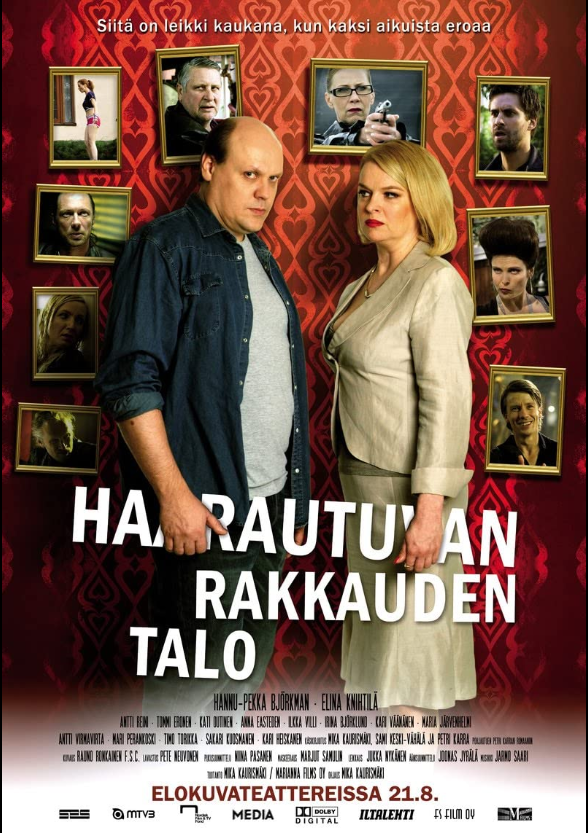
Haarautuvan rakkauden talo / The House of Branching Love


Mika Kaurismäki: Haarautuvan rakkauden talo / The House of Branching Love (FI 2009) starring Hannu-Pekka Björkman (Juhani Helin), Elina Knihtilä (Tuula Helin).

Den kluvna kärlekens hus.
    FI © 2009 Marianna Films.
    P+D: Mika Kaurismäki. SC: Mika Kaurismäki, Sami Keski-Vähälä – based on the novel by Petri Karra (2008). DP: Rauno Ronkainen – colour.
    C: Hannu-Pekka Björkman (Juhani Helin), Elina Knihtilä (Tuula Helin), Kati Outinen (Yrsa), Antti Reini (Wolffi), Tommi Eronen (Pekka), Irina Björklund (Marjut), Maria Järvenhelmi (Kitty), Kari Väänänen (Niilo), Anna Easteden (Nina), Ilkka Villi (Marco), Antti Virmavirta (Timo), Mari Perankoski (Tiina), Timo Torikka (PK), Jevgeni Haukka (Vidar), Wanda Dubiel (Sanna), Sakari Kuosmanen (Boogie), Kari Heiskanen (neighbour), Aino Seppo (neighbour's wife), Martti Syrjä (taxi driver), Pertti Sveholm (fireman), Clas-Ove Bruun (tall crook in the bar).
    107 min
    A FS Film release with Swedish subtitles by Markus Karjalainen.
    Viewed at Kinopalatsi 5, 3 Sep 2009.

The print has a digimastered look. It is not jarring in close-ups and medium shots.

The story belongs to the comedy / drama of remarriage tradition (The Awful Truth), complete with fake escorts to make the ex-partner jealous. The actors are good, and there are interesting performers even in small parts.

There are funny scenes with Juhani's paid escort Nina – "my wife has to think you're my girlfriend, although you are not" – "usually it's the other way around" – yet they start genuinely to like each other, and Nina introduces fresh ideas of her own to fool Tuula. They annoy Tuula with sounds of simulated sex but end up being genuinely aroused by their play-acting.

There are also funny scenes with Juhani's playboy friend Pekka – his self-confident double pick-up procedure in the bar in the company of the timid divorced Juhani is a humoristic and realistic record of the manners of today. Pekka is also a humoristic commentator to the tortuous divorce process ("no mites teillä on täällä eroaminen sujunut", this line is difficult to translate).

Unfortunately the film is not as good as its best elements. There is too much: the criminal world, the world of prostitution, the topic of childlessness. Too often the characters just display their shallow, indifferent, and ugly characteristics. The viewer ceases to care.

This is one of the several Finnish divorce films of the decade where the wife is such a harridan that the viewer is puzzled why the man is not simply celebrating his freedom.

Vihreä kulta / Green Gold (2009 KAVA transfer quality check)


Valentin Vaala: Vihreä kulta / Green Gold (FI 1939). Olavi Reimas (ylimetsänhoitaja Suontaa) and Hanna Taini (vuorineuvoksetar Kristine Bergman). Both are married. On a nocturnal sleigh ride a mutual passion is aroused. Photo from / view movie at Elonet: Vihreä kulta.

Grönt guld / Det susar i Nordanskog (Swedish title in Sweden) / L'Or vert. FI 1939.
A recent 35 mm KAVA print avec sous-titres francais par Aline Vannier-Sihvola. Viewed at Cinema Orion, 2 Sep 2009. - I revisited this great movie for 10 minutes to check the quality of the print: luminous, paying justice to the definition of light by cinematographer Armas Hirvonen and director Valentin Vaala. - The film, based on the play by Hella Wuolijoki, is topical because of its ecological message. - The opening feature of our Kino Forest retrospective, a tribute to the 150th anniversary of Metsähallitus (The Finnish Forest Administration), curated by Ms. Tuulikki Halla.

See my later, longer blog remarks on Vihreä kulta (2014 digital transfer).

Jätkien ja tukkien valtamailla

In the Land of the Lumberjack. FI 1946. PC: Finlandia-Kuva. D: Yrjö Haapanen. Documentary. 10 min. Viewed at Cinema Orion, Helsinki, 2 Sep 2009. - Print ok. - A documentary on the Finnish lumbercamps in the North in the winter. Lumber industry was Finland's number one industry, but now it has changed. The whole work chain of the lumberjack now belongs to history; in the 1960s everything changed.

Wednesday, September 02, 2009

Stendhal: Le Rouge et le Noir (novel)


Stendhal: Le Rouge et le Noir (FR 1830-1831). Frontispice du tome II (1831).

Stendhal: Le Rouge et le Noir; chronique du XIXe siècle / Punainen ja musta; kronikka XIX vuosisadalta. FR 1830. Finnish translation by J. A. Hollo / WSOY 1956 [the first edition of this translation. A previous translation into Finnish by Joel Lehtonen dates from 1929.]. This translation feels right, but I'm not able to compare it with the original text:
http://fr.wikisource.org/wiki/Le_Rouge_et_le_Noir

I read this novel for the first time and I found remarkable:
– the sense of history, the turbulence of the decades after the Revolution, the great movements of the recent generations all still valid during the Restoration
– the sense of society: Le Rouge et le Noir has been called the first class-conscious novel – after the Revolution, the aristocracy and the clerical estate are still mighty during the Restoration, but they are constantly afraid – the bourgeoisie has the financial power but not yet the social and political status which it deserves – Julien Sorel is the poor but talented provincial son of a sawyer
– the theme of corruption: the society is run by networks – corruption is rampant – influence is not based on justice and fairness
– the clerical world is also run by power games and evil machinations, including the power fight between the Jesuits and the Jansenists – clerical titles can be bought – the Church is also profoundly corrupt
– Julien Sorel as an anti-hero: he is not idealized by Stendhal – he has fatal weaknesses such as vanity and envy – his clerical career is pure opportunism – he knows the Bible by heart but does not believe in God – there is a line of development from Rastignac to Julien Sorel to Frédéric Moreau
– Le Rouge et le Noir is also a Bildungsroman of disillusionment – a deeply bitter one – and tragic, because Julien has both greatness and fatal weaknesses
– Julien Sorel is deeply loved by Madame de Rênal and Mathilde de Mole, but he is hardly worthy of either – both women have more strength of character than he does
– the story of the passion seems incredible to a modern reader, but it is full of surprises and elements of psychological credibility
– there is a line of development from Madame de Rênal to Emma Bovary to Anna Karenina – in her audacity of passion Madame de Rênal is close to Anna Karenina
– the style of Stendhal is concise, ironic, empathizing and yet with a fine sense of distance – in Stendhal's age, the writer was not afraid of blunt statements and generalizations – the writer's frankly subjective and partial statements I don't find inhibiting but on the contrary they provoke the reader to take a stand himself
– considering the current popularity of fantasy, I find historical novels like this as amazing and much more exciting, because the past is a foreign country

I have not seen film adaptations of Le Rouge et le Noir, the most essential of which is:
Le Rouge et le Noir / Punaista ja mustaa. FR/IT 1954. D: Claude Autant-Lara. SC: Jean Aurenche, Pierre Bost, Claude Autant-Lara. DP: Michael Kelber (Eastmancolor). CAST: Gérard Philipe (Julien Sorel), Danielle Darrieux (Madame de Rênal), Antonella Lualdi (Mathilde de Mole). 185 min