If a museum or a gallery in Finland wants to have a certain hit, there is no better choice than Albert Edelfelt, but in Retretti, they have not lazily gone for a familiar formula, instead introducing a fresh and critical perspective.
Albert Edelfelt (1854-1905) was one of the first Finnish artists with an international standing. In Paris, he painted the official portrait of Louis Pasteur, and in Russia, Czar Nicolas II modelled for him. In his way of expression, he belonged to the Realist line of painters, his professional skill based on studies in Paris (Ecole des Beaux-Arts), schooled also in Naturalism. Also his affinities with the contemporary Russian artists are evident. Edelfelt was a professional, well-paid artist with great financial responsibilities. This often affected his choice of subject-matter.
In Finland, Edelfelt was a leading figure in the Golden Age of Finnish art during the last decades of the 19th century and the first decades of the 20th century. He was an important part in the awakening of the Finnish culture, in the great cultural project of building the Finnish nation, a foundation of Finnish independence in 1917.
The curator of Retretti's Edelfelt exhibition, Ms. Maria Vainio-Kurtakko, had chosen interesting angles to the selection. I try to summarize below some key points from her catalogue introduction.
She has selected a Nordic viewpoint, Edelfelt's close contacts with his colleagues in Sweden, Denmark and Norway. In Denmark, Georg Brandes formulated key ideas of the era, which became known as the breakthrough of modernity (det moderne genembrud). The Norwegian artist Christian Krohg (1852-1925) stressed social awareness and social conscience.
In the summer 1879 many artists belonging to the Georg Brandes circle visited Skagen in order to depict Danish peasants and the Danish landscape in the French "plein air" style. Edelfelt's friends included the Danes Karl Madsen (1855-1938), Anna Ancher (1859-1935), Michael Ancher (1849-1927), and P.S. Kröyer (1851-1909). Edelfelt's friends included also the Swede Anders Zorn (1860-1920) with his bucolic landscapes and ample female figures. All these artists are on display in Retretti.
During the 1880s the Nordic artist community flourished in Paris. Even before visiting Paris Edelfelt had felt the passion to paint the seaside views of the Haikko Bay, and starting in 1879 he realized several such paintings. Villa Edelfelt in Haikko became a favourite stop for Finnish intelligentsia.
Inspired by the poet J.L. Runeberg, Edelfelt liked to paint the lives of ordinary people, the hard-working fishermen, in a spirit of dignity irrespective of their poverty and harsh living conditions. There is no sign of social criticism in Edelfelt's work.
The concept of the new woman was essential in the breakthrough of modernity. In Edelfelt's work, women have a central place, including in his definitive portraits of central women artists of the age, such as the actress Ida Ahlberg and the opera diva Aino Achté, and the magnificent portraits of his mother, Alexandra Edelfelt.
The summer idyll of children playing in the sunshine is one of the favourite themes in Edelfelt's paintings. Solskenstycken (sunny pictures) was a favourite genre of him; they almost always depict women and children. Ms. Vainio-Kurtakko points out that they are the opposite of social awareness in the age of Henrik Ibsen and The Doll's House. Edelfelt paints the idyllic portrait of the traditional woman, glorifying the mother and the beautiful young girl relaxing in the garden.
One might call Edelfelt a master of the belle époque in Finland. He died in 1905, the year of the first Russian Revolution, the year of the Battleship Potyomkin.
In Retretti, familiar paintings are juxtaposed with little-known ones, and the paintings of the five Nordic contemporary painters illuminate even the standard Edelfelt works in an interesting way.
Saturday, June 20, 2009


Retretti art center 2009 (1)
 |
| Albert Edelfelt and the Nordic Summer. Art Center Retretti exhibition catalogue 2009. Art: detail from: Albert Edelfelt: Lekande pojkar på stranden / Leikkiviä poikia rannalla / Boys Playing on the Shore (FI 1884). Oil on canvas. 90 x 107,5. Kansallisgalleria: Ateneum A III 1755. |
Retretti, Punkaharju, Midsummer Day, 20 June 2009. - On a cloudy and chilly Midsummer Day it seemed like a good idea to visit the Art Center Retretti. - We soon noticed that many others had the same idea. The center was well attended but not too crowded for comfort. - Retretti is one of the biggest art centers in the Nordic countries. - It is located on the Punkaharju esker / ridge in the Puruvesi district of Lake Saimaa. The Punkaharju ridge is famous for one of the most ravishing landscapes in Finland. (The name Punkaharju itself means Punka Ridge.)
The Retretti Summer 2009 comprises:
1. Kim Simonsson: The Golden Deer exhibition with 20 ceramic sculptures
2. An Albert Edelfelt documentary video in the Rock Concert Hall
3. Children's Workshop: "It has ears on two sides, what can it be?" - an imaginary forest where colourful butterflies can be created
4. Materials Live - Ceramics and Glass Art from the Kyösti Kakkonen collection - Finnish art and design objects from the 1940s to the 1960s, a period of high modernism
5. Vesa Varrela: Surfing Fish - 8 vases and 18 glass surfboards
6. Albert Edelfelt and the Nordic Summer - Edelfelt and his contemporary Nordic colleagues Anders Zorn, P. S. Kröyer, Anna Ancher, Michael Ancher, and Christian Krohg
7. Children's Exhibition - Ransu at Retretti - the video retriever Ransu and his friends Riku and Eno Elmeri, familiar from YLE TV2 Pikku Kakkonen children's programming
8. Siim-Tanel Annus: Money and Poetry - Estonian art reflecting history and politics via paintings based on obsolete banknotes from Estonia, the Soviet Union, Germany, and Finland
9. Punkalive: Freedom of Form - Furniture and Pavilion - also presented in the Milan Furniture Fair in 2009
10. The Himmelblau Graphic Print Workshop - leading artists: Inari Krohn, Tapani Kokko, and Marja Pirilä - also on show prints by Outi Heiskanen, Juho Karjalainen, Juhani Linnovaara, Elina Luukkanen, Gunnar Pohjola, Esa Riippa, and Rafael Wardi
Wednesday, June 17, 2009
Une vie / One Life
 |
| Alexandre Astruc: Une vie / One Life (IT/FR 1958) starring Maria Schell as Jeanne Dandieu. |
Eräs elämäntarina / Mannen i mitt liv.
IT/FR © 1958 Agnès Delahaie Productions. P: Annie Dorfmann [= Agnès Delahaie], Louis Wipf.
D: Alexandre Astruc. SC: Alexandre Astruc, Roland Laudenbach – based on the novel (1883) by Guy de Maupassant – title in English: A Woman's Life – in Finnish: Elämän tarina. DP: Claude Renoir – Eastmancolor – 1,66:1. PD: Paul Bertrand. COST: Mayo, Lucilla Mussini. M: Roman Vlad. ED: Claudine Bouché.
LOC: Normandie. Le film a été tourné en grande partie près de Cherbourg, dans les paysages de la Hague.
CAST: Maria Schell (Jeanne Dandieu épouse de Lamare), Christian Marquand (Julien de Lamare), Pascale Petit (Rosalie, the maid), Louis Arbessier (M. Dandieu, the father), Marie-Hélène Dasté (Mme. Dandieu, the mother), Antonella Lualdi (Gilberte de Fourcheville), Ivan Desny (De Fourcheville).
85 min.
Finnish premiere: 20 Oct 1961 Elysée, released by Pons-Filmi.
A vintage KAVI 35 mm print with Finnish / Swedish intertitles viewed at Cinema Orion, 17 June 2009.
A good vintage print with the colour pretty ok, intact.
A visually dynamic adaptation of Maupassant's first novel. There is a surge of consistent movement in this story filmed on location in Normandy.
In marriage, the woman finds herself. In marriage, the man loses himself, being an eternal seeker, a wanderer. The man's wild, untamed sexuality brings forth tragedy. The sex scenes are strong and original. His three women: Jeanne, his wife. Rosalie, the maid, who gets pregnant. Gilberte, the wife of his best friend.
The Normandy location is vivid. The sea, the beach, the wind are important. Expressive cinematography by Claude Renoir. A dynamic score by Roman Vlad. The actors are fine. Antonella Lualdi is capable of implying a lot in just one look.
Kuningas lähtee Ranskaan / The King Goes Forth to France
 |
| Anssi Mänttäri: Kuningas lähtee Ranskaan / The King Goes Forth to France (FI 1986). |
Kungen beger sig till Frankrike.
FI 1986. PC: Reppufilmi.
P+D: Anssi Mänttäri. ASS.D.: Pauli Pentti. SC: Paavo Haavikko, Anssi Mänttäri, Heikki Katajisto – based on the play (1974) and the radioplay (1975) by Haavikko. DP: Heikki Katajisto – b&w – 1,66:1. Gaffer: Aki Kaurismäki. AD+COST: Pertti Hilkamo, Tuula Hilkamo. M: Anssi Tikanmäki. Songs by Anssi Tikanmäki to the lyrics of Paavo Haavikko performed by Susanna Haavisto, Paavo Piskonen, Paavo Haavikko and the "singing soldiers". S: Timo Linnasalo. ED: Irma Taina.
CAST: Paavo Piskonen (The King), Susanna Haavisto (Caroline The Merry One), Kati Outinen (Caroline The Mare's Hair), Riitta Havukainen (Anne The Stripper), Kylli Köngäs (Anne The Thief), Harri Nikkonen (The Prime Minister), Lasse Pöysti (The Equester), Kalevi Kahra (The Blind King of Bohemia), Matti Pellonpää (The Earless Man), Markku Toikka (The Young Knight), Heikki Paavilainen (The Young Prime Minister), Pertti Sveholm (The Soldier of the King of Bohemia), Heikki Ortamo (Froissart, The Secretary), Tupuna Vaissi (The Queen), Timo Toikka (The English Knight), Martti Syrjä (A Singing Soldier), Pantse Syrjä (A Singing Soldier), Saku Kuosmanen (A Singing Soldier).
LOC: Hämeenlinna: the Sirola Institute, Aulanko, Laajasalo, Vantaanjoki Falls, Suomenlinna, the ruins of the Karjalohja Church, Yyteri, the Raasepori Fortress, Vantaanjoki by Königstedt.
84 min
A vintage print viewed at Cinema Orion, Helsinki, 17 June 2009.
Paavo Piskonen was watching the film in the audience. – A brilliant black and white print. – Based on an absurd radioplay by Paavo Haavikko, which has also been adapted as an opera by Aulis Sallinen. – The equester of the Prince of England predicts that the Prince will cross the English Channel as a King on horseback by July. His spouse will be called Anne or Caroline. However, the Emperor of Japan has caused global freezing in the summer of 1945 by ordering a taxi. The Prime Minister warns against going to France, because this would mean war. According to the Prince this would be the only war which would start because there is no reason, and that is why it is unavoidable. The blind King of Bohemia is on his way to the battle of Crécy, but his troops are going around in circles. Finally, one of the soldiers executes the blind king. The Queen arrives and follows the troops to the South. By spring the King orders protection to eggs of cranes, because a wedge of cranes is his only compass. – Eccentric, ambitious, bewildering, boring, mad. – The stark cinematography is often impressive. – The actors read their crazy lines straight. – Reportedly, Paavo Haavikko approved.
Paavo Piskonen was watching the film in the audience. – A brilliant black and white print. – Based on an absurd radioplay by Paavo Haavikko, which has also been adapted as an opera by Aulis Sallinen. – The equester of the Prince of England predicts that the Prince will cross the English Channel as a King on horseback by July. His spouse will be called Anne or Caroline. However, the Emperor of Japan has caused global freezing in the summer of 1945 by ordering a taxi. The Prime Minister warns against going to France, because this would mean war. According to the Prince this would be the only war which would start because there is no reason, and that is why it is unavoidable. The blind King of Bohemia is on his way to the battle of Crécy, but his troops are going around in circles. Finally, one of the soldiers executes the blind king. The Queen arrives and follows the troops to the South. By spring the King orders protection to eggs of cranes, because a wedge of cranes is his only compass. – Eccentric, ambitious, bewildering, boring, mad. – The stark cinematography is often impressive. – The actors read their crazy lines straight. – Reportedly, Paavo Haavikko approved.
Saturday, June 13, 2009
Sunshine
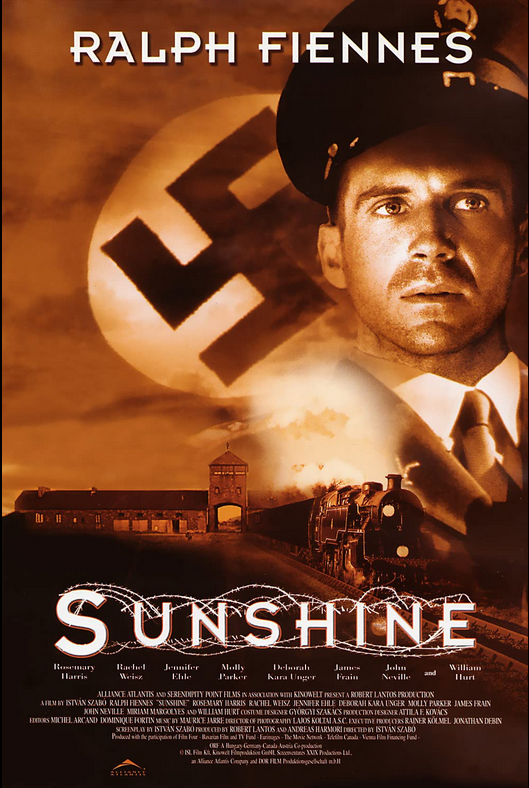 |
| István Szabó: Sunshine (DE/AT/CA/HU 1999). Ralph Fiennes as Ignatz Sonnenschein / Adam Sors / Ivan Sors. |
DE/AT/CA/HU © 1999 [many production companies]. P: Andras Hamori, Robert Lantos.
D: István Szabó. SC: István Szabó, Israel Horovitz. DP: Lajos Koltai – colour and black & white (archival footage) – 1,85:1. M: Maurice Jarre. Egmont overture by Beethoven. PD: Attila Kovács. AD: Zsuzsanna Borvendég. COST: Györgyi Szakács. ED: Michal Arcand.
CAST: Ralph Fiennes (Ignatz Sonnenschein / Adam Sors / Ivan Sors), Jennifer Ehle (Valerie Sonnenschein as a young woman) Rosemary Harris (Valerie Sors as a grown-up woman), Rachel Weisz (Greta), Deborah Kara Unger (Maj. Carole Kovacs), John Neville (Gustave Sors as an old man), Miriam Margolyes (Rose Sonnenschein), Rüdiger Vogler (Gen. Jakofalvy), Hanns Zischler (Baron Margitta), Mari Töröcsik (Older Kato), William Hurt (Andor Knorr).
181 min.
A Filmunio print, original in English, viewed at Cinema Orion, Helsinki, 12 June 2009.
Print with beautiful colour, pleasant photochemical look, wear and tear in changeovers.
One of the essential films by István Szabó, one of the essential Jewish films of all time, an essential film of reckoning with the Eastern European past, celebrating the 20th anniversary of the fall of the wall.
It is the story of a hundred years in three generations of the Sonnenschein / Sors family. It starts from the shtetl, the family patriarch the inventor of a herbal liquor. Ignatz becomes a judge, and has to change his name. His son Adam becomes an Olympic fencer, and has to convert to Catholicism. That does not prevent him from becoming a victim of the Holocaust. His son Ivan becomes a police officer in Socialist Hungary, to bring the fascists to justice. But witnessing the crimes of Stalinism and the bloody repression of the people's uprising of 1956 he turns his back to the new system.
A unique attempt to cover honestly the various totalitarian administrations in Hungary.
As a Jewish film, it is about the tragedy of forced assimilation and persecution. The Holocaust episode belongs to the most harrowing in the history of the cinema.
Among the recurrent motifs: the lost recipe notebook, the grandfather's watch, the splinters.
Towards the end of the film certain lessons first mentioned in the start get new resonance. "We are afraid to see clearly and to be seen clearly". "If you struggle for acceptance, you'll always be unhappy". "You are not in prison, they are in prison". "One day I'll wipe that smile off your face". "I'm not anybody's wife, I'm myself".
The finest sequence: the 1956 uprising edited to the rhythm of Beethoven's Egmont overture.
There are gorgeous female roles in the film, and especially the scenes with the bright Jennifer Ehle radiate with intelligence, courage, sensuality and frank sexuality.
Rachel Weisz would have deserved more screen time, but of course the film is long as it is. Rosemary Harris is excellent as the grown-up Valerie.
Although Ralph Fiennes in his triple role portrays the three main characters, finally, Valerie is the soul and heart of the film, the only one who never loses her inner compass.
A film I decided I want to see again even while still watching it.
Thursday, June 11, 2009
Being Julia
 |
| István Szabó: Being Julia (CA/GB/OB 2004) starrring Annette Bening as Julia Lambert. |
CA/GB/HU © 2004 2024846 Ontario, Inc. / Being Julia Productions Limited / ISL Film Kft. Serendipity Point Films presents. P: Robert Lantos.
D: István Szabó. SC: Ronald Harwood – based on the novel by W. Somerset Maugham (Theatre, 1937, in Finnish Näyttelijätär 1951 J.A. Hollo / Otava, 5. ed. 2005). DP: Lajos Koltai – colour: DeLuxe – 1,85:1. AD: Luciana Arrighi. COST: John Bloomfield. Make-up: Erzsébet Forgács. M: Mychael Danna. S: Jane Tattersall. ED: Susan Shipton.
CAST: Annette Bening (Julia Lambert), Jeremy Irons (Michael Gosselyn), Bruce Greenwood (Lord Charles), Miriam Margolyes (Dolly de Vries), Juliet Stevenson (Evie), Shaun Evans (Tom Fennel), Lucy Punch (Avice Crichton), Tom Sturridge (Roger Gosselyn), Maury Chaykin (Walter Gibbs), Sheila McCarthy (Grace Dexter), Rosemary Harris (Julia's aunt), Rita Tushingham (Aunt Carrie).
103 min.
A print with Finnish / Swedish subtitles by Sanna Manninen / Hellevi Raita.
Viewed at Cinema Orion, 11 June 2009.
A print without joins or scratches but with a digital intermediate look.
A great satire about the theatre, show business, and actors.
Annette Bening is wonderful as the narcissistic theatre diva approaching the age of 50. There is a grand finale in which she faces all the disasters and overcomes them (for the time being) in magnificent theatrical manner.
Mychael Danna's music is very appealing, spiced with 1930s hit songs.
D: István Szabó. SC: Ronald Harwood – based on the novel by W. Somerset Maugham (Theatre, 1937, in Finnish Näyttelijätär 1951 J.A. Hollo / Otava, 5. ed. 2005). DP: Lajos Koltai – colour: DeLuxe – 1,85:1. AD: Luciana Arrighi. COST: John Bloomfield. Make-up: Erzsébet Forgács. M: Mychael Danna. S: Jane Tattersall. ED: Susan Shipton.
CAST: Annette Bening (Julia Lambert), Jeremy Irons (Michael Gosselyn), Bruce Greenwood (Lord Charles), Miriam Margolyes (Dolly de Vries), Juliet Stevenson (Evie), Shaun Evans (Tom Fennel), Lucy Punch (Avice Crichton), Tom Sturridge (Roger Gosselyn), Maury Chaykin (Walter Gibbs), Sheila McCarthy (Grace Dexter), Rosemary Harris (Julia's aunt), Rita Tushingham (Aunt Carrie).
103 min.
A print with Finnish / Swedish subtitles by Sanna Manninen / Hellevi Raita.
Viewed at Cinema Orion, 11 June 2009.
A print without joins or scratches but with a digital intermediate look.
A great satire about the theatre, show business, and actors.
Annette Bening is wonderful as the narcissistic theatre diva approaching the age of 50. There is a grand finale in which she faces all the disasters and overcomes them (for the time being) in magnificent theatrical manner.
Mychael Danna's music is very appealing, spiced with 1930s hit songs.
This film belongs to the same tradition as All About Eve: Annette Bening invites comparison with Bette Davis, and Lucy Punch gets the role of Eve.
The victory belongs to Julia Lambert, the character played by Annette Bening. But the most cutting criticism Julia receives from her own son, who accuses her mother that she "does not exist", and that all that she has to say is second hand.
The victory belongs to Julia Lambert, the character played by Annette Bening. But the most cutting criticism Julia receives from her own son, who accuses her mother that she "does not exist", and that all that she has to say is second hand.
Friday, June 05, 2009
Bizalom / Confidence
 |
| István Szabó: Bizalom / Confidence (HU 1979) with Ildikó Bánsági (Kata) and Péter Andorai (Janos). |
HU 1979. PC: Objektiv Filmstudio.
D+SC: István Szabó. DP: Lajos Koltai. CAST: Ildikó Bánsági (Kata), Péter Andorai (Janos).
117 min.
A Filmunio print with English subtitles.
Viewed at Cinema Orion, 5 June 2009.
A worn print, turned red, shortened by 10 min and badly battered in previous venues.
Revisited: an intensive chamber piece that I had previously seen only on tv, very tired.
One of Szabó's best films, still strong, it has stood the test of time well.
Life during the final period of the Nazi occupation in Budapest, when the terror and the persecution were at their worst. This is, however, not a Holocaust story. It's the personal story of the wife of a resistance fighter, who has to lead a double life during the final year of the Nazi occupation. She has to assume a false identity, living in isolation in a room with a fake husband, also a Resistance fighter.
It is about the constant fear of the small detail giving one away.
Elliptic montage.
Ildikó Bánsági has the same kind of nobility in her demeanour as Ingrid Bergman.
Life under extreme pressure. "It does not matter where you are as long as you are at ease with yourself".
This is also an erotic film: sex with the perfect stranger. The sex scenes belong to the best in the history of the cinema, thanks to Ildikó Bánsági's delicate candour.
After the liberation the terror and the persecution start again under a different banner.
Thursday, June 04, 2009
Viimeiset rotannahat / [The Last Rat Skins] / Rare, Medium, Well Done
Viimeiset rotannahat. Impressio / De sista skinnena. FI (c) 1985 Filmiauer. P+D+SC: Anssi Mänttäri. DP: Heikki Katajisto - 1,66:1 - colour and b&w - lab: Johan Ankerstjerne. M: "Bad Morning Blues" (comp. Anssi Mänttäri, arr. Asko Mänttäri), "Uni tulee, uni tulee" (trad.) pres. A. Köster (voc) and Kollage. "Best With Beer" (Asko Mänttäri). CAST: Anssi Mänttäri (the man in the white suit), Sarina Röhr (the woman with a sound sleep), Taina Saikkonen (young intellectual woman), Riitta Havukainen (lecturer in semiotics), Eero Tuomikoski (Nuutinen, drunk CEO), Sanna-Kaisa Palo (Irma Manner, the woman who never stops talking), Aki Kaurismäki (Ville, son of the man in the white suit), Sallamaari Muhonen (Redhead), Marja Packalén (the ex-wife of the man in the white suit), Matti Pellonpää (father of the man in the white suit), Elina Hurme (Kaisa, the young moralistic woman), Eeva Eloranta (female theologist), Heikki Peltonen (male theologist), Ilkka Kylävaara (Väisänen, successful businessman), Titta Antti-Poika (Tiina, the woman with the car), Erkki Saarela (Pera, the good-natured man), Paavo Piskonen (Harri, the conceited man), Kristiina Repo (Seija Pikkaranen, the woman who hates poverty), Pirkko Hämäläinen (Riitta, the bitchy woman), Jyrki Kovaleff (the honest working man), Sanna Fransman (the woman next door), Kari Väänänen (psychiatrist), Ann-Cathrine Fröjdö (not just a skin). Viewed at Cinema Orion, Helsinki, 3 June 2009.
The image in the print varied from good to grainy. - A fascinating Bukowskian odyssey starring the director himself as the man in the white suit, who conquers almost any woman in a series of superficial relationships. With witty dialogue, the film is constantly interesting, and with a hidden despair beneath. - The framing story reveals the burned-out old man giving his account to a video camera. The white suit is now folded on the chair. - It is a satire on a life based on easy gratification, short attention span, self-centeredness, about always taking the easy way out. - This film was not a success at its time, but it has stood the test of time well. There is not a dull moment in it.
The image in the print varied from good to grainy. - A fascinating Bukowskian odyssey starring the director himself as the man in the white suit, who conquers almost any woman in a series of superficial relationships. With witty dialogue, the film is constantly interesting, and with a hidden despair beneath. - The framing story reveals the burned-out old man giving his account to a video camera. The white suit is now folded on the chair. - It is a satire on a life based on easy gratification, short attention span, self-centeredness, about always taking the easy way out. - This film was not a success at its time, but it has stood the test of time well. There is not a dull moment in it.
Jotkut teistä ovat ehkä kuulleet minusta / [Some of You May Have Heard About Me]
Viewed at Cinema Orion, Helsinki, 3 June 2009. See earlier note. Revisited, a perfect parody of a making of. The film in question is mainly Viimeiset rotannahat.
Saturday, May 30, 2009
Buenos Aires 23-30 May 2009
I was for the first time in Buenos Aires and in Argentina for the FIAF Congress. These are my first impressions of the mighty country.
I was impressed by the intelligence, culture and style of the Argentinians. The people I met were friendly and dignified. I wish I knew Spanish, as English is not very widely spoken in Argentina. Interestingly, though, there is a touch of British dignity in the Argentinian manners.
Our Congress took place in the San Nicolas Theatre District, on Avenida Corrientes, the Broadway of South America, which may be even bigger a theatre street than the Broadway of New York. There are big and evidently popular theatres of all kinds one after another. On a parallel street, Lavalle, there were also a lot of cinemas and multiplexes. There were lots of bookstores, cd stores, and dvd stores, and on almost every block there were magazine stands which also sold books, including volumes of Goethe and Cervantes.
There are many good restaurants, I never tired of the delicious bife de lomo, and Argentinian wines are excellent. I got to see street tango shows, but there was no chance to experience the famous nightlife.
I had the chance to visit the Recoleta, Palermo, and San Telmo districts, as well as Retiro and Microcentro. No one could miss the poverty, the homeless, and the beggars. Two of my colleagues became victims of theft on the day of arrival. Many streets and buildings are in bad shape, including the building where our Congress took place. In the mornings, as we arrived to start the daily session, we met homeless people, even families, sleeping on the sidewalk of the Congress building. Argentina is struggling mightily against economic adversity, and Argentinians are suffering and embarrassed by the dark sides of the current situation.
The world's grave economical injustice was dramatized daily. In San Telmo, beggars came to steal food from the restaurant table. The image of Argentina's rebel hero, Che Guevara, was ubiquitous.
I was impressed by the intelligence, culture and style of the Argentinians. The people I met were friendly and dignified. I wish I knew Spanish, as English is not very widely spoken in Argentina. Interestingly, though, there is a touch of British dignity in the Argentinian manners.
Our Congress took place in the San Nicolas Theatre District, on Avenida Corrientes, the Broadway of South America, which may be even bigger a theatre street than the Broadway of New York. There are big and evidently popular theatres of all kinds one after another. On a parallel street, Lavalle, there were also a lot of cinemas and multiplexes. There were lots of bookstores, cd stores, and dvd stores, and on almost every block there were magazine stands which also sold books, including volumes of Goethe and Cervantes.
There are many good restaurants, I never tired of the delicious bife de lomo, and Argentinian wines are excellent. I got to see street tango shows, but there was no chance to experience the famous nightlife.
I had the chance to visit the Recoleta, Palermo, and San Telmo districts, as well as Retiro and Microcentro. No one could miss the poverty, the homeless, and the beggars. Two of my colleagues became victims of theft on the day of arrival. Many streets and buildings are in bad shape, including the building where our Congress took place. In the mornings, as we arrived to start the daily session, we met homeless people, even families, sleeping on the sidewalk of the Congress building. Argentina is struggling mightily against economic adversity, and Argentinians are suffering and embarrassed by the dark sides of the current situation.
The world's grave economical injustice was dramatized daily. In San Telmo, beggars came to steal food from the restaurant table. The image of Argentina's rebel hero, Che Guevara, was ubiquitous.
Wednesday, May 27, 2009
The Second Century Forum: Film Heritage and Cultural Patrimony? Not Yet! (FIAF Congress in Buenos Aires)
Sala Leopoldo Lugones, Complejo Teatral de Buenos Aires.
Introduction: "The contemporary era of the digital market is presenting film archives and museums with new challenges that bring into question their identity. A key aspect of this situation is the need to reconsider the idea of film heritage as cultural patrimony for the future. The Second Century Forum in Buenos Aires will consider three approaches to this question:
A) What can FIAF archives and museums do in this respect?
B) How can we raise awareness outside FIAF about this aspect?
C) What models can other institutions that take care of cultural patrimony offer to film archives and museums?
Paolo Cherchi Usai, David Francis, and Michael Loebenstein, in collaboration with the FIAF Programming and Access to Collections Commission will explore the issues, the strategies, and the tools necessary to find solutions. The Second Century Forum will address such topics as: the need for selection; the need for shared access criteria; the need to preserve the cinematic event; film heritage as 'unique' cultural objects; memory vs. repository; culture and market; and public and private sectors. The Second Century Forum has been designed as an open discussion with FIAF members' active participation in three consecutive workshop-like sessions devoted to SELECTION, ACCESS, and EXPERIENCE / EVENT.
Chairman: Luca Giuliani
Keynote Speakers:
- Paolo Cherchi Usai: ISSUES
- Michael Loebenstein: STRATEGIES
- David Francis: THE WAY AHEAD
1 Session: SELECTION - chair: Meg Labrum
2 Session: ACCESS - chair: Jon Wengström
3 Session: EXPERIENCE / EVENT - chair: Luca Giuliani
Conclusions and Outcomes: drafted by AA
Introduction: "The contemporary era of the digital market is presenting film archives and museums with new challenges that bring into question their identity. A key aspect of this situation is the need to reconsider the idea of film heritage as cultural patrimony for the future. The Second Century Forum in Buenos Aires will consider three approaches to this question:
A) What can FIAF archives and museums do in this respect?
B) How can we raise awareness outside FIAF about this aspect?
C) What models can other institutions that take care of cultural patrimony offer to film archives and museums?
Paolo Cherchi Usai, David Francis, and Michael Loebenstein, in collaboration with the FIAF Programming and Access to Collections Commission will explore the issues, the strategies, and the tools necessary to find solutions. The Second Century Forum will address such topics as: the need for selection; the need for shared access criteria; the need to preserve the cinematic event; film heritage as 'unique' cultural objects; memory vs. repository; culture and market; and public and private sectors. The Second Century Forum has been designed as an open discussion with FIAF members' active participation in three consecutive workshop-like sessions devoted to SELECTION, ACCESS, and EXPERIENCE / EVENT.
Chairman: Luca Giuliani
Keynote Speakers:
- Paolo Cherchi Usai: ISSUES
- Michael Loebenstein: STRATEGIES
- David Francis: THE WAY AHEAD
1 Session: SELECTION - chair: Meg Labrum
2 Session: ACCESS - chair: Jon Wengström
3 Session: EXPERIENCE / EVENT - chair: Luca Giuliani
Conclusions and Outcomes: drafted by AA
The Cinematheques in Search of Their New Audiences (FIAF / Ibermedia Symposium), Day 2: Major Themes
Sala Leopoldo Lugones, Complejo Teatral de Buenos Aires (CTBA), 1530 Corrientes Avenue, 10th Floor. - The Symposium was trilingual: English, French, and Spanish.
Perspectives and Future: Perspectives and Context of Film Culture in the New Media World
- 9.25 Chair / Introduction: Serge Toubiana, General Director, La Cinémathèque francaise, Paris
- 9.40 Robin Baker, British Film Institute National Archive, London
- 10.00 Michael Loebenstein, Curator, Research, Education, Österreichisches Filmmuseum, Wien
- 10.06 Rainer Rother, Artistic Director, Deutsches Filminstitut, Berlin
Education and Cinema: Future Audiences
- 10.27 Chair / Introduction: Luca Giuliani, Head of Film Collections, Museo Nazionale del Cinema, Torino
- 10.39 Anne Morra, Assistant Curator, Department of Film, The Museum of Modern Art, New York
- 10.58 Anna Duran, Ministry of Education, Buenos Aires
- 11.14 Dolly Pussi, Federación Latinoamericana de Escuelas de Cine, Buenos Aires - 11.28
New Technologies and Future Audiences: Technical Aspects
- 12.00 Chair / Introduction: Thomas Christensen, Film Curator, Danish Film Institute, Copenhagen
- 12.03 Eric Le Roy, Access, Valorisation et Enrichissement des collections, AFF / CNC, Paris
- 12.19 Lise Gustavson, Norwegian Film Institute, Oslo
- 12.35 Paula Félix Didier, Director, Museo del Cine de Buenos Aires - 12.55
Lunch break 12.55 - 14.35
Programming Trends and Challenges
- 14.35 Chair / Introduction: AA
- 14.37 Dan Nissen, Director, Archive and Cinematheque, Danish Film Institute, Copenhagen
- 15.00 Diego Brodersen, Fundación Cinemateca Argentina, Buenos Aires
- 15.15 Jean-Yves de Lépinay, Directeur des Programmes, Forum des Images, Paris
- 15.33 Katie Trainor, Department of Film, The Museum of Modern Art, New York
- discussion - 15.45
Special Events
- 15.45 Chair / Introduction: Karl Griep
- Vittorio Boarini, Director, Fondazione Federico Fellini, Rimini - 16.08
- Claude Bertemes, Conservateur de la Cinémathèque de la Ville du Luxembourg - 16.26 *
- Eleonora Jaureguiberry, Director of Culture, City of San Isidro, Buenos Aires - 16.33
- Santiago Chotsourian, Composer and Orchestra Conductor, Buenos Aires - 16.44
Coffee Break 16.45 - 17.15
Festivals and the Role Played by the Cinematheques and Critics
- 17.15 Chair / Introduction: Eduardo "Quintin" Anton, Film Critic, Buenos Aires
- 17.27 Christian Dimitriu, FIAF
- 17.45 Sandra den Hamer, Director, Filmmuseum, Amsterdam *
- 17.54 Anna Fiaccarini, Cineteca del Comune di Bologna
- 18.05 Sergio Wolf, Director of the Buenos Aires Film Festival BAFICI, Buenos Aires
- 18.26 Natacha Laurent, La Cinémathèque de Toulouse - 18.35
The 29 distinguished speakers had much important and interesting to say, but the audience was yearning for more room for discussion.
Perspectives and Future: Perspectives and Context of Film Culture in the New Media World
- 9.25 Chair / Introduction: Serge Toubiana, General Director, La Cinémathèque francaise, Paris
- 9.40 Robin Baker, British Film Institute National Archive, London
- 10.00 Michael Loebenstein, Curator, Research, Education, Österreichisches Filmmuseum, Wien
- 10.06 Rainer Rother, Artistic Director, Deutsches Filminstitut, Berlin
Education and Cinema: Future Audiences
- 10.27 Chair / Introduction: Luca Giuliani, Head of Film Collections, Museo Nazionale del Cinema, Torino
- 10.39 Anne Morra, Assistant Curator, Department of Film, The Museum of Modern Art, New York
- 10.58 Anna Duran, Ministry of Education, Buenos Aires
- 11.14 Dolly Pussi, Federación Latinoamericana de Escuelas de Cine, Buenos Aires - 11.28
New Technologies and Future Audiences: Technical Aspects
- 12.00 Chair / Introduction: Thomas Christensen, Film Curator, Danish Film Institute, Copenhagen
- 12.03 Eric Le Roy, Access, Valorisation et Enrichissement des collections, AFF / CNC, Paris
- 12.19 Lise Gustavson, Norwegian Film Institute, Oslo
- 12.35 Paula Félix Didier, Director, Museo del Cine de Buenos Aires - 12.55
Lunch break 12.55 - 14.35
Programming Trends and Challenges
- 14.35 Chair / Introduction: AA
- 14.37 Dan Nissen, Director, Archive and Cinematheque, Danish Film Institute, Copenhagen
- 15.00 Diego Brodersen, Fundación Cinemateca Argentina, Buenos Aires
- 15.15 Jean-Yves de Lépinay, Directeur des Programmes, Forum des Images, Paris
- 15.33 Katie Trainor, Department of Film, The Museum of Modern Art, New York
- discussion - 15.45
Special Events
- 15.45 Chair / Introduction: Karl Griep
- Vittorio Boarini, Director, Fondazione Federico Fellini, Rimini - 16.08
- Claude Bertemes, Conservateur de la Cinémathèque de la Ville du Luxembourg - 16.26 *
- Eleonora Jaureguiberry, Director of Culture, City of San Isidro, Buenos Aires - 16.33
- Santiago Chotsourian, Composer and Orchestra Conductor, Buenos Aires - 16.44
Coffee Break 16.45 - 17.15
Festivals and the Role Played by the Cinematheques and Critics
- 17.15 Chair / Introduction: Eduardo "Quintin" Anton, Film Critic, Buenos Aires
- 17.27 Christian Dimitriu, FIAF
- 17.45 Sandra den Hamer, Director, Filmmuseum, Amsterdam *
- 17.54 Anna Fiaccarini, Cineteca del Comune di Bologna
- 18.05 Sergio Wolf, Director of the Buenos Aires Film Festival BAFICI, Buenos Aires
- 18.26 Natacha Laurent, La Cinémathèque de Toulouse - 18.35
The 29 distinguished speakers had much important and interesting to say, but the audience was yearning for more room for discussion.
Monday, May 25, 2009
The Cinematheques in Search of Their New Audiences (FIAF / Ibermedia Symposium), Day 1: Global Perspective
 |
| Filmoteca UNAM: sala Julio Bracho, Ciudad de México. |
Sala Leopoldo Lugones, Complejo Teatral de Buenos Aires (CTBA), 1530 Corrientes Avenue, 10th Floor. – The Symposium was trilingual: in English, French, and Spanish.
9.50 Official Opening Ceremony of the FIAF Congress
– Guillermo Fernández Jurado, President of the Fundación Cinemateca Argentina (FCA), Buenos Aires
– Eva Orbanz, President of FIAF, Berlin
– Liliana Mazure, President of the Instituto Nacional de Cine y Artes Audiovisuales (I.N.C.A.A.)
– Marcela Cassinelli, Vice President of the FCA, Buenos Aires
10.05 Introduction and Objectives of the Symposium: Present Situation and Perspectives
– Moderator: Christian Dimitriu, Senior Administrator, FIAF, Brussels
– Keynote Speech: Robert Daudelin, FIAF Honorary Member, Montréal
– Keynote Speech: David Francis, FIAF Honorary Member, Bloomington, Indiana
10.35 Focus on Africa: Future of Access and Programming of Moving Images
– Chair/Introduction: Christian Dimitriu
– Flavio Florencio, Director of the AFRICALA Festival, México
– Guillermo Fernández Jurado
– Melisia Shinners, South African Film, Video and South Archives, Pretoria
– Afonso António, Director of Cinemateca Nacional de Angola, Luanda
11.32 Coffee Break
12.08 Focus on Latin America: Experience of the Film Archives Movement in Latin America
– Chair/Introduction: Guadalupe Ferrer Andrade, Filmoteca de la Unam, Direccion General de Actividades, México
– Ignacio Aliaga Riquelme, Director of Cineteca Nacional, Santiago de Chile
– Nancy Irela Nuñez del Pozo, Cinemateca Uruguaya, Montevideo
– Luis Felipe de Cueto Alvarez, AECID, Madrid
– Guadalupe Ferrer Andrade
– Federico Veiroj, Montevideo
– Elena Vilardell, FIAF-Ibermedia Programme, Madrid
12.54 Lunch Break
14.35 Focus on Asia: Experiences and Perspectives
– Chair/Introduction: Hisashi Okajima, Chief Curator, Head of National Film Center, Tokyo
– Oh Sunji, Korean Film Archive, Seoul
– Tan Bee Thiam, Executive Director of Asian Film Archive, Singapore
– Yiwen Zhang, China Film Archive, Beijing
– Hisashi Okajima
15.55 Focus on North America: Experiences and Perspectives
– Chair/Introduction: Patrick Loughney, Senior Curator, Library of Congress, Culpeper
– Susan Oxtoby, Senior Curator, Pacific Film Archive, Berkeley
– Rajendra Roy, Chief Curator, Department of Film, The Museum of Modern Art, New York
– Jan-Christopher Horak, Director, UCLA Film and Television Archive, Los Angeles
– Haden Guest, Director, Harvard Film Archive, Cambridge
16.45 Coffee Break
17.15 Focus on Europe: European Challenges of the Future
– Chair/Introduction: Claudia Dillman, Director of Deutsches Filminstitut, Frankfurt
– Catherine Gautier, Deputy Director and Programming, Filmoteca Española, Madrid
– Sergio Toffetti, Conservateur, Cineteca Nazionale, Roma
– Sunniva O'Flynn, Archive Curator, Irish Film Archive, Dublin
18.00–18.15 Conclusion of the first day
To sum up some of the first day's experiences: globally, the cinematheques are yet to find huge audiences among some of the biggest and youngest peoples and countries of the world.
Sunday, May 24, 2009
Acto de apertura del 65:o Congreso de la Federación Internacional de Archivos de Films (FIAF). Celebrando los 100 años del cine Argentino
Salón Dorado-Hipólito Yrigoyen del Palacio Legislativo (Av. Julia A. Roca 575). The opening of the FIAF Congress in Buenos Aires in the banquet salon of the City Hall, 24 May 2009. - A couple of hundred film archive experts from around the world getting together. Celebrating the Centenary of Argentinian cinema two films were shown on video to charming live music on the guitar and on the flute:
La revolucion de mayo [The May Revolution] AR 1909. D: Mario Gallo. A historical tableau on the birth of independent Argentina, the first Argentinian fiction film, restored by the Argentinian film archive in 2009, Spanish intertitles, originally 25 min, the surviving excerpt at sound speed 5 min*
Buenos-Aires. FR 1924. A French travelogue restored by AFF / CNC, with French intertitles, 14 min
* On the May Revolution in Wikipedia: "On 25 May 1810, after confirmation of the rumors on the overthrow of King Ferdinand VII by Napoleon, citizens of Buenos Aires created the First Government Junta (May Revolution). Two nations emerged in what is now Argentina: the United Provinces of South America (1810) and the Liga Federal (1815). Other provinces, as a result of differences between autonomist and centralist quarters, delayed taking part in a unified State; Paraguay seceded, declaring its independence in 1811."
La revolucion de mayo [The May Revolution] AR 1909. D: Mario Gallo. A historical tableau on the birth of independent Argentina, the first Argentinian fiction film, restored by the Argentinian film archive in 2009, Spanish intertitles, originally 25 min, the surviving excerpt at sound speed 5 min*
Buenos-Aires. FR 1924. A French travelogue restored by AFF / CNC, with French intertitles, 14 min
* On the May Revolution in Wikipedia: "On 25 May 1810, after confirmation of the rumors on the overthrow of King Ferdinand VII by Napoleon, citizens of Buenos Aires created the First Government Junta (May Revolution). Two nations emerged in what is now Argentina: the United Provinces of South America (1810) and the Liga Federal (1815). Other provinces, as a result of differences between autonomist and centralist quarters, delayed taking part in a unified State; Paraguay seceded, declaring its independence in 1811."
Wednesday, May 20, 2009
Szerelmesfilm / Love Film
 |
| István Szabó: Szerelmesfilm / Love Film (HU 1970). |
Elokuva rakkaudesta / En film om kärlek.
HU 1970. PC: Mafilm. D+SC: István Szabó. DP: József Lörincz – b&w and colour – 1,66:1. AD: Tamás Vayer. COST: Erzsébet Mialkovszky. Make-up: Ábrisné Basilides, Edit Basilides, András Tolnai. M: János Gonda. S: György Kovács, György Pintér. ED: György Sívó. CAST: Judit Halász (Kata), András Bálint (Jancsi), Edit Kelemen (Kata as a child), András Szamosfalvi (Jancsi as a child), Rita Békes (Klári), Erzsébet Mialkovszky (young Kata), Éva Berényi (young Jancsi), Mária Baga, Erika Kúnszenti (Jutka), Péter Huszti (Karcsi), Ervin Csomák, Tamás Eröss (Pattantyús), György Aranyossy (Klári férje), Iván Mándy (doctor), Kati Andai (Magdi), Lucyna Winnicka (Ágnes).
There is reportedly a 143 min version. This version 123 min. A Filmunio print with English subtitles. Viewed at Cinema Orion (tribute to István Szabó), 20 May 2009.
A worn print with scratches, print partly all red, partly reddish, heavy scratches in the changeovers, yet watchable.
AA: The story of Kata and Jancsi, separated by the tragedy of history, Hungary's 1956 uprising and its violent aftermath.
Like in Jules et Jim, tragic truths are approached playfully, yet not flinching from the terror.
A poetic film does not follow the conventions of narration. It moves in various time dimensions, and includes direct address to the spectator. The protagonists are simultaneously children, young persons, and adults in the anti-chronological narration.
There are sequences of rapid cutting. There are recurrent motifs (holding hands, the carp in the tub).
The main continuity is the adult Jancsi's train voyage from Budapest to Paris to meet Kata. They still love each other after many years and across the cultural and political abyss. One of Jancsi's friends has become an American soldier and may be on his way to Vietnam. "If we happen to fight on opposite sides one day, don't shoot me". (Qf. Jules et Jim).
Interesting Neo-Baroque music by János Gonda. Virtuoso editing by György Sívó.
Pyhä perhe / [Family] / [The Holy Family]
Perhe [title on screen] / Familjen. FI (c) 1976 Jörn Donner Productions. EX: Jörn Donner. D+SC: Anssi Mänttäri - based on the play Familjen (1974) by Claes Andersson. DP: Heikki Katajisto - Eastmancolour - 1,66:1 - 16 mm blown up to 35 mm. M: Asko Mänttäri. S: Jouko Lumme. ED: Juho Gartz. CAST: Lasse Pöysti (Paavo Mäkinen), Birgitta Ulfsson (Terttu Mäkinen), Rita Polster (Marja Mäkinen), Martti-Mikael Järvinen (Tapsa = Tapio Mäkinen), Sanna Fransman (Sanna = Susanna Mäkinen), Mikko Majanlahti (doctor), Marja-Sisko Aimonen (Miss Vuorio). 101 min. A KAVA print with Swedish subtitles by Anna-Lisa Holmqvist. Viewed at Cinema Orion, 20 May 2009.
The quality of the definition varies: soft in the beginning, it gets better at times. This seems to have been the trouble also originally. Colour ok. - Lauri Tykkyläinen writes to me on 25 May that the film was shot on 16 mm, and that the blow-up methods at the Suomi-Filmi laboratory were not at their best when this film was printed. - The story of a bourgeois nuclear family whose entire energy circles around the father's (Lasse Pöysti) alcoholism. The mother (Birgitta Ulfsson) refrains from divorce for economic reasons and to protect the children. The elder daughter (Rita Polster) sleeps around, the son (Martti-Mikael Järvinen) annoys his parents with Marxism, and the younger daughter (Sanna Fransman) plays hookey from school. - The first turning-point is when the father goes to a alcoholists' sanatorium and returns sober, an absolutist. His personality changes, he starts to study English and annoys his secretary with his erroneous advice. - Now the mother goes mad, is hospitalized, and when she returns home, the tables are turned. The mother and the children share a cognac, the father is shut out, needs fresh air, and the circle is closed when he is heard from the yard yelling, stone drunk again. - I have not seen the play. This is one of the few adaptations in Mänttäri's oeuvre. Also the casting of the masterful Pöysti and Ulfsson (a real-life couple) is from the stage production. - Although an adaptation, this is an essential block in Mänttäri's building, often related to King Alcohol. - The terrible psychodynamics of the family has an affinity with Cassavetes (A Woman Under the Influence). - This is a story of hell on earth. There is a ring of truth in every scene. - The debut film of Sanna Fransman and Rita Polster. Marja-Sisko Aimonen is excellent in her role.
The quality of the definition varies: soft in the beginning, it gets better at times. This seems to have been the trouble also originally. Colour ok. - Lauri Tykkyläinen writes to me on 25 May that the film was shot on 16 mm, and that the blow-up methods at the Suomi-Filmi laboratory were not at their best when this film was printed. - The story of a bourgeois nuclear family whose entire energy circles around the father's (Lasse Pöysti) alcoholism. The mother (Birgitta Ulfsson) refrains from divorce for economic reasons and to protect the children. The elder daughter (Rita Polster) sleeps around, the son (Martti-Mikael Järvinen) annoys his parents with Marxism, and the younger daughter (Sanna Fransman) plays hookey from school. - The first turning-point is when the father goes to a alcoholists' sanatorium and returns sober, an absolutist. His personality changes, he starts to study English and annoys his secretary with his erroneous advice. - Now the mother goes mad, is hospitalized, and when she returns home, the tables are turned. The mother and the children share a cognac, the father is shut out, needs fresh air, and the circle is closed when he is heard from the yard yelling, stone drunk again. - I have not seen the play. This is one of the few adaptations in Mänttäri's oeuvre. Also the casting of the masterful Pöysti and Ulfsson (a real-life couple) is from the stage production. - Although an adaptation, this is an essential block in Mänttäri's building, often related to King Alcohol. - The terrible psychodynamics of the family has an affinity with Cassavetes (A Woman Under the Influence). - This is a story of hell on earth. There is a ring of truth in every scene. - The debut film of Sanna Fransman and Rita Polster. Marja-Sisko Aimonen is excellent in her role.
Saturday, May 16, 2009
Koeputkessa Anssi Mänttäri (seminar)
Anssi Mänttäri in a Test Tube. Seminar / discussion with Anssi Mänttäri, Matti Ijäs, Timo Linnasalo, and Jari Halonen, interviewed by Kari Pirhonen. At Cinema Andorra, Helsinki, 16 May 2009. - A witty discussion with four film directors. - The evening went on with several concerts at Dubrovnik, but I was too tired to stay. - My personal conclusions of the Anssi Mänttäri weekend:
1) Anssi Mänttäri's films, which often did not have a great success at the box office at the time of release, nor always found favour with critics, have stood the test of time, are constantly interesting to watch now, and more substance is easy to detect in them now than then.
2) They would deserve to be published as dvd's, in editions like those of Aki Kaurismäki and Mika Kaurismäki. Anssi Mänttäri's films were finely photographed on 35mm film by Heikki Katajisto, and they would deserve to be mastered well.
3) Anssi Mänttäri is a great storyteller. He should publish his memoirs, or somebody should publish an interview book on him. It would be a great read.
4) Seen back to back Mänttäri's films connect in a new way. He does not repeat himself, although the same milieux and characters reappear.
1) Anssi Mänttäri's films, which often did not have a great success at the box office at the time of release, nor always found favour with critics, have stood the test of time, are constantly interesting to watch now, and more substance is easy to detect in them now than then.
2) They would deserve to be published as dvd's, in editions like those of Aki Kaurismäki and Mika Kaurismäki. Anssi Mänttäri's films were finely photographed on 35mm film by Heikki Katajisto, and they would deserve to be mastered well.
3) Anssi Mänttäri is a great storyteller. He should publish his memoirs, or somebody should publish an interview book on him. It would be a great read.
4) Seen back to back Mänttäri's films connect in a new way. He does not repeat himself, although the same milieux and characters reappear.
[The Making of Kuningas lähtee Ranskaan]
[The Making of A King Goes Forth to France]. FI 1986. D: Timo Linnasalo. 8 mm footage edited and projected on dvd. [Some 20 min?]. Viewed at Cinema Andorra, Helsinki, 16 May 2009. - Part of the Anssi Mänttäri tribute weekend. - Interesting behind-the-scene footage, on different locations, in various seasons. Several cinematographers, including a vignette shot by Aki Kaurismäki of three shoes.
Jeanne d'Arc (2009 Lauri Timonen)
.jpg) |
| Lauri Timonen: Jeanne d'Arc (FI 2009) with Nuppu Koivu. |
FI © 2009 Sputnik. P: Aki Kaurismäki. D+SC: Lauri Timonen. DP: Olli Varja – b&w. S: Tero Malmberg. ED: Timo Linnasalo. CAST: Nuppu Koivu (Jeanne d'Arc), Timo Aarniala, Juuso Hirvikangas, Matti Kuortti, Erkki Lahti, Elena Leeve, Leena Lepistö, Velipekka Makkonen, Anssi Mänttäri, Jorma Markkula, Minna Maskulin, Heikki Metsämäki, Jyrki Näsänen, Päivi Paldan, Esa Pälve, Eeva Putro, Sakari Salko, Rain Tolk, Esko Valtaoja, Markku Varjola, Peter Wright. 22 min. Viewed at Cinema Andorra, Helsinki, 16 May 2009. – Part of the Anssi Mänttäri weekend programme. – The synopsis by the film-makers: "A young woman recovering from a suicide attempt arrives at a city at war and gets employed as a waitress in a bar. Jeanne becomes friendly with a drunken writer who has fallen out of favour, but fate has other plans for them... ". – Bitter, iconoclastic, non-believing remix of Jeanne d'Arc motifs in an Anssi Mänttäri style bar milieu (see Palkkasoturi / Soldier of Fortune). – Jeanne d'Arc is a heroin addict and a virgin who gets burned at the stake. – Stark black and white imagery.
Palkkasoturi / Soldier of Fortune
Legosoldaten. FI (c) 1997 Reppufilmi. P: Olli Vesala. D+SC: Anssi Mänttäri. DP: Heikki Katajisto - b&w - 1,66:1. M: Asko Mänttäri. "Valkean vallan aaveet" sung by Pentti Auer. ED: Mira Ranta. LOC: Restaurant KuuKuu (Museokatu 17, Helsinki). CAST: Ilkka Heiskanen (The Modest One), Martti Suosalo (The Ingenious One), Kari Heiskanen (Ylikoski, The Blonde), Turo Pajala (The Unemployed One), Jukka Voutilainen (The One With The Cravat), Monna Kamu (The Harsh-Voiced One), Tommi Rinne (The Dignified One), Jouni Takamäki (The One With The Crewcut), Ulla-Riikka Koskela (The Little Sister of The Modest One), Anssi Mänttäri (The Artist), Olli Vesala (Paatelainen, The Cosy One), Hanna Manu (The Student), Sara Paavolainen (The 1. Peacekeeper), Raija Vuorio (The 2. Peacekeeper), Tarja Markus (The Doctor), Vesa Vierikko (The Gun Merchant), Tero Laitinen (The Janitor), Pentti Auer (The Singer). 78 min. A KAVA print viewed at Cinema Orion, 16 May 2009. In the presence of Martti Suosalo, Anssi Mänttäri, and Olli Vesala, interviewed by Eero Tammi.
The print had partially a good definition of light, partially it had high contrast.
AM: "This film was based on two newspaper stories. Also one had to document one's favourite bars." - Martti Suosalo: "The fee was beer and nuts. No, as soon as the film was sold to YLE (Finnish Broadcasting Company), there was money, too. The text I received two weeks in advance. It had been written for Matti Pellonpää, who died." AM: "I wrote roles to actors who owed me. As Matti Pellonpää entered a bar, he used to say: 'Anssi, give me a line of dialogue' (= buy me a drink). Little by little he had collected a big role. Two days after he died I was puzzled what to do." - MS: "It would be desirable even now to do films like this. Actors are ready to take chances. I could even work for free." - Olli Vesala: "This was a student work for several students, a very successful project, in a harmonious atmosphere. We shot it in eight days. There was good karma."
Revisited a "small" film that mainly takes place in the bar Kuu-Kuu. The young father (Kari Heiskanen) paints the birth hour of his baby daughter on the asphalt yard of the tenement building; he will be ordered to cover it. The Modest One (Ilkka Heiskanen) resigns from his job and plans to go to former Yugoslavia as a soldier of fortune. The film is a cross-section of the bar customers, regulars and occasional visitors. - Tragedy: the unemployed one (Turo Pajala) is beaten and robbed at night in a strong vignette. - Comedy: the parents advise their son, the modest one. - "But high is the cloud raised by the bomb." - The women peacekeepers are the sharpest characters of the film. - The Ingenious One (Martti Suosalo) is irresistible to women. But he is retired on grounds of health, and he is under dialysis. "How do you get women buzzing?" "A bee does not know that theoretically he cannot fly." - "Advertising is the rich one's way to beg". The tie-wearing advertising man has been fired weeks ago. - "Crying is the soap for the soul, said the Jew". - The mosaic, the cross-section grows into a picture of life in the 1990s: the presence of the Balkan War, the threat of unemployment after the big depression. - The film that seemed slight then now appears as having more substance. And no, there is nothing trivial in it.
The print had partially a good definition of light, partially it had high contrast.
AM: "This film was based on two newspaper stories. Also one had to document one's favourite bars." - Martti Suosalo: "The fee was beer and nuts. No, as soon as the film was sold to YLE (Finnish Broadcasting Company), there was money, too. The text I received two weeks in advance. It had been written for Matti Pellonpää, who died." AM: "I wrote roles to actors who owed me. As Matti Pellonpää entered a bar, he used to say: 'Anssi, give me a line of dialogue' (= buy me a drink). Little by little he had collected a big role. Two days after he died I was puzzled what to do." - MS: "It would be desirable even now to do films like this. Actors are ready to take chances. I could even work for free." - Olli Vesala: "This was a student work for several students, a very successful project, in a harmonious atmosphere. We shot it in eight days. There was good karma."
Revisited a "small" film that mainly takes place in the bar Kuu-Kuu. The young father (Kari Heiskanen) paints the birth hour of his baby daughter on the asphalt yard of the tenement building; he will be ordered to cover it. The Modest One (Ilkka Heiskanen) resigns from his job and plans to go to former Yugoslavia as a soldier of fortune. The film is a cross-section of the bar customers, regulars and occasional visitors. - Tragedy: the unemployed one (Turo Pajala) is beaten and robbed at night in a strong vignette. - Comedy: the parents advise their son, the modest one. - "But high is the cloud raised by the bomb." - The women peacekeepers are the sharpest characters of the film. - The Ingenious One (Martti Suosalo) is irresistible to women. But he is retired on grounds of health, and he is under dialysis. "How do you get women buzzing?" "A bee does not know that theoretically he cannot fly." - "Advertising is the rich one's way to beg". The tie-wearing advertising man has been fired weeks ago. - "Crying is the soap for the soul, said the Jew". - The mosaic, the cross-section grows into a picture of life in the 1990s: the presence of the Balkan War, the threat of unemployment after the big depression. - The film that seemed slight then now appears as having more substance. And no, there is nothing trivial in it.
Muuttolinnun aika / Katya's Autumn (in the presence of Timo Linnasalo)
 |
| Anssi Mänttäri: Muuttolinnun aika / Katya's Autumn (FI 1991). Hanna Manu as Katja. Poster design: Raimo Kanerva, Marja-Leena Helin. |
Flyttfågelns tid.
FI 1991. PC: Reppufilmi. P: Petra Tarjanne. D+SC: Anssi Mänttäri. DP: Heikki Katajisto. M: Asko Mänttäri. ED: Timo Linnasalo. CAST: Antti Litja (Ossi Eerola), Hanna Manu (Katja), Kari Heiskanen (Pekka), Liisa Halonen (Merja), Tarja Markus (Mirjami). 94 min.
In the presence of Timo Linnasalo, interviewed by Markku Varjola.
A KAVA print viewed at Orion, 16 May 2009.
"Muuttolintu" / "flyttfågel" in the Finnish and Swedish titles mean "Zugvogel" in German, "migrant" / "migratory bird" in English and "un oiseau migrateur" in French.
A print with good definition of light and colour. – The editor Timo Linnasalo gave us an account of the Reppufilmi company. "I participated in ca 15 productions of Anssi Mänttäri, including for tv the Jorma Laine series and the Hanhivaara series. Anssi never shot too much footage." – Revisited the story of a daughter who is growing up and a father who lost her in a divorce long ago. Perfect strangers, they hardly get to know another. – This is a comedy of embarrassment. The daddy's miserable collection of records. The photo album which becomes empty after the divorce. – The neighbours with their hidden secret, which is revealed in the beginning: their baby has incurable cancer. – It is surprising that this film seems clearly better now than then, there is nothing trivial in it. – A fine, strong scene where the restaurant boss tries to pressure the young Katja into sex, and she holds her own. – After many blunders Ossi is on the verge of getting to know Katja, but when he comes home there is a letter to him: "You will never learn anyway".
Siihen aikaan kun isä lipputangon osti / When Daddy Bought a New Flagpole
 |
| Anssi Mänttäri: Siihen aikaan kun isä lipputangon osti / When Daddy Bought a New Flagpole (FI 1995) with Pertti Sveholm, Olli Vesala and Tiina Harpf, in front of them Rasmus Vesala and Matias Mesimäki. |
FI 1995. D: Anssi Mänttäri. CAST: Olli Vesala (Dad), Tiina Harpf (Mum), Pertti Sveholm (Neighbour). 6 min. A KAVA print with English subtitles viewed at Cinema Orion, 16 May 2009.
A Centenary of the Cinema production.
"Perkele, don't you know that we are living in a time of depression?"
Rakkauselokuva / Nothing But Love (in the presence of Markku Toikka)
 |
| Anssi Mänttäri: Rakkauselokuva / Nothing But Love (FI 1984) with Liisa Halonen (Raija Torniainen). |
En kärleksfilm.
FI 1984. PC: Reppufilmi.
P+D+SC: Anssi Mänttäri. DP: Heikki Katajisto – colour – 1,66:1. M: Fernando Sur, Anssi Tikanmäki, Asko Mänttäri.
CAST: Liisa Halonen (Raija Torniainen, air hostess), Antti Litja (Kalle = Kalevi Karlsson, architect), Markku Toikka (Hanski = Hannu Torniainen, construction engineer).
73 min
A KAVA print with Swedish subtitles screened at Cinema Orion, 15 May 2009.
In the presence of Markku Toikka, interviewed by Markku Varjola.
I watched just the beginning. The print had scratches at least in the start.
I saw the couple's attempt at making a baby, the husband Hanski's trouble in performance and sperm count ("can't do this by force"). In a party, Raija meets Kalle, an unknown, whose first words are: "Forget that man and follow me to disaster".
From Markku Toikka's long and interesting introduction: "In Anssi Mänttäri's films the actor is king. There is but a skeleton crew: the director, the cinematographer, the soundman, the lighting man." "Eero Tuomikoski taught me that in the circus you don't put two elephant numbers after another." "The actor needs to undress. He must become a perfect interpreter for the character he is playing. He needs to eliminate himself."
MV: Actors are usually narcissists. You are an anti-narcissist. "We did not have many takes. Often just one take. The first take is always the best." "In a film there may be that one moment, light as a butterfly, when you forget the actor and just follow the character." "Liisa Halonen we loved. She had been a tv announcer, the most cordial person, a wonderful human being." "Antti Litja is a fine Finnish film actor. His authenticity, his credibility is astounding." "This was the time of the basement gang, Filmtotal." "We were penniless. We lived together with Matti Pellonpää in another basement on Kristianinkatu. Upstairs there was a printing press which ground porn mags at night. We threw parties downstairs."
MV: you are a top comedian. Why do they always choose you for the most desperate roles, which include angst and suicide? "The minor key is hidden in a comedian's deepest being. The greatest comedians are tragic. Mikko Kivinen. Comedy is born out of failure."
I was too tired to see but the beginning of the film. About the rest I read from Suomen kansallisfilmografia. The press release states: "This is a comedy about grown-ups falling in love, a pensive smile, the despair of an infertile man, the tragedy of a childless woman, a marriage tale, the solitude of a divorced man, a promise of tomorrow, the brusqueness of the civil servant, a triangle drama."
I read from the synopsis that Kalle, a divorced father of a 16-year-old son, makes Raija pregnant, but Raija and Hanski stay together. Kalle informs Raija of his plan to slowly kill himself by drinking, although the process is slow and uncertain. Kalle refuses to grant Raija her wish that he would recite her a poem and walks away.
Kello
Klockan / The Clock. PC: Reppufilmi. P+D+SC: Anssi Mänttäri. DP: Heikki Katajisto - colour - 1,66:1. M: Beethoven, Mozart. "Pilvee" by Tuuliajolla Chorus and Juice Leskinen Slam. "Aamuyön improvisaatioita" by Benjamin Oroza. CAST: Paavo Piskonen (Lasse = Lauri Valjakka, docent of sociology), Riitta Havukainen (Marita Kunnas, secretary), Tiina Bergström (Marianne Kunnas, little sister), Benjamin Oroza (Pave, musician), Juhani Laitala (Lauri's school mate), Tarja Keinänen (Ulla Valjakka, Lauri's wife), Jone Takamäki (youth instructor), Matti Pellonpää (honest man), Kirsi Tykkyläinen (woman on train). 66 min. A KAVA print viewed at Cinema Orion, 15 May 2009. In the presence of Anssi Mänttäri and Paavo Piskonen interviewed by Markku Varjola. - A brilliant print. - In 1982-1986, Anssi Mänttäri directed 11 feature films in five years, exceptional in that era in Finnish film history. Kello broke a record as it was shot in two days (although the second day had 30 hours). - The film was crushed by critics who hated its dismal view of humanity. - It starts on the train, where we hear the frustrated monologue of Ulla, the wife of the male protagonist Lasse. In the restaurant of the railway station Lasse meets his schoolmate, now a successful director in an electronics company. On his voyage from bar to bar Lasse accidentally bumps into a young woman, Marita, who wedges into the taxi ordered by Lasse. They spend the night in Marita's elegant apartment. It turns out it's not hers, but she has permission to stay there. It's just for sex, but the sex act lasts less than a minute. Instead, Lasse and Marita insult each other in every possible way. When Marita's little sister and her boyfriend turn up, Lasse insults them, as well. - A bitter comedy of bad manners, frustration and desillusion. Maybe the glimpse of the young ones shows that there might be hope of something better. - This film is quite original. Mänttäri has maybe been inspired by the gloomiest relationship hells portrayed by Bergman. Bergman's films may have encouraged him, but there is no imitation here.
Friday, May 15, 2009
Salama (in person: Anssi Mänttäri)
 |
| Anssi Mänttäri: Salama (FI 1986). A documentary about Hannu Salama, one of the most prominent Finnish writers of his time. |
FI 1986. PC: Reppufilmi. YLE TV2.
P+D+SC+ commentary read by: Anssi Mänttäri. DP: Heikki Katajisto, etc. – 16 mm – colour. ED: Raija Talvio, etc.
Loc: Pispala (Tampere).
A documentary film with: Hannu Salama (a famous writer), Timo Harakka (interviewer), Pekka Tarkka (literary critic and historian).
51 min.
In person: Anssi Mänttäri interviewed by Markku Varjola.
A 16 mm Suomen Elokuvakontakti print viewed at Cinema Orion, 15 May 2009.
NB. Salama means "lightning".
A fine print with colour intact.
"We were neighbours in Pispala, frequented the Pispalan Pulteri pub. At Restaurant Kosmos, the painter Aimo Kanerva used to repeat: 'Anssi, do make a film about Hannu Salama'. Hannu Salama turned 50, he is the shyest man in the world, I had never met a man as shy as him. He was nice, and friendly, and sometimes he visited me. 'Is Anssi home? Well, maybe he wouldn't have had booze anyway.' Hannu refused to see the rough cut. When the film was finished, he saw it twice back to back. After that, he stopped drinking for half a year. 'I didn't realize I'm that terrible when I'm drunk'."
Revisited "A non-festive festive film" for the 50th anniversary of the controversial writer. Materials include:
– Footage shot for the film. The interviewer is the 23-year old Mr. Timo Harakka, who had recently published the book Markiisi de Salaman vuodet [The Years of Marquis de Salama].– Footage from Hannu Salama's blasphemy trial in 1965. He was convicted for blasphemy in the novel Juhannustanssit [Midsummer Night Dance]. This was one of the last of such trials in Finland. The legislation and the concepts of justice were liberated by the 1970s, partially thanks to Salama.
– Excerpts from Mr. Timo Hämäläinen's Kulttuuriraportti [Culture Report] tv programs, 19 Nov 1978, 29 Sep 1983
– Excerpts from Ms. Tuulikki Islander's tv program Ajassa liikkuu [Movement in Time], 25 Sep 1972
– The interviewee Mr. Pekka Tarkka, the Salama scholar Number One.
Morena (in person: Anssi Mänttäri, Heikki Katajisto)
 |
| Anssi Mänttäri: Morena (FI 1986). Caroline Krüger as Morena. |
Morena – blues [title on film].
FI 1986. PC: Reppufilmi. P+D+SC: Anssi Mänttäri. [Finnish and English translation by Mikko Lyytikäinen, n.c.] Ass. D: Mika Kaurismäki. Prod. M: Pauli Pentti. DP: Heikki Katajisto – Agfacolor – 1,66:1. M: Jukka Hakoköngas, Costas Papanastasiou, Asko Mänttäri, Claes Andersson, Robert Schumann, Nanook, Black Sheep, Anssi Mänttäri, Pentti Lahti, Mikko Mattila, W. A. Mozart. S: Aki Kaurismäki, Juuso Hirvikangas. ED: Raija Talvio. LOC: West Berlin
– around the bar Ruine in Kreuzberg
– Café Belmont, Budapester Strasse
– restaurant La Bocca, Marburger Strasse
– restaurant Land's End, Kreuzberg
CAST: Anssi Mänttäri (Red Beard), Caroline Krüger (Morena), Claes Andersson (Red Beard's big brother).
– around the bar Ruine in Kreuzberg
– Café Belmont, Budapester Strasse
– restaurant La Bocca, Marburger Strasse
– restaurant Land's End, Kreuzberg
CAST: Anssi Mänttäri (Red Beard), Caroline Krüger (Morena), Claes Andersson (Red Beard's big brother).
Original in English, with Finnish subtitles.
65 min
In person: Anssi Mänttäri and Heikki Katajisto interviewed by Markku Varjola (MV).
A KAVA print viewed at Finnish Film Archive, Orion, 15 May 2009.
OK print, OK colour.
"During Berlin Film Festival we frequented the restaurant La Bocca because of its beautiful waitress Morena. When we returned to make the film dedicated to her we learned that she had been sent back to Italy to protect her from us. The film was a purely Finnish production. A German company worked as our contractor. Together with Mika Kaurismäki we financed the film by drawing weekly cash on our Visa cards, taking turns. In Germany I became known as Rotbärtich. Commenting Pauli Pentti's telegram from Cannes: Susanne was white wine and Crème de Menthe. Besides, there was Susanne on the jukebox."
MV commented that in this film the collaboration of the director and the cinematographer was at its best. Claes Andersson was happy to act in the film. AM: "He said that 'That has always been my greatest fear and dream'. If you do something cheaply you must not do it too well. K. J. Koski wanted to see how I do it. If you don't plan too well you are free to change everything." Filmtotal was the basement which Villealfa, Reppufilmi, and Giron-Filmi shared. "We had common equipment. We worked in each others' teams without pay."
...
SUOMEN ELOKUVA-ARKISTO
FINLANDS FILMARKIV
PROGRAM NOTE EDITED BY SAKARI TOIVIAINEN
Morena
Morena
Suomi 1986. Tuotantoyhtiö: Reppufilmi Oy. Tuottaja: Anssi Mänttäri. Ohjaus: Anssi Mänttäri. Apulaisohjaaja: Mika Kaurismäki. Käsikirjoitus: Anssi Mänttäri. Kuvaus: Heikki Katajisto; Heikki Ortamo, Wolfgang Kluge, Peter Hoffman. Musiikki: Kostas Papanastasiou, Jukka Hakoköngäs, Asko Mänttäri, Claes Andersson, Robert Schumann, Mikko Mattila, Black Sheep, Wolfgang Amadeus Mozart, Anssi Mänttäri. Miksaus: Tom Forsström. Leikkaus: Raija Talvio; Jukka Nykänen. Ääni: Aki Kaurismäki, Juuso Hirvikangas. Pääosissa: Anssi Mänttäri (punapartainen mies), Caroline Kruger (Morena), Claes Andersson (vanhempi veli), Dan Van Husen (Henry, katutaiteilija), Uwe Reusch (baarimikko), Gunther Stocklöv (juopunut utelias), Matthias Weiss (mies muurilla), Klaus Tonke (tietojen välittäjä), Giuseppe Scinto (Morenan isä), Robert Botador (pianisti), Mikaela Tanneberger (huonosti tanssiva tyttö), Samuli Mänttäri (punapartainen nuorena), Oskari Mänttäri (vanhempi veli nuorena), Kostas Papanastasiou (kreikkalainen), Heikki Ortamo (talonmies), Volkmar Richter (stilettimies), Marcus Menzel (kengännauhapoika), Lassi Tykkyläinen (punapartainen lapsena), Mikael Tanneberger (Morenan poikaystävä), Udo Tobollik (hovimestari), Seija Heinonen (Finnairin virkailija), Hilla Tarjanne (tyttö koulussa), Juuso Hirvikangas (poliisi), Richi Schiebke (2. hovimestari), Black Sheep (punkbändi). Helsingin ensiesitys: 7.3.1986 Formia 3, Nordia 2 – levittäjä: Finnkino Oy – VET A-25540 – S – 1780 m / 65 min
Viimeisten rotannahkojen tavoin Morenan pääosassa on tuottaja-ohjaaja-käsikirjoittaja Anssi Mänttäri itse. Hän on subjektiivinen kertoja ja maalitaulu, ei tekijän alter ego, vaan kritiikin kohde, negatiivinen sankari ja häviäjä Mänttärin tyypilliseen tapaan. Tällä kertaa Mänttärin maailma ja visio avautuvat Berliinin muurien keskeltä, suurkaupungin sykkeestä ja hengityksestä. Mänttärin esittämä "Punaparta", nuhruinen ja irrallinen kulkuri, on tullut Berliiniin jäljittämään vanhempaa veljeään, mutta yhtä paljon hän näyttää etsivän itseään, minuuttaan ja paikkaansa maailmassa. Hän muistelee lapsuuttaan, yleensä kohtaloaan, ja päättää ettei hänellä oikeastaan ole mitään muistettavaa. Sen sijaan hän kaiken aikaa koettaa keksiä jotakin unohdettavaa. Niinpä hän rakastuu Morenaan, italialaisravintolan tarjoilijattareen, palvovan mietteliäällä tavalla, mutta suhde on ohi ennen kuin se kunnolla on alkanutkaan.
Mänttärin elokuva on toisin sanoen kuin elämä itse: etsiminen on kaikki, löytäminen ei mitään. Luonteensa mukaisesti tämä elokuva etsimisestä, muistamisesta, unohtamisesta ja yksinäisyydestä on kaihoisa ja surumielinen – blues, niin kuin alaotsikko ilmoittaakin. Yksinäisyyden ja märkien katujen bluesin lisäksi musiikkitaustalla saavat sijansa hämärien kapakoiden energinen, räjähtävä rock, pianobaarien viipyilevä jazz, Mozartin ja Schumannin klassiset värähtelyt. Ja kapakassa nimeltä Land's End yksinäinen saksofoni särisee öisen suurkaupungin ikävää ja kaipuuta.
Morena on epäilemättä tekijänsä näköinen elokuva: sympaattinen, persoonallinen, sopivasti sekopäinen. Se sisältää soveliaasti annosteltuna improvisoinnin herkkyyttä, ohikiitävien tunnelmien hetkellisyyttä ja perimmäisten kysymysten vakavuutta. Berliini-kuvauksessa iskevät vastakkain suurkaupungin romantiikka ja katutason arki. Yö- ja laitapuolen atmosfääri on tarttunut kuviin sillä määrätietoisella satunnaisuudella mitä Mänttärin budjettien perusteella sopii odottaa. Amatöörimäisyydestä Mänttäriä tuskin voi moittia, sitä vastoin katsoja saattaa tuntea kiitollisuutta, että suomalainen elokuvaohjaaja panee itsensä alttiiksi, avautuu näin monella tasolla.
– Sakari Toiviaisen (1986) ja muiden arvostelujen mukaan
Ystävykset
Guy de Maupassantin Ystävykset [title on film] / [Deux amis]. FI 1969. PC: FJ Filmi. P+D+SC: Anssi Mänttäri - based on the short story "Deux amis" by Guy de Maupassant (1883). DP: Heikki Katajisto - colour. M: Asko Mänttäri. S: Erkki Seiro. ED: Taina Kanth. CAST: Jukka Sipilä and Olavi Ahonen (the two friends), Jaakko Pakkasvirta, Matti Oravisto. 16 min. A KAVA print viewed at Cinema Orion, 15 May 2009. - The colour was somewhat red-brownish, but AM told me that it was already a bit like that when the print arrived from the Gevaert lab in the Netherlands in 1969. - In the presence of Anssi Mänttäri and Heikki Katajisto, interviewed by Markku Varjola. - AM: "As a young man I thought I was a gifted actor. Then I participated in Sissit [Guerrilla Patrol, 1963] as an actor, and started to think that I would want to become a director, instead. Aito Mäkinen and Juho Gartz urged me to apply for a grant for young artists. As I was leafing through books at the Academic Bookstore, I stumbled upon Guy de Maupassant short story 'Deux amis', read it then and there and decided to film it. There was never a script. On location we had the short story itself in hand. The DP was Heikki Katajisto, we shot in Kirkkonummi and Sipoo. As our crew asked for permission, the land-owner complained that there was still a hole in his boat since the last film crew was there. He never learned that I was to blame since I had been the propman in Hopeaa rajan takaa [Silver Beyond the Border, 1963]. " - Heikki Katajisto has photographed all Anssi Mänttäri's films during 40 years. "Like a ram by the rope", no. They have basically agreed on things, and sometimes quarrelled. - It is war. Two friends want to go fishing. "How stupid men are".
Wednesday, May 13, 2009
Rokonok / Relatives (2006) (in person: István Szabó)
 |
| István Szabó: Rokonok / Relatives (HU 2006). Ildikó Tóth (Lina Szentkálnay), Sándor Csányi (István Kopjáss), Erika Marozsán (Magdaléna Szentkálnay), Károly Eperjes (Soma Kardics). |
HU 2006. D: István Szabó. Based on the novel by Zsigmond Móricz (1932). DP: Lajos Koltai. CAST: Sándor Csányi (István Kopjáss), Ildikó Tóth (Lina Szentkálnay), Károly Eperjes (Soma Kardics), Erika Marozsán (Magdaléna Szentkálnay), Oleg Tabakov (Mayor), Jiri Menzel (Mr. Menzel).
110 min.
In person: István Szabó.
A Filmunio (Budapest) print with English subtitles screened at Cinema Orion, Helsinki, 12 May 2009.
Szabó's latest film was seen for the first time in Finland. In his introduction, István Szabó told us about the significance of the novel in Hungarian culture, of his long and uninterrupted collaboration with the cinematographer Lajos Koltai since Bizalom, and of the continuing significance of the Hungarian classic tale of nepotism and corruption.
This is a bitterly satirical tale of corruption. A young attorney accepts the post of the prosecutor in a small but wealthy community near Budapest, where all business is gradually revealed to be tainted with corruption. The attorney's wife is concerned and reminds her husband that also honest business exists. She is worried about her husband's interest in buying an expensive villa. It turns out that there is not a single tile in it that is not tainted with crime.
The film mixes drama, satire, and comedy, and ends in tragedy. The actors are great, for instance Sándor Csányi and the two leading ladies, Ildikó Toth and Erika Marozsán.
After the screening, several Hungarian friends stated that it's still like that.
István Szabó in Finland
István Szabó visited Finland 11-12 May as the guest of the Hungarian Embassy and our National Audiovisual Archive, and I participated in hosting him. Last time we met at Cinema Orion and at the Hungarian Embassy was in October 1989, just before the fall of the wall.
He is a real gentleman, a thoughtful and sensitive artist.
Hungary had had a special situation in the Eastern Bloc. Although the 1956 revolt was crushed, liberalization happened anyway, and it was also evident in the new Hungarian cinema by István Szabó and his friends but also of older generations.
Hungary became the most liberal zone of freedom in Eastern Europe, and that was also evident in its film culture, one of whose leading artists was Szabó.
The fall of the iron curtain changed everything also in Hungary, although there had been more freedom there than in East Germany, for instance.
In his masterclass presented by Peter von Bagh Szabó downplayed questions of influences, styles and attempts to classify.
As a young man he liked the New Italian Cinema (Visconti, De Sica). He was impressed by la Nouvelle Vague, which changed film-making 100%. He preferred Truffaut and early Godard to the militant Godard.
"I'm not interested in forms. The only thing that interests me is the story: do I get the goosebumps when I read the story."
In Hungary he had lived during the Stalinist rule 1947-1956, and the first five years after the crushing of the people's uprising were hard. "But in 1961-1963 politics changed. The minister said: now is your time. He urged us to do what we want. We did our best work, also Jancsó (The Round-Up), Kovács (Cold Days), Makk (Love), Fabri, Kosa (10.000 Suns), Sara, in 1963-1970. Hungarian cinema was important. "
"There was censorship, we could not blame the USSR, but much was possible. The chief of censorship urged me to be more courageous. It was different in the GDR. Hungarian bureaucrats were pressured from abroad. We developed a flower language."
"I am not aware of having gone deeper and deeper. I tracked down the roots of the problems I dealt with in our Austro-Hungarian background. My grandfather was a village doctor, and he said that every disease has a history."
"Hungarian society is a tribal society the roots of which go back to the feudal era. We had feudal socialism, now we have a feudal tribe democracy. Corruption is difficult to discuss. Character assassination is the way to make life impossible. This habit stems from the middle age. It seems that my films are going back in time."
The long time spans in Fireman Street and in Sunshine, covering many decades. "I was influenced by Dylan Thomas' beautiful radio play Under Milk Wood."
Mephisto: "Klaus Mann's personal knowledge of Nazism was not great, but Erika Mann's first husband was Gustaf Gründgens. Mephisto is also the story of Hungarian society. We have to put our details in the historical films. The paintings on the killing of the children of Bethlehem: Brueghel painted a Dutch village." "You should show the audience Gründgens's Faust film".
"I wanted to find a similar guy to play Höfgren, somebody who has the same power, charisma, energy. Gründgens was refined, Brandauer is a peasant. Film is energy. What is unique in film? What is unique in literature / Dostoyevsky, in painting / Rembrandt, in music / Beethoven? In film, what is unique is the living human face with emotions, emotions in movement, being born, and dying. The energy is on the face of somebody."
"Many fantastic screenplays have been ruined by boring actors. Sometimes, rubbish screenplays turn miraculously, when an actor gives his life, his power to them. The film is always a face. My history of the cinema is only about the faces."
"Face is the essence of the time".
"Garbo: her dignity in the time of the uniform, when people disappeared into a mass. A woman of dignity kept her personality. Marlene: represented danger, the dance on the volcano, in a time when you could be hit by a tiny bullet, and life would be over. Marilyn: We have to enjoy life. The anti-war movement: Jane Fonda, Vanessa Redgrave. Women in power: how cold a woman can be: Faye Dunaway, Catherine Deneuve, ice cold faces. The male stars from Gable to Schwarzenegger. Young man lost in society: Dean. The new fighters: Pacino, Hoffman.
Brandauer. "Colonel Redl: I wrote the script for him. Hanussen was proposed to Brandauer by Artur Brauner."
Taking Sides: "A film based on faces. I wanted to capture the intellectual power of Furtwängler".
Making sense of international production: "I learned from Brandauer. Actors are not really listening to what their partners are saying. Actors communicate with their eyes. Mephisto was filmed in Czech, Polish, Hungarian, and German, and later dubbed into German. The emotions are real, the power is real. The look in the eyes: give energy, take energy, it is an exchange of energy. If the energy is there, language is not that important."
Each society produces its counterforces. "Politics is about reaching power. Humanity is about life. I am not a politician."
An excerpt from Sunshine was shown, where the protagonist condemns Stalinist terror.
"Documents are easy to fake by selection. In Triumph des Willens Hitler is shown as a dangerous seducer. In Stalin footage Stalin's speech is shown without cut in a 10 min long take, he speaks slowly, and all the time plays with a glass of water. They were both mad."
The actor's unexpected behaviour. "I'm always looking forward to that. I invite talented people, and everyone's joy in the work is the basis."
The cinematographer: "He is the most important partner in every detail. The cadrage is planned a year ahead."
Production design: "I never had good relations with the art director. In the beginning I only shot on location, but since the 3. film also in a studio. I believed in La terra trema. Even today, I'm happy to shoot on location. We study the lighting possibilities: where is the door, where is the window."
"But see Ashes and Diamonds, the polonaise sequence. There are 5-6 windows and doors, and from all of them sun is coming in. The scene needs sun from everywhere. It is the fantastic sun of Citizen Kane's library. It is the same sun 17 years later. Light is important."
Digital vs. celluloid: "I like celluloid, it is the habit of the human eye, not so sharp, not so precise, but imperfect. I know the future is different. What is important is the motion picture, the living human face with emotions. I don't care whether it is digital or celluloid."
"Bogart was once asked for a small role in a film. Only one shooting day. - I don't care. No dialogue. - I don't care. What is important is: Who is doing the suffering? Who is representing the pain of the audience?"
He is a real gentleman, a thoughtful and sensitive artist.
Hungary had had a special situation in the Eastern Bloc. Although the 1956 revolt was crushed, liberalization happened anyway, and it was also evident in the new Hungarian cinema by István Szabó and his friends but also of older generations.
Hungary became the most liberal zone of freedom in Eastern Europe, and that was also evident in its film culture, one of whose leading artists was Szabó.
The fall of the iron curtain changed everything also in Hungary, although there had been more freedom there than in East Germany, for instance.
In his masterclass presented by Peter von Bagh Szabó downplayed questions of influences, styles and attempts to classify.
As a young man he liked the New Italian Cinema (Visconti, De Sica). He was impressed by la Nouvelle Vague, which changed film-making 100%. He preferred Truffaut and early Godard to the militant Godard.
"I'm not interested in forms. The only thing that interests me is the story: do I get the goosebumps when I read the story."
In Hungary he had lived during the Stalinist rule 1947-1956, and the first five years after the crushing of the people's uprising were hard. "But in 1961-1963 politics changed. The minister said: now is your time. He urged us to do what we want. We did our best work, also Jancsó (The Round-Up), Kovács (Cold Days), Makk (Love), Fabri, Kosa (10.000 Suns), Sara, in 1963-1970. Hungarian cinema was important. "
"There was censorship, we could not blame the USSR, but much was possible. The chief of censorship urged me to be more courageous. It was different in the GDR. Hungarian bureaucrats were pressured from abroad. We developed a flower language."
"I am not aware of having gone deeper and deeper. I tracked down the roots of the problems I dealt with in our Austro-Hungarian background. My grandfather was a village doctor, and he said that every disease has a history."
"Hungarian society is a tribal society the roots of which go back to the feudal era. We had feudal socialism, now we have a feudal tribe democracy. Corruption is difficult to discuss. Character assassination is the way to make life impossible. This habit stems from the middle age. It seems that my films are going back in time."
The long time spans in Fireman Street and in Sunshine, covering many decades. "I was influenced by Dylan Thomas' beautiful radio play Under Milk Wood."
Mephisto: "Klaus Mann's personal knowledge of Nazism was not great, but Erika Mann's first husband was Gustaf Gründgens. Mephisto is also the story of Hungarian society. We have to put our details in the historical films. The paintings on the killing of the children of Bethlehem: Brueghel painted a Dutch village." "You should show the audience Gründgens's Faust film".
"I wanted to find a similar guy to play Höfgren, somebody who has the same power, charisma, energy. Gründgens was refined, Brandauer is a peasant. Film is energy. What is unique in film? What is unique in literature / Dostoyevsky, in painting / Rembrandt, in music / Beethoven? In film, what is unique is the living human face with emotions, emotions in movement, being born, and dying. The energy is on the face of somebody."
"Many fantastic screenplays have been ruined by boring actors. Sometimes, rubbish screenplays turn miraculously, when an actor gives his life, his power to them. The film is always a face. My history of the cinema is only about the faces."
"Face is the essence of the time".
"Garbo: her dignity in the time of the uniform, when people disappeared into a mass. A woman of dignity kept her personality. Marlene: represented danger, the dance on the volcano, in a time when you could be hit by a tiny bullet, and life would be over. Marilyn: We have to enjoy life. The anti-war movement: Jane Fonda, Vanessa Redgrave. Women in power: how cold a woman can be: Faye Dunaway, Catherine Deneuve, ice cold faces. The male stars from Gable to Schwarzenegger. Young man lost in society: Dean. The new fighters: Pacino, Hoffman.
Brandauer. "Colonel Redl: I wrote the script for him. Hanussen was proposed to Brandauer by Artur Brauner."
Taking Sides: "A film based on faces. I wanted to capture the intellectual power of Furtwängler".
Making sense of international production: "I learned from Brandauer. Actors are not really listening to what their partners are saying. Actors communicate with their eyes. Mephisto was filmed in Czech, Polish, Hungarian, and German, and later dubbed into German. The emotions are real, the power is real. The look in the eyes: give energy, take energy, it is an exchange of energy. If the energy is there, language is not that important."
Each society produces its counterforces. "Politics is about reaching power. Humanity is about life. I am not a politician."
An excerpt from Sunshine was shown, where the protagonist condemns Stalinist terror.
"Documents are easy to fake by selection. In Triumph des Willens Hitler is shown as a dangerous seducer. In Stalin footage Stalin's speech is shown without cut in a 10 min long take, he speaks slowly, and all the time plays with a glass of water. They were both mad."
The actor's unexpected behaviour. "I'm always looking forward to that. I invite talented people, and everyone's joy in the work is the basis."
The cinematographer: "He is the most important partner in every detail. The cadrage is planned a year ahead."
Production design: "I never had good relations with the art director. In the beginning I only shot on location, but since the 3. film also in a studio. I believed in La terra trema. Even today, I'm happy to shoot on location. We study the lighting possibilities: where is the door, where is the window."
"But see Ashes and Diamonds, the polonaise sequence. There are 5-6 windows and doors, and from all of them sun is coming in. The scene needs sun from everywhere. It is the fantastic sun of Citizen Kane's library. It is the same sun 17 years later. Light is important."
Digital vs. celluloid: "I like celluloid, it is the habit of the human eye, not so sharp, not so precise, but imperfect. I know the future is different. What is important is the motion picture, the living human face with emotions. I don't care whether it is digital or celluloid."
"Bogart was once asked for a small role in a film. Only one shooting day. - I don't care. No dialogue. - I don't care. What is important is: Who is doing the suffering? Who is representing the pain of the audience?"
Monday, May 04, 2009
Roger Moore in Finland (May 2009)
 |
| Sir Roger Moore and Lady Kristina Moore at the Shopping Mall Sello in Espoo, Finland, on Sunday, 3 May 2009 at 13.00. During the three days of his book tour, everywhere the place was packed. Photo: Seppo Sirkka/Eastpress. Jorma Lehtola: "Apu vakoili Roger Moorea Suomessa", Apu 24 May 2017. In memoriam Roger Moore 14 Oct 1927 – 23 May 2017. |
Bio Bristol, 3 May 2009. I had the pleasure to host Sir Roger Moore (accompanied by Lady Kristina Moore and Mr. Gareth Owen) in sold-out Bio Bristol (seating 600) for a Q & A and to introduce a screening of For Your Eyes Only (a good print with e-subtitles in Finnish by Juha Nurminen).
I met Roger Moore (born 14 October 1927) for the first time and was amazed at his high spirits and great condition. As he arrived at the stage, he had already been busy presenting and signing his book My Word Is My Bond for five hours without a break. Knowing him only from his film and tv performances (I remember him since he was Ivanhoe on tv) I was surprised how great he is as a live performer.
The rapport was immediate, the audience was cheering and laughing, and there was standing ovation. I had prepared a set of questions, and to all of the he had a funny story to tell, or he turned them into jokes ("I did all my stunts myself, but in the love scenes I had a stand-in"). Perhaps not all the stories were that funny, but he made them so. Roger Moore answered also several questions from the audience.
We got more than we expected: a great performer and humorist.
Roger Moore had visited Finland twice before as the UNICEF good will ambassador, but this was his most prominent visit, three days, mostly presenting his book, published in Finland by Like Kustannus.
P.S. 26 July 2025.
Moore was a true human being, without vanity. He saw his fame as a joke. He did his best to avoid discussing James Bond, "a secret agent whom everybody knows". He had real artistic ambition and seemed to find himself unfulfilled as an artist. He was happy to recite his favourite poem, "If—" (1910) by Rudyard Kipling. He loved his wife Kristina dearly. According to Moore, the two words you need for happiness in life:
"Yes, dear".
RUDYARD KIPLING: IF—
If you can keep your head when all about you
Are losing theirs and blaming it on you;
If you can trust yourself when all men doubt you,
But make allowance for their doubting too:
If you can wait and not be tired by waiting,
Or being lied about, don't deal in lies,
Or being hated don't give way to hating,
And yet don't look too good, nor talk too wise;
If you can dream—and not make dreams your master;
If you can think—and not make thoughts your aim,
If you can meet with Triumph and Disaster
And treat those two impostors just the same:
If you can bear to hear the truth you've spoken
Twisted by knaves to make a trap for fools,
Or watch the things you gave your life to, broken,
And stoop and build 'em up with worn-out tools;
If you can make one heap of all your winnings
And risk it on one turn of pitch-and-toss,
And lose, and start again at your beginnings
And never breathe a word about your loss:
If you can force your heart and nerve and sinew
To serve your turn long after they are gone,
And so hold on when there is nothing in you
Except the Will which says to them: 'Hold on!'
If you can talk with crowds and keep your virtue,
Or walk with Kings—nor lose the common touch,
If neither foes nor loving friends can hurt you,
If all men count with you, but none too much:
If you can fill the unforgiving minute
With sixty seconds' worth of distance run,
Yours is the Earth and everything that's in it,
And—which is more—you'll be a Man, my son!
Written in 1895 in tribute to Leander Starr Jameson. First published in Rewards and Fairies (1910).
Saturday, April 25, 2009
Marjo Pipinen: Indiewood (lecture)
Cinema Orion, 24 April 2009. The concluding lecture in the U.S. Independents series. How the independent companies became subsidiaries of the major companies.
Lions Gate Films, Summit Entertainment, Overture Films, IFC Films, Samuel Goldwyn Films, Warner Independent Pictures, The Weinstein Company / Dimension Films, Magnolia Pictures, Palm Pictures, Tartan Fils, Newmarket Films, Picturehouse, ThinkFilm, Troma Entertainment, First Look Studios, Image Entertainment.
Independent Film and Television Alliance
The story of DreamWorks
Lions Gate Films, Summit Entertainment, Overture Films, IFC Films, Samuel Goldwyn Films, Warner Independent Pictures, The Weinstein Company / Dimension Films, Magnolia Pictures, Palm Pictures, Tartan Fils, Newmarket Films, Picturehouse, ThinkFilm, Troma Entertainment, First Look Studios, Image Entertainment.
Independent Film and Television Alliance
The story of DreamWorks
Thursday, April 23, 2009
Rally 'Round the Flag, Boys!
 |
| Leo McCarey: Rally 'Round the Flag, Boys! (US 1958). Joanne Woodward (Grace Bannerman), Stanley Livingston (Peter Bannerman), Ralph Osborn III (Danny Bannerman), Paul Newman (Harry Bannerman). |
Rakettirakkautta / Raketkärlek. US © 1958 Twentieth Century-Fox Film Corp. P+D: Leo McCarey. SC: Claude Binyon, Leo McCarey – based on the novel by Max Shulman (1957, in Finnish: Ohjukset irrallaan [Missiles on the Loose], Juhana Perkki / Otava, 1959). DP: Leon Shamroy – CinemaScope – colour: De Luxe. AD: Lyle R. Wheeler, Leland Fuller (art dir.). COST: Charles LeMaire. Make-up: Ben Nye. Hair: Helen Turpin. M: Cyril J. Mockridge. Song: "Seein' As How You're Mah Boojum" (comp. + lyrics: Leo McCarey). Conductor: Lionel Newman. Orchestra: Edward B. Powell. S: Eugene Grossman, Harry M. Leonard. ED: Louis R. Loeffler. CAST: Paul Newman (Harry Bannerman), Joanne Woodward (Grace Bannerman), Joan Collins (Angela Hoffa), Jack Carson (Capt. Hoxie), Dwayne Hickman (Grady Metcalf), Tuesday Weld (Comfort Goodpasture), Gale Gordon (Gen. Thorwald), Tom Gilson (Opie), O.Z. Whitehead (Isaac Goodpasture). 108 min. A Twentieth Century-Fox studio print viewed at Cinema Orion, Helsinki, 22 April 2009. - A fine print with good colour. - Leo McCarey's last comedy, after a comedy directing career of over 30 years, starting with Laurel & Hardy and other Hal Roach greats. One can still recognize the zany impulse, but although the cast is great, the actors are not as funny as the Hal Roach ensemble or Cary Grant and Irene Dunne. Not bad but not one of his best.
Wednesday, April 22, 2009
Showgirls
 |
| Paul Verhoeven: Showgirls (US 1995) with Elizabeth Berkley as Nomi Malone. |
Helsingin Sanomat
Dvd-klassikko
22 April 2009
Antti Alanen
Pinnallinen satiiri muovisesta maailmasta
Showgirls. USA © 1995 Chargetex 6 S.A. O: Paul Verhoeven. N: Elizabeth Berkley, Kyle MacLachlan, Gina Gershon, Robert Davi. Väri, anamorfinen 1,85:1, 125 min Future Film 22.4.2009
Elokuvakritiikki ja -historiankirjoitus on julmaa. Vihan kohteiksi valikoituu elokuvia, joihin kohdistettu inho paisuu ylettömiin mittasuhteisiin. Suurimpiin syntipukkeihin lukeutuu Showgirls. Paul Verhoeven on uransa ajan kulkenut huonon maun rajavyöhykkeellä, ja Showgirls on siinä suhteessa vain yksi monista esimerkeistä. Ehkä hänen eurooppalaisissa elokuvissaan on enemmän luonnollisuutta eurooppalaisen katsojan näkökulmasta. Showgirls sijoittuu Las Vegasin seksibaareihin. Esiintyjillä (Elizabeth Berkley Gina Gershon, Kyle MacLachlan) on sarkastinen ote materiaaliin. Showgirls on katkera satiiri esineellistymisestä, välineellistymisestä ja pinnallistumisesta. Se on myös alhaisuuden spektaakkeli. Seksi etääntyy rakkaudesta mahdollisimman kauas, halveksunnan, loukkaamisen, vihan ja väkivallankin välineeksi. Prostituution teema on keskeinen, eikä elokuvaa voi väittää kohdettaan kaunistelevaksi. Huoruuden kohtaaminen ja itsehalveksunta korostuu. Naishenkilöiden välinen lesbolainen viritys kohoaa esiin, ja ainoa intohimoinen suudelma nähdään heidän välillään. Showgirls on eksploitaatiota amerikkalaiseen makuun. Suomessa paljaiden rintojen ja pakaroiden esitteleminen on aina ollut lapsille sallittua, mutta Yhdysvalloissa siitä tehdään edelleenkin suuri numero. Kyseistä herkkua on tarjolla runsain mitoin, aitoa ja synteettistä. Lahjakkaille näyttelijöille olisi suonut enemmän muuta esiteltävää. Lopussa suuntana on Los Angeles.
Antti Alanen
My Son John
Agentti 52 / Agent 52. US (c) 1952 Paramount. P+D: Leo McCarey. SC: Myles Connolly, Leo McCarey - adaptation: John Lee Mahin - based on a story by Leo McCarey. DP: Harry Stradling. AD: Hal Pereira, William Flannery. Song: "Alma Mater" (composed by Leo McCarey and Robert Emmett Dolan, lyrics by Leo McCarey). COST: Edith Head. ED: Marvin Coil. CAST: Helen Hayes (Lucille Jefferson), Van Heflin (Stedman), Dean Jagger (Dan Jefferson), Robert Walker (John Jefferson), Minor Watson (Dr. Carver), Frank McHugh (Father O'Dowd). 122 min. A Paramount (Hollywood) print viewed at Cinema Orion, Helsinki, 21 April 2009. - A brilliant print. - A seminal anti-communistic film made with total devotion by Leo McCarey, who not only wrote, directed, and produced, but also dubbed John's final speech and composed and wrote lyrics to the final song that accompanies it. - After this film, there was a five year hiatus in McCarey's filmography. - A strange film beneath McCarey's usual intelligence, wit and sense of humour. - McCarey had certainly demonstrated audacity in treating serious political issues in Hollywood entertainment in Once Upon a Honeymoon. - Before this, he had made one non-comedy, Make Way for Tomorrow, but there was a profound sense of humour in it. - It seems that for McCarey, Communism was a force of evil, of Satan (as in Satan Never Sleeps). - The strange conclusions in this film include that intellect, intellectuality, and academic achievements become suspect. And a fatally dysfunctional family (a weak, conformist and alcoholic father, and a mother on the verge of nervous breakdown) becomes the ideal of America. - Robin Wood has remarked that if this film had been properly understood, McCarey, himself, might have been hauled before the Un-American activities committee. - A pervasive sense of unease, fraud, and phoniness. - A terrible film with a lot of fascinating unconscious content. - An apology of naming names, informing, and espionage. - Robert Walker plays John for a monster. - Helen Hayes is great as the neurotic mother, who also makes fun about her condition (pretending to catch a fly).
Saturday, April 18, 2009
Going My Way
Kulje tietäni / Vandra min väg. US 1944. PC: Paramount. P+D: Leo McCarey. CAST: Bing Crosby (Father Chuck O'Malley), Barry Fitzgerald (Father Fitzgibbon), Rise Stevens (Genevieve Linden). 126 min. A Universal print viewed at Cinema Orion, Helsinki, 17 April 2009. - A brilliant print. - Revisited: a masterpiece made during WWII about spiritual regeneration. - The old St. Dominic church is deteriorating, and even finally burns down, but Father O'Malley comes to start a revival with his high spirits. The generation clash (qf. Make Way for Tomorrow) with the old Father Fitzgibbon. - The music is based on the contrast between the Metropolitan Opera, where Genevieve sings the habanera from Carmen, and the church, where Bing Crosby leads a magnificent performance of "Adeste fideles". - It seems that O'Malley has been in love with Genevieve, but because of a misunderstanding had come to believe that Genevieve was not interested in him anymore. - This is a film about the joy of helping, about the pain of the generation gap, and the difficulty of giving up. - It is played as a comedy, but there is a profound sense of sadness and disappointment, also because of the human condition in 1944, as in The Bells of St. Mary's. - Going My Way was made in order to make The Bells of St. Mary's, which was Leo McCarey's original project.
Subscribe to:
Posts (Atom)
