Friday, July 03, 2020

Leo Tolstoy: After the Ball (1903), a short story


Boris Kustodiev: book cover art (1926) to Leo Tolstoy: After the Ball (1903/1911). Обложка "После бала", Лев Толстой, 1926. Б. Кустодиев. 2009 self-photographed by shakko. From: Wikipedia.

Jennifer Wilson's essay "Leo Tolstoy vs. the Police" in The New York Times (25 June 2020) inspired me to read again Tolstoy's short story "After the Ball", newly topical in the wake of the of murder of the unarmed black George Floyd in the hands of the police on 25 May 2020 in Minneapolis. "I can't breathe", he was repeating as he was dying. In Tolstoy's story, a tatar officer is being punished. “The plea “Have mercy, brothers” would haunt Ivan Vassilievich for the rest of his life.

"After the Ball" is based on a true experience of Leo Tolstoy's brother. Tolstoy wrote his story to be published in a book to help Jews that been persecuted in the pogrom of Chișinău, but he failed to finish the story in time, and it was published posthumously.

LEO TOLSTOY: AFTER THE BALL

“--AND you say that a man cannot, of himself, understand what is good and evil; that it is all environment, that the environment swamps the man. But I believe it is all chance. Take my own case...”

Thus spoke our excellent friend, Ivan Vasilievich, after a conversation between us on the impossibility of improving individual character without a change of the conditions under which men live. Nobody had actually said that one could not of oneself understand good and evil; but it was a habit of Ivan Vasilievich to answer in this way the thoughts aroused in his own mind by conversation, and to illustrate those thoughts by relating incidents in his own life. He often quite forgot the reason for his story in telling it; but he always told it with great sincerity and feeling.

He did so now.

“Take my own case. My whole life was moulded, not by environment, but by something quite different.”

“By what, then?” we asked.

“Oh, that is a long story. I should have to tell you about a great many things to make you understand.”

“Well, tell us then.”

Ivan Vasilievich thought a little, and shook his head.

“My whole life,” he said, “was changed in one night, or, rather, morning.”

“Why, what happened?” one of us asked.

“What happened was that I was very much in love. I have been in love many times, but this was the most serious of all. It is a thing of the past; she has married daughters now. It was Varinka B----.” Ivan Vasilievich mentioned her surname. “Even at fifty she is remarkably handsome; but in her youth, at eighteen, she was exquisite--tall, slender, graceful, and stately. Yes, stately is the word; she held
herself very erect, by instinct as it were; and carried her head high, and that together with her beauty and height gave her a queenly air in spite of being thin, even bony one might say. It might indeed have been deterring had it not been for her smile, which was always gay and cordial, and for the charming light in her eyes and for her youthful sweetness.”

“What an entrancing description you give, Ivan Vasilievich!”

“Description, indeed! I could not possibly describe her so that you could appreciate her. But that does not matter; what I am going to tell you happened in the forties. I was at that time a student in a
provincial university. I don’t know whether it was a good thing or no, but we had no political clubs, no theories in our universities then. We were simply young and spent our time as young men do, studying and amusing ourselves. I was a very gay, lively, careless fellow, and had plenty of money too. I had a fine horse, and used to go tobogganing with the young ladies. Skating had not yet come into fashion. I went to drinking parties with my comrades -- in those days we drank nothing but champagne -- if we had no champagne we drank nothing at all. We never drank vodka, as they do now. Evening parties and balls were my  favourite amusements. I danced well, and was not an ugly fellow.”

“Come, there is no need to be modest,” interrupted a lady near him. “We have seen your photograph. Not ugly, indeed! You were a handsome fellow.”

“Handsome, if you like. That does not matter. When my love for her was at its strongest, on the last day of the carnival, I was at a ball at the provincial marshal’s, a good-natured old man, rich and hospitable, and a court chamberlain. The guests were welcomed by his wife, who was as good-natured as himself. She was dressed in puce-coloured velvet, and had a diamond diadem on her forehead, and her plump, old white shoulders and bosom were bare like the portraits of Empress Elizabeth, the daughter of Peter the Great.

“It was a delightful ball. It was a splendid room, with a gallery for the orchestra, which was famous at the time, and consisted of serfs belonging to a musical landowner. The refreshments were magnificent, and the champagne flowed in rivers. Though I was fond of champagne I did not drink that night, because without it I was drunk with love. But I made up for it by dancing waltzes and polkas till I was ready to drop--of course, whenever possible, with Varinka. She wore a white dress with a pink sash, white shoes, and white kid gloves, which did not quite reach to her thin pointed elbows. A disgusting engineer named Anisimov robbed me of the mazurka with her -- to this day I cannot forgive him. He asked her for the dance the minute she arrived, while I had driven to the hair-dresser’s to get a pair of gloves, and was late. So I did not dance the mazurka with her, but with a German girl to whom I had previously paid a little attention; but I am afraid I did not behave very politely to her that evening. I hardly spoke or looked at her, and saw nothing but the tall, slender figure in a white dress, with a pink sash, a flushed, beaming, dimpled face, and sweet, kind eyes. I was not alone; they were all looking at her with admiration, the men and women alike, although she outshone all of them. They could not help admiring her.

“Although I was not nominally her partner for the mazurka, I did as a matter of fact dance nearly the whole time with her. She always came forward boldly the whole length of the room to pick me out. I flew to meet her without waiting to be chosen, and she thanked me with a smile for my intuition. When I was brought up to her with somebody else, and she guessed wrongly, she took the other man’s hand with a shrug of her slim shoulders, and smiled at me regretfully.

“Whenever there was a waltz figure in the mazurka, I waltzed with her for a long time, and breathing fast and smiling, she would say, ‘Encore’; and I went on waltzing and waltzing, as though unconscious of any bodily existence.”

“Come now, how could you be unconscious of it with your arm round her waist? You must have been conscious, not only of your own existence, but of hers,” said one of the party.

Ivan Vasilievich cried out, almost shouting in anger: “There you are, moderns all over! Nowadays you think of nothing but the body. It was different in our day. The more I was in love the less corporeal was she in my eyes. Nowadays you think of nothing but the body. It was different in our day. The more I was in love the less corporeal was she in my eyes. Nowadays you set legs, ankles, and I don’t know what. You undress the women you are in love with. In my eyes, as Alphonse Karr said--and he was a good writer--’ the one I loved was always draped in robes of bronze.’ We never thought of doing so; we tried to veil her nakedness, like Noah’s good-natured son. Oh, well, you can’t understand.”

“Don’t pay any attention to him. Go on,” said one of them.

“Well, I danced for the most part with her, and did not notice how time was passing. The musicians kept playing the same mazurka tunes over and over again in desperate exhaustion--you know what it is towards the end of a ball. Papas and mammas were already getting up from the card-tables in the drawing-room in expectation of supper, the men-servants were running to and fro bringing in things. It was nearly three o’clock. I had to make the most of the last minutes. I chose her again for the mazurka, and for the hundredth time we danced across the room.

“‘The quadrille after supper is mine,’ I said, taking her to her place.

“‘Of course, if I am not carried off home,’ she said, with a smile.

“‘I won’t give you up,’ I said.

“‘Give me my fan, anyhow,’ she answered.

“‘I am so sorry to part with it,’ I said, handing her a cheap white fan.

“‘Well, here’s something to console you,’ she said, plucking a feather out of the fan, and giving it to me.

“I took the feather, and could only express my rapture and gratitude with my eyes. I was not only pleased and gay, I was happy, delighted; I was good, I was not myself but some being not of this earth, knowing nothing of evil. I hid the feather in my glove, and stood there unable to tear myself away from her.

“‘Look, they are urging father to dance,’ she said to me, pointing to the tall, stately figure of her father, a colonel with silver epaulettes, who was standing in the doorway with some ladies.

“‘Varinka, come here!’ exclaimed our hostess, the lady with the diamond ferronniere and with shoulders like Elizabeth, in a loud voice.

“‘Varinka went to the door, and I followed her.

“‘Persuade your father to dance the mazurka with you, ma chere.--Do, please, Peter Valdislavovich,’ she said, turning to the colonel.

“Varinka’s father was a very handsome, well-preserved old man. He had a good colour, moustaches curled in the style of Nicolas I., and white whiskers which met the moustaches. His hair was combed on to his forehead, and a bright smile, like his daughter’s, was on his lips and in his eyes. He was splendidly set up, with a broad military chest, on which he wore some decorations, and he had powerful shoulders and long slim legs. He was that ultra-military type produced by the discipline of Emperor Nicolas I.

“When we approached the door the colonel was just refusing to dance, saying that he had quite forgotten how; but at that instant he smiled, swung his arm gracefully around to the left, drew his sword from its sheath, handed it to an obliging young man who stood near, and smoothed his suede glove on his right hand.

“‘Everything must be done according to rule,’ he said with a smile. He took the hand of his daughter, and stood one-quarter turned, waiting for the music.

“At the first sound of the mazurka, he stamped one foot smartly, threw the other forward, and, at first slowly and smoothly, then buoyantly and impetuously, with stamping of feet and clicking of boots, his tall, imposing figure moved the length of the room. Varinka swayed gracefully beside him, rhythmically and easily, making her steps short or long, with her little feet in their white satin slippers.

“All the people in the room followed every movement of the couple. As for me I not only admired, I regarded them with enraptured sympathy. I was particularly impressed with the old gentleman’s boots. They were not the modern pointed affairs, but were made of cheap leather, squared-toed, and evidently built by the regimental cobbler. In order that his daughter might dress and go out in society, he did not buy fashionable boots, but wore home-made ones, I thought, and his square toes seemed to me most touching. It was obvious that in his time he had been a good dancer; but now he was too heavy, and his legs had not spring enough for all the beautiful steps he tried to take. Still, he contrived to go twice round the room. When at the end, standing with legs apart, he suddenly clicked his feet together and fell on one knee, a bit heavily, and she danced gracefully around him, smiling and adjusting her skirt, the whole room applauded.

“Rising with an effort, he tenderly took his daughter’s face between his hands. He kissed her on the forehead, and brought her to me, under the impression that I was her partner for the mazurka. I said I was not. ‘Well, never mind, just go around the room once with her,’ he said, smiling kindly, as he replaced his sword in the sheath.

“As the contents of a bottle flow readily when the first drop has been poured, so my love for Varinka seemed to set free the whole force of loving within me. In surrounding her it embraced the world. I loved the hostess with her diadem and her shoulders like Elizabeth, and her husband and her guests and her footmen, and even the engineer Anisimov who felt peevish towards me. As for Varinka’s father, with his home-made boots and his kind smile, so like her own, I felt a sort of tenderness for him that was almost rapture.

“After supper I danced the promised quadrille with her, and though I had been infinitely happy before, I grew still happier every moment.

“We did not speak of love. I neither asked myself nor her whether she loved me. It was quite enough to know that I loved her. And I had only one fear--that something might come to interfere with my great joy.

“When I went home, and began to undress for the night, I found it quite out of the question. I held the little feather out of her fan in my hand, and one of her gloves which she gave me when I helped her into the carriage after her mother. Looking at these things, and without closing my eyes I could see her before me as she was for an instant when she had to choose between two partners. She tried to guess what kind of person  was represented in me, and I could hear her sweet voice as she said, ‘Pride -- am I right?’ and merrily gave me her hand. At supper she took the first sip from my glass of champagne, looking at me over the rim with her caressing glance. But, plainest of all, I could see her as she danced with her father, gliding along beside him, and looking at the admiring observers with pride and happiness.

“He and she were united in my mind in one rush of pathetic tenderness.

“I was living then with my brother, who has since died. He disliked going out, and never went to dances; and besides, he was busy preparing for his last university examinations, and was leading a very regular life. He was asleep. I looked at him, his head buried in the pillow and half covered with the quilt; and I affectionately pitied him, pitied him for his ignorance of the bliss I was experiencing. Our serf Petrusha had met me with a candle, ready to undress me, but I sent him away. His sleepy face and tousled hair seemed to me so touching. Trying not to make a noise, I went to my room on tiptoe and sat down on my bed. No, I was too happy; I could not sleep. Besides, it was too hot in the rooms. Without taking off my uniform, I went quietly into the hall, put on my overcoat, opened the front door and stepped out into the street.

“It was after four when I had left the ball; going home and stopping there a while had occupied two hours, so by the time I went out it was dawn. It was regular carnival weather--foggy, and the road full
of water-soaked snow just melting, and water dripping from the eaves. Varinka’s family lived on the edge of town near a large field, one end of which was a parade ground: at the other end was a boarding-school for young ladies. I passed through our empty little street and came to the main thoroughfare, where I met pedestrians and sledges laden with wood, the runners grating the road. The horses swung with regular paces beneath their shining yokes, their backs covered with straw mats
and their heads wet with rain; while the drivers, in enormous boots, splashed through the mud beside the sledges. All this, the very horses themselves, seemed to me stimulating and fascinating, full of
suggestion.

“When I approached the field near their house, I saw at one end of it, in the direction of the parade ground, something very huge and black, and I heard sounds of fife and drum proceeding from it. My heart had been full of song, and I had heard in imagination the tune of the mazurka, but this was very harsh music. It was not pleasant.

“‘What can that be?’ I thought, and went towards the sound by a slippery path through the centre of the field. Walking about a hundred paces, I began to distinguish many black objects through the mist. They were evidently soldiers. ‘It is probably a drill,’ I thought.

“So I went along in that direction in company with a blacksmith, who wore a dirty coat and an apron, and was carrying something. He walked ahead of me as we approached the place. The soldiers in black uniforms stood in two rows, facing each other motionless, their guns at rest. Behind them stood the fifes and drums, incessantly repeating the same unpleasant tune.

“‘What are they doing?’ I asked the blacksmith, who halted at my side.

“‘A Tartar is being beaten through the ranks for his attempt to desert,’ said the blacksmith in an angry tone, as he looked intently at the far end of the line.

“I looked in the same direction, and saw between the files something horrid approaching me. The thing that approached was a man, stripped to the waist, fastened with cords to the guns of two soldiers who were leading him. At his side an officer in overcoat and cap was walking, whose figure had a familiar look. The victim advanced under the blows that rained upon him from both sides, his whole body plunging, his feet dragging through the snow. Now he threw himself backward, and the
subalterns who led him thrust him forward. Now he fell forward, and they pulled him up short; while ever at his side marched the tall officer, with firm and nervous pace. It was Varinka’s father, with his rosy face and white moustache.

“At each stroke the man, as if amazed, turned his face, grimacing with pain, towards the side whence the blow came, and showing his white teeth repeated the same words over and over. But I could only hear what the words were when he came quite near. He did not speak them, he sobbed them out,--“‘Brothers, have mercy on me! Brothers, have mercy on me!’ But the brothers had, no mercy, and when the procession came close to me, I saw how a soldier who stood opposite me took a firm step forward and lifting his stick with a whirr, brought it down upon the man’s back. The man plunged forward, but the subalterns pulled him back, and another blow came down from the other side, then from this side and then from the other. The colonel marched beside him, and looking now at his feet and now at the man, inhaled the air, puffed out his cheeks, and breathed it out between his protruded lips. When they passed the place where I stood, I caught a glimpse between the two files of the back of the man that was being punished. It was something so many-coloured, wet, red, unnatural, that I could hardly believe it was a human body.

“‘My God!”’ muttered the blacksmith.

The procession moved farther away. The blows continued to rain upon the writhing, falling creature; the fifes shrilled and the drums beat, and the tall imposing figure of the colonel moved along-side the man, just as before. Then, suddenly, the colonel stopped, and rapidly approached a man in the ranks.

“‘I’ll teach you to hit him gently,’ I heard his furious voice say. ‘Will you pat him like that? Will you?’ and I saw how his strong hand in the suede glove struck the weak, bloodless, terrified soldier for not bringing down his stick with sufficient strength on the red neck of the Tartar.

“‘Bring new sticks!’ he cried, and looking round, he saw me. Assuming an air of not knowing me, and with a ferocious, angry frown, he hastily turned away. I felt so utterly ashamed that I didn’t know where to look. It was as if I had been detected in a disgraceful act. I dropped my eyes, and quickly hurried home. All the way I had the drums beating and the fifes whistling in my ears. And I heard the words, ‘Brothers, have mercy on me!’ or ‘Will you pat him? Will you?’ My heart was full of physical disgust that was almost sickness. So much so that I halted several times on my way, for I had the feeling that I was going to be really sick from all the horrors that possessed me at that sight. I do not remember how I got home and got to bed. But the moment I was about to fall asleep I heard and saw again all that had happened, and I sprang up.

“‘Evidently he knows something I do not know,’ I thought about the colonel. ‘If I knew what he knows I should certainly grasp -- understand -- what I have just seen, and it would not cause me such
suffering.’

“But however much I thought about it, I could not understand the thing that the colonel knew. It was evening before I could get to sleep, and then only after calling on a friend and drinking till I; was quite drunk.

“Do you think I had come to the conclusion that the deed I had witnessed was wicked? Oh, no. Since it was done with such assurance, and was recognised by every one as indispensable, they doubtless knew something which I did not know. So I thought, and tried to understand. But no matter, I could never understand it, then or afterwards. And not being able to grasp it, I could not enter the service as I had intended. I don’t mean only the military service: I did not enter the Civil Service either. And so I have been of no use whatever, as you can see.”

“Yes, we know how useless you’ve been,” said one of us. “Tell us, rather, how many people would be of any use at all if it hadn’t been for you.”

“Oh, that’s utter nonsense,” said Ivan Vasilievich, with genuine annoyance.

“Well; and what about the love affair?

“My love? It decreased from that day. When, as often happened, she looked dreamy and meditative, I instantly recollected the colonel on the parade ground, and I felt so awkward and uncomfortable that I began to see her less frequently. So my love came to naught. Yes; such chances arise, and they alter and direct a man’s whole life,” he said in summing up. “And you say . . .”

После бала, 1903, published posthumously in 1911.

From:
Leo Tolstoy: Forged Coupon and Other Stories. Editor and translator Charles Theodore Hagberg Wright (1862–1940). Project Gutenberg.

Wednesday, July 01, 2020

Meeting Gorbachev


Werner Herzog, André Singer: Meeting Gorbachev (2018). Werner Herzog and Mikhail Gorbachev. On the wall: a portrait of Raisa Gorbacheva.

Werner Herzog & André Singer: Meeting Gorbachev (2018). Herzog asks Gorbachev what he would like to have on his grave marker. Gorbachev replies that he cannot tell about himself, but an epitaph of a friend of his has remained unforgettable: "Мы старались." / "We tried". My screenshot from Yle Areena. I tried.

Ystäväni Gorbatshov / Min vän Gorbatjov.
    GB/DE/US © 2018 History Films / Spring Films Ltd. / Werner Herzog Filmproduktion GmbH. PC: Werner Herzog Filmproduktion. P: Svetlana Palmer.
    D: Werner Herzog, André Singer. SC: Werner Herzog. Cin: Yuri Burak – colour – camera: Zeiss CP.3 lenses. M: Nicholas Singer. S: Vasily Amochkin, Andy Coles, Vladimir Rizun. ED: Michael Ellis.
    Soundtrack selections include: "Zamuchen tyazholoi nevolei" / "Замучен тяжелой неволей" / "Slavery and Suffering" / "Sait kärsiä puolesta aatteen" (L. Shulgina / Grigori Machtet, 1876) played at the funerals of Brezhnev, Andropov and Chernenko.
    Poem read by Gorbachev: Mikhail Lermontov: "Vyhozhu odin ya dorogu" / "Выхожу один я на дорогу" / "All alone I walk upon the roadway" / "Yksin kuljen autiolla tiellä" (1841).
    Featuring in new footage: Mikhail Gorbachev, Werner Herzog, James Baker, Miklós Németh, George Shultz, André Singer, Horst Teltschik, Lech Wałęsa.
    Archival: Leonid Brezhnev, Yuri Andropov, Konstantin Chernenko, Raisa Gorbacheva, Vladimir Putin, Ronald Reagan, Margaret Thatcher, Boris Yeltsin.
    Consultant: William Taubman
    Thanks: Vitaly Mansky.
    Languages: Gorbachev speaks in Russian, Herzog in English, Wałęsa in Polish, Teltschik in German.
    90 min
    Festival premiere: 1 Sep 2018 Telluride Film Festival.
    US premiere: 3 May 2019.
    Finnish telepremiere: 1 July 2020 Yle Teema.
    Corona lockdown viewings.
    Viewed with Finnish subtitles by Kari Jokelainen from Yle Areena, viewed at a forest retreat in Punkaharju on a tv screen, 1 July 2020.

Larry Gross (Telluride Film Festival 2018): "Werner Herzog and André Singer’s riveting documentary, filled with unforgettable archive materials and based on three long interviews, provides incredible access to, arguably, the world’s greatest living politician. Now 87 and battling illness, the visionary Mikhail Gorbachev, the former General Secretary of the U.S.S.R, has mellowed and slowed down. Still, gently but resolutely, he is pushing towards his goals. Herzog, as on-screen interviewer, does not disguise his affection, celebrating Gorbachev’s three remarkable accomplishments: negotiations with the U.S. to reduce nuclear weapons; cessation of Soviet control of Eastern Europe and the reunification of Germany; and the dissolution of the Soviet Union and Eastern Bloc. All of this in six years! One German diplomat sums up Gorbachev’s approach: “The process went so quickly that ... opponents were overcome by the reality of the situation.” Herzog and Singer remind us of the drastic and unforeseeable way the world changes." –LG (U.K.-U.S.-Germany, 2018, 90 m)

AA: The Cold War ended 30 years ago, and if there was a politician during the period of transition that would deserve to be called "a world-historical individual", that person would be Mikhail Gorbachev.

Gorbachev led the moribund Soviet Union to the transformations called "perestroika" and "glasnost", he accelerated the process of détente into high gear, and he let the process happen that led to the fall of the wall in 1989.

In Werner Herzog and André Singer's documentary Gorbachev emphasizes that the end of the cold war was something that the global powers achieved together. It was their mutual and intentional purpose.

The Chernobyl catastrophe of 1986 was a particularly severe setback in which the USSR under the leadership of Gorbachev acted disgracefully at first. But Gorbachev took the nuclear calamity very seriously and multiplied his efforts in nuclear disarmament.

Gorbachev did not want to dismantle the Soviet Union. He wanted to transform it. He failed. Instead of democracy, freedom and justice, forces of autocracy and money prevailed. But the world is changing, and perhaps Gorbachev will be assessed not as someone who ended something but as a harbinger of something bigger yet to come.

In a film of 90 minutes it is possible to discuss Gorbachev's career mostly as a list of main clauses. They are familiar, yet it is really rewarding to repeat them. As the leader of the USSR Gorbachev was in office only for six years (1985–1991), but during those years the world changed, largely thanks to him.

Herzog and Singer's film can be recommended as a recent history excursion for young people who had not been born by 1991. It is deeply moving for people like me who were alive at the time. I remember learning about Chernobyl as a student in West Berlin. The Fall of the Berlin Wall was the most important day in my life. I was hosting Alexander Sokurov as a guest of the Helsinki Festival in the early autumn of 1991: he did not know to which country he would return (it was still the USSR).

The subject is of maximum gravity, but the film-makers display a sense of humour. The Soviet funeral march is repeated in three memorials before the appointment of Gorbachev as the Soviet leader. The Austrian news anchor fails to realize the significance of the fall of the iron curtain, instead focusing on slug control by beer. Gorbachev displays dignity in his televised resignation speech, despite farcical attempts by the tv crew to mastermind the event.

Herzog evokes the Greek divine force of Kairos, the God of the right moment. Gorbachev repeats his famous remark to Honecker: "Who comes late in politics will be punished by life".

The most emotional dimension in the film is devoted to the love of Mikhail's life, Raisa, whose portrait hangs over Mikhail and Werner.

In the end, Mikhail is proud of his achievements and still committed to the projects of democracy and nuclear disarmament. He is disappointed about the victory of the forces that seized the power and the property in their own hands.

Werner Herzog asks him what epitaph he would like on his grave. Gorbachev says that he does not know, but he will eternally remember the one on the grave of a friend: "Мы старались." / "We tried". The film ends with Gorbachev reciting a beloved Russian poem, even better known as a song, Mikhail Lermontov's "All alone I walk alone the roadway".

An interesting double review of Meeting Gorbachev and Ludmila Gordon's Pravo na pamiat / The Right to Memory: Benjamin Nathans: "Profiles in Decency", NYRB 23 April, 2020.

BEYOND THE JUMP BREAK: YLE AREENA INTRO:

Mikhail Lermontov: "All alone I walk upon the roadway" (poem, 1841)


Mikhail Lermontov: "All alone I walk upon the roadway" / "Выхожу один я на дорогу". Иллюстрация к стихотворению М. Лермонтова из книги "...И звезда с звездою говорит". С. 35. Source: …И звезда с звездою говорит / Сост. Л. Баньковский, Художник М. Курушин — Пермь: Кн. изд-во, 1986. — 202 с. Author: М. А. Курушин. Source: Wikipedia.

The film Meeting Gorbachev (Werner Herzog and André Singer, 2018) ends with Gorbachev reading Mikhail Lermontov's beloved poem "Выхожу один я на дорогу" / "All alone I walk upon the roadway" (1841). It is well-known also as a song composed by Elizaveta Shashina in 1861. A legendary performer of the song was the great Russian bass Boris Shtokolov (1930–2005). The song is popular also in Finland as "Yksin kuljen autiolla tiellä" (translated by Antero Byman and sung by Kauko Käyhkö in 1964). In the Finnish translation of Herzog and Singer's movie a different Finnish translation was used.

All alone I walk upon the roadway,
Mistborne whiteness glimmers in my view,
Night is still, to God the desert listens,
And the stars are talking in the blue.

All the heavens breathe in solemn wonder,
All the earth is lost in dark blue light.
Do I wait for something in the darkness?
Do I mourn for some forlorn delight?

Nay, I wait for nothing in the darkness,
And I mourn for nothing in the past.
All I ask is freedom and oblivion,
All I seek is but to sleep at last.

Not in death's cold arms in some dark graveyard
I could wish eternatlly to rest,
But to sleep in solemn breathing slumber
With the strength of life still in my breast.

And all night, all day, my ear caressing,
A celestial voice should sing of love,
Underneath an oak whose shady leafage
Should be whispering my couch above.

Translated by J. J. Robbins in A Sheaf from Lermontov. New York : Lichter & Lewis, 1923, p. 68. From: Dragan Milivojevič: "English translations of Lermontov's 'Vyxožu odin ja na dorogu". Russian Language Journal / Russki jazyk, Vol. 34, No. 118 (Spring 1980), pp. 169-1977.

* * * * * * * * * * * *

Выхожу один я на дорогу;
Сквозь туман кремнистый путь блестит;
Ночь тиха. Пустыня внемлет богу,
И звезда с звездою говорит.

В небесах торжественно и чудно!
Спит земля в сиянье голубом…
Что же мне так больно и так трудно?
Жду ль чего? жалею ли о чем?

Уж не жду от жизни ничего я,
И не жаль мне прошлого ничуть;
Я ищу свободы и покоя!
Я б хотел забыться и заснуть!

Но не тем холодным сном могилы…
Я б желал навеки так заснуть,
Чтоб в груди дремали жизни силы,
Чтоб, дыша, вздымалась тихо грудь;

Чтоб всю ночь, весь день мой слух лелея,
Про любовь мне сладкий голос пел,
Надо мной чтоб, вечно зеленея,
Темный дуб склонялся и шумел.

* * * * * * * * * * * *

Yksin kuljen autiolla tiellä
Halki seudun aavan, sumuisen.
Yö on vaiti, hiljaisina siellä
Tähdet vilkkuvat vain toisilleen,
Tähdet vilkkuvat vain toisilleen.

Öinen taivas tumman kaaren lailla
Kietoo tienoon siniloistollaan.
Miksi mieleni on rauhaa vailla?
Elon onneako odotan,
Elon onneako odotan?

Mitä toivon enää elämältä
Mua mennyt ei voi lohduttaa.
Etsin rauhaa että voisin täältä
Unhoituksen uneen uinahtaa
Unhoituksen uneen uinahtaa.

Öin ja päivin hellän äänen soisin
Lemmenlaulun mulle laulavan.
Toivon, että nukkuessa voisin
Aina kuulla tammen huminan,
Aina kuulla tammen huminan.

Jelizaveta Šašina (Елизавета Сергеевна Шашина) luki 1858 Lermontovin 1841 kirjoittaman runon, "Yksin kuljen autiolla tiellä" (Выхожу один я на дорогу, Vyhozhu odin ja na dorogu, Kuljen yksin tietä pitkin) Mineralnyje vodyssa, sovitti ja sai kustannetuksi 1861 Pietarissa. Laulusta otettiin useita painoksia, yhteensä noin miljoona kappaletta. Laulun on sanoittanut suomeksi Antero Byman, sovittanut suomeksi Taito Vainio ja laulanut Kauko Käyhkö 1964. Laulun on tulkinnut myös Anna German. (Suomennoksen tiedot Suomen Wikipediasta).


* * * * * * * * * * * *

Aivan yksin kuljen tietä pitkin,
utuinen on polku kivinen.
Yö on tyyni, luonto kuulee Luojaa,
tähti tähden kanssa puhelee.

Taivas on niin juhlava ja kaunis,
sinessänsä uinuu koko maa.
Miksi on mun tuskaisaa niin olla?
Mitä ootan? Mitä ikävöin?

Odota en mitään elämältä,
mennyttä en kadu vähääkään.
Etsin vain mä vapautta, rauhaa,
tahdon unhoitukseen uinahtaa.

Vaan en tahdo haudan kylmää unta,
toiseen uneen tahdon ikuiseen.
Rintaani mä toivon elon voimaa,
hengittää vain hiljaa haluan.

Korvissani kuulen hellän äänen,
rakkaudesta laulun päivin öin.
Päälläin kaartuu vehreänä tammi
oksin vihrein hiljaa humisten.

Suomennos: Werner Herzog & André Singer: Ystäväni Gorbatshov (2018), Yle Areena 29.6.2020. Elokuvan suomentaja: Kari Jokelainen. Runolle ei ole kreditoitu eri suomentajaa.

YKSIN LÄHDEN KIVISELLE TIELLE (suom. Marja-Leena Mikkola 2020)

Yksin lähden kiviselle tielle,
joka usvan läpi kajastaa.
Yö on vaiti. Tähti tähden kanssa puhuu,
luojaansa vain kuulee erämaa.

Kuinka juhlava ja kaunis onkaan taivas!
Maa nukkuu sinisessä hämyssä...
Miksi minun on niin tuskallista?
Jotain odotanko? Jotain kadunko?

En enää odota elämältä mitään,
en kadu menneisyyttä hiukkaakaan.
Odotan rauhaa vain ja vapautta!
Haluan unohdukseen nukahtaa!

Mutta en toivo haudan kylmää unta...
Ikuiseen uneen tahdon vaipua
niin että rinta yhä kohoilisi
elävän hengityksen voimasta,

ja öin ja päivin ääni suloinen
laulaisi rakkaudesta, korvaa hyväillen,
ja tammi ikuisessa vihreydessään
ylleni kumartuisi humisten.

(1841, suom. Marja-Leena Mikkola, Facebook, 18.9.2020)

Friday, June 26, 2020

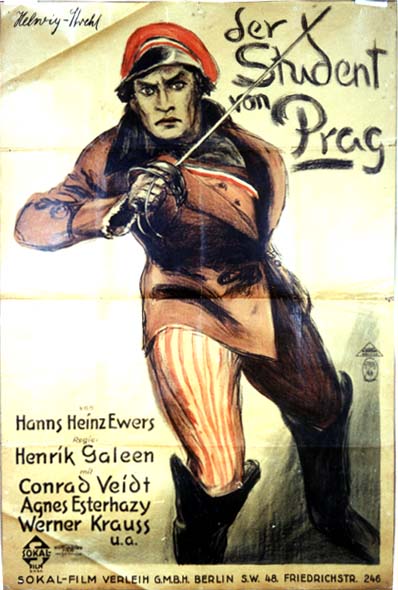
Der Student von Prag / The Student of Prague (1926) (2020 Filmmuseum München)


Henrik Galeen: Der Student von Prag / The Student of Prague (1926). Conrad Veidt in the title role as Balduin, "the best fencer of Prague", a master of Mensuren (academic fencing). Photo in IMDb and Wikipedia.

Henrik Galeen: Der Student von Prag / The Student of Prague (1926). Werner Krauss as Scapinelli. Gelatin silver print. Austrian Theatre Museum. From: Marcus Bunyan: Art Blart.

Henrik Galeen: Der Student von Prag / The Student of Prague (1926). Balduin (Conrad Veidt) meets his Doppelgänger. From: Lotte H. Eisner: L'Écran démoniaque (1952).

Henrik Galeen: Der Student von Prag / The Student of Prague (1926). A scene worthy of Herodotus (on Croesus) and Stroheim (Greed). Gold, gold, gold. Scapinelli opens his bottomless purse for Balduin (Conrad Veidt). My screenshot from the Filmmuseum München Vimeo account.

Henrik Galeen: Der Student von Prag / The Student of Prague (1926). The original art intertitles have been restored, as well. "Your mirror image... your second self!" My screenshot from the Filmmuseum München Vimeo account.

Henrik Galeen: Der Student von Prag / The Student of Prague (1926). Scapinelli's (Werner Krauss) part of the bargain: with his gold he purchases Balduin's reflection who steps out of the mirror and becomes his evil Doppelgänger (Conrad Veidt in a double role). My screenshot from the Filmmuseum München Vimeo account.

Prahan ylioppilas / Studenten från Prag.
    DE 1926. PC: Sokal-Film GmbH. P: Henry Sokal.
    D: Henrik Galeen. SC: Henrik Galeen, Hanns Heinz Ewers. DP: Günther Krampf. Camera: Erich Nitzschmann. AD: Hermann Warm. M for cinema orchestra: Willy Schmidt-Gentner.
    C: Conrad Veidt (Balduin, a student), Elizza La Porta (Lyduschka, the flower girl), Fritz Alberti (Imperial Count von Schwarzenberg), Gräfin Agnes Esterhazy (Margit, his daughter), Ferdinand von Alten (Baron von Waldis-Schwarzenberg, Margit's fiancé), Werner Krauss (Scapinelli, usurer), Erich Kober (student), Max Maximilian (student), Sylvia Torff, Marian Alma, Horst Wessel.
    3173 m
    Uraufführung: 25 Oct 1926 Berlin, Capitol.
    Finnish premiere: 20 March 1927.
    Restored and reconstructed by Filmmuseum München (2020) by combining two prints: a Spanish colour edition from Archivo Nacional de la Imagen y la Palabra – Sodre in Montevideo, preserved by L'Immagine Ritrovata in Bologna, and a German release print copied by Gosfilmofond (Belye Stolby). Image restored in 1999/2019. The music score composed and played with several instruments by Stephen Horne in 2020, recorded at Orpheus Studio (London). Reconstruction: Stefan Drössler, Gerhard Ullmann, Klaus Volkmer. Digitization and mastering: Thomas Bakels.
    134 min (2020 Filmmuseum München).
    Corona lockdown viewings / Restaurierungen des Filmmuseums München (Vimeo).
    Viewed from Filmmuseum München's Vimeo platform at a forest retreat in Punkaharju on a tv screen, 26 June 2020.

AA: A legendary Weimar film has been made available by Filmmuseum München in a better edition than ever in my lifetime. The restoration and the reconstruction has been conducted with loving care, including the original hand-painted art titles.

The original 1913 version of The Student of Prague has a place of honour in the history of the cinema, in German cinema and in cinefantastique. Directed by the Dane Stellan Rye, it came into being in early cinema mode. The Student of Prague was filmed even in the Nazi period as a sound film with a Theo Mackeben score.

But this 1926 Henrik Galeen film, full of Weimar glory, is the definitive adaptation of Hanns Heinz Ewers's original screenplay. Ewers was one of the early visionaries of the cinema. In a bit part is his fellow student Horst Wessel who wrote the Nazi anthem (1929) and about whom Ewers later wrote his novel Horst Wessel (1932). Both were veterans of Mensuren (academic fencing), featuring prominently in the film.

Conrad Veidt and Werner Krauss had had their international breakthrough together in The Cabinet of Dr. Caligari (1920), but both were established stars by then and had even appeared together in Robert Reinert's Opium (1919). They are both great in The Student of Prague, two masters of the macabre at the peak of their craft. They know how to perform in nightmarish and exaggerated poses. It is a special art form, a mode of performance in which they excel. Their convulsive and cramped gestures seem to convey secret messages from the inside.

With good judgement, Henrik Galeen cast in the female leads two appealing actresses who perform in a sober and refined mode, Elizza La Porta as the flower maid and Agnes Esterhazy as the countess.

Visually, the film is stunning, as appreciated by Lotte H. Eisner in L'Écran démoniaque, channeling influences from the period of the tale (1820), masters of German Romanticism including Caspar David Friedrich. The designer Hermann Warm and the cinematographer Günther Krampf created some of the most potent images in Weimar cinema, of which there is an excellent digest in the special magazine Film-Kurier Der Student von Prag (1926). It can be examined in Deutsche Digitale Bibliothek on the page of Heinrich-Heine-Institut.

In the theme of gold the mythical resonance is comparable with Herodotus's tale of King Croesus and Erich von Stroheim's Greed (1924).

The theme of the Doppelgänger resonates with Chamisso (Peter Schlemihl, 1814), Hoffmann (Die Elixiere des Teufels, 1815), Poe ("William Wilson", 1839), Dostoevsky (The Double, 1846) and Oscar Wilde (The Picture of Dorian Gray, 1890), and selling one's soul to the Devil belongs of course to the great German tradition of the Faustian pact (16th century). It also brings to mind Pushkin's The Queen of Spades (1833), interpreted on the screen by Ivan Mosjoukine (1916) in a performance that has affinities with Conrad Veidt. It was a remarkable achievement by Ewers to have created an original and engaging tale in such a lineage.

Henrik Galeen was a talented writer but not necessarily a great director. While much in Der Student von Prag is excellent, it is at its best in its many anthology moments and setpieces. There are problems of dramatic tension and sustained momentum. We understand what is being attempted but Galeen fails to deliver the full potential of his exciting material.

The restoration and production is state of the art. I cherish the passages with a subtle digital simulation of toning and, as always, have my problems with the contemporary simulation of tinting which obscures the images that have been painstakingly restored from the best remaining sources, as negatives have been lost.

Henrik Galeen: Der Student von Prag / The Student of Prague (1926). Having aimed at his reflection Balduin (Conrad Veidt) finds himself hit in the heart. In the broken mirror he witnesses his death throes. My screenshot from the Filmmuseum München Vimeo account.

BEYOND THE JUMP BREAK: STEFAN DRÖSSLER'S INTRO (FILMMUSEUM MÜNCHEN):

Medena zemja / Honeyland


Медена земја / Bal Ülkesi / Hunajan maa / Honungslandet.
    A creative documentary.
    MK (Republic of North Macedonia) © 2019 www.honeyland.earth. PC: Apolo Media / Trice Films. P: Atanas Georgiev, Ljubomir Stefanov.
    D: Tamara Kotevska, Ljumobir Stefanov. Cin: Fejmi Daut, Samir Ljuma – digital – camera: Nikon DSLR – colour – 1,85:1 – release: DCP. M: Foltin. S: Rana Eid. ED: Atanas Georgiev. Additional documentary footage: Kristijan Karadjovski.
    Featuring: Hatidze Muratova, Nazife Muratova, Hussein Sam, Ljutvie Sam.
    Loc: North Macedonia: Bekirlija and Skopje.
    Language: Turkish ("an ancient Turkish vernacular" according to the official website)
    89 min
    Festival premiere: 28 Jan 2019 Sundance Film Festival.
    Finnish festival premiere: 12 June 2019 Midnight Sun Film Festival.
    Republic of North Macedonia premiere: 29 Aug 2019.
    Finnish telepremiere: 29 March 2020 Yle Teema.
    Corona lockdown viewings / Midnight Sun Film Festival (MSFF) online edition / Women Make Film.
    Viewed with Finnish subtitles by Seija Uuskoski and Sampsa Peltonen (Yle) from Yle Areena, viewed at a forest retreat in Punkaharju on a tv screen, 27 June 2020.

Official synopsis: "When a nomadic family moves in and breaks Honeyland’s basic rule, the last female wild beekeeper in Europe must save the bees and restore the natural balance."

AA: As far as I can tell Honeyland is the first film I have seen from the country called the Republic of North Macedonia. But I have seen and liked for instance Milcho Manchevski's Before the Rain / Pred dozhdot (1994) made in the same country while it was still known as plain Macedonia. Both films are distinguished.

The global existential crisis of the bees has been discussed in contemporary cinema by the likes of Alice Rohrwacher (Le meraviglie) and Markus Imhoof (Des abeilles et des hommes), both directors coming from beekeeping families. In Tamara Kotevska and Ljumobir Stefanov's Honeyland the existential implications are also present, but not explicitly.

Honeyland belongs to one of the noblest traditions in documentary cinema. It records an ancient trade with a loving care worthy of Robert Flaherty. A careful balance is observed between nature and humanity. Beekeeping takes place in a sustainable way, with attention paid to the surrounding milieu and to the long view of continuity.

The simple way of life of the beekeeper is very demanding. You need to devote all your life to the art and craft. Hatidze even becomes a member of the bee world. She talks with bees and sings with them.

This is not understood by a nomadic family that moves to the neighbouring house of the beekeeper veteran Hatidze Muratova. The new family's way of life is based on the depletion of resources. In beekeeping, this becomes calamitous also for the neighbour, because starved bees attack the surrounding beehives. By controlled burn the nomad family destroys the flora from the mountain slope, causing further damage to beekeeping. By breaking an ancient log bridge over a wild river they destroy yet another source of bees. Finally they pack their things and move on.

All this is witnessed by Hatidze. It's a tragic tale, and no viewer can fail to realize the allegory, although it is not telegraphed.

Digitally photographed with a Nikon DSLR camera by Fejmi Daut and Samir Ljuma, the visual experience is ravishing and painterly. There are breathtaking extreme long shots of mountain views. The beekeeping scenes have special documentary value. Mostly the film takes place in the mountain area, but there are also scenes from the market of Skopje, the capital of the country. Besides the gorgeous, panoramic landscape shots there are also many scenes with illuminating details. All seasons are covered, from the lush summer to the snowy winter. The colour is radiant and glowing in a most appealing way.

Humanly, the film is of the highest order, focusing on the veteran Hatidze and her blind and paralyzed mother of whom she takes loving care. Honeyland is a profoundly religious, Christian film, in an unobtrusive way. Faith is expressed in action, in the good deeds and the patience with which Hatidze weathers the calamities caused by greedy and shortsighted neighbours and in her commitment to restore the broken order.

BEYOND THE JUMP BREAK: DATA FROM YLE TEEMA AND THE OFFICIAL HONEYLAND WEBSITE:

Beethoven 250: Piano Sonata No. 9 (Stephen Kovacevich, 1997)


Cover art for CD 19/80: Carl Blechen: Waldlandschaft mit Wasserfall (1833). 31,1 × 35,5 cm. Gemälde. Öl auf Papier. Aufbewahrungsort: Berlin. Sammlung: Schloss Charlottenburg. Epoche: Romantik. Land: Deutschland. Permalink: http://www.zeno.org/nid/20003893200. Lizenz: Gemeinfrei. From: Zeno.org.

Beethoven: The Complete Works (80 CD). Warner Classics / © 2019 Parlophone Records Limited. Also available on Spotify etc. I bought my box set from Fuga at Helsinki Music Centre.
    Ludwig van Beethoven 1770–1827.
    Beethoven 250 / corona lockdown listening.

From: CD 19/80  Piano Sonatas Nos. 8–11
Op. 14
Der Baronin Josefa von Braun gewidmet.
Stephen Kovacevich, 1997.

Opus 14 Nr. 1: Klaviersonate Nr. 9 in E-Dur (1799)
Erster Satz: Allegro, E-Dur, 4/4 Takt, 162 Takte
Zweiter Satz: Allegretto, e-Moll, 3/4 Takt, 116 Takte
Dritter Satz: Rondo, Allegro commodo, E-Dur, 4/4 Takt alla breve, 131 Takte.

Wikipedia: "Die zwei Sonaten op. 14 entstanden zur gleichen Zeit wie die Pathetique, bilden jedoch ein lyrisch-entspanntes Gegengewicht und sind von eher kammermusikalischem Charakter. Die Sonate op. 14 Nr. 1 hat Beethoven selbst 1801/1802 für Streichquartett umgearbeitet."

AA: Beethoven's ninth piano sonata is not among the best-known, but it is a sparkling masterpiece, like a string of pearls. The more I listen to it the more delightful it gets.

András Schiff emphasizes the fact that Beethoven also composed a string quartet based on this piano sonata (Streichquartett F-Dur nach Sonate op. 14,1) and that one can already hear a string quartet quality in the piano sonata itself.

He underlines that by now Beethoven's piano sonatas have acquired an integral psychological stage. The movements are no longer separate; they form a single psychological course. Schiff also repeats his conviction that it is important to play these sonatas in chronological order to appreciate their organic evolution and development.

Schiff tells that this sonata had no success, but it did not matter for the composer whose work was based on an inner urge. For Schiff, this sonata is "frightfully difficult to play and to interpret". It has to be played with a singing and imaginative approach.

From the gracious first movement we proceed to the second movement, characterized by Anton Rubinstein as "gloomy" ("мрачной", a word resonant in Pushkin, Dostoevsky and Chekhov). The third movement is in allegro commodo, a "comfortable allegro". All doubts are overcome. Despite being "comfortable", there is also a quality that has been called "Sturm und Drang", for the first time in Beethoven. The pre-classical period of the original Sturm und Drang (Werther, Die Räuber) had taken place over 20 years ago, and in Beethoven it transformed into a highly personal stance of facing the wildest storms in proud defiance.

Stephen Kovacevich plays this sonata with panache.

BEYOND THE JUMP BREAK: ROBERT CUMMINGS (ALLMUSIC.COM):

Thursday, June 25, 2020

Beethoven 250: Piano Sonata No. 8 "Pathétique" (Stephen Kovacevich, 1997)


Hildegard Koegler (1904–1981): Beethoven Sonate pathétique: Adagio. Etching. 40 x 30 cm. From: SJSU King Library Digital Collections.

Orfeo circondato dagli animali. Mosaico pavimentale romano, da Palermo. Museo archeologico regionale di Palermo. / Orpheus surrounded by animals. Ancient Roman floor mosaic, from Palermo, now in the Museo archeologico regionale di Palermo. Foto di Giovanni Dall'Orto, 28 Sep 2006. From: Wikipedia.

Beethoven: The Complete Works (80 CD). Warner Classics / © 2019 Parlophone Records Limited. Also available on Spotify etc. I bought my box set from Fuga at Helsinki Music Centre.
    Ludwig van Beethoven 1770–1827.
    Beethoven 250 / corona lockdown listening.

From: CD 19/80  Piano Sonatas Nos. 8–11
Stephen Kovacevich, 1997.

Opus 13: Klaviersonate Nr. 8 in c-Moll (1799)
Grande Sonate Pathétique.
Dem Fürsten Karl von Lichnowsky gewidmet.

Erster Satz: Grave / Allegro di molto e con brio, c-Moll, 4/4 Takt alla breve, 310 Takte
Zweiter Satz: Adagio cantabile, As-Dur, 2/4 Takt, 73 Takte
Dritter Satz: Rondo allegro, 4/4 Takt alla breve, 210 Takte.

AA: In June I have been listening to four piano sonatas, Nos. 8–11, by Ludwig van Beethoven, published by him in 1799–1800. Twelve days ago I moved to a forest retreat in Punkaharju, but that did not cause a break to my listening, on the contrary.

For the forest quarantine I bought a good portable CD stereo system with solid speakers and learned in the process that CD systems are becoming hard to come by due to the decline of the format.

Here Beethoven sounds better than at home. In the city I live in the middle of the heavy traffic of Tehtaankatu. The busiest tramline of the city passes by in both directions. Three motorcycles are parked in front of the house where I live. The house trembles and the windows rattle with the traffic.

Here I enjoy deep silence. I only hear the wind in the trees. Now in June, the forest is filled with birdsong. Birds are giving singing lessons to their offspring.

Beethoven's piano sonatas in the forest retreat are a perfect fit. There is no incongruity. During his daily three hour walks in Vienna woods Beethoven was inspired to compose, and I can hear that in his piano sonatas. Here I imagine that even the birds are listening.

I am thinking about Orpheus playing the lyre. His musical magic mesmerized all living things (and even stones). Väinämöinen, the great shaman of Finnish mythology, achieved the same with his kantele. The beloved Finnish composer Oskar Merikanto took his piano to his forest retreat, and it is told that the birds gathered around him to listen.

Beethoven's eighth piano sonata, la grande sonate pathétique, is a treasure of world culture, one of the best-known compositions of all times. I never tire of it. All Beethoven's piano sonatas are great, but melodically, this one is more engrossing than the previous ones. And more than in the preceding piano sonatas, there is a quintessentially Beethovenian sense of heroic and tragic grandeur, comparable with the composer's symphonies, piano concertos and the violin concerto.

This piano sonata is also a pop hit. Particularly the adagio cantabile has become widespread in popular culture. It is also one of the most beloved compositions in motion picture soundtracks. Even in films released in Finland this year I have heard it twice: in Greta Gerwig's Little Women (2019) and Lulu Wang's Farewell / Bie gaosu ta (2019).

Monday, June 22, 2020

Midnight Sun Film Festival 10–14 June, 2020


L'Année dernière à Sodankylä: Midnight Sun Film Festival, 2019. Photo: Juuso Hirvonen.

Due to the corona lockdown, Midnight Sun Film Festival (10–14 June, 2020) took place online as the first Finnish online film festival. It also became my first experience of an online film festival. The experience was far from the real thing, but the organization succeeded in creating access to a smoothly operating screening platform. I saw many great films.

In the middle of the festival I moved to a forest retreat by the lake. The sublime sunlight of the white nights was doubled by its reflection in the lake. Despite super weather, it was not necessary to close the curtains of the many windows of the lakeside viewing room at the forest cabin. The presence of the surrounding brilliant sunlight elevated the viewing experience.

These films I saw:

Abrir puertas y ventanas / Back to Stay (Milagros Mumenthaler, AR/CH 2012).

Adults in the Room (Costa-Gavras, FR/GR 2019).

El diablo entre las piernas / Devil Between the Legs (Arturo Ripstein, MX 2019).

Dylda / Beanpole (Kantemir Balagov, RU 2019).

Es gilt das gesprochene Wort / I Was, I Am, I Will Be (Ilker Çatak, DE/FR 2019).

L'extraordinaire voyage de Marona / Călătoria fantastică a Maronei / Marona's Fantastic Tale (Anca Damian, FR/BE/RO 2019).

Frantsuz / Француз / The Frenchman (Andrei Smirnov, RU 2019).

Intemperie / Out in the Open (Benito Zambrano, ES/PT 2019).

Le jeune Ahmed / Young Ahmed (Luc Dardenne & Jean-Pierre Dardenne, BE/FR 2019).

Medena zemja / Медена земја / Honeyland (Tamara Kotevska, Ljumobir Stefanov, MK 2019).

Official Secrets (Gavin Hood, GB/US/CH/CN 2018).

Peterloo (Mike Leigh, GB 2018).

Šarlatán / Charlatan (Agnieszka Holland, CZ/IE/PL/SK 2020).

Sid al-mghul / سيد المجهول / Le Miracle du saint inconnu / The Unknown Saint (Alaa Eddine Aljem, MA/FR 2019).

Sorkhpoost / سرخ‌پوست / The Warden (Nima Javidi, IR 2019).

Surematu / Nemirstīgie / Бессмертный / Immortal (Ksenia Okhapkina, EE/LV 2019).

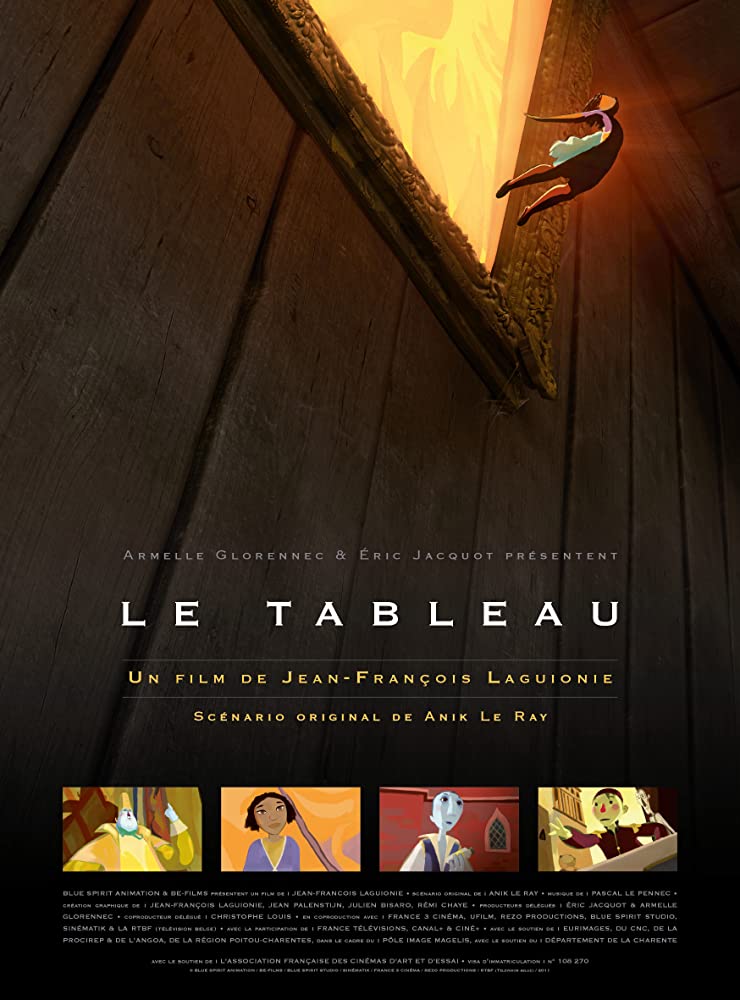
Le Tableau / The Painting (Jean-François Laguionie, FR/BE/CA 2011).

Všechno bude / Winter Flies (Olmo Omerzu, CZ/SI/PL/SK/FR 2018).

Es gilt das gesprochene Wort / I Was, I Am, I Will Be


İlker Çatak: Es gilt das gesprochene Wort / I Was, I Am, I Will Be (2019) with Ogulcan Arman Uslu (Baran) and Anne Ratte-Polle (Marion).

DE/FR © 2019 if... Productions / LDO / ZDF/arte. P: Ingo Fliess.
    D: İlker Çatak. SC: Nils Mohl and İlker Çatak – from a story by İlker Çatak and Johannes Duncker. Cin: Florian Mag – digital – colour – 2,35:1. PD: Zazie Knepper. Cost: Christian Röhrs. Makeup: Barbara Kreuzer. VFX: Christoph Hierl. M: Marvin Miller. S: Christoph von Schönburg. ED: Sascha Gerlach, Jan Ruschke.
    C: Anne Ratte-Polle (Marion), Ogulcan Arman Uslu (Baran), Godehard Giese (Raphael), Jörg Schüttauf (Mark), Johanna Polley (Leonie), Sebastian Urzendowsky (Johann), Lina Wendel (Dr. Evi Stade), Sandra Bourdonnec (Colette), Ali Seçkiner Alici (Idris).
    Theme song: Franz Schubert: "Ständchen" ("Leise flehen meine Lieder") ("Serenade"), lyrics by Ludwig Rellstab, from Schwanengesang, D 957. Sung during the closing credits by Fritz Wunderlich (1966). Heard also in other interpretations.
    Loc: Bodrum, Mugla, Marmaris, Hamburg. Concert sequence: Eröffnungskonzert: Elbphilharmonie (Hamburg).
    In German and Turkish.
    120 min
    Festival premiere: 2 July 2019 Munich International Film Festival.
    German premiere: 1 Aug 2019.
    English subtitles by Matthew Way / Way Film Translation.
    Corona lockdown viewings / Midnight Sun Film Festival (MSFF) online edition.
    Viewed with English subtitles from the MSFF FestivalScope screening platform, viewed at a forest retreat in Punkaharju on a tv screen, 22 June 2020.

The title of the film is a quote from the German marriage vow in civil marriage. It means in English: "The Spoken Word Is Binding".

AA: İlker Çatak's excellent human drama across a chasm of cultures belongs to an established lineage of film narratives perhaps best known from Peter Weir's Green Card (1990) starring Andie MacDowell and Gérard Depardieu.

In İlker Çatak's original movie both protagonists are proud and edgy.

The young Kurd Baran (Ogulcan Arman Uslu) is a loner and outsider, marginalized and without possessions in Turkey trying to establish a life of his own. In the Marmaris beach paradise he finds a job at a restaurant and becomes a beach boy, available as a companion for European female tourists. It is a method of survival. Meanwhile he is actively pursuing marriage with a European woman as a way out from a life of discrimination and persecution.

Against all odds he succeeds with Marion (Anne Ratte-Polle). She is a pilot in command of the biggest airliners. She promises to help and get involved in a green card marriage to help Baran launch a better life. She is convinced of Baran's sincerity of enterprise, although she also knows that he is a thief.

Baran starts from scratch. He must learn the language, he must pass the test for a driver's licence, he must learn German workplace culture. He is required by Marion even to acquire musical culture by weekly visiting the Elbphilharmonie.

Although the deal is strictly Platonic, the inevitable happens, and to her amazement Marion finds herself pregnant, although the medicament she is taking after a breast cancer operation was supposed to prevent pregnancy.

İlker Çatak's film belongs also to the Pygmalion lineage of fiction. In the cinema it was something of a specialty of George Cukor, although his films were always about a male Pygmalion and a female Galatea. The world has changed.

İlker Çatak's film is unusual, unpredictable and genuinely moving. There is nothing ingratiating here. İlker Çatak shows his people with warts and all. The film starts like a slice of life, but it is a profoundly thought out accomplishment in which all details make sense.

The chemistry between the main couple is so convincing that if there would be no reunion we would still be left thinking that they would have deserved one more chance.

BEYOND THE JUMP BREAK: DATA FROM MSFF:

Sorkhpoost / The Warden


Nima Javidi: Sorkhpoost / سرخ‌پوست / The Warden (2019) with Navid Mohammadzadeh (Colonel Jahed) and Parinaz Izadyar (Susan Karimi).

Nima Javidi: Sorkhpoost / سرخ‌پوست / The Warden (2019) with Navid Mohammadzadeh (Colonel Jahed).

سرخ‌پوست
    IR 2019. P: Majid Motalebi.
    D+SC: Nima Javidi. Cin: Hooman Behmanesh – digital – 4K – 1,85:1 – Dolby Digital. PD: Mohsen Nasrollahi. Cost: Shima Mirhamidi. Makeup: Iman Omidvari. VFX: Javad Matouri. M: Ramin Kousha. S: Naeim Meschian. ED: Emad Khodabakhsh.
    C: Navid Mohammadzadeh (Major > Colonel Jahed), Parinaz Izadyar (Susan Karimi), Setareh Pesyani (Ahmad's wife), Mani Haghighi (Colonel Modabber), Habib Rezaei (prisoner), Atila Pesiani (airport manager), Yadollah Shademani (witness), Ali Mardaneh (doctor), Ismaeel Pourreza (Seyed Davoud), Amir Keyban Masoumi (Sergeant Naji).
    Loc: Tehran.
    100 min
    Festival premiere: 1 Feb 2019 Fajr Film Festival.
    Premiere in Iran: 5 June 2019.
    Corona lockdown viewings / Midnight Sun Film Festival (MSFF) online edition.
    Viewed with English subtitles from the MSFF FestivalScope screening platform, viewed at a forest retreat in Punkaharju on a tv screen, 22 June 2020.

Synopsis (IMDb): "A prison is about to be evacuated to make room for an airport expansion project. Colonel Jahed and his officers are busy transferring all inmates to the new facility, but one inmate is missing."

AA: The Warden, directed by Nima Javidi, is a first-rate political thriller set in the Iran of the 1960s, during the brutal dictatorship of Shah Mohammad Reza Pahlavi.

The Warden belongs to the genre of the prison break movie. It is an Iranian Un condamné à mort s'est échappé, to evoke Robert Bresson's French Resistance classic which takes place in a high security Nazi prison. Nima Javidi acknowledges the conventions of the genre but does everything differently.

The protagonist, the prison warden Jahed, has set his sights in a long-awaited promotion. But just when it finally takes place, there is a mysterious prison break that threatens his very career.

A death row prisoner named Ahmad is found to be missing when a prison is evacuated. A female social worker, Susan Karimi, tells that the poor sharecropper Ahmad was framed for murder because an excuse was needed to have his land confiscated. During the film several other witnesses confirm this. Jahed ignores the statements because he is only doing his duty.

The Warden is also a man hunt movie and a detective story of the "locked room" variety. I was even reminded of Rian Johnson's Knives Out, which also brought fresh blood to the classic genre, the roots of which in fact go back to ancient Iran, the tale of "The Three Apples" in One Thousand and One Nights. Perhaps there is a touch of Scheherazade in Susan Karimi?

The laconic wit of The Warden invites comparison with Hollywood classics such as Don Siegel's Escape from Alcatraz, starring Clint Eastwood (and presumably also influenced by Bresson). Javidi relishes puzzling details such as Ahmad's pet toad and four boxes of shoe polish. His film is intelligent, refined and powerful, and the many surprises of the finale are not gimmicks but contribute to the social and ethical message.

The score is poetic, and there is a humoristic twist in the soundtrack when Jahed plays a sweet love song through the prison's loudspeakers to woo Susan. Susan, for her part, uses her considerable charm and sophistication to persuade Jahed to drop the matter of chasing Ahmad.

The cinematography by Hooman Behmanesh conveys the reign of terror of Shah's Iran, but at the same time there is a dimension of timeless magic in the refined, painterly colour palette.

BEYOND THE JUMP BREAK: MSFF INTRO:

L'extraordinaire voyage de Marona / Marona's Fantastic Tale


Anca Damian: L'extraordinaire voyage de Marona / Marona's Fantastic Tale (2019). Please click on the images to enlarge them!

Anca Damian: L'extraordinaire voyage de Marona / Marona's Fantastic Tale (2019). The dog Marona with Solange.

Anca Damian: L'extraordinaire voyage de Marona / Marona's Fantastic Tale (2019). Istvan and the dog Marona.

Călătoria fantastică a Maronei.
    Animation.
    FR/BE/RO © 2019 Aparte Film / Sacrebleu Productions / Minds Meet. PC: Sacrebleu Productions / Marmitafilms. P: Ron Dyens.
    D: Anca Damian. SC: Anghel Damian – based on the idea by Anca Damian. Colour – 1,85:1 – digital. Character design: Brecht Evens. AD: Gina Thorstensen, Sarah Mazzetti. AN: Dan Panaitescu, Hefang Wei, Loïc Espuche, Chloé Roux, Claudia Ilea, Marjorie Caup, Mathieu Labeye. M: Pablo Pico. S: Clément Badin, Mathieu Z'graggen, Régis Diebold. S mixer: Lionel Guenolin. ED: Boubkar Benzabat.
    Voice talent: Lizzie Brocheré (Marona), Bruno Salomone (Manole), Thierry Hancisse (Istvan), Isabelle Vitari (Madalina), Nathalie Boutefeu (Medeea), Shyrelle Mai Yvart (Solange enfant), Maïra Schmitt (Solange adolescente), Georges Claisse (grand-père Solange).
    Langue originale : français.
    92 min
    Festival premiere: 10 June 2019 Festival international du film d'animation d'Annecy
    France: date de sortie: 8 Jan 2020 (en salles).
    Corona lockdown viewings / Midnight Sun Film Festival (MSFF) online edition.
    Viewed with English subtitles by Sionann O'Neill from the MSFF FestivalScope screening platform, viewed at a forest retreat in Punkaharju on a tv screen, 22 June 2020.

AA: An animation masterpiece by Anca Damian, rich in invention, with wonderful colour solutions, expanding the possibilities of animation, profound in the nexus of animation and animism, and philosophical in its discourse of the categories of human understanding.

Sounds pompous, I know, this being the story of a little dog, the result of a stray love affair of glaring imbalance between two dogs who could not be more incongruous as mates.

The narrative concept is familiar from a long tradition of stories of pet animals (dogs, horses, etc.) who are passed from hand to hand. The way we treat animals reveals who we are. All the while a dog's unconditional love reminds us of what is most precious in life.

Among animated dog stories Anca Damian and her team certainly know Walt Disney's Lady and the Tramp and One Hundred and One Dalmatians. There are fleeting allusions to them.

Based on such traditions Anca Damian flies to the Moon. She updates, reverses, revolutionizes and creates something else.

Marona's masters include the rubber man Manole, the garbage man Istvan and the schoolgirl Solange who transforms into a teenager. The masters' different worlds are seen through Marona's eyes.

There is something fundamental and universal in this film. Animation is used as a creative device to express pure sensation, pure observation, pure perception. There is a drive to break free from cliché, from the customary, from the tried and true. This is about animating essences.

The film is a display of a joy of invention. New ideas and insights keep flowing at breakneck pace. Many visual registers are in use. The colour world is bold and vigorous. Anca Damian understands how to animate movement, the wind, dreams, and a huojuva talo (a tottering house).

Life is everywhere, and this is even revealed in an extraordinary near-death experience where the grandfather's spirit rises to the heaven (but he is revived as a shadow of his former self).

While Damian's vision of selfishness is sober and unsentimental, still this is a life-affirming film. A great achievement from the entire team, including the composer Pablo Pico.

BEYOND THE JUMP BREAK: JENNIFER BARKER'S INTRO (MSFF):

Sunday, June 21, 2020

El diablo entre las piernas / Devil Between the Legs


MX © 2019 Alebrije Cine y Video S.A. de C.V. / Carnaval Films S.A. de C.V. / Estudios Churubusco Azteca S.A. / Oberon Cinematografica S.A. / Fondo de Inversion Estimulos al Cine (Fidecine). P: Antonio Chavarrarías, Marco Polo Constandse.
    D: Arturo Ripstein. SC: Paz Alicia Garciadiego. Cin: Alejandro Cantú. PD: Alejandro García. Makeup: Mari Paz Robles. M: David Mansfield. S: Pablo Lach. ED: Mariana Rodríguez.
    C: Sylvia Pasquel (Beatriz), Alejandro Suárez (El viejo), Greta Cervantes (Dinorah), Patricia Reyes Spindola (Isabel), Daniel Giménez-Cacho García (tango partner).
    Theme song: "Ich bin von Kopf bis Fuss mit Liebe eingestellt" (comp.+lyr. Friedrich Hollaender), sung by Marlene Dietrich (1930) and heard in instrumental variations by David Mansfield.
    "Perfume de gardenias" (Rafael Hernández Marín, 1935), a recording for this film in 2019.
    Language: Spanish.
    147 min
    Festival premiere: 12 Sep 2019 Toronto International Film Festival.
    Corona lockdown viewings / Midnight Sun Film Festival (MSFF) online edition.
    Viewed with English subtitles from the MSFF FestivalScope screening platform, viewed at a forest retreat in Punkaharju on a tv screen, 21 June 2020.

AA: Directed by Arturo Ripstein, the old Mexican master of "le cinéma de cruauté", and written by his wife Paz Alicia Garciadiego, his regular screenwriter since decades, El diablo entre las piernas is a harrowing account of sexual obsession.

The film is also a startling account of an old couple whose love has turned to hate. Nobody can torture each other as cruelly as an old married couple, because they know each other so well.

The classic of the theme is naturally August Strindberg's play The Dance of Death (1900), memorably filmed by Marcel Cravenne as La Danse de mort (1948) starring the real-life couple Erich von Stroheim and Denise Vernac.

Perhaps inspired by it Edward Albee wrote Who's Afraid of Virginia Woolf? (1962); Elizabeth Taylor and Richard Burton starred in Mike Nichols's film adaptation. Let's also remember a cinema original, Sacha Guitry's La Poison (1951), and Pierre Granier-Deferre's Le Chat (1971) based on the novel by Georges Simenon and starring Simone Signoret and Jean Gabin.

Apparently Ripstein's claustrophobic film has been filmed at the same Estudios Churubusco where the director started his film career as an uncredited assistant to Luis Buñuel in El ángel exterminador, another claustrophobic tale of black humour.

I have been slow in getting acquainted with Arturo Ripstein's films. The claustrophobic quality and the vision of life as hell was hard for me to take in El lugar sin limites (Hell Without Limits). Paz Alicia Garciadiego was not yet writing his films at the time.

Touches of fetishism, morbid jealousy and obsessions with smells are hallmarks of El diablo entre las piernas. The obsession is sex, but there is no love. Or the love has become so twisted that is hard to recognize. In the most touching sequence Beatriz and El Viejo study their honeymoon photographs and agonize over their gliding into their "little tricks". "When did this happen?".

A record I often heard in my childhood was Alvin and the Chipmunks' spoof version of "Buffalo Gals" (1962, featuring, besides David Seville [Ross Bagdasarian] the guest stars Mel Blanc [as Buffalo Bill] and June Foray [as Buffalo Gal]; the original song by John Hodges being from 1844).
– You've got everything!
– No son, there is one thing missing.
– What's missing, Buffalo Bill?
– Here's what's missing, boy: love, boy, love!

El diablo entre las piernas is well written and acted, and it has a compelling, unique atmosphere. But there is that one thing missing.

The visual approach is a "digital Death Valley" in black and white. Thinking back at La Danse de mort (1948) its unique visual solution was to shoot in an actual castle so cold that one could see the vapour of the actors' breath while they spitted out their venomous dialogue. There is not even such vapour in the airless digital space of El diablo entre las piernas.

BEYOND THE JUMP BREAK: OLAF MÖLLER'S MSFF INTRODUCTION and DIANA SANCHEZ (TIFF INTRODUCTION):

Le Tableau / The Painting


FR/BE/CA © 2011 Blue Spirit Animation, BE-Films, Blue Spirit Studio, Sinematik, France 3 Cinéma, Rezo Productions, RTBF (Télévision Belge). PC: Blue Spirit Animation / BE-Films. P: Armelle Glorennec, Eric Jacquot.
    D: Jean-François Laguionie. SC: Anik Le Ray. Image: digital 3D – 1,85:1 – colour. AN: Hilere. M: Pascal Le Pennec. S: Alexandre Fleurant.
    Animation.
    Voice talent (Wikipédia): Jessica Monceau : Lola
    Adrien Larmande : Ramo
    Thierry Jahn : Plume
    Julien Bouanich : Gom
    Céline Ronté : Garance
    Thomas Sagols : Magenta
    Magali Rosenzweig : Orange de Mars
    Chloé Berthier : Claire
    Jean-François Laguionie : L'autoportrait et le peintre
    Jacques Roehrich : Le Grand Chandelier
    Jérémy Prévost : Monsieur Gris
    Michel Vigné : Le Capitaine
    Jean Barney : Le peintre de Venise
    Serge Faliu : Pierrot
    76 min
    Festival premiere: 12 Oct 2011 Festival International du Film de La Roche-sur-Yon.
    Date de sortie: 23 Nov 2011.
    Language: French.
    Corona lockdown viewings / Midnight Sun Film Festival (MSFF) online edition / Jennifer Barker masterclass.
    Viewed with English subtitles from the MSFF FestivalScope screening platform, viewed at a forest retreat in Punkaharju on a tv screen, 21 June 2020.

AA: A fascinating and original animation by Jean-François Laguionie.

The concept of a painting coming alive has been familiar in the cinema since Georges Méliès, but in Le Tableau, Laguionie and Anik Le Ray develop it further than any other movie I know.

The setting is an unfinished painting in which we meet characters in various stages of completion: the Alldunns, the Halfies and the Sketchies (les Toupins, les Pafinis et les Reufs).

A social order starts to form in which the Alldunns plan to marginalize and eliminate all others. But the meta-animation opens to new levels. The painted characters find their way to the atelier and other paintings, including the autoportrait of the painter. They gain access to paints and are able to complete each other. This is not the end: Lola finds a passage to the real world and the live action painter, the creator himself.

Le Tableau is not about being clever about many self-reflections. It is a story of social stratification. It is a story of persecution and liberation. It is a story of art as an endlessly evolving process of cognition. It is a story of the joy of creation.

It is a film with a sense of wonder.

It is a story of love which brings full colour to pale contours.

It is a wonderful fairy-tale. The chase leads to a magic forest with death flowers. The passage to different paintings brings us in the middle of a battlefield. We also enter the carnival of Venice. The story seems to take place in the 1920s, and in the painter's sketches we detect influences of Modigliani, Gauguin, Matisse, Chagall and Derain. Among the living paintings is a radiant odalisque called Garance, painted in a style between Renoir and Modigliani. The painter himself looks like Monet. He is finishing a cloud painting into which Lola would like to disappear.

The original score by Pascal Le Pennec is delightful and enchanting. There are touches reminiscent of Nino Rota's scores for Fellini and John Williams Star Wars theme, but the music remains original.

BEYOND THE JUMP BREAK: THE MSFF INTRODUCTION BY JENNIFER BARKER and DATA FROM WIKIPÉDIA:

Saturday, June 20, 2020

Surematu / Immortal


Ksenia Okhapkina: Surematu / Immortal (2019).

Ksenia Okhapkina: Surematu / Immortal (2019).

Surematu / Nemirstīgie / Бессмертный.
    EE / LV © 2019 OU Vesilind / VFS Films. P: Riho Västrik. Co-P: Uldis Cekulis.
    D+SC: Ksenia Okhapkina. Cin: Aleksandr Demyanenko, Artem Ignatov, Ksenia Okhapkina – 1,85:1 – 25 fps – 4K – digital – release: D-Cinema. M: Robert Jurjendal, Arian Levin. S: Alexander Dudarev. ED: Stijn Deconinck, Ksenia Okhapkina.
    Among the advisors: Memorial.
    Soundtrack selections include: "State Anthem of the Russian Federation" (comp. Alexander Alexandrov, 1939, lyr. Sergei Mikhalkov, 2000).
    A creative documentary film.
    Location: Apatity (Murmansk Oblast, Russia). Apatity House of Culture, Angazhement, Zapolyarie, Theater Dialogue.
    Language: Russian.
    61 min
    Festival premiere: 2 July 2019 Karlovy Vary International Film Festival.
    Corona lockdown viewings / Midnight Sun Film Festival (MSFF) online edition.
    Viewed with English subtitles from the MSFF FestivalScope screening platform, viewed at a forest retreat in Punkaharju on a tv screen, 20 June 2020.

AA: An eternal night has set into an industrial town far north. Massive freight trains are passing through. Children enjoy neither family warmth or play. Little girls are drilled to dance. Little boys engage in military exercise. Between exercise children visit the war museum. Homes are in dismal barracks. Children sleep in severe dormitories. Barbed wire surrounds the premises. A stray dog wanders on the tracks in freezing cold.

This dystopian view is not Enki Bilal's Immortal (2004). This is a documentary film by Ksenia Okhapkina about the mining town of Apatity in the Murmansk Oblast in Russia. It is a center of heavy industry, essential for world economy in producing apatite. The famous Murmansk Railway traverses the town. It is also one of the most polluted districts in the world.

The apatite mines were opened in 1929, and during Stalin's Great Terror in 1935 a prison camp was established in Apatity, a major unit in the Gulag Archipelago. Prosperous peasants of North Russia were dispatched there for slave labour in the mines.

The Soviet Union was dissolved 29 years ago, but Ksenia Okhapina's film proves that it remains immortal at least in Apatity. Dilapidated Soviet symbols and slogans appear on walls, buildings and memorials. The time of the town seems to have stopped to an eternal Great Patriotic War. The ghostly figure of Putin hovers behind it all.

Apatity is not far away from Sodankylä: 435 kilometers, that is, within a drive of five and a half hours. The Eternal Night dystopia is being viewed at Midnight Sun Film Festival, albeit online.

Ksenia Okhapkina's artistic vision of a modern Sparta is strong, consistent and single-minded. A monolithic way of life is conveyed in a monolithic interpretation. There is no midnight sun in the movie. Viewers may want to react against attempts of mind control. But what Okhapkina shows us has true gravity.

PS. A meta-text of the movie is H. C. Andersen's fairy-tale The Snow Queen (Snedronningen, 1844). An evil troll has made a magic mirror that distorts the appearance of everything that it reflects. The magic mirror fails to reflect the good and the beautiful, and magnifies the bad and the ugly. The mirror falls from the sky, splinters are blown by the wind, freeze people's hearts like blocks of ice and make their eyes like the troll-mirror itself. In search of the ice-eyed Kai Gerda is carried away to the Snow Queen's palace in Lapland. Her tears of love melt the ice in Kai's eyes. When they stop dancing the splinters fall down to spell "eternity". (I riff on Wikipedia's formulations in this Snow Queen resume).

Russian Lapland belongs to the Murmansk Oblast like Apatity, but Apatity is just a little bit to the south of Lapland.

BEYOND THE JUMP BREAK: DATA FROM MSFF AND KSENIA OKHAPKINA'S INTERVIEW FROM THE PRESS KIT:

Sid al-mghul / Le Miracle du saint inconnu / The Unknown Saint


Alaa Eddine Aljem: سيد المجهول / Le Miracle du saint inconnu / The Unknown Saint  (2019).

Sid al-mghul / سيد المجهول
    MA/FR © 2019 Le Moindre Geste Productions / Altamar Films. P: Francesca Duca, Alexa Rivero. Assoc: Michael Weber, Georges Schoucair, Rabah Mezioud.
    D+SC: Alaa Eddine Aljem. Cin: Amine Berrada – colour – 1,85:1. PD: Kaoutar Haddioui. M: Amine Bouhafa. S: Yassine Bellouquid, Paul Jousselin, Matthieu Deniau. ED: Lilian Corbeille.
    C: Younes Bouab (the thief), Salah Bensalah (the brain), Bouchaib Essamak (Hassan), Mohamed Naimane (Brahim), Anas El Baz (the doctor), Hassan Ben Bdida (the nurse), Abdelghani Kitab (the guard), Ahmed Yarziz (the hairdresser).
    Loc: Agafay Desert, Morocco.
    In Arabic (Darija)
    100 min
    Festival premiere: Cannes Film Festival: Semaine de la critique and Caméra d'Or.
    A Match Factory screener with English subtitles.
    Corona lockdown viewings / Midnight Sun Film Festival (MSFF) online edition.
    30 minutes sampled from the MSFF FestivalScope screening platform, viewed at a forest retreat in Punkaharju on a tv screen, 20 June 2020.

Unifrance synopsis: "Moments before his capture by police, a thief digs a grave to hide a bag of money. Released from prison years later he returns to retrieve the bag, only to find a shrine to an Unknown Saint build directly over his loot, and a brand new village constructed all around it."

AA: In his feature film debut the Moroccan director Alaa Eddine Aljem displays talent in humoristic observation, satire and laconic wit. The Unknown Saint is based on themes of the false marabout (prophet) and the fake mausoleum that seem to be well-known in Moroccan comedy, also in popular films such as Tayeb Saddiki's Zeft (1984, see also Wikipedia: Zeft).

Alaa Eddine Aljem's touch is original, with precise mise-en-scène and timing without which such comedy would not work. However, perhaps due to flanking heavyweight Eastern European titles on my virtual Sodankylä menu, I fail to connect and am happy to sample the first half an hour and clips from the rest.

Alaa Eddine Aljem's rewarding interview in the film's press kit I copy beyond the jump break.

BEYOND THE JUMP BREAK: DATA FROM MSFF AND ALAA EDDINE ALJEM INTERVIEW FROM THE PRESS KIT: